Learn · January 14, 2026
Sales Coaching: Boost Performance 2025
Elevate sales performance & hit quota! Discover proven sales coaching strategies, from AI to 1:1s, to grow your business.
By The Catalyst Editorial Team Operator education · 14 min read · Updated July 24, 2026

What Sales Coaching Is and Why It Transforms Sales Performance
Sales coaching is the personalized, one-on-one process where sales managers guide reps to improve their skills, refine their approach, and consistently hit targets. Unlike one-time training events, coaching is an ongoing practice that addresses individual weaknesses, reinforces strengths, and helps salespeople take ownership of their performance. For home services business owners managing teams that handle everything from HVAC installations to plumbing repairs, effective sales coaching means turning average performers into top closers and keeping your best reps engaged and growing.
What Sales Coaching Delivers:
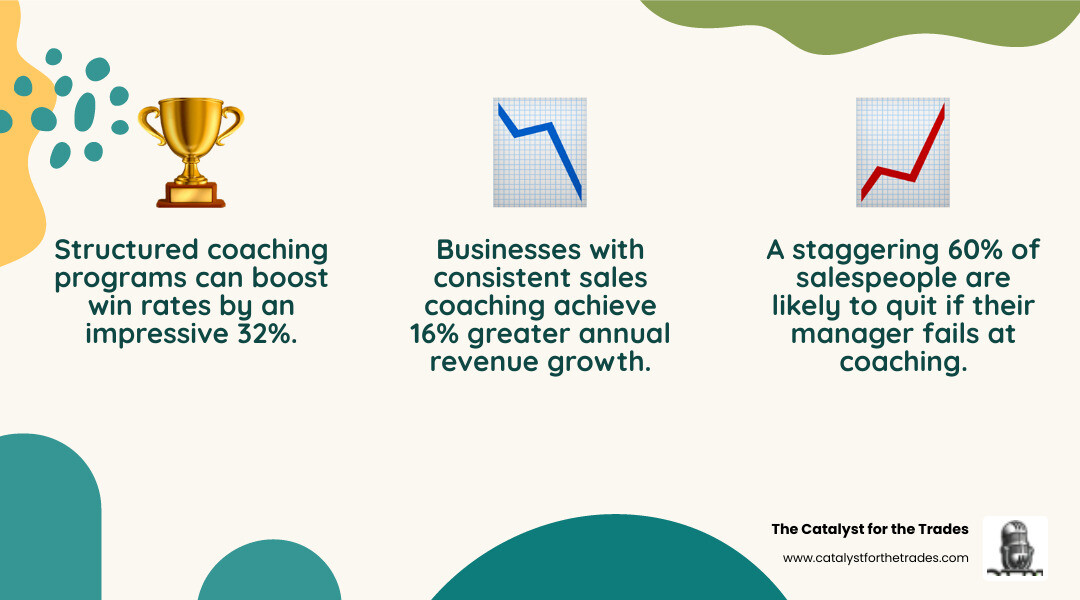
- Higher Win Rates – Structured coaching increases win rates by 32 percent
- Better Performance – Effective coaching boosts sales performance by up to 8% according to industry research
- Improved Retention – 60% of salespeople are likely to quit if their manager fails at coaching
- Faster Revenue Growth – Companies that coach consistently see 16 percent greater annual revenue growth
- Stronger Skills – Personalized development that focuses on each rep’s specific gaps and opportunities
| Sales Coaching | Sales Training |
|---|---|
| Ongoing, individualized mentoring | One-time or periodic group instruction |
| Focuses on refining existing skills | Teaches new skills and processes |
| Addresses specific rep challenges | Covers general team-wide strategies |
| Manager-led through observation and feedback | Often delivered by external trainers |
| Measured by individual performance improvement | Measured by knowledge retention |
The difference matters because while training teaches your team what to do, coaching ensures they actually do it well. It’s the difference between knowing how to present a maintenance agreement and consistently closing them. Only 26% of reps receive weekly one-on-one coaching, yet those who do are far more likely to meet quota, stay engaged, and contribute to team success.
When you’re managing a home services sales team, coaching isn’t a nice-to-have. It’s how you turn service calls into sold jobs, build a team culture that retains top talent, and drive the consistent revenue growth that separates thriving businesses from struggling ones.
Sales coaching vocab explained:
- customer relationship management
- customer experience optimization
- customer loyalty programs
The Core Components of an Effective Sales Coaching Program
Building a successful sales team in the home services industry isn’t just about hiring great people; it’s about nurturing their potential. An effective sales coaching program provides the framework for this growth, changing raw talent into consistent performers. We’ve identified several core components that are essential for any coaching initiative designed to lift performance.
Establishing Clear Goals and Expectations
Just like a well-executed HVAC installation, a successful sales coaching program starts with a blueprint. This means setting clear, attainable goals for both individuals and the team. For our home services sales reps, this might involve specific targets for selling maintenance agreements during routine service calls, improving the close rate on furnace replacement quotes, or increasing the average ticket size for plumbing repairs.
These individual goals must seamlessly align with our overall company objectives. If our goal is to become the most trusted plumbing service in the region, then individual coaching should focus on communication skills that build rapport and trust with homeowners. We use data to establish benchmarks, looking at current conversion rates for specific services to set realistic yet challenging targets. Creating a shared vision, where everyone understands their role in achieving collective success, is paramount. As one business leader wrote, “people respect what you inspect.” This means holding our team accountable for their commitments and clearly communicating what we expect.
Delivering Constructive, Actionable Feedback
Feedback is the breakfast of champions, but only if it’s served right! Constructive, actionable feedback is a cornerstone of effective sales coaching. This isn’t about pointing fingers; it’s about identifying specific behaviors that can be refined. Imagine a rep who struggles to upsell a water heater warranty—instead of just saying “you need to sell more warranties,” we provide timely feedback after a specific service call, focusing on how they presented the warranty.
We encourage self-evaluation first. As one sales expert advises, asking open-ended questions like, “How did it go?” and “What was it like?” allows reps to diagnose their own performance. This empowers them to take ownership of their improvement. When we do provide feedback, we strive for a balance, ensuring that positive reinforcement outweighs critique. High-performing teams, for instance, often receive 5.6 positive comments for every negative one. This positive reinforcement celebrates best practices and motivates our team to continuously hit (or exceed) quota.
Prioritizing Rep Wellbeing and Trust
Our sales reps in home services face unique challenges—long hours, demanding customers, and the pressure of being in someone’s home. It’s no wonder that many sellers (70%) say that they struggle with mental health, according to a recent report on mental health in sales. Burnout, an “always on” work ethic, and isolation can deeply affect our reps’ mental health and, consequently, their sales performance.
As coaches, it’s our responsibility to prioritize their well-being. This includes setting clear work-life boundaries, encouraging them not to schedule calls outside defined hours (unless it’s an emergency, of course!), and creating a supportive environment. Building trust is foundational here. We foster trust through authenticity and vulnerability, sharing our own stories of overcoming challenges—perhaps a tough plumbing job early in our careers or a difficult customer interaction that taught us a valuable lesson. This creates a sense of connection and shows our team that they’re not alone, allowing them to feel more comfortable asking for help.
Proven Techniques and Methodologies for High-Impact Coaching
Once we have the core components in place, it’s time to dive into the practical application of sales coaching. We use a variety of proven techniques and methodologies to ensure our home services sales team is continuously growing and performing at their best. For more straightforward tips that work, we often refer to helpful online resources and guides.
The Power of Individualized Sales Coaching
Just as no two HVAC systems are identical, no two sales reps are either. That’s why individualized sales coaching through one-on-one meetings is incredibly powerful. This personalized attention allows us to tailor our coaching to each rep’s specific needs. One rep might need help with upselling maintenance plans for older heating systems, while another might excel at closing but needs to improve their findy questions for larger AC installations.
We focus on one improvement area at a time. Trying to fix everything at once can be overwhelming and lead to frustration. Instead, we identify the most impactful skill gap and work on that until it becomes a strength. A key part of this is creating written action plans. For example, a rep might commit to “asking for referrals on 3 out of 5 service calls this week” and we’ll follow up on that specific goal. We’ve seen the impressive results of dedicated coaching, where focused guidance has led to significant growth for a team member.
Leveraging Group Dynamics and Peer Learning
While one-on-one coaching is vital, we also harness the collective power of our team through group coaching sessions and peer learning. These sessions are fantastic for discussing common customer objections in home services, like “I’m not sure I need that upgrade right now,” or sharing successful approaches to selling smart home thermostats.
We encourage our top performers to share their winning strategies, fostering an environment where best practices are disseminated organically. Team-building exercises, like a friendly competition for the most service agreements sold in a month, can also boost morale and engagement. Peer reviews allow reps to learn from diverse perspectives, and shadowing senior reps is an invaluable method for junior team members. As one industry leader notes, “[Through shadowing], new reps see how the pros handle real sales situations. Afterward, we give feedback to help them improve their skills.” This hands-on observation helps new hires understand pre-sales rituals, processes, and develop crucial soft skills like tone of voice awareness.
Practical Application: Role-Playing and Call Rehearsing
Practice makes perfect, and for our home services sales team, this often means role-playing and call rehearsing. These techniques provide a safe environment for our reps to practice critical tasks without the pressure of a real customer interaction. They can hone their pitch for a new energy-efficient furnace, practice handling objections like “I need to think about it,” or refine their negotiation skills for a larger plumbing project.
Simulating real-world customer scenarios, from initial contact to closing the deal, allows them to experiment with different approaches and build confidence. It’s about being prepared for anything a homeowner might throw their way, ensuring they can deliver a smooth, professional, and persuasive experience every time.
Frameworks for Success: The GROW Model
To structure our sales coaching conversations and empower our reps to find their own solutions, we often use the GROW model:
- Goal: What does the rep want to achieve? (e.g., “I want to increase my average ticket size on AC repairs by 15%”).
- Reality: What is the current situation? What are the obstacles? (e.g., “I often forget to suggest additional services like duct cleaning”).
- Options/Obstacles: What are the possible solutions or strategies? What stands in the way? (e.g., “I could create a checklist of upsell opportunities for each call, or practice specific phrases”).
- Will/Way Forward: What specific actions will the rep commit to? When will they take them? (e.g., “I will create a checklist and use it on every call this week, then review my results next Monday”).
This framework helps us ask powerful questions that guide our reps to their own “aha!” moments, fostering greater ownership and self-sufficiency. It’s a powerful tool to develop problem-solving skills and strategic thinking.
Building and Measuring Your Program for Maximum Impact
A well-oiled sales coaching machine for home services doesn’t just happen; it’s built and continually refined. This means having a structured approach, standardizing our metrics, and consistently tracking progress to ensure our efforts are paying off. Just like we monitor the efficiency of a new heating system, we monitor the effectiveness of our coaching.
Building Your Sales Coaching Program from Scratch
When we set out to build a robust sales coaching program, we follow a straightforward, three-step workflow outlined in leading industry guides:
- Step 1: Set Outcomes. We begin by standardizing key metrics across our team. This could be anything from the average conversion rate on service calls to the number of maintenance agreements sold per week. Once these benchmarks are in place, we can then personalize individual goals, ensuring they contribute to our broader objectives.
- Step 2: Analyze Performance. Data is our friend here! We review team trends to identify common strengths and weaknesses. This helps us spot opportunities for group coaching or pinpoint individuals who might need more intensive, targeted coaching on specific skills, such as handling objections for complex water filtration systems.
- Step 3: Meet and Repeat. Consistency is key. We establish a regular cadence of one-on-one meetings with focused goals. These aren’t just casual chats; they are structured sessions designed to review progress, address challenges, and plan next steps. We often use a coaching plan template to ensure every session is productive and actionable.
Measuring Coaching Effectiveness and ROI
How do we know if our sales coaching is actually working? We measure it! We track a variety of metrics to assess the impact and return on investment (ROI) of our coaching initiatives:
- Performance Metrics: These are the numbers that directly reflect our sales success—quota attainment, average deal size (e.g., the value of a typical HVAC system replacement), and the length of our sales cycle. Are these improving?
- Observational Metrics: We also look at how our managers are coaching. Are they conducting regular 1:1s? Are they providing constructive feedback? We use checklists and frameworks to ensure consistency in coaching behaviors.
- Cultural Metrics: These give us insights into team health, such as rep attrition rate and promotion percentage. A positive shift here indicates a thriving coaching culture.
As one manager says, “Data brings objectivity to the practice of coaching a team. The film does not lie.” By embracing data, we can move beyond gut feelings and make truly informed decisions about our coaching strategies.
[LIST] of Best Practices for a Sustainable Program
To ensure our sales coaching program is not just effective but also sustainable, we adhere to several best practices:
- Prioritize Coaching Time: We make sales coaching a non-negotiable part of our managers’ schedules. It’s an investment, not an afterthought.
- Coach the Middle 60% of Performers: While it’s tempting to focus on top or bottom performers, research suggests the biggest gains often come from coaching the middle 60% of our team. These are the reps on the cusp of greatness who can significantly boost overall team performance.
- Separate Coaching from Managing: We understand the difference. Managing is about giving instructions; coaching is about empowering reps to find their own solutions. We ensure distinct times and approaches for each.
- Offer Professional Development Opportunities: Learning fuels engagement. According to one workplace learning report, seven in 10 people say learning improves their sense of connection to their organization. We provide opportunities like workshops, courses, or even internal book clubs focused on sales skills.
- Maintain Consistency and Follow-up: Coaching isn’t a one-and-done event. We establish a consistent coaching cadence and always follow up on action items from previous sessions to maintain momentum and ensure continuous development.
The Future is Now: Technology’s Role in Modern Sales Coaching
In the rapidly evolving landscape of home services, technology isn’t just for scheduling and dispatch; it’s revolutionizing sales coaching. Artificial Intelligence (AI) and conversation intelligence are changing how we analyze performance, identify coachable moments, and support our team. This means less time on administrative tasks and more time for managers to focus on genuine rep development. AI, for instance, can conduct a performance analysis on our reps’ outreach, recording their calls and emails, and offering insights on performance highs and lows.
Leveraging Conversation Intelligence for Deeper Insights
Imagine having a complete, unbiased record of every customer interaction. That’s the power of conversation intelligence. For home services, this means:
- Call Recording and Transcription: Every service call, every quote discussion, every follow-up is recorded and transcribed. This provides an invaluable dataset.
- Analyzing Talk-to-Listen Ratios: We can see if our technicians are listening enough to the homeowner’s concerns or if they’re dominating the conversation. This is crucial for building trust.
- Identifying Keywords and Objections: AI can pinpoint common phrases used by customers (e.g., “Your price is too high,” “I need to discuss this with my spouse for that new AC unit”) and track how our reps handle them.
- Spotting Trends Across the Team: If multiple reps are struggling with the same objection, it signals a need for group coaching or a revised sales script.
Leading companies have committed to listening to at least one call recording each week. This practice ensures specific, targeted coaching, moving beyond general advice to addressing particular opportunities or challenges observed in real-world interactions.
The Rise of AI-Assisted Coaching and Tools
AI isn’t just for analysis; it’s becoming an active partner in sales coaching.
- AI Pre-populates Scorecards: Using conversation intelligence, managers can quickly identify coachable moments for team members. AI pre-populates scorecards with assessments of rep performance by analyzing conversation transcripts of customer interactions and meetings, saving managers a significant amount of time. This means we can instantly see how well a rep adhered to a service agreement script or handled a specific objection during a recent plumbing visit.
- AI-Generated Feedback: Some tools can even offer automated feedback on aspects like tone, sentiment, and adherence to talking points.
- Personalized Learning Paths: Based on a rep’s performance data, AI can suggest personalized learning modules or practice exercises. If a rep struggles with upselling furnace filters, the AI might recommend specific training videos.
- Gamification Platforms & LMS: Sales coaching and gamification platforms offer leaderboards and challenges to motivate teams. Learning Management Systems (LMS) provide structured environments for delivering continuous, bite-sized training.
These technologies don’t replace the human element of coaching; they amplify it, allowing our managers to be more strategic, efficient, and impactful in developing our home services sales team.
Conclusion: Coach Your Team, Grow Your Business
In the dynamic world of home services, effective sales coaching isn’t just a management strategy—it’s a growth imperative. We’ve seen how a dedicated, structured approach to coaching can fundamentally transform our sales team, leading to improved performance, higher retention, and a stronger bottom line.
By establishing clear goals, delivering actionable feedback, prioritizing rep well-being, and leveraging proven techniques like individualized sessions, group learning, and role-playing, we empower our team to excel. Furthermore, embracing cutting-edge technology like AI and conversation intelligence allows us to gain deeper insights, automate administrative tasks, and deliver more targeted, impactful coaching than ever before. This commitment to continuous development leads to accountability, consistent quota attainment, and ultimately, significant revenue growth. Companies that coach consistently see an average of 16 percent greater annual revenue growth, proving that investing in our people truly pays off.
Coaching is an ongoing journey, not a destination. It’s how we ensure our home services business remains competitive, innovative, and customer-focused. For more on combining proven strategies with modern technology, listen to The Catalyst for the Trades podcast.


