Learn · February 27, 2026
13 Essential Financial Management and Profitability Keywords
Master financial management and profitability keywords to boost resumes, growth, and business success!
By The Catalyst Editorial Team Operator education · 9 min read · Updated July 24, 2026

Why Financial Management and Profitability Keywords Matter for Home Services Business Success

Financial management and profitability keywords are the specialized terms that define how successfully your home services business generates revenue, controls costs, and builds long-term value. For owners and managers in the trades—whether you run an HVAC, plumbing, or electrical company—understanding these terms isn’t just about sounding professional. It’s about making smarter decisions that directly impact your bottom line. When you can confidently discuss ROI, profit margins, cash flow, and EBITDA, you gain the clarity needed to scale operations, attract investors, and plan a profitable exit strategy. Without this financial fluency, even the most skilled technicians and best customer service can’t compensate for poor business management.
Key financial management and profitability keywords you need to know:
- ROI (Return on Investment) – Measures the gain from an investment relative to its cost
- Profit Margin – The percentage of revenue remaining after expenses are paid
- EBITDA – Earnings before interest, taxes, depreciation, and amortization; shows operational cash flow
- Cash Flow – The movement of money in and out of your business
- Working Capital – Current assets minus current liabilities; measures short-term financial health
- Gross Profit – Revenue minus direct costs of services delivered
- Net Profit – Total revenue minus all expenses; your actual bottom line
- Asset Management – How effectively you use company resources to generate revenue
- Risk Assessment – Evaluating potential financial threats to your business
- Strategic Financial Planning – Long-term money management aligned with growth goals
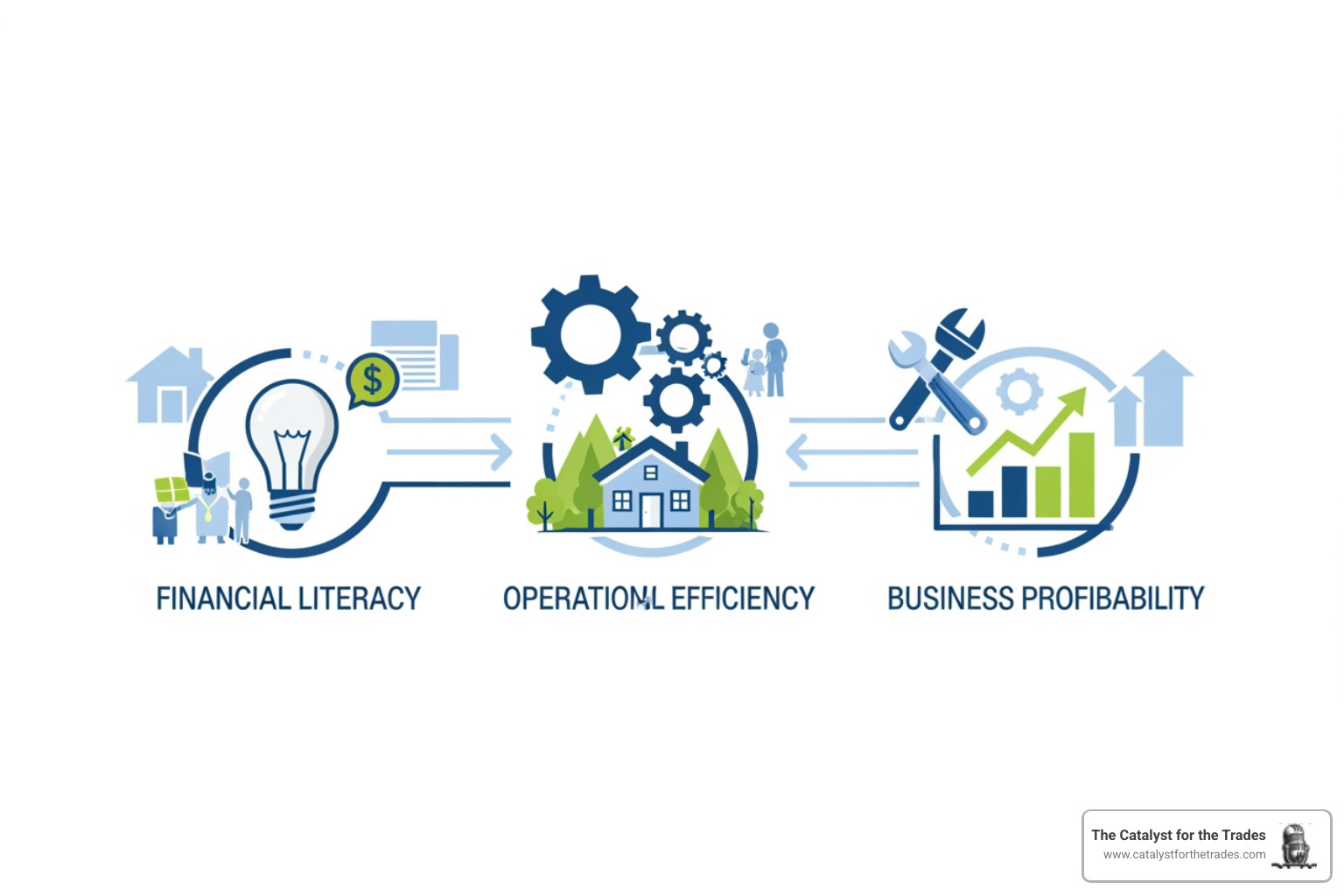
Financial management and profitability keywords terms to remember:
Essential Finance Buzzwords to Optimize Your Professional Profile
In the competitive world of the trades, whether you are applying for a service manager role or looking to bring on a high-level CFO, the language you use matters. Research shows that hiring managers often receive dozens of applications for a single finance or management position and may only spend a few minutes scanning each resume. This is where financial management and profitability keywords become your best friend.
Using industry-standard buzzwords like profit and loss management, ROI, and forecasting can significantly increase your chances of moving past the initial screening. This isn’t just about impressing a human reader; it’s about satisfying Applicant Tracking Systems (ATS). These software programs scan resumes for specific terms to determine if a candidate has the necessary expertise.
Key Buzzwords for Your Profile:
- Profit and Loss Management: This shows you know how to maximize profits while minimizing losses. In the home services world, this might involve analyzing P&L reports to identify where fuel costs are eating into margins or where service call efficiency can be improved.
- ROI (Return on Investment): Demonstrating that you understand how to calculate the ratio between net income and investment cost is vital. For example, did that new fleet of wrapped vans pay for itself in leads?
- Forecasting: This indicates your ability to use analytical tools to predict future financial outcomes, helping the business prepare for seasonal dips or growth spurts.
- Compliance: Mentioning compliance shows you understand the legal and regulatory implications of financial work, from tax laws to industry-specific licensing requirements.
- Valuation: Highlighting valuation projects demonstrates your skill in assessing the worth of assets or the entire company—a crucial skill if the business is looking to sell or acquire a competitor.
- Risk Assessment: This term proves you can evaluate potential threats, such as market volatility or changes in local building codes, and develop strategies to mitigate them.
By learning how smart accounting transforms chaos into opportunity, you can better articulate these skills. Instead of saying you “checked the money,” you can say you “optimized profit and loss management to increase net margins by 12%.”
Mastering Financial Management and Profitability Keywords for Business Growth
To truly lead a trades business, we must move beyond the checkbook and into the field of high-level financial health indicators. Mastering financial management and profitability keywords allows us to communicate effectively with banks, investors, and internal stakeholders.
One of the most important concepts for any manager is EBITDA (Earnings Before Interest, Taxes, Depreciation, and Amortization). This is a common measure of a company’s ability to generate cash flow from its day-to-day operations. It strips away the “noise” of financing and accounting decisions to show how well the core business—fixing pipes or installing AC units—is actually performing.
Cash flow is another non-negotiable term. It is the lifeblood of the trades. You can have a million dollars in booked jobs, but if the cash isn’t flowing in to pay your technicians and suppliers, your business is in trouble. Understanding the balance sheet—which follows the equation Assets = Liabilities + Owners’ Equity—provides a snapshot of what the business owns and owes at any given time.
Effective financial management for contractors also involves managing working capital. This is the money you have available for daily operations. If your working capital is low, you might struggle to buy parts for a big project before the customer pays.
Other high-level terms to master include:
- Capital Gain: The profit made from selling an asset (like a piece of real estate or a specialized piece of equipment) for more than its purchase price.
- Compound Interest: The “interest on interest” that can either grow your savings exponentially or bury you in debt if not managed carefully.
- Liquidity: A measure of how quickly you can turn assets into cash. Cash is the most liquid, while a warehouse full of inventory is less so.
- Asset Allocation: The strategic distribution of your business’s investments across various categories to balance risk and reward.
Defining Core Financial Management and Profitability Keywords
To “know your numbers,” you have to understand the specific formulas that drive them. If we want to know our numbers to grow our business, we start with these three:
- Return on Investment (ROI): Calculated as
[(Income - Cost) / Cost] * 100. If you spend $1,000 on a marketing campaign and it generates $5,000 in profit, your ROI is 400%. - Profit Margin: This is your net income divided by revenue. It tells you how many cents of every dollar earned actually stay in the business.
- Net Profit: This is the “bottom line”—what’s left after every single expense, including taxes and interest, has been paid.
We should also differentiate between gross profit (revenue minus the direct cost of goods sold, like parts and labor) and operating income, which accounts for overhead costs like rent and office staff. Tracking revenue growth is the final piece, ensuring that the business is expanding its reach year-over-year.
Strategic Financial Management and Profitability Keywords in Decision Making
When we look at the big picture, financial management and profitability keywords help us steer complex maneuvers like mergers and acquisitions. Whether you are buying out a local competitor or being acquired by a larger firm, terms like strategic financial planning and asset management become the foundation of the deal.
Understanding business valuation for contractors is essential here. You need to know what your business is worth before you sit at the negotiating table. This often involves a cost-benefit analysis, where you weigh the predicted costs of a new initiative against the expected net value it will bring.
Furthermore, investor relations aren’t just for Wall Street. If you have private investors or even a bank loan, being able to speak their language builds trust. By staying on top of industry trends and implementing risk mitigation strategies—like diversifying your service offerings so you aren’t reliant solely on new construction—you prove that you are a steward of the business’s financial future.
13 Financial Performance Measures Every Manager Should Monitor
To keep your finger on the pulse of the business, we recommend monitoring these 13 KPIs (Key Performance Indicators). These are the “vital signs” of your company’s health.
| Category | Metric | What it Tells You |
|---|---|---|
| Profitability | Gross Profit Margin | Efficiency of direct service delivery. |
| Profitability | Net Profit Margin | Overall business health after all costs. |
| Profitability | Return on Equity (ROE) | How effectively you use owner investment. |
| Profitability | Return on Assets (ROA) | How well your equipment/trucks generate profit. |
| Liquidity | Working Capital | Ability to cover short-term bills. |
| Liquidity | Current Ratio | Current assets vs. current liabilities. |
| Liquidity | Quick Ratio | Ability to meet obligations with cash/receivables. |
| Solvency | Leverage | The extent to which you use borrowed money. |
| Solvency | Debt-to-Equity Ratio | Balance between debt and owner investment. |
| Efficiency | Inventory Turnover | How fast you use and replace parts. |
| Efficiency | Total Asset Turnover | Revenue generated per dollar of assets. |
| Cash Flow | Operating Cash Flow | Cash generated from core business activities. |
| Context | Seasonality | Adjustment for predictable yearly fluctuations. |
Implementing smart accounting moves for contractors means not just looking at these numbers once a year, but tracking them monthly or even weekly. For example, in the HVAC industry, seasonality is huge. You might have a massive cash influx in July but need to ensure your operating cash flow can sustain you through a mild October.
Frequently Asked Questions about Financial Management
Why are finance buzzwords important for resumes and ATS?
Hiring managers and automated systems (ATS) use these keywords to quickly filter for qualified candidates. Using terms like “P&L management” or “strategic financial planning” acts as a shorthand to prove you have the technical skills required for leadership roles. It ensures your resume isn’t buried under hundreds of others that use generic, non-technical language.
How does profit and loss management improve company profitability?
Profit and loss management involves the constant analysis of P&L reports to identify trends. By looking at these reports, a manager can see exactly where costs are rising (e.g., technician overtime or rising material costs) and take immediate action. It allows for “surgical” cost-cutting and revenue-boosting strategies rather than just guessing.
What is the difference between gross profit margin and net profit margin?
Gross profit margin only considers the direct costs of doing the work (parts and labor). Net profit margin is the final percentage after everything—rent, insurance, taxes, and office salaries—has been paid. You can have a great gross margin but still go out of business if your overhead is too high, which is why monitoring both is essential.
Conclusion
Mastering financial management and profitability keywords is about more than just vocabulary; it’s about taking ownership of your business’s destiny. When we accept financial stewardship, we move from being “just a contractor” to being a sophisticated business leader capable of operational scaling and strategic growth.
At The Catalyst for the Trades, we believe that the combination of technical excellence and financial fluency is the “secret sauce” that separates the companies that struggle from the ones that dominate their local markets. By applying these concepts, you aren’t just working in your business; you are working on it.
Ready to take the next step in your financial journey? Listen to our episode on smart money moves for your business to hear real-world applications of these strategies from industry experts. Your bottom line will thank you.


