Develop a winning technology strategy to future-proof your business. Align tech with goals, implement effectively, and leverage AI for growth.

Business development is the process of creating long-term value for your company by identifying opportunities, building relationships, and implementing growth strategies. For home services business owners, it’s the foundation for sustainable growth, market expansion, and long-term profitability.
Key elements include creating value from customers and markets, forming strategic partnerships, expanding into new service areas, and integrating sales, marketing, and operations. It’s about continuous innovation and diversifying revenue to manage risk.
The difference between businesses that grow steadily and those that plateau often comes down to business development. Research shows that companies with structured initiatives see significant increases in qualified leads (35%), customer retention (25%), and reductions in recruitment costs (30%).
For home services companies, business development impacts everything from talent attraction and technology adoption to operational improvements and strategic partnerships. It provides the roadmap for scaling your business, whether you're growing your team or planning an exit.
Learn more about strategic growth strategies for contractors and find how The Catalyst for the Trades helps businesses scale sustainably.
Essential business development terms:
If you've ever wondered why some businesses grow effortlessly while others struggle, the answer often lies in business development: the strategic process of creating long-term value through customers, markets, and relationships. It’s not about quick wins but about positioning your business for lasting success by identifying and implementing growth opportunities, from strategic partnerships to market expansion.
To understand the difference, think of sales as “hunting” for the next customer, while business development is “farming”—cultivating relationships and laying the groundwork for future success. This continuous process requires a long-term vision to create systems that convert leads into loyal customers. For home services, this could mean building partnerships with suppliers or establishing recurring service contracts.
Want to dive deeper into building these growth strategies? Check out our comprehensive guide on Business Development: Definition, Strategies, Steps, and Skills.
The primary objective of business development is creating sustainable value that supports your company for years. For home services, this means securing recurring maintenance contracts for predictable revenue, building a strong brand reputation, and establishing partnerships that open doors to new customer segments.
Business development drives profitability by optimizing operations and exploring new revenue streams. It improves brand awareness to attract new customers and fosters enduring success through smart systems and relationships, rather than relying on a daily hustle. Explore more about achieving sustainable growth in our insights on Business Growth Strategies.
While closely related, business development and sales play different roles. Sales focuses on converting qualified leads into customers, closing deals, and meeting immediate revenue targets. They are the closers.
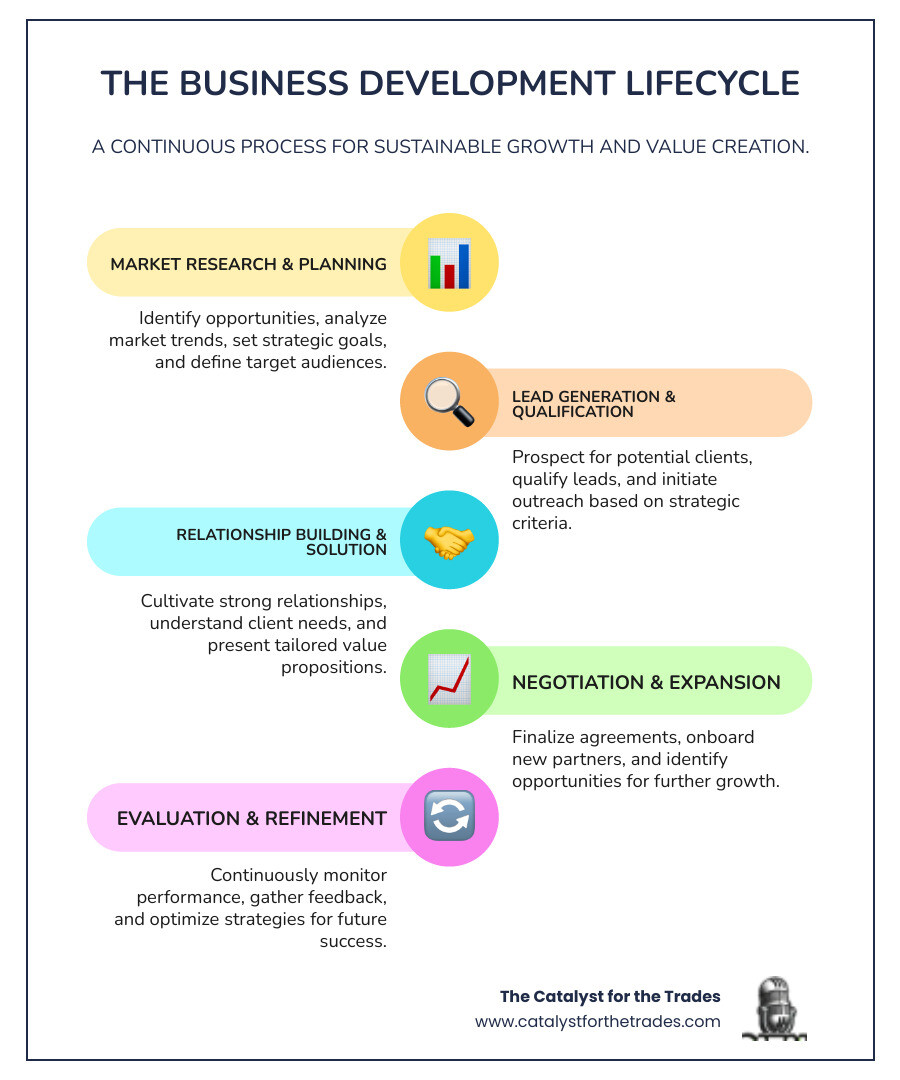
Business development, however, operates at the top of the sales funnel. Its job is to identify and qualify the right prospects through market research and relationship building. In short, business development creates the pipeline that sales converts, ensuring the sales team focuses on the most promising opportunities.
The timeframe tells the story: sales is about today's deal, while business development creates tomorrow's opportunities. This distinction is crucial for home services companies, as it builds a foundation for consistent growth and prevents the feast-or-famine cycle. Learn more about creating this synergy in Building a Modern Sales Culture.

Think of business development as your company's central nervous system, connecting sales, marketing, operations, and finance. When it works well, the whole organization moves forward together. This cross-departmental impact is where the magic happens. Insights from market research and customer conversations ripple through every function, making each department stronger and more aligned with your growth goals.
The synergy between business development, sales, and marketing yields immediate results. Business development identifies qualified leads, so your sales team talks to prospects who are ready to buy. This alignment creates a powerful feedback loop: business development finds leads, marketing creates targeted content for them, and sales receives educated, warm prospects primed for conversion.
Companies that align these efforts see results like a 35% increase in qualified leads. This partnership also excels at lead nurturing, as business development guides prospects through the customer journey, informing marketing's content creation and ensuring sales receives high-quality leads. For more insights on creating this kind of synergy, check out How to Unlock Real Growth, Follow-Up, and Future-Proofing in the Trades.
Business development acts as your innovation engine by using market gap analysis and customer feedback to spot opportunities. By identifying unmet needs, they provide a roadmap for process improvement and service expansion. For example, one company increased user engagement by 40% after its business development team identified a market demand that led to a new feature.
For home services, this could mean introducing maintenance plans or after-hours emergency services based on customer requests. By understanding both market demands and internal capabilities, business development can identify ways to optimize productivity, such as streamlining scheduling or adding complementary service lines. These are strategic moves based on real market intelligence.
Learn more about optimizing your operations with Process Improvement, and find How Systems Create Freedom: Mike Abramowitz's Blueprint for Trades Success.
Business development also integrates with foundational departments. For finance, it creates new revenue streams that diversify income and reduce risk. For HR, market engagement and a growing profile attract top talent; one company reduced recruitment costs by 30% through industry meetups organized by its business development team. Top performers are drawn to innovative, growing companies.
For IT, business development identifies customer experience gaps and operational inefficiencies that technology can solve. This leads to strategic technology adoption that drives real results, rather than just chasing trends. Understanding how to manage these financial opportunities is crucial for long-term success. Explore more with Financial Management Contractors.

Sustainable growth requires a strategic blueprint to guide your business development efforts. Hoping for growth isn't a plan.
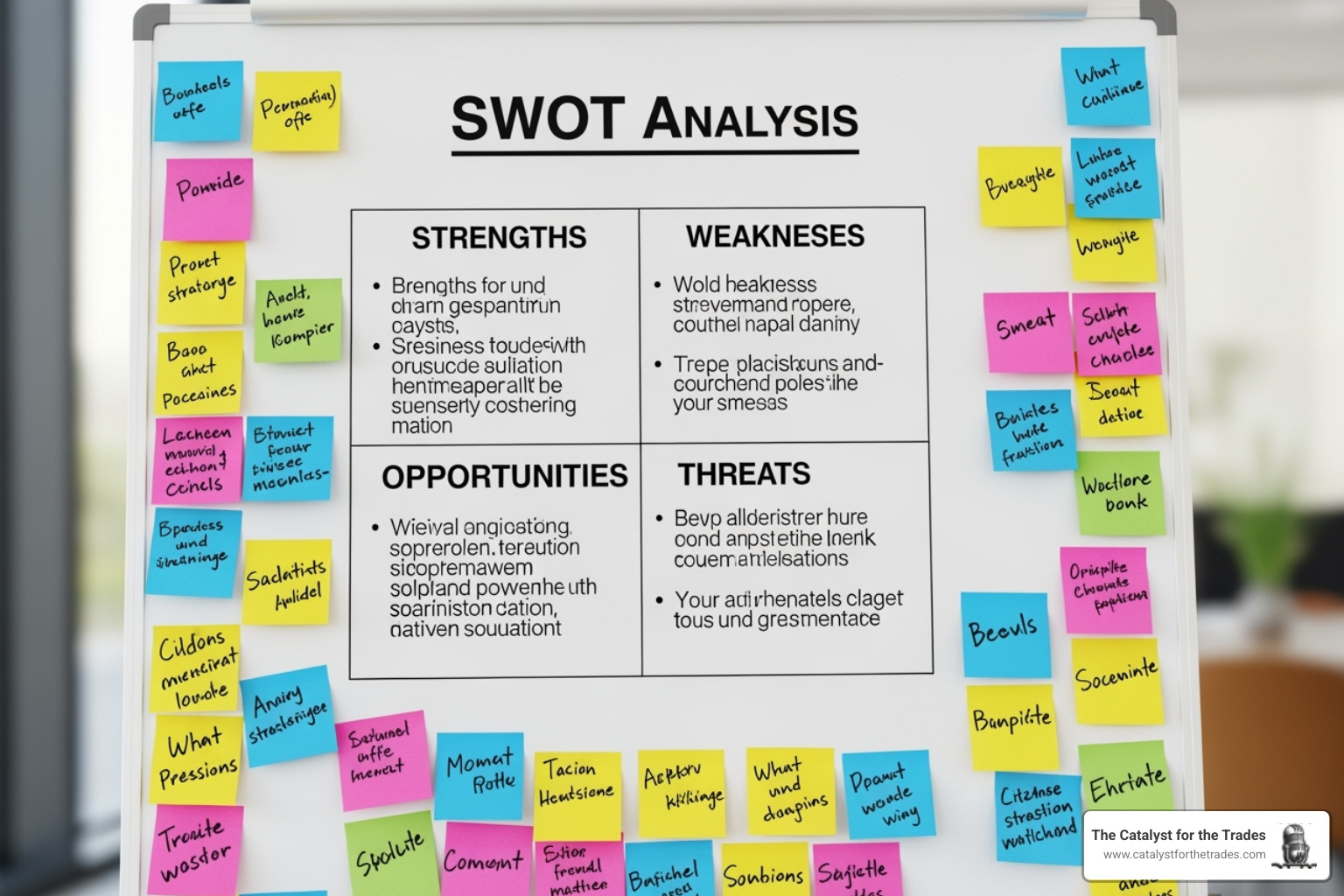
The foundation is understanding your current position through market research to identify trends, customer needs, and market gaps. Next, conduct a SWOT analysis to assess your internal strengths and weaknesses against external opportunities and threats. This provides a clear starting point.
From there, establish SMART (Specific, Measurable, Achievable, Relevant, Time-bound) goals, like "increase commercial contracts by 20% in 12 months." Track progress with Key Performance Indicators (KPIs) such as lead conversion rates or customer acquisition cost. Finally, define an outreach strategy to connect with customers and partners where they are. For a deeper dive, check out our guide on the Strategic Planning Process.
With your blueprint in place, focus on strategies that build genuine connections. These are the most powerful business development approaches for home services.
These strategies are effective for breaking through growth plateaus in the trades and choosing the right vendors to partner with as you scale.
A business development plan is your growth roadmap, focused exclusively on expansion and value creation. It answers, "How will we grow this year?"
Your plan should include:
The best plans start with the end in mind. Working backward from your long-term vision helps you define the steps you need to take today. Learn more about building a more profitable business with the end in mind and understanding business valuation for contractors as you plan your growth trajectory.
The world of business development is constantly evolving. Adaptation isn't just about survival; it's about seizing new opportunities. For home services companies, this means embracing data analytics, CRM systems, and AI to understand customers and innovate. The businesses that thrive are those willing to learn and adapt. AI, for instance, is now essential for staying competitive. Explore The AI Revolution in Home Services: How to Future-Proof Your Trades Business and learn about adapting to consumer behavior by leveraging AI and digital tools in the trades.
Modern business development professionals require a unique blend of skills:
These capabilities are strengthened through ongoing management development to keep your team forward-thinking.
Technology has transformed business development. Modern tools provide powerful capabilities:
The impact can be dramatic. One retail company used augmented reality to create a virtual try-on feature, resulting in a 25% increase in online sales and a 40% reduction in returns. For home services, technology can amplify everything from lead scoring to service delivery. To learn more about using data effectively in your business, explore CRM Success in the Trades: Celia Church's Guide to Data Implementation and Next-Level Growth.

Successful business development is fundamentally about people. Every partnership and customer interaction relies on genuine connections built on trust. For home services businesses, these relationships are your most valuable asset, as your reputation travels fast. The ethical foundation you build today determines your success tomorrow, creating a sustainable business people want to champion. As we explore in How to Lead, Serve, and Grow in the Trades with Raul Rodriguez, integrity and service are the backbone of lasting growth.
Business development is a long game focused on relationships, not just transactions. The goal is repeat business and referrals.
A powerful strategy is implementing quarterly business reviews for key accounts. Proactively checking in positions you as a trusted advisor. One B2B software company used this to increase customer retention by 25% and boost upsells by 30%. Customer loyalty is earned through consistent value and genuine care. This fosters reciprocation, turning customers into advocates.
The same principles apply to partner relationships. Mutually beneficial collaborations with suppliers or complementary services create a network effect, a hallmark of true industry leadership.
In today's connected world, your reputation is your most valuable asset. Customers, employees, and partners all evaluate your integrity. Ethical practices in business development are essential for sustainable success, meaning honesty, impartiality, and fairness in all dealings.
When expanding, cultural agility is crucial. Respecting regional norms, customs, and communication styles while maintaining your core values is key. The field of business ethics provides practical guidelines that build trust and protect your business. Consistently demonstrating these values creates a brand known not just for what you do, but how you do it.

When we talk about business development, questions naturally arise—especially for home services business owners who are navigating growth for the first time or looking to refine their approach. Let's address some of the most common questions we hear.
A business development representative (BDR) is a growth strategist. Their core responsibilities include qualifying leads to ensure they fit your ideal customer profile, prospecting for new clients through outreach and networking, and seeking new opportunities like underserved markets or strategic partners. They also conduct market research to stay on top of trends and customer demands. Finally, they report to sales with vetted leads and valuable insights, all while promoting customer satisfaction from the first interaction to ensure a smooth handoff.
Business development is critical for small businesses looking to scale beyond word-of-mouth referrals. It proactively drives growth and increases revenue by identifying new markets, service lines, and customer segments. It also builds brand value through strategic networking and partnerships, creating a reputation that attracts customers and talent. By creating strategic alliances, small businesses can expand their capabilities without massive investment. Business development helps you stand out from competitors by creating differentiators like innovative service packages or strategic community involvement.
Measuring business development success requires looking at long-term value through several Key Performance Indicators (KPIs):
Business development is a continuous journey of growth and strategic thinking. As we've explored, it's about creating long-term value by building relationships, making ethical decisions, and leveraging technology.
Successful trades businesses don't just react to opportunities; they create them. A growth mindset is essential in the evolving home services landscape. Whether you're expanding markets or forging partnerships, business development provides the framework for sustainable success.
Start with what makes sense for your business now—perhaps strengthening customer relationships, exploring a partnership, or investing in CRM technology. Each small step contributes to long-term growth.
At The Catalyst for the Trades, we're passionate about helping home service businesses open up their full potential. We understand your unique challenges and provide the insights and strategies you need to succeed.
Ready to make smarter decisions about your business's financial future? Tune into our discussions on Smart Money Moves for expert guidance custom to the trades.
Your growth journey starts with a single step. Let's take it together.
Business development is the process of creating long-term value for your company by identifying opportunities, building relationships, and implementing growth strategies. For home services business owners, it’s the foundation for sustainable growth, market expansion, and long-term profitability.
Key elements include creating value from customers and markets, forming strategic partnerships, expanding into new service areas, and integrating sales, marketing, and operations. It’s about continuous innovation and diversifying revenue to manage risk.
The difference between businesses that grow steadily and those that plateau often comes down to business development. Research shows that companies with structured initiatives see significant increases in qualified leads (35%), customer retention (25%), and reductions in recruitment costs (30%).
For home services companies, business development impacts everything from talent attraction and technology adoption to operational improvements and strategic partnerships. It provides the roadmap for scaling your business, whether you're growing your team or planning an exit.
Learn more about strategic growth strategies for contractors and find how The Catalyst for the Trades helps businesses scale sustainably.

Essential business development terms:
If you've ever wondered why some businesses grow effortlessly while others struggle, the answer often lies in business development: the strategic process of creating long-term value through customers, markets, and relationships. It’s not about quick wins but about positioning your business for lasting success by identifying and implementing growth opportunities, from strategic partnerships to market expansion.
To understand the difference, think of sales as “hunting” for the next customer, while business development is “farming”—cultivating relationships and laying the groundwork for future success. This continuous process requires a long-term vision to create systems that convert leads into loyal customers. For home services, this could mean building partnerships with suppliers or establishing recurring service contracts.
Want to dive deeper into building these growth strategies? Check out our comprehensive guide on Business Development: Definition, Strategies, Steps, and Skills.
The primary objective of business development is creating sustainable value that supports your company for years. For home services, this means securing recurring maintenance contracts for predictable revenue, building a strong brand reputation, and establishing partnerships that open doors to new customer segments.
Business development drives profitability by optimizing operations and exploring new revenue streams. It improves brand awareness to attract new customers and fosters enduring success through smart systems and relationships, rather than relying on a daily hustle. Explore more about achieving sustainable growth in our insights on Business Growth Strategies.
While closely related, business development and sales play different roles. Sales focuses on converting qualified leads into customers, closing deals, and meeting immediate revenue targets. They are the closers.
Business development, however, operates at the top of the sales funnel. Its job is to identify and qualify the right prospects through market research and relationship building. In short, business development creates the pipeline that sales converts, ensuring the sales team focuses on the most promising opportunities.
The timeframe tells the story: sales is about today's deal, while business development creates tomorrow's opportunities. This distinction is crucial for home services companies, as it builds a foundation for consistent growth and prevents the feast-or-famine cycle. Learn more about creating this synergy in Building a Modern Sales Culture.

Think of business development as your company's central nervous system, connecting sales, marketing, operations, and finance. When it works well, the whole organization moves forward together. This cross-departmental impact is where the magic happens. Insights from market research and customer conversations ripple through every function, making each department stronger and more aligned with your growth goals.
The synergy between business development, sales, and marketing yields immediate results. Business development identifies qualified leads, so your sales team talks to prospects who are ready to buy. This alignment creates a powerful feedback loop: business development finds leads, marketing creates targeted content for them, and sales receives educated, warm prospects primed for conversion.
Companies that align these efforts see results like a 35% increase in qualified leads. This partnership also excels at lead nurturing, as business development guides prospects through the customer journey, informing marketing's content creation and ensuring sales receives high-quality leads. For more insights on creating this kind of synergy, check out How to Unlock Real Growth, Follow-Up, and Future-Proofing in the Trades.
Business development acts as your innovation engine by using market gap analysis and customer feedback to spot opportunities. By identifying unmet needs, they provide a roadmap for process improvement and service expansion. For example, one company increased user engagement by 40% after its business development team identified a market demand that led to a new feature.
For home services, this could mean introducing maintenance plans or after-hours emergency services based on customer requests. By understanding both market demands and internal capabilities, business development can identify ways to optimize productivity, such as streamlining scheduling or adding complementary service lines. These are strategic moves based on real market intelligence.
Learn more about optimizing your operations with Process Improvement, and find How Systems Create Freedom: Mike Abramowitz's Blueprint for Trades Success.
Business development also integrates with foundational departments. For finance, it creates new revenue streams that diversify income and reduce risk. For HR, market engagement and a growing profile attract top talent; one company reduced recruitment costs by 30% through industry meetups organized by its business development team. Top performers are drawn to innovative, growing companies.
For IT, business development identifies customer experience gaps and operational inefficiencies that technology can solve. This leads to strategic technology adoption that drives real results, rather than just chasing trends. Understanding how to manage these financial opportunities is crucial for long-term success. Explore more with Financial Management Contractors.

Sustainable growth requires a strategic blueprint to guide your business development efforts. Hoping for growth isn't a plan.
The foundation is understanding your current position through market research to identify trends, customer needs, and market gaps. Next, conduct a SWOT analysis to assess your internal strengths and weaknesses against external opportunities and threats. This provides a clear starting point.
From there, establish SMART (Specific, Measurable, Achievable, Relevant, Time-bound) goals, like "increase commercial contracts by 20% in 12 months." Track progress with Key Performance Indicators (KPIs) such as lead conversion rates or customer acquisition cost. Finally, define an outreach strategy to connect with customers and partners where they are. For a deeper dive, check out our guide on the Strategic Planning Process.
With your blueprint in place, focus on strategies that build genuine connections. These are the most powerful business development approaches for home services.
These strategies are effective for breaking through growth plateaus in the trades and choosing the right vendors to partner with as you scale.
A business development plan is your growth roadmap, focused exclusively on expansion and value creation. It answers, "How will we grow this year?"
Your plan should include:
The best plans start with the end in mind. Working backward from your long-term vision helps you define the steps you need to take today. Learn more about building a more profitable business with the end in mind and understanding business valuation for contractors as you plan your growth trajectory.
The world of business development is constantly evolving. Adaptation isn't just about survival; it's about seizing new opportunities. For home services companies, this means embracing data analytics, CRM systems, and AI to understand customers and innovate. The businesses that thrive are those willing to learn and adapt. AI, for instance, is now essential for staying competitive. Explore The AI Revolution in Home Services: How to Future-Proof Your Trades Business and learn about adapting to consumer behavior by leveraging AI and digital tools in the trades.
Modern business development professionals require a unique blend of skills:
These capabilities are strengthened through ongoing management development to keep your team forward-thinking.
Technology has transformed business development. Modern tools provide powerful capabilities:
The impact can be dramatic. One retail company used augmented reality to create a virtual try-on feature, resulting in a 25% increase in online sales and a 40% reduction in returns. For home services, technology can amplify everything from lead scoring to service delivery. To learn more about using data effectively in your business, explore CRM Success in the Trades: Celia Church's Guide to Data Implementation and Next-Level Growth.

Successful business development is fundamentally about people. Every partnership and customer interaction relies on genuine connections built on trust. For home services businesses, these relationships are your most valuable asset, as your reputation travels fast. The ethical foundation you build today determines your success tomorrow, creating a sustainable business people want to champion. As we explore in How to Lead, Serve, and Grow in the Trades with Raul Rodriguez, integrity and service are the backbone of lasting growth.
Business development is a long game focused on relationships, not just transactions. The goal is repeat business and referrals.
A powerful strategy is implementing quarterly business reviews for key accounts. Proactively checking in positions you as a trusted advisor. One B2B software company used this to increase customer retention by 25% and boost upsells by 30%. Customer loyalty is earned through consistent value and genuine care. This fosters reciprocation, turning customers into advocates.
The same principles apply to partner relationships. Mutually beneficial collaborations with suppliers or complementary services create a network effect, a hallmark of true industry leadership.
In today's connected world, your reputation is your most valuable asset. Customers, employees, and partners all evaluate your integrity. Ethical practices in business development are essential for sustainable success, meaning honesty, impartiality, and fairness in all dealings.
When expanding, cultural agility is crucial. Respecting regional norms, customs, and communication styles while maintaining your core values is key. The field of business ethics provides practical guidelines that build trust and protect your business. Consistently demonstrating these values creates a brand known not just for what you do, but how you do it.

When we talk about business development, questions naturally arise—especially for home services business owners who are navigating growth for the first time or looking to refine their approach. Let's address some of the most common questions we hear.
A business development representative (BDR) is a growth strategist. Their core responsibilities include qualifying leads to ensure they fit your ideal customer profile, prospecting for new clients through outreach and networking, and seeking new opportunities like underserved markets or strategic partners. They also conduct market research to stay on top of trends and customer demands. Finally, they report to sales with vetted leads and valuable insights, all while promoting customer satisfaction from the first interaction to ensure a smooth handoff.
Business development is critical for small businesses looking to scale beyond word-of-mouth referrals. It proactively drives growth and increases revenue by identifying new markets, service lines, and customer segments. It also builds brand value through strategic networking and partnerships, creating a reputation that attracts customers and talent. By creating strategic alliances, small businesses can expand their capabilities without massive investment. Business development helps you stand out from competitors by creating differentiators like innovative service packages or strategic community involvement.
Measuring business development success requires looking at long-term value through several Key Performance Indicators (KPIs):
Business development is a continuous journey of growth and strategic thinking. As we've explored, it's about creating long-term value by building relationships, making ethical decisions, and leveraging technology.
Successful trades businesses don't just react to opportunities; they create them. A growth mindset is essential in the evolving home services landscape. Whether you're expanding markets or forging partnerships, business development provides the framework for sustainable success.
Start with what makes sense for your business now—perhaps strengthening customer relationships, exploring a partnership, or investing in CRM technology. Each small step contributes to long-term growth.
At The Catalyst for the Trades, we're passionate about helping home service businesses open up their full potential. We understand your unique challenges and provide the insights and strategies you need to succeed.
Ready to make smarter decisions about your business's financial future? Tune into our discussions on Smart Money Moves for expert guidance custom to the trades.
Your growth journey starts with a single step. Let's take it together.
Business development is the process of creating long-term value for your company by identifying opportunities, building relationships, and implementing growth strategies. For home services business owners, it’s the foundation for sustainable growth, market expansion, and long-term profitability.
Key elements include creating value from customers and markets, forming strategic partnerships, expanding into new service areas, and integrating sales, marketing, and operations. It’s about continuous innovation and diversifying revenue to manage risk.
The difference between businesses that grow steadily and those that plateau often comes down to business development. Research shows that companies with structured initiatives see significant increases in qualified leads (35%), customer retention (25%), and reductions in recruitment costs (30%).
For home services companies, business development impacts everything from talent attraction and technology adoption to operational improvements and strategic partnerships. It provides the roadmap for scaling your business, whether you're growing your team or planning an exit.
Learn more about strategic growth strategies for contractors and find how The Catalyst for the Trades helps businesses scale sustainably.

Essential business development terms:
If you've ever wondered why some businesses grow effortlessly while others struggle, the answer often lies in business development: the strategic process of creating long-term value through customers, markets, and relationships. It’s not about quick wins but about positioning your business for lasting success by identifying and implementing growth opportunities, from strategic partnerships to market expansion.
To understand the difference, think of sales as “hunting” for the next customer, while business development is “farming”—cultivating relationships and laying the groundwork for future success. This continuous process requires a long-term vision to create systems that convert leads into loyal customers. For home services, this could mean building partnerships with suppliers or establishing recurring service contracts.
Want to dive deeper into building these growth strategies? Check out our comprehensive guide on Business Development: Definition, Strategies, Steps, and Skills.
The primary objective of business development is creating sustainable value that supports your company for years. For home services, this means securing recurring maintenance contracts for predictable revenue, building a strong brand reputation, and establishing partnerships that open doors to new customer segments.
Business development drives profitability by optimizing operations and exploring new revenue streams. It improves brand awareness to attract new customers and fosters enduring success through smart systems and relationships, rather than relying on a daily hustle. Explore more about achieving sustainable growth in our insights on Business Growth Strategies.
While closely related, business development and sales play different roles. Sales focuses on converting qualified leads into customers, closing deals, and meeting immediate revenue targets. They are the closers.
Business development, however, operates at the top of the sales funnel. Its job is to identify and qualify the right prospects through market research and relationship building. In short, business development creates the pipeline that sales converts, ensuring the sales team focuses on the most promising opportunities.
The timeframe tells the story: sales is about today's deal, while business development creates tomorrow's opportunities. This distinction is crucial for home services companies, as it builds a foundation for consistent growth and prevents the feast-or-famine cycle. Learn more about creating this synergy in Building a Modern Sales Culture.

Think of business development as your company's central nervous system, connecting sales, marketing, operations, and finance. When it works well, the whole organization moves forward together. This cross-departmental impact is where the magic happens. Insights from market research and customer conversations ripple through every function, making each department stronger and more aligned with your growth goals.
The synergy between business development, sales, and marketing yields immediate results. Business development identifies qualified leads, so your sales team talks to prospects who are ready to buy. This alignment creates a powerful feedback loop: business development finds leads, marketing creates targeted content for them, and sales receives educated, warm prospects primed for conversion.
Companies that align these efforts see results like a 35% increase in qualified leads. This partnership also excels at lead nurturing, as business development guides prospects through the customer journey, informing marketing's content creation and ensuring sales receives high-quality leads. For more insights on creating this kind of synergy, check out How to Unlock Real Growth, Follow-Up, and Future-Proofing in the Trades.
Business development acts as your innovation engine by using market gap analysis and customer feedback to spot opportunities. By identifying unmet needs, they provide a roadmap for process improvement and service expansion. For example, one company increased user engagement by 40% after its business development team identified a market demand that led to a new feature.
For home services, this could mean introducing maintenance plans or after-hours emergency services based on customer requests. By understanding both market demands and internal capabilities, business development can identify ways to optimize productivity, such as streamlining scheduling or adding complementary service lines. These are strategic moves based on real market intelligence.
Learn more about optimizing your operations with Process Improvement, and find How Systems Create Freedom: Mike Abramowitz's Blueprint for Trades Success.
Business development also integrates with foundational departments. For finance, it creates new revenue streams that diversify income and reduce risk. For HR, market engagement and a growing profile attract top talent; one company reduced recruitment costs by 30% through industry meetups organized by its business development team. Top performers are drawn to innovative, growing companies.
For IT, business development identifies customer experience gaps and operational inefficiencies that technology can solve. This leads to strategic technology adoption that drives real results, rather than just chasing trends. Understanding how to manage these financial opportunities is crucial for long-term success. Explore more with Financial Management Contractors.

Sustainable growth requires a strategic blueprint to guide your business development efforts. Hoping for growth isn't a plan.
The foundation is understanding your current position through market research to identify trends, customer needs, and market gaps. Next, conduct a SWOT analysis to assess your internal strengths and weaknesses against external opportunities and threats. This provides a clear starting point.
From there, establish SMART (Specific, Measurable, Achievable, Relevant, Time-bound) goals, like "increase commercial contracts by 20% in 12 months." Track progress with Key Performance Indicators (KPIs) such as lead conversion rates or customer acquisition cost. Finally, define an outreach strategy to connect with customers and partners where they are. For a deeper dive, check out our guide on the Strategic Planning Process.
With your blueprint in place, focus on strategies that build genuine connections. These are the most powerful business development approaches for home services.
These strategies are effective for breaking through growth plateaus in the trades and choosing the right vendors to partner with as you scale.
A business development plan is your growth roadmap, focused exclusively on expansion and value creation. It answers, "How will we grow this year?"
Your plan should include:
The best plans start with the end in mind. Working backward from your long-term vision helps you define the steps you need to take today. Learn more about building a more profitable business with the end in mind and understanding business valuation for contractors as you plan your growth trajectory.
The world of business development is constantly evolving. Adaptation isn't just about survival; it's about seizing new opportunities. For home services companies, this means embracing data analytics, CRM systems, and AI to understand customers and innovate. The businesses that thrive are those willing to learn and adapt. AI, for instance, is now essential for staying competitive. Explore The AI Revolution in Home Services: How to Future-Proof Your Trades Business and learn about adapting to consumer behavior by leveraging AI and digital tools in the trades.
Modern business development professionals require a unique blend of skills:
These capabilities are strengthened through ongoing management development to keep your team forward-thinking.
Technology has transformed business development. Modern tools provide powerful capabilities:
The impact can be dramatic. One retail company used augmented reality to create a virtual try-on feature, resulting in a 25% increase in online sales and a 40% reduction in returns. For home services, technology can amplify everything from lead scoring to service delivery. To learn more about using data effectively in your business, explore CRM Success in the Trades: Celia Church's Guide to Data Implementation and Next-Level Growth.

Successful business development is fundamentally about people. Every partnership and customer interaction relies on genuine connections built on trust. For home services businesses, these relationships are your most valuable asset, as your reputation travels fast. The ethical foundation you build today determines your success tomorrow, creating a sustainable business people want to champion. As we explore in How to Lead, Serve, and Grow in the Trades with Raul Rodriguez, integrity and service are the backbone of lasting growth.
Business development is a long game focused on relationships, not just transactions. The goal is repeat business and referrals.
A powerful strategy is implementing quarterly business reviews for key accounts. Proactively checking in positions you as a trusted advisor. One B2B software company used this to increase customer retention by 25% and boost upsells by 30%. Customer loyalty is earned through consistent value and genuine care. This fosters reciprocation, turning customers into advocates.
The same principles apply to partner relationships. Mutually beneficial collaborations with suppliers or complementary services create a network effect, a hallmark of true industry leadership.
In today's connected world, your reputation is your most valuable asset. Customers, employees, and partners all evaluate your integrity. Ethical practices in business development are essential for sustainable success, meaning honesty, impartiality, and fairness in all dealings.
When expanding, cultural agility is crucial. Respecting regional norms, customs, and communication styles while maintaining your core values is key. The field of business ethics provides practical guidelines that build trust and protect your business. Consistently demonstrating these values creates a brand known not just for what you do, but how you do it.

When we talk about business development, questions naturally arise—especially for home services business owners who are navigating growth for the first time or looking to refine their approach. Let's address some of the most common questions we hear.
A business development representative (BDR) is a growth strategist. Their core responsibilities include qualifying leads to ensure they fit your ideal customer profile, prospecting for new clients through outreach and networking, and seeking new opportunities like underserved markets or strategic partners. They also conduct market research to stay on top of trends and customer demands. Finally, they report to sales with vetted leads and valuable insights, all while promoting customer satisfaction from the first interaction to ensure a smooth handoff.
Business development is critical for small businesses looking to scale beyond word-of-mouth referrals. It proactively drives growth and increases revenue by identifying new markets, service lines, and customer segments. It also builds brand value through strategic networking and partnerships, creating a reputation that attracts customers and talent. By creating strategic alliances, small businesses can expand their capabilities without massive investment. Business development helps you stand out from competitors by creating differentiators like innovative service packages or strategic community involvement.
Measuring business development success requires looking at long-term value through several Key Performance Indicators (KPIs):
Business development is a continuous journey of growth and strategic thinking. As we've explored, it's about creating long-term value by building relationships, making ethical decisions, and leveraging technology.
Successful trades businesses don't just react to opportunities; they create them. A growth mindset is essential in the evolving home services landscape. Whether you're expanding markets or forging partnerships, business development provides the framework for sustainable success.
Start with what makes sense for your business now—perhaps strengthening customer relationships, exploring a partnership, or investing in CRM technology. Each small step contributes to long-term growth.
At The Catalyst for the Trades, we're passionate about helping home service businesses open up their full potential. We understand your unique challenges and provide the insights and strategies you need to succeed.
Ready to make smarter decisions about your business's financial future? Tune into our discussions on Smart Money Moves for expert guidance custom to the trades.
Your growth journey starts with a single step. Let's take it together.

Discover how leading home‑service companies are leveraging AI, subscription models, and digital‑first strategies.
Learn why private equity, automation, and customer‑centric tech are reshaping the trades.

Develop a winning technology strategy to future-proof your business. Align tech with goals, implement effectively, and leverage AI for growth.

If you're a home service business owner trying to make sense of the changing tech landscape, this is a must-watch episode. Discover some of the highlights below.

Conquer growth! Learn how customer relationship management empowers home services with data, boosts efficiency, and delights customers.