Learn · February 3, 2026
Content Marketing Strategy: Your 4-Step Blueprint
Master your content marketing strategy. Learn to build, execute, and measure your plan for business growth and increased ROI.
By The Catalyst Editorial Team Operator education · 13 min read · Updated July 24, 2026

Why Every Home Service Business Needs a Content Marketing Strategy

A content marketing strategy is a documented plan for creating and distributing valuable content to attract your target audience and achieve specific business goals. For home service businesses, this means producing materials that answer customer questions, build trust, and drive service calls—not just posting sporadically.
An effective strategy includes:
- Clear business goals (e.g., more leads, higher revenue)
- A defined target audience and their problems
- Specific content types and formats (blogs, videos, etc.)
- Distribution channels (website, social media, email)
- A consistent publishing schedule
- Performance metrics to measure success
Many home service businesses struggle to get consistent leads from marketing because their efforts are haphazard. A documented strategy is the key differentiator for predictable growth. Research shows that 70% of marketers are actively investing in content marketing, and those with a written plan are far more effective, efficient, and able to prove ROI.
A solid content marketing strategy aligns every piece of content with your business goals, streamlines creation and distribution, and enables you to optimize results over time. Without it, you’re just guessing.
To master your overall business growth approach, start with Business Growth Strategies. When you’re ready to implement your content plan, check out Organic Traffic Growth.
Why a Documented Strategy is Your Blueprint for Success
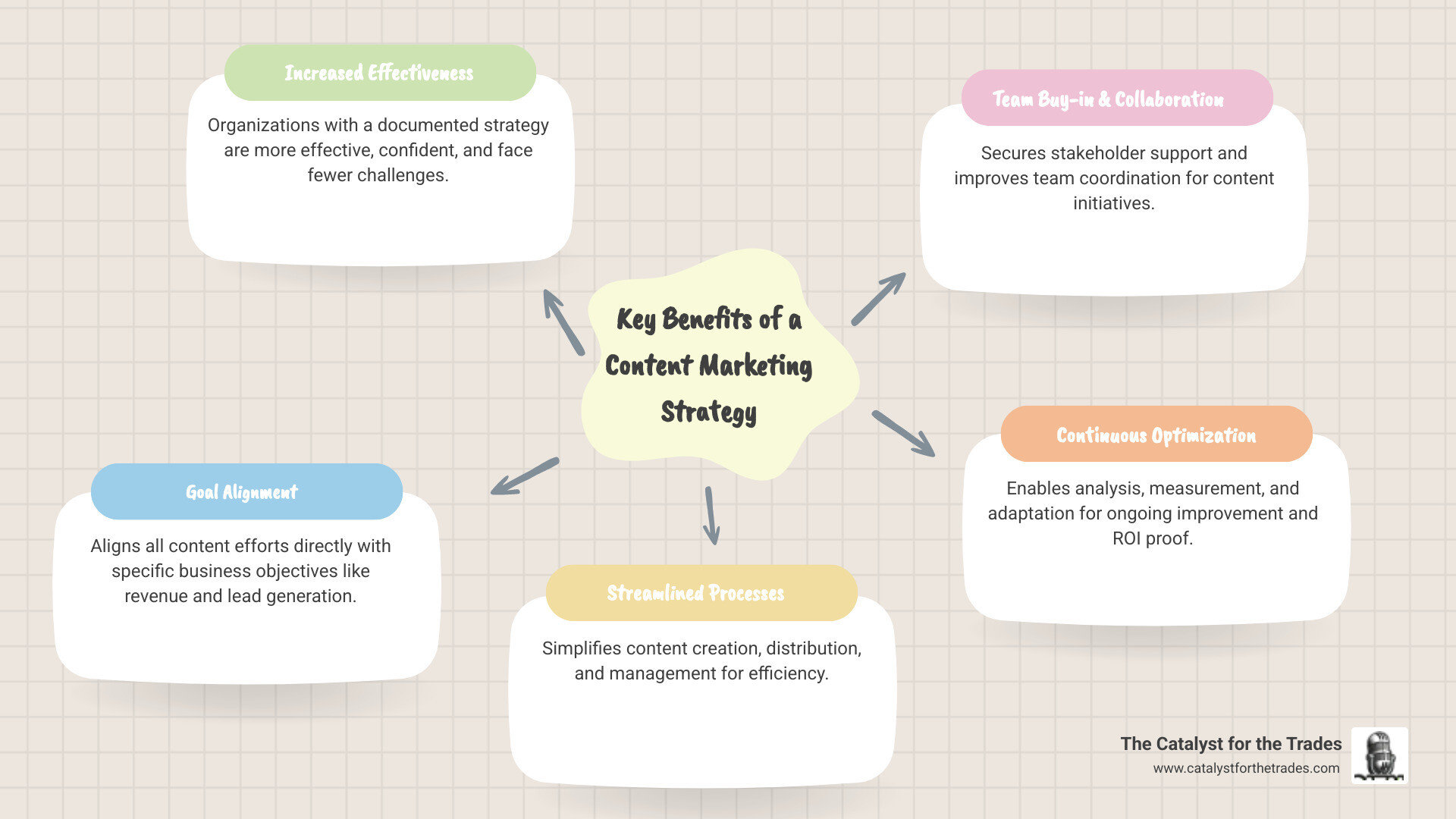
A documented content marketing strategy isn’t just a formality; it’s your blueprint for turning scattered efforts into a results-driven engine. Organizations with a written plan are more effective, confident, and efficient in their marketing.
A documented strategy is essential because it:
- Aligns Content with Business Goals: Ensures every piece of content serves a purpose, whether it’s increasing revenue, lowering costs, or attracting better customers.
- Secures Stakeholder Buy-in: A clear plan makes it easier to get support from your team by articulating the “why” behind your content efforts.
- Streamlines Processes: Provides a roadmap for content creation, publication, and promotion, helping you plan and allocate resources effectively.
- Enables Analysis and Optimization: Allows you to track performance against goals and make data-driven adjustments to improve results.
A documented strategy is the foundation for achieving Organic Traffic Growth and establishing Thought Leadership.
Content Marketing Strategy vs. Content Strategy vs. Content Plan
These terms are often used interchangeably, but they have distinct roles. Understanding the difference is crucial for building an effective system.
Content Marketing Strategy: The “Why”This is your high-level vision. It defines your purpose, your audience, and how content will help you achieve business goals like increased revenue or better customers.
Content Strategy: The “What, How, and When” of Useful ContentThis focuses on the entire lifecycle of your content assets, ensuring they are well-structured, consistent, and useful. It covers governance, management, and measurement frameworks.
Content Plan: The Tactical “Execution”This is your day-to-day roadmap. The content plan details specific topics, assignments, and distribution schedules, turning your strategy into actionable tasks.
Think of it like building a house:
- The content marketing strategy is the decision to build a house to sell for profit (the why).
- The content strategy is the architectural design and materials (the what and how).
- The content plan is the construction schedule (the tactical execution).
Here’s a table to clarify:
| Feature | Content Marketing Strategy | Content Strategy | Content Plan |
|---|---|---|---|
| Primary Goal | Drive business outcomes (leads, sales, ROI) | Create, manage, and govern useful content assets | Schedule and execute specific content deliverables |
| Focus | Marketing objectives and audience needs | Content lifecycle, structure, and usability | Content topics, formats, and distribution schedule |
| Scope | Strategic, business-oriented | Strategic, content-oriented | Tactical, execution-oriented |
| Key Questions | Why are we creating content? | What content do we need? How will it be managed? | What specific content, when, and where? |
| Deliverables | Mission statement, audience profile, KPIs | Content audit, style guides, content models | Editorial calendar, content briefs, task assignments |
The Essential Benefits of Strategic Content
A robust content marketing strategy offers numerous benefits that drive genuine growth.
- Increased Website Traffic: Consistently creating valuable, keyword-rich content helps customers find you through search engines. Websites with blogs have 434% more indexed pages and 97% more inbound links.
- Improved Brand Awareness and Credibility: Strategic content positions your brand as an authority. Sharing expertise through articles and guides establishes you as a go-to resource, building trust before a customer ever calls. Learn more about developing your Thought Leadership.
- Stronger Lead Generation: Quality content addresses customer pain points and guides them toward solutions. Companies with active blogs generate 67% more leads monthly.
- Fosters Trust and Builds Relationships: Delivering value without an immediate sales pitch builds goodwill and cultivates a loyal audience.
- Better Customer Retention: Providing valuable content post-sale strengthens client relationships, encouraging repeat business and referrals. This is a key part of effective Customer Retention Strategies.
- Cost-Effectiveness: Unlike ads, content provides long-term value, making it a smart investment that continues to deliver results over time.
Building Your Foundation: Audience, Goals, and Research
Before creating content, we must lay a foundation by understanding who we’re talking to, what we want to achieve, and what the competitive landscape looks like.
Start by setting SMART (specific, measurable, achievable, relevant, time-bound) goals. For example, aim to “increase qualified service call leads by 20% through blog content in the next six months.” For help, download this goal-planning template to determine your content goals.
Next, dive into consumer research to understand your audience’s needs and motivations. Finally, analyze your competition and audit your existing content to identify gaps and opportunities. Understanding your Competitive Intelligence is key to standing out.
Defining Your Target Audience
An effective content marketing strategy is built on a deep understanding of your target audience. We create detailed buyer personas—semi-fictional representations of ideal customers—based on real data.
Key elements of a buyer persona include:
- Demographics: Age, location, income, and homeownership status.
- Pain Points: The specific problems your services can solve (e.g., a leaky faucet, an inefficient HVAC system).
- Motivations and Goals: What drives them (e.g., reliability, safety, peace of mind).
- Decision Criteria: Factors influencing their purchases (e.g., budget, quality, speed).
Gather this information through:
- Surveys and Interviews: Directly ask current and potential customers.
- Website Analytics: Use Google Analytics to understand user demographics and behavior.
- Customer Service Teams: Consult your front-line team for insights into common customer issues.
- Social Media Listening: Monitor conversations on relevant platforms.
Building rich personas helps map customer needs to your services. For more, see this post from Seer on audience research. A robust CRM tool can help manage this data. Learn more with How to Get Your CRM Right and Why It Matters More Than You Think.
The Role of Consumer Research in Your Content Marketing Strategy
Consumer research is the engine of a successful content marketing strategy. It’s the difference between guessing what your audience wants and knowing with confidence.
Research is vital for:
- Understanding Audience Needs: It helps us create content that directly addresses their questions and solves their problems.
- Identifying Trends: By analyzing consumer behavior, we can spot emerging trends and unmet needs.
- Informing Content Choices: Research pinpoints which topics and formats (e.g., videos vs. blog posts) resonate most with your audience.
- Enabling Personalization: Insights allow you to tailor content to different buyer personas, making it more impactful.
The ultimate goal of research is to map your persona’s pain points to the solutions you offer, ensuring your content guides potential customers toward your services. Leveraging AI Business Intelligence can further improve these efforts by uncovering deeper insights.
Content Creation and Management: From Ideas to Execution
With a solid foundation, it’s time to bring your content marketing strategy to life. This phase is about selecting the right content formats, mapping them to the buyer’s journey, and establishing a clear process for creation and promotion to attract, engage, and convert your audience.
Choosing the Right Content Formats
Selecting the right content types depends on your goals and audience preferences. Here are some of the most impactful formats:
- Blog Posts: The workhorse of content marketing, excellent for SEO and lead generation. Websites with blogs see significantly more indexed pages and inbound links. 16% of marketers say blogs generated their biggest ROI in 2024.
- Video Content: Highly engaging and versatile for tutorials, behind-the-scenes content, or service explanations. 91% of content marketers use video, and 90% report it increases brand awareness.
- Social Media Content: Essential for reaching a wide audience and fostering engagement. With users on 7.1 social media platforms monthly, it’s a crucial touchpoint for brand research and community building. Learn How to Turn Social Media into a Growth Engine for Your Home Service Business.
- Podcasts: A powerful medium for in-depth discussions and building authority. With nearly 505 million worldwide listeners in 2024, they offer a convenient way for audiences to consume content.
- Infographics: Transform complex information into easily digestible visuals. Content with images can see up to 650% higher engagement than text-only posts.
- Email Marketing: A crucial tool for direct communication and lead nurturing, boasting an average ROI of $36 for every dollar spent.
- White Papers: In-depth reports that establish expertise, particularly for complex home service topics.
Mapping Content to the Buyer’s Journey
Your content marketing strategy must meet customers at each stage of their journey: awareness, consideration, and decision.
Top-of-Funnel (TOFU) Content: AwarenessAt this stage, potential customers are identifying a problem. Your goal is to attract them with helpful, general information.
- Content Types: Blog posts (“Signs Your HVAC Needs Repair”), social media tips, infographics, and explainer videos.
Middle-of-Funnel (MOFU) Content: ConsiderationHere, customers are researching solutions. Your content should provide deeper insights to nurture leads.
- Content Types: Detailed guides, case studies, comparison articles (“Tankless vs. Traditional Water Heaters”), and email newsletters.
Bottom-of-Funnel (BOFU) Content: DecisionCustomers are ready to choose a provider. Your content should drive action and give them a reason to choose you.
- Content Types: Testimonials, detailed service pages, free consultations, and FAQs. This content is crucial for Lead Conversion Optimization.
Developing a Content Calendar
A content calendar is your command center for ensuring consistency and organization. It helps you track the creation process, plan content months in advance, and align everything with your strategy.
Your calendar should include:
- Editorial Workflow: The stages of content creation (ideation, writing, editing, SEO, publication) with clear roles.
- Publishing Frequency: A consistent schedule for different content types.
- Promotion Plan: How and where each piece of content will be shared.
- Tools for Management: Use tools like Google Sheets, Trello, Asana, or Basecamp to manage your content pipeline and deadlines.
Planning ahead allows you to align content with seasonal demands, promotions, and industry events.
Measuring, Adapting, and Overcoming Challenges
Even the most carefully crafted content marketing strategy isn’t set in stone. The digital landscape is constantly evolving, and our strategy needs to evolve with it. This means regularly measuring our performance, adapting to changes, and proactively addressing common challenges. We can measure and track our content performance so we can adjust our strategy as needed to achieve our goals.
How to Measure the ROI of Your Content Marketing Strategy
Measuring the Return on Investment (ROI) of your content marketing strategy is crucial for proving its value.
- Key Performance Indicators (KPIs): Define KPIs that align with your goals. These include:
- Traffic Metrics: Organic traffic, page views, time on page.
- Engagement Metrics: Social shares, comments, email open rates.
- Conversion Rates: Form submissions, phone calls from content, newsletter sign-ups.
- Lead Quality: Which content generates leads that become customers.
- ROI Calculation: Attribute leads and sales back to specific content. For example, email marketing has an average ROI of $36 for every dollar spent.
- Tools for Measurement: Use tools like Google Analytics and HubSpot’s analytics platform to track progress. Monitoring these metrics is key to effective Performance Management.
Adapting to Changing Algorithms and Platforms
The digital world is dynamic, so your strategy must be agile.
- Stay Updated: Search engine and social media algorithms change constantly, impacting content visibility. Stay informed and adapt your tactics, such as optimizing for new formats like voice search.
- Follow Your Audience: Monitor where your audience spends their time and be ready to adjust your distribution strategy to meet them there.
- Review Regularly: Review your strategy at least annually (or quarterly if you’re new or in a fast-changing market) to ensure it remains effective. This is crucial for How to Stay Competitive as AI and Consumer Behavior Reshape Home Services and navigating The AI Revolution in Home Services: How to Future-Proof Your Trades Business.
Common Content Marketing Challenges and Solutions
Anticipating common challenges helps you maintain momentum.
- Challenge: Capturing Audience Attention
- Solution: Create unique, highly valuable content that addresses specific pain points. Use storytelling, compelling visuals, and personalization.
- Challenge: Generating Traffic and Leads
- Solution: Optimize content for search (SEO), promote it across relevant channels, and include clear calls to action mapped to the buyer’s journey.
- Challenge: Proving ROI
- Solution: Establish clear KPIs from the start, use robust analytics to track results, and attribute leads and sales back to your content.
- Challenge: Resource Constraints (Time, Budget, Talent)
- Solution: Prioritize high-impact content, repurpose existing materials into new formats, and implement efficient workflows through Process Improvement.
Frequently Asked Questions about Content Marketing Strategy
Here are clear answers to some of the most common questions about building an effective content marketing strategy.
How often should I update my content marketing strategy?
Your core mission and business goals should remain consistent, but dynamic elements like channel strategy, topics, and team processes need periodic updates. We recommend a full review at least annually. If you’re just starting out or your industry is evolving rapidly, a quarterly review is better to stay agile and responsive to market changes.
What’s the first step in creating a content marketing strategy?
The first step is to define your goals. Before creating any content, you must articulate what you want to achieve. Are you aiming for brand awareness, lead generation, or customer retention? Your goals should be SMART: Specific, Measurable, Achievable, Relevant, and Time-bound. Knowing your destination lets you chart the most effective course.
How can a small business with a limited budget implement content marketing?
A limited budget doesn’t prevent an effective content marketing strategy.
- Focus on a Niche: Target a specific audience segment with highly relevant content.
- Prioritize Evergreen Content: Create content that stays relevant over time for long-term value.
- Repurpose Content: Turn one blog post into multiple social media snippets, an infographic, or a short video.
- Leverage Free Tools: Use free tools for keyword research, analytics, and design (e.g., Google Analytics, Canva).
- Emphasize Quality Over Quantity: One high-quality piece is more effective than ten mediocre ones.
Conclusion
Developing and implementing a robust content marketing strategy is no longer optional for home service businesses—it’s essential for sustainable growth. We’ve explored how a documented plan serves as our blueprint for success, aligning our content with business goals, streamlining our efforts, and fostering deeper connections with our audience.
From understanding the nuanced differences between content marketing strategy, content strategy, and content plan, to building a solid foundation through audience research and goal setting, every step is crucial. We’ve also digd into choosing the right content formats, mapping content to the buyer’s journey, and organizing our efforts with a content calendar.
The journey doesn’t end with creation. Continuous measurement of ROI, adapting to ever-changing algorithms, and proactively overcoming common challenges are vital for long-term success. By embracing these principles, we can transform our content efforts from haphazard attempts into a powerful engine for lead generation, brand building, and customer loyalty.
For ongoing insights, expert interviews, and actionable strategies to help your home service business thrive, we invite you to listen to The Catalyst for the Trades Podcast. Explore more Business Growth Strategies to scale your home service company and make your content work harder for you.


