Learn · November 28, 2025
Competitive Intelligence: Master 5 Steps for 2025
Unlock growth with competitive intelligence. Learn to gather, analyze & act on CI for your home service business.
By The Catalyst Editorial Team Operator education · 12 min read · Updated July 24, 2026

Why Every Home Service Business Needs Competitive Intelligence
Competitive intelligence is the systematic process of gathering, analyzing, and acting on information about your competitors, market trends, and customer behavior to make smarter strategic decisions and gain an edge in your market.
Quick Answer: What is Competitive Intelligence?
- Definition: A legal, ethical process of collecting data about competitors, industry trends, and market dynamics
- Purpose: To anticipate market shifts, identify opportunities, and make proactive decisions
- Key Components: Market intelligence, competitor analysis, customer insights, product intelligence, and technology tracking
- How It Works: Through a five-step cycle of planning, gathering, analyzing, sharing insights, and taking action
- Frequency: Continuous monitoring with regular quarterly reviews and updates after major market events
If you’re running a home service business—HVAC, plumbing, or electrical—you might be playing a high-stakes chess game without seeing the full board. You know your business, but what about your competitors? What are they charging, what services are they adding, and how are they winning the customers you’re losing?
That’s where competitive intelligence comes in. It’s not about spying; it’s about systematically gathering public information to make proactive, not reactive, decisions. Research shows 82% of large companies have organized intelligence systems because it works.
For home service businesses trying to scale, CI is no longer optional. It’s the difference between wondering why your phone stopped ringing and knowing how to adjust your strategy before it’s too late. Understanding your competitive landscape is the foundation for any strategic growth plan.
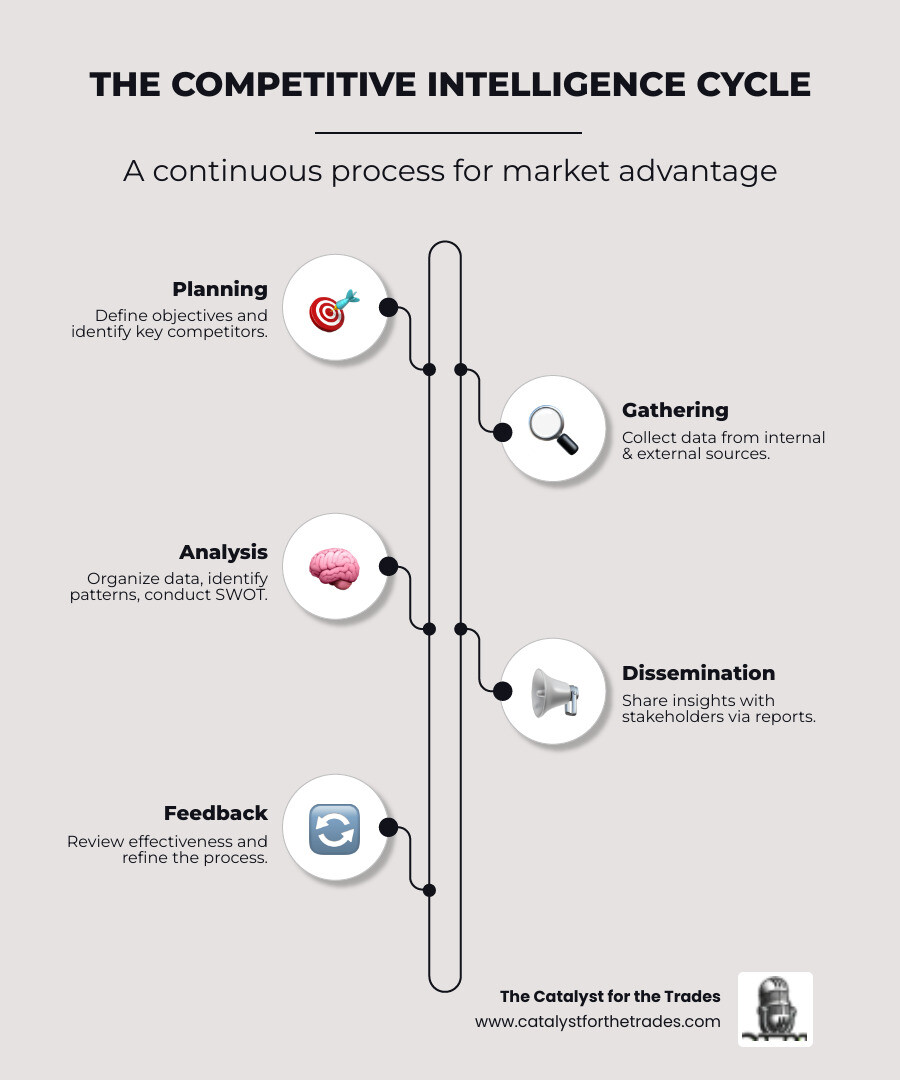
Competitive intelligence terms made easy:
The Intelligence Blueprint: Strategic vs. Tactical CI
Think of competitive intelligence as a toolbox for your home service business. You need different tools for different jobs. The intelligence you gather falls into several categories:
- Market Intelligence: Understanding big-picture trends like the housing market or consumer spending.
- Product Intelligence: Focusing on competitor services, packaging, and financing options.
- Customer Intelligence: Digging into why homeowners choose one company over another.
- Competitor Intelligence: Tracking specific rivals’ pricing, marketing, and operations.
- Technological Intelligence: Staying ahead of innovations like AI scheduling or smart home tech.
Within these, CI breaks down into two main approaches: strategic (long-term planning) and tactical (short-term action). It’s the difference between designing the whole house (strategic) and choosing the cabinet screws (tactical).
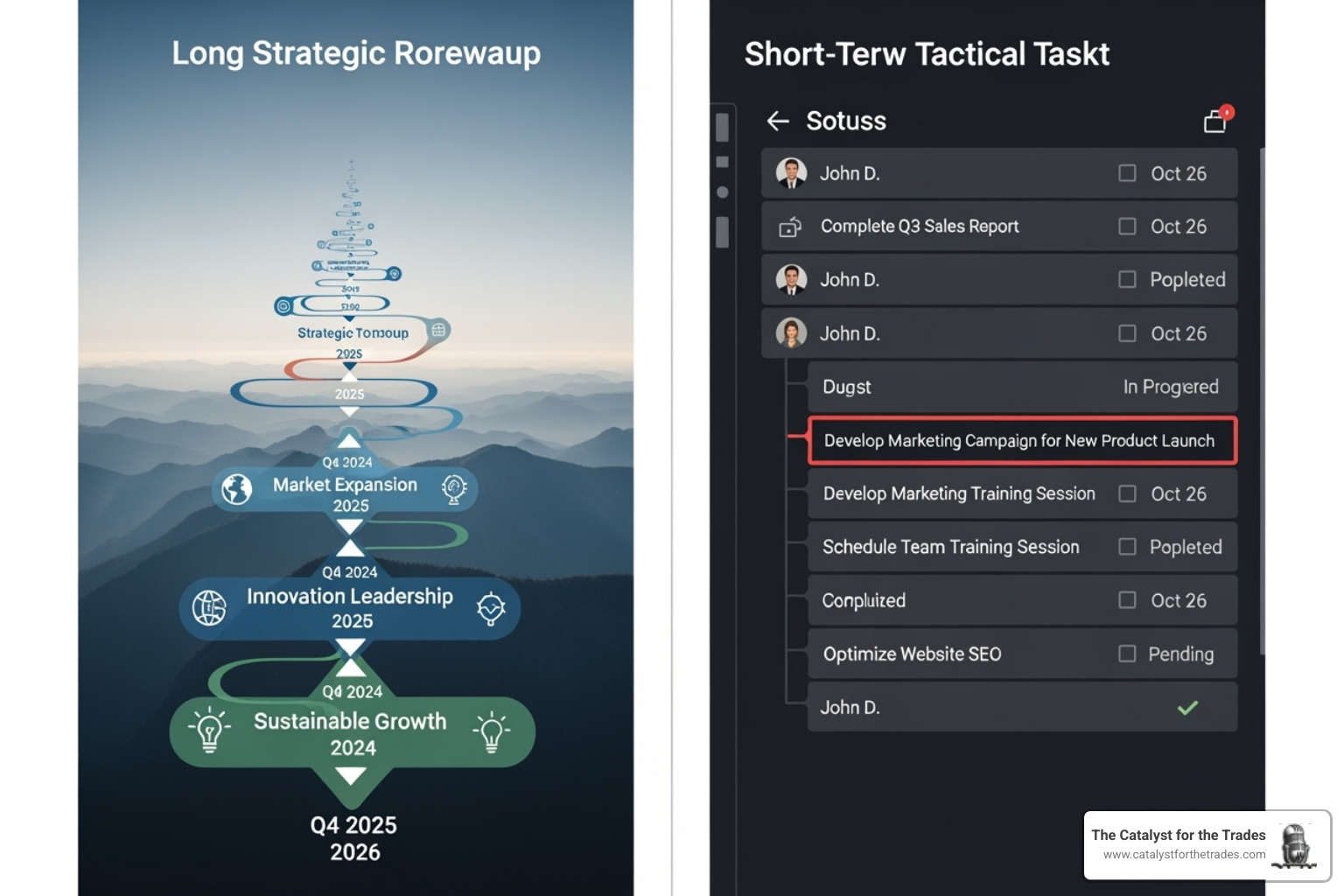
Understanding Strategic Competitive Intelligence
Strategic CI is your long-range radar, shaping your business’s future over the next one to three years. It answers the big questions that drive fundamental change:
- Market Expansion: Should you expand into a new city or add a service line, like an HVAC company adding solar?
- Major Investments: Does it make sense to invest in a new fleet of trucks or state-of-the-art equipment?
- Threat Identification: What disruptive threats, like on-demand service apps or DIY trends, are on the horizon?
Strategic CI is about anticipating market shifts so you can position your business to thrive. This intelligence directly feeds into your Business Growth Strategies and shapes your Strategic Planning Process.
Leveraging Tactical Competitive Intelligence
If strategic CI is the blueprint, tactical competitive intelligence is the daily work. It drives the immediate decisions that keep you competitive right now:
- Pricing Adjustments: How do you respond when a competitor launches a seasonal discount?
- Marketing Refinements: If a rival is dominating local search for “emergency plumber,” tactical CI helps you adjust your SEO or ad copy to compete.
- Sales Enablement: When your team hears, “The other company is $200 cheaper,” tactical data helps you train them to build value.
- Promotion Response: When a rival offers a “free service call,” you can craft a smart counter-strategy, like highlighting your faster response times.
This intelligence helps you Stop Chasing New Leads, Start Closing the Ones You Already Have by making your current operations sharper and more effective.
The CI Process: How to Gather and Analyze Actionable Data
Competitive intelligence isn’t a mystical art; it’s a systematic process. Raw data is like a pile of lumber and pipe—it has potential but is useless until assembled. The CI process turns scattered information into actionable insights that move your business forward.
The intelligence cycle follows five steps: planning, gathering, analysis, dissemination, and feedback. Let’s dig into the two most critical phases for home service businesses: gathering and analysis.

Gathering Your Intel: Key Sources and Methods
The best part about CI is that most of the data you need is publicly available and free. The challenge is knowing where to look and how to organize it. Your sources fall into two main categories: internal and external.
Inside your own business, you’re sitting on a treasure trove of insights:
- Your CRM: It’s a competitive intelligence powerhouse. Analyze win-loss rates against specific competitors to spot patterns. If your CRM data is a mess, it’s time to clean it up. How to Get Your CRM Right and Why It Matters More Than You Think can help.
- Your Team: Your sales and service teams hear what customers say about competitors every day. Use regular check-ins and win-loss analysis to systematically capture this intel.
- Call Recordings: These show exactly how your messaging lands and what objections come up. Set up alerts for competitor mentions to surface key insights.
Beyond your own walls, the external world is rich with information:
- Competitor Websites and Social Media: Check what services they’re promoting, what content they’re posting, and what promotions they’re running.
- Customer Reviews: Platforms like Google and Yelp offer unfiltered truth about what competitors do well and where they fall short. Each review is a window into what customers value.
- Industry Reports and Surveys: Use reports from organizations like Gartner for broad trends, or conduct your own surveys with platforms like SurveyMonkey.
- Local News and Hiring: When a competitor hires for a new role or announces a partnership, it signals their strategic direction.
Analyzing the Data for a Competitive Advantage
Collecting information is just the start. The real advantage comes from turning that data into insights that change how you operate.
- Organize Your Data: First, categorize everything you’ve collected by competitor, service type, or geographic area. Structure is key.
- Conduct a SWOT Analysis: This framework forces you to be honest about your Strengths, Weaknesses, Opportunities, and Threats relative to your market.
- Identify Patterns and Gaps: Are competitors consistently getting poor reviews for slow response times? That’s an opportunity. Is a customer segment being ignored? That’s a potential opening.
- Benchmark Performance: How does your customer satisfaction or service delivery time compare to others? Benchmarking is critical, as 20% of marketers consider it a top benefit of CI.
- Create Battlecards: Turn your analysis into practical tools for your sales team. These concise documents summarize each competitor’s offerings, weaknesses, and common objections, along with your best responses. The Ultimate Battlecard Building Toolkit can help you build them.
According to research, 45% of marketers say CI’s biggest benefit is anticipating market trends. That’s the goal—seeing what’s coming and positioning your business accordingly. By leveraging AI Business Intelligence, you can process data faster and spot patterns you might otherwise miss.
Activating Intelligence: Shaping Strategy and Winning More Deals
Competitive intelligence is only valuable if you use it. Data sitting in a spreadsheet is useless. The magic happens when you translate insights into concrete actions that move your business forward.

Using CI to Drive Your Business Strategy
Understanding your competitive landscape lets you make decisions with confidence. When the pandemic hit, Zoom’s popularity skyrocketed. Microsoft Teams, a more complex tool, didn’t panic. They used competitive intelligence to understand Zoom’s appeal and quickly added user-friendly features like Together Mode and Dynamic view, helping them stay in the game.
For your home service business, this means:
- Match or Differentiate: If a competitor is crushing it with maintenance plans, dig into how. Then, match their service level or differentiate yourself to become the better choice.
- Find Unmet Needs: Maybe no one is targeting older homeowners with smart home installations or offering eco-friendly HVAC solutions. Your CI can reveal these gaps, allowing you to own a niche.
- Refine Your Messaging: If you know competitors are over-promising, you can highlight your reliability. Knowing what customers hear from others helps your message cut through the noise.
- Improve Operations: If a rival is known for speed, analyze your own processes to match or beat them. This is how businesses stay competitive as AI and consumer behavior reshape home services.
Ongoing CI also helps you anticipate a competitor’s next move, allowing you to be proactive instead of reactive.
The Role of Technology and CI Frequency
Manually tracking everything is overwhelming. That’s where technology becomes your best friend.
Specialized CI platforms and automation tools can do the heavy lifting, monitoring websites, social media, and ad spend for you. This frees you up to focus on analysis and action.
Artificial intelligence is also changing the game. AI can process massive amounts of unstructured data—like thousands of customer reviews—to identify patterns and trends that would take humans weeks to find. This is a big part of the AI revolution in home services.
Finally, competitive intelligence isn’t a one-time project; it must be continuous. While you might generate comprehensive reports quarterly for strategic planning, you should be monitoring key competitors and market shifts constantly. Integrate CI into your regular workflows, like weekly team meetings, to ensure insights reach the people who need them. When CI becomes part of your business rhythm, it becomes truly powerful.
Playing by the Rules: Ethical and Legal Considerations
Competitive intelligence is powerful, but it’s only valuable when it’s done right—legally, ethically, and with integrity.
To be crystal clear: competitive intelligence is not industrial espionage. It’s not hacking into systems, bribing employees, or pretending to be someone you’re not to gain proprietary data. Those actions are illegal and can destroy your business faster than any competitor.

Legitimate competitive intelligence focuses entirely on publicly available information like websites, social media, customer reviews, and public records. There’s a wealth of insight available without ever stepping into a gray zone.
The Ethics of Competitive Intelligence
The Society of Competitive Intelligence Professionals (SCIP) established a code of ethics that serves as our north star. The key principles are:
- Never misrepresent yourself. If you call a competitor, be honest about who you are. Don’t pretend to be a potential customer to extract information. It’s deceptive and undermines ethical business practices.
- Respect confidentiality. Protect your sources and avoid conflicts of interest. Never share confidential information between competing parties.
- Comply with data privacy laws. Ensure your collection, storage, and use of information comply with all regulations.
You can read more about these principles in SCIP’s official code of ethics.
A Cautionary Tale: The WestJet vs. Air Canada Snooping Incident
Ignoring these boundaries has severe consequences. In 2004, Air Canada found that WestJet had accessed its internal, employee-only website hundreds of thousands of times. This was systematic data gathering, not casual browsing. Air Canada filed a corporate espionage lawsuit, and the fallout was devastating for WestJet.
The airline paid Air Canada $15.5 million and donated $10 million to charity. But the real cost was to their reputation. This incident, documented by sources like Canada.com, is a stark reminder: the short-term gain from unethical intelligence is never worth the long-term damage. For a home service business, your local reputation is everything.
Beyond ethics, be aware of other risks:
- Information Overload: It’s easy to get buried in data. Focus on what’s relevant and actionable.
- Misinterpreting Data: Numbers can be misleading without context. Always cross-reference findings before making big decisions.
- Becoming Too Reactive: Your strategy should be informed by CI, not dictated by it. Play your own game.
- Resource Drain: A CI program requires time and money. Ensure you’re allocating resources wisely and getting a clear return on investment.
Frequently Asked Questions about Competitive Intelligence
We know that adding competitive intelligence to your plate can feel overwhelming. Here are answers to some of the most common questions we hear from home service business owners.
How does competitive intelligence differ from market research?
This is an important distinction. Competitive intelligence (CI) zeroes in specifically on your competitors—their pricing, services, marketing tactics, and weaknesses. The goal is to inform your strategy and gain an edge. Think of it as “knowing your opponent.”
Market research is much broader. It’s focused on understanding the entire market ecosystem: customer needs, demographic trends, and overall industry dynamics. It’s about “understanding the entire playing field.” In many ways, CI is a subset of market intelligence.
For example, market research might tell you that homeowners want energy-efficient HVAC systems. CI would then reveal which local competitors offer them, how they price them, and what customers say about their work.
What are the biggest risks of implementing a CI program?
While powerful, CI has potential pitfalls. The biggest risks include acting on misinterpreted or incomplete data, becoming too reactive to competitors’ moves, violating legal or ethical boundaries, drowning in information overload, and allocating resources without a clear return on investment (ROI). A structured, ethical approach is crucial to avoid these issues.
How can a small home service business start with competitive intelligence?
You don’t need a dedicated team or a massive budget. Start small and stay consistent.
- Identify your top 3 local competitors. Focus your efforts on the rivals you encounter most often.
- Monitor their online presence. Regularly check their websites, social media, and Google My Business profiles. Note any new services, promotions, or content themes.
- Read customer reviews. Spend time on Google and Yelp. What do customers consistently praise? More importantly, what are their common complaints? These gaps are your opportunities.
- Ask your own customers. When someone books a job, a simple question like, “What made you decide to call us?” can reveal valuable insights about your positioning.
- Talk to your team. Your technicians and office staff hear intel every day. Create a simple way for them to share what they learn about competitors.
- Start a simple tracking system. A basic spreadsheet is perfect. Track competitor services, promotions, and patterns in customer feedback. Over time, this becomes an invaluable strategic tool.
The key is to build your CI habits over time. Even a few of these practices will give you a much clearer view of your market.
Conclusion: Stay Ahead of the Curve
In today’s home service industry, winging it is no longer a viable strategy. Competitive intelligence isn’t a corporate buzzword; it’s your secret weapon for staying profitable in a crowded market.
The businesses that win are the ones who see the whole board—they understand competitors, market trends, and customer wants. This guide has shown you how to plan, gather, analyze, and act on intelligence to make smarter decisions. We’ve covered how strategic CI shapes long-term growth and how tactical CI keeps you nimble day-to-day.
You don’t need a massive budget to start. Begin by monitoring your top competitors, reading reviews, and talking to your customers and team. This foundation of continuous learning will put you miles ahead of rivals who are flying blind.
The goal isn’t to obsess over competitors, but to understand the landscape so you can carve out your own path to sustainable growth. That’s how you build a lasting competitive advantage.
For more strategies on scaling your home service business with a blend of technology and operational wisdom, tune into The Catalyst for the Trades podcast.
Ready to take the next step? Learn more about business growth strategies and start seeing the whole board today.


