Why Business Growth and Operations Keywords Matter for Home Service Businesses

Business growth and operations keywords are the essential terms defining how successful home service companies scale, measure performance, and manage daily execution. They cover financial metrics like ROI, process methodologies like Lean Six Sigma, tech systems like CRM, and leadership concepts like change management. Using these keywords correctly helps you communicate strategy, hire the right talent, and drive sustainable growth.
If you run an HVAC, plumbing, or electrical business, you've likely felt the frustration of miscommunication. This language gap—whether with your team, software vendors, or bankers—costs you time, money, and growth. As technology advances and customer expectations rise, mastering the language of modern operations is crucial for survival. It’s not about sounding smart; it’s about executing faster, hiring better, and scaling smarter.
Ready to scale your business with clarity? Explore proven growth strategies and discover how The Catalyst for the Trades can help you build a more valuable business.
This guide breaks down the business growth and operations keywords you need, organized by function: foundational financial and strategic terms, process optimization concepts, technology, and talent. You'll learn what each term means and how to apply it—just practical language to help you grow.
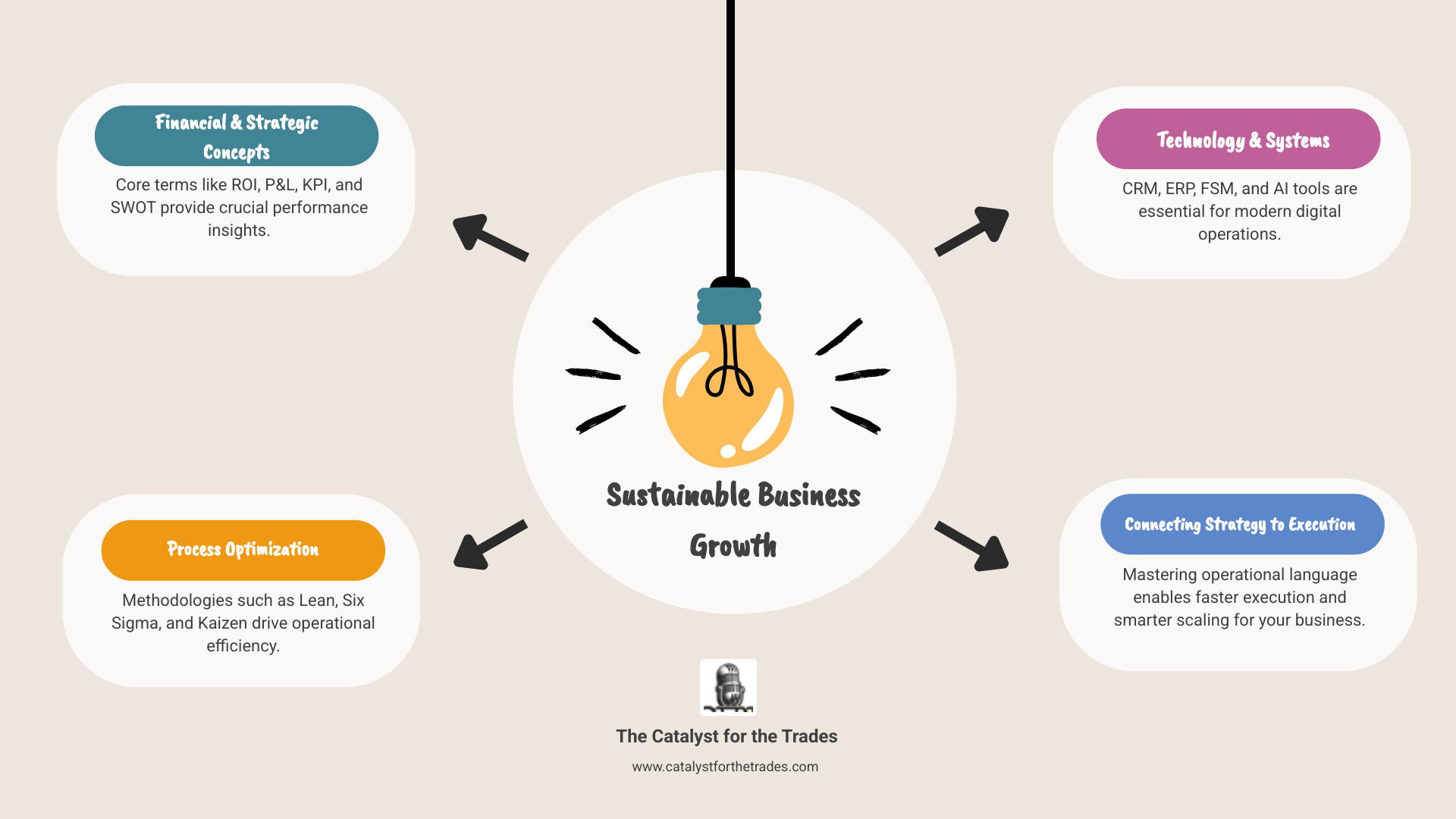
Key terms for business growth and operations keywords:
Foundational Business Growth and Operations Keywords
For any home service business aiming for growth, a solid grasp of foundational business growth and operations keywords is non-negotiable. These terms are the bedrock of financial literacy and strategic thinking, enabling clear communication with accountants, investors, and your team. Without this shared understanding, strategic planning falters and execution becomes chaotic.
To understand where your business stands and where it's headed, you need to dive into core concepts. From plotting your long-term vision with a Strategic Planning Process to understanding your company's worth through Business Valuation: Contractors, these keywords are your compass.
Core Financial & Strategic Concepts
Let's explain some of the most crucial financial and strategic terms:
- Return on Investment (ROI): Measures the profitability of an investment as a ratio of net income to cost. It helps determine if an activity, like buying new software, is financially worthwhile.
- Profit & Loss (P&L) Management: The P&L (or income) statement shows revenues and expenses over a period, revealing net income or loss. Effective management involves actively monitoring these figures to ensure profitability.
- CAPEX vs. OPEX:
- Capital Expenditure (CAPEX) is money spent to acquire or upgrade fixed assets, like new service vehicles. These are long-term investments.
- Operating Expenditure (OPEX) covers ongoing business costs, such as salaries and utilities, to keep operations running.
- SWOT Analysis: A strategic tool to identify your Strengths, Weaknesses, Opportunities, and Threats, guiding informed decision-making and strategy development.
- Key Performance Indicator (KPI): A measurable value that shows how effectively a business is achieving key objectives. Examples include sales growth and customer retention.
- Benchmarking: Comparing your business performance against a standard (e.g., competitors, industry averages) to identify areas for improvement.
Understanding these concepts is vital for developing a sound Competitive Strategy and truly knowing your numbers. For more, check out Know Your Numbers: Grow Your Business - Financial Strategies for Trades.
Essential Operational Responsibilities
The core responsibilities of an Operations Manager ensure smooth, efficient service delivery:
- Resource Management: The efficient allocation of all business resources—people, equipment, and finances—to meet operational goals.
- Workflow Optimization: Continuously streamlining processes to eliminate bottlenecks and improve workflow from customer contact to service completion. This directly impacts Operational Efficiency.
- Quality Control: Ensuring services consistently meet or exceed customer and industry standards by setting standards and inspecting work.
- Compliance: Adhering to all relevant laws, regulations, and industry standards (e.g., safety protocols). Compliance protects the business and builds customer trust.
Our HVAC Business Operations Guide offers deeper insights into these responsibilities.
The Role of Data in Operations
In today's data-rich environment, the ability to act on information is a cornerstone of effective operations.
- Data Analysis: The process of inspecting and modeling data to find useful information that supports decision-making, such as analyzing service times or customer feedback.
- Problem-Solving: Using data to identify issues, diagnose root causes, and implement effective solutions, like fixing a recurring equipment failure.
- Performance Metrics: Quantifiable measurements used to assess operational performance. They can be broader than KPIs, tracking things like truck maintenance or call center response times.
- Root Cause Analysis: A systematic approach that identifies the underlying cause of an issue, rather than just fixing the symptom, to prevent recurrence.
- Decision Making: Using data and insights to make informed decisions that impact efficiency, cost, and quality, such as choosing a new vendor.
Tools for AI Business Intelligence are becoming increasingly vital. As highlighted in How Systems Create Freedom: Mike Abramowitz's Blueprint for Trades Success, strong systems around data create freedom.
With foundational terms understood, the next step is optimizing processes and tracking performance. This involves business growth and operations keywords for methodologies that eliminate waste and improve efficiency. These powerful frameworks transform operations, helping achieve Process Improvement and better Performance Management.
Process Improvement Methodologies
These methodologies provide structured approaches to making operations more effective:
- Lean Principles: Originating from Toyota, Lean focuses on maximizing customer value while minimizing waste. It involves eliminating non-value-added activities to provide faster service with fewer steps.
- Six Sigma (DMAIC): A data-driven methodology to eliminate defects and improve processes using the DMAIC (Define, Measure, Analyze, Improve, Control) framework. The American Society for Quality (ASQ) notes its importance.
- Kaizen (Continuous Improvement): A Japanese philosophy of "continuous improvement." It involves all employees in making small, incremental improvements to processes, fostering a culture of constant betterment.
- Value Stream Mapping: A Lean tool that visually maps every step in a service delivery process. It helps identify waste, bottlenecks, and improvement opportunities in workflows.
- 5S Methodology: A Lean tool for workplace organization to improve efficiency and safety. The 5S are Sort, Set in order, Shine, Standardize, and Sustain.
Applying these principles can drastically improve our Sales Process Optimization: Complete Guide.
Here are specific KPIs that are essential business growth and operations keywords for measuring success in the trades:
- First-Time Fix Rate: Percentage of service calls resolved on the first visit. A high rate indicates efficiency and boosts customer satisfaction.
- Customer Satisfaction (CSAT): A metric that measures how satisfied customers are with your service, typically gathered through surveys.
- Net Promoter Score (NPS): Measures customer loyalty and willingness to recommend your services, indicating long-term growth potential.
- Technician Utilization Rate: The percentage of a technician's time spent on billable jobs versus idle time. Optimizing this boosts productivity and revenue.
- Average Ticket Size: The average revenue generated per service call, which can be increased through effective upselling and cross-selling.
- Cost Per Acquisition (CPA): The total cost of acquiring a new customer. Keeping this low is crucial for profitable growth.
Tracking these KPIs allows for data-driven decisions. Optimizing Lead Conversion Optimization efforts depends heavily on monitoring relevant KPIs.
Balancing Hard and Soft Skills for Operational Excellence
An Operations Manager is a master of processes and a leader of people, requiring a blend of hard and soft skills.
- Technical Proficiency: The specific knowledge required for the job, like understanding HVAC systems or proficiency with specialized software.
- Analytical Skills: The ability to interpret data to identify patterns, solve problems, and make informed decisions.
- Leadership: The ability to inspire, motivate, and guide teams toward common goals, ensuring strategies are enthusiastically executed.
- Communication: Clear and empathetic communication is vital for aligning teams, setting expectations, and giving feedback across the business.
- Stakeholder Management: The ability to engage with all parties affected by operations, including employees, customers, and suppliers.
Soft skills like leadership and communication enable effective problem-solving and facilitate Change Management. Investing in Skill Development for your teams is a direct investment in your business's future.
In modern home services, technology is the backbone of efficient operations and a key driver of business growth and operations keywords. Digital tools streamline work, reduce errors, and improve the customer experience. Embracing Technology Adoption and ensuring seamless System Integration are paramount.
Managing the Modern Supply Chain and Logistics
Effective management of these business growth and operations keywords ensures technicians have the right parts when they need them, minimizing costly delays.
- Inventory Management: Tracking and controlling the flow of parts to ensure enough stock to meet demand without holding excessive, costly inventory.
- Vendor Management: Building and maintaining supplier relationships, negotiating terms, and monitoring performance to ensure reliable delivery. APICS (Association for Supply Chain Management) is a key resource.
- Procurement: The strategic process of acquiring goods and services, including supplier selection, negotiation, and supply chain strategy.
- Logistics: The coordination of complex operations, including optimizing routes, scheduling deliveries, and managing equipment movement.
- Supplier Performance: Evaluating how well vendors meet contractual obligations like delivery times and product quality to ensure a robust supply chain.
Proactive Vendor Management Strategies are essential for keeping operations running smoothly.
Essential Software for Home Service Operations
The right software can revolutionize operations. Here are some critical tools and related business growth and operations keywords:
- Customer Relationship Management (CRM): A system for managing customer relationships and interactions. It houses customer data to help track interactions and personalize service. How to Get Your CRM Right and Why It Matters More Than You Think explains its importance.
- Field Service Management (FSM) Software: Software designed for field operations to help with scheduling, dispatching, routing, and invoicing. It's the central nervous system for on-site teams. Learn more about Field Service Management Software.
- Enterprise Resource Planning (ERP): Integrates all business facets (planning, sales, finance) into a single system. Scaled-down versions can benefit growing home service companies.
- Business Intelligence (BI) Tools: Tools that analyze data from various sources (CRM, FSM) to gain insights into performance and trends. Examples include Power BI and Tableau.
Other common systems include project management tools like Asana or Trello and financial software like Oracle or SAP, depending on your business's scale.
The Future: AI in Operations
Artificial Intelligence (AI) is rapidly becoming integral to modern operations.
- Predictive Maintenance: AI algorithms analyze equipment data to predict failures, allowing for proactive maintenance that prevents breakdowns and improves customer satisfaction.
- AI-Driven Scheduling: AI optimizes technician scheduling and routing by considering traffic, job complexity, and technician skills to maximize efficiency.
- Automated Customer Service: AI-powered chatbots handle routine inquiries and schedule appointments, freeing up human agents for more complex issues.
The AI revolution offers unprecedented opportunities for efficiency. We explore this in The AI Revolution in Home Services: How to Future-Proof Your Trades Business and dig into AI Customer Service capabilities.
Applying Keywords for Talent, Strategy, and Growth
The real power of business growth and operations keywords is in applying them to your talent strategy and business development. It's about attracting the right people, aligning them with your vision, and fostering a growth environment.
This involves a holistic approach to Talent Management: Complete Guide and a robust Business Development: Complete Guide.
Integrating business growth and operations keywords into Your Strategy
Strategic planning is where you define your future, and the right business growth and operations keywords help articulate that vision clearly.
- Goal Setting: Clearly defining what you want to achieve, such as increasing market share or expanding into a new service area.
- Strategic Alignment: Ensuring all departments, teams, and daily operations work in harmony toward overarching business objectives.
- Market Penetration: A strategy to increase your share in existing markets by adjusting pricing, boosting marketing, or enhancing services.
- Competitive Analysis: Understanding competitors' strengths and weaknesses to identify opportunities and differentiate your services.
A well-defined business growth strategy is a plan of action to achieve your goals. You must be willing to accept Strategic Adaptation to stay agile. Our guide on Business Growth Strategies offers further insights.
Keywords for Hiring: From Junior to Director
When hiring for operational roles, use the right business growth and operations keywords in job descriptions to attract the perfect fit for each experience level.
| Level | Key Responsibilities & Keywords |
|---|
| Junior Operations | Task Coordination, Reporting, Data Entry, Administrative Support, Scheduling, Inventory Tracking |
| Senior Operations | Process Optimization, Budget Management, Team Supervision, Vendor Relations, Project Implementation, Performance Analysis |
| Director of Operations | Strategic Oversight, P&L Ownership, Cross-Functional Leadership, Business Development, Risk Management, Succession Planning |
A Junior role focuses on Task Coordination and Reporting. A Senior role requires Process Optimization and Budget Management. A Director needs Strategic Oversight and P&L Ownership. This differentiation is key for Workforce Planning and Succession Planning.
Distinguishing Operations Manager vs. Project Manager
While both roles are vital, Operations Managers and Project Managers have distinct focuses.
- Operations Manager:
- Focus: Ongoing, business-as-usual (BAU) activities.
- Goal: Efficiency and continuous improvement of existing processes.
- Nature of Work: Repetitive and long-term.
- Keywords: Workflow Optimization, Resource Allocation, Quality Control, Process Improvement.
- Project Manager:
- Focus: Temporary projects with a defined start and end.
- Goal: Delivering a unique outcome within a specific scope, budget, and deadline.
- Nature of Work: Unique and goal-oriented.
- Keywords: Project Planning, Scope Management, Risk Assessment, Budget Control.
An Operations Manager ensures the service department runs smoothly daily. A Project Manager oversees a one-time project, like a new CRM implementation. Both are critical for Organizational Leadership and success.
Frequently Asked Questions about Operations Keywords
Here are answers to common questions about leveraging these business growth and operations keywords.
How do I identify the most important operations keywords for my specific trade (e.g., HVAC, Plumbing)?
To find the most important keywords for your trade:
- Analyze Your Industry: Follow trends and best practices in your sector. Resources like the American Society for Quality (ASQ), APICS (Association for Supply Chain Management), and our Industry Insights Guide 2025 are helpful.
- Review Job Descriptions: Look at job postings for operations roles in your trade to see what skills and terms are in demand.
- Consult Peers: Talk to other successful business owners and consultants for insights into what drives success.
Focus on keywords related to your core processes, equipment, and compliance standards.
How can I use keywords to showcase achievements in my business strategy?
To showcase achievements, tie keywords to measurable results:
- Quantify Results: Use numbers and percentages (e.g., "Improved operational efficiency by 15%").
- Use Action Verbs: Start with verbs like "Implemented," "Optimized," or "Reduced."
- Connect Keywords to Metrics: Link the term directly to a positive outcome.
Example: "Implemented Lean principles, resulting in a 20% reduction in service cycle time and a 10% increase in First-Time Fix Rate."
This approach demonstrates tangible value, a key part of building a sellable home service business.
What are the most crucial leadership keywords for an Operations Manager?
Crucial leadership keywords for an Operations Manager reflect both strategic and interpersonal skills:
- Cross-Functional Leadership: Collaborating effectively across departments (sales, finance, service) to achieve shared goals.
- Change Management: Guiding teams through transitions like new software or processes while minimizing disruption.
- Team Development: Fostering staff growth through training, mentoring, and feedback.
- Stakeholder Management: Managing expectations with all invested parties, from employees to customers to suppliers.
- Strategic Vision: Seeing the big picture and connecting daily operations to overall business goals.
These keywords are vital for driving teams forward and are a cornerstone of Trades Leadership Development.
Conclusion: Turning Keywords into Your Growth Catalyst
Mastering business growth and operations keywords is about adopting a mindset that connects strategy to execution. It's the language that turns customer needs into efficient processes and empowers your team.
Throughout this guide, we've covered foundational finance terms, process optimization methods, essential technology, and leadership insights. Integrating these keywords into your daily planning and decision-making helps you operate smarter. This clarity drives efficiency, aligns your team, and ultimately, catalyzes the growth of your home service business.
We believe that combining cutting-edge tech insights with real-world industry experience is the key to thriving in today's market.
Ready to put these insights into action and truly grow your business? Explore more strategies for your home service business and let The Catalyst for the Trades be your partner on this exciting journey.
Why Business Growth and Operations Keywords Matter for Home Service Businesses

Business growth and operations keywords are the essential terms defining how successful home service companies scale, measure performance, and manage daily execution. They cover financial metrics like ROI, process methodologies like Lean Six Sigma, tech systems like CRM, and leadership concepts like change management. Using these keywords correctly helps you communicate strategy, hire the right talent, and drive sustainable growth.
If you run an HVAC, plumbing, or electrical business, you've likely felt the frustration of miscommunication. This language gap—whether with your team, software vendors, or bankers—costs you time, money, and growth. As technology advances and customer expectations rise, mastering the language of modern operations is crucial for survival. It’s not about sounding smart; it’s about executing faster, hiring better, and scaling smarter.
Ready to scale your business with clarity? Explore proven growth strategies and discover how The Catalyst for the Trades can help you build a more valuable business.
This guide breaks down the business growth and operations keywords you need, organized by function: foundational financial and strategic terms, process optimization concepts, technology, and talent. You'll learn what each term means and how to apply it—just practical language to help you grow.

Key terms for business growth and operations keywords:
Foundational Business Growth and Operations Keywords
For any home service business aiming for growth, a solid grasp of foundational business growth and operations keywords is non-negotiable. These terms are the bedrock of financial literacy and strategic thinking, enabling clear communication with accountants, investors, and your team. Without this shared understanding, strategic planning falters and execution becomes chaotic.
To understand where your business stands and where it's headed, you need to dive into core concepts. From plotting your long-term vision with a Strategic Planning Process to understanding your company's worth through Business Valuation: Contractors, these keywords are your compass.
Core Financial & Strategic Concepts
Let's explain some of the most crucial financial and strategic terms:
- Return on Investment (ROI): Measures the profitability of an investment as a ratio of net income to cost. It helps determine if an activity, like buying new software, is financially worthwhile.
- Profit & Loss (P&L) Management: The P&L (or income) statement shows revenues and expenses over a period, revealing net income or loss. Effective management involves actively monitoring these figures to ensure profitability.
- CAPEX vs. OPEX:
- Capital Expenditure (CAPEX) is money spent to acquire or upgrade fixed assets, like new service vehicles. These are long-term investments.
- Operating Expenditure (OPEX) covers ongoing business costs, such as salaries and utilities, to keep operations running.
- SWOT Analysis: A strategic tool to identify your Strengths, Weaknesses, Opportunities, and Threats, guiding informed decision-making and strategy development.
- Key Performance Indicator (KPI): A measurable value that shows how effectively a business is achieving key objectives. Examples include sales growth and customer retention.
- Benchmarking: Comparing your business performance against a standard (e.g., competitors, industry averages) to identify areas for improvement.
Understanding these concepts is vital for developing a sound Competitive Strategy and truly knowing your numbers. For more, check out Know Your Numbers: Grow Your Business - Financial Strategies for Trades.
Essential Operational Responsibilities
The core responsibilities of an Operations Manager ensure smooth, efficient service delivery:
- Resource Management: The efficient allocation of all business resources—people, equipment, and finances—to meet operational goals.
- Workflow Optimization: Continuously streamlining processes to eliminate bottlenecks and improve workflow from customer contact to service completion. This directly impacts Operational Efficiency.
- Quality Control: Ensuring services consistently meet or exceed customer and industry standards by setting standards and inspecting work.
- Compliance: Adhering to all relevant laws, regulations, and industry standards (e.g., safety protocols). Compliance protects the business and builds customer trust.
Our HVAC Business Operations Guide offers deeper insights into these responsibilities.
The Role of Data in Operations
In today's data-rich environment, the ability to act on information is a cornerstone of effective operations.
- Data Analysis: The process of inspecting and modeling data to find useful information that supports decision-making, such as analyzing service times or customer feedback.
- Problem-Solving: Using data to identify issues, diagnose root causes, and implement effective solutions, like fixing a recurring equipment failure.
- Performance Metrics: Quantifiable measurements used to assess operational performance. They can be broader than KPIs, tracking things like truck maintenance or call center response times.
- Root Cause Analysis: A systematic approach that identifies the underlying cause of an issue, rather than just fixing the symptom, to prevent recurrence.
- Decision Making: Using data and insights to make informed decisions that impact efficiency, cost, and quality, such as choosing a new vendor.
Tools for AI Business Intelligence are becoming increasingly vital. As highlighted in How Systems Create Freedom: Mike Abramowitz's Blueprint for Trades Success, strong systems around data create freedom.
With foundational terms understood, the next step is optimizing processes and tracking performance. This involves business growth and operations keywords for methodologies that eliminate waste and improve efficiency. These powerful frameworks transform operations, helping achieve Process Improvement and better Performance Management.
Process Improvement Methodologies
These methodologies provide structured approaches to making operations more effective:
- Lean Principles: Originating from Toyota, Lean focuses on maximizing customer value while minimizing waste. It involves eliminating non-value-added activities to provide faster service with fewer steps.
- Six Sigma (DMAIC): A data-driven methodology to eliminate defects and improve processes using the DMAIC (Define, Measure, Analyze, Improve, Control) framework. The American Society for Quality (ASQ) notes its importance.
- Kaizen (Continuous Improvement): A Japanese philosophy of "continuous improvement." It involves all employees in making small, incremental improvements to processes, fostering a culture of constant betterment.
- Value Stream Mapping: A Lean tool that visually maps every step in a service delivery process. It helps identify waste, bottlenecks, and improvement opportunities in workflows.
- 5S Methodology: A Lean tool for workplace organization to improve efficiency and safety. The 5S are Sort, Set in order, Shine, Standardize, and Sustain.
Applying these principles can drastically improve our Sales Process Optimization: Complete Guide.
Here are specific KPIs that are essential business growth and operations keywords for measuring success in the trades:
- First-Time Fix Rate: Percentage of service calls resolved on the first visit. A high rate indicates efficiency and boosts customer satisfaction.
- Customer Satisfaction (CSAT): A metric that measures how satisfied customers are with your service, typically gathered through surveys.
- Net Promoter Score (NPS): Measures customer loyalty and willingness to recommend your services, indicating long-term growth potential.
- Technician Utilization Rate: The percentage of a technician's time spent on billable jobs versus idle time. Optimizing this boosts productivity and revenue.
- Average Ticket Size: The average revenue generated per service call, which can be increased through effective upselling and cross-selling.
- Cost Per Acquisition (CPA): The total cost of acquiring a new customer. Keeping this low is crucial for profitable growth.
Tracking these KPIs allows for data-driven decisions. Optimizing Lead Conversion Optimization efforts depends heavily on monitoring relevant KPIs.
Balancing Hard and Soft Skills for Operational Excellence
An Operations Manager is a master of processes and a leader of people, requiring a blend of hard and soft skills.
- Technical Proficiency: The specific knowledge required for the job, like understanding HVAC systems or proficiency with specialized software.
- Analytical Skills: The ability to interpret data to identify patterns, solve problems, and make informed decisions.
- Leadership: The ability to inspire, motivate, and guide teams toward common goals, ensuring strategies are enthusiastically executed.
- Communication: Clear and empathetic communication is vital for aligning teams, setting expectations, and giving feedback across the business.
- Stakeholder Management: The ability to engage with all parties affected by operations, including employees, customers, and suppliers.
Soft skills like leadership and communication enable effective problem-solving and facilitate Change Management. Investing in Skill Development for your teams is a direct investment in your business's future.
In modern home services, technology is the backbone of efficient operations and a key driver of business growth and operations keywords. Digital tools streamline work, reduce errors, and improve the customer experience. Embracing Technology Adoption and ensuring seamless System Integration are paramount.
Managing the Modern Supply Chain and Logistics
Effective management of these business growth and operations keywords ensures technicians have the right parts when they need them, minimizing costly delays.
- Inventory Management: Tracking and controlling the flow of parts to ensure enough stock to meet demand without holding excessive, costly inventory.
- Vendor Management: Building and maintaining supplier relationships, negotiating terms, and monitoring performance to ensure reliable delivery. APICS (Association for Supply Chain Management) is a key resource.
- Procurement: The strategic process of acquiring goods and services, including supplier selection, negotiation, and supply chain strategy.
- Logistics: The coordination of complex operations, including optimizing routes, scheduling deliveries, and managing equipment movement.
- Supplier Performance: Evaluating how well vendors meet contractual obligations like delivery times and product quality to ensure a robust supply chain.
Proactive Vendor Management Strategies are essential for keeping operations running smoothly.
Essential Software for Home Service Operations
The right software can revolutionize operations. Here are some critical tools and related business growth and operations keywords:
- Customer Relationship Management (CRM): A system for managing customer relationships and interactions. It houses customer data to help track interactions and personalize service. How to Get Your CRM Right and Why It Matters More Than You Think explains its importance.
- Field Service Management (FSM) Software: Software designed for field operations to help with scheduling, dispatching, routing, and invoicing. It's the central nervous system for on-site teams. Learn more about Field Service Management Software.
- Enterprise Resource Planning (ERP): Integrates all business facets (planning, sales, finance) into a single system. Scaled-down versions can benefit growing home service companies.
- Business Intelligence (BI) Tools: Tools that analyze data from various sources (CRM, FSM) to gain insights into performance and trends. Examples include Power BI and Tableau.
Other common systems include project management tools like Asana or Trello and financial software like Oracle or SAP, depending on your business's scale.
The Future: AI in Operations
Artificial Intelligence (AI) is rapidly becoming integral to modern operations.
- Predictive Maintenance: AI algorithms analyze equipment data to predict failures, allowing for proactive maintenance that prevents breakdowns and improves customer satisfaction.
- AI-Driven Scheduling: AI optimizes technician scheduling and routing by considering traffic, job complexity, and technician skills to maximize efficiency.
- Automated Customer Service: AI-powered chatbots handle routine inquiries and schedule appointments, freeing up human agents for more complex issues.
The AI revolution offers unprecedented opportunities for efficiency. We explore this in The AI Revolution in Home Services: How to Future-Proof Your Trades Business and dig into AI Customer Service capabilities.
Applying Keywords for Talent, Strategy, and Growth
The real power of business growth and operations keywords is in applying them to your talent strategy and business development. It's about attracting the right people, aligning them with your vision, and fostering a growth environment.
This involves a holistic approach to Talent Management: Complete Guide and a robust Business Development: Complete Guide.
Integrating business growth and operations keywords into Your Strategy
Strategic planning is where you define your future, and the right business growth and operations keywords help articulate that vision clearly.
- Goal Setting: Clearly defining what you want to achieve, such as increasing market share or expanding into a new service area.
- Strategic Alignment: Ensuring all departments, teams, and daily operations work in harmony toward overarching business objectives.
- Market Penetration: A strategy to increase your share in existing markets by adjusting pricing, boosting marketing, or enhancing services.
- Competitive Analysis: Understanding competitors' strengths and weaknesses to identify opportunities and differentiate your services.
A well-defined business growth strategy is a plan of action to achieve your goals. You must be willing to accept Strategic Adaptation to stay agile. Our guide on Business Growth Strategies offers further insights.
Keywords for Hiring: From Junior to Director
When hiring for operational roles, use the right business growth and operations keywords in job descriptions to attract the perfect fit for each experience level.
| Level | Key Responsibilities & Keywords |
|---|
| Junior Operations | Task Coordination, Reporting, Data Entry, Administrative Support, Scheduling, Inventory Tracking |
| Senior Operations | Process Optimization, Budget Management, Team Supervision, Vendor Relations, Project Implementation, Performance Analysis |
| Director of Operations | Strategic Oversight, P&L Ownership, Cross-Functional Leadership, Business Development, Risk Management, Succession Planning |
A Junior role focuses on Task Coordination and Reporting. A Senior role requires Process Optimization and Budget Management. A Director needs Strategic Oversight and P&L Ownership. This differentiation is key for Workforce Planning and Succession Planning.
Distinguishing Operations Manager vs. Project Manager
While both roles are vital, Operations Managers and Project Managers have distinct focuses.
- Operations Manager:
- Focus: Ongoing, business-as-usual (BAU) activities.
- Goal: Efficiency and continuous improvement of existing processes.
- Nature of Work: Repetitive and long-term.
- Keywords: Workflow Optimization, Resource Allocation, Quality Control, Process Improvement.
- Project Manager:
- Focus: Temporary projects with a defined start and end.
- Goal: Delivering a unique outcome within a specific scope, budget, and deadline.
- Nature of Work: Unique and goal-oriented.
- Keywords: Project Planning, Scope Management, Risk Assessment, Budget Control.
An Operations Manager ensures the service department runs smoothly daily. A Project Manager oversees a one-time project, like a new CRM implementation. Both are critical for Organizational Leadership and success.
Frequently Asked Questions about Operations Keywords
Here are answers to common questions about leveraging these business growth and operations keywords.
How do I identify the most important operations keywords for my specific trade (e.g., HVAC, Plumbing)?
To find the most important keywords for your trade:
- Analyze Your Industry: Follow trends and best practices in your sector. Resources like the American Society for Quality (ASQ), APICS (Association for Supply Chain Management), and our Industry Insights Guide 2025 are helpful.
- Review Job Descriptions: Look at job postings for operations roles in your trade to see what skills and terms are in demand.
- Consult Peers: Talk to other successful business owners and consultants for insights into what drives success.
Focus on keywords related to your core processes, equipment, and compliance standards.
How can I use keywords to showcase achievements in my business strategy?
To showcase achievements, tie keywords to measurable results:
- Quantify Results: Use numbers and percentages (e.g., "Improved operational efficiency by 15%").
- Use Action Verbs: Start with verbs like "Implemented," "Optimized," or "Reduced."
- Connect Keywords to Metrics: Link the term directly to a positive outcome.
Example: "Implemented Lean principles, resulting in a 20% reduction in service cycle time and a 10% increase in First-Time Fix Rate."
This approach demonstrates tangible value, a key part of building a sellable home service business.
What are the most crucial leadership keywords for an Operations Manager?
Crucial leadership keywords for an Operations Manager reflect both strategic and interpersonal skills:
- Cross-Functional Leadership: Collaborating effectively across departments (sales, finance, service) to achieve shared goals.
- Change Management: Guiding teams through transitions like new software or processes while minimizing disruption.
- Team Development: Fostering staff growth through training, mentoring, and feedback.
- Stakeholder Management: Managing expectations with all invested parties, from employees to customers to suppliers.
- Strategic Vision: Seeing the big picture and connecting daily operations to overall business goals.
These keywords are vital for driving teams forward and are a cornerstone of Trades Leadership Development.
Conclusion: Turning Keywords into Your Growth Catalyst
Mastering business growth and operations keywords is about adopting a mindset that connects strategy to execution. It's the language that turns customer needs into efficient processes and empowers your team.
Throughout this guide, we've covered foundational finance terms, process optimization methods, essential technology, and leadership insights. Integrating these keywords into your daily planning and decision-making helps you operate smarter. This clarity drives efficiency, aligns your team, and ultimately, catalyzes the growth of your home service business.
We believe that combining cutting-edge tech insights with real-world industry experience is the key to thriving in today's market.
Ready to put these insights into action and truly grow your business? Explore more strategies for your home service business and let The Catalyst for the Trades be your partner on this exciting journey.
Why Business Growth and Operations Keywords Matter for Home Service Businesses

Business growth and operations keywords are the essential terms defining how successful home service companies scale, measure performance, and manage daily execution. They cover financial metrics like ROI, process methodologies like Lean Six Sigma, tech systems like CRM, and leadership concepts like change management. Using these keywords correctly helps you communicate strategy, hire the right talent, and drive sustainable growth.
If you run an HVAC, plumbing, or electrical business, you've likely felt the frustration of miscommunication. This language gap—whether with your team, software vendors, or bankers—costs you time, money, and growth. As technology advances and customer expectations rise, mastering the language of modern operations is crucial for survival. It’s not about sounding smart; it’s about executing faster, hiring better, and scaling smarter.
Ready to scale your business with clarity? Explore proven growth strategies and discover how The Catalyst for the Trades can help you build a more valuable business.
This guide breaks down the business growth and operations keywords you need, organized by function: foundational financial and strategic terms, process optimization concepts, technology, and talent. You'll learn what each term means and how to apply it—just practical language to help you grow.

Key terms for business growth and operations keywords:
Foundational Business Growth and Operations Keywords
For any home service business aiming for growth, a solid grasp of foundational business growth and operations keywords is non-negotiable. These terms are the bedrock of financial literacy and strategic thinking, enabling clear communication with accountants, investors, and your team. Without this shared understanding, strategic planning falters and execution becomes chaotic.
To understand where your business stands and where it's headed, you need to dive into core concepts. From plotting your long-term vision with a Strategic Planning Process to understanding your company's worth through Business Valuation: Contractors, these keywords are your compass.
Core Financial & Strategic Concepts
Let's explain some of the most crucial financial and strategic terms:
- Return on Investment (ROI): Measures the profitability of an investment as a ratio of net income to cost. It helps determine if an activity, like buying new software, is financially worthwhile.
- Profit & Loss (P&L) Management: The P&L (or income) statement shows revenues and expenses over a period, revealing net income or loss. Effective management involves actively monitoring these figures to ensure profitability.
- CAPEX vs. OPEX:
- Capital Expenditure (CAPEX) is money spent to acquire or upgrade fixed assets, like new service vehicles. These are long-term investments.
- Operating Expenditure (OPEX) covers ongoing business costs, such as salaries and utilities, to keep operations running.
- SWOT Analysis: A strategic tool to identify your Strengths, Weaknesses, Opportunities, and Threats, guiding informed decision-making and strategy development.
- Key Performance Indicator (KPI): A measurable value that shows how effectively a business is achieving key objectives. Examples include sales growth and customer retention.
- Benchmarking: Comparing your business performance against a standard (e.g., competitors, industry averages) to identify areas for improvement.
Understanding these concepts is vital for developing a sound Competitive Strategy and truly knowing your numbers. For more, check out Know Your Numbers: Grow Your Business - Financial Strategies for Trades.
Essential Operational Responsibilities
The core responsibilities of an Operations Manager ensure smooth, efficient service delivery:
- Resource Management: The efficient allocation of all business resources—people, equipment, and finances—to meet operational goals.
- Workflow Optimization: Continuously streamlining processes to eliminate bottlenecks and improve workflow from customer contact to service completion. This directly impacts Operational Efficiency.
- Quality Control: Ensuring services consistently meet or exceed customer and industry standards by setting standards and inspecting work.
- Compliance: Adhering to all relevant laws, regulations, and industry standards (e.g., safety protocols). Compliance protects the business and builds customer trust.
Our HVAC Business Operations Guide offers deeper insights into these responsibilities.
The Role of Data in Operations
In today's data-rich environment, the ability to act on information is a cornerstone of effective operations.
- Data Analysis: The process of inspecting and modeling data to find useful information that supports decision-making, such as analyzing service times or customer feedback.
- Problem-Solving: Using data to identify issues, diagnose root causes, and implement effective solutions, like fixing a recurring equipment failure.
- Performance Metrics: Quantifiable measurements used to assess operational performance. They can be broader than KPIs, tracking things like truck maintenance or call center response times.
- Root Cause Analysis: A systematic approach that identifies the underlying cause of an issue, rather than just fixing the symptom, to prevent recurrence.
- Decision Making: Using data and insights to make informed decisions that impact efficiency, cost, and quality, such as choosing a new vendor.
Tools for AI Business Intelligence are becoming increasingly vital. As highlighted in How Systems Create Freedom: Mike Abramowitz's Blueprint for Trades Success, strong systems around data create freedom.
With foundational terms understood, the next step is optimizing processes and tracking performance. This involves business growth and operations keywords for methodologies that eliminate waste and improve efficiency. These powerful frameworks transform operations, helping achieve Process Improvement and better Performance Management.
Process Improvement Methodologies
These methodologies provide structured approaches to making operations more effective:
- Lean Principles: Originating from Toyota, Lean focuses on maximizing customer value while minimizing waste. It involves eliminating non-value-added activities to provide faster service with fewer steps.
- Six Sigma (DMAIC): A data-driven methodology to eliminate defects and improve processes using the DMAIC (Define, Measure, Analyze, Improve, Control) framework. The American Society for Quality (ASQ) notes its importance.
- Kaizen (Continuous Improvement): A Japanese philosophy of "continuous improvement." It involves all employees in making small, incremental improvements to processes, fostering a culture of constant betterment.
- Value Stream Mapping: A Lean tool that visually maps every step in a service delivery process. It helps identify waste, bottlenecks, and improvement opportunities in workflows.
- 5S Methodology: A Lean tool for workplace organization to improve efficiency and safety. The 5S are Sort, Set in order, Shine, Standardize, and Sustain.
Applying these principles can drastically improve our Sales Process Optimization: Complete Guide.
Here are specific KPIs that are essential business growth and operations keywords for measuring success in the trades:
- First-Time Fix Rate: Percentage of service calls resolved on the first visit. A high rate indicates efficiency and boosts customer satisfaction.
- Customer Satisfaction (CSAT): A metric that measures how satisfied customers are with your service, typically gathered through surveys.
- Net Promoter Score (NPS): Measures customer loyalty and willingness to recommend your services, indicating long-term growth potential.
- Technician Utilization Rate: The percentage of a technician's time spent on billable jobs versus idle time. Optimizing this boosts productivity and revenue.
- Average Ticket Size: The average revenue generated per service call, which can be increased through effective upselling and cross-selling.
- Cost Per Acquisition (CPA): The total cost of acquiring a new customer. Keeping this low is crucial for profitable growth.
Tracking these KPIs allows for data-driven decisions. Optimizing Lead Conversion Optimization efforts depends heavily on monitoring relevant KPIs.
Balancing Hard and Soft Skills for Operational Excellence
An Operations Manager is a master of processes and a leader of people, requiring a blend of hard and soft skills.
- Technical Proficiency: The specific knowledge required for the job, like understanding HVAC systems or proficiency with specialized software.
- Analytical Skills: The ability to interpret data to identify patterns, solve problems, and make informed decisions.
- Leadership: The ability to inspire, motivate, and guide teams toward common goals, ensuring strategies are enthusiastically executed.
- Communication: Clear and empathetic communication is vital for aligning teams, setting expectations, and giving feedback across the business.
- Stakeholder Management: The ability to engage with all parties affected by operations, including employees, customers, and suppliers.
Soft skills like leadership and communication enable effective problem-solving and facilitate Change Management. Investing in Skill Development for your teams is a direct investment in your business's future.
In modern home services, technology is the backbone of efficient operations and a key driver of business growth and operations keywords. Digital tools streamline work, reduce errors, and improve the customer experience. Embracing Technology Adoption and ensuring seamless System Integration are paramount.
Managing the Modern Supply Chain and Logistics
Effective management of these business growth and operations keywords ensures technicians have the right parts when they need them, minimizing costly delays.
- Inventory Management: Tracking and controlling the flow of parts to ensure enough stock to meet demand without holding excessive, costly inventory.
- Vendor Management: Building and maintaining supplier relationships, negotiating terms, and monitoring performance to ensure reliable delivery. APICS (Association for Supply Chain Management) is a key resource.
- Procurement: The strategic process of acquiring goods and services, including supplier selection, negotiation, and supply chain strategy.
- Logistics: The coordination of complex operations, including optimizing routes, scheduling deliveries, and managing equipment movement.
- Supplier Performance: Evaluating how well vendors meet contractual obligations like delivery times and product quality to ensure a robust supply chain.
Proactive Vendor Management Strategies are essential for keeping operations running smoothly.
Essential Software for Home Service Operations
The right software can revolutionize operations. Here are some critical tools and related business growth and operations keywords:
- Customer Relationship Management (CRM): A system for managing customer relationships and interactions. It houses customer data to help track interactions and personalize service. How to Get Your CRM Right and Why It Matters More Than You Think explains its importance.
- Field Service Management (FSM) Software: Software designed for field operations to help with scheduling, dispatching, routing, and invoicing. It's the central nervous system for on-site teams. Learn more about Field Service Management Software.
- Enterprise Resource Planning (ERP): Integrates all business facets (planning, sales, finance) into a single system. Scaled-down versions can benefit growing home service companies.
- Business Intelligence (BI) Tools: Tools that analyze data from various sources (CRM, FSM) to gain insights into performance and trends. Examples include Power BI and Tableau.
Other common systems include project management tools like Asana or Trello and financial software like Oracle or SAP, depending on your business's scale.
The Future: AI in Operations
Artificial Intelligence (AI) is rapidly becoming integral to modern operations.
- Predictive Maintenance: AI algorithms analyze equipment data to predict failures, allowing for proactive maintenance that prevents breakdowns and improves customer satisfaction.
- AI-Driven Scheduling: AI optimizes technician scheduling and routing by considering traffic, job complexity, and technician skills to maximize efficiency.
- Automated Customer Service: AI-powered chatbots handle routine inquiries and schedule appointments, freeing up human agents for more complex issues.
The AI revolution offers unprecedented opportunities for efficiency. We explore this in The AI Revolution in Home Services: How to Future-Proof Your Trades Business and dig into AI Customer Service capabilities.
Applying Keywords for Talent, Strategy, and Growth
The real power of business growth and operations keywords is in applying them to your talent strategy and business development. It's about attracting the right people, aligning them with your vision, and fostering a growth environment.
This involves a holistic approach to Talent Management: Complete Guide and a robust Business Development: Complete Guide.
Integrating business growth and operations keywords into Your Strategy
Strategic planning is where you define your future, and the right business growth and operations keywords help articulate that vision clearly.
- Goal Setting: Clearly defining what you want to achieve, such as increasing market share or expanding into a new service area.
- Strategic Alignment: Ensuring all departments, teams, and daily operations work in harmony toward overarching business objectives.
- Market Penetration: A strategy to increase your share in existing markets by adjusting pricing, boosting marketing, or enhancing services.
- Competitive Analysis: Understanding competitors' strengths and weaknesses to identify opportunities and differentiate your services.
A well-defined business growth strategy is a plan of action to achieve your goals. You must be willing to accept Strategic Adaptation to stay agile. Our guide on Business Growth Strategies offers further insights.
Keywords for Hiring: From Junior to Director
When hiring for operational roles, use the right business growth and operations keywords in job descriptions to attract the perfect fit for each experience level.
| Level | Key Responsibilities & Keywords |
|---|
| Junior Operations | Task Coordination, Reporting, Data Entry, Administrative Support, Scheduling, Inventory Tracking |
| Senior Operations | Process Optimization, Budget Management, Team Supervision, Vendor Relations, Project Implementation, Performance Analysis |
| Director of Operations | Strategic Oversight, P&L Ownership, Cross-Functional Leadership, Business Development, Risk Management, Succession Planning |
A Junior role focuses on Task Coordination and Reporting. A Senior role requires Process Optimization and Budget Management. A Director needs Strategic Oversight and P&L Ownership. This differentiation is key for Workforce Planning and Succession Planning.
Distinguishing Operations Manager vs. Project Manager
While both roles are vital, Operations Managers and Project Managers have distinct focuses.
- Operations Manager:
- Focus: Ongoing, business-as-usual (BAU) activities.
- Goal: Efficiency and continuous improvement of existing processes.
- Nature of Work: Repetitive and long-term.
- Keywords: Workflow Optimization, Resource Allocation, Quality Control, Process Improvement.
- Project Manager:
- Focus: Temporary projects with a defined start and end.
- Goal: Delivering a unique outcome within a specific scope, budget, and deadline.
- Nature of Work: Unique and goal-oriented.
- Keywords: Project Planning, Scope Management, Risk Assessment, Budget Control.
An Operations Manager ensures the service department runs smoothly daily. A Project Manager oversees a one-time project, like a new CRM implementation. Both are critical for Organizational Leadership and success.
Frequently Asked Questions about Operations Keywords
Here are answers to common questions about leveraging these business growth and operations keywords.
How do I identify the most important operations keywords for my specific trade (e.g., HVAC, Plumbing)?
To find the most important keywords for your trade:
- Analyze Your Industry: Follow trends and best practices in your sector. Resources like the American Society for Quality (ASQ), APICS (Association for Supply Chain Management), and our Industry Insights Guide 2025 are helpful.
- Review Job Descriptions: Look at job postings for operations roles in your trade to see what skills and terms are in demand.
- Consult Peers: Talk to other successful business owners and consultants for insights into what drives success.
Focus on keywords related to your core processes, equipment, and compliance standards.
How can I use keywords to showcase achievements in my business strategy?
To showcase achievements, tie keywords to measurable results:
- Quantify Results: Use numbers and percentages (e.g., "Improved operational efficiency by 15%").
- Use Action Verbs: Start with verbs like "Implemented," "Optimized," or "Reduced."
- Connect Keywords to Metrics: Link the term directly to a positive outcome.
Example: "Implemented Lean principles, resulting in a 20% reduction in service cycle time and a 10% increase in First-Time Fix Rate."
This approach demonstrates tangible value, a key part of building a sellable home service business.
What are the most crucial leadership keywords for an Operations Manager?
Crucial leadership keywords for an Operations Manager reflect both strategic and interpersonal skills:
- Cross-Functional Leadership: Collaborating effectively across departments (sales, finance, service) to achieve shared goals.
- Change Management: Guiding teams through transitions like new software or processes while minimizing disruption.
- Team Development: Fostering staff growth through training, mentoring, and feedback.
- Stakeholder Management: Managing expectations with all invested parties, from employees to customers to suppliers.
- Strategic Vision: Seeing the big picture and connecting daily operations to overall business goals.
These keywords are vital for driving teams forward and are a cornerstone of Trades Leadership Development.
Conclusion: Turning Keywords into Your Growth Catalyst
Mastering business growth and operations keywords is about adopting a mindset that connects strategy to execution. It's the language that turns customer needs into efficient processes and empowers your team.
Throughout this guide, we've covered foundational finance terms, process optimization methods, essential technology, and leadership insights. Integrating these keywords into your daily planning and decision-making helps you operate smarter. This clarity drives efficiency, aligns your team, and ultimately, catalyzes the growth of your home service business.
We believe that combining cutting-edge tech insights with real-world industry experience is the key to thriving in today's market.
Ready to put these insights into action and truly grow your business? Explore more strategies for your home service business and let The Catalyst for the Trades be your partner on this exciting journey.
Jennifer Bagley
Jennifer Bagley is the CEO and founder of CI Web Group, an AI-enabled marketing agency helping home service businesses achieve exceptional growth. With over 15 years of experience, she has led companies to significantly increase their leads and revenue through innovative strategies and emerging technologies. Her 12 Step Roadmap to Accelerated Results is a trusted framework for HVAC, plumbing, and electrical companies looking to expand their markets and achieve lasting success.
Chuck Staszkiewicz
Chuck is an accomplished entrepreneur and growth strategist, renowned for scaling All Hours Plumbing into a $20 million industry leader before its successful sale in 2023. A co-founder of The Opus & Golds Group, he helps companies grow through innovative strategies and operational excellence. Through his work, Chuck continues to inspire entrepreneurs to achieve their highest potential.
Episodes you may like
Your Content, Your Plan: A Step-by-Step Strategy Guide
Master your content marketing strategy. Learn to build, execute, and measure your plan for business growth and increased ROI.
How Cortex AI SEO Transforms Your Digital Presence
Revolutionize your digital presence with Cortex AI SEO. Get 1000x faster optimization, dominate local search & future-proof your trades business.
The Path Forward: Choosing Your Ideal Career Development Program
Chart your path! Explore career development, self-assessment, and program types to choose your ideal growth strategy.