Episode
December 30, 2025

The Efficiency Edge: Reducing Costs and Boosting Output

Understanding the Core Concepts: Efficiency vs. Productivity

When you search for operational efficiency, you're looking for ways to improve business performance. Here's a quick overview:

  • Definition: Delivering the highest possible output (like services or products) using the least amount of input (such as time, money, or effort).
  • Goal: To maximize profit, reduce costs, and improve overall productivity and quality.
  • Impact: Leads to stronger financial performance, increased customer satisfaction, and a competitive advantage.
  • Measurement: Often tracked by comparing outputs (revenue, completed jobs, quality) against inputs (operating expenses, labor hours).

Operational efficiency is about delivering more value with fewer resources. For trade businesses, this means finding smarter ways to work, reduce waste, and boost your bottom line without sacrificing quality. It’s how you get the most out of every dollar, every hour, and every technician. In fact, a global survey found that 77% of CEOs would pursue operational efficiencies to drive total revenue growth. It’s not just about cutting costs; it’s about making your business agile, resilient, and more profitable.

At its heart, operational efficiency is a measurement of resource allocation. Think of it as a ratio: the output you gain from your business operations compared to the input you put in. Inputs can be anything from costs and headcount to time and effort. Outputs might be revenue, profit margins, new customers, or the quality of services provided. The greater our operational efficiency, the more profitable our trade business becomes.
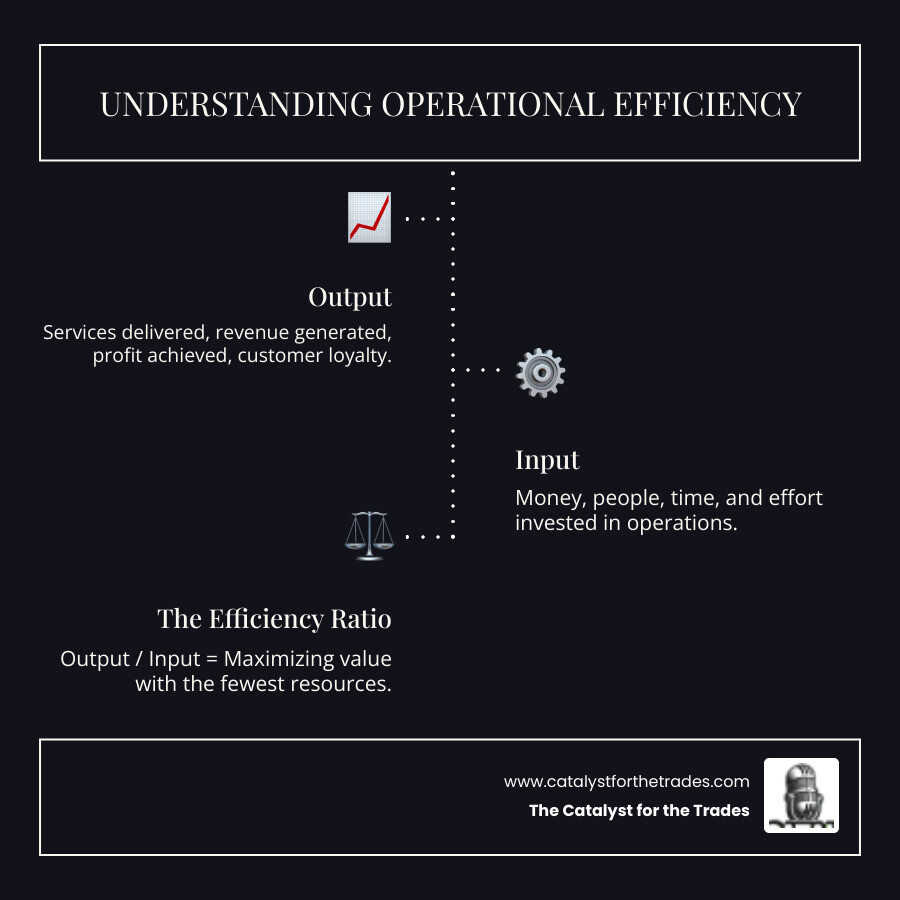
Infographic explaining the core formula of operational efficiency (Output / Input) - operational efficiency infographic infographic-line-3-steps-dark

Simple operational efficiency glossary:

Defining Operational Efficiency for Your Trade Business

For home service businesses like HVAC, plumbing, or electrical, operational efficiency isn't just a corporate buzzword; it's the secret sauce to thriving in a competitive market. It means optimizing every aspect of your daily operations—your technicians, vans, time, and money—to their fullest potential.

Imagine your team completing more service calls in a day with fewer return visits and happier customers, all without burning out your staff. That’s operational efficiency in action. By focusing on it, you gain a significant competitive advantage, delivering high-quality service reliably and consistently. This builds trust and customer loyalty. True efficiency often leads to higher quality because processes are clearer and errors are reduced. We've discussed the importance of smart financial strategies for contractors on our podcast; tune into Smart Accounting Moves: Devin Nordgran’s Financial Strategies For Contractors for more on this.

Efficiency vs. Productivity vs. Effectiveness

These three terms are often used interchangeably, but they each describe a distinct aspect of business performance. Understanding their differences is key to truly optimizing our operations.

| Aspect | Definition -|| Efficiency | Doing things right. Minimizing waste and maximizing resource utilization. | Minimizing resource consumption to perform a specific task. For example, a technician completing a job with the fewest possible trips, parts, and time. || Productivity | Doing more things. Focus on the quantity of output within a given timeframe. | Maximizing the number of tasks or services completed. For example, a technician completing 5 service calls instead of 4 in a day. || Effectiveness | Doing the right things. Achieving desired outcomes and aligning with strategic goals. | Ensuring the services provided genuinely solve the customer's problem and align with the business's long-term goals (e.g., customer satisfaction, repeat business). |

While we often associate operational efficiency with productivity, they are distinct. Productivity measures our output, typically expressed as units per amount of time (e.g., how many HVAC tune-ups per day). Efficiency, however, relates to the costs per unit of production, not just the number of units. An efficient company will be more profitable even if two companies are equally productive. Think of it this way: a technician might be highly productive, completing many jobs, but if they're constantly driving across town for parts they should have had, or making return visits due to incomplete work, that productivity isn't truly efficient.

Our goal is to achieve both high productivity and high efficiency, all while ensuring our efforts are effective in meeting our strategic goals. We want to reduce waste – whether it's wasted time, wasted materials, or wasted effort – to simplify our processes, improve quality, and ultimately boost our output and profitability.

How to Measure What Matters in Your Operations

Here's the truth about improving operational efficiency: you can't fix what you can't see. To improve, you must first measure. Without clear data, you're just guessing. By defining and tracking the right key performance indicators (KPIs), you can benchmark your performance, identify bottlenecks, and make informed decisions.

Think of it like diagnosing a customer's HVAC system. We wouldn't just guess at the problem, right? We'd take measurements, check the data, and make informed decisions based on what we find. The same principle applies to our business operations. We need solid data to understand where our efforts are making a difference and where we're spinning our wheels.

This is where benchmarking becomes our friend. By comparing our performance against industry standards or our own historical data, we can spot trends and identify opportunities. These insights are gold because they tell us exactly where to focus our improvement efforts.

As we've explored in previous discussions, smart accounting isn't just about keeping the books balanced. It's about changing chaos into opportunity by giving us the data we need to make confident operational decisions. If you're looking to strengthen this foundation, check out How Smart Accounting Transforms Chaos Into Opportunity: Why Every Home Services Business Needs A Strategic Financial Partner.

Key Metrics for Measuring Operational Efficiency

Generic business metrics don't always cut it for home service businesses. We need to track what actually matters in our day-to-day operations. Let's talk about the metrics that give us real insight into our operational efficiency.

Cycle Time measures the complete journey from the first customer call to final payment. Shorter cycle times usually mean happier customers and more capacity to take on additional work.

Technician Utilization Rate shows how effectively we're using our most valuable resource: our skilled technicians. This is the percentage of their day spent on billable work versus non-billable activities like waiting for parts or excessive drive time. We want our technicians doing what they do best – serving customers.

First-Time Fix Rate (FTFR) tells us what percentage of service calls we resolve on the first visit without needing a callback. This metric reflects technician training, van stock levels, and process quality. A high FTFR means satisfied customers and eliminated return trip costs.

For trade businesses, Inventory Turnover is critical. This metric reveals how quickly we're cycling through our parts and supplies. Healthy turnover means we're not tying up cash in dusty shelves, but we're also not constantly running out of essential items.

Finally, Cost per Unit of Service calculates what it actually costs us to deliver a specific service – including labor, materials, and overhead. Understanding this number helps us spot cost reduction opportunities and ensures our pricing keeps us profitable. We can adapt the operational efficiency ratio here: (Operating Expenses + Cost of Goods Sold) / Net Sales. Lower ratios generally signal higher operational efficiency.

Common Challenges in Measurement

Let's be honest: measuring operational efficiency comes with its fair share of headaches. Understanding these challenges upfront helps us steer them more effectively.

Data overload is a common trap. The problem isn't too little data – it's figuring out which data actually matters. This can lead to analysis paralysis, where we spend so much time collecting that we never act on the insights.

Inaccurate data collection can undermine everything. When team members manually enter information, or when systems don't talk to each other, inconsistencies creep in. These errors make our metrics unreliable and can send us chasing solutions to the wrong problems.

Then there's the very human challenge of resistance to change. Implementing new measurement systems can feel like extra work. We might encounter pushback from employees who are comfortable with how things have always been done. Building buy-in requires clear communication about the benefits and involving our team in the process. As Mike Abramowitz discusses in Building Predictable Freedom: Mike Abramowitz On Systems, Scaling, Founder's Mindset In The Trades, overcoming these systemic challenges is essential for creating the freedom we're working toward.

Finally, the cost of implementation can feel daunting. New software and training require an upfront investment. For small and medium-sized trade businesses, this can be a tough pill to swallow. But these aren't expenses – they're investments in our future profitability and growth. The long-term benefits of improved operational efficiency almost always outweigh the initial costs.

Core Strategies for Improving Operational Efficiency

Improving operational efficiency isn't a one-time fix; it's an ongoing journey of continuous improvement. By adopting principles from methodologies like Lean and Six Sigma, trade businesses can systematically eliminate waste, simplify processes, and boost quality. Tools like Kaizen, which means "continuous improvement," are fantastic for making sure we use our resources as effectively as possible.

Streamline and Standardize Your Processes

One of the most powerful ways to boost your operational efficiency is to take a close look at how you currently do things. This is where process mapping shines. By mapping out every step, from the first customer call to the final invoice, we can easily spot slowdowns, unnecessary repeats, or tasks that don't add value.

Once we've found these areas, we can streamline them by combining tasks, removing unneeded approvals, or changing the order of operations. The goal is to make our processes faster, more affordable, and more productive.

Another helpful tool is creating Standard Operating Procedures (SOPs). These are clear, step-by-step guides for routine tasks. SOPs ensure everyone does things the same way, which cuts down on mistakes and makes training new team members a breeze. This leads to higher quality and more consistent service. We've talked a lot about how process improvement helps our trade businesses thrive; you can learn even more by reading our article on Process Improvement and our helpful HVAC Business Operations Guide.

Optimize Your Resources and Inventory

Managing your resources wisely is key for top-notch operational efficiency. This means making sure your technicians, vehicles, tools, and inventory are all working together like a well-oiled machine.

Just-in-Time (JIT) inventory is a clever strategy where you have just the right amount of parts on hand exactly when you need them. JIT helps save on storage costs and reduces the chance of parts becoming obsolete. Modern inventory tools can be a huge help here, letting us track stock in real-time.

Strategic scheduling and route optimization are two sides of the same coin. We want to make sure our technicians are booked in the most efficient way possible, cutting down on travel time. Software that plans routes based on location and job urgency can save on fuel and allow our teams to complete more calls in a day.

Lastly, capacity planning is all about making sure we have the right number of skilled technicians ready to meet customer demand, without having too many or too few. By fine-tuning our systems, we create a sense of freedom and predictability in our operations, just as Mike Abramowitz explains in How Systems Create Freedom: Mike Abramowitz's Blueprint For Trades Success.

Invest in Your Team

Our people are our most valuable asset. When you invest in their growth and well-being, it directly translates into better operational efficiency.

Employee training is incredibly important. Well-trained technicians are more productive, make fewer mistakes, and feel more confident in their work. Offering targeted training and opportunities for ongoing learning empowers our team to do their best. Investing in training also helps you hold onto your best talent, which is less costly than constantly hiring and training new people.

Clear communication channels are non-negotiable. Poor communication can lead to stress, delays, and lower morale. This means giving clear job instructions, making it easy for technicians to talk to the office, and having open feedback loops. When everyone is on the same page, jobs get done more smoothly.

Finally, empowering employees and setting up strong feedback loops helps build a culture where everyone is invested in improving operational efficiency. Our team members on the front lines often have the best ideas about what's working and what's not. Encouraging them to share their thoughts can uncover amazing efficiencies. Casey Eberhart often highlights how important leadership and team empowerment are for growing a trade business; you can hear more about this in Command The Room, Grow Your Business: Casey Eberhart’s Blueprint For Trade Success.

The Technology Multiplier: Tools to Boost Efficiency

You know that feeling when everything just clicks? When your team is humming along, customers are happy, and you're making the most of every minute? Technology is the secret ingredient that can make that feeling a daily reality for your trade business. Think of it as a powerful multiplier, taking all your hard work and making it even more effective.

Leveraging the right tools can truly transform your operations. It helps you move from constantly putting out fires to proactively managing your business. Technology brings in automation, gives you real-time data at your fingertips, fosters centralized communication, and ensures seamless software integration. This isn't just about making things a little easier; it's about fundamentally boosting your operational efficiency and giving you an edge.

Leveraging Software for Seamless Operations

For trade businesses, the right software isn't just a nice-to-have; it's a game-changer. These tools let you automate repetitive tasks, manage your workforce more effectively, and give you valuable insights into how your business is performing.

Field Service Management (FSM) software is your command center for everything: scheduling, dispatching, customer information, job progress, invoicing, and inventory. It brings all your information together in one place, ensuring everyone has the up-to-date details they need.

Customer Relationship Management (CRM) systems help you track all customer interactions and service history, and even remind you to schedule follow-ups. This helps you build stronger relationships and encourages repeat business.

Enterprise Resource Planning (ERP) systems tie together different parts of your business—from accounting to inventory—into a single platform. This means no more isolated pockets of information; everything talks to everything else, helping you improve operational efficiency across the board. Specialized ERPs can improve facility usage efficiency by over 39% and cut maintenance costs by more than 15%!

Software solutions like these lead to clearer timelines, better resource use, and more accurate key performance indicators (KPIs). When you bring clarity to your operations, these tools help you grow and scale your business without the usual chaos. We've talked a lot about how structured systems can transform a business on our podcast; dive deeper into this with How EOS Helps You Scale Without The Chaos and From Chaos To Clarity: How EOS Transforms Your Business.

The Role of AI and Automation

Artificial Intelligence (AI) and automation are practical tools that can boost your operational efficiency right now.

Automated dispatching uses AI to look at service requests, technician availability, skills, and location to automatically assign the best technician to each job. This drastically cuts down on manual work, optimizes routes, and means your customers get help faster.

AI-powered lead management can sort through new leads, identify the most promising ones, and automate the first follow-up. This frees up your team to focus on building relationships and closing deals. We've explored the power of AI in lead management on our podcast; listen to Unlocking Efficiency: AI Lead Management Automation for all the details.

Predictive maintenance alerts use AI-powered sensors to monitor equipment performance and predict potential problems before they cause a breakdown. This allows you to schedule proactive maintenance, preventing costly emergencies and keeping customers happy.

Automated invoicing can kick in once a service is completed. The system automatically sends accurate invoices to customers, which speeds up your cash flow and reduces administrative headaches.

These technologies help you work smarter, minimize human error, and deliver a superior customer experience, all while boosting your bottom line.

Frequently Asked Questions about Operational Efficiency

Many trade business owners have questions about improving operational efficiency. Here are answers to some of the most common ones.

What are the first steps to improving operational efficiency in a small trade business?

Starting small and being strategic is key. Here’s a simple roadmap to get you started on your journey to better operational efficiency:

First, map one core process. Think about a single, high-impact process in your business, like how you handle service calls or invoicing. Visually map out every step.

As you map, you’ll naturally identify one major bottleneck or source of waste. Look for delays, redundant steps, or where errors frequently occur. These are your opportunities for improvement.

Next, implement a small, measurable change. Don't try to fix everything at once. Choose one specific change that directly addresses the bottleneck you found. For instance, a simple checklist for your call takers could make a huge difference.

Finally, involve your team for feedback. The people on the front lines have the best insights. Ask for their input on the current process and the change you're considering. Their buy-in is crucial for success.

How does operational efficiency benefit my customers?

While operational efficiency is about improving internal processes, the benefits extend directly to your customers. When you operate more efficiently, everyone wins. Your customers will enjoy:

  • Faster response times: Optimized scheduling means we can get a technician to their home quicker.
  • More accurate scheduling and arrival times: Better planning means we can give customers precise appointment windows and stick to them.
  • Higher first-time fix rates: Well-trained and equipped technicians get the job done right on the first visit.
  • Fewer errors in billing: Streamlined processes reduce mistakes, ensuring customers receive clear and accurate bills.
  • An overall improved and more reliable service experience: All these efficiencies add up to a smoother, more professional service that builds trust and loyalty.

Can a business be too efficient?

Yes, it's possible. While the goal is to improve operational efficiency, it’s crucial to balance that drive with "effectiveness." If we pursue efficiency blindly, without considering its impact on work quality, employee well-being, or customer satisfaction, we can run into problems.

For example, extreme cost-cutting might lead to using lower-quality parts or overworking technicians. This might look efficient on a spreadsheet, but it will quickly harm your reputation, increase costly call-backs, and lead to team burnout.

Remember the distinction: efficiency is "doing things right," but effectiveness is "doing the right things." We want to be efficient in how we deliver services, but we must also ensure the services are high-quality, customer-focused, and aligned with our business's core values. The sweet spot is finding the balance where we are lean and agile without sacrificing the quality that makes our business shine.

Conclusion: Building a More Resilient and Profitable Business

Focusing on operational efficiency creates a positive ripple effect across your entire business. Streamlining processes saves time, optimizing resources cuts costs and improves customer service, and investing in technology and your team builds a scalable, sustainable operation. It's not about a single fix, but a commitment to continuous improvement.

In a competitive market, efficiency delivers tangible benefits: wider profit margins, increased productivity, improved customer satisfaction, and a significant competitive edge that helps you stand out.

Perhaps most importantly, operational efficiency gives us something priceless: freedom. Freedom from the constant firefighting and chaos. Freedom to focus on strategic growth rather than just surviving day-to-day. Freedom to enjoy the business we've worked so hard to build.

At The Catalyst for the Trades, we're passionate about helping home service business owners like you achieve this level of excellence. Our podcast brings together Jennifer Bagley's expertise in AI and marketing with Chuck Staszkiewicz's real-world operational scaling experience to give you practical strategies you can implement right away.

Whether you're just starting to think about operational improvements or you're ready to take your already-successful business to the next level, we're here to support you. Every episode of our podcast is designed to give you actionable insights, real stories from business owners who've been where you are, and cutting-edge strategies that actually work in the trades.

Ready to transform your operations and lead with confidence? Learn more strategies for your home service business and join our community of forward-thinking trade business owners who are building resilient, profitable, and enjoyable businesses. Your journey to operational excellence starts with a single step – and we'd be honored to walk alongside you.

Understanding the Core Concepts: Efficiency vs. Productivity

When you search for operational efficiency, you're looking for ways to improve business performance. Here's a quick overview:

  • Definition: Delivering the highest possible output (like services or products) using the least amount of input (such as time, money, or effort).
  • Goal: To maximize profit, reduce costs, and improve overall productivity and quality.
  • Impact: Leads to stronger financial performance, increased customer satisfaction, and a competitive advantage.
  • Measurement: Often tracked by comparing outputs (revenue, completed jobs, quality) against inputs (operating expenses, labor hours).

Operational efficiency is about delivering more value with fewer resources. For trade businesses, this means finding smarter ways to work, reduce waste, and boost your bottom line without sacrificing quality. It’s how you get the most out of every dollar, every hour, and every technician. In fact, a global survey found that 77% of CEOs would pursue operational efficiencies to drive total revenue growth. It’s not just about cutting costs; it’s about making your business agile, resilient, and more profitable.

At its heart, operational efficiency is a measurement of resource allocation. Think of it as a ratio: the output you gain from your business operations compared to the input you put in. Inputs can be anything from costs and headcount to time and effort. Outputs might be revenue, profit margins, new customers, or the quality of services provided. The greater our operational efficiency, the more profitable our trade business becomes.

Infographic explaining the core formula of operational efficiency (Output / Input) - operational efficiency infographic infographic-line-3-steps-dark

Simple operational efficiency glossary:

Defining Operational Efficiency for Your Trade Business

For home service businesses like HVAC, plumbing, or electrical, operational efficiency isn't just a corporate buzzword; it's the secret sauce to thriving in a competitive market. It means optimizing every aspect of your daily operations—your technicians, vans, time, and money—to their fullest potential.

Imagine your team completing more service calls in a day with fewer return visits and happier customers, all without burning out your staff. That’s operational efficiency in action. By focusing on it, you gain a significant competitive advantage, delivering high-quality service reliably and consistently. This builds trust and customer loyalty. True efficiency often leads to higher quality because processes are clearer and errors are reduced. We've discussed the importance of smart financial strategies for contractors on our podcast; tune into Smart Accounting Moves: Devin Nordgran’s Financial Strategies For Contractors for more on this.

Efficiency vs. Productivity vs. Effectiveness

These three terms are often used interchangeably, but they each describe a distinct aspect of business performance. Understanding their differences is key to truly optimizing our operations.

| Aspect | Definition -|| Efficiency | Doing things right. Minimizing waste and maximizing resource utilization. | Minimizing resource consumption to perform a specific task. For example, a technician completing a job with the fewest possible trips, parts, and time. || Productivity | Doing more things. Focus on the quantity of output within a given timeframe. | Maximizing the number of tasks or services completed. For example, a technician completing 5 service calls instead of 4 in a day. || Effectiveness | Doing the right things. Achieving desired outcomes and aligning with strategic goals. | Ensuring the services provided genuinely solve the customer's problem and align with the business's long-term goals (e.g., customer satisfaction, repeat business). |

While we often associate operational efficiency with productivity, they are distinct. Productivity measures our output, typically expressed as units per amount of time (e.g., how many HVAC tune-ups per day). Efficiency, however, relates to the costs per unit of production, not just the number of units. An efficient company will be more profitable even if two companies are equally productive. Think of it this way: a technician might be highly productive, completing many jobs, but if they're constantly driving across town for parts they should have had, or making return visits due to incomplete work, that productivity isn't truly efficient.

Our goal is to achieve both high productivity and high efficiency, all while ensuring our efforts are effective in meeting our strategic goals. We want to reduce waste – whether it's wasted time, wasted materials, or wasted effort – to simplify our processes, improve quality, and ultimately boost our output and profitability.

How to Measure What Matters in Your Operations

Here's the truth about improving operational efficiency: you can't fix what you can't see. To improve, you must first measure. Without clear data, you're just guessing. By defining and tracking the right key performance indicators (KPIs), you can benchmark your performance, identify bottlenecks, and make informed decisions.

Think of it like diagnosing a customer's HVAC system. We wouldn't just guess at the problem, right? We'd take measurements, check the data, and make informed decisions based on what we find. The same principle applies to our business operations. We need solid data to understand where our efforts are making a difference and where we're spinning our wheels.

This is where benchmarking becomes our friend. By comparing our performance against industry standards or our own historical data, we can spot trends and identify opportunities. These insights are gold because they tell us exactly where to focus our improvement efforts.

As we've explored in previous discussions, smart accounting isn't just about keeping the books balanced. It's about changing chaos into opportunity by giving us the data we need to make confident operational decisions. If you're looking to strengthen this foundation, check out How Smart Accounting Transforms Chaos Into Opportunity: Why Every Home Services Business Needs A Strategic Financial Partner.

Key Metrics for Measuring Operational Efficiency

Generic business metrics don't always cut it for home service businesses. We need to track what actually matters in our day-to-day operations. Let's talk about the metrics that give us real insight into our operational efficiency.

Cycle Time measures the complete journey from the first customer call to final payment. Shorter cycle times usually mean happier customers and more capacity to take on additional work.

Technician Utilization Rate shows how effectively we're using our most valuable resource: our skilled technicians. This is the percentage of their day spent on billable work versus non-billable activities like waiting for parts or excessive drive time. We want our technicians doing what they do best – serving customers.

First-Time Fix Rate (FTFR) tells us what percentage of service calls we resolve on the first visit without needing a callback. This metric reflects technician training, van stock levels, and process quality. A high FTFR means satisfied customers and eliminated return trip costs.

For trade businesses, Inventory Turnover is critical. This metric reveals how quickly we're cycling through our parts and supplies. Healthy turnover means we're not tying up cash in dusty shelves, but we're also not constantly running out of essential items.

Finally, Cost per Unit of Service calculates what it actually costs us to deliver a specific service – including labor, materials, and overhead. Understanding this number helps us spot cost reduction opportunities and ensures our pricing keeps us profitable. We can adapt the operational efficiency ratio here: (Operating Expenses + Cost of Goods Sold) / Net Sales. Lower ratios generally signal higher operational efficiency.

Common Challenges in Measurement

Let's be honest: measuring operational efficiency comes with its fair share of headaches. Understanding these challenges upfront helps us steer them more effectively.

Data overload is a common trap. The problem isn't too little data – it's figuring out which data actually matters. This can lead to analysis paralysis, where we spend so much time collecting that we never act on the insights.

Inaccurate data collection can undermine everything. When team members manually enter information, or when systems don't talk to each other, inconsistencies creep in. These errors make our metrics unreliable and can send us chasing solutions to the wrong problems.

Then there's the very human challenge of resistance to change. Implementing new measurement systems can feel like extra work. We might encounter pushback from employees who are comfortable with how things have always been done. Building buy-in requires clear communication about the benefits and involving our team in the process. As Mike Abramowitz discusses in Building Predictable Freedom: Mike Abramowitz On Systems, Scaling, Founder's Mindset In The Trades, overcoming these systemic challenges is essential for creating the freedom we're working toward.

Finally, the cost of implementation can feel daunting. New software and training require an upfront investment. For small and medium-sized trade businesses, this can be a tough pill to swallow. But these aren't expenses – they're investments in our future profitability and growth. The long-term benefits of improved operational efficiency almost always outweigh the initial costs.

Core Strategies for Improving Operational Efficiency

Improving operational efficiency isn't a one-time fix; it's an ongoing journey of continuous improvement. By adopting principles from methodologies like Lean and Six Sigma, trade businesses can systematically eliminate waste, simplify processes, and boost quality. Tools like Kaizen, which means "continuous improvement," are fantastic for making sure we use our resources as effectively as possible.

Streamline and Standardize Your Processes

One of the most powerful ways to boost your operational efficiency is to take a close look at how you currently do things. This is where process mapping shines. By mapping out every step, from the first customer call to the final invoice, we can easily spot slowdowns, unnecessary repeats, or tasks that don't add value.

Once we've found these areas, we can streamline them by combining tasks, removing unneeded approvals, or changing the order of operations. The goal is to make our processes faster, more affordable, and more productive.

Another helpful tool is creating Standard Operating Procedures (SOPs). These are clear, step-by-step guides for routine tasks. SOPs ensure everyone does things the same way, which cuts down on mistakes and makes training new team members a breeze. This leads to higher quality and more consistent service. We've talked a lot about how process improvement helps our trade businesses thrive; you can learn even more by reading our article on Process Improvement and our helpful HVAC Business Operations Guide.

Optimize Your Resources and Inventory

Managing your resources wisely is key for top-notch operational efficiency. This means making sure your technicians, vehicles, tools, and inventory are all working together like a well-oiled machine.

Just-in-Time (JIT) inventory is a clever strategy where you have just the right amount of parts on hand exactly when you need them. JIT helps save on storage costs and reduces the chance of parts becoming obsolete. Modern inventory tools can be a huge help here, letting us track stock in real-time.

Strategic scheduling and route optimization are two sides of the same coin. We want to make sure our technicians are booked in the most efficient way possible, cutting down on travel time. Software that plans routes based on location and job urgency can save on fuel and allow our teams to complete more calls in a day.

Lastly, capacity planning is all about making sure we have the right number of skilled technicians ready to meet customer demand, without having too many or too few. By fine-tuning our systems, we create a sense of freedom and predictability in our operations, just as Mike Abramowitz explains in How Systems Create Freedom: Mike Abramowitz's Blueprint For Trades Success.

Invest in Your Team

Our people are our most valuable asset. When you invest in their growth and well-being, it directly translates into better operational efficiency.

Employee training is incredibly important. Well-trained technicians are more productive, make fewer mistakes, and feel more confident in their work. Offering targeted training and opportunities for ongoing learning empowers our team to do their best. Investing in training also helps you hold onto your best talent, which is less costly than constantly hiring and training new people.

Clear communication channels are non-negotiable. Poor communication can lead to stress, delays, and lower morale. This means giving clear job instructions, making it easy for technicians to talk to the office, and having open feedback loops. When everyone is on the same page, jobs get done more smoothly.

Finally, empowering employees and setting up strong feedback loops helps build a culture where everyone is invested in improving operational efficiency. Our team members on the front lines often have the best ideas about what's working and what's not. Encouraging them to share their thoughts can uncover amazing efficiencies. Casey Eberhart often highlights how important leadership and team empowerment are for growing a trade business; you can hear more about this in Command The Room, Grow Your Business: Casey Eberhart’s Blueprint For Trade Success.

The Technology Multiplier: Tools to Boost Efficiency

You know that feeling when everything just clicks? When your team is humming along, customers are happy, and you're making the most of every minute? Technology is the secret ingredient that can make that feeling a daily reality for your trade business. Think of it as a powerful multiplier, taking all your hard work and making it even more effective.

Leveraging the right tools can truly transform your operations. It helps you move from constantly putting out fires to proactively managing your business. Technology brings in automation, gives you real-time data at your fingertips, fosters centralized communication, and ensures seamless software integration. This isn't just about making things a little easier; it's about fundamentally boosting your operational efficiency and giving you an edge.

Leveraging Software for Seamless Operations

For trade businesses, the right software isn't just a nice-to-have; it's a game-changer. These tools let you automate repetitive tasks, manage your workforce more effectively, and give you valuable insights into how your business is performing.

Field Service Management (FSM) software is your command center for everything: scheduling, dispatching, customer information, job progress, invoicing, and inventory. It brings all your information together in one place, ensuring everyone has the up-to-date details they need.

Customer Relationship Management (CRM) systems help you track all customer interactions and service history, and even remind you to schedule follow-ups. This helps you build stronger relationships and encourages repeat business.

Enterprise Resource Planning (ERP) systems tie together different parts of your business—from accounting to inventory—into a single platform. This means no more isolated pockets of information; everything talks to everything else, helping you improve operational efficiency across the board. Specialized ERPs can improve facility usage efficiency by over 39% and cut maintenance costs by more than 15%!

Software solutions like these lead to clearer timelines, better resource use, and more accurate key performance indicators (KPIs). When you bring clarity to your operations, these tools help you grow and scale your business without the usual chaos. We've talked a lot about how structured systems can transform a business on our podcast; dive deeper into this with How EOS Helps You Scale Without The Chaos and From Chaos To Clarity: How EOS Transforms Your Business.

The Role of AI and Automation

Artificial Intelligence (AI) and automation are practical tools that can boost your operational efficiency right now.

Automated dispatching uses AI to look at service requests, technician availability, skills, and location to automatically assign the best technician to each job. This drastically cuts down on manual work, optimizes routes, and means your customers get help faster.

AI-powered lead management can sort through new leads, identify the most promising ones, and automate the first follow-up. This frees up your team to focus on building relationships and closing deals. We've explored the power of AI in lead management on our podcast; listen to Unlocking Efficiency: AI Lead Management Automation for all the details.

Predictive maintenance alerts use AI-powered sensors to monitor equipment performance and predict potential problems before they cause a breakdown. This allows you to schedule proactive maintenance, preventing costly emergencies and keeping customers happy.

Automated invoicing can kick in once a service is completed. The system automatically sends accurate invoices to customers, which speeds up your cash flow and reduces administrative headaches.

These technologies help you work smarter, minimize human error, and deliver a superior customer experience, all while boosting your bottom line.

Frequently Asked Questions about Operational Efficiency

Many trade business owners have questions about improving operational efficiency. Here are answers to some of the most common ones.

What are the first steps to improving operational efficiency in a small trade business?

Starting small and being strategic is key. Here’s a simple roadmap to get you started on your journey to better operational efficiency:

First, map one core process. Think about a single, high-impact process in your business, like how you handle service calls or invoicing. Visually map out every step.

As you map, you’ll naturally identify one major bottleneck or source of waste. Look for delays, redundant steps, or where errors frequently occur. These are your opportunities for improvement.

Next, implement a small, measurable change. Don't try to fix everything at once. Choose one specific change that directly addresses the bottleneck you found. For instance, a simple checklist for your call takers could make a huge difference.

Finally, involve your team for feedback. The people on the front lines have the best insights. Ask for their input on the current process and the change you're considering. Their buy-in is crucial for success.

How does operational efficiency benefit my customers?

While operational efficiency is about improving internal processes, the benefits extend directly to your customers. When you operate more efficiently, everyone wins. Your customers will enjoy:

  • Faster response times: Optimized scheduling means we can get a technician to their home quicker.
  • More accurate scheduling and arrival times: Better planning means we can give customers precise appointment windows and stick to them.
  • Higher first-time fix rates: Well-trained and equipped technicians get the job done right on the first visit.
  • Fewer errors in billing: Streamlined processes reduce mistakes, ensuring customers receive clear and accurate bills.
  • An overall improved and more reliable service experience: All these efficiencies add up to a smoother, more professional service that builds trust and loyalty.

Can a business be too efficient?

Yes, it's possible. While the goal is to improve operational efficiency, it’s crucial to balance that drive with "effectiveness." If we pursue efficiency blindly, without considering its impact on work quality, employee well-being, or customer satisfaction, we can run into problems.

For example, extreme cost-cutting might lead to using lower-quality parts or overworking technicians. This might look efficient on a spreadsheet, but it will quickly harm your reputation, increase costly call-backs, and lead to team burnout.

Remember the distinction: efficiency is "doing things right," but effectiveness is "doing the right things." We want to be efficient in how we deliver services, but we must also ensure the services are high-quality, customer-focused, and aligned with our business's core values. The sweet spot is finding the balance where we are lean and agile without sacrificing the quality that makes our business shine.

Conclusion: Building a More Resilient and Profitable Business

Focusing on operational efficiency creates a positive ripple effect across your entire business. Streamlining processes saves time, optimizing resources cuts costs and improves customer service, and investing in technology and your team builds a scalable, sustainable operation. It's not about a single fix, but a commitment to continuous improvement.

In a competitive market, efficiency delivers tangible benefits: wider profit margins, increased productivity, improved customer satisfaction, and a significant competitive edge that helps you stand out.

Perhaps most importantly, operational efficiency gives us something priceless: freedom. Freedom from the constant firefighting and chaos. Freedom to focus on strategic growth rather than just surviving day-to-day. Freedom to enjoy the business we've worked so hard to build.

At The Catalyst for the Trades, we're passionate about helping home service business owners like you achieve this level of excellence. Our podcast brings together Jennifer Bagley's expertise in AI and marketing with Chuck Staszkiewicz's real-world operational scaling experience to give you practical strategies you can implement right away.

Whether you're just starting to think about operational improvements or you're ready to take your already-successful business to the next level, we're here to support you. Every episode of our podcast is designed to give you actionable insights, real stories from business owners who've been where you are, and cutting-edge strategies that actually work in the trades.

Ready to transform your operations and lead with confidence? Learn more strategies for your home service business and join our community of forward-thinking trade business owners who are building resilient, profitable, and enjoyable businesses. Your journey to operational excellence starts with a single step – and we'd be honored to walk alongside you.

Understanding the Core Concepts: Efficiency vs. Productivity

When you search for operational efficiency, you're looking for ways to improve business performance. Here's a quick overview:

  • Definition: Delivering the highest possible output (like services or products) using the least amount of input (such as time, money, or effort).
  • Goal: To maximize profit, reduce costs, and improve overall productivity and quality.
  • Impact: Leads to stronger financial performance, increased customer satisfaction, and a competitive advantage.
  • Measurement: Often tracked by comparing outputs (revenue, completed jobs, quality) against inputs (operating expenses, labor hours).

Operational efficiency is about delivering more value with fewer resources. For trade businesses, this means finding smarter ways to work, reduce waste, and boost your bottom line without sacrificing quality. It’s how you get the most out of every dollar, every hour, and every technician. In fact, a global survey found that 77% of CEOs would pursue operational efficiencies to drive total revenue growth. It’s not just about cutting costs; it’s about making your business agile, resilient, and more profitable.

At its heart, operational efficiency is a measurement of resource allocation. Think of it as a ratio: the output you gain from your business operations compared to the input you put in. Inputs can be anything from costs and headcount to time and effort. Outputs might be revenue, profit margins, new customers, or the quality of services provided. The greater our operational efficiency, the more profitable our trade business becomes.

Infographic explaining the core formula of operational efficiency (Output / Input) - operational efficiency infographic infographic-line-3-steps-dark

Simple operational efficiency glossary:

Defining Operational Efficiency for Your Trade Business

For home service businesses like HVAC, plumbing, or electrical, operational efficiency isn't just a corporate buzzword; it's the secret sauce to thriving in a competitive market. It means optimizing every aspect of your daily operations—your technicians, vans, time, and money—to their fullest potential.

Imagine your team completing more service calls in a day with fewer return visits and happier customers, all without burning out your staff. That’s operational efficiency in action. By focusing on it, you gain a significant competitive advantage, delivering high-quality service reliably and consistently. This builds trust and customer loyalty. True efficiency often leads to higher quality because processes are clearer and errors are reduced. We've discussed the importance of smart financial strategies for contractors on our podcast; tune into Smart Accounting Moves: Devin Nordgran’s Financial Strategies For Contractors for more on this.

Efficiency vs. Productivity vs. Effectiveness

These three terms are often used interchangeably, but they each describe a distinct aspect of business performance. Understanding their differences is key to truly optimizing our operations.

| Aspect | Definition -|| Efficiency | Doing things right. Minimizing waste and maximizing resource utilization. | Minimizing resource consumption to perform a specific task. For example, a technician completing a job with the fewest possible trips, parts, and time. || Productivity | Doing more things. Focus on the quantity of output within a given timeframe. | Maximizing the number of tasks or services completed. For example, a technician completing 5 service calls instead of 4 in a day. || Effectiveness | Doing the right things. Achieving desired outcomes and aligning with strategic goals. | Ensuring the services provided genuinely solve the customer's problem and align with the business's long-term goals (e.g., customer satisfaction, repeat business). |

While we often associate operational efficiency with productivity, they are distinct. Productivity measures our output, typically expressed as units per amount of time (e.g., how many HVAC tune-ups per day). Efficiency, however, relates to the costs per unit of production, not just the number of units. An efficient company will be more profitable even if two companies are equally productive. Think of it this way: a technician might be highly productive, completing many jobs, but if they're constantly driving across town for parts they should have had, or making return visits due to incomplete work, that productivity isn't truly efficient.

Our goal is to achieve both high productivity and high efficiency, all while ensuring our efforts are effective in meeting our strategic goals. We want to reduce waste – whether it's wasted time, wasted materials, or wasted effort – to simplify our processes, improve quality, and ultimately boost our output and profitability.

How to Measure What Matters in Your Operations

Here's the truth about improving operational efficiency: you can't fix what you can't see. To improve, you must first measure. Without clear data, you're just guessing. By defining and tracking the right key performance indicators (KPIs), you can benchmark your performance, identify bottlenecks, and make informed decisions.

Think of it like diagnosing a customer's HVAC system. We wouldn't just guess at the problem, right? We'd take measurements, check the data, and make informed decisions based on what we find. The same principle applies to our business operations. We need solid data to understand where our efforts are making a difference and where we're spinning our wheels.

This is where benchmarking becomes our friend. By comparing our performance against industry standards or our own historical data, we can spot trends and identify opportunities. These insights are gold because they tell us exactly where to focus our improvement efforts.

As we've explored in previous discussions, smart accounting isn't just about keeping the books balanced. It's about changing chaos into opportunity by giving us the data we need to make confident operational decisions. If you're looking to strengthen this foundation, check out How Smart Accounting Transforms Chaos Into Opportunity: Why Every Home Services Business Needs A Strategic Financial Partner.

Key Metrics for Measuring Operational Efficiency

Generic business metrics don't always cut it for home service businesses. We need to track what actually matters in our day-to-day operations. Let's talk about the metrics that give us real insight into our operational efficiency.

Cycle Time measures the complete journey from the first customer call to final payment. Shorter cycle times usually mean happier customers and more capacity to take on additional work.

Technician Utilization Rate shows how effectively we're using our most valuable resource: our skilled technicians. This is the percentage of their day spent on billable work versus non-billable activities like waiting for parts or excessive drive time. We want our technicians doing what they do best – serving customers.

First-Time Fix Rate (FTFR) tells us what percentage of service calls we resolve on the first visit without needing a callback. This metric reflects technician training, van stock levels, and process quality. A high FTFR means satisfied customers and eliminated return trip costs.

For trade businesses, Inventory Turnover is critical. This metric reveals how quickly we're cycling through our parts and supplies. Healthy turnover means we're not tying up cash in dusty shelves, but we're also not constantly running out of essential items.

Finally, Cost per Unit of Service calculates what it actually costs us to deliver a specific service – including labor, materials, and overhead. Understanding this number helps us spot cost reduction opportunities and ensures our pricing keeps us profitable. We can adapt the operational efficiency ratio here: (Operating Expenses + Cost of Goods Sold) / Net Sales. Lower ratios generally signal higher operational efficiency.

Common Challenges in Measurement

Let's be honest: measuring operational efficiency comes with its fair share of headaches. Understanding these challenges upfront helps us steer them more effectively.

Data overload is a common trap. The problem isn't too little data – it's figuring out which data actually matters. This can lead to analysis paralysis, where we spend so much time collecting that we never act on the insights.

Inaccurate data collection can undermine everything. When team members manually enter information, or when systems don't talk to each other, inconsistencies creep in. These errors make our metrics unreliable and can send us chasing solutions to the wrong problems.

Then there's the very human challenge of resistance to change. Implementing new measurement systems can feel like extra work. We might encounter pushback from employees who are comfortable with how things have always been done. Building buy-in requires clear communication about the benefits and involving our team in the process. As Mike Abramowitz discusses in Building Predictable Freedom: Mike Abramowitz On Systems, Scaling, Founder's Mindset In The Trades, overcoming these systemic challenges is essential for creating the freedom we're working toward.

Finally, the cost of implementation can feel daunting. New software and training require an upfront investment. For small and medium-sized trade businesses, this can be a tough pill to swallow. But these aren't expenses – they're investments in our future profitability and growth. The long-term benefits of improved operational efficiency almost always outweigh the initial costs.

Core Strategies for Improving Operational Efficiency

Improving operational efficiency isn't a one-time fix; it's an ongoing journey of continuous improvement. By adopting principles from methodologies like Lean and Six Sigma, trade businesses can systematically eliminate waste, simplify processes, and boost quality. Tools like Kaizen, which means "continuous improvement," are fantastic for making sure we use our resources as effectively as possible.

Streamline and Standardize Your Processes

One of the most powerful ways to boost your operational efficiency is to take a close look at how you currently do things. This is where process mapping shines. By mapping out every step, from the first customer call to the final invoice, we can easily spot slowdowns, unnecessary repeats, or tasks that don't add value.

Once we've found these areas, we can streamline them by combining tasks, removing unneeded approvals, or changing the order of operations. The goal is to make our processes faster, more affordable, and more productive.

Another helpful tool is creating Standard Operating Procedures (SOPs). These are clear, step-by-step guides for routine tasks. SOPs ensure everyone does things the same way, which cuts down on mistakes and makes training new team members a breeze. This leads to higher quality and more consistent service. We've talked a lot about how process improvement helps our trade businesses thrive; you can learn even more by reading our article on Process Improvement and our helpful HVAC Business Operations Guide.

Optimize Your Resources and Inventory

Managing your resources wisely is key for top-notch operational efficiency. This means making sure your technicians, vehicles, tools, and inventory are all working together like a well-oiled machine.

Just-in-Time (JIT) inventory is a clever strategy where you have just the right amount of parts on hand exactly when you need them. JIT helps save on storage costs and reduces the chance of parts becoming obsolete. Modern inventory tools can be a huge help here, letting us track stock in real-time.

Strategic scheduling and route optimization are two sides of the same coin. We want to make sure our technicians are booked in the most efficient way possible, cutting down on travel time. Software that plans routes based on location and job urgency can save on fuel and allow our teams to complete more calls in a day.

Lastly, capacity planning is all about making sure we have the right number of skilled technicians ready to meet customer demand, without having too many or too few. By fine-tuning our systems, we create a sense of freedom and predictability in our operations, just as Mike Abramowitz explains in How Systems Create Freedom: Mike Abramowitz's Blueprint For Trades Success.

Invest in Your Team

Our people are our most valuable asset. When you invest in their growth and well-being, it directly translates into better operational efficiency.

Employee training is incredibly important. Well-trained technicians are more productive, make fewer mistakes, and feel more confident in their work. Offering targeted training and opportunities for ongoing learning empowers our team to do their best. Investing in training also helps you hold onto your best talent, which is less costly than constantly hiring and training new people.

Clear communication channels are non-negotiable. Poor communication can lead to stress, delays, and lower morale. This means giving clear job instructions, making it easy for technicians to talk to the office, and having open feedback loops. When everyone is on the same page, jobs get done more smoothly.

Finally, empowering employees and setting up strong feedback loops helps build a culture where everyone is invested in improving operational efficiency. Our team members on the front lines often have the best ideas about what's working and what's not. Encouraging them to share their thoughts can uncover amazing efficiencies. Casey Eberhart often highlights how important leadership and team empowerment are for growing a trade business; you can hear more about this in Command The Room, Grow Your Business: Casey Eberhart’s Blueprint For Trade Success.

The Technology Multiplier: Tools to Boost Efficiency

You know that feeling when everything just clicks? When your team is humming along, customers are happy, and you're making the most of every minute? Technology is the secret ingredient that can make that feeling a daily reality for your trade business. Think of it as a powerful multiplier, taking all your hard work and making it even more effective.

Leveraging the right tools can truly transform your operations. It helps you move from constantly putting out fires to proactively managing your business. Technology brings in automation, gives you real-time data at your fingertips, fosters centralized communication, and ensures seamless software integration. This isn't just about making things a little easier; it's about fundamentally boosting your operational efficiency and giving you an edge.

Leveraging Software for Seamless Operations

For trade businesses, the right software isn't just a nice-to-have; it's a game-changer. These tools let you automate repetitive tasks, manage your workforce more effectively, and give you valuable insights into how your business is performing.

Field Service Management (FSM) software is your command center for everything: scheduling, dispatching, customer information, job progress, invoicing, and inventory. It brings all your information together in one place, ensuring everyone has the up-to-date details they need.

Customer Relationship Management (CRM) systems help you track all customer interactions and service history, and even remind you to schedule follow-ups. This helps you build stronger relationships and encourages repeat business.

Enterprise Resource Planning (ERP) systems tie together different parts of your business—from accounting to inventory—into a single platform. This means no more isolated pockets of information; everything talks to everything else, helping you improve operational efficiency across the board. Specialized ERPs can improve facility usage efficiency by over 39% and cut maintenance costs by more than 15%!

Software solutions like these lead to clearer timelines, better resource use, and more accurate key performance indicators (KPIs). When you bring clarity to your operations, these tools help you grow and scale your business without the usual chaos. We've talked a lot about how structured systems can transform a business on our podcast; dive deeper into this with How EOS Helps You Scale Without The Chaos and From Chaos To Clarity: How EOS Transforms Your Business.

The Role of AI and Automation

Artificial Intelligence (AI) and automation are practical tools that can boost your operational efficiency right now.

Automated dispatching uses AI to look at service requests, technician availability, skills, and location to automatically assign the best technician to each job. This drastically cuts down on manual work, optimizes routes, and means your customers get help faster.

AI-powered lead management can sort through new leads, identify the most promising ones, and automate the first follow-up. This frees up your team to focus on building relationships and closing deals. We've explored the power of AI in lead management on our podcast; listen to Unlocking Efficiency: AI Lead Management Automation for all the details.

Predictive maintenance alerts use AI-powered sensors to monitor equipment performance and predict potential problems before they cause a breakdown. This allows you to schedule proactive maintenance, preventing costly emergencies and keeping customers happy.

Automated invoicing can kick in once a service is completed. The system automatically sends accurate invoices to customers, which speeds up your cash flow and reduces administrative headaches.

These technologies help you work smarter, minimize human error, and deliver a superior customer experience, all while boosting your bottom line.

Frequently Asked Questions about Operational Efficiency

Many trade business owners have questions about improving operational efficiency. Here are answers to some of the most common ones.

What are the first steps to improving operational efficiency in a small trade business?

Starting small and being strategic is key. Here’s a simple roadmap to get you started on your journey to better operational efficiency:

First, map one core process. Think about a single, high-impact process in your business, like how you handle service calls or invoicing. Visually map out every step.

As you map, you’ll naturally identify one major bottleneck or source of waste. Look for delays, redundant steps, or where errors frequently occur. These are your opportunities for improvement.

Next, implement a small, measurable change. Don't try to fix everything at once. Choose one specific change that directly addresses the bottleneck you found. For instance, a simple checklist for your call takers could make a huge difference.

Finally, involve your team for feedback. The people on the front lines have the best insights. Ask for their input on the current process and the change you're considering. Their buy-in is crucial for success.

How does operational efficiency benefit my customers?

While operational efficiency is about improving internal processes, the benefits extend directly to your customers. When you operate more efficiently, everyone wins. Your customers will enjoy:

  • Faster response times: Optimized scheduling means we can get a technician to their home quicker.
  • More accurate scheduling and arrival times: Better planning means we can give customers precise appointment windows and stick to them.
  • Higher first-time fix rates: Well-trained and equipped technicians get the job done right on the first visit.
  • Fewer errors in billing: Streamlined processes reduce mistakes, ensuring customers receive clear and accurate bills.
  • An overall improved and more reliable service experience: All these efficiencies add up to a smoother, more professional service that builds trust and loyalty.

Can a business be too efficient?

Yes, it's possible. While the goal is to improve operational efficiency, it’s crucial to balance that drive with "effectiveness." If we pursue efficiency blindly, without considering its impact on work quality, employee well-being, or customer satisfaction, we can run into problems.

For example, extreme cost-cutting might lead to using lower-quality parts or overworking technicians. This might look efficient on a spreadsheet, but it will quickly harm your reputation, increase costly call-backs, and lead to team burnout.

Remember the distinction: efficiency is "doing things right," but effectiveness is "doing the right things." We want to be efficient in how we deliver services, but we must also ensure the services are high-quality, customer-focused, and aligned with our business's core values. The sweet spot is finding the balance where we are lean and agile without sacrificing the quality that makes our business shine.

Conclusion: Building a More Resilient and Profitable Business

Focusing on operational efficiency creates a positive ripple effect across your entire business. Streamlining processes saves time, optimizing resources cuts costs and improves customer service, and investing in technology and your team builds a scalable, sustainable operation. It's not about a single fix, but a commitment to continuous improvement.

In a competitive market, efficiency delivers tangible benefits: wider profit margins, increased productivity, improved customer satisfaction, and a significant competitive edge that helps you stand out.

Perhaps most importantly, operational efficiency gives us something priceless: freedom. Freedom from the constant firefighting and chaos. Freedom to focus on strategic growth rather than just surviving day-to-day. Freedom to enjoy the business we've worked so hard to build.

At The Catalyst for the Trades, we're passionate about helping home service business owners like you achieve this level of excellence. Our podcast brings together Jennifer Bagley's expertise in AI and marketing with Chuck Staszkiewicz's real-world operational scaling experience to give you practical strategies you can implement right away.

Whether you're just starting to think about operational improvements or you're ready to take your already-successful business to the next level, we're here to support you. Every episode of our podcast is designed to give you actionable insights, real stories from business owners who've been where you are, and cutting-edge strategies that actually work in the trades.

Ready to transform your operations and lead with confidence? Learn more strategies for your home service business and join our community of forward-thinking trade business owners who are building resilient, profitable, and enjoyable businesses. Your journey to operational excellence starts with a single step – and we'd be honored to walk alongside you.

Episodes you may like

The Skill Set Upgrade: Boosting Your Team's Potential

Boost your team's potential! Learn how skill development drives growth, retention, and competitive advantage for your home service business.

Read more
Published
December 29, 2025
From Skeptic to Super-User: Navigating the Technology Adoption Curve

Master technology adoption in home services. Navigate the S-curve, overcome skepticism, and gain a competitive edge for business growth.

Read more
Published
December 26, 2025
Stay Ahead of the Curve: A Guide to Future-Proofing Your Business

Master future-proofing business! Build resilience, leverage tech & AI, empower teams, and grow sustainably. Stay ahead of market changes.

Read more
Published
December 25, 2025