Learn · February 24, 2026
Business Acumen: Top 5 Critical Skills
Discover business acumen: core components, traits of leaders, development steps & metrics to boost decision-making and scale success.
By The Catalyst Editorial Team Operator education · 9 min read · Updated July 24, 2026

Why Business Acumen Matters for Home Services Leaders

Business acumen is the ability to understand how your company works as a system and use that knowledge to make decisions that drive growth and profitability. It combines market awareness, financial literacy, and strategic thinking into a practical skill set that separates struggling contractors from thriving business owners.
Quick Definition:
- What it is: The ability to see the big picture of your business, understand how money flows through your company, and make decisions that improve financial and strategic outcomes
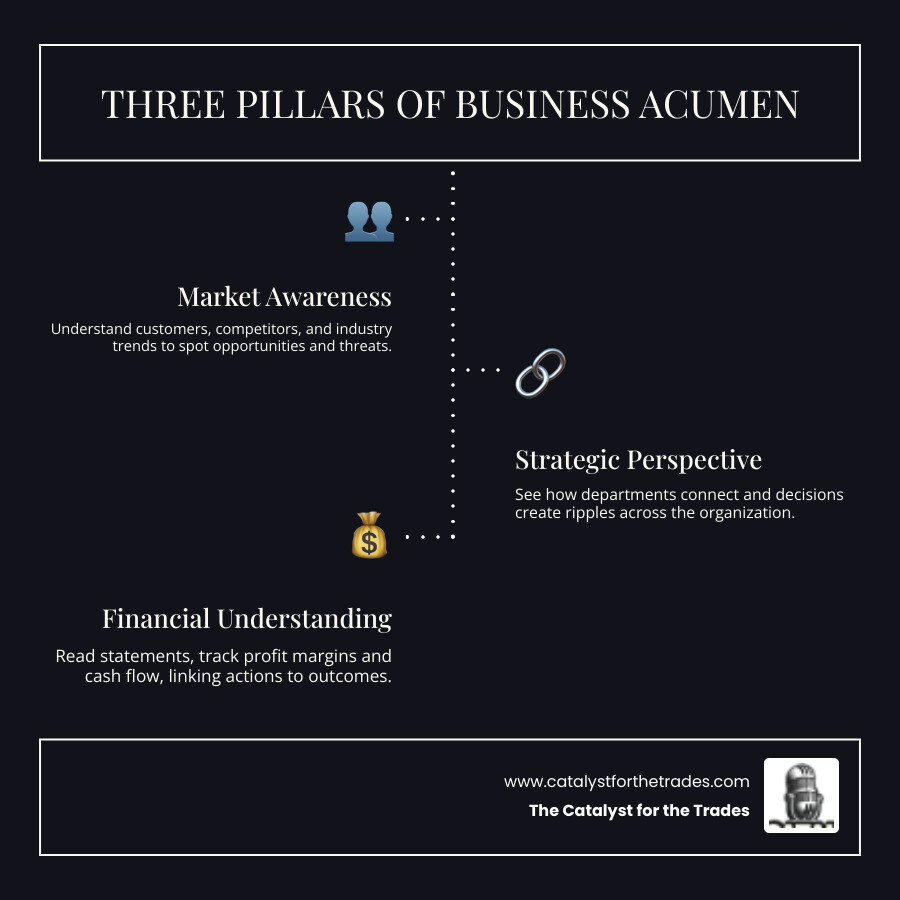
- Core components: Market awareness (knowing your customers and competitors), strategic perspective (understanding how departments connect), and financial understanding (reading the numbers that matter)
- Why it matters: Leaders with strong business acumen make better tradeoffs, execute strategy more effectively, and build companies that scale beyond the owner
- Who needs it: Not just executives—every manager, department head, and future leader in your home services business
If you run an HVAC, plumbing, or electrical company, you know the technical side of the business cold. But growing past seven figures requires a different skill set. Research shows that 93% of executives face talent gaps that prevent business change, and 42% cite business acumen as their biggest missing piece. Meanwhile, nearly 70% of employees lack access to the financial reports and competitive intelligence they need to make good decisions.
For home services business owners planning to scale, improve margins, or eventually exit, business acumen isn’t optional—it’s the operating system that makes everything else work.
Learn proven growth strategies for contractors and find how strategic financial planning transforms trades businesses.
Key business acumen vocabulary:
Defining Business Acumen: More Than Just Financial Literacy
Many people mistake business acumen for simply being “good with numbers.” While knowing your way around a spreadsheet is part of it, true acumen is much broader. It is the keenness and speed in understanding and deciding on a business situation. It involves executive thinking—the ability to see the “big picture” of how various organizational drivers interact.
In the trades, we often see brilliant technicians who struggle as owners because they haven’t yet developed this situational awareness. They might know how to fix a complex HVAC system, but they don’t yet see how a 10% discount on a project might completely wipe out their net profit once overhead is factored in. High-acumen leaders use behavioral finance to understand how their decisions impact the company’s financial health and valuation.
The Core Components of Business Acumen
To truly master this skill, we must look at it as a three-legged stool:
- Market Awareness: This is your “outside-in” view. It’s about knowing your customers’ pain points, tracking what your competitors are doing, and staying ahead of economic trends that affect the home services industry.
- Strategic Perspective: This is the “big picture.” It’s understanding how your marketing department’s lead generation affects your service department’s scheduling, and how both impact your overall company goals.
- Financial Understanding: This is the “language of money.” It’s the ability to read an income statement, balance sheet, and cash flow statement to see where the business is leaking cash or where the greatest opportunities for growth lie.
We believe that to truly scale, you must know your numbers and grow your business through specific financial strategies custom for the trades.
Distinguishing Traits of High-Acumen Leaders
What does a leader with high business acumen look like in the wild? They usually possess a few specific traits:
- Curiosity: They are always asking “Why?” or “How does this work?” They want to understand the mechanics of the business beyond their own department.
- Cross-functional Knowledge: A high-acumen service manager understands how the warehouse works; a high-acumen dispatcher understands the basics of job costing.
- Calculated Risk-Taking: They don’t just gamble; they make decisions based on data and an understanding of the potential ROI.
- Adaptability: They stay updated with an industry insights guide to ensure their strategy remains relevant as technology and markets shift.
Why Business Acumen is Critical for Modern Leaders
In today’s environment, the “wait for orders from the top” model is dead. We are living in a VUCA world—one that is Volatile, Uncertain, Complex, and Ambiguous. To survive, organizations need leaders at every level who can think like owners.
The stats are startling: 57% of global leaders report their businesses are struggling to meet the pace of technological change. When leaders lack business acumen, the organization suffers from “strategic drag.” Decisions take longer, resources are wasted on low-impact projects, and the company fails to capitalize on market shifts.
Impact on Decision-Making and Strategy Execution
Strong acumen turns vague goals into actionable choices. Without it, strategy is just a wish list. High-acumen leaders focus on profitability drivers. They ask: “Will this new service line actually contribute to our bottom line, or is it just adding complexity?”
When you have a deep understanding of resource management and ROI, you stop “spraying and praying” with your marketing budget and start investing in the channels that produce the highest lifetime value customers. This is the heart of effective contractor business strategy.
Scaling Decision Quality Across the Organization
The goal for any growing home services business should be distributed leadership. You can’t be on every job site or every sales call. By building business acumen in your mid-level managers and even your front-line technicians, you empower them to make better decisions in real-time.
When a technician understands the cost of a “callback” or the value of a maintenance agreement to the company’s long-term health, they work differently. This shift transforms chaos into opportunity because your team is finally aligned with your strategic financial goals.
How to Develop Business Acumen Through Experience and Training
The good news? Business acumen is not an innate “gift”—it is a learnable skill. While some people might have a natural disposition toward it, it is primarily developed through a combination of experience, reflection, and structured learning.
One of the most effective ways to learn is through Kolb’s Cycle of Experiential Learning:
- Concrete Experience: Doing the work.
- Reflective Observation: Looking back at what happened (e.g., reviewing a project’s final numbers).
- Abstract Conceptualization: Forming a theory (e.g., “Our labor costs are high because our dispatching is inefficient”).
- Active Experimentation: Testing the theory (e.g., changing the dispatch process and measuring the result).
Practical Steps to Improve Your Business Acumen
If you want to level up your own acumen, or that of your team, start with these actionable steps:
- Talk to Customers: Move beyond “How was the service?” Ask what problems they are trying to solve and how they perceive the value of what you offer.
- Dig into Financial Statements: Don’t just look at the bank balance. Study your P&L and balance sheet monthly. If you need help, check out our guide on financial management for contractors.
- Follow Industry Trends: Read trade journals, listen to podcasts, and attend conferences to see where the industry is heading in 2025 and beyond.
| Feature | Business Knowledge | Business Acumen |
|---|---|---|
| Definition | Understanding concepts and terms. | Applying knowledge to make sound decisions. |
| Focus | “What is a profit margin?” | “How do we improve our profit margin?” |
| Context | Theoretical and general. | Specific to the organization and market. |
| Outcome | Passing a test or knowing a fact. | Driving financial and strategic results. |
Leveraging Real-World Experience and Mentorship
Nothing beats varied work experience. If you’re a business owner, encourage your managers to spend a day in a different department. This “cross-pollination” breaks down silos and builds a more holistic understanding of the business.
Mentorship is also a shortcut to high acumen. Finding someone who has already scaled a trades business can provide the “executive-level thinking” you might be missing. We often discuss these strategic accounting moves and financial strategies on our podcast to give you that “mentor-in-your-ear” experience.
Measuring and Assessing Business Acumen in Your Organization
How do you know if your team’s business acumen is actually improving? You can’t just “feel” it; you need to measure it. One common framework is the Business Acumen Canvas, which evaluates performance across five dimensions: Market/Customer, Financial, Strategic, Problem-Solving, and Execution.
Frameworks for Understanding Organizational Systems
To assess acumen, look for dual-perspective gaps. This means evaluating both what a leader knows (knowledge) and how they apply it (behavior). A manager might know that “customer-centricity” is important, but if they prioritize short-term savings over long-term customer satisfaction, there is an application gap.
Using a framework helps ensure everyone is speaking the same language. It allows for a competitive strategy that is understood by the whole team, not just the person at the top.
Key Metrics for Evaluating Acumen Growth
The ultimate proof of increased business acumen is in the results. Organizations with high acumen typically see:
- Improved Profit Margins: Because leaders understand the relationship between price, volume, and cost.
- Healthier Cash Flow: Because managers understand that “profit is an opinion, but cash is a fact.”
- Increased Customer-Centricity: Research shows customer-centric companies are 60% more profitable.
- Higher Business Valuation: If you are building with an exit in mind, maximizing your business value requires a team that understands how their daily actions impact the company’s worth.
Frequently Asked Questions about Business Acumen
Is business acumen a soft skill?
It’s actually a “hybrid” skill. It combines “soft” skills like leadership, communication, and situational awareness with “hard” or technical skills like financial analysis and market research. You need both to be effective.
How does it differ from strategic thinking?
Strategic thinking is about the “where” and “why”—where are we going and why? Business acumen is the “how”—how do we use our resources, steer our market, and manage our finances to actually get there? It makes strategic thinking practical and grounded in reality. You can learn more about this in our strategic planning process guide.
Who needs business acumen the most?
While it’s critical for executives, it’s increasingly important for mid-level managers and even functional specialists. When your HR director understands the ROI of training, or your lead technician understands the impact of inventory management on cash flow, the whole business wins.
Conclusion
At The Catalyst for the Trades, we believe that business acumen is the ultimate tool for future-proofing your business. Whether you are navigating technological disruption or planning for a smooth transition, having a team that understands the “big picture” is your greatest competitive advantage.
By investing in this skill set, you aren’t just improving your bottom line today—you are building a sustainable, agile organization that can thrive for decades.
Visit Catalyst for the Trades to explore more resources and start your journey toward mastery.


