Learn · February 18, 2026
Strategic Recruiting: 7 Proven Steps
Unlock growth with strategic recruiting. Build a proactive hiring plan, leverage AI, and attract top talent efficiently.
By The Catalyst Editorial Team Operator education · 7 min read · Updated July 24, 2026

Why Strategic Recruiting Is Essential for Business Success

Strategic recruiting is the practice of aligning hiring efforts with long-term business goals to build high-performing teams that drive sustainable growth.
Quick Answer: What is Strategic Recruiting?
Strategic recruiting involves:
- Planning ahead: Forecasting workforce needs based on business growth projections
- Quality focus: Targeting candidates whose skills and values align with company objectives
- Data-driven decisions: Using metrics like time-to-hire and retention rates
- Employer branding: Building a reputation that attracts top talent before positions open
- Technology integration: Leveraging AI and applicant tracking systems to streamline processes
- Long-term thinking: Connecting hiring to succession planning and organizational strategy
Organizations with strategic recruitment plans can reduce time-to-fill, improve retention, and build more consistent teams compared to reactive hiring approaches.
This isn’t just an HR initiative—it’s a business imperative that directly impacts team performance, customer satisfaction, and the ability to take on new work. Strategic recruiting means you’re building your team intentionally, not urgently filling seats when someone quits.
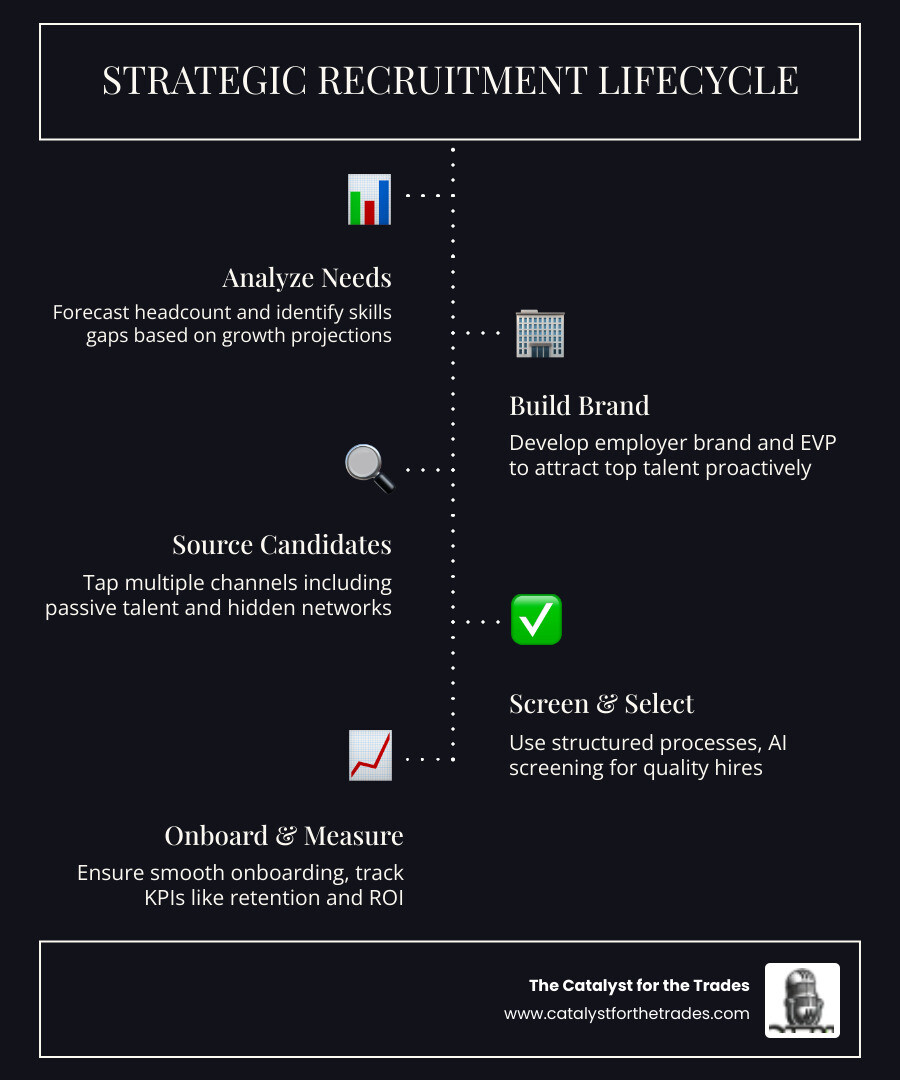
Quick look at strategic recruiting:
Defining Strategic Recruiting for Business Growth
In home services, growth isn’t just about how many trucks you have on the road; it’s about who is driving them and who is managing the dispatch. Strategic recruiting is the bridge between your high-level business goals and the daily reality of your workforce. Unlike traditional recruiting, which often starts only when a vacancy appears, a strategic approach is constantly in motion.
To truly win, organizations must align their talent acquisition efforts with their long-term business objectives. If your goal is to double your HVAC service revenue in two years, your workforce planning must account for the lead time required to find, hire, and integrate senior technicians. Proactive hiring ensures that when the busy season hits, you aren’t turning away customers because you lack the hands to do the work.
By focusing on hiring process optimization, you create a competitive advantage. You aren’t just looking for “a body” to fill a role; you are looking for the right person who will contribute to your company culture and stay for the long haul. This moves the needle from simply surviving the labor market to dominating it.
Building a Comprehensive Strategic Recruitment Plan
Creating a plan that actually works requires looking under the hood of your current operation. It starts with a skills gap analysis to identify the distance between your current team’s capabilities and the skills needed to achieve your next milestone. Once you know what’s missing, you can focus on skill development for existing staff or targeted hiring for new talent.
A robust plan includes:
- Headcount Forecasting: Partnering with your leadership team to predict future needs based on sales targets and seasonal trends.
- Workforce Development: Building a pipeline through workforce development initiatives that prepare future talent.
- Job Description SEO: Writing job postings that don’t just list requirements but sell the opportunity. Using searchable titles and clear headers makes your roles easier to find.
- Employer Branding: Developing a strong employer branding strategy that showcases your culture, values, and why someone would want to work for you.
| Feature | Reactive Recruitment | Proactive Strategic Recruiting |
|---|---|---|
| Trigger | An employee quits or a crisis occurs | Long-term business growth goals |
| Sourcing | Posting to one job board and waiting | Multi-channel sourcing and talent pipelining |
| Candidate Quality | Whoever applies first | Pre-vetted, high-fit candidates |
| Speed | Slow to find the “right” person | Faster with an established pipeline |
How does a strong EVP improve strategic recruiting?
Your Employee Value Proposition (EVP) is the “why” behind your brand. It is the unique set of benefits and values an employee receives in return for their skills. In a market where many job seekers research company reviews and ratings before applying, your reputation is everything.
A strong EVP directly impacts the candidate experience. When your brand sentiment is positive, you attract higher-quality applicants who are already sold on your mission. This leads to higher workplace satisfaction because the reality of the job matches the promise made during the interview.
What role does AI play in a modern strategic recruiting process?
Technology is no longer optional; it’s a force multiplier. In our discussions on How to Win in the Trades: Recruitment, AI, and Trust with Mike Disney, we explore how these tools can free up your team to focus on the human side of hiring.
AI and modern Applicant Tracking Systems (ATS) help with:
- Automated Screening: Using AI to screen resumes so you spend time on the most qualified leads.
- Resume Parsing: Quickly extracting data to compare skills across your talent pool.
- Candidate Engagement: Using AI-driven communication to keep applicants informed, preventing the “black hole” effect that ruins the candidate experience.
- Sourcing: Automating candidate searches to find people who haven’t even applied yet.
By implementing hiring process optimization, teams can reduce time-to-fill and improve consistency in hiring decisions.
Advanced Sourcing: Tapping into Passive and Hidden Talent
If you only look for people who are currently unemployed, you are missing out on the vast majority of the talent pool. According to LinkedIn, 70% of the global workforce consists of passive candidates. These are professionals who aren’t actively looking but would move for the right opportunity.
To reach them, you need specific contractor recruiting strategies and a multi-channel recruitment marketing approach. This includes:
- The Hidden Workforce: Tapping into the 14% to 17% of workers who are often overlooked, such as retirees, caregivers, or neurodiverse individuals.
- Boomerang Employees: Roughly 28% of new hires are people who previously left the organization but returned within three years. Staying on good terms with former staff can pay off significantly.
- Alumni Networks: There are over 118,000 corporate alumni groups on LinkedIn. These are goldmines for referrals and re-hires.
- DEI Integration: Integrating diversity, equity, and inclusion isn’t just about ethics; it’s about expanding your talent pool. Using team building strategies that value different perspectives leads to more innovative and resilient teams.
Measuring Success: KPIs and ROI of Strategic Hiring
You cannot manage what you do not measure. To determine the ROI of your strategic recruiting efforts, you must track key performance indicators (KPIs) that go beyond just “filling the seat.”
- Time-to-Hire: How long does it take from the first contact to a signed offer?
- Quality of Hire: Measured by performance management scores and how quickly a new hire becomes productive.
- Talent Retention: Are your new hires staying? Research shows many new hires decide how long they will stay within their first six months.
- Onboarding Effectiveness: A great onboarding experience can ensure talent retention for years. Organizations with strong onboarding processes see higher long-term retention.
For a deeper dive into keeping the people you work so hard to find, check out our Employee Retention Strategies Guide 2026 and our Talent Management Complete Guide.
Frequently Asked Questions about Talent Acquisition
What are the key elements of a successful recruitment strategy?
A successful strategy requires clear goal setting (knowing exactly who you need and when), diversified sourcing channels (don’t just rely on one job board), a strong recruitment marketing plan to build your brand, and rigorous measurement systems to track what’s working.
How can organizations integrate DEI into their hiring plans?
Start by using inclusive job descriptions that focus on skills rather than “years of experience” or specific degrees. Implement blind auditions or structured interviews to reduce bias, and ensure your interview panels are diverse. This fosters a company culture development environment where everyone feels they have a fair shot.
Why is skills-based hiring becoming a standard practice?
Around 81% of employers report using skills-based hiring. By focusing on what a candidate can actually do rather than where they went to school, you open up the talent pool. Plus, skills-based hires show a 9% higher tenure and often engage more deeply in professional development and skill development.
Conclusion
At The Catalyst for the Trades, we know that your business is only as strong as the people behind the tools. Moving from reactive hiring to strategic recruiting is a powerful step you can take toward operational scaling and leadership excellence. By treating recruitment as a core business strategy rather than an administrative task, you ensure that your company is always ready for the next challenge.
For more insights on building a powerhouse team, explore our Talent Management Complete Guide.
Ready to optimize your hiring strategy? Visit The Catalyst for the Trades today.


