Learn · January 9, 2026
Employee Retention Strategies 2025: Unlock Success
Unlock powerful employee retention strategies. Build a loyal, engaged team with our expert guide to culture, growth, and leadership.
By The Catalyst Editorial Team Operator education · 16 min read · Updated July 24, 2026

Why Employee Retention is Your Business’s Superpower
Employee retention strategies are the backbone of a thriving home services business, yet 93% of organizations worry about keeping their best people. If you’re running an HVAC, plumbing, or electrical company, you know the pain of watching trained technicians walk out the door—taking their skills, customer relationships, and institutional knowledge with them. The average cost to replace just one employee can reach up to two times their annual salary, and with 56% of workers planning to look for new jobs in 2025, retention isn’t just an HR concern—it’s a business survival issue.
Quick Answer: Top Employee Retention Strategies
- Offer competitive compensation and benefits – Fair pay and comprehensive benefits packages
- Invest in professional development – Training, certifications, and clear career paths
- Build a positive company culture – Values alignment, respect, and psychological safety
- Provide flexible work arrangements – When possible, offer scheduling flexibility
- Recognize and reward contributions – Formal programs and peer-to-peer appreciation
- Strengthen leadership quality – Train managers in people skills and communication
- Create internal mobility – Promote from within and offer advancement opportunities
- Maintain open communication – Regular feedback, transparency, and listening to concerns
- Support work-life balance – Prevent burnout through reasonable hours and time off
- Implement mentorship programs – Pair experienced workers with newer team members
Learn more about building a strong employer brand and contact us to transform your retention approach.
The stakes are high. With 3.3 million voluntary separations in October 2024 alone—and research showing that 42% of this turnover is preventable—the businesses that master retention will dominate their markets. High turnover doesn’t just drain your bank account through recruiting and training costs. It damages team morale, disrupts customer service, erases institutional knowledge, and weakens your competitive position.
The good news? Most employees don’t leave because of money alone. Research shows that emotional needs—feeling respected, valued, and heard—top the list of retention drivers. Only 32% of employees believe their pay is fair, but the real retention killers are non-supportive cultures, stressful working conditions, and poor management. In fact, managers can be responsible for as much as 70% of the variance in employee engagement rates.
This guide breaks down the proven strategies that successful trades businesses use to keep their teams loyal and engaged. From building a culture people want to be part of, to creating clear career paths, to mastering the art of recognition—you’ll find practical tactics you can implement immediately.
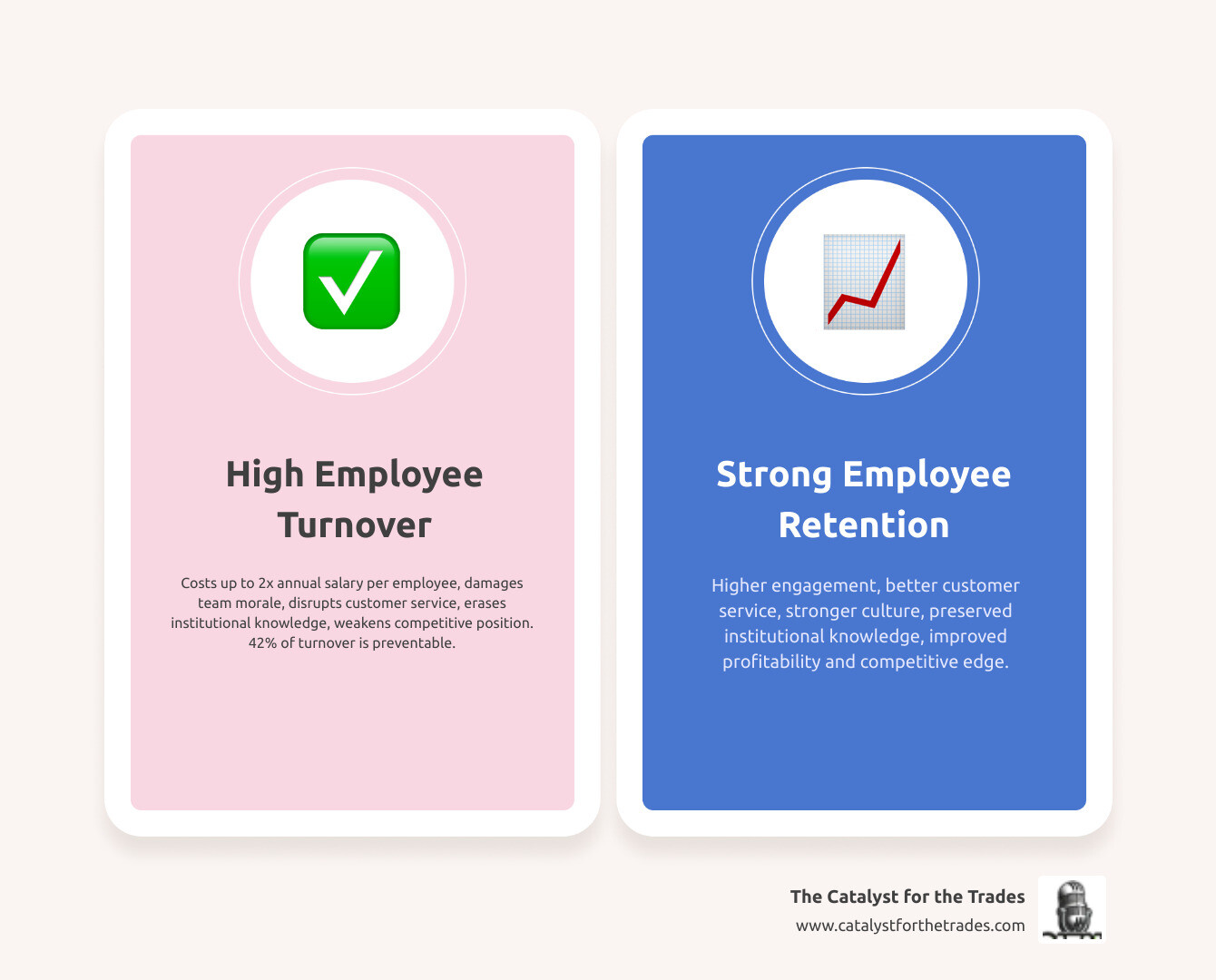
Key employee retention strategies vocabulary:
Building the Foundation: Culture, Compensation, and Wellbeing
At the heart of any successful trades business is its people, and keeping those people happy, healthy, and committed starts with a strong foundation. This foundation is built upon three critical pillars: a compelling company culture, competitive compensation, and a genuine commitment to employee wellbeing. When these elements are in place, we create an environment where our team members don’t just work, they thrive.
A recent study revealed that a non-supportive culture (27%) and stressful working conditions (26%) are significant drivers for employees to quit. Conversely, a culture that champions diversity, equity, inclusion, and mental health are key reasons for 30% of respondents to stay. This tells us that while skills and experience are crucial, the environment we cultivate matters just as much, if not more.
Only 32% of employees believe that their pay is fair, highlighting a significant perception gap. But as we’ll explore, while competitive pay is essential, it’s often the emotional needs—feeling valued, respected, and heard—that ultimately drive loyalty. Moreover, 83% of employees report facing challenges in achieving their wellbeing goals, many of which are directly tied to their jobs. This underscores the need for a holistic approach that supports our team members both professionally and personally.
Creating a Culture That Sticks
A supportive company culture isn’t just a nice-to-have; it’s a powerful employee retention strategy. It’s about fostering an environment where every team member, from the newest apprentice to the most seasoned technician, feels accepted, respected, and treated fairly. This includes a commitment to diversity and inclusion, ensuring that our workplace is psychologically safe and that everyone feels they belong. After all, employees who feel a strong sense of community at work are 66% more likely to stay with their organization.
When we hire new talent, we’re not just looking for skills; we’re looking for individuals whose values align with our company’s ethos. This “cultural fit” ensures that new hires will thrive within our environment, contributing positively to our team dynamic. It’s about building a team where everyone is united by shared values, driving collaboration and creativity.
A strong Employer Branding strategy helps attract the right talent who will naturally fit our culture, and a positive Candidate Experience ensures they get a great first impression, setting the stage for long-term loyalty. Creating a great workplace experience starts even before someone joins our team.
Crafting a Competitive Compensation and Benefits Package
Let’s be real: people need to be paid fairly for their hard work. Offering competitive salaries and benefits is non-negotiable for effective employee retention strategies. We must regularly benchmark our compensation offerings against industry standards to ensure our team members feel valued and adequately rewarded for their expertise in the trades. This isn’t just about matching what others pay; it’s about leading the way.
But compensation goes beyond the hourly rate. A truly competitive package includes:
- Salary Benchmarking: Regularly review salaries from a market analysis and fairness perspective. A 2024 engagement and retention report indicates that seeking better compensation is a top reason for job hunting.
- Performance Bonuses: Reward exceptional effort and results with performance-based bonuses or profit-sharing plans.
- Comprehensive Health Insurance: Go beyond the basics with dental, vision, and even expanded benefits like mental health support, fertility assistance, or elder care.
- Retirement Plans: Offer robust retirement savings plans with employer matching to help our team secure their future.
- Lifestyle Benefits: Consider perks like student loan repayment assistance, sabbaticals, or flexible spending accounts that cater to diverse individual needs.
- Pay Transparency: While full pay transparency (such as publishing all salaries) might be radical for some, increasing transparency around pay structures and decision-making can significantly build trust.
When our team members feel that their pay is fair and their benefits package truly supports their lives, they are far more likely to stay with us.
Investing in Growth: Career Paths and Professional Development
In the dynamic world of home services, standing still means falling behind. Our team members, especially those in the trades, are constantly looking to grow their skills and advance their careers. Investing in their professional development and providing clear career paths is not just a perk; it’s a crucial employee retention strategy that keeps them engaged and prevents them from seeking opportunities elsewhere.
A staggering 86% of employees stated they would leave their current job for another offering more advancement opportunities, and 59% of millennials consider learning opportunities extremely important when applying for jobs. This highlights a clear message: if we want to retain our best talent, we need to show them a future with us. This means fostering upskilling and reskilling, promoting internal mobility, and establishing robust mentorship programs.
Our Talent Management Complete Guide provides a deeper dive into how to strategically develop our workforce.
Key professional development employee retention strategies
Professional development opportunities are a powerful tool in our employee retention strategies arsenal. They directly address our employees’ desires for growth and career advancement, combating job stagnation—a common reason for seeking new roles.
- Training Programs: Offer regular training and upskilling programs custom to the evolving needs of the trades. This could include workshops on new technologies, customer service excellence, or advanced diagnostic techniques.
- Tuition Reimbursement: Support our team members in pursuing relevant courses or certifications by offering tuition reimbursement. This shows we’re invested in their long-term success.
- Clear Career Pathways: Create transparent roadmaps that outline potential advancement opportunities within our company. Employees want to see where their career can go with us. Only 33% of employees are satisfied with promotion opportunities, so we have a chance to stand out here.
- Promoting from Within: Prioritize internal candidates for open positions. This not only rewards loyalty and hard work but also demonstrates that growth is genuinely possible within our organization.
Here are some in-demand skills for trades professionals that we can focus on developing in our team:
- Advanced Diagnostic and Troubleshooting
- Customer Communication and Relationship Building
- Digital Tool Proficiency (e.g., job management software, smart home tech)
- Problem-Solving and Critical Thinking
- Adaptability to New Technologies (e.g., VR for training, IoT devices)
- Safety and Compliance Expertise
- Project Management Basics
- Energy Efficiency and Sustainability Practices
For more insights on cultivating leadership from within, explore our Trades Leadership Development resources.
The Power of Mentorship and Internal Mobility
Mentorship programs are often overlooked but incredibly powerful employee retention strategies. Pairing newer employees with seasoned professionals helps transfer institutional knowledge, provides guidance, and builds strong internal connections. Mentored employees report higher job satisfaction and commitment, and mentee retention rates are likely to be 50% higher than those who haven’t been mentored. This initiative also cultivates a culture of collaboration and innovation.
Internal mobility, allowing employees to move between roles or departments within our company, is equally vital. According to industry data, 53% of organizations that prioritize internal mobility report longer employee tenures. It keeps our talent engaged by offering new challenges and preventing them from feeling stagnant. This also feeds directly into our succession planning, ensuring we have a pipeline of skilled individuals ready for leadership roles.
- Succession Planning: Integrate skill-based training and development programs into our succession plans to prepare employees for future leadership roles.
- Skill-Based Training: Offer custom learning opportunities that equip employees with the specific skills needed for internal advancement.
Our Leadership Circles Guide and the insights from How to Lead, Serve, and Grow in the Trades with Raul Rodriguez offer valuable perspectives on developing our internal talent and fostering effective leadership.
The Human Element: Leadership, Recognition, and Communication
No matter how competitive our pay or how shiny our career paths, people are fundamentally driven by human connection and feeling valued. This is where leadership, recognition, and communication become paramount in our employee retention strategies. The adage “people don’t leave bad jobs, they leave bad managers” rings true for a reason. Managers or team leaders can be responsible for as high as 70% variance in employee engagement rates. This means the quality of our leadership directly impacts our team’s desire to stay.
When employees feel engaged, supported by their leaders, and connected to their colleagues, they are far more likely to commit for the long haul. Building a strong sense of community within the workplace, regularly recognizing contributions, and maintaining open, honest communication channels are not just good practices—they are essential for fostering trust and loyalty.
To dive deeper into cultivating effective leadership, explore The Future of Leadership: How to Build a Team That Drives Growth.
Strengthening Leadership and Fostering Trust
Our leaders are the frontline of our employee retention strategies. Their ability to inspire, support, and communicate effectively is critical. Great managers are linked with a 72% reduction in attrition risk and a 3.2X increase in employee retention. This isn’t magic; it’s the result of intentional effort and proper training.
- Manager Training: Invest in ongoing leadership development programs that equip managers with skills in communication, conflict resolution, empathy, and effective feedback delivery.
- 1-on-1 Meetings: Encourage regular, meaningful one-on-one meetings between employees and their managers. These are crucial for discussing goals, progress, challenges, and career aspirations, preventing employees from feeling disconnected.
- Open-Door Policy: Implement a genuine open-door policy where team members feel comfortable approaching leadership with ideas, questions, or concerns without fear of reprisal.
- Employee Feedback Surveys: Regularly use surveys to gather valuable feedback on management effectiveness, team dynamics, and overall job satisfaction. And crucially, act on this feedback! As an expert notes, “when they get feedback, it’s really tough and challenging to turn that into actual results.” We must be ready to translate insights into action.
Our resources on Organizational Leadership and the story of How Trey McWilliams Balances Big Growth with People-First Leadership offer practical examples of strong leadership in action.
The Impact of Recognition and Open Communication
Who doesn’t love a pat on the back for a job well done? Recognizing and appreciating our team members’ contributions is one of the most cost-effective and powerful employee retention strategies. Research has revealed that employees who feel adequately recognized for their contributions were 45% less likely to have changed organizations two years later. And it’s not just about any recognition; high-quality praise makes employees 65% less likely to seek a new role.
- Formal Recognition Programs: Implement structured programs to highlight achievements, such as “Employee of the Month,” annual awards, or bonuses for exceptional performance.
- Peer-to-Peer Recognition: Encourage team members to recognize each other’s efforts. This builds a strong sense of community and connection, which is vital for retention. Employees who feel a strong sense of community at work are 66% more likely to stay.
- Transparency: Open and honest communication fosters trust, which is the bedrock of loyalty. In a 2024 global human capital trends survey, 86% of leaders said that the more transparent the organization is, the greater the workforce trust. This means being open about company goals, challenges, and decisions.
- Townhall Meetings: Hold regular townhall meetings with executive leadership to share updates, answer questions, and ensure everyone feels informed and heard.
Cultivating Employee Loyalty is deeply intertwined with how we communicate and appreciate our team. Insights from Mike Disney on Building Trust, Recruiting Top Talent, and Winning in the Trades further emphasize the importance of these human elements.
Measuring Success and Adapting Your Employee Retention Strategies
We wouldn’t run our business without tracking our financial performance, so why would we manage our most valuable asset—our people—without measuring our success? Effectively measuring the impact of our employee retention strategies is crucial for understanding what’s working, what isn’t, and where we need to adapt. This continuous feedback loop ensures our efforts are impactful and aligned with evolving employee expectations and market trends. Our Performance Management framework can provide a solid foundation for this.
How to Track the Effectiveness of Your Retention Efforts
To truly understand if our employee retention strategies are hitting the mark, we need to track key performance indicators (KPIs) and gather regular feedback.
- Retention Rate Calculation: This is our most fundamental KPI. We calculate our retention rate by taking the number of employees who stayed during a specific period, dividing it by the number of employees at the start of that period, and multiplying by 100. For example, if we started with 50 employees and 47 remained, our retention rate is 94%. We recommend calculating this monthly or quarterly.
- Turnover Rate Analysis: While retention focuses on who stays, turnover tells us who leaves. Analyzing our turnover rate, especially identifying if the turnover was preventable (remember, 42% often is!), helps us pinpoint specific issues.
- Engagement Scores: Regular employee engagement surveys provide invaluable insights into how connected, motivated, and satisfied our team members feel. A 2023 study showed that while only 23% of employees were engaged globally, companies following HR best practices saw 72% engagement. High engagement correlates with higher retention.
- Feedback Analysis:
- Exit Interviews: These are not just formalities. They provide critical insights into why employees are leaving, helping us identify systemic issues we might otherwise miss.
- Stay Interviews: Proactively checking in with current, valuable employees to understand what makes them stay, what challenges they face, and what might make them leave. This allows us to address concerns before they become reasons for departure.
- Pulse Surveys: Short, frequent surveys to gauge real-time sentiment and gather feedback on specific initiatives.
- Performance Reviews: Use performance reviews not just for evaluation but as opportunities for two-way feedback, goal setting, and career discussions. 51% of employees are not satisfied with the amount of feedback from their supervisor, highlighting a clear area for improvement.
By consistently monitoring these metrics and actively listening to our team, we can adapt our strategies to evolving employee expectations and market trends, ensuring we remain an employer of choice in the trades. For more on leveraging data and trust, check out How to Win in the Trades: Recruitment, AI, and Trust with Mike Disney.
Frequently Asked Questions about Employee Retention
We often hear similar questions from business owners navigating the complexities of keeping their teams. Here are some of the most common ones.
What are the primary drivers of employee turnover today?
Employees leave for a variety of reasons, but several key factors consistently emerge:
- Low Pay: While money isn’t everything, it’s a significant factor. 82% of surveyed US and UK employees said they would leave their current job for a higher salary or better benefits.
- Lack of Advancement Opportunities: If employees don’t see a clear path for growth, they’ll look elsewhere. 86% of employees would leave for another job offering more advancement.
- Poor Management: People often leave managers, not companies. Bad leadership can be a huge motivator for departure.
- Burnout: High workloads, unsustainable expectations, and a lack of work-life balance lead to burnout, which 95% of HR professionals attribute to the loss of good talent.
- Lack of Flexibility: The modern workforce values flexibility. 80% of knowledge workers find flexible work highly valuable, but only 25% experience the level they seek.
- Feeling Disrespected/Undervalued: Emotional needs are critical. Employees who feel unheard, unappreciated, or disrespected are likely to seek a more supportive environment. A non-supportive culture and stressful working conditions are major drivers for quitting.
What is a good employee retention rate for the trades industry?
While retention rates can vary by industry (for example, the average separation rate for the private sector was 4.0% in 2023), a good benchmark to aim for across all sectors is 90% or higher. Achieving this means that less than 10% of our team members are leaving voluntarily each year.
The trades industry might have specific nuances, such as seasonality or project-based work, that can influence typical retention. However, striving for a 90% or higher rate indicates a healthy, stable workforce and successful employee retention strategies.
How often should a business review its retention strategies?
We recommend reviewing our employee retention strategies at least annually or bi-annually. However, continuous monitoring and adaptation throughout the year are equally important. The job market and employee expectations are constantly evolving, so a static strategy won’t cut it.
Here’s why continuous review is key:
- Market Trends: Staying attuned to shifts in compensation, benefits, and work preferences in the broader market.
- Employee Feedback: Regularly analyzing insights from exit interviews, stay interviews, and employee satisfaction surveys helps us identify emerging issues and opportunities for improvement in real-time.
- Organizational Changes: Any significant changes within our company, such as growth, restructuring, or new leadership, should prompt a review of how our retention efforts might need to adapt.
By making retention a dynamic, ongoing process, we can proactively address challenges and ensure our strategies remain effective.
Conclusion: Building a Loyal Team for Long-Term Success
The revolution in how we approach work demands a revolution in our employee retention strategies. It’s clear that keeping our best people isn’t just about filling a spot; it’s about nurturing a thriving ecosystem where talent feels valued, supported, and empowered to grow. We’ve seen that from competitive pay and robust benefits to strong leadership, clear career paths, and genuine recognition, each element plays a vital role in building a loyal, engaged team.
This isn’t a one-and-done task. It’s a continuous commitment to our people, requiring regular assessment, open communication, and a willingness to adapt. By focusing on these core principles, we not only reduce costly turnover but also cultivate a powerful competitive advantage—a stable, skilled, and motivated workforce ready to deliver exceptional service in the trades.
Learn more about building a winning team in the trades with The Catalyst for the Trades, where we combine cutting-edge tech insights with real-world industry experience to help your business grow and thrive.


