Learn · February 25, 2026
Top 5 Strategic Thinking Skills 2026
Master strategic thinking: Boost decision-making, spot opportunities, and drive long-term success for leaders today!
By The Catalyst Editorial Team Operator education · 11 min read · Updated July 24, 2026

Why Strategic Thinking is the Missing Link in Home Services Leadership

Strategic thinking is the difference between reacting to every crisis and building a business that scales predictably. For home services business owners and managers, the daily grind of recruiting technicians, managing service calls, and putting out fires often crowds out the bigger picture. You’re working harder than ever, but growth feels unpredictable, profitability inconsistent, and the path to your eventual exit unclear. The problem isn’t your work ethic—it’s that tactical execution without strategic direction keeps you stuck in the same patterns, year after year.
What is strategic thinking?
- A mental process for analyzing critical factors that influence long-term success
- Synthesis over analysis — connecting disparate information to spot opportunities others miss
- Influencing what you don’t control — shaping customer behavior, market position, and competitive advantage
- Multi-variable decision-making — considering resources, risks, trends, and team capabilities simultaneously
- Future-oriented planning — anticipating threats and opportunities before they arrive
Strategic thinking isn’t reserved for Fortune 500 executives. It’s a learnable skill that transforms how you allocate resources, respond to disruption, and position your business for sustainable growth. Whether you’re exploring Business Strategy Development or ready to take the next step with a strategic planning consultation, developing this capability is how you move from surviving to thriving.
The best part? You don’t need an MBA or a consultant on retainer. You need a deliberate practice routine, the right questions, and a willingness to think beyond tomorrow’s schedule.
Strategic thinking terms to remember:
What is Strategic Thinking?
At its core, strategic thinking is an intentional and rational thought process. It isn’t just “thinking about the future”; it’s a disciplined way of analyzing critical factors and variables that will influence the long-term success of your business. In the trades, we often get caught up in the “What”—what calls are on the board today, or what parts do we need to order? Strategic thinking shifts the focus to the “Why” and the “How.”
This process involves systems thinking, which is the ability to see how different parts of your business interact. For example, if you increase your marketing spend for HVAC installs, how does that affect your service department’s capacity or your cash flow three months from now? It’s about recognizing that your business is a living, breathing network of interconnected parts.
Key elements of this mindset include:
- Future-oriented perspective: Anticipating market shifts before they happen.
- Opportunity spotting: Seeing a gap in the local market for specialized indoor air quality services before your competitors do.
- Risk mitigation: Identifying potential threats, like a sudden shift in refrigerant regulations, and preparing for them early.
- Mental models: Using frameworks to simplify complex realities and make better decisions.
By focusing on Business Strategy Development, we move away from guesswork and toward a logical evaluation of information that drives real competitive advantage.
Strategic Thinking vs. Strategic Planning
It is a common mistake to use these terms interchangeably, but they are distinct parts of the Strategic Planning Process. Think of strategic thinking as the “creative” phase and strategic planning as the “organizational” phase.
| Feature | Strategic Thinking | Strategic Planning |
|---|---|---|
| Focus | Synthesis (Connecting the dots) | Analysis (Breaking things down) |
| Goal | Vision and Innovation | Implementation and Control |
| Flexibility | High; adapts to new info | Lower; follows a set roadmap |
| Question | “Where should we go and why?” | “How do we get there and when?” |
Strategic thinking is about discovery. It requires creative dialogue and a willingness to challenge the status quo. Strategic planning, on the other hand, is about operational control—setting budgets, timelines, and KPIs. You need both to succeed, but without the “thinking” part, your “planning” will likely just lead you to do the same things more efficiently, rather than doing the right things.
Why Strategic Thinking Matters for Leaders
For owners in the HVAC, plumbing, and electrical fields, strategic thinking is the ultimate tool for leadership. It moves you from being the “Lead Firefighter” to being the “Chief Navigator.”
- Adaptability: The world changes fast. Whether it’s new technology or economic shifts, strategic thinkers pivot while others panic.
- Team Alignment: When you have a clear strategic vision, your team knows why they are doing what they do. This creates a culture of purpose rather than just a list of tasks.
- Resource Allocation: You have a limited amount of time, money, and manpower. Strategic thinking ensures these resources are directed toward mission-critical initiatives that drive growth.
- Succession Planning: If you ever want to sell your business or pass it on, you need to think strategically about the future. Succession Planning is a long-term strategic play that starts years before the actual transition.
- Crisis Readiness: Strategic leaders “see around corners.” They have already considered various scenarios, so when a crisis hits, they have a framework for making fast, confident decisions.
Key Characteristics of a Strategic Mindset
Developing a strategic mindset requires more than just a desire to grow; it requires a specific set of cognitive habits. One of the most important is abductive reasoning. While schools often teach deductive and inductive logic, strategic thinkers use abductive reasoning—the “inference to the best explanation.” This means looking at incomplete data (like a slight shift in customer feedback) and asking, “What is the most likely truth here?”
Other vital characteristics include:
- Systems Perspective: Understanding the interdependencies of your business.
- Intent Focus: Having a “strategic intent” that provides the energy and direction for the organization.
- Thinking in Time: Connecting the past, present, and future. How did our history lead us here, and how does today’s decision create tomorrow’s reality?
- Intelligent Opportunism: Being open to new possibilities that don’t necessarily fit the original plan but align with the overall goal. This is a core part of an effective Innovation Strategy.
- Omnivorous Information Consumption: Not just looking at your financial statements, but looking at metaphors, analogies, and trends from completely different industries to find inspiration.
Essential Skills for Strategic Thinking
To be an effective strategic thinker, you need to sharpen several core competencies. It’s not just about “big ideas”; it’s about the ability to execute them logically.
- Analytical Skills: You must be able to look at market conditions, KPIs, and resources objectively.
- Communication: You can have the best strategy in the world, but if you can’t communicate it clearly to your technicians and office staff, it won’t happen.
- Problem-Solving: Strategic thinkers don’t just fix the leak; they perform a root-cause analysis to ensure the leak doesn’t happen again.
- Decisiveness: Gathering data is important, but at some point, you must commit. Strategic thinkers make decisions with confidence and adjust only when new data warrants it.
- Cognitive Flexibility: The ability to switch between logical problem-solving and innovative, out-of-the-box thinking.
- Objective Observation: Seeing the business as it is, not as you wish it were. This is crucial for a winning Competitive Strategy.
Applying Strategy in Complex Environments
The home services industry is a complex environment. You deal with recursive causality—where one action causes a reaction that eventually circles back to affect the original action. For example, a rush to hire “warm bodies” to fill trucks might lead to poor service quality, which leads to bad reviews, which eventually makes it even harder to hire good people.
To steer this, we use:
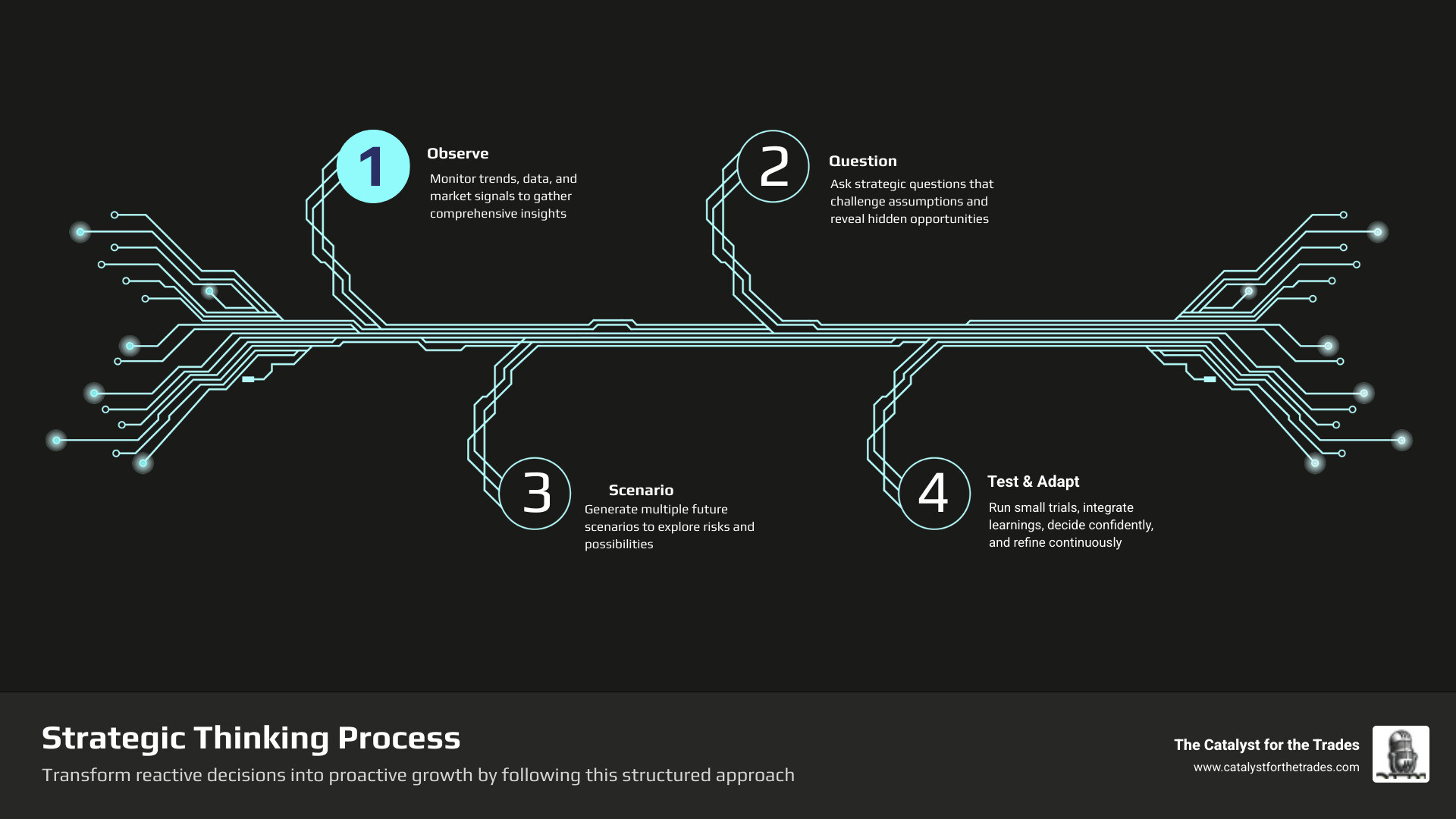
- Scenario Planning: Imagining different futures (e.g., “What if interest rates stay high for two years?”) and preparing for them.
- Holistic Approaches: Looking at the whole system rather than just one department.
- Business Transition Planning: Strategically preparing for the next phase of your business life cycle. Business Transition Planning helps you handle uncertainty by creating a roadmap for change.
How to Improve Your Strategic Abilities
The good news is that strategic thinking is a muscle. The more you use it, the stronger it gets. It starts with creating space. You cannot think strategically if your hair is on fire 24/7.
- The Reflection Process: Schedule uninterrupted time—even just 30 minutes a week—to step back. Ask yourself: “If I were starting this business today with what I know now, what would I do differently?”
- Feedback Loops: Seek feedback from your team, your customers, and even your peers. Use anonymous surveys or post-project reviews to uncover truths you might be missing.
- Challenging Assumptions: We all have biases. Strategic thinkers actively play “devil’s advocate” with their own ideas.
- Technology Strategy: Stay ahead of the curve. Whether it’s new dispatch software or Technology Strategy, understand how tools can give you a strategic edge.
- Formal Training: Don’t be afraid to invest in yourself. Whether it’s an online course or a workshop, structured learning can provide the frameworks you need to think more clearly.
- Contractor AI Strategy: Ignoring AI is a strategic failure. A solid Contractor AI Strategy can help you automate the tactical so you have more time for the strategic.
Practical Exercises for Daily Practice
You don’t need a retreat in the woods to practice strategic thinking. You can build it into your daily routine:
- Ditch Perfectionism: Don’t wait for “perfect” data—it doesn’t exist for the future. Make the best inference you can and move.
- Mind Mapping: Use visual tools to see how different ideas connect.
- Brainstorming: Encourage your team to bring “wild” ideas to the table without judgment.
- Small-Scale Trials: Before rolling out a massive new service line, try a pilot project. Test your hypothesis on a small scale to see if the logic holds up.
- Trend Monitoring: Spend 10 minutes a day reading about trends in home automation, green energy, or consumer behavior.
- The “What Would Have to be True?” Question: When considering a new move, ask: “What would have to be true for this to be the right choice?” This helps uncover the risks and assumptions in your logic. For more deep dives, check out our Contractor Business Strategy Ultimate Guide.
Overcoming Barriers to Strategy
Why isn’t everyone a strategic thinker? Because there are significant barriers, both internal and external.
One of the biggest problems is tactical labeling. Many talented managers in the trades get stuck with the label “great at getting things done, but not strategic.” This often happens because they are so good at firefighting that the organization never lets them put down the hose. To break this, you must demonstrate the ability to see the “big picture” and communicate long-term value.
Other barriers include:
- The Control Illusion: Believing you can control every variable. Strategic thinkers accept that they can only influence certain things, like customer behavior.
- Data Limitations: Relying only on “statistically significant” data. Strategy often requires acting on qualitative insights and metaphors.
- Short-termism: The pressure to hit this month’s numbers can kill long-term Business Growth Strategies.
- Cognitive Bias: We tend to favor information that confirms what we already believe.
- Rigid Adherence: Sticking to a plan even when the environment has changed. Flexibility is a hallmark of the strategic mind.
Frequently Asked Questions about Strategic Thinking
Can strategic thinking be learned or is it innate?
The answer is a resounding “yes” to both. While some people may have a natural inclination toward big-picture thinking, it is absolutely a skill that can be developed through deliberate practice. Like any trade, you start as an apprentice, learn the tools (frameworks), and through mentorship and experience, you become a master. A growth mindset is the only prerequisite.
What are the common disqualifiers for strategic thinkers?
You might be disqualifying yourself from strategic thinking if you:
- Focus only on local optimization (making one department better at the expense of the whole company).
- Refuse to make a move without 100% data certainty.
- Think linearly (A always leads to B) rather than systemically.
- Avoid all risks rather than managing them.
- Work in a silo, ignoring how your decisions affect other teams.
How can organizations foster a strategic culture?
Organizations that excel are those where strategic thinking happens at every level, not just in the owner’s office. You can foster this by:
- Cross-functional collaboration: Get your lead techs and your office manager in the same room to solve problems.
- Open dialogue: Encourage people to ask “Why?” and “What if?”
- Experimentation: Create a safe space for small-scale trials and “intelligent failures.”
- Shared Vision: Ensure everyone knows the “North Star” of the company.
- Empowering Teams: Give people the authority to make decisions within a strategic framework.
Conclusion
At The Catalyst for the Trades, we believe that the difference between a job and a legacy is strategy. By moving away from reactive “guessing” and embracing the disciplined practice of strategic thinking, you open up the potential for true operational scaling and innovation. You aren’t just fixing pipes or AC units; you are building a machine that creates value for your customers, your team, and your family.
Stop letting the daily grind dictate your future. Start asking the tough questions, observing the patterns, and making the integrated choices that lead to strategic excellence.
Ready to transform your business from tactical to strategic? Visit Catalyst for the Trades today to explore our podcast, resources, and strategies designed specifically for the men and women who keep our homes running. Let’s build something that lasts.


