Episode
December 8, 2025

Future-Proof Your Business: A Guide to Developing Your Technology Strategy

Why Your Home Services Business Needs a Technology Strategy Now

A technology strategy is your plan for using technology to achieve specific business goals—from streamlining operations to winning more customers. For home services business owners struggling to scale or compete, a clear technology strategy is the difference between reactive firefighting and proactive growth. It delivers alignment, efficiency, a competitive edge, adaptability, and a measurable ROI by connecting every tech investment directly to business outcomes.

The stakes are high. Research shows that large-scale changes fail about 70 percent of the time, yet global spending on digital change will reach $3.4 trillion by 2026. Many executives now recognize technology investments as a valuable competitive advantage. The home services industry is no exception—companies that strategically adopt AI, cloud computing, and data analytics are pulling ahead while others fall behind.

Ready to future-proof your trades business? Learn How Top Contractors Win: Mindset, AI, and Showing Up in the Trades, and find how The Catalyst for the Trades can help you develop a winning technology strategy.
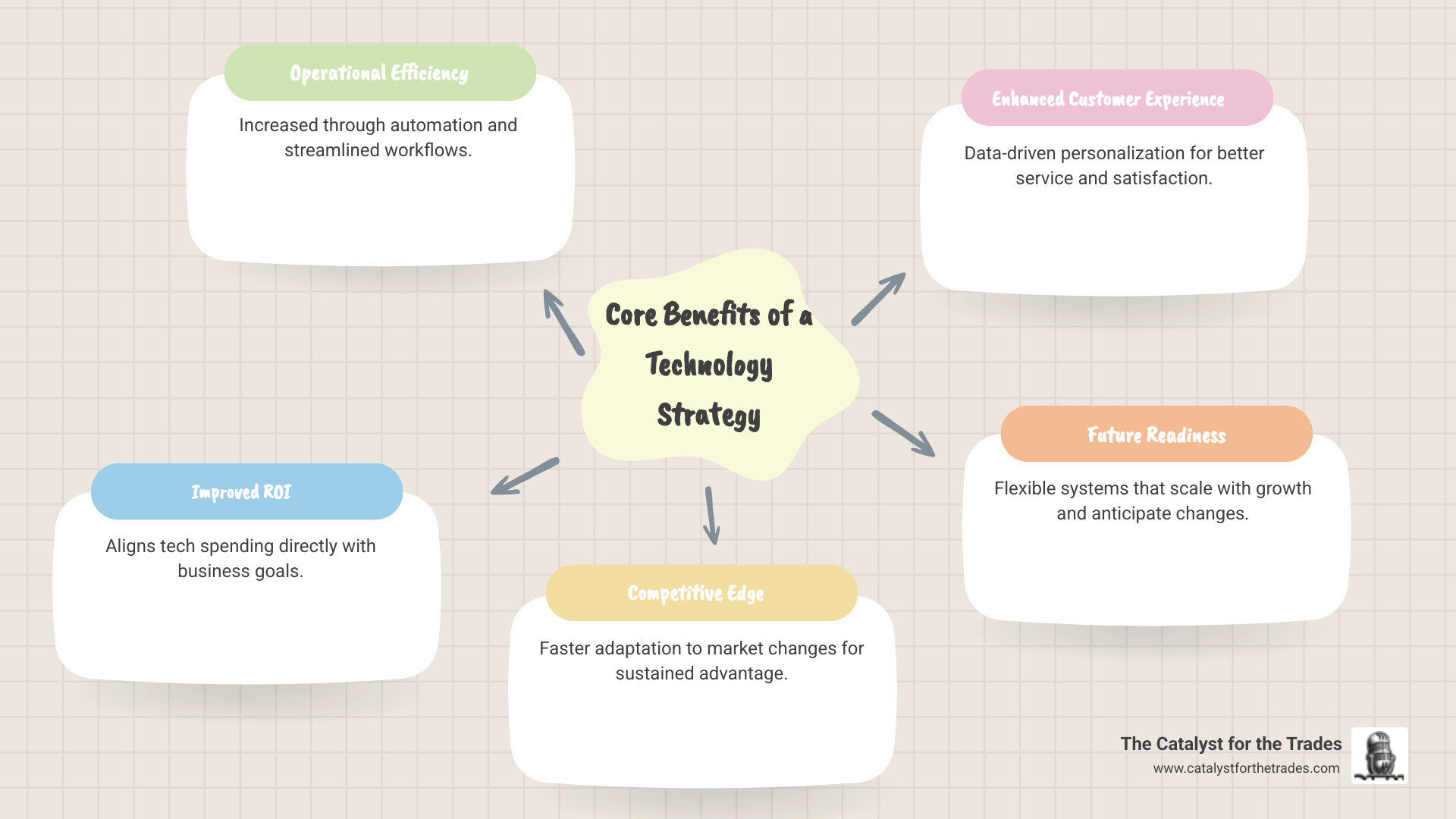
Infographic showing the core benefits of a technology strategy: increased operational efficiency through automation and streamlined workflows, improved return on investment by aligning tech spending with business goals, competitive advantage through faster adaptation to market changes, enhanced customer experience via data-driven personalization, and future readiness by building flexible systems that scale with growth - technology strategy infographic mindmap-5-items

Quick technology strategy definitions:

What is a Technology Strategy and Why is it Crucial for Success?

At its core, a technology strategy is a plan that outlines how an organization will use technology to support its overarching business goals. It's not about buying the latest gadgets; it's about making deliberate choices that contribute to your company's success. Think of it as your digital roadmap.

In the fast-evolving home services sector, where customer expectations are shaped by digital experiences, a well-defined technology strategy is no longer a luxury—it's a necessity.

Why is this so important for your home services business?

  • Business Growth: A clear technology strategy identifies opportunities to expand services, reach new customers, and create new revenue streams.
  • Competitive Advantage: Many executives now recognize technology as a key advantage. If competitors use advanced software and you don't, you're already behind. A proactive strategy helps you stay ahead and differentiate your offerings.
  • Operational Efficiency: Strategically implementing tools for dispatch, inventory, or routing reduces manual errors, saves time, and cuts costs. This translates directly into higher profitability.
  • Data-Driven Decisions: A robust technology strategy ensures you're collecting and analyzing the right data to make informed decisions about customer preferences, peak demand, and service routes.
  • Improved Customer Experience: Technology can transform the client journey with easy online booking, transparent communication, and personalized reminders, building loyalty and positive word-of-mouth.

Without a deliberate technology strategy, businesses risk making ad-hoc tech purchases that lead to fragmented, inefficient, and costly systems. It's like building a house without a blueprint—it won't be stable or meet your long-term needs.

The Blueprint: Key Elements of an Effective Technology Strategy

Building a technology strategy requires understanding where you are, where you want to go, and what tools you'll need to get there.

A flowchart illustrating the core components of a technology strategy, including business objectives, current tech assessment, emerging tech trends, risk management, resource allocation, and implementation roadmap. - technology strategy

Aligning Technology with Business Objectives

Technology for its own sake is expensive clutter. The most critical part of any technology strategy is ensuring it connects directly to your business goals. For example, if your goal is to cut customer wait times, your strategy should specify how technology like dispatch software or route optimization will achieve that.

Start by clarifying your strategic business goals, whether it's growth, higher profit margins, or better customer satisfaction. Then, run a SWOT analysis on your current tech to see what's working and where technology can make the biggest impact. Many executives recognize technology investments as a valuable competitive advantage and are reshaping their strategies around digital tools. This process, known as strategic alignment, separates winning companies from those just collecting software.

Frameworks to Guide Your Technology Strategy

Frameworks provide a structured way to evaluate options and prioritize investments.

One approach is Technology Business Management (TBM), which helps you understand the cost, value, and quality of your tech services. Another is Enterprise Architecture (EA), which acts as a master blueprint for your entire technology landscape, ensuring all your systems work together cohesively.

A simple "strategy on a page" document can also be valuable, boiling down your plan so everyone on the team understands the vision. As McKinsey research shows, clear strategies help organizations grasp the scale of change required.

The Role of Leadership in a Successful Technology Strategy

A technology strategy will fail without strong leadership. The entire leadership team needs to be tech-fluent, meaning they understand what AI, cloud computing, and data analytics can do for the business.

Your CIO or CTO should be a strategic partner who works with other managers to develop the strategy and translate technical jargon into business value. Involving stakeholders from all departments early on is also crucial. When people understand the "why" behind the strategy, you'll face less resistance and see better adoption. This collaborative approach creates a culture of innovation.

As we explore in How Top Contractors Win: Mindset, AI, and Showing Up in the Trades, the right leadership mindset is essential for embracing new tools. When leadership takes ownership of the technology strategy, real change happens.

From Vision to Reality: Implementing and Managing Your Strategy

Having a brilliant technology strategy on paper is just the first step. The real work happens when you bring that vision to life, changing your blueprint into an efficient operation.

A Step-by-Step Implementation Guide

Implementing a technology strategy is a structured process requiring careful planning and execution.

  1. Assess your current state: Take an honest inventory of your existing technology, processes, and infrastructure. A SWOT analysis can help identify strengths, weaknesses, and opportunities.
  2. Define your future state and create a roadmap: Picture what your tech landscape should look like in 3-5 years. Develop a detailed roadmap outlining which technologies to adopt, systems to upgrade, and processes to streamline, including timelines and resources.
  3. Prioritize initiatives: You can't do everything at once. Prioritize projects based on their potential impact on business goals and the resources you have available.
  4. Execute with clear milestones: Move into execution mode with clear milestones, responsibilities, and key performance indicators (KPIs) for each project to track progress.
  5. Measure and adapt continuously: Implementation isn't a one-time event. Continuously monitor KPIs, gather feedback, and adapt your strategy as technology and market conditions evolve.

Overcoming Common Implementation Challenges

Even the best plans face obstacles. Since large-scale transformations fail about 70 percent of the time, awareness of common pitfalls is key.

  • Managing tech sprawl: Over time, businesses accumulate a messy collection of software. A good strategy helps rationalize your tech stack, eliminating redundant systems, reducing costs, and improving system coherence.
  • Ensuring security and compliance: Your strategy must include governance to protect sensitive data and meet regulatory requirements. As ENISA's Executive Director notes, "It is our responsibility to take all measures possible upfront to ensure we increase our resilience".
  • Fostering adaptability: Technology evolves rapidly. Your strategy must include mechanisms for ongoing learning and adaptation, allowing you to revisit the plan when business goals or market conditions change.
  • Change management: New technology means new ways of working, which can meet resistance. Use proven change management frameworks to communicate the "why," provide training, and ensure your team is comfortable with new tools.

How a Strong Strategy Drives Adaptability

In the dynamic home services market, adaptability is a superpower. A robust technology strategy builds organizational resilience, allowing you to steer disruptions. It empowers you to adapt to changing market conditions, respond to competitive threats, and even pivot your business model. Companies that leverage technology strategically can launch new services or enter new markets with a speed that is impossible with outdated systems. This agility is crucial for growth, as we explore in The Future of Home Services: What Smart Companies Are Doing Now.

Leveraging Emerging Tech to Accelerate Growth and Efficiency

A forward-thinking technology strategy accepts emerging innovations like AI, cloud computing, and data analytics as powerful tools for growth and efficiency.
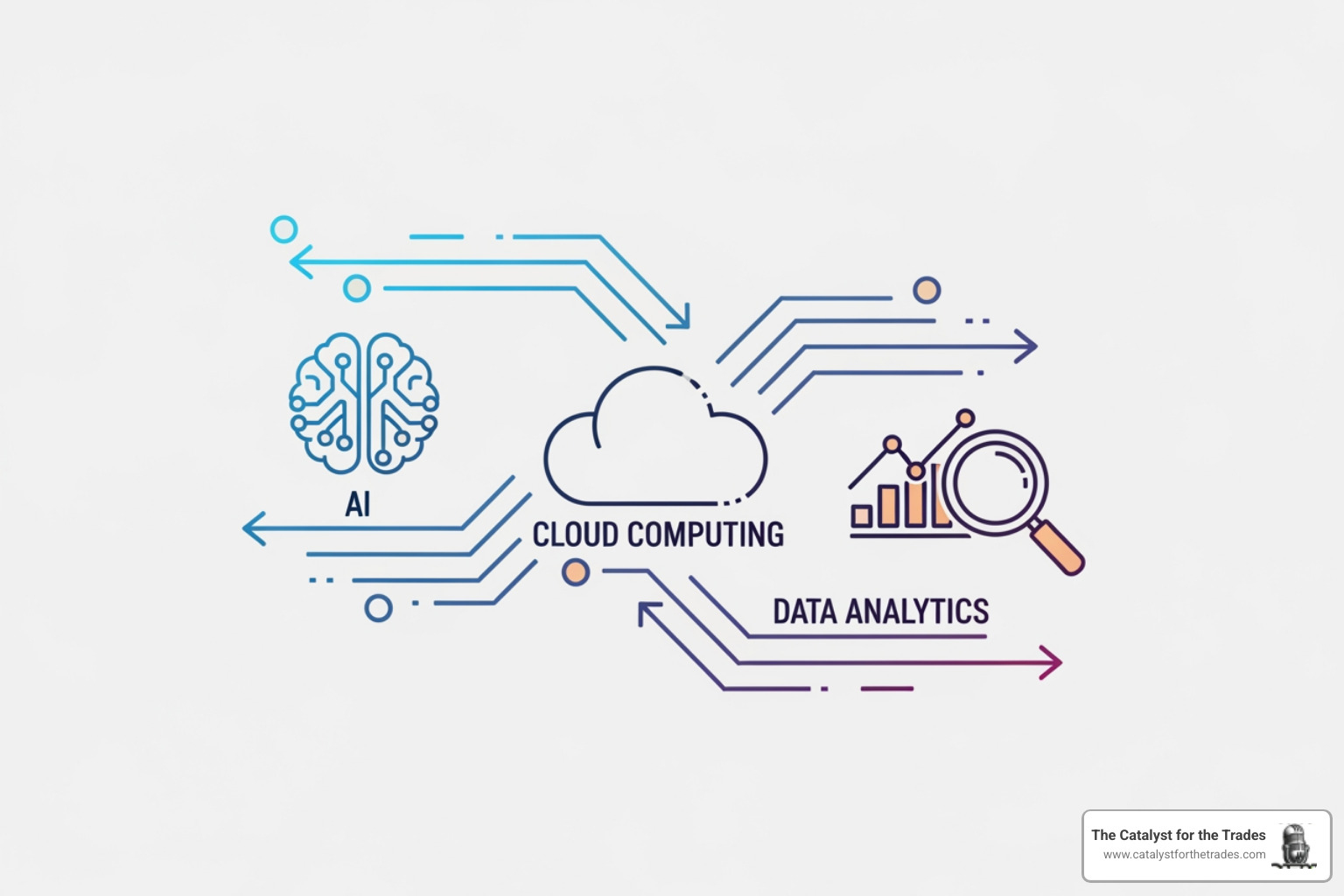
Interconnected icons representing Artificial Intelligence (AI), cloud computing, and data analytics, with lines connecting them to show synergy. - technology strategy

Using AI, Data Analytics, and Business Intelligence

AI, data analytics, and business intelligence are now indispensable for changing raw data into actionable insights. With a solid AI Business Intelligence approach, you can turn your business data into a competitive advantage.

  • AI for customer acquisition: AI-powered tools analyze customer data to optimize marketing outreach, ensuring you spend your budget effectively. Learn more about AI Customer Acquisition.
  • Smarter customer service: AI chatbots and intelligent call routing make communication more efficient and responsive, leading to better AI Customer Service. Brad Scruggs discusses this in How AI is Transforming Call Handling.
  • Boosted operational efficiency: AI and machine learning can forecast demand, optimize scheduling, predict equipment failure, and improve routing to reduce drive time and increase productivity.

Embracing Cloud Computing and Digital Change

Cloud computing offers unparalleled scalability, flexibility, and cost-efficiency. It allows field teams to access information from anywhere and enables you to scale operations without massive hardware investments.

Beyond the cloud, digital change involves integrating technology across all business areas to overhaul operations and improve customer value. With global digital change spending projected to reach $3.4 trillion in 2026, this is a fundamental shift. Embracing it requires a cultural shift toward innovation and continuous learning. As explored in How Tech-Savvy Contractors Will Win: E-commerce, AI, and the Lean Business Revolution, success depends on both the tools and your willingness to adapt.

Creating a Future-Proof Contractor AI Strategy

A future-proof technology strategy anticipates new technologies. This means building a flexible architecture, fostering continuous innovation, and being strategic about AI integration.

A robust digital core integrating cloud, data, and AI allows for easy integration of new tools. Your business should also dedicate time to exploring new tech-inspired ideas. A specific Contractor AI Strategy ensures AI is woven into your business intentionally. As Paul Redman discusses in Future-Proofing Contracting: Paul Redman on Tech, AI, and the New Customer Experience, future-proofing is about building an organization that can adapt to whatever comes next.

Frequently Asked Questions about Technology Strategy

Here are answers to common questions about making a technology strategy work for your home services business.

How can a technology strategy help manage 'tech sprawl'?

"Tech sprawl" is the accumulation of redundant software and systems—a silent profit killer. A well-designed technology strategy acts as an organizing principle to rationalize your systems.

By identifying overlapping tools, you can streamline your tech stack. This means fewer subscriptions, less training on multiple platforms, and cleaner data flow. When systems integrate properly, you eliminate manual data entry and reduce errors. This rationalization also improves data security by minimizing vulnerabilities. The result is a lower total cost of ownership and a more efficient operation.

How often should a business revisit its technology strategy?

A technology strategy is a living document, not a one-time project. We recommend a formal annual review, but you should also revisit it whenever a significant shift occurs. This could be a new business goal, a major market disruption, or the emergence of a game-changing technology like AI.

Your strategy must be flexible and include mechanisms for regular reassessment. This continuous process ensures your tech investments stay aligned with your business's actual direction. As technology strategies have proven invaluable in helping organizations understand the scale of necessary change, staying adaptable is crucial for success.

What are some examples of successful technology strategies?

Successful strategies directly enable specific business goals. Here are some examples relevant to home services:

  • Personalized Customer Experience: A company uses AI and data analytics to understand customer service history and equipment age, allowing them to predict maintenance needs and send personalized reminders. Technicians arrive on-site fully informed, creating a seamless experience.
  • Optimized Field Operations: A plumbing company uses route optimization and mobile field service tools to minimize drive time and maximize daily jobs. Technicians have all necessary information on tablets, can process payments on-site, and automatically update office systems, boosting profitability and customer satisfaction.

These strategies work because they connect technology directly to business outcomes. As we explore in The AI Revolution in Home Services: How to Future-Proof Your Trades Business, the most successful companies view technology as a strategic enabler, not just an expense.

Conclusion: Build Your Business for Tomorrow, Today

A technology strategy is not a static document; it's your living roadmap to success in a rapidly evolving industry. Technology is no longer a cost center but the strategic enabler that separates thriving businesses from those just keeping up. A well-crafted strategy aligns tech investments with business goals, streamlines operations, and builds the adaptability needed to steer market shifts.

Proactive technology adoption—from AI and data analytics to cloud computing—is essential for home service businesses. It's the difference between reacting to change and leading it. This journey requires committed leadership, stakeholder buy-in, and a culture of continuous learning.

You don't have to figure it out alone. The Catalyst for the Trades was created to help. Hosts Jennifer Bagley and Chuck Staszkiewicz combine tech insights with real-world experience to empower home service businesses with practical strategies for growth and innovation.

The future belongs to those who act today. Don't wait for competitors to pull ahead. Start building your future-proof business strategy today and find how the right technology can transform your business from the inside out.

Why Your Home Services Business Needs a Technology Strategy Now

A technology strategy is your plan for using technology to achieve specific business goals—from streamlining operations to winning more customers. For home services business owners struggling to scale or compete, a clear technology strategy is the difference between reactive firefighting and proactive growth. It delivers alignment, efficiency, a competitive edge, adaptability, and a measurable ROI by connecting every tech investment directly to business outcomes.

The stakes are high. Research shows that large-scale changes fail about 70 percent of the time, yet global spending on digital change will reach $3.4 trillion by 2026. Many executives now recognize technology investments as a valuable competitive advantage. The home services industry is no exception—companies that strategically adopt AI, cloud computing, and data analytics are pulling ahead while others fall behind.

Ready to future-proof your trades business? Learn How Top Contractors Win: Mindset, AI, and Showing Up in the Trades, and find how The Catalyst for the Trades can help you develop a winning technology strategy.

Infographic showing the core benefits of a technology strategy: increased operational efficiency through automation and streamlined workflows, improved return on investment by aligning tech spending with business goals, competitive advantage through faster adaptation to market changes, enhanced customer experience via data-driven personalization, and future readiness by building flexible systems that scale with growth - technology strategy infographic mindmap-5-items

Quick technology strategy definitions:

What is a Technology Strategy and Why is it Crucial for Success?

At its core, a technology strategy is a plan that outlines how an organization will use technology to support its overarching business goals. It's not about buying the latest gadgets; it's about making deliberate choices that contribute to your company's success. Think of it as your digital roadmap.

In the fast-evolving home services sector, where customer expectations are shaped by digital experiences, a well-defined technology strategy is no longer a luxury—it's a necessity.

Why is this so important for your home services business?

  • Business Growth: A clear technology strategy identifies opportunities to expand services, reach new customers, and create new revenue streams.
  • Competitive Advantage: Many executives now recognize technology as a key advantage. If competitors use advanced software and you don't, you're already behind. A proactive strategy helps you stay ahead and differentiate your offerings.
  • Operational Efficiency: Strategically implementing tools for dispatch, inventory, or routing reduces manual errors, saves time, and cuts costs. This translates directly into higher profitability.
  • Data-Driven Decisions: A robust technology strategy ensures you're collecting and analyzing the right data to make informed decisions about customer preferences, peak demand, and service routes.
  • Improved Customer Experience: Technology can transform the client journey with easy online booking, transparent communication, and personalized reminders, building loyalty and positive word-of-mouth.

Without a deliberate technology strategy, businesses risk making ad-hoc tech purchases that lead to fragmented, inefficient, and costly systems. It's like building a house without a blueprint—it won't be stable or meet your long-term needs.

The Blueprint: Key Elements of an Effective Technology Strategy

Building a technology strategy requires understanding where you are, where you want to go, and what tools you'll need to get there.

A flowchart illustrating the core components of a technology strategy, including business objectives, current tech assessment, emerging tech trends, risk management, resource allocation, and implementation roadmap. - technology strategy

Aligning Technology with Business Objectives

Technology for its own sake is expensive clutter. The most critical part of any technology strategy is ensuring it connects directly to your business goals. For example, if your goal is to cut customer wait times, your strategy should specify how technology like dispatch software or route optimization will achieve that.

Start by clarifying your strategic business goals, whether it's growth, higher profit margins, or better customer satisfaction. Then, run a SWOT analysis on your current tech to see what's working and where technology can make the biggest impact. Many executives recognize technology investments as a valuable competitive advantage and are reshaping their strategies around digital tools. This process, known as strategic alignment, separates winning companies from those just collecting software.

Frameworks to Guide Your Technology Strategy

Frameworks provide a structured way to evaluate options and prioritize investments.

One approach is Technology Business Management (TBM), which helps you understand the cost, value, and quality of your tech services. Another is Enterprise Architecture (EA), which acts as a master blueprint for your entire technology landscape, ensuring all your systems work together cohesively.

A simple "strategy on a page" document can also be valuable, boiling down your plan so everyone on the team understands the vision. As McKinsey research shows, clear strategies help organizations grasp the scale of change required.

The Role of Leadership in a Successful Technology Strategy

A technology strategy will fail without strong leadership. The entire leadership team needs to be tech-fluent, meaning they understand what AI, cloud computing, and data analytics can do for the business.

Your CIO or CTO should be a strategic partner who works with other managers to develop the strategy and translate technical jargon into business value. Involving stakeholders from all departments early on is also crucial. When people understand the "why" behind the strategy, you'll face less resistance and see better adoption. This collaborative approach creates a culture of innovation.

As we explore in How Top Contractors Win: Mindset, AI, and Showing Up in the Trades, the right leadership mindset is essential for embracing new tools. When leadership takes ownership of the technology strategy, real change happens.

From Vision to Reality: Implementing and Managing Your Strategy

Having a brilliant technology strategy on paper is just the first step. The real work happens when you bring that vision to life, changing your blueprint into an efficient operation.

A Step-by-Step Implementation Guide

Implementing a technology strategy is a structured process requiring careful planning and execution.

  1. Assess your current state: Take an honest inventory of your existing technology, processes, and infrastructure. A SWOT analysis can help identify strengths, weaknesses, and opportunities.
  2. Define your future state and create a roadmap: Picture what your tech landscape should look like in 3-5 years. Develop a detailed roadmap outlining which technologies to adopt, systems to upgrade, and processes to streamline, including timelines and resources.
  3. Prioritize initiatives: You can't do everything at once. Prioritize projects based on their potential impact on business goals and the resources you have available.
  4. Execute with clear milestones: Move into execution mode with clear milestones, responsibilities, and key performance indicators (KPIs) for each project to track progress.
  5. Measure and adapt continuously: Implementation isn't a one-time event. Continuously monitor KPIs, gather feedback, and adapt your strategy as technology and market conditions evolve.

Overcoming Common Implementation Challenges

Even the best plans face obstacles. Since large-scale transformations fail about 70 percent of the time, awareness of common pitfalls is key.

  • Managing tech sprawl: Over time, businesses accumulate a messy collection of software. A good strategy helps rationalize your tech stack, eliminating redundant systems, reducing costs, and improving system coherence.
  • Ensuring security and compliance: Your strategy must include governance to protect sensitive data and meet regulatory requirements. As ENISA's Executive Director notes, "It is our responsibility to take all measures possible upfront to ensure we increase our resilience".
  • Fostering adaptability: Technology evolves rapidly. Your strategy must include mechanisms for ongoing learning and adaptation, allowing you to revisit the plan when business goals or market conditions change.
  • Change management: New technology means new ways of working, which can meet resistance. Use proven change management frameworks to communicate the "why," provide training, and ensure your team is comfortable with new tools.

How a Strong Strategy Drives Adaptability

In the dynamic home services market, adaptability is a superpower. A robust technology strategy builds organizational resilience, allowing you to steer disruptions. It empowers you to adapt to changing market conditions, respond to competitive threats, and even pivot your business model. Companies that leverage technology strategically can launch new services or enter new markets with a speed that is impossible with outdated systems. This agility is crucial for growth, as we explore in The Future of Home Services: What Smart Companies Are Doing Now.

Leveraging Emerging Tech to Accelerate Growth and Efficiency

A forward-thinking technology strategy accepts emerging innovations like AI, cloud computing, and data analytics as powerful tools for growth and efficiency.

Interconnected icons representing Artificial Intelligence (AI), cloud computing, and data analytics, with lines connecting them to show synergy. - technology strategy

Using AI, Data Analytics, and Business Intelligence

AI, data analytics, and business intelligence are now indispensable for changing raw data into actionable insights. With a solid AI Business Intelligence approach, you can turn your business data into a competitive advantage.

  • AI for customer acquisition: AI-powered tools analyze customer data to optimize marketing outreach, ensuring you spend your budget effectively. Learn more about AI Customer Acquisition.
  • Smarter customer service: AI chatbots and intelligent call routing make communication more efficient and responsive, leading to better AI Customer Service. Brad Scruggs discusses this in How AI is Transforming Call Handling.
  • Boosted operational efficiency: AI and machine learning can forecast demand, optimize scheduling, predict equipment failure, and improve routing to reduce drive time and increase productivity.

Embracing Cloud Computing and Digital Change

Cloud computing offers unparalleled scalability, flexibility, and cost-efficiency. It allows field teams to access information from anywhere and enables you to scale operations without massive hardware investments.

Beyond the cloud, digital change involves integrating technology across all business areas to overhaul operations and improve customer value. With global digital change spending projected to reach $3.4 trillion in 2026, this is a fundamental shift. Embracing it requires a cultural shift toward innovation and continuous learning. As explored in How Tech-Savvy Contractors Will Win: E-commerce, AI, and the Lean Business Revolution, success depends on both the tools and your willingness to adapt.

Creating a Future-Proof Contractor AI Strategy

A future-proof technology strategy anticipates new technologies. This means building a flexible architecture, fostering continuous innovation, and being strategic about AI integration.

A robust digital core integrating cloud, data, and AI allows for easy integration of new tools. Your business should also dedicate time to exploring new tech-inspired ideas. A specific Contractor AI Strategy ensures AI is woven into your business intentionally. As Paul Redman discusses in Future-Proofing Contracting: Paul Redman on Tech, AI, and the New Customer Experience, future-proofing is about building an organization that can adapt to whatever comes next.

Frequently Asked Questions about Technology Strategy

Here are answers to common questions about making a technology strategy work for your home services business.

How can a technology strategy help manage 'tech sprawl'?

"Tech sprawl" is the accumulation of redundant software and systems—a silent profit killer. A well-designed technology strategy acts as an organizing principle to rationalize your systems.

By identifying overlapping tools, you can streamline your tech stack. This means fewer subscriptions, less training on multiple platforms, and cleaner data flow. When systems integrate properly, you eliminate manual data entry and reduce errors. This rationalization also improves data security by minimizing vulnerabilities. The result is a lower total cost of ownership and a more efficient operation.

How often should a business revisit its technology strategy?

A technology strategy is a living document, not a one-time project. We recommend a formal annual review, but you should also revisit it whenever a significant shift occurs. This could be a new business goal, a major market disruption, or the emergence of a game-changing technology like AI.

Your strategy must be flexible and include mechanisms for regular reassessment. This continuous process ensures your tech investments stay aligned with your business's actual direction. As technology strategies have proven invaluable in helping organizations understand the scale of necessary change, staying adaptable is crucial for success.

What are some examples of successful technology strategies?

Successful strategies directly enable specific business goals. Here are some examples relevant to home services:

  • Personalized Customer Experience: A company uses AI and data analytics to understand customer service history and equipment age, allowing them to predict maintenance needs and send personalized reminders. Technicians arrive on-site fully informed, creating a seamless experience.
  • Optimized Field Operations: A plumbing company uses route optimization and mobile field service tools to minimize drive time and maximize daily jobs. Technicians have all necessary information on tablets, can process payments on-site, and automatically update office systems, boosting profitability and customer satisfaction.

These strategies work because they connect technology directly to business outcomes. As we explore in The AI Revolution in Home Services: How to Future-Proof Your Trades Business, the most successful companies view technology as a strategic enabler, not just an expense.

Conclusion: Build Your Business for Tomorrow, Today

A technology strategy is not a static document; it's your living roadmap to success in a rapidly evolving industry. Technology is no longer a cost center but the strategic enabler that separates thriving businesses from those just keeping up. A well-crafted strategy aligns tech investments with business goals, streamlines operations, and builds the adaptability needed to steer market shifts.

Proactive technology adoption—from AI and data analytics to cloud computing—is essential for home service businesses. It's the difference between reacting to change and leading it. This journey requires committed leadership, stakeholder buy-in, and a culture of continuous learning.

You don't have to figure it out alone. The Catalyst for the Trades was created to help. Hosts Jennifer Bagley and Chuck Staszkiewicz combine tech insights with real-world experience to empower home service businesses with practical strategies for growth and innovation.

The future belongs to those who act today. Don't wait for competitors to pull ahead. Start building your future-proof business strategy today and find how the right technology can transform your business from the inside out.

Why Your Home Services Business Needs a Technology Strategy Now

A technology strategy is your plan for using technology to achieve specific business goals—from streamlining operations to winning more customers. For home services business owners struggling to scale or compete, a clear technology strategy is the difference between reactive firefighting and proactive growth. It delivers alignment, efficiency, a competitive edge, adaptability, and a measurable ROI by connecting every tech investment directly to business outcomes.

The stakes are high. Research shows that large-scale changes fail about 70 percent of the time, yet global spending on digital change will reach $3.4 trillion by 2026. Many executives now recognize technology investments as a valuable competitive advantage. The home services industry is no exception—companies that strategically adopt AI, cloud computing, and data analytics are pulling ahead while others fall behind.

Ready to future-proof your trades business? Learn How Top Contractors Win: Mindset, AI, and Showing Up in the Trades, and find how The Catalyst for the Trades can help you develop a winning technology strategy.

Infographic showing the core benefits of a technology strategy: increased operational efficiency through automation and streamlined workflows, improved return on investment by aligning tech spending with business goals, competitive advantage through faster adaptation to market changes, enhanced customer experience via data-driven personalization, and future readiness by building flexible systems that scale with growth - technology strategy infographic mindmap-5-items

Quick technology strategy definitions:

What is a Technology Strategy and Why is it Crucial for Success?

At its core, a technology strategy is a plan that outlines how an organization will use technology to support its overarching business goals. It's not about buying the latest gadgets; it's about making deliberate choices that contribute to your company's success. Think of it as your digital roadmap.

In the fast-evolving home services sector, where customer expectations are shaped by digital experiences, a well-defined technology strategy is no longer a luxury—it's a necessity.

Why is this so important for your home services business?

  • Business Growth: A clear technology strategy identifies opportunities to expand services, reach new customers, and create new revenue streams.
  • Competitive Advantage: Many executives now recognize technology as a key advantage. If competitors use advanced software and you don't, you're already behind. A proactive strategy helps you stay ahead and differentiate your offerings.
  • Operational Efficiency: Strategically implementing tools for dispatch, inventory, or routing reduces manual errors, saves time, and cuts costs. This translates directly into higher profitability.
  • Data-Driven Decisions: A robust technology strategy ensures you're collecting and analyzing the right data to make informed decisions about customer preferences, peak demand, and service routes.
  • Improved Customer Experience: Technology can transform the client journey with easy online booking, transparent communication, and personalized reminders, building loyalty and positive word-of-mouth.

Without a deliberate technology strategy, businesses risk making ad-hoc tech purchases that lead to fragmented, inefficient, and costly systems. It's like building a house without a blueprint—it won't be stable or meet your long-term needs.

The Blueprint: Key Elements of an Effective Technology Strategy

Building a technology strategy requires understanding where you are, where you want to go, and what tools you'll need to get there.

A flowchart illustrating the core components of a technology strategy, including business objectives, current tech assessment, emerging tech trends, risk management, resource allocation, and implementation roadmap. - technology strategy

Aligning Technology with Business Objectives

Technology for its own sake is expensive clutter. The most critical part of any technology strategy is ensuring it connects directly to your business goals. For example, if your goal is to cut customer wait times, your strategy should specify how technology like dispatch software or route optimization will achieve that.

Start by clarifying your strategic business goals, whether it's growth, higher profit margins, or better customer satisfaction. Then, run a SWOT analysis on your current tech to see what's working and where technology can make the biggest impact. Many executives recognize technology investments as a valuable competitive advantage and are reshaping their strategies around digital tools. This process, known as strategic alignment, separates winning companies from those just collecting software.

Frameworks to Guide Your Technology Strategy

Frameworks provide a structured way to evaluate options and prioritize investments.

One approach is Technology Business Management (TBM), which helps you understand the cost, value, and quality of your tech services. Another is Enterprise Architecture (EA), which acts as a master blueprint for your entire technology landscape, ensuring all your systems work together cohesively.

A simple "strategy on a page" document can also be valuable, boiling down your plan so everyone on the team understands the vision. As McKinsey research shows, clear strategies help organizations grasp the scale of change required.

The Role of Leadership in a Successful Technology Strategy

A technology strategy will fail without strong leadership. The entire leadership team needs to be tech-fluent, meaning they understand what AI, cloud computing, and data analytics can do for the business.

Your CIO or CTO should be a strategic partner who works with other managers to develop the strategy and translate technical jargon into business value. Involving stakeholders from all departments early on is also crucial. When people understand the "why" behind the strategy, you'll face less resistance and see better adoption. This collaborative approach creates a culture of innovation.

As we explore in How Top Contractors Win: Mindset, AI, and Showing Up in the Trades, the right leadership mindset is essential for embracing new tools. When leadership takes ownership of the technology strategy, real change happens.

From Vision to Reality: Implementing and Managing Your Strategy

Having a brilliant technology strategy on paper is just the first step. The real work happens when you bring that vision to life, changing your blueprint into an efficient operation.

A Step-by-Step Implementation Guide

Implementing a technology strategy is a structured process requiring careful planning and execution.

  1. Assess your current state: Take an honest inventory of your existing technology, processes, and infrastructure. A SWOT analysis can help identify strengths, weaknesses, and opportunities.
  2. Define your future state and create a roadmap: Picture what your tech landscape should look like in 3-5 years. Develop a detailed roadmap outlining which technologies to adopt, systems to upgrade, and processes to streamline, including timelines and resources.
  3. Prioritize initiatives: You can't do everything at once. Prioritize projects based on their potential impact on business goals and the resources you have available.
  4. Execute with clear milestones: Move into execution mode with clear milestones, responsibilities, and key performance indicators (KPIs) for each project to track progress.
  5. Measure and adapt continuously: Implementation isn't a one-time event. Continuously monitor KPIs, gather feedback, and adapt your strategy as technology and market conditions evolve.

Overcoming Common Implementation Challenges

Even the best plans face obstacles. Since large-scale transformations fail about 70 percent of the time, awareness of common pitfalls is key.

  • Managing tech sprawl: Over time, businesses accumulate a messy collection of software. A good strategy helps rationalize your tech stack, eliminating redundant systems, reducing costs, and improving system coherence.
  • Ensuring security and compliance: Your strategy must include governance to protect sensitive data and meet regulatory requirements. As ENISA's Executive Director notes, "It is our responsibility to take all measures possible upfront to ensure we increase our resilience".
  • Fostering adaptability: Technology evolves rapidly. Your strategy must include mechanisms for ongoing learning and adaptation, allowing you to revisit the plan when business goals or market conditions change.
  • Change management: New technology means new ways of working, which can meet resistance. Use proven change management frameworks to communicate the "why," provide training, and ensure your team is comfortable with new tools.

How a Strong Strategy Drives Adaptability

In the dynamic home services market, adaptability is a superpower. A robust technology strategy builds organizational resilience, allowing you to steer disruptions. It empowers you to adapt to changing market conditions, respond to competitive threats, and even pivot your business model. Companies that leverage technology strategically can launch new services or enter new markets with a speed that is impossible with outdated systems. This agility is crucial for growth, as we explore in The Future of Home Services: What Smart Companies Are Doing Now.

Leveraging Emerging Tech to Accelerate Growth and Efficiency

A forward-thinking technology strategy accepts emerging innovations like AI, cloud computing, and data analytics as powerful tools for growth and efficiency.

Interconnected icons representing Artificial Intelligence (AI), cloud computing, and data analytics, with lines connecting them to show synergy. - technology strategy

Using AI, Data Analytics, and Business Intelligence

AI, data analytics, and business intelligence are now indispensable for changing raw data into actionable insights. With a solid AI Business Intelligence approach, you can turn your business data into a competitive advantage.

  • AI for customer acquisition: AI-powered tools analyze customer data to optimize marketing outreach, ensuring you spend your budget effectively. Learn more about AI Customer Acquisition.
  • Smarter customer service: AI chatbots and intelligent call routing make communication more efficient and responsive, leading to better AI Customer Service. Brad Scruggs discusses this in How AI is Transforming Call Handling.
  • Boosted operational efficiency: AI and machine learning can forecast demand, optimize scheduling, predict equipment failure, and improve routing to reduce drive time and increase productivity.

Embracing Cloud Computing and Digital Change

Cloud computing offers unparalleled scalability, flexibility, and cost-efficiency. It allows field teams to access information from anywhere and enables you to scale operations without massive hardware investments.

Beyond the cloud, digital change involves integrating technology across all business areas to overhaul operations and improve customer value. With global digital change spending projected to reach $3.4 trillion in 2026, this is a fundamental shift. Embracing it requires a cultural shift toward innovation and continuous learning. As explored in How Tech-Savvy Contractors Will Win: E-commerce, AI, and the Lean Business Revolution, success depends on both the tools and your willingness to adapt.

Creating a Future-Proof Contractor AI Strategy

A future-proof technology strategy anticipates new technologies. This means building a flexible architecture, fostering continuous innovation, and being strategic about AI integration.

A robust digital core integrating cloud, data, and AI allows for easy integration of new tools. Your business should also dedicate time to exploring new tech-inspired ideas. A specific Contractor AI Strategy ensures AI is woven into your business intentionally. As Paul Redman discusses in Future-Proofing Contracting: Paul Redman on Tech, AI, and the New Customer Experience, future-proofing is about building an organization that can adapt to whatever comes next.

Frequently Asked Questions about Technology Strategy

Here are answers to common questions about making a technology strategy work for your home services business.

How can a technology strategy help manage 'tech sprawl'?

"Tech sprawl" is the accumulation of redundant software and systems—a silent profit killer. A well-designed technology strategy acts as an organizing principle to rationalize your systems.

By identifying overlapping tools, you can streamline your tech stack. This means fewer subscriptions, less training on multiple platforms, and cleaner data flow. When systems integrate properly, you eliminate manual data entry and reduce errors. This rationalization also improves data security by minimizing vulnerabilities. The result is a lower total cost of ownership and a more efficient operation.

How often should a business revisit its technology strategy?

A technology strategy is a living document, not a one-time project. We recommend a formal annual review, but you should also revisit it whenever a significant shift occurs. This could be a new business goal, a major market disruption, or the emergence of a game-changing technology like AI.

Your strategy must be flexible and include mechanisms for regular reassessment. This continuous process ensures your tech investments stay aligned with your business's actual direction. As technology strategies have proven invaluable in helping organizations understand the scale of necessary change, staying adaptable is crucial for success.

What are some examples of successful technology strategies?

Successful strategies directly enable specific business goals. Here are some examples relevant to home services:

  • Personalized Customer Experience: A company uses AI and data analytics to understand customer service history and equipment age, allowing them to predict maintenance needs and send personalized reminders. Technicians arrive on-site fully informed, creating a seamless experience.
  • Optimized Field Operations: A plumbing company uses route optimization and mobile field service tools to minimize drive time and maximize daily jobs. Technicians have all necessary information on tablets, can process payments on-site, and automatically update office systems, boosting profitability and customer satisfaction.

These strategies work because they connect technology directly to business outcomes. As we explore in The AI Revolution in Home Services: How to Future-Proof Your Trades Business, the most successful companies view technology as a strategic enabler, not just an expense.

Conclusion: Build Your Business for Tomorrow, Today

A technology strategy is not a static document; it's your living roadmap to success in a rapidly evolving industry. Technology is no longer a cost center but the strategic enabler that separates thriving businesses from those just keeping up. A well-crafted strategy aligns tech investments with business goals, streamlines operations, and builds the adaptability needed to steer market shifts.

Proactive technology adoption—from AI and data analytics to cloud computing—is essential for home service businesses. It's the difference between reacting to change and leading it. This journey requires committed leadership, stakeholder buy-in, and a culture of continuous learning.

You don't have to figure it out alone. The Catalyst for the Trades was created to help. Hosts Jennifer Bagley and Chuck Staszkiewicz combine tech insights with real-world experience to empower home service businesses with practical strategies for growth and innovation.

The future belongs to those who act today. Don't wait for competitors to pull ahead. Start building your future-proof business strategy today and find how the right technology can transform your business from the inside out.

Episodes you may like

Future-Proofing Your Business with AI: A Conversation with Remy Skerjanz

If you're a home service business owner trying to make sense of the changing tech landscape, this is a must-watch episode. Discover some of the highlights below.

Read more
Published
December 8, 2025
Connect and Conquer: Understanding CRM

Conquer growth! Learn how customer relationship management empowers home services with data, boosts efficiency, and delights customers.

Read more
Published
December 5, 2025
Beyond the Click: Strategies for Supercharging Lead Generation and Conversion

Boost sales! Discover top strategies for lead conversion optimization, leveraging nurturing, AI, and data-driven personalization.

Read more
Published
December 4, 2025

Guests

Remy Skerjanz
Sales Blaster AI