Learn · February 20, 2026
Contractor Leadership: 2026's Path to Victory
Lead your crew to victory! Master essential contractor leadership strategies for project success, safety, and team empowerment.
By The Catalyst Editorial Team Operator education · 9 min read · Updated July 24, 2026

The Core of Effective Contractor Leadership

Contractor leadership is about more than just managing projects; it’s about inspiring teams, fostering growth, and ensuring lasting success in the dynamic world of the trades. For business owners and managers in home services, strong leadership is the engine that drives operational scaling, boosts profitability, and steers challenges like talent recruitment and new technology adoption. It’s the critical difference between merely completing tasks and building a high-performance organization.
Here’s what contractor leadership involves:
- Setting clear expectations and standards: Defining roles, quality, and policies.
- Effective communication: Ensuring everyone is aligned with project goals.
- Building strong relationships: Fostering trust with both internal teams and external partners.
- Providing support and resources: Equipping teams with what they need to succeed.
- Monitoring performance and giving feedback: Guiding growth and accountability.
- Resolving conflicts: Addressing challenges fairly and effectively.
- Prioritizing safety: Creating a secure and healthy work environment.
- Investing in continuous learning: Staying ahead in an evolving industry.
Great leadership helps your business adapt and thrive. It secures your legacy and prepares your company for future opportunities. To truly excel, you need a plan for developing leaders at every level of your organization.
Ready to boost your team’s potential? Explore how to build a high-performing team by investing in Trades Leadership Development for your organization, and connect with The Catalyst for the Trades to learn more.
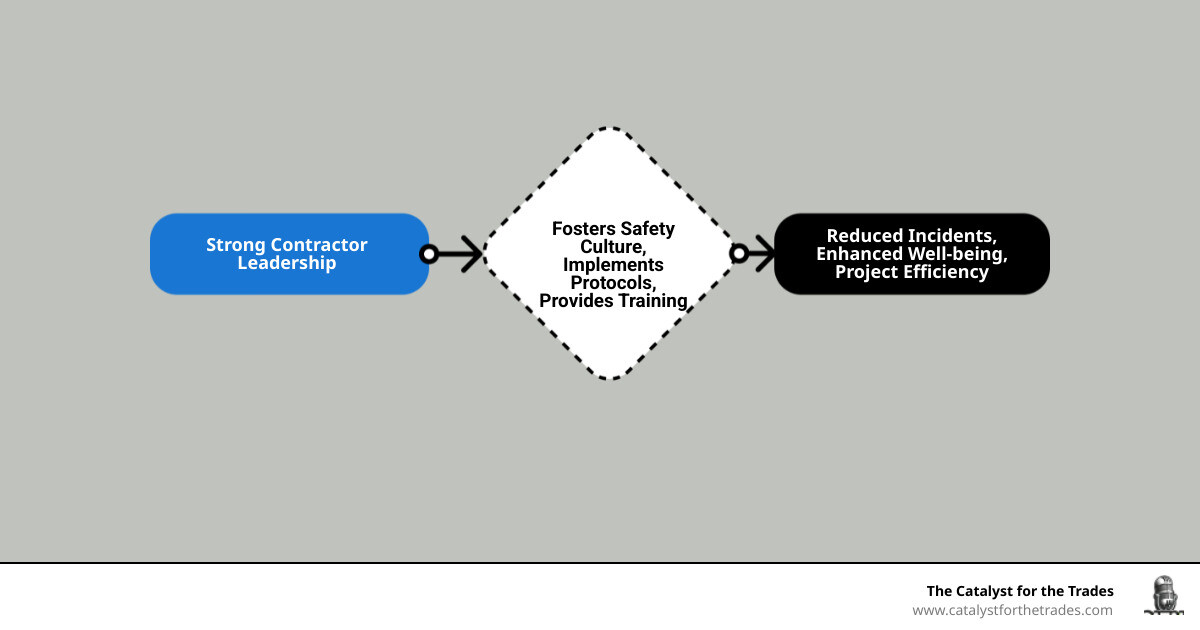
Contractor leadership definitions:
Foundations of Effective Contractor Leadership
At the heart of every successful home service business is a foundation built on more than just technical skill. It is built on contractor leadership that prioritizes people as much as it does pipes or HVAC units. We often see business owners get caught in the “technician trap”—being so good at the trade that they forget to lead the humans doing the work.
Effective Organizational Leadership requires a fundamental shift in mindset. You are no longer just the person fixing the comfort system; you are the person running the company. This means moving from “doing” to “guiding.” Research shows that when leaders set a clear vision and remove hierarchical barriers, the “us versus them” mentality disappears, and safety and productivity skyrocket.
Contractor Leadership: Leading by Example
If we want our crews to show up on time, wear their PPE, and treat customers with respect, we have to do the same. Transparency and professionalism aren’t just buzzwords; they are the currency of trust. When we are self-aware and consistent in our values, our crews respond positively.
In our experience, and as highlighted in Unfiltered Leadership Lessons from Kathryn Elizabeth and Laura Kelly, authenticity is key. If you make a mistake on a bid or a schedule, own it. This level of accountability sets a standard that your team will mirror. Leading by example means exhibiting the work ethic you expect to see in the field every single day.
Building a Culture of Safety and Trust
Safety isn’t just about avoiding OSHA fines; it’s a leadership responsibility. A strong safety culture is built when leaders visibly and consistently demonstrate safe behaviors. This includes honoring “stop-work” calls and proactively addressing hazards.
According to industry data, STEP members who consistently track safety indicators are nearly six times safer than the industry average. By involving your crews in problem-solving and hazard identification, you empower them. As discussed in Jazmin Ramirez: How Real Leadership Powers Change in the Trades, real leadership is what powers sustainable change, moving safety from a checklist to a core value.
Communication and Relationship Building Strategies
Communication failures account for a staggering portion of workplace issues—exceeding 93% in some studies. In construction and home services, poor communication isn’t just annoying; it’s dangerous. It contributes to 72% of workplace incidents. Effective contractor leadership hinges on your ability to bridge the gap between the office and the job site.
We need to move beyond “checking the box” with meetings. Every interaction should provide value and clarity. This involves developing Management Development skills that focus on active listening. Active listening means giving your full attention, acknowledging nonverbal signals, and showing genuine interest in the crew’s feedback.
Effective Communication Strategies for Contractor Leadership
Clear expectations are the antidote to project delays. We must define project timelines, deliverables, and quality standards with absolute precision. Utilizing tools like project management software can streamline this, but the human element remains paramount.
As we explore in How AI Voice and Chat Are Changing the Home Service Game, technology can improve how we communicate, but it cannot replace the leader’s voice. Whether you are Navigating AI, Change, and Growth in Home Services or simply running a morning huddle, your message must be both clear and motivational.
Fostering Strong Relationships with External Partners
No contractor is an island. Our success depends on Strategic Partnerships with suppliers, subcontractors, and vendors. Building rapport based on mutual respect ensures that when you need a favor—like a last-minute parts delivery—your partners are willing to go the extra mile.
Implementing solid Vendor Management Strategies involves open communication and transparency. When we treat our partners as an extension of our own team, we create a collaborative environment that benefits the client and the bottom line.
Performance Monitoring and Accountability
How do we ensure the work actually gets done to our standards? It starts with a robust Performance Management system. Monitoring performance isn’t about micromanagement; it’s about maintaining the quality that protects our reputation.
In contracting, your reputation lives or dies with each project. Therefore, leaders must be proactive in How to Protect Profit and Lead with Purpose in Home Services. This means evaluating deliverables regularly and providing feedback that is constructive, not destructive.
| Feature | Managing In-House Staff | Managing Independent Contractors |
|---|---|---|
| Focus | Long-term career growth & culture | Project-specific deliverables & KPIs |
| Direction | High level of daily supervision | High level of autonomy & results-oriented |
| Accountability | Standard HR policies & reviews | Contractual obligations & project milestones |
| Relationship | Employer-Employee bond | Professional B2B partnership |
Establishing Clear Standards and Expectations
Accountability only works if people know what they are being held accountable for. We must clearly define the consequences of not meeting standards, but also the rewards for exceeding them.
How Trey McWilliams Balances Big Growth with People-First Leadership shows us that growth and people-first values can coexist. By setting high standards for policy adherence while remaining approachable, you create a culture where employees want to perform well, rather than just doing enough to avoid getting in trouble.
Ensuring Accountability Through Data and Feedback
“What gets measured gets managed.” To lead effectively, you must Know Your Numbers, Grow Your Business: Financial Strategies for Trades. This includes tracking everything from call booking rates to labor percentages.
Data provides an objective basis for feedback. Instead of saying “you’re slow,” you can say “the data shows this install took 20% longer than our standard.” This shifts the conversation from a personal critique to a professional problem-solving session.
Addressing Challenges and Conflict Resolution
Disagreements are inevitable when you have high-stakes projects and tight deadlines. Contractor leadership is tested most during these moments of friction. Whether it’s a dispute between two techs or a disagreement with a client, we must handle it with professionalism and a calm demeanor.
Mastering Conflict Resolution on the Job Site
Conflict resolution requires us to be comfortable with hard, uncomfortable conversations. We must listen to all parties involved before making a decision. The goal is to find lasting solutions that align with project goals, rather than temporary fixes that leave resentment simmering.
As we discuss in How to Unlock Real Growth, Transformation, Follow-Up, and Future-Proofing in the Trades, mastering these soft skills is what allows a business to scale. Using a Leadership Circles Guide can help you and your management team practice these scenarios in a safe environment.
Supporting Mental Health and Physical Well-being
We cannot ignore the human toll of our industry. Construction workers and tradespeople have higher rates of mental health issues compared to the general population. Strong contractor leadership involves recognizing when a team member is struggling.
Investing in Company Culture Development means providing resources for both physical and mental health. This could be as simple as ensuring proper PPE to prevent eye strain or as complex as implementing Change Management strategies that reduce workplace stress during busy seasons.
The Future of Leadership in the Trades
The trades are changing rapidly. From the rise of Gen Z to the integration of AI, the leaders of tomorrow will look different than the leaders of yesterday. Companies utilizing VR simulations for training, for example, report improved recruitment and retention.
Embracing Technological Innovation
We must stay informed about industry trends to relay valuable information to our teams. Whether it’s The AI Revolution in Home Services: How to Future-Proof Your Trades Business or new project management software, technology is a tool for the modern leader.
You can’t afford to wait to Lead Digital Transformation in Home Service Marketing. Embracing these changes shows your team that you are committed to the long-term success of the business. For more insights on this, check out The Future of Leadership: How to Build a Team That Drives Growth.
Developing the Next Generation of Leader-Managers
The best future leaders are often already working within your organization. We need to create structured ways for key employees to gain business experience—like managing project budgets or participating in bonding discussions.
Succession Planning and Business Transition Planning should be natural and gradual. By mentoring internal talent today, you protect your legacy and ensure the company thrives long after you’ve stepped back from daily operations.
Frequently Asked Questions about Contractor Leadership
What are the key differences between managing in-house staff and contractors?
Managing in-house staff focuses on long-term cultural integration and career development. Managing contractors is often more project-based, requiring a focus on specific deliverables, contractual boundaries, and a high degree of independent autonomy. For a deeper dive, see A Fair Way to Lead a Team of Contractors and Full-Time Employees.
How can leaders ensure contractors align with project goals?
Alignment is achieved through clear documentation of project scopes, regular check-ins, and a shared vision of the final outcome. It’s about ensuring the contractor understands not just what to do, but why it matters to the overall Strategic Planning Process.
What role does providing resources play in contractor success?
A leader’s job is to remove roadblocks. Ensuring contractors have access to the right tools, equipment, and site data is essential for Operational Efficiency. If they are waiting on you for resources, your project momentum stalls.
Conclusion
The journey of contractor leadership is a continuous process of growth. It requires a commitment to a growth mindset, a passion for operational scaling, and a willingness to accept innovation. By focusing on the strategies outlined in this guide, you can transform your crew into a high-performance team that delivers excellence on every job.
At The Catalyst for the Trades, we are dedicated to helping you steer this journey. Whether you are looking to integrate AI into your workflow or develop your next generation of managers, we provide the insights you need to win.
Take the next step in your leadership journey with The Catalyst for the Trades and let’s build a future for your business that is as strong as the work you do.


