Learn to boost output & reduce costs. Master operational efficiency with strategies, tools, and metrics for your trade business.

Company culture development is the process of intentionally shaping the shared values, behaviors, and environment that define how your team works, communicates, and performs. For home services business owners and managers, a strong culture directly impacts your ability to attract and retain skilled technicians, deliver consistent customer experiences, and scale profitably in an increasingly competitive market.
Key elements of effective company culture development include:
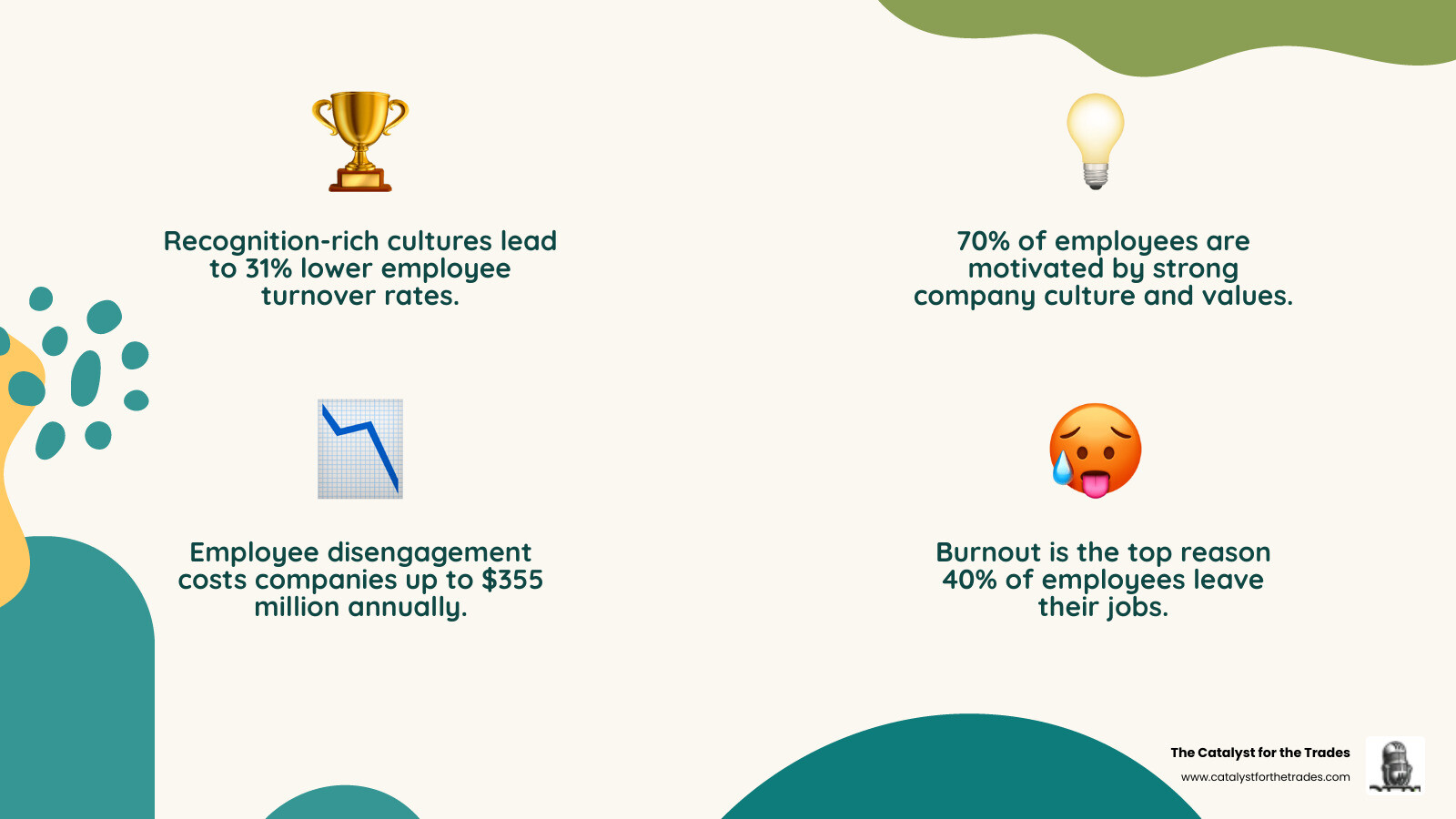
According to a Salesforce report, more than 70 percent of U.S. employees say connecting to their company's culture and values motivates them to do their best work. On the flip side, employee disengagement could cost a median-size S&P 500 company between $228 million and $355 million per year in lost productivity. Companies that emphasize recognition-rich cultures have 31% lower turnover rates, while 40 percent of employees cite burnout as the top reason for leaving their jobs.
If you're struggling to recruit and retain skilled technicians, improve team performance, or prepare your business for long-term growth, your culture may be working against you rather than for you. The good news? Culture isn't something that just happens—it's something you can deliberately build and continuously improve. Learn more about talent acquisition strategies and explore management development approaches to strengthen your leadership foundation.
Company culture development terms simplified:
Company culture development isn't something that happens by accident. It requires intentional effort, strategic thinking, and consistent follow-through. The foundation of a thriving culture in your home services business rests on several core components: clear values, effective leadership, open communication, meaningful recognition, a sense of belonging, and continuous development opportunities.
When these elements work together, they create an environment where your technicians and office staff feel connected to something bigger than themselves. They improve collaboration, boost employee satisfaction, and drive the kind of business performance that sets you apart from the competition. As SHRM's research shows, building a strong organizational culture is about developing practical approaches that achieve these goals—not just hoping for the best.
Think of company culture development as building a house. You need a solid blueprint before you start construction. That blueprint includes your values, your communication systems, and the leadership behaviors that will either strengthen or undermine everything you're trying to build.

Your company's values aren't just words on a wall or bullet points on your website. They're your North Star—the guiding principles that define what's important and meaningful to your organization. When done right, these values speak loudly about who you are and what you stand for.
But here's the thing: values only matter when they're lived, not just listed. The true test of your culture isn't what you say at the annual meeting—it's how your team handles tough decisions on a Tuesday afternoon when no one's watching. If there's a disconnect between your stated values and your everyday actions, especially from leadership, your culture becomes performative and unsustainable. Employees see right through it.
Authenticity starts with your mission and vision. When employees understand how their daily work contributes to your organization's success, motivation follows naturally. More than 70 percent of U.S. employees say connecting to their company's culture and values motivates them to do their best work. That connection isn't built through posters or wallet cards—it's built by embedding your values into every aspect of your business, from how you handle customer complaints to who you hire.
Hiring for cultural fit is especially crucial. When you bring someone onto your team, you're not just filling a position—you're inviting them into your company's story. Look for people who naturally align with your values and work style. Leaders like Trey McWilliams demonstrate this principle beautifully, balancing big growth with people-first leadership by staying true to core values even during rapid expansion. Learn more about talent acquisition strategies to strengthen your hiring process.
Communication is the lifeblood of your company culture. It's how you create alignment, inspire confidence, and foster innovation. Without it, even the best values and intentions fall flat.
Transparency matters, especially during challenging times. If you're not straightforward about what's happening, or if you try to "spin" difficult news, trust erodes quickly. Your team deserves honesty—the kind that acknowledges challenges while maintaining hope and direction.
Effective communication isn't just about what you say; it's about how you listen. An open-door policy should be more than a phrase—it should be a lived reality where employees feel genuinely safe to voice concerns and offer suggestions. When team members know their input matters, they become more invested in your company's success.
As Raul Rodriguez emphasizes in how to lead, serve, and grow in the trades, clear and consistent communication builds trust and alignment across your entire organization.
Effective communication practices for home services businesses include:
Your leaders are the primary architects of your company culture. Their behavior, more than any policy or statement, defines what's acceptable and what's celebrated. In fact, research suggests that 70 percent of an employee's experience is based on manager behavior. If you want a positive culture, your leaders must embody it every single day.
This means leading with integrity, accountability, and consistency. When leaders demonstrate the values you espouse—showing up on time, treating everyone with respect, admitting mistakes, following through on commitments—they send a powerful message about what matters in your organization.
Conversely, when leaders tolerate toxic behaviors or prioritize short-term profits over people, that sends a message too. If a high-performing technician treats colleagues poorly but faces no consequences because they bring in revenue, you've just told your entire team that performance trumps culture. That's a dangerous precedent that can quickly erode everything you're trying to build.
Building trust requires leaders to be visible, accessible, and human. They need to show vulnerability when appropriate, celebrate wins publicly, and address problems directly. This kind of leadership doesn't happen automatically—it requires ongoing management development and a commitment to personal growth.
As we explore in the future of leadership, building a team that drives growth is intrinsically linked to how your leaders inspire and empower others. Real leadership, as exemplified by Jazmin Ramirez, powers change in the trades by building trust, fostering a supportive environment, and consistently modeling the behaviors you want to see throughout your organization.
When your technicians walk into work each morning, do they feel like they truly belong? Do they believe their opinions matter? Are they burning out, or are they energized? These aren't soft questions—they're critical to your bottom line. Creating a thriving environment means building a workplace where people feel genuinely valued, psychologically safe, and supported in their growth. This foundation directly strengthens employee loyalty and keeps your best people on your team.

Psychological safety sounds like corporate jargon, but it's actually quite simple: it means your team members believe they won't be punished or humiliated for speaking up. When a technician notices a safety issue on a job site, will they feel comfortable raising it? When someone has an idea to streamline a process, do they know they'll be heard rather than dismissed?
This kind of environment doesn't just make people feel good—it drives innovation. If employees fear being chastised for mistakes, they'll stop taking risks. They'll stick to the safe, known path, even when a better way exists. Instead, we should celebrate smart experimentation and frame setbacks as learning opportunities. What worked? What didn't? What would we try differently next time? This approach to failing smarter helps us innovate faster.
But encouraging employee voice isn't just about creating space to speak—it's about acting on what you hear. When a field tech suggests a scheduling change and you implement it, that person's engagement skyrockets. They see proof that their input matters. Regular employee surveys, open forums, and one-on-one check-ins all create channels for feedback. This two-way communication becomes the backbone of effective performance management and genuine company culture development.
Here's a sobering fact: employees who don't feel recognized are twice as likely to quit within a year. On the flip side, companies with recognition-rich cultures see 31% lower turnover rates. In an industry where skilled technicians are hard to find and expensive to replace, recognition isn't a nice-to-have—it's essential.
Recognition doesn't require grand gestures or expensive programs. It's about noticing specific contributions and calling them out. When a technician goes above and beyond for a customer, say so. When someone mentors a new hire effectively, acknowledge it. When your dispatcher handles a chaotic day with grace, let them know you saw it.
The most powerful recognition often comes from peers, not just managers. When team members celebrate each other's wins, it builds camaraderie and distributes the responsibility for maintaining a positive culture across the entire organization. According to Gallup's research, when people believe their work matters, they're four times more likely to be engaged, more motivated, learn faster, and feel more fulfilled. That sense of purpose—of being seen and valued—is what keeps great people around.
Your business won't grow if your people don't grow. It's that simple. Investing in employee development isn't just about filling skill gaps—it's a powerful statement that you value your team's potential and future. This commitment builds loyalty and creates an agile workforce ready to adapt to new technologies, customer expectations, and industry changes.
Development takes many forms. It might be formal training programs that teach new technical skills. It could be mentorship pairings between experienced technicians and newer hires. Sometimes it's stretch assignments that push someone beyond their comfort zone in a supportive way. The key is showing your team that their growth matters to you.
A culture of continuous learning keeps your business competitive and your people engaged. When technicians see a clear career path ahead of them, they're far more likely to stick around and invest themselves fully in your success. This focus on growth and development is central to comprehensive talent management, ensuring you have the right people with the right skills not just for today, but for whatever tomorrow brings.
Even the strongest cultures can drift over time. Sometimes, despite your best intentions, the values you worked so hard to establish start to fade. The workplace is constantly evolving—remote work, hybrid teams, generational shifts—and these changes can strain the cultural bonds that once felt unshakeable. The encouraging news? Culture isn't set in stone. It can be rebuilt, refreshed, and adapted to meet new realities. This work requires honest assessment, committed leadership, and effective change management to guide your team through the transition.

Toxic culture rarely announces itself with a dramatic entrance. It creeps in quietly—through small acts of disrespect, unreasonable workloads, favoritism, or the subtle rewarding of bad behavior. Micromanagement becomes the norm. Trust erodes. Before long, you're dealing with high turnover, and your best people are walking out the door. In fact, 40 percent of employees cite burnout as the top reason for leaving their jobs.
A 2022 study examining the Great Resignation identified toxic work culture as a major driver of employee exits. The research defined toxicity as a workplace lacking diversity, equity, and inclusion—one where workers feel disrespected or where unethical behavior goes unchecked. Other warning signs include poor communication, persistent high stress levels, and a workforce that seems detached or just going through the motions. When people stop caring, you know something fundamental is broken.
If you're seeing these red flags in your home services business, it's time to act. Rebuilding a damaged culture starts with leadership taking full ownership. You can't fix what you won't acknowledge. Be transparent about what went wrong, communicate openly about the path forward, and most importantly, involve your team in creating solutions. People need to see that change isn't just talk—it's backed by real action and genuine commitment. This approach helps you protect profit and lead with purpose in home services, ensuring your business thrives while your people feel valued.
Adapting your culture to fit today's work environment is no longer optional—it's essential. With more businesses embracing remote and hybrid models, maintaining connection becomes a deliberate effort. Twenty-five percent of remote workers report feeling lonely, which tells us that physical distance can create emotional distance if we're not careful. The solution? Create intentional opportunities for "collisions"—those informal moments where people connect naturally. Whether through virtual coffee chats, hybrid team gatherings, or shared digital spaces, fostering spontaneous interaction keeps your culture alive across distances.
Balancing innovation with structure is another critical piece of company culture development in a changing landscape. Your rituals and routines form the backbone of your organization's culture, but they need to evolve alongside your business. Outdated processes can stifle growth, while too much flexibility can create chaos. The key is maintaining enough structure to provide stability while creating safe spaces for experimentation. This requires both strategic adaptation and a thoughtful innovation strategy that encourages new ideas without abandoning what already works.
Diversity and inclusion aren't just buzzwords—they're fundamental to building a resilient, adaptable culture. When people feel that their unique talents and perspectives are genuinely valued, they don't just stay; they invest themselves fully in your mission. An inclusive culture has become essential for companies to meet their talent, performance, and productivity objectives. This means intentionally celebrating differences and weaving them into every aspect of your company, from how you hire and promote to how you develop leaders and solve problems. When everyone feels they belong, your entire organization becomes stronger and more capable of navigating whatever challenges come next.
You've got questions about company culture development, and we've got answers. These are the most common concerns we hear from home services business owners who are ready to transform their workplace.
Here's the truth: you can't improve what you don't measure. But measuring culture isn't about one single metric—it's about looking at the full picture through both numbers and stories.
Start with the quantitative side. Employee retention rates tell you a lot. If fewer people are walking out the door, your culture is probably improving. Track your eNPS (Employee Net Promoter Score) through regular surveys—this simple question ("Would you recommend this company as a place to work?") reveals how your team really feels. Monitor productivity metrics and performance indicators to see if engagement is translating into results.
But don't stop at spreadsheets. The qualitative side matters just as much. Listen to what people say in one-on-one meetings. Notice how teams interact during busy seasons. Pay attention to the stories employees tell about their workday. Are they energized or exhausted? Do they solve problems together or point fingers?
Highly engaged organizations measure engagement frequently—often more than once a year—to catch issues early and celebrate wins quickly. Think of it like checking your truck's oil: regular monitoring helps you catch problems before they become expensive disasters.
Let's be honest: changing your company's culture takes time. We're talking years, not months. Anyone promising you a quick cultural change is selling snake oil.
Culture change is a marathon, not a sprint. It requires unwavering leadership commitment and consistent effort day after day, week after week. You can't announce new values on Monday and expect everyone to live them by Friday. Deep cultural shifts happen through thousands of small interactions, decisions, and behaviors that gradually reshape how people work together.
That said, you can accelerate the process. Change efforts are about four times more likely to succeed when influencers within your organization support them. These are your informal leaders—the veteran technician everyone respects, the dispatcher who keeps spirits high, the manager who people trust. When they champion the change, others follow.
Celebrate small wins along the way. Did a team member speak up about a safety concern? That's psychological safety taking root. Did someone recognize a coworker publicly? That's your recognition culture growing. These moments matter, and acknowledging them creates momentum.
The key is patience paired with persistence. Keep showing up, keep modeling the behaviors you want to see, and keep communicating why the change matters. Slow progress is still progress.
If we had to pick just one factor that matters most, it's this: strong, authentic leadership.
Everything flows from the top. Your leaders—whether that's you, your management team, or your supervisors—are the primary architects of your culture. They define values, shape communication, and set the tone for how everyone else behaves. When leaders walk the talk, culture thrives. When they don't, it crumbles.
Think about it: employees watch how leaders communicate during tough times. They notice how leaders react to mistakes. They see which behaviors get rewarded and which get ignored. As Harvard Business School explains, how leaders leverage mistakes and communicate with teams directly shapes the cultural landscape.
Leadership creates the foundation for everything else—trust, psychological safety, purpose, recognition. Without authentic leadership, all the employee perks and culture initiatives in the world won't stick. With it, you create a ripple effect that touches every technician, every customer interaction, and every business decision.
That's why investing in your leaders through management development isn't optional—it's essential for sustainable company culture development. When your leaders grow, your culture grows. And when your culture grows, your business thrives.
Here's the truth: in the competitive world of home services, your culture is one of the few things your competitors can't copy. They can match your prices, replicate your services, and even poach your marketing strategies. But they can't duplicate the unique environment you've built where your team feels valued, engaged, and committed to excellence.
A thriving company culture development strategy becomes your growth engine. When your technicians wake up excited to come to work, when your office staff feels heard and appreciated, when your managers are equipped to lead with purpose—that's when magic happens. Your team delivers better customer experiences, solves problems more creatively, and sticks with you through thick and thin.
The long-term success of your business doesn't just depend on your technical expertise or your marketing budget. It hinges on whether your people believe in what you're building together. Strong culture dramatically improves employee retention, cutting the costs and disruptions of constant turnover. It attracts top talent who want to work somewhere meaningful. And it creates a resilience that helps you weather industry challenges and market shifts.
Think about the home services businesses that have stood the test of time. They're the ones where employees become family, where values aren't just words on a wall, and where leaders walk the talk every single day. That's not accidental—it's the result of intentional, consistent company culture development.
If you're ready to stop treating culture as an afterthought and start leveraging it as your competitive advantage, we're here to help. Whether you're dealing with rapid growth, struggling with retention, or simply want to take your business to the next level, understanding how to build and sustain a powerful culture is essential.
Want to dive deeper into systems and strategies that bring clarity to your operations? Check out our episode From Chaos to Clarity: How EOS Transforms Your Business. And for more insights on leadership, innovation, and operational excellence in the trades, explore more leadership strategies on the Catalyst for the Trades podcast.
Your culture is your legacy. Build it intentionally, nurture it consistently, and watch it become the competitive advantage that sets you apart.
Company culture development is the process of intentionally shaping the shared values, behaviors, and environment that define how your team works, communicates, and performs. For home services business owners and managers, a strong culture directly impacts your ability to attract and retain skilled technicians, deliver consistent customer experiences, and scale profitably in an increasingly competitive market.
Key elements of effective company culture development include:
According to a Salesforce report, more than 70 percent of U.S. employees say connecting to their company's culture and values motivates them to do their best work. On the flip side, employee disengagement could cost a median-size S&P 500 company between $228 million and $355 million per year in lost productivity. Companies that emphasize recognition-rich cultures have 31% lower turnover rates, while 40 percent of employees cite burnout as the top reason for leaving their jobs.
If you're struggling to recruit and retain skilled technicians, improve team performance, or prepare your business for long-term growth, your culture may be working against you rather than for you. The good news? Culture isn't something that just happens—it's something you can deliberately build and continuously improve. Learn more about talent acquisition strategies and explore management development approaches to strengthen your leadership foundation.

Company culture development terms simplified:
Company culture development isn't something that happens by accident. It requires intentional effort, strategic thinking, and consistent follow-through. The foundation of a thriving culture in your home services business rests on several core components: clear values, effective leadership, open communication, meaningful recognition, a sense of belonging, and continuous development opportunities.
When these elements work together, they create an environment where your technicians and office staff feel connected to something bigger than themselves. They improve collaboration, boost employee satisfaction, and drive the kind of business performance that sets you apart from the competition. As SHRM's research shows, building a strong organizational culture is about developing practical approaches that achieve these goals—not just hoping for the best.
Think of company culture development as building a house. You need a solid blueprint before you start construction. That blueprint includes your values, your communication systems, and the leadership behaviors that will either strengthen or undermine everything you're trying to build.

Your company's values aren't just words on a wall or bullet points on your website. They're your North Star—the guiding principles that define what's important and meaningful to your organization. When done right, these values speak loudly about who you are and what you stand for.
But here's the thing: values only matter when they're lived, not just listed. The true test of your culture isn't what you say at the annual meeting—it's how your team handles tough decisions on a Tuesday afternoon when no one's watching. If there's a disconnect between your stated values and your everyday actions, especially from leadership, your culture becomes performative and unsustainable. Employees see right through it.
Authenticity starts with your mission and vision. When employees understand how their daily work contributes to your organization's success, motivation follows naturally. More than 70 percent of U.S. employees say connecting to their company's culture and values motivates them to do their best work. That connection isn't built through posters or wallet cards—it's built by embedding your values into every aspect of your business, from how you handle customer complaints to who you hire.
Hiring for cultural fit is especially crucial. When you bring someone onto your team, you're not just filling a position—you're inviting them into your company's story. Look for people who naturally align with your values and work style. Leaders like Trey McWilliams demonstrate this principle beautifully, balancing big growth with people-first leadership by staying true to core values even during rapid expansion. Learn more about talent acquisition strategies to strengthen your hiring process.
Communication is the lifeblood of your company culture. It's how you create alignment, inspire confidence, and foster innovation. Without it, even the best values and intentions fall flat.
Transparency matters, especially during challenging times. If you're not straightforward about what's happening, or if you try to "spin" difficult news, trust erodes quickly. Your team deserves honesty—the kind that acknowledges challenges while maintaining hope and direction.
Effective communication isn't just about what you say; it's about how you listen. An open-door policy should be more than a phrase—it should be a lived reality where employees feel genuinely safe to voice concerns and offer suggestions. When team members know their input matters, they become more invested in your company's success.
As Raul Rodriguez emphasizes in how to lead, serve, and grow in the trades, clear and consistent communication builds trust and alignment across your entire organization.
Effective communication practices for home services businesses include:
Your leaders are the primary architects of your company culture. Their behavior, more than any policy or statement, defines what's acceptable and what's celebrated. In fact, research suggests that 70 percent of an employee's experience is based on manager behavior. If you want a positive culture, your leaders must embody it every single day.
This means leading with integrity, accountability, and consistency. When leaders demonstrate the values you espouse—showing up on time, treating everyone with respect, admitting mistakes, following through on commitments—they send a powerful message about what matters in your organization.
Conversely, when leaders tolerate toxic behaviors or prioritize short-term profits over people, that sends a message too. If a high-performing technician treats colleagues poorly but faces no consequences because they bring in revenue, you've just told your entire team that performance trumps culture. That's a dangerous precedent that can quickly erode everything you're trying to build.
Building trust requires leaders to be visible, accessible, and human. They need to show vulnerability when appropriate, celebrate wins publicly, and address problems directly. This kind of leadership doesn't happen automatically—it requires ongoing management development and a commitment to personal growth.
As we explore in the future of leadership, building a team that drives growth is intrinsically linked to how your leaders inspire and empower others. Real leadership, as exemplified by Jazmin Ramirez, powers change in the trades by building trust, fostering a supportive environment, and consistently modeling the behaviors you want to see throughout your organization.
When your technicians walk into work each morning, do they feel like they truly belong? Do they believe their opinions matter? Are they burning out, or are they energized? These aren't soft questions—they're critical to your bottom line. Creating a thriving environment means building a workplace where people feel genuinely valued, psychologically safe, and supported in their growth. This foundation directly strengthens employee loyalty and keeps your best people on your team.

Psychological safety sounds like corporate jargon, but it's actually quite simple: it means your team members believe they won't be punished or humiliated for speaking up. When a technician notices a safety issue on a job site, will they feel comfortable raising it? When someone has an idea to streamline a process, do they know they'll be heard rather than dismissed?
This kind of environment doesn't just make people feel good—it drives innovation. If employees fear being chastised for mistakes, they'll stop taking risks. They'll stick to the safe, known path, even when a better way exists. Instead, we should celebrate smart experimentation and frame setbacks as learning opportunities. What worked? What didn't? What would we try differently next time? This approach to failing smarter helps us innovate faster.
But encouraging employee voice isn't just about creating space to speak—it's about acting on what you hear. When a field tech suggests a scheduling change and you implement it, that person's engagement skyrockets. They see proof that their input matters. Regular employee surveys, open forums, and one-on-one check-ins all create channels for feedback. This two-way communication becomes the backbone of effective performance management and genuine company culture development.
Here's a sobering fact: employees who don't feel recognized are twice as likely to quit within a year. On the flip side, companies with recognition-rich cultures see 31% lower turnover rates. In an industry where skilled technicians are hard to find and expensive to replace, recognition isn't a nice-to-have—it's essential.
Recognition doesn't require grand gestures or expensive programs. It's about noticing specific contributions and calling them out. When a technician goes above and beyond for a customer, say so. When someone mentors a new hire effectively, acknowledge it. When your dispatcher handles a chaotic day with grace, let them know you saw it.
The most powerful recognition often comes from peers, not just managers. When team members celebrate each other's wins, it builds camaraderie and distributes the responsibility for maintaining a positive culture across the entire organization. According to Gallup's research, when people believe their work matters, they're four times more likely to be engaged, more motivated, learn faster, and feel more fulfilled. That sense of purpose—of being seen and valued—is what keeps great people around.
Your business won't grow if your people don't grow. It's that simple. Investing in employee development isn't just about filling skill gaps—it's a powerful statement that you value your team's potential and future. This commitment builds loyalty and creates an agile workforce ready to adapt to new technologies, customer expectations, and industry changes.
Development takes many forms. It might be formal training programs that teach new technical skills. It could be mentorship pairings between experienced technicians and newer hires. Sometimes it's stretch assignments that push someone beyond their comfort zone in a supportive way. The key is showing your team that their growth matters to you.
A culture of continuous learning keeps your business competitive and your people engaged. When technicians see a clear career path ahead of them, they're far more likely to stick around and invest themselves fully in your success. This focus on growth and development is central to comprehensive talent management, ensuring you have the right people with the right skills not just for today, but for whatever tomorrow brings.
Even the strongest cultures can drift over time. Sometimes, despite your best intentions, the values you worked so hard to establish start to fade. The workplace is constantly evolving—remote work, hybrid teams, generational shifts—and these changes can strain the cultural bonds that once felt unshakeable. The encouraging news? Culture isn't set in stone. It can be rebuilt, refreshed, and adapted to meet new realities. This work requires honest assessment, committed leadership, and effective change management to guide your team through the transition.

Toxic culture rarely announces itself with a dramatic entrance. It creeps in quietly—through small acts of disrespect, unreasonable workloads, favoritism, or the subtle rewarding of bad behavior. Micromanagement becomes the norm. Trust erodes. Before long, you're dealing with high turnover, and your best people are walking out the door. In fact, 40 percent of employees cite burnout as the top reason for leaving their jobs.
A 2022 study examining the Great Resignation identified toxic work culture as a major driver of employee exits. The research defined toxicity as a workplace lacking diversity, equity, and inclusion—one where workers feel disrespected or where unethical behavior goes unchecked. Other warning signs include poor communication, persistent high stress levels, and a workforce that seems detached or just going through the motions. When people stop caring, you know something fundamental is broken.
If you're seeing these red flags in your home services business, it's time to act. Rebuilding a damaged culture starts with leadership taking full ownership. You can't fix what you won't acknowledge. Be transparent about what went wrong, communicate openly about the path forward, and most importantly, involve your team in creating solutions. People need to see that change isn't just talk—it's backed by real action and genuine commitment. This approach helps you protect profit and lead with purpose in home services, ensuring your business thrives while your people feel valued.
Adapting your culture to fit today's work environment is no longer optional—it's essential. With more businesses embracing remote and hybrid models, maintaining connection becomes a deliberate effort. Twenty-five percent of remote workers report feeling lonely, which tells us that physical distance can create emotional distance if we're not careful. The solution? Create intentional opportunities for "collisions"—those informal moments where people connect naturally. Whether through virtual coffee chats, hybrid team gatherings, or shared digital spaces, fostering spontaneous interaction keeps your culture alive across distances.
Balancing innovation with structure is another critical piece of company culture development in a changing landscape. Your rituals and routines form the backbone of your organization's culture, but they need to evolve alongside your business. Outdated processes can stifle growth, while too much flexibility can create chaos. The key is maintaining enough structure to provide stability while creating safe spaces for experimentation. This requires both strategic adaptation and a thoughtful innovation strategy that encourages new ideas without abandoning what already works.
Diversity and inclusion aren't just buzzwords—they're fundamental to building a resilient, adaptable culture. When people feel that their unique talents and perspectives are genuinely valued, they don't just stay; they invest themselves fully in your mission. An inclusive culture has become essential for companies to meet their talent, performance, and productivity objectives. This means intentionally celebrating differences and weaving them into every aspect of your company, from how you hire and promote to how you develop leaders and solve problems. When everyone feels they belong, your entire organization becomes stronger and more capable of navigating whatever challenges come next.
You've got questions about company culture development, and we've got answers. These are the most common concerns we hear from home services business owners who are ready to transform their workplace.
Here's the truth: you can't improve what you don't measure. But measuring culture isn't about one single metric—it's about looking at the full picture through both numbers and stories.
Start with the quantitative side. Employee retention rates tell you a lot. If fewer people are walking out the door, your culture is probably improving. Track your eNPS (Employee Net Promoter Score) through regular surveys—this simple question ("Would you recommend this company as a place to work?") reveals how your team really feels. Monitor productivity metrics and performance indicators to see if engagement is translating into results.
But don't stop at spreadsheets. The qualitative side matters just as much. Listen to what people say in one-on-one meetings. Notice how teams interact during busy seasons. Pay attention to the stories employees tell about their workday. Are they energized or exhausted? Do they solve problems together or point fingers?
Highly engaged organizations measure engagement frequently—often more than once a year—to catch issues early and celebrate wins quickly. Think of it like checking your truck's oil: regular monitoring helps you catch problems before they become expensive disasters.
Let's be honest: changing your company's culture takes time. We're talking years, not months. Anyone promising you a quick cultural change is selling snake oil.
Culture change is a marathon, not a sprint. It requires unwavering leadership commitment and consistent effort day after day, week after week. You can't announce new values on Monday and expect everyone to live them by Friday. Deep cultural shifts happen through thousands of small interactions, decisions, and behaviors that gradually reshape how people work together.
That said, you can accelerate the process. Change efforts are about four times more likely to succeed when influencers within your organization support them. These are your informal leaders—the veteran technician everyone respects, the dispatcher who keeps spirits high, the manager who people trust. When they champion the change, others follow.
Celebrate small wins along the way. Did a team member speak up about a safety concern? That's psychological safety taking root. Did someone recognize a coworker publicly? That's your recognition culture growing. These moments matter, and acknowledging them creates momentum.
The key is patience paired with persistence. Keep showing up, keep modeling the behaviors you want to see, and keep communicating why the change matters. Slow progress is still progress.
If we had to pick just one factor that matters most, it's this: strong, authentic leadership.
Everything flows from the top. Your leaders—whether that's you, your management team, or your supervisors—are the primary architects of your culture. They define values, shape communication, and set the tone for how everyone else behaves. When leaders walk the talk, culture thrives. When they don't, it crumbles.
Think about it: employees watch how leaders communicate during tough times. They notice how leaders react to mistakes. They see which behaviors get rewarded and which get ignored. As Harvard Business School explains, how leaders leverage mistakes and communicate with teams directly shapes the cultural landscape.
Leadership creates the foundation for everything else—trust, psychological safety, purpose, recognition. Without authentic leadership, all the employee perks and culture initiatives in the world won't stick. With it, you create a ripple effect that touches every technician, every customer interaction, and every business decision.
That's why investing in your leaders through management development isn't optional—it's essential for sustainable company culture development. When your leaders grow, your culture grows. And when your culture grows, your business thrives.
Here's the truth: in the competitive world of home services, your culture is one of the few things your competitors can't copy. They can match your prices, replicate your services, and even poach your marketing strategies. But they can't duplicate the unique environment you've built where your team feels valued, engaged, and committed to excellence.
A thriving company culture development strategy becomes your growth engine. When your technicians wake up excited to come to work, when your office staff feels heard and appreciated, when your managers are equipped to lead with purpose—that's when magic happens. Your team delivers better customer experiences, solves problems more creatively, and sticks with you through thick and thin.
The long-term success of your business doesn't just depend on your technical expertise or your marketing budget. It hinges on whether your people believe in what you're building together. Strong culture dramatically improves employee retention, cutting the costs and disruptions of constant turnover. It attracts top talent who want to work somewhere meaningful. And it creates a resilience that helps you weather industry challenges and market shifts.
Think about the home services businesses that have stood the test of time. They're the ones where employees become family, where values aren't just words on a wall, and where leaders walk the talk every single day. That's not accidental—it's the result of intentional, consistent company culture development.
If you're ready to stop treating culture as an afterthought and start leveraging it as your competitive advantage, we're here to help. Whether you're dealing with rapid growth, struggling with retention, or simply want to take your business to the next level, understanding how to build and sustain a powerful culture is essential.
Want to dive deeper into systems and strategies that bring clarity to your operations? Check out our episode From Chaos to Clarity: How EOS Transforms Your Business. And for more insights on leadership, innovation, and operational excellence in the trades, explore more leadership strategies on the Catalyst for the Trades podcast.
Your culture is your legacy. Build it intentionally, nurture it consistently, and watch it become the competitive advantage that sets you apart.
Company culture development is the process of intentionally shaping the shared values, behaviors, and environment that define how your team works, communicates, and performs. For home services business owners and managers, a strong culture directly impacts your ability to attract and retain skilled technicians, deliver consistent customer experiences, and scale profitably in an increasingly competitive market.
Key elements of effective company culture development include:
According to a Salesforce report, more than 70 percent of U.S. employees say connecting to their company's culture and values motivates them to do their best work. On the flip side, employee disengagement could cost a median-size S&P 500 company between $228 million and $355 million per year in lost productivity. Companies that emphasize recognition-rich cultures have 31% lower turnover rates, while 40 percent of employees cite burnout as the top reason for leaving their jobs.
If you're struggling to recruit and retain skilled technicians, improve team performance, or prepare your business for long-term growth, your culture may be working against you rather than for you. The good news? Culture isn't something that just happens—it's something you can deliberately build and continuously improve. Learn more about talent acquisition strategies and explore management development approaches to strengthen your leadership foundation.

Company culture development terms simplified:
Company culture development isn't something that happens by accident. It requires intentional effort, strategic thinking, and consistent follow-through. The foundation of a thriving culture in your home services business rests on several core components: clear values, effective leadership, open communication, meaningful recognition, a sense of belonging, and continuous development opportunities.
When these elements work together, they create an environment where your technicians and office staff feel connected to something bigger than themselves. They improve collaboration, boost employee satisfaction, and drive the kind of business performance that sets you apart from the competition. As SHRM's research shows, building a strong organizational culture is about developing practical approaches that achieve these goals—not just hoping for the best.
Think of company culture development as building a house. You need a solid blueprint before you start construction. That blueprint includes your values, your communication systems, and the leadership behaviors that will either strengthen or undermine everything you're trying to build.

Your company's values aren't just words on a wall or bullet points on your website. They're your North Star—the guiding principles that define what's important and meaningful to your organization. When done right, these values speak loudly about who you are and what you stand for.
But here's the thing: values only matter when they're lived, not just listed. The true test of your culture isn't what you say at the annual meeting—it's how your team handles tough decisions on a Tuesday afternoon when no one's watching. If there's a disconnect between your stated values and your everyday actions, especially from leadership, your culture becomes performative and unsustainable. Employees see right through it.
Authenticity starts with your mission and vision. When employees understand how their daily work contributes to your organization's success, motivation follows naturally. More than 70 percent of U.S. employees say connecting to their company's culture and values motivates them to do their best work. That connection isn't built through posters or wallet cards—it's built by embedding your values into every aspect of your business, from how you handle customer complaints to who you hire.
Hiring for cultural fit is especially crucial. When you bring someone onto your team, you're not just filling a position—you're inviting them into your company's story. Look for people who naturally align with your values and work style. Leaders like Trey McWilliams demonstrate this principle beautifully, balancing big growth with people-first leadership by staying true to core values even during rapid expansion. Learn more about talent acquisition strategies to strengthen your hiring process.
Communication is the lifeblood of your company culture. It's how you create alignment, inspire confidence, and foster innovation. Without it, even the best values and intentions fall flat.
Transparency matters, especially during challenging times. If you're not straightforward about what's happening, or if you try to "spin" difficult news, trust erodes quickly. Your team deserves honesty—the kind that acknowledges challenges while maintaining hope and direction.
Effective communication isn't just about what you say; it's about how you listen. An open-door policy should be more than a phrase—it should be a lived reality where employees feel genuinely safe to voice concerns and offer suggestions. When team members know their input matters, they become more invested in your company's success.
As Raul Rodriguez emphasizes in how to lead, serve, and grow in the trades, clear and consistent communication builds trust and alignment across your entire organization.
Effective communication practices for home services businesses include:
Your leaders are the primary architects of your company culture. Their behavior, more than any policy or statement, defines what's acceptable and what's celebrated. In fact, research suggests that 70 percent of an employee's experience is based on manager behavior. If you want a positive culture, your leaders must embody it every single day.
This means leading with integrity, accountability, and consistency. When leaders demonstrate the values you espouse—showing up on time, treating everyone with respect, admitting mistakes, following through on commitments—they send a powerful message about what matters in your organization.
Conversely, when leaders tolerate toxic behaviors or prioritize short-term profits over people, that sends a message too. If a high-performing technician treats colleagues poorly but faces no consequences because they bring in revenue, you've just told your entire team that performance trumps culture. That's a dangerous precedent that can quickly erode everything you're trying to build.
Building trust requires leaders to be visible, accessible, and human. They need to show vulnerability when appropriate, celebrate wins publicly, and address problems directly. This kind of leadership doesn't happen automatically—it requires ongoing management development and a commitment to personal growth.
As we explore in the future of leadership, building a team that drives growth is intrinsically linked to how your leaders inspire and empower others. Real leadership, as exemplified by Jazmin Ramirez, powers change in the trades by building trust, fostering a supportive environment, and consistently modeling the behaviors you want to see throughout your organization.
When your technicians walk into work each morning, do they feel like they truly belong? Do they believe their opinions matter? Are they burning out, or are they energized? These aren't soft questions—they're critical to your bottom line. Creating a thriving environment means building a workplace where people feel genuinely valued, psychologically safe, and supported in their growth. This foundation directly strengthens employee loyalty and keeps your best people on your team.

Psychological safety sounds like corporate jargon, but it's actually quite simple: it means your team members believe they won't be punished or humiliated for speaking up. When a technician notices a safety issue on a job site, will they feel comfortable raising it? When someone has an idea to streamline a process, do they know they'll be heard rather than dismissed?
This kind of environment doesn't just make people feel good—it drives innovation. If employees fear being chastised for mistakes, they'll stop taking risks. They'll stick to the safe, known path, even when a better way exists. Instead, we should celebrate smart experimentation and frame setbacks as learning opportunities. What worked? What didn't? What would we try differently next time? This approach to failing smarter helps us innovate faster.
But encouraging employee voice isn't just about creating space to speak—it's about acting on what you hear. When a field tech suggests a scheduling change and you implement it, that person's engagement skyrockets. They see proof that their input matters. Regular employee surveys, open forums, and one-on-one check-ins all create channels for feedback. This two-way communication becomes the backbone of effective performance management and genuine company culture development.
Here's a sobering fact: employees who don't feel recognized are twice as likely to quit within a year. On the flip side, companies with recognition-rich cultures see 31% lower turnover rates. In an industry where skilled technicians are hard to find and expensive to replace, recognition isn't a nice-to-have—it's essential.
Recognition doesn't require grand gestures or expensive programs. It's about noticing specific contributions and calling them out. When a technician goes above and beyond for a customer, say so. When someone mentors a new hire effectively, acknowledge it. When your dispatcher handles a chaotic day with grace, let them know you saw it.
The most powerful recognition often comes from peers, not just managers. When team members celebrate each other's wins, it builds camaraderie and distributes the responsibility for maintaining a positive culture across the entire organization. According to Gallup's research, when people believe their work matters, they're four times more likely to be engaged, more motivated, learn faster, and feel more fulfilled. That sense of purpose—of being seen and valued—is what keeps great people around.
Your business won't grow if your people don't grow. It's that simple. Investing in employee development isn't just about filling skill gaps—it's a powerful statement that you value your team's potential and future. This commitment builds loyalty and creates an agile workforce ready to adapt to new technologies, customer expectations, and industry changes.
Development takes many forms. It might be formal training programs that teach new technical skills. It could be mentorship pairings between experienced technicians and newer hires. Sometimes it's stretch assignments that push someone beyond their comfort zone in a supportive way. The key is showing your team that their growth matters to you.
A culture of continuous learning keeps your business competitive and your people engaged. When technicians see a clear career path ahead of them, they're far more likely to stick around and invest themselves fully in your success. This focus on growth and development is central to comprehensive talent management, ensuring you have the right people with the right skills not just for today, but for whatever tomorrow brings.
Even the strongest cultures can drift over time. Sometimes, despite your best intentions, the values you worked so hard to establish start to fade. The workplace is constantly evolving—remote work, hybrid teams, generational shifts—and these changes can strain the cultural bonds that once felt unshakeable. The encouraging news? Culture isn't set in stone. It can be rebuilt, refreshed, and adapted to meet new realities. This work requires honest assessment, committed leadership, and effective change management to guide your team through the transition.

Toxic culture rarely announces itself with a dramatic entrance. It creeps in quietly—through small acts of disrespect, unreasonable workloads, favoritism, or the subtle rewarding of bad behavior. Micromanagement becomes the norm. Trust erodes. Before long, you're dealing with high turnover, and your best people are walking out the door. In fact, 40 percent of employees cite burnout as the top reason for leaving their jobs.
A 2022 study examining the Great Resignation identified toxic work culture as a major driver of employee exits. The research defined toxicity as a workplace lacking diversity, equity, and inclusion—one where workers feel disrespected or where unethical behavior goes unchecked. Other warning signs include poor communication, persistent high stress levels, and a workforce that seems detached or just going through the motions. When people stop caring, you know something fundamental is broken.
If you're seeing these red flags in your home services business, it's time to act. Rebuilding a damaged culture starts with leadership taking full ownership. You can't fix what you won't acknowledge. Be transparent about what went wrong, communicate openly about the path forward, and most importantly, involve your team in creating solutions. People need to see that change isn't just talk—it's backed by real action and genuine commitment. This approach helps you protect profit and lead with purpose in home services, ensuring your business thrives while your people feel valued.
Adapting your culture to fit today's work environment is no longer optional—it's essential. With more businesses embracing remote and hybrid models, maintaining connection becomes a deliberate effort. Twenty-five percent of remote workers report feeling lonely, which tells us that physical distance can create emotional distance if we're not careful. The solution? Create intentional opportunities for "collisions"—those informal moments where people connect naturally. Whether through virtual coffee chats, hybrid team gatherings, or shared digital spaces, fostering spontaneous interaction keeps your culture alive across distances.
Balancing innovation with structure is another critical piece of company culture development in a changing landscape. Your rituals and routines form the backbone of your organization's culture, but they need to evolve alongside your business. Outdated processes can stifle growth, while too much flexibility can create chaos. The key is maintaining enough structure to provide stability while creating safe spaces for experimentation. This requires both strategic adaptation and a thoughtful innovation strategy that encourages new ideas without abandoning what already works.
Diversity and inclusion aren't just buzzwords—they're fundamental to building a resilient, adaptable culture. When people feel that their unique talents and perspectives are genuinely valued, they don't just stay; they invest themselves fully in your mission. An inclusive culture has become essential for companies to meet their talent, performance, and productivity objectives. This means intentionally celebrating differences and weaving them into every aspect of your company, from how you hire and promote to how you develop leaders and solve problems. When everyone feels they belong, your entire organization becomes stronger and more capable of navigating whatever challenges come next.
You've got questions about company culture development, and we've got answers. These are the most common concerns we hear from home services business owners who are ready to transform their workplace.
Here's the truth: you can't improve what you don't measure. But measuring culture isn't about one single metric—it's about looking at the full picture through both numbers and stories.
Start with the quantitative side. Employee retention rates tell you a lot. If fewer people are walking out the door, your culture is probably improving. Track your eNPS (Employee Net Promoter Score) through regular surveys—this simple question ("Would you recommend this company as a place to work?") reveals how your team really feels. Monitor productivity metrics and performance indicators to see if engagement is translating into results.
But don't stop at spreadsheets. The qualitative side matters just as much. Listen to what people say in one-on-one meetings. Notice how teams interact during busy seasons. Pay attention to the stories employees tell about their workday. Are they energized or exhausted? Do they solve problems together or point fingers?
Highly engaged organizations measure engagement frequently—often more than once a year—to catch issues early and celebrate wins quickly. Think of it like checking your truck's oil: regular monitoring helps you catch problems before they become expensive disasters.
Let's be honest: changing your company's culture takes time. We're talking years, not months. Anyone promising you a quick cultural change is selling snake oil.
Culture change is a marathon, not a sprint. It requires unwavering leadership commitment and consistent effort day after day, week after week. You can't announce new values on Monday and expect everyone to live them by Friday. Deep cultural shifts happen through thousands of small interactions, decisions, and behaviors that gradually reshape how people work together.
That said, you can accelerate the process. Change efforts are about four times more likely to succeed when influencers within your organization support them. These are your informal leaders—the veteran technician everyone respects, the dispatcher who keeps spirits high, the manager who people trust. When they champion the change, others follow.
Celebrate small wins along the way. Did a team member speak up about a safety concern? That's psychological safety taking root. Did someone recognize a coworker publicly? That's your recognition culture growing. These moments matter, and acknowledging them creates momentum.
The key is patience paired with persistence. Keep showing up, keep modeling the behaviors you want to see, and keep communicating why the change matters. Slow progress is still progress.
If we had to pick just one factor that matters most, it's this: strong, authentic leadership.
Everything flows from the top. Your leaders—whether that's you, your management team, or your supervisors—are the primary architects of your culture. They define values, shape communication, and set the tone for how everyone else behaves. When leaders walk the talk, culture thrives. When they don't, it crumbles.
Think about it: employees watch how leaders communicate during tough times. They notice how leaders react to mistakes. They see which behaviors get rewarded and which get ignored. As Harvard Business School explains, how leaders leverage mistakes and communicate with teams directly shapes the cultural landscape.
Leadership creates the foundation for everything else—trust, psychological safety, purpose, recognition. Without authentic leadership, all the employee perks and culture initiatives in the world won't stick. With it, you create a ripple effect that touches every technician, every customer interaction, and every business decision.
That's why investing in your leaders through management development isn't optional—it's essential for sustainable company culture development. When your leaders grow, your culture grows. And when your culture grows, your business thrives.
Here's the truth: in the competitive world of home services, your culture is one of the few things your competitors can't copy. They can match your prices, replicate your services, and even poach your marketing strategies. But they can't duplicate the unique environment you've built where your team feels valued, engaged, and committed to excellence.
A thriving company culture development strategy becomes your growth engine. When your technicians wake up excited to come to work, when your office staff feels heard and appreciated, when your managers are equipped to lead with purpose—that's when magic happens. Your team delivers better customer experiences, solves problems more creatively, and sticks with you through thick and thin.
The long-term success of your business doesn't just depend on your technical expertise or your marketing budget. It hinges on whether your people believe in what you're building together. Strong culture dramatically improves employee retention, cutting the costs and disruptions of constant turnover. It attracts top talent who want to work somewhere meaningful. And it creates a resilience that helps you weather industry challenges and market shifts.
Think about the home services businesses that have stood the test of time. They're the ones where employees become family, where values aren't just words on a wall, and where leaders walk the talk every single day. That's not accidental—it's the result of intentional, consistent company culture development.
If you're ready to stop treating culture as an afterthought and start leveraging it as your competitive advantage, we're here to help. Whether you're dealing with rapid growth, struggling with retention, or simply want to take your business to the next level, understanding how to build and sustain a powerful culture is essential.
Want to dive deeper into systems and strategies that bring clarity to your operations? Check out our episode From Chaos to Clarity: How EOS Transforms Your Business. And for more insights on leadership, innovation, and operational excellence in the trades, explore more leadership strategies on the Catalyst for the Trades podcast.
Your culture is your legacy. Build it intentionally, nurture it consistently, and watch it become the competitive advantage that sets you apart.

Discover how leading home‑service companies are leveraging AI, subscription models, and digital‑first strategies.
Learn why private equity, automation, and customer‑centric tech are reshaping the trades.

Learn to boost output & reduce costs. Master operational efficiency with strategies, tools, and metrics for your trade business.

Boost your team's potential! Learn how skill development drives growth, retention, and competitive advantage for your home service business.

Master technology adoption in home services. Navigate the S-curve, overcome skepticism, and gain a competitive edge for business growth.