Episode
December 9, 2025

From Journeyman to Juggernaut: Cultivating Leadership in the Trades

From Tools to Teams: Bridging the Leadership Gap in the Trades

Trades leadership development is the structured process of building management, communication, and strategic skills in skilled tradespeople to prepare them for supervisory, business ownership, and advocacy roles. If you're a journeyperson ready to step up or a business owner looking to scale, this is your roadmap.

The training gap in the trades is real; most people are promoted to supervisory roles nearly a decade before receiving any formal leadership training. Effective leaders need skills beyond the technical, mastering communication, conflict resolution, and financial literacy. Fortunately, leadership programs are designed for you, ranging from short online certificates to multi-year university programs, with many offering funding. This training opens doors to supervisor roles, business ownership, and industry advocacy, and modern programs are focusing on inclusivity to support underrepresented groups.

The skilled trades are booming, but we're promoting talented technicians into leadership roles and expecting them to figure it out. Being the best on the crew doesn't automatically make you great at managing people or planning for business growth. The industry needs leaders who can bridge the gap between wrenches and workforce management.

If you're ready to scale your business with stronger leadership, explore how strategic business development can support your growth, and schedule a strategy call to discuss your leadership development needs.
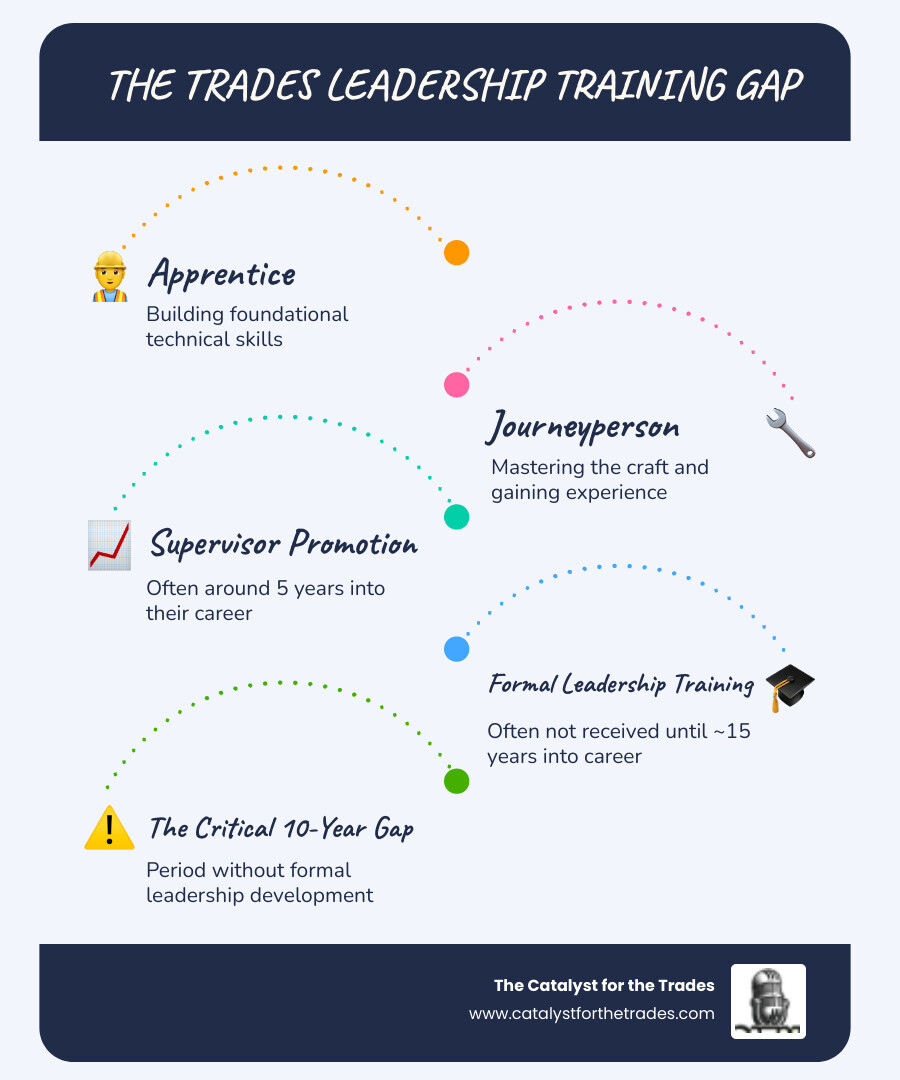
infographic showing the nearly 10-year gap between promotion to supervisory roles and receiving formal leadership training, with icons representing apprentice, journeyperson, supervisor promotion at year 5, and leadership training received at year 15, highlighting the critical skills gap period - trades leadership development infographic infographic-line-5-steps-blues-accent_colors

Must-know trades leadership development terms:

Why Bother with Leadership? The Benefits for You and Your Business

Stepping into leadership in the trades fundamentally changes your career trajectory and improves the entire industry.

diverse group of tradespeople collaborating effectively on a project - trades leadership development

When you invest in trades leadership development, you're investing in yourself first. The most immediate benefits are career advancement and increased earning potential as you move from executing work to orchestrating it. But the benefits go deeper. Strong leadership skills lead to improved job satisfaction as you solve bigger problems and shape workplace culture. When leaders create environments where people want to work, employee loyalty skyrockets and turnover drops.

For the business, this means improved company performance. Projects run smoother, communication is clearer, and problems are solved before they become disasters. As Raul Rodriguez discusses in his conversation about building people-centered, resilient service companies, a people-first culture is smart business. This professionalism lifts the entire industry's reputation.

From the Job Site to the C-Suite: Career Advancement Opportunities

The path from journeyperson to leader has many branches:

  • Supervisor roles: Your first taste of leadership, managing a small team and delegating tasks.
  • Management positions: Overseeing multiple crews or departments, requiring bigger-picture thinking about budgets and long-term planning.
  • Union stewardship: A path for worker advocacy, navigating contracts and representing members.
  • Entrepreneurship: The ultimate expression of leadership, building a business around your technical skills. George Donaldson's story of building a $100M business shows what's possible when technical excellence meets business acumen.
  • Industry advocacy and mentorship: Shaping policy, promoting the trades, and guiding the next generation.

Building a Stronger Industry, One Leader at a Time

When you become a better leader, you help solve the industry's biggest problems. Effective leaders close the skills gap by properly training and mentoring apprentices. They create a culture of safety that goes beyond regulations, which, combined with process improvement, makes workplaces safer and more efficient.

Seeing clear career paths and professional leaders helps with attracting new talent. Strategic talent acquisition becomes easier when the industry looks professional from the outside. Leadership development directly boosts productivity and profitability. Leaders who understand financial management and strategic thinking make better decisions. As the saying goes, smart accounting transforms chaos into opportunity—which is why every home services business needs a strategic financial partner. Every tradesperson who invests in leadership skills makes the entire industry stronger.

The Modern Trades Leader's Toolkit: Core Skills and Competencies

Moving from doing the work to leading the team requires a new toolbox of skills. Trades leadership development programs exist to help you build it.

mentor showing apprentice complex plan on blueprint - trades leadership development

  • Communication: As a leader, you're actively listening, giving constructive feedback, and creating an environment where your team feels comfortable speaking up.
  • Conflict Resolution: The difference between a chaotic job site and a productive one is a leader who can mediate disputes and turn tension into teamwork.
  • Financial Literacy: Understanding project costs, budgets, and profitability separates leaders who survive from those who thrive. This knowledge is crucial for effective Financial Management Contractors need.
  • Strategic Thinking & Decision-Making: This is about anticipating what's next, planning for long-term success, and making choices that consider the bigger picture. It's fundamental to developing a solid Business Strategy Development approach.
  • Emotional Intelligence: This means understanding and managing your own emotions while reading and responding to others. It's the self-awareness, empathy, and social skills that build high-performance teams.

Balancing Technical Expertise with People Management

You spent years mastering your craft, but leading a team requires a different skill set. Trades leadership development programs are designed for this challenge, blending industry-specific knowledge with general leadership principles.

One of the biggest problems is leading former peers. Effective Management Development training teaches you how to coach vs. tell and delegate effectively. Your primary job becomes building trust with your team—empowering people while maintaining accountability. As Trey McWilliams demonstrates, balancing big growth with people-first leadership means staying grounded in relationships. These skills are vital for Performance Management and creating a positive work environment.

Key Success Factors for Aspiring Trades Leaders

Formal training provides the framework, but certain qualities separate good leaders from great ones.

  • A commitment to Continuous Learning is essential in an changing industry.
  • Your strong work ethic shifts from hands-on labor to setting the standard for your team.
  • A "big picture" perspective enables strategic planning and creative problem-solving.
  • Leaders have a motivation to take action—they don't just spot problems, they solve them. As Vince Heuser's journey shows, understanding how to break through growth plateaus requires bold action.
  • Active participation in training is crucial. Real learning happens through engagement, not passive attendance.

Forging Your Path: A Guide to Trades Leadership Development

So you're ready to level up. The programs available today are built for real tradespeople juggling jobs and families.

Program structures are designed for flexibility. Many are module-based, asking for a manageable number of hours per week over several months. Some certificate programs allow you to finish in as little as four months or spread the work over a few years to suit your life.

Delivery methods have evolved, with many programs offering online learning. This blend of self-paced learning and interactive virtual group sessions means you can study whenever it works for you.

Some of the most valuable parts of these programs are the networking opportunities and community building. Many programs include roundtables with business leaders and help you develop a network of peers. Connecting with others who understand your challenges is priceless, and these relationships often last long after the program ends.

Here's how different types of programs stack up:

Program TypeTypical DurationPrimary FocusTarget Audience
University Certificate4 months - 3 yearsStrategic thinking, business acumen, general managementAspiring managers, business owners, tradespeople seeking formal credentials
Union-Led ProgramsVaries (e.g., multi-session)Union advocacy, jobsite supervision, member engagementApprentices, journeypersons, union delegates
Industry Association Programs4-10 monthsIndustry-specific leadership challenges, peer networkingJourneypersons, managers within specific trades
Corporate TrainingShort workshops - 6 monthsSpecific leadership skills (e.g., communication, HR)High-potential employees, new supervisors

Finding the Right Program for Your Experience Level

Modern trades leadership development has something for everyone, no matter your career stage.

  • For apprentices, some programs help you understand the bigger picture of the industry, professionalism, and productivity, recognizing that leadership development can start early.
  • For journeypersons, many programs focus on the skills you need to take the next step: leadership, mentoring, and communication. Others are designed for qualified tradespersons who want to understand the business side of things.
  • If you're in or eyeing a supervisory role, Management Development programs dig deeper into running a team effectively.
  • For experienced managers, advanced programs target high-potential leaders, tackling topics like change management and board governance.

Many of these programs lead to recognized credentials that demonstrate business aptitude. You'll find common modules across programs, including: Leadership Fundamentals, Communicating with Confidence, Supervisory Skills, Teamwork & Conflict Resolution, Strategic Thinking, Financial Processes, and Human Resources Management.

The Critical Role of Mentorship in Trades Leadership Development

Formal training can't fully replicate the wisdom of someone who's been there. Mentorship is a critical part of trades leadership development.

Finding a mentor—someone with more experience who can offer advice and encouragement—can change your career. Conversely, being an effective mentor is a leadership skill in itself. Some programs equip experienced tradespeople with mentorship skills to guide newcomers, sometimes with a focus on cultural competency. When you mentor someone, you sharpen your own leadership abilities.

Peer-to-peer learning is another powerful form of mentorship. Many programs deliberately build strong peer networks that become your professional community. As Raul Rodriguez shares in his insights on how to lead, serve, and grow in the trades, lifting others as you climb is good leadership. These professional networks are an investment that pays dividends throughout your career.

The Future of Leadership: Embracing Technology and Inclusivity

The skilled trades are at a crossroads of advancing technology and a growing recognition of the power of diversity. The future of trades leadership development is about embracing change, leveraging smart tools, and creating workplaces where everyone can thrive.

female trades leader using AR glasses on a job site - trades leadership development

Today's leaders need to be comfortable with digital change. This means understanding how technology can make your team more efficient, your job sites safer, and your customers happier. As we explored in Embracing Change: The Future of Leadership, the leaders who succeed tomorrow are the ones who adapt today. Strong Change Management skills are essential for introducing new systems without causing chaos. Leaders are also becoming more data-driven, using performance metrics and operational data to make smarter decisions. Tools like AI Business Intelligence can help you spot patterns and opportunities you might otherwise miss.

How AI is Reshaping Leadership in the Trades

Artificial intelligence isn't here to replace skilled tradespeople or good leaders—it's here to make both more effective.

AI can automate administrative tasks like scheduling and reporting, freeing you to focus on strategy and team development. In project management, predictive analytics can warn you about potential delays and help allocate resources more efficiently. This foresight transforms reactive management into proactive leadership. Lynn Wise breaks down how AI-driven success for contractors works in practice. A thoughtful Contractor AI Strategy is quickly becoming essential.

AI also improves customer communication. Automated systems can handle routine questions 24/7, freeing your team for complex issues that need a human touch. This leads to better AI Customer Service and less team burnout.

Championing Diversity: Leading Inclusive Teams

The trades have traditionally been a homogeneous field, but that's changing. Leaders who accept diversity are building stronger, more innovative teams.

Many leadership programs are now specifically designed to support women, gender-diverse individuals, and other underrepresented groups. These are strategic investments in untapped talent that create a pipeline of diverse leaders who bring fresh perspectives. Jazmin Ramirez shows us how real leadership powers change in the trades through her work championing inclusion.

Cultural competency is another critical skill for modern leaders. Training in this area ensures leaders can provide meaningful support that respects diverse backgrounds and creates genuinely welcoming environments. Creating an equitable workplace means actively removing systemic barriers and ensuring every team member feels valued and has opportunities to advance. When you build a team that reflects your community, you bring in varied perspectives that strengthen your entire organization. Inclusion isn't a buzzword—it's a competitive advantage.

Frequently Asked Questions about Trades Leadership Development

What are the first steps to becoming a leader in the trades?

The path begins with mastering your craft to earn the respect and credibility every leader needs. Demonstrate reliability and a strong work ethic by showing up on time and following through on commitments. Proactively communicate with supervisors about your career goals and volunteer for extra responsibility, like coordinating a small crew or training an apprentice. These experiences build confidence and show you're ready for more. Finally, seek out a mentor and express interest in formal Management Development opportunities to show you're serious about stepping up.

How long do leadership development programs typically take?

Program duration varies. Intensive workshops can be completed in a few days, while certificate programs typically run about four to six months of part-time study. Some university-level programs offer flexibility, allowing you to complete them quickly or stretch them out over several years. The key isn't speed but consistent, Continuous Learning that transforms how you lead. What matters is engaging with the material and applying what you learn.

Are there funded leadership training opportunities available?

Yes. Many people assume quality leadership training is expensive, but numerous funded opportunities exist for tradespeople. Some programs are fully funded for successful applicants, sometimes including expenses for travel, accommodation, or even wage subsidies. Beyond specific programs, industry associations, government initiatives, and employers often provide grants, scholarships, or tuition reimbursement. The key is to do your homework. Check with your local trade associations and government job grant programs, and ask program coordinators about available funding sources. Removing financial barriers helps everyone succeed.

Conclusion

Stepping up from journeyperson to industry leader is a journey that requires dedication and a willingness to grow beyond your technical skills. It demands developing crucial people skills—communication, empathy, strategic thinking, and the ability to inspire others.

Investing in trades leadership development is about more than career advancement; it's about positioning yourself to make a lasting impact on your team, your company, and the skilled trades industry. When you commit to developing your leadership abilities, you create ripples of positive change.

The most successful leaders accept Continuous Learning. They leverage technology to work smarter and understand that inclusivity is a strength. These leaders become catalysts for change, combining technical mastery with genuine care for their people. The skilled trades need more leaders who measure success not just in profit margins, but in the growth of their teams and the reputation they build.

At The Catalyst for the Trades, we empower home service businesses with strategies for growth, innovation, and leadership. We combine tech insights with real-world experience to help you steer today's market.

Listen to our latest episodes to hear from industry leaders who have made the leap and find how you can transform your career and your business. The tools and training are within reach. Are you ready to take the first step?

From Tools to Teams: Bridging the Leadership Gap in the Trades

Trades leadership development is the structured process of building management, communication, and strategic skills in skilled tradespeople to prepare them for supervisory, business ownership, and advocacy roles. If you're a journeyperson ready to step up or a business owner looking to scale, this is your roadmap.

The training gap in the trades is real; most people are promoted to supervisory roles nearly a decade before receiving any formal leadership training. Effective leaders need skills beyond the technical, mastering communication, conflict resolution, and financial literacy. Fortunately, leadership programs are designed for you, ranging from short online certificates to multi-year university programs, with many offering funding. This training opens doors to supervisor roles, business ownership, and industry advocacy, and modern programs are focusing on inclusivity to support underrepresented groups.

The skilled trades are booming, but we're promoting talented technicians into leadership roles and expecting them to figure it out. Being the best on the crew doesn't automatically make you great at managing people or planning for business growth. The industry needs leaders who can bridge the gap between wrenches and workforce management.

If you're ready to scale your business with stronger leadership, explore how strategic business development can support your growth, and schedule a strategy call to discuss your leadership development needs.

infographic showing the nearly 10-year gap between promotion to supervisory roles and receiving formal leadership training, with icons representing apprentice, journeyperson, supervisor promotion at year 5, and leadership training received at year 15, highlighting the critical skills gap period - trades leadership development infographic infographic-line-5-steps-blues-accent_colors

Must-know trades leadership development terms:

Why Bother with Leadership? The Benefits for You and Your Business

Stepping into leadership in the trades fundamentally changes your career trajectory and improves the entire industry.

diverse group of tradespeople collaborating effectively on a project - trades leadership development

When you invest in trades leadership development, you're investing in yourself first. The most immediate benefits are career advancement and increased earning potential as you move from executing work to orchestrating it. But the benefits go deeper. Strong leadership skills lead to improved job satisfaction as you solve bigger problems and shape workplace culture. When leaders create environments where people want to work, employee loyalty skyrockets and turnover drops.

For the business, this means improved company performance. Projects run smoother, communication is clearer, and problems are solved before they become disasters. As Raul Rodriguez discusses in his conversation about building people-centered, resilient service companies, a people-first culture is smart business. This professionalism lifts the entire industry's reputation.

From the Job Site to the C-Suite: Career Advancement Opportunities

The path from journeyperson to leader has many branches:

  • Supervisor roles: Your first taste of leadership, managing a small team and delegating tasks.
  • Management positions: Overseeing multiple crews or departments, requiring bigger-picture thinking about budgets and long-term planning.
  • Union stewardship: A path for worker advocacy, navigating contracts and representing members.
  • Entrepreneurship: The ultimate expression of leadership, building a business around your technical skills. George Donaldson's story of building a $100M business shows what's possible when technical excellence meets business acumen.
  • Industry advocacy and mentorship: Shaping policy, promoting the trades, and guiding the next generation.

Building a Stronger Industry, One Leader at a Time

When you become a better leader, you help solve the industry's biggest problems. Effective leaders close the skills gap by properly training and mentoring apprentices. They create a culture of safety that goes beyond regulations, which, combined with process improvement, makes workplaces safer and more efficient.

Seeing clear career paths and professional leaders helps with attracting new talent. Strategic talent acquisition becomes easier when the industry looks professional from the outside. Leadership development directly boosts productivity and profitability. Leaders who understand financial management and strategic thinking make better decisions. As the saying goes, smart accounting transforms chaos into opportunity—which is why every home services business needs a strategic financial partner. Every tradesperson who invests in leadership skills makes the entire industry stronger.

The Modern Trades Leader's Toolkit: Core Skills and Competencies

Moving from doing the work to leading the team requires a new toolbox of skills. Trades leadership development programs exist to help you build it.

mentor showing apprentice complex plan on blueprint - trades leadership development

  • Communication: As a leader, you're actively listening, giving constructive feedback, and creating an environment where your team feels comfortable speaking up.
  • Conflict Resolution: The difference between a chaotic job site and a productive one is a leader who can mediate disputes and turn tension into teamwork.
  • Financial Literacy: Understanding project costs, budgets, and profitability separates leaders who survive from those who thrive. This knowledge is crucial for effective Financial Management Contractors need.
  • Strategic Thinking & Decision-Making: This is about anticipating what's next, planning for long-term success, and making choices that consider the bigger picture. It's fundamental to developing a solid Business Strategy Development approach.
  • Emotional Intelligence: This means understanding and managing your own emotions while reading and responding to others. It's the self-awareness, empathy, and social skills that build high-performance teams.

Balancing Technical Expertise with People Management

You spent years mastering your craft, but leading a team requires a different skill set. Trades leadership development programs are designed for this challenge, blending industry-specific knowledge with general leadership principles.

One of the biggest problems is leading former peers. Effective Management Development training teaches you how to coach vs. tell and delegate effectively. Your primary job becomes building trust with your team—empowering people while maintaining accountability. As Trey McWilliams demonstrates, balancing big growth with people-first leadership means staying grounded in relationships. These skills are vital for Performance Management and creating a positive work environment.

Key Success Factors for Aspiring Trades Leaders

Formal training provides the framework, but certain qualities separate good leaders from great ones.

  • A commitment to Continuous Learning is essential in an changing industry.
  • Your strong work ethic shifts from hands-on labor to setting the standard for your team.
  • A "big picture" perspective enables strategic planning and creative problem-solving.
  • Leaders have a motivation to take action—they don't just spot problems, they solve them. As Vince Heuser's journey shows, understanding how to break through growth plateaus requires bold action.
  • Active participation in training is crucial. Real learning happens through engagement, not passive attendance.

Forging Your Path: A Guide to Trades Leadership Development

So you're ready to level up. The programs available today are built for real tradespeople juggling jobs and families.

Program structures are designed for flexibility. Many are module-based, asking for a manageable number of hours per week over several months. Some certificate programs allow you to finish in as little as four months or spread the work over a few years to suit your life.

Delivery methods have evolved, with many programs offering online learning. This blend of self-paced learning and interactive virtual group sessions means you can study whenever it works for you.

Some of the most valuable parts of these programs are the networking opportunities and community building. Many programs include roundtables with business leaders and help you develop a network of peers. Connecting with others who understand your challenges is priceless, and these relationships often last long after the program ends.

Here's how different types of programs stack up:

Program TypeTypical DurationPrimary FocusTarget Audience
University Certificate4 months - 3 yearsStrategic thinking, business acumen, general managementAspiring managers, business owners, tradespeople seeking formal credentials
Union-Led ProgramsVaries (e.g., multi-session)Union advocacy, jobsite supervision, member engagementApprentices, journeypersons, union delegates
Industry Association Programs4-10 monthsIndustry-specific leadership challenges, peer networkingJourneypersons, managers within specific trades
Corporate TrainingShort workshops - 6 monthsSpecific leadership skills (e.g., communication, HR)High-potential employees, new supervisors

Finding the Right Program for Your Experience Level

Modern trades leadership development has something for everyone, no matter your career stage.

  • For apprentices, some programs help you understand the bigger picture of the industry, professionalism, and productivity, recognizing that leadership development can start early.
  • For journeypersons, many programs focus on the skills you need to take the next step: leadership, mentoring, and communication. Others are designed for qualified tradespersons who want to understand the business side of things.
  • If you're in or eyeing a supervisory role, Management Development programs dig deeper into running a team effectively.
  • For experienced managers, advanced programs target high-potential leaders, tackling topics like change management and board governance.

Many of these programs lead to recognized credentials that demonstrate business aptitude. You'll find common modules across programs, including: Leadership Fundamentals, Communicating with Confidence, Supervisory Skills, Teamwork & Conflict Resolution, Strategic Thinking, Financial Processes, and Human Resources Management.

The Critical Role of Mentorship in Trades Leadership Development

Formal training can't fully replicate the wisdom of someone who's been there. Mentorship is a critical part of trades leadership development.

Finding a mentor—someone with more experience who can offer advice and encouragement—can change your career. Conversely, being an effective mentor is a leadership skill in itself. Some programs equip experienced tradespeople with mentorship skills to guide newcomers, sometimes with a focus on cultural competency. When you mentor someone, you sharpen your own leadership abilities.

Peer-to-peer learning is another powerful form of mentorship. Many programs deliberately build strong peer networks that become your professional community. As Raul Rodriguez shares in his insights on how to lead, serve, and grow in the trades, lifting others as you climb is good leadership. These professional networks are an investment that pays dividends throughout your career.

The Future of Leadership: Embracing Technology and Inclusivity

The skilled trades are at a crossroads of advancing technology and a growing recognition of the power of diversity. The future of trades leadership development is about embracing change, leveraging smart tools, and creating workplaces where everyone can thrive.

female trades leader using AR glasses on a job site - trades leadership development

Today's leaders need to be comfortable with digital change. This means understanding how technology can make your team more efficient, your job sites safer, and your customers happier. As we explored in Embracing Change: The Future of Leadership, the leaders who succeed tomorrow are the ones who adapt today. Strong Change Management skills are essential for introducing new systems without causing chaos. Leaders are also becoming more data-driven, using performance metrics and operational data to make smarter decisions. Tools like AI Business Intelligence can help you spot patterns and opportunities you might otherwise miss.

How AI is Reshaping Leadership in the Trades

Artificial intelligence isn't here to replace skilled tradespeople or good leaders—it's here to make both more effective.

AI can automate administrative tasks like scheduling and reporting, freeing you to focus on strategy and team development. In project management, predictive analytics can warn you about potential delays and help allocate resources more efficiently. This foresight transforms reactive management into proactive leadership. Lynn Wise breaks down how AI-driven success for contractors works in practice. A thoughtful Contractor AI Strategy is quickly becoming essential.

AI also improves customer communication. Automated systems can handle routine questions 24/7, freeing your team for complex issues that need a human touch. This leads to better AI Customer Service and less team burnout.

Championing Diversity: Leading Inclusive Teams

The trades have traditionally been a homogeneous field, but that's changing. Leaders who accept diversity are building stronger, more innovative teams.

Many leadership programs are now specifically designed to support women, gender-diverse individuals, and other underrepresented groups. These are strategic investments in untapped talent that create a pipeline of diverse leaders who bring fresh perspectives. Jazmin Ramirez shows us how real leadership powers change in the trades through her work championing inclusion.

Cultural competency is another critical skill for modern leaders. Training in this area ensures leaders can provide meaningful support that respects diverse backgrounds and creates genuinely welcoming environments. Creating an equitable workplace means actively removing systemic barriers and ensuring every team member feels valued and has opportunities to advance. When you build a team that reflects your community, you bring in varied perspectives that strengthen your entire organization. Inclusion isn't a buzzword—it's a competitive advantage.

Frequently Asked Questions about Trades Leadership Development

What are the first steps to becoming a leader in the trades?

The path begins with mastering your craft to earn the respect and credibility every leader needs. Demonstrate reliability and a strong work ethic by showing up on time and following through on commitments. Proactively communicate with supervisors about your career goals and volunteer for extra responsibility, like coordinating a small crew or training an apprentice. These experiences build confidence and show you're ready for more. Finally, seek out a mentor and express interest in formal Management Development opportunities to show you're serious about stepping up.

How long do leadership development programs typically take?

Program duration varies. Intensive workshops can be completed in a few days, while certificate programs typically run about four to six months of part-time study. Some university-level programs offer flexibility, allowing you to complete them quickly or stretch them out over several years. The key isn't speed but consistent, Continuous Learning that transforms how you lead. What matters is engaging with the material and applying what you learn.

Are there funded leadership training opportunities available?

Yes. Many people assume quality leadership training is expensive, but numerous funded opportunities exist for tradespeople. Some programs are fully funded for successful applicants, sometimes including expenses for travel, accommodation, or even wage subsidies. Beyond specific programs, industry associations, government initiatives, and employers often provide grants, scholarships, or tuition reimbursement. The key is to do your homework. Check with your local trade associations and government job grant programs, and ask program coordinators about available funding sources. Removing financial barriers helps everyone succeed.

Conclusion

Stepping up from journeyperson to industry leader is a journey that requires dedication and a willingness to grow beyond your technical skills. It demands developing crucial people skills—communication, empathy, strategic thinking, and the ability to inspire others.

Investing in trades leadership development is about more than career advancement; it's about positioning yourself to make a lasting impact on your team, your company, and the skilled trades industry. When you commit to developing your leadership abilities, you create ripples of positive change.

The most successful leaders accept Continuous Learning. They leverage technology to work smarter and understand that inclusivity is a strength. These leaders become catalysts for change, combining technical mastery with genuine care for their people. The skilled trades need more leaders who measure success not just in profit margins, but in the growth of their teams and the reputation they build.

At The Catalyst for the Trades, we empower home service businesses with strategies for growth, innovation, and leadership. We combine tech insights with real-world experience to help you steer today's market.

Listen to our latest episodes to hear from industry leaders who have made the leap and find how you can transform your career and your business. The tools and training are within reach. Are you ready to take the first step?

From Tools to Teams: Bridging the Leadership Gap in the Trades

Trades leadership development is the structured process of building management, communication, and strategic skills in skilled tradespeople to prepare them for supervisory, business ownership, and advocacy roles. If you're a journeyperson ready to step up or a business owner looking to scale, this is your roadmap.

The training gap in the trades is real; most people are promoted to supervisory roles nearly a decade before receiving any formal leadership training. Effective leaders need skills beyond the technical, mastering communication, conflict resolution, and financial literacy. Fortunately, leadership programs are designed for you, ranging from short online certificates to multi-year university programs, with many offering funding. This training opens doors to supervisor roles, business ownership, and industry advocacy, and modern programs are focusing on inclusivity to support underrepresented groups.

The skilled trades are booming, but we're promoting talented technicians into leadership roles and expecting them to figure it out. Being the best on the crew doesn't automatically make you great at managing people or planning for business growth. The industry needs leaders who can bridge the gap between wrenches and workforce management.

If you're ready to scale your business with stronger leadership, explore how strategic business development can support your growth, and schedule a strategy call to discuss your leadership development needs.

infographic showing the nearly 10-year gap between promotion to supervisory roles and receiving formal leadership training, with icons representing apprentice, journeyperson, supervisor promotion at year 5, and leadership training received at year 15, highlighting the critical skills gap period - trades leadership development infographic infographic-line-5-steps-blues-accent_colors

Must-know trades leadership development terms:

Why Bother with Leadership? The Benefits for You and Your Business

Stepping into leadership in the trades fundamentally changes your career trajectory and improves the entire industry.

diverse group of tradespeople collaborating effectively on a project - trades leadership development

When you invest in trades leadership development, you're investing in yourself first. The most immediate benefits are career advancement and increased earning potential as you move from executing work to orchestrating it. But the benefits go deeper. Strong leadership skills lead to improved job satisfaction as you solve bigger problems and shape workplace culture. When leaders create environments where people want to work, employee loyalty skyrockets and turnover drops.

For the business, this means improved company performance. Projects run smoother, communication is clearer, and problems are solved before they become disasters. As Raul Rodriguez discusses in his conversation about building people-centered, resilient service companies, a people-first culture is smart business. This professionalism lifts the entire industry's reputation.

From the Job Site to the C-Suite: Career Advancement Opportunities

The path from journeyperson to leader has many branches:

  • Supervisor roles: Your first taste of leadership, managing a small team and delegating tasks.
  • Management positions: Overseeing multiple crews or departments, requiring bigger-picture thinking about budgets and long-term planning.
  • Union stewardship: A path for worker advocacy, navigating contracts and representing members.
  • Entrepreneurship: The ultimate expression of leadership, building a business around your technical skills. George Donaldson's story of building a $100M business shows what's possible when technical excellence meets business acumen.
  • Industry advocacy and mentorship: Shaping policy, promoting the trades, and guiding the next generation.

Building a Stronger Industry, One Leader at a Time

When you become a better leader, you help solve the industry's biggest problems. Effective leaders close the skills gap by properly training and mentoring apprentices. They create a culture of safety that goes beyond regulations, which, combined with process improvement, makes workplaces safer and more efficient.

Seeing clear career paths and professional leaders helps with attracting new talent. Strategic talent acquisition becomes easier when the industry looks professional from the outside. Leadership development directly boosts productivity and profitability. Leaders who understand financial management and strategic thinking make better decisions. As the saying goes, smart accounting transforms chaos into opportunity—which is why every home services business needs a strategic financial partner. Every tradesperson who invests in leadership skills makes the entire industry stronger.

The Modern Trades Leader's Toolkit: Core Skills and Competencies

Moving from doing the work to leading the team requires a new toolbox of skills. Trades leadership development programs exist to help you build it.

mentor showing apprentice complex plan on blueprint - trades leadership development

  • Communication: As a leader, you're actively listening, giving constructive feedback, and creating an environment where your team feels comfortable speaking up.
  • Conflict Resolution: The difference between a chaotic job site and a productive one is a leader who can mediate disputes and turn tension into teamwork.
  • Financial Literacy: Understanding project costs, budgets, and profitability separates leaders who survive from those who thrive. This knowledge is crucial for effective Financial Management Contractors need.
  • Strategic Thinking & Decision-Making: This is about anticipating what's next, planning for long-term success, and making choices that consider the bigger picture. It's fundamental to developing a solid Business Strategy Development approach.
  • Emotional Intelligence: This means understanding and managing your own emotions while reading and responding to others. It's the self-awareness, empathy, and social skills that build high-performance teams.

Balancing Technical Expertise with People Management

You spent years mastering your craft, but leading a team requires a different skill set. Trades leadership development programs are designed for this challenge, blending industry-specific knowledge with general leadership principles.

One of the biggest problems is leading former peers. Effective Management Development training teaches you how to coach vs. tell and delegate effectively. Your primary job becomes building trust with your team—empowering people while maintaining accountability. As Trey McWilliams demonstrates, balancing big growth with people-first leadership means staying grounded in relationships. These skills are vital for Performance Management and creating a positive work environment.

Key Success Factors for Aspiring Trades Leaders

Formal training provides the framework, but certain qualities separate good leaders from great ones.

  • A commitment to Continuous Learning is essential in an changing industry.
  • Your strong work ethic shifts from hands-on labor to setting the standard for your team.
  • A "big picture" perspective enables strategic planning and creative problem-solving.
  • Leaders have a motivation to take action—they don't just spot problems, they solve them. As Vince Heuser's journey shows, understanding how to break through growth plateaus requires bold action.
  • Active participation in training is crucial. Real learning happens through engagement, not passive attendance.

Forging Your Path: A Guide to Trades Leadership Development

So you're ready to level up. The programs available today are built for real tradespeople juggling jobs and families.

Program structures are designed for flexibility. Many are module-based, asking for a manageable number of hours per week over several months. Some certificate programs allow you to finish in as little as four months or spread the work over a few years to suit your life.

Delivery methods have evolved, with many programs offering online learning. This blend of self-paced learning and interactive virtual group sessions means you can study whenever it works for you.

Some of the most valuable parts of these programs are the networking opportunities and community building. Many programs include roundtables with business leaders and help you develop a network of peers. Connecting with others who understand your challenges is priceless, and these relationships often last long after the program ends.

Here's how different types of programs stack up:

Program TypeTypical DurationPrimary FocusTarget Audience
University Certificate4 months - 3 yearsStrategic thinking, business acumen, general managementAspiring managers, business owners, tradespeople seeking formal credentials
Union-Led ProgramsVaries (e.g., multi-session)Union advocacy, jobsite supervision, member engagementApprentices, journeypersons, union delegates
Industry Association Programs4-10 monthsIndustry-specific leadership challenges, peer networkingJourneypersons, managers within specific trades
Corporate TrainingShort workshops - 6 monthsSpecific leadership skills (e.g., communication, HR)High-potential employees, new supervisors

Finding the Right Program for Your Experience Level

Modern trades leadership development has something for everyone, no matter your career stage.

  • For apprentices, some programs help you understand the bigger picture of the industry, professionalism, and productivity, recognizing that leadership development can start early.
  • For journeypersons, many programs focus on the skills you need to take the next step: leadership, mentoring, and communication. Others are designed for qualified tradespersons who want to understand the business side of things.
  • If you're in or eyeing a supervisory role, Management Development programs dig deeper into running a team effectively.
  • For experienced managers, advanced programs target high-potential leaders, tackling topics like change management and board governance.

Many of these programs lead to recognized credentials that demonstrate business aptitude. You'll find common modules across programs, including: Leadership Fundamentals, Communicating with Confidence, Supervisory Skills, Teamwork & Conflict Resolution, Strategic Thinking, Financial Processes, and Human Resources Management.

The Critical Role of Mentorship in Trades Leadership Development

Formal training can't fully replicate the wisdom of someone who's been there. Mentorship is a critical part of trades leadership development.

Finding a mentor—someone with more experience who can offer advice and encouragement—can change your career. Conversely, being an effective mentor is a leadership skill in itself. Some programs equip experienced tradespeople with mentorship skills to guide newcomers, sometimes with a focus on cultural competency. When you mentor someone, you sharpen your own leadership abilities.

Peer-to-peer learning is another powerful form of mentorship. Many programs deliberately build strong peer networks that become your professional community. As Raul Rodriguez shares in his insights on how to lead, serve, and grow in the trades, lifting others as you climb is good leadership. These professional networks are an investment that pays dividends throughout your career.

The Future of Leadership: Embracing Technology and Inclusivity

The skilled trades are at a crossroads of advancing technology and a growing recognition of the power of diversity. The future of trades leadership development is about embracing change, leveraging smart tools, and creating workplaces where everyone can thrive.

female trades leader using AR glasses on a job site - trades leadership development

Today's leaders need to be comfortable with digital change. This means understanding how technology can make your team more efficient, your job sites safer, and your customers happier. As we explored in Embracing Change: The Future of Leadership, the leaders who succeed tomorrow are the ones who adapt today. Strong Change Management skills are essential for introducing new systems without causing chaos. Leaders are also becoming more data-driven, using performance metrics and operational data to make smarter decisions. Tools like AI Business Intelligence can help you spot patterns and opportunities you might otherwise miss.

How AI is Reshaping Leadership in the Trades

Artificial intelligence isn't here to replace skilled tradespeople or good leaders—it's here to make both more effective.

AI can automate administrative tasks like scheduling and reporting, freeing you to focus on strategy and team development. In project management, predictive analytics can warn you about potential delays and help allocate resources more efficiently. This foresight transforms reactive management into proactive leadership. Lynn Wise breaks down how AI-driven success for contractors works in practice. A thoughtful Contractor AI Strategy is quickly becoming essential.

AI also improves customer communication. Automated systems can handle routine questions 24/7, freeing your team for complex issues that need a human touch. This leads to better AI Customer Service and less team burnout.

Championing Diversity: Leading Inclusive Teams

The trades have traditionally been a homogeneous field, but that's changing. Leaders who accept diversity are building stronger, more innovative teams.

Many leadership programs are now specifically designed to support women, gender-diverse individuals, and other underrepresented groups. These are strategic investments in untapped talent that create a pipeline of diverse leaders who bring fresh perspectives. Jazmin Ramirez shows us how real leadership powers change in the trades through her work championing inclusion.

Cultural competency is another critical skill for modern leaders. Training in this area ensures leaders can provide meaningful support that respects diverse backgrounds and creates genuinely welcoming environments. Creating an equitable workplace means actively removing systemic barriers and ensuring every team member feels valued and has opportunities to advance. When you build a team that reflects your community, you bring in varied perspectives that strengthen your entire organization. Inclusion isn't a buzzword—it's a competitive advantage.

Frequently Asked Questions about Trades Leadership Development

What are the first steps to becoming a leader in the trades?

The path begins with mastering your craft to earn the respect and credibility every leader needs. Demonstrate reliability and a strong work ethic by showing up on time and following through on commitments. Proactively communicate with supervisors about your career goals and volunteer for extra responsibility, like coordinating a small crew or training an apprentice. These experiences build confidence and show you're ready for more. Finally, seek out a mentor and express interest in formal Management Development opportunities to show you're serious about stepping up.

How long do leadership development programs typically take?

Program duration varies. Intensive workshops can be completed in a few days, while certificate programs typically run about four to six months of part-time study. Some university-level programs offer flexibility, allowing you to complete them quickly or stretch them out over several years. The key isn't speed but consistent, Continuous Learning that transforms how you lead. What matters is engaging with the material and applying what you learn.

Are there funded leadership training opportunities available?

Yes. Many people assume quality leadership training is expensive, but numerous funded opportunities exist for tradespeople. Some programs are fully funded for successful applicants, sometimes including expenses for travel, accommodation, or even wage subsidies. Beyond specific programs, industry associations, government initiatives, and employers often provide grants, scholarships, or tuition reimbursement. The key is to do your homework. Check with your local trade associations and government job grant programs, and ask program coordinators about available funding sources. Removing financial barriers helps everyone succeed.

Conclusion

Stepping up from journeyperson to industry leader is a journey that requires dedication and a willingness to grow beyond your technical skills. It demands developing crucial people skills—communication, empathy, strategic thinking, and the ability to inspire others.

Investing in trades leadership development is about more than career advancement; it's about positioning yourself to make a lasting impact on your team, your company, and the skilled trades industry. When you commit to developing your leadership abilities, you create ripples of positive change.

The most successful leaders accept Continuous Learning. They leverage technology to work smarter and understand that inclusivity is a strength. These leaders become catalysts for change, combining technical mastery with genuine care for their people. The skilled trades need more leaders who measure success not just in profit margins, but in the growth of their teams and the reputation they build.

At The Catalyst for the Trades, we empower home service businesses with strategies for growth, innovation, and leadership. We combine tech insights with real-world experience to help you steer today's market.

Listen to our latest episodes to hear from industry leaders who have made the leap and find how you can transform your career and your business. The tools and training are within reach. Are you ready to take the first step?

Episodes you may like

Future-Proof Your Business: A Guide to Developing Your Technology Strategy

Develop a winning technology strategy to future-proof your business. Align tech with goals, implement effectively, and leverage AI for growth.

Read more
Published
December 8, 2025
Future-Proofing Your Business with AI: A Conversation with Remy Skerjanz

If you're a home service business owner trying to make sense of the changing tech landscape, this is a must-watch episode. Discover some of the highlights below.

Read more
Published
December 8, 2025
Connect and Conquer: Understanding CRM

Conquer growth! Learn how customer relationship management empowers home services with data, boosts efficiency, and delights customers.

Read more
Published
December 5, 2025

Guests

Remy Skerjanz
Sales Blaster AI