Episode
December 3, 2025

Grow Your Green: Investing in Professional Development

Why Professional Development Is Your Most Strategic Business Move

Professional development isn't just training—it's the continuous process of building new skills, knowledge, and capabilities that keep your team sharp and your business competitive. For home services business owners, it's the difference between a team that's merely competent and one that drives real growth. Here's what you need to know:

  • What it is: Ongoing learning that goes beyond initial training, including workshops, certifications, mentoring, and skill-building
  • Why it matters: 74% of employees say lack of development opportunities prevents them from reaching full potential
  • The retention factor: 94% of employees would stay longer at a company that invests in their development
  • The business impact: Better retention, higher productivity, improved customer satisfaction, and stronger competitive positioning

If you're struggling to attract and keep skilled technicians, or if you're trying to scale without sacrificing quality, the problem might not be your pay or your market—it might be that your team doesn't see a clear path forward. In the trades, where skilled labor is increasingly scarce and customer expectations are rising, investing in your people isn't optional anymore. It's the foundation of sustainable growth.

Ready to build a team that drives results? Start by exploring proven talent acquisition strategies and find how to position your business for long-term growth.

The numbers tell a clear story: when you invest in professional development, your employees grow, your retention improves, and your business becomes more profitable and resilient. The question isn't whether you can afford to invest in development—it's whether you can afford not to.

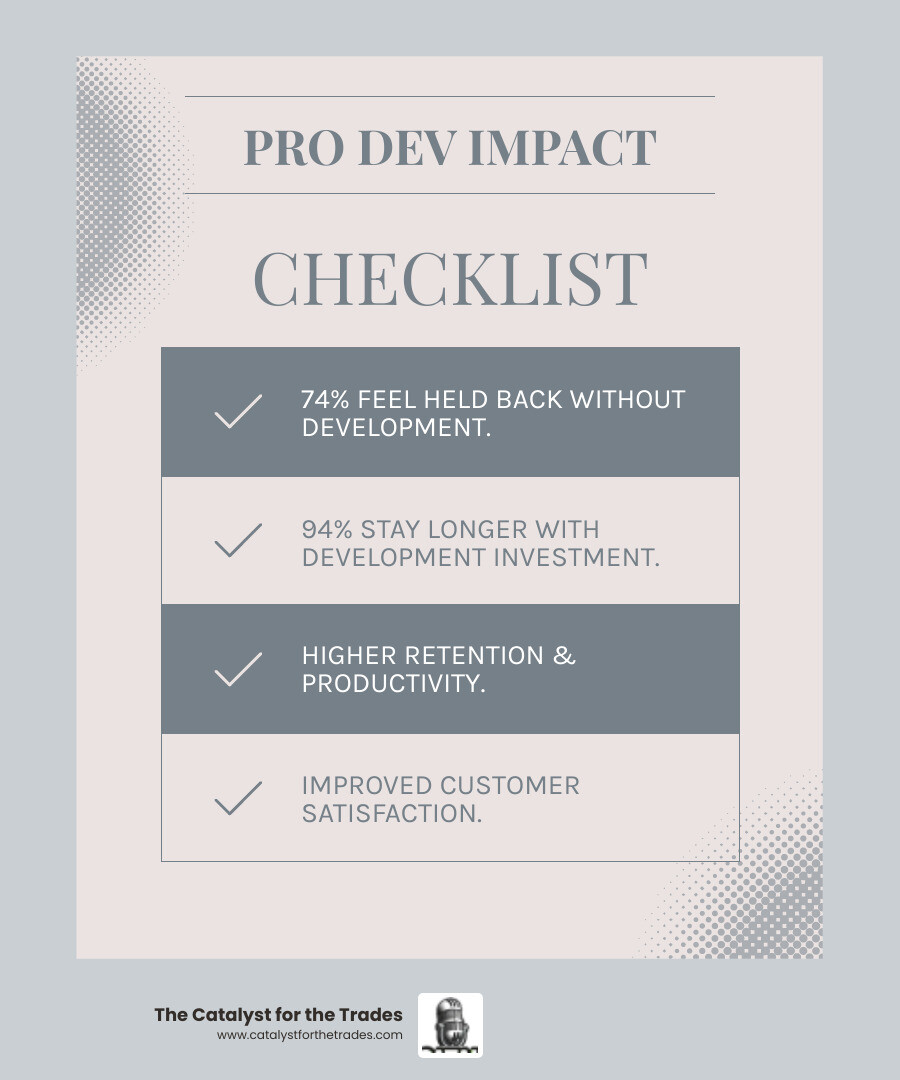
Infographic showing professional development impact: 74% of employees feel held back without development opportunities, 94% would stay longer at companies that invest in staff development, leading to higher retention rates, improved productivity, better customer satisfaction, and stronger competitive advantage - professional development infographic checklist-light-blue-grey

Simple professional development glossary:

Why Development is a Non-Negotiable Investment

In the home services industry, you're either moving forward or falling behind. Professional development isn't something you do with extra time or budget—it's the strategic investment that determines whether your business thrives or just survives.

From your team's perspective, a staggering 74% of employees feel they can't reach their full potential due to a lack of development opportunities. And 94% of employees would stay longer at a company that invests in their growth. In an industry where retaining skilled technicians is a constant battle, these numbers are critical.

Investing in professional development directly impacts employee morale, boosts productivity, creates a genuine competitive advantage, and improves customer satisfaction. Skilled, confident employees work smarter, feel valued, and deliver better service. This commitment to growth is what industry leaders like Mike Disney emphasize in how to win in the trades: recruitment, AI, and trust. It's also a cornerstone of effective talent acquisition, as top professionals want to work for companies that invest in their future.

Benefits for Your Team (The Individual)

Investing in an employee's professional development improves their entire career trajectory with tangible benefits.

Skill improvement helps them get ahead by mastering new software, advanced techniques, or customer communication. They become genuinely better at their jobs.

Increased confidence is a natural result of learning and applying new skills. This confidence improves customer interactions and job performance, leading to greater satisfaction.

Career advancement becomes a clear path. When team members see opportunities for promotion to lead tech or management roles, they see a long-term future with your company.

This growth translates to higher earning potential. As skills and experience deepen, so does their value and pay. This commitment deserves recognition.

All of this leads to genuine job satisfaction. Challenged and supported employees with a clear path forward are happier, more engaged, and stay longer. This is the environment Raul Rodriguez discusses in how to lead, serve, and grow in the trades.

A confident technician successfully completing a complex job, smiling as they finalize their work on a home's HVAC system - professional development

Benefits for Your Business (The Employer)

A commitment to professional development transforms your business, with returns that directly impact your bottom line and competitiveness.

Higher retention rates are an immediate benefit. The 94% statistic is clear: invest in people, and they stay. This reduces the substantial costs of turnover, often paying for the development program itself.

Attracting top talent is easier when you're known for investing in your people. In a tight labor market, a strong development program is a secret weapon for attracting career-focused technicians.

Improved efficiency is a natural result of a skilled team. They work smarter, faster, and with fewer mistakes, reducing callbacks and increasing productivity.

Your brand reputation strengthens with knowledgeable, professional technicians. Satisfied customers become your best marketing, spreading the word about your exceptional service.

This all leads to increased profitability. Better retention, talent, efficiency, and reputation all contribute to a healthier bottom line. This is the foundation of what Dana Staszkiewicz teaches in how to build a profitable, scalable trades business, and it's essential for sustainable home service business growth.

The question isn't whether you can afford to invest in professional development. It's whether you can afford not to.

The Blueprint for Growth: Methods of Professional Development

Professional development isn't one-size-fits-all. To build a skilled workforce, offer a mix of structured opportunities and an environment that encourages daily, natural learning, catering to different learning styles and career paths.
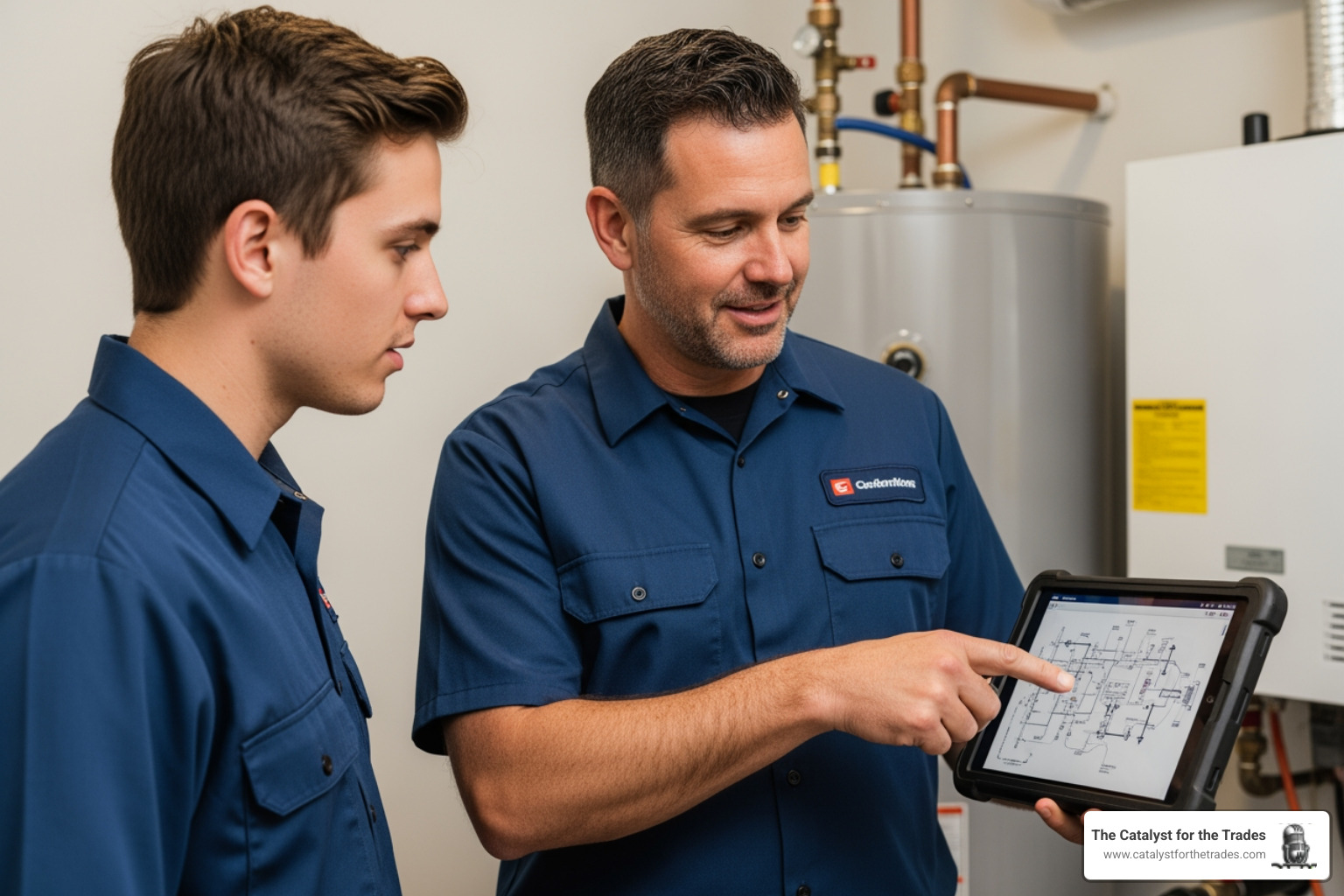
A trades professional mentoring a junior technician on-site, pointing to a diagram on a tablet while discussing a technical aspect - professional development

Professional development is a systematic, ongoing process. It's not a one-time workshop but a culture where growth is expected and supported, where continuous learning becomes part of your company's DNA, and where management development is as important as technical skills.

Structured Learning Opportunities

Formal training programs provide an organized foundation for excellence with clear objectives and measurable outcomes.

Workshops and seminars offer deep dives into specific skills, like new techniques or customer communication, providing practical knowledge for immediate application. Manufacturer training keeps your team current on the latest equipment, ensuring they can install, service, and troubleshoot new products.

Online courses offer flexibility, allowing your team to learn at their own pace. Digital platforms provide access to everything from quick webinars to full certification programs. Industry conferences provide unique networking opportunities and insights into what's next in the trades. Finally, certification renewals are key opportunities to refresh skills, learn updated best practices, and maintain the high professional standards that set your business apart.

This approach to structured learning is what Mark Evans used to build real wealth by working less and thinking bigger, as he understood that investing in structured development creates leverage.

Building an Internal Growth Culture

The most powerful learning is often informal, happening right within your organization. When you build a culture that values growth, learning becomes contagious.

Mentorship programs pair seasoned technicians with newer employees. Mentors share technical skills, problem-solving approaches, and customer interaction nuances, benefiting both the mentee's growth and the mentor's expertise.

Coaching provides personalized development, helping individuals identify blind spots, set goals, and create action plans. Peer-to-peer learning allows technicians to share wins, challenges, and solutions, expanding the entire team's knowledge base.

Communities of practice unite people with a shared passion for a specific skill, allowing them to share insights and push each other forward. Don't underestimate lunch and learns—these are simple, effective ways to introduce concepts, discuss industry changes, or share successes in a short, informal setting.

This internal growth culture drives real change and is the foundation of the future of leadership: how to build a team that drives growth. It's the kind of leadership approach that Jazmin Ramirez demonstrates when powering change in the trades.

The best professional development programs blend both worlds, combining the structure of formal training with the relevance of internal learning. When you get this balance right, you create a team that's not just skilled—they're unstoppable.

How to Fuel Your Team's Growth Engine

A thriving professional development program isn't a once-a-year seminar; it's about weaving growth into the DNA of your business, making it a natural part of your operations.

For development to stick, it must be genuine. It starts with leadership buy-in, where managers champion learning, share their own journeys, and celebrate progress, shifting the entire culture. Your team needs the same attention as your equipment. Create individual development plans that align personal aspirations with business needs, strengthening both your employees and your service offerings.

The practical side requires budgeting for training and providing time for it. Real commitment means blocking out schedules, investing funds, and treating learning as essential work, not a luxury. Finally, recognizing progress is a powerful motivator that can fuel an employee's drive for months.

This balanced approach to growth, where you scale your business while genuinely caring for your people, is exactly what Trey McWilliams demonstrates in balancing big growth with people-first leadership.

Encouraging and Supporting Employee Growth

A great program is nothing without genuine support for your team. Here's how to provide it.

Start with regular, informal check-ins to discuss career goals. Ask what excites them, what challenges they want, and what skills they want to learn. You might be surprised by their ambitions. From there, work together on concrete goal setting, like mastering a technique or earning a certification. Clear goals create a visible path forward.

Tie development directly to career paths. Show how a new skill or certification opens doors to promotions or advanced roles. Training then becomes a roadmap to their future. For bigger investments, offering tuition reimbursement removes a massive barrier and shows you're willing to invest in them.

Finally, celebrate achievements. When someone completes a course or applies a new skill, share it in meetings or group chats. Recognition shows that growth is valued and is central to protecting profit while leading with purpose in home services.

Managing the Costs of Professional Development

Professional development is an investment, not just a cost. The expense of turnover, mistakes, and lost customers is far greater. The real question isn't if you can afford to invest, but if you can afford not to.

Smart development doesn't require a huge budget. Start with in-house training and mentorship programs to leverage the expertise of your veteran technicians. This costs little and strengthens team culture.

Use free online resources from industry associations and other learning platforms. Your team can learn at their own pace, often from their phones. For external training, seek group discounts, as many providers offer bulk rates that make specialized training more accessible.

Look into government grants and industry programs for workforce development. The application time can be well worth the significant cost savings. Also, consider a phased implementation. Start with your most critical training needs and build from there. Small, consistent investments compound over time.

This strategic approach to managing resources while fueling growth is a cornerstone of effective business growth strategies that work in the real world.

Future-Proofing Your Business Through Continuous Learning

The home services industry is constantly changing due to new technology, regulations, and customer behaviors. Professional development is key to building the agility and resilience your business needs to thrive amid this change.
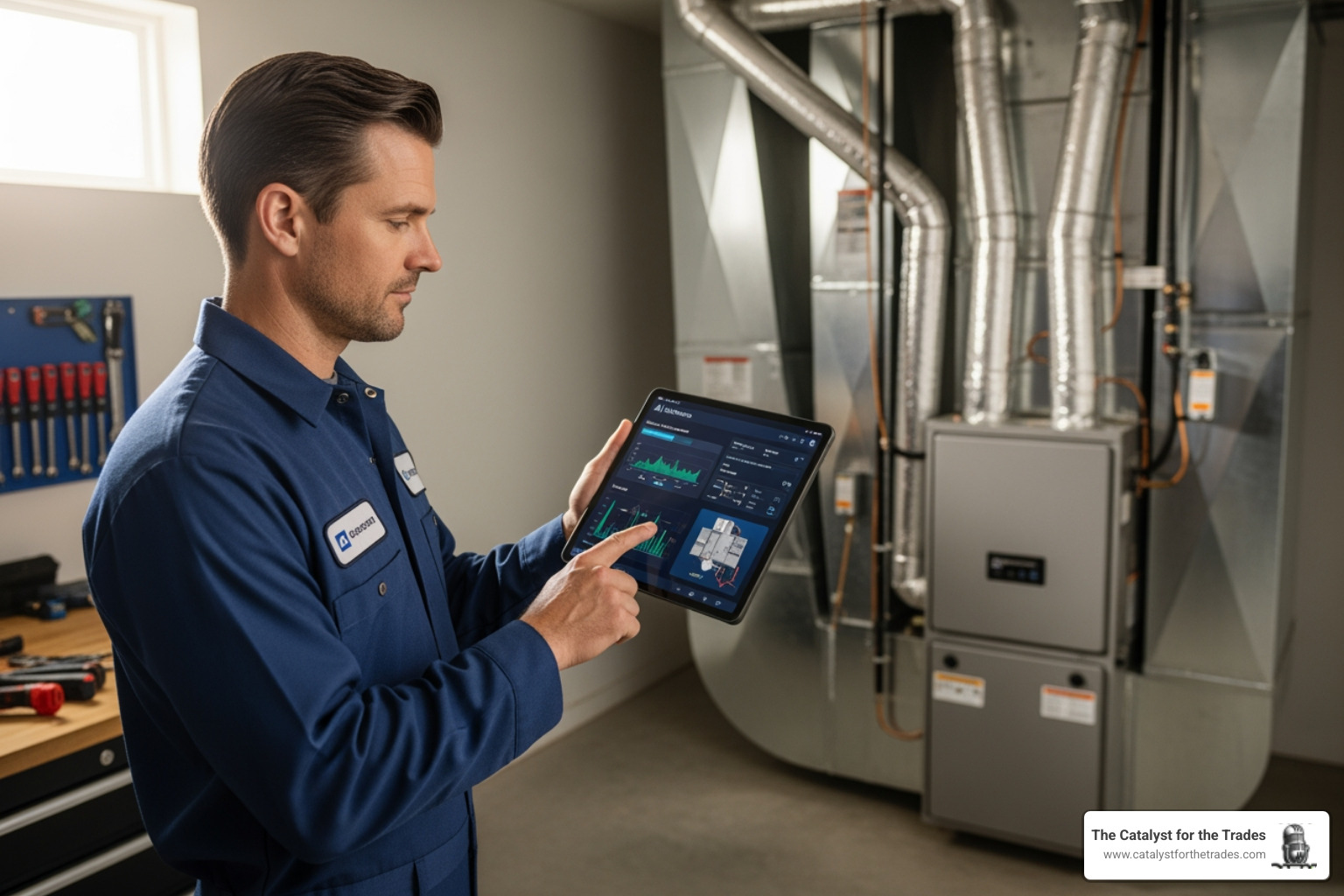
A technician using a tablet with AI-driven diagnostic software to analyze a home's HVAC system - professional development

As the nature of work changes, flexible learning is crucial. For home service companies, this means staying ahead of trends and adapting to new technologies and customer expectations. Continuous learning prepares your team for tomorrow's challenges, changing potential disruptions into opportunities. This forward-thinking approach is the foundation of effective change management and positions your business for strategic adaptation.

Embracing Technology and Innovation

Technology is rapidly reshaping our industry. Tools like smart thermostats, AI diagnostics, and automated scheduling are now standard. Your team's proficiency with these innovations is critical for your competitive position.

Digital tools and software proficiency are the backbone of modern service. Mastery of CRM, field service apps, and scheduling software leads to smoother operations and better customer experiences, but it requires intentional training.

AI and automation offer significant advantages. Predictive maintenance, optimized routing, and chatbots improve efficiency and service. Leveraging AI is no longer optional for staying competitive, as explored in the AI revolution in home services: how to future-proof your trades business.

The shift to e-commerce for services meets modern customer expectations. Homeowners want to book and manage services online. Training your team on these platforms ensures you're meeting customers where they are, a critical digital change detailed in how to lead digital transformation in home service marketing (and why you can't wait).

Smart home technology is now standard in many homes. Technicians need specialized knowledge to install and integrate these systems, as customers expect their service professionals to be experts.

Developing the Next Generation of Leaders

Your business's long-term success depends on having strong leaders ready to step up. Cultivating internal talent through professional development is non-negotiable for succession planning, expansion, or unexpected transitions.

Succession planning begins by identifying high-potential employees with leadership aptitude. Provide them with targeted, structured development opportunities to prepare them for greater responsibilities.

Leadership skills like communication, conflict resolution, and delegation are learnable and critical. Investing in this training builds a bench of leaders who can effectively manage and inspire teams.

Strategic thinking lifts managers to leaders. Help emerging leaders see beyond daily operations to understand market dynamics and contribute to long-term strategy, turning them into business builders.

Financial literacy is crucial for future leaders. Understanding financials, budgeting, and profitability drivers empowers them to make sound decisions and think like owners.

Effective people management skills are essential for building strong teams. This includes hiring, training, giving feedback, and creating an environment where top talent wants to stay.

By investing in these areas, you build a culture of excellence that permeates your organization. This commitment to developing leaders creates true industry leadership and establishes your business as a source of thought leadership in the home services sector.

Frequently Asked Questions about Professional Development

Here are answers to common questions about how professional development works in the real world of home services.

What exactly is professional development in the trades?

Professional development is the continuous process of learning that occurs after initial job training. It keeps technicians sharp and businesses competitive by covering new tools, leadership skills, regulations, and emerging technologies. It includes everything from short webinars to long-term programs, all aimed at improving career-related skills. This process helps professionals stay current with trends and best practices to excel in their roles.

How is this different from the initial training a technician receives?

Initial training focuses on the foundational, entry-level skills needed to perform a job safely, like basic installations and repairs. Professional development is the next step: ongoing learning for experienced professionals to refine their expertise, adapt to new challenges, learn advanced skills, and develop leadership qualities. It builds on the initial foundation, focusing on specialization and continuous improvement rather than basic qualification.

How can I get my team excited about more training?

The key is to frame professional development as an investment in their personal and career growth, not a mandatory task. Link development opportunities to what they care about: career advancement, higher earning potential, and mastering new technologies. When a technician sees a clear path to a promotion or pay raise, training becomes more appealing.

Make it personal and practical by showing how new skills boost confidence and make work more engaging. Use specific examples, like how a certification can lead to project leadership roles. Lead by example; when your team sees you pursuing your own development, they'll understand it's part of the company DNA. Also, celebrate their achievements publicly, as recognition is a powerful motivator.

Finally, ensure training is relevant by tailoring it to individual career goals. Show you're invested in their unique success, and they'll become genuinely excited to grow their skills.

Conclusion

Here's the truth: professional development isn't just another line item in your business plan. It's the engine that drives everything else forward. When we invest in our people's growth, we're not just teaching them new skills—we're building a foundation for sustainable success that can weather any storm the home services industry throws our way.

Think about what we've covered: teams that feel valued and see a path forward stay longer. They work smarter. They deliver better service. They become the kind of professionals that customers rave about and that competitors wish they could hire. That's not just good for morale—it's a massive competitive edge that directly impacts your bottom line.

The home services landscape is changing fast. New technologies like AI, evolving customer expectations, and the constant need for specialized skills mean that standing still is the same as falling behind. But when you cultivate a culture of continuous learning, when you accept innovation, and when you actively develop the leaders who'll take your business into the future, you're not just keeping up. You're leading the pack.

At The Catalyst for the Trades, we've seen how empowering people through ongoing learning transforms businesses from the inside out. It's the difference between a company that's just getting by and one that's genuinely thriving. It's the difference between hoping tomorrow will be better and knowing you're actively building something extraordinary.

The choice is clear: invest in your people, and they'll invest themselves in your success. That's the kind of partnership that builds legacy businesses.

Ready to take the next step? Explore more strategies for growth and leadership in the trades and find what's possible when you put your team's development first. Let's build something great together.

Why Professional Development Is Your Most Strategic Business Move

Professional development isn't just training—it's the continuous process of building new skills, knowledge, and capabilities that keep your team sharp and your business competitive. For home services business owners, it's the difference between a team that's merely competent and one that drives real growth. Here's what you need to know:

  • What it is: Ongoing learning that goes beyond initial training, including workshops, certifications, mentoring, and skill-building
  • Why it matters: 74% of employees say lack of development opportunities prevents them from reaching full potential
  • The retention factor: 94% of employees would stay longer at a company that invests in their development
  • The business impact: Better retention, higher productivity, improved customer satisfaction, and stronger competitive positioning

If you're struggling to attract and keep skilled technicians, or if you're trying to scale without sacrificing quality, the problem might not be your pay or your market—it might be that your team doesn't see a clear path forward. In the trades, where skilled labor is increasingly scarce and customer expectations are rising, investing in your people isn't optional anymore. It's the foundation of sustainable growth.

Ready to build a team that drives results? Start by exploring proven talent acquisition strategies and find how to position your business for long-term growth.

The numbers tell a clear story: when you invest in professional development, your employees grow, your retention improves, and your business becomes more profitable and resilient. The question isn't whether you can afford to invest in development—it's whether you can afford not to.

Infographic showing professional development impact: 74% of employees feel held back without development opportunities, 94% would stay longer at companies that invest in staff development, leading to higher retention rates, improved productivity, better customer satisfaction, and stronger competitive advantage - professional development infographic checklist-light-blue-grey

Simple professional development glossary:

Why Development is a Non-Negotiable Investment

In the home services industry, you're either moving forward or falling behind. Professional development isn't something you do with extra time or budget—it's the strategic investment that determines whether your business thrives or just survives.

From your team's perspective, a staggering 74% of employees feel they can't reach their full potential due to a lack of development opportunities. And 94% of employees would stay longer at a company that invests in their growth. In an industry where retaining skilled technicians is a constant battle, these numbers are critical.

Investing in professional development directly impacts employee morale, boosts productivity, creates a genuine competitive advantage, and improves customer satisfaction. Skilled, confident employees work smarter, feel valued, and deliver better service. This commitment to growth is what industry leaders like Mike Disney emphasize in how to win in the trades: recruitment, AI, and trust. It's also a cornerstone of effective talent acquisition, as top professionals want to work for companies that invest in their future.

Benefits for Your Team (The Individual)

Investing in an employee's professional development improves their entire career trajectory with tangible benefits.

Skill improvement helps them get ahead by mastering new software, advanced techniques, or customer communication. They become genuinely better at their jobs.

Increased confidence is a natural result of learning and applying new skills. This confidence improves customer interactions and job performance, leading to greater satisfaction.

Career advancement becomes a clear path. When team members see opportunities for promotion to lead tech or management roles, they see a long-term future with your company.

This growth translates to higher earning potential. As skills and experience deepen, so does their value and pay. This commitment deserves recognition.

All of this leads to genuine job satisfaction. Challenged and supported employees with a clear path forward are happier, more engaged, and stay longer. This is the environment Raul Rodriguez discusses in how to lead, serve, and grow in the trades.

A confident technician successfully completing a complex job, smiling as they finalize their work on a home's HVAC system - professional development

Benefits for Your Business (The Employer)

A commitment to professional development transforms your business, with returns that directly impact your bottom line and competitiveness.

Higher retention rates are an immediate benefit. The 94% statistic is clear: invest in people, and they stay. This reduces the substantial costs of turnover, often paying for the development program itself.

Attracting top talent is easier when you're known for investing in your people. In a tight labor market, a strong development program is a secret weapon for attracting career-focused technicians.

Improved efficiency is a natural result of a skilled team. They work smarter, faster, and with fewer mistakes, reducing callbacks and increasing productivity.

Your brand reputation strengthens with knowledgeable, professional technicians. Satisfied customers become your best marketing, spreading the word about your exceptional service.

This all leads to increased profitability. Better retention, talent, efficiency, and reputation all contribute to a healthier bottom line. This is the foundation of what Dana Staszkiewicz teaches in how to build a profitable, scalable trades business, and it's essential for sustainable home service business growth.

The question isn't whether you can afford to invest in professional development. It's whether you can afford not to.

The Blueprint for Growth: Methods of Professional Development

Professional development isn't one-size-fits-all. To build a skilled workforce, offer a mix of structured opportunities and an environment that encourages daily, natural learning, catering to different learning styles and career paths.

A trades professional mentoring a junior technician on-site, pointing to a diagram on a tablet while discussing a technical aspect - professional development

Professional development is a systematic, ongoing process. It's not a one-time workshop but a culture where growth is expected and supported, where continuous learning becomes part of your company's DNA, and where management development is as important as technical skills.

Structured Learning Opportunities

Formal training programs provide an organized foundation for excellence with clear objectives and measurable outcomes.

Workshops and seminars offer deep dives into specific skills, like new techniques or customer communication, providing practical knowledge for immediate application. Manufacturer training keeps your team current on the latest equipment, ensuring they can install, service, and troubleshoot new products.

Online courses offer flexibility, allowing your team to learn at their own pace. Digital platforms provide access to everything from quick webinars to full certification programs. Industry conferences provide unique networking opportunities and insights into what's next in the trades. Finally, certification renewals are key opportunities to refresh skills, learn updated best practices, and maintain the high professional standards that set your business apart.

This approach to structured learning is what Mark Evans used to build real wealth by working less and thinking bigger, as he understood that investing in structured development creates leverage.

Building an Internal Growth Culture

The most powerful learning is often informal, happening right within your organization. When you build a culture that values growth, learning becomes contagious.

Mentorship programs pair seasoned technicians with newer employees. Mentors share technical skills, problem-solving approaches, and customer interaction nuances, benefiting both the mentee's growth and the mentor's expertise.

Coaching provides personalized development, helping individuals identify blind spots, set goals, and create action plans. Peer-to-peer learning allows technicians to share wins, challenges, and solutions, expanding the entire team's knowledge base.

Communities of practice unite people with a shared passion for a specific skill, allowing them to share insights and push each other forward. Don't underestimate lunch and learns—these are simple, effective ways to introduce concepts, discuss industry changes, or share successes in a short, informal setting.

This internal growth culture drives real change and is the foundation of the future of leadership: how to build a team that drives growth. It's the kind of leadership approach that Jazmin Ramirez demonstrates when powering change in the trades.

The best professional development programs blend both worlds, combining the structure of formal training with the relevance of internal learning. When you get this balance right, you create a team that's not just skilled—they're unstoppable.

How to Fuel Your Team's Growth Engine

A thriving professional development program isn't a once-a-year seminar; it's about weaving growth into the DNA of your business, making it a natural part of your operations.

For development to stick, it must be genuine. It starts with leadership buy-in, where managers champion learning, share their own journeys, and celebrate progress, shifting the entire culture. Your team needs the same attention as your equipment. Create individual development plans that align personal aspirations with business needs, strengthening both your employees and your service offerings.

The practical side requires budgeting for training and providing time for it. Real commitment means blocking out schedules, investing funds, and treating learning as essential work, not a luxury. Finally, recognizing progress is a powerful motivator that can fuel an employee's drive for months.

This balanced approach to growth, where you scale your business while genuinely caring for your people, is exactly what Trey McWilliams demonstrates in balancing big growth with people-first leadership.

Encouraging and Supporting Employee Growth

A great program is nothing without genuine support for your team. Here's how to provide it.

Start with regular, informal check-ins to discuss career goals. Ask what excites them, what challenges they want, and what skills they want to learn. You might be surprised by their ambitions. From there, work together on concrete goal setting, like mastering a technique or earning a certification. Clear goals create a visible path forward.

Tie development directly to career paths. Show how a new skill or certification opens doors to promotions or advanced roles. Training then becomes a roadmap to their future. For bigger investments, offering tuition reimbursement removes a massive barrier and shows you're willing to invest in them.

Finally, celebrate achievements. When someone completes a course or applies a new skill, share it in meetings or group chats. Recognition shows that growth is valued and is central to protecting profit while leading with purpose in home services.

Managing the Costs of Professional Development

Professional development is an investment, not just a cost. The expense of turnover, mistakes, and lost customers is far greater. The real question isn't if you can afford to invest, but if you can afford not to.

Smart development doesn't require a huge budget. Start with in-house training and mentorship programs to leverage the expertise of your veteran technicians. This costs little and strengthens team culture.

Use free online resources from industry associations and other learning platforms. Your team can learn at their own pace, often from their phones. For external training, seek group discounts, as many providers offer bulk rates that make specialized training more accessible.

Look into government grants and industry programs for workforce development. The application time can be well worth the significant cost savings. Also, consider a phased implementation. Start with your most critical training needs and build from there. Small, consistent investments compound over time.

This strategic approach to managing resources while fueling growth is a cornerstone of effective business growth strategies that work in the real world.

Future-Proofing Your Business Through Continuous Learning

The home services industry is constantly changing due to new technology, regulations, and customer behaviors. Professional development is key to building the agility and resilience your business needs to thrive amid this change.

A technician using a tablet with AI-driven diagnostic software to analyze a home's HVAC system - professional development

As the nature of work changes, flexible learning is crucial. For home service companies, this means staying ahead of trends and adapting to new technologies and customer expectations. Continuous learning prepares your team for tomorrow's challenges, changing potential disruptions into opportunities. This forward-thinking approach is the foundation of effective change management and positions your business for strategic adaptation.

Embracing Technology and Innovation

Technology is rapidly reshaping our industry. Tools like smart thermostats, AI diagnostics, and automated scheduling are now standard. Your team's proficiency with these innovations is critical for your competitive position.

Digital tools and software proficiency are the backbone of modern service. Mastery of CRM, field service apps, and scheduling software leads to smoother operations and better customer experiences, but it requires intentional training.

AI and automation offer significant advantages. Predictive maintenance, optimized routing, and chatbots improve efficiency and service. Leveraging AI is no longer optional for staying competitive, as explored in the AI revolution in home services: how to future-proof your trades business.

The shift to e-commerce for services meets modern customer expectations. Homeowners want to book and manage services online. Training your team on these platforms ensures you're meeting customers where they are, a critical digital change detailed in how to lead digital transformation in home service marketing (and why you can't wait).

Smart home technology is now standard in many homes. Technicians need specialized knowledge to install and integrate these systems, as customers expect their service professionals to be experts.

Developing the Next Generation of Leaders

Your business's long-term success depends on having strong leaders ready to step up. Cultivating internal talent through professional development is non-negotiable for succession planning, expansion, or unexpected transitions.

Succession planning begins by identifying high-potential employees with leadership aptitude. Provide them with targeted, structured development opportunities to prepare them for greater responsibilities.

Leadership skills like communication, conflict resolution, and delegation are learnable and critical. Investing in this training builds a bench of leaders who can effectively manage and inspire teams.

Strategic thinking lifts managers to leaders. Help emerging leaders see beyond daily operations to understand market dynamics and contribute to long-term strategy, turning them into business builders.

Financial literacy is crucial for future leaders. Understanding financials, budgeting, and profitability drivers empowers them to make sound decisions and think like owners.

Effective people management skills are essential for building strong teams. This includes hiring, training, giving feedback, and creating an environment where top talent wants to stay.

By investing in these areas, you build a culture of excellence that permeates your organization. This commitment to developing leaders creates true industry leadership and establishes your business as a source of thought leadership in the home services sector.

Frequently Asked Questions about Professional Development

Here are answers to common questions about how professional development works in the real world of home services.

What exactly is professional development in the trades?

Professional development is the continuous process of learning that occurs after initial job training. It keeps technicians sharp and businesses competitive by covering new tools, leadership skills, regulations, and emerging technologies. It includes everything from short webinars to long-term programs, all aimed at improving career-related skills. This process helps professionals stay current with trends and best practices to excel in their roles.

How is this different from the initial training a technician receives?

Initial training focuses on the foundational, entry-level skills needed to perform a job safely, like basic installations and repairs. Professional development is the next step: ongoing learning for experienced professionals to refine their expertise, adapt to new challenges, learn advanced skills, and develop leadership qualities. It builds on the initial foundation, focusing on specialization and continuous improvement rather than basic qualification.

How can I get my team excited about more training?

The key is to frame professional development as an investment in their personal and career growth, not a mandatory task. Link development opportunities to what they care about: career advancement, higher earning potential, and mastering new technologies. When a technician sees a clear path to a promotion or pay raise, training becomes more appealing.

Make it personal and practical by showing how new skills boost confidence and make work more engaging. Use specific examples, like how a certification can lead to project leadership roles. Lead by example; when your team sees you pursuing your own development, they'll understand it's part of the company DNA. Also, celebrate their achievements publicly, as recognition is a powerful motivator.

Finally, ensure training is relevant by tailoring it to individual career goals. Show you're invested in their unique success, and they'll become genuinely excited to grow their skills.

Conclusion

Here's the truth: professional development isn't just another line item in your business plan. It's the engine that drives everything else forward. When we invest in our people's growth, we're not just teaching them new skills—we're building a foundation for sustainable success that can weather any storm the home services industry throws our way.

Think about what we've covered: teams that feel valued and see a path forward stay longer. They work smarter. They deliver better service. They become the kind of professionals that customers rave about and that competitors wish they could hire. That's not just good for morale—it's a massive competitive edge that directly impacts your bottom line.

The home services landscape is changing fast. New technologies like AI, evolving customer expectations, and the constant need for specialized skills mean that standing still is the same as falling behind. But when you cultivate a culture of continuous learning, when you accept innovation, and when you actively develop the leaders who'll take your business into the future, you're not just keeping up. You're leading the pack.

At The Catalyst for the Trades, we've seen how empowering people through ongoing learning transforms businesses from the inside out. It's the difference between a company that's just getting by and one that's genuinely thriving. It's the difference between hoping tomorrow will be better and knowing you're actively building something extraordinary.

The choice is clear: invest in your people, and they'll invest themselves in your success. That's the kind of partnership that builds legacy businesses.

Ready to take the next step? Explore more strategies for growth and leadership in the trades and find what's possible when you put your team's development first. Let's build something great together.

Why Professional Development Is Your Most Strategic Business Move

Professional development isn't just training—it's the continuous process of building new skills, knowledge, and capabilities that keep your team sharp and your business competitive. For home services business owners, it's the difference between a team that's merely competent and one that drives real growth. Here's what you need to know:

  • What it is: Ongoing learning that goes beyond initial training, including workshops, certifications, mentoring, and skill-building
  • Why it matters: 74% of employees say lack of development opportunities prevents them from reaching full potential
  • The retention factor: 94% of employees would stay longer at a company that invests in their development
  • The business impact: Better retention, higher productivity, improved customer satisfaction, and stronger competitive positioning

If you're struggling to attract and keep skilled technicians, or if you're trying to scale without sacrificing quality, the problem might not be your pay or your market—it might be that your team doesn't see a clear path forward. In the trades, where skilled labor is increasingly scarce and customer expectations are rising, investing in your people isn't optional anymore. It's the foundation of sustainable growth.

Ready to build a team that drives results? Start by exploring proven talent acquisition strategies and find how to position your business for long-term growth.

The numbers tell a clear story: when you invest in professional development, your employees grow, your retention improves, and your business becomes more profitable and resilient. The question isn't whether you can afford to invest in development—it's whether you can afford not to.

Infographic showing professional development impact: 74% of employees feel held back without development opportunities, 94% would stay longer at companies that invest in staff development, leading to higher retention rates, improved productivity, better customer satisfaction, and stronger competitive advantage - professional development infographic checklist-light-blue-grey

Simple professional development glossary:

Why Development is a Non-Negotiable Investment

In the home services industry, you're either moving forward or falling behind. Professional development isn't something you do with extra time or budget—it's the strategic investment that determines whether your business thrives or just survives.

From your team's perspective, a staggering 74% of employees feel they can't reach their full potential due to a lack of development opportunities. And 94% of employees would stay longer at a company that invests in their growth. In an industry where retaining skilled technicians is a constant battle, these numbers are critical.

Investing in professional development directly impacts employee morale, boosts productivity, creates a genuine competitive advantage, and improves customer satisfaction. Skilled, confident employees work smarter, feel valued, and deliver better service. This commitment to growth is what industry leaders like Mike Disney emphasize in how to win in the trades: recruitment, AI, and trust. It's also a cornerstone of effective talent acquisition, as top professionals want to work for companies that invest in their future.

Benefits for Your Team (The Individual)

Investing in an employee's professional development improves their entire career trajectory with tangible benefits.

Skill improvement helps them get ahead by mastering new software, advanced techniques, or customer communication. They become genuinely better at their jobs.

Increased confidence is a natural result of learning and applying new skills. This confidence improves customer interactions and job performance, leading to greater satisfaction.

Career advancement becomes a clear path. When team members see opportunities for promotion to lead tech or management roles, they see a long-term future with your company.

This growth translates to higher earning potential. As skills and experience deepen, so does their value and pay. This commitment deserves recognition.

All of this leads to genuine job satisfaction. Challenged and supported employees with a clear path forward are happier, more engaged, and stay longer. This is the environment Raul Rodriguez discusses in how to lead, serve, and grow in the trades.

A confident technician successfully completing a complex job, smiling as they finalize their work on a home's HVAC system - professional development

Benefits for Your Business (The Employer)

A commitment to professional development transforms your business, with returns that directly impact your bottom line and competitiveness.

Higher retention rates are an immediate benefit. The 94% statistic is clear: invest in people, and they stay. This reduces the substantial costs of turnover, often paying for the development program itself.

Attracting top talent is easier when you're known for investing in your people. In a tight labor market, a strong development program is a secret weapon for attracting career-focused technicians.

Improved efficiency is a natural result of a skilled team. They work smarter, faster, and with fewer mistakes, reducing callbacks and increasing productivity.

Your brand reputation strengthens with knowledgeable, professional technicians. Satisfied customers become your best marketing, spreading the word about your exceptional service.

This all leads to increased profitability. Better retention, talent, efficiency, and reputation all contribute to a healthier bottom line. This is the foundation of what Dana Staszkiewicz teaches in how to build a profitable, scalable trades business, and it's essential for sustainable home service business growth.

The question isn't whether you can afford to invest in professional development. It's whether you can afford not to.

The Blueprint for Growth: Methods of Professional Development

Professional development isn't one-size-fits-all. To build a skilled workforce, offer a mix of structured opportunities and an environment that encourages daily, natural learning, catering to different learning styles and career paths.

A trades professional mentoring a junior technician on-site, pointing to a diagram on a tablet while discussing a technical aspect - professional development

Professional development is a systematic, ongoing process. It's not a one-time workshop but a culture where growth is expected and supported, where continuous learning becomes part of your company's DNA, and where management development is as important as technical skills.

Structured Learning Opportunities

Formal training programs provide an organized foundation for excellence with clear objectives and measurable outcomes.

Workshops and seminars offer deep dives into specific skills, like new techniques or customer communication, providing practical knowledge for immediate application. Manufacturer training keeps your team current on the latest equipment, ensuring they can install, service, and troubleshoot new products.

Online courses offer flexibility, allowing your team to learn at their own pace. Digital platforms provide access to everything from quick webinars to full certification programs. Industry conferences provide unique networking opportunities and insights into what's next in the trades. Finally, certification renewals are key opportunities to refresh skills, learn updated best practices, and maintain the high professional standards that set your business apart.

This approach to structured learning is what Mark Evans used to build real wealth by working less and thinking bigger, as he understood that investing in structured development creates leverage.

Building an Internal Growth Culture

The most powerful learning is often informal, happening right within your organization. When you build a culture that values growth, learning becomes contagious.

Mentorship programs pair seasoned technicians with newer employees. Mentors share technical skills, problem-solving approaches, and customer interaction nuances, benefiting both the mentee's growth and the mentor's expertise.

Coaching provides personalized development, helping individuals identify blind spots, set goals, and create action plans. Peer-to-peer learning allows technicians to share wins, challenges, and solutions, expanding the entire team's knowledge base.

Communities of practice unite people with a shared passion for a specific skill, allowing them to share insights and push each other forward. Don't underestimate lunch and learns—these are simple, effective ways to introduce concepts, discuss industry changes, or share successes in a short, informal setting.

This internal growth culture drives real change and is the foundation of the future of leadership: how to build a team that drives growth. It's the kind of leadership approach that Jazmin Ramirez demonstrates when powering change in the trades.

The best professional development programs blend both worlds, combining the structure of formal training with the relevance of internal learning. When you get this balance right, you create a team that's not just skilled—they're unstoppable.

How to Fuel Your Team's Growth Engine

A thriving professional development program isn't a once-a-year seminar; it's about weaving growth into the DNA of your business, making it a natural part of your operations.

For development to stick, it must be genuine. It starts with leadership buy-in, where managers champion learning, share their own journeys, and celebrate progress, shifting the entire culture. Your team needs the same attention as your equipment. Create individual development plans that align personal aspirations with business needs, strengthening both your employees and your service offerings.

The practical side requires budgeting for training and providing time for it. Real commitment means blocking out schedules, investing funds, and treating learning as essential work, not a luxury. Finally, recognizing progress is a powerful motivator that can fuel an employee's drive for months.

This balanced approach to growth, where you scale your business while genuinely caring for your people, is exactly what Trey McWilliams demonstrates in balancing big growth with people-first leadership.

Encouraging and Supporting Employee Growth

A great program is nothing without genuine support for your team. Here's how to provide it.

Start with regular, informal check-ins to discuss career goals. Ask what excites them, what challenges they want, and what skills they want to learn. You might be surprised by their ambitions. From there, work together on concrete goal setting, like mastering a technique or earning a certification. Clear goals create a visible path forward.

Tie development directly to career paths. Show how a new skill or certification opens doors to promotions or advanced roles. Training then becomes a roadmap to their future. For bigger investments, offering tuition reimbursement removes a massive barrier and shows you're willing to invest in them.

Finally, celebrate achievements. When someone completes a course or applies a new skill, share it in meetings or group chats. Recognition shows that growth is valued and is central to protecting profit while leading with purpose in home services.

Managing the Costs of Professional Development

Professional development is an investment, not just a cost. The expense of turnover, mistakes, and lost customers is far greater. The real question isn't if you can afford to invest, but if you can afford not to.

Smart development doesn't require a huge budget. Start with in-house training and mentorship programs to leverage the expertise of your veteran technicians. This costs little and strengthens team culture.

Use free online resources from industry associations and other learning platforms. Your team can learn at their own pace, often from their phones. For external training, seek group discounts, as many providers offer bulk rates that make specialized training more accessible.

Look into government grants and industry programs for workforce development. The application time can be well worth the significant cost savings. Also, consider a phased implementation. Start with your most critical training needs and build from there. Small, consistent investments compound over time.

This strategic approach to managing resources while fueling growth is a cornerstone of effective business growth strategies that work in the real world.

Future-Proofing Your Business Through Continuous Learning

The home services industry is constantly changing due to new technology, regulations, and customer behaviors. Professional development is key to building the agility and resilience your business needs to thrive amid this change.

A technician using a tablet with AI-driven diagnostic software to analyze a home's HVAC system - professional development

As the nature of work changes, flexible learning is crucial. For home service companies, this means staying ahead of trends and adapting to new technologies and customer expectations. Continuous learning prepares your team for tomorrow's challenges, changing potential disruptions into opportunities. This forward-thinking approach is the foundation of effective change management and positions your business for strategic adaptation.

Embracing Technology and Innovation

Technology is rapidly reshaping our industry. Tools like smart thermostats, AI diagnostics, and automated scheduling are now standard. Your team's proficiency with these innovations is critical for your competitive position.

Digital tools and software proficiency are the backbone of modern service. Mastery of CRM, field service apps, and scheduling software leads to smoother operations and better customer experiences, but it requires intentional training.

AI and automation offer significant advantages. Predictive maintenance, optimized routing, and chatbots improve efficiency and service. Leveraging AI is no longer optional for staying competitive, as explored in the AI revolution in home services: how to future-proof your trades business.

The shift to e-commerce for services meets modern customer expectations. Homeowners want to book and manage services online. Training your team on these platforms ensures you're meeting customers where they are, a critical digital change detailed in how to lead digital transformation in home service marketing (and why you can't wait).

Smart home technology is now standard in many homes. Technicians need specialized knowledge to install and integrate these systems, as customers expect their service professionals to be experts.

Developing the Next Generation of Leaders

Your business's long-term success depends on having strong leaders ready to step up. Cultivating internal talent through professional development is non-negotiable for succession planning, expansion, or unexpected transitions.

Succession planning begins by identifying high-potential employees with leadership aptitude. Provide them with targeted, structured development opportunities to prepare them for greater responsibilities.

Leadership skills like communication, conflict resolution, and delegation are learnable and critical. Investing in this training builds a bench of leaders who can effectively manage and inspire teams.

Strategic thinking lifts managers to leaders. Help emerging leaders see beyond daily operations to understand market dynamics and contribute to long-term strategy, turning them into business builders.

Financial literacy is crucial for future leaders. Understanding financials, budgeting, and profitability drivers empowers them to make sound decisions and think like owners.

Effective people management skills are essential for building strong teams. This includes hiring, training, giving feedback, and creating an environment where top talent wants to stay.

By investing in these areas, you build a culture of excellence that permeates your organization. This commitment to developing leaders creates true industry leadership and establishes your business as a source of thought leadership in the home services sector.

Frequently Asked Questions about Professional Development

Here are answers to common questions about how professional development works in the real world of home services.

What exactly is professional development in the trades?

Professional development is the continuous process of learning that occurs after initial job training. It keeps technicians sharp and businesses competitive by covering new tools, leadership skills, regulations, and emerging technologies. It includes everything from short webinars to long-term programs, all aimed at improving career-related skills. This process helps professionals stay current with trends and best practices to excel in their roles.

How is this different from the initial training a technician receives?

Initial training focuses on the foundational, entry-level skills needed to perform a job safely, like basic installations and repairs. Professional development is the next step: ongoing learning for experienced professionals to refine their expertise, adapt to new challenges, learn advanced skills, and develop leadership qualities. It builds on the initial foundation, focusing on specialization and continuous improvement rather than basic qualification.

How can I get my team excited about more training?

The key is to frame professional development as an investment in their personal and career growth, not a mandatory task. Link development opportunities to what they care about: career advancement, higher earning potential, and mastering new technologies. When a technician sees a clear path to a promotion or pay raise, training becomes more appealing.

Make it personal and practical by showing how new skills boost confidence and make work more engaging. Use specific examples, like how a certification can lead to project leadership roles. Lead by example; when your team sees you pursuing your own development, they'll understand it's part of the company DNA. Also, celebrate their achievements publicly, as recognition is a powerful motivator.

Finally, ensure training is relevant by tailoring it to individual career goals. Show you're invested in their unique success, and they'll become genuinely excited to grow their skills.

Conclusion

Here's the truth: professional development isn't just another line item in your business plan. It's the engine that drives everything else forward. When we invest in our people's growth, we're not just teaching them new skills—we're building a foundation for sustainable success that can weather any storm the home services industry throws our way.

Think about what we've covered: teams that feel valued and see a path forward stay longer. They work smarter. They deliver better service. They become the kind of professionals that customers rave about and that competitors wish they could hire. That's not just good for morale—it's a massive competitive edge that directly impacts your bottom line.

The home services landscape is changing fast. New technologies like AI, evolving customer expectations, and the constant need for specialized skills mean that standing still is the same as falling behind. But when you cultivate a culture of continuous learning, when you accept innovation, and when you actively develop the leaders who'll take your business into the future, you're not just keeping up. You're leading the pack.

At The Catalyst for the Trades, we've seen how empowering people through ongoing learning transforms businesses from the inside out. It's the difference between a company that's just getting by and one that's genuinely thriving. It's the difference between hoping tomorrow will be better and knowing you're actively building something extraordinary.

The choice is clear: invest in your people, and they'll invest themselves in your success. That's the kind of partnership that builds legacy businesses.

Ready to take the next step? Explore more strategies for growth and leadership in the trades and find what's possible when you put your team's development first. Let's build something great together.

Episodes you may like

Connect and Conquer: Understanding CRM

Conquer growth! Learn how customer relationship management empowers home services with data, boosts efficiency, and delights customers.

Read more
Published
December 5, 2025
Beyond the Click: Strategies for Supercharging Lead Generation and Conversion

Boost sales! Discover top strategies for lead conversion optimization, leveraging nurturing, AI, and data-driven personalization.

Read more
Published
December 4, 2025
Beyond the Field: Comparing Leading Business Management and Automation Solutions

Unlock efficiency & growth with field service management software. Explore features, AI, and choose the best solution for your business.

Read more
Published
December 2, 2025

Guests

Courtney Van Delden Supplee
VDWWS