Learn · January 22, 2026
Hiring process optimization: 7 Flawless Steps 2025
Transform recruitment with hiring process optimization. Attract top talent, reduce costs, and build winning teams.
By The Catalyst Editorial Team Operator education · 16 min read · Updated July 24, 2026

Why Hiring Process Optimization Matters for Your Business
Hiring process optimization is the systematic approach to refining your recruitment workflow to attract, evaluate, and hire top talent faster, more efficiently, and at lower cost. For home services business owners, every day a position sits empty means lost revenue, overworked teams, and missed growth opportunities.
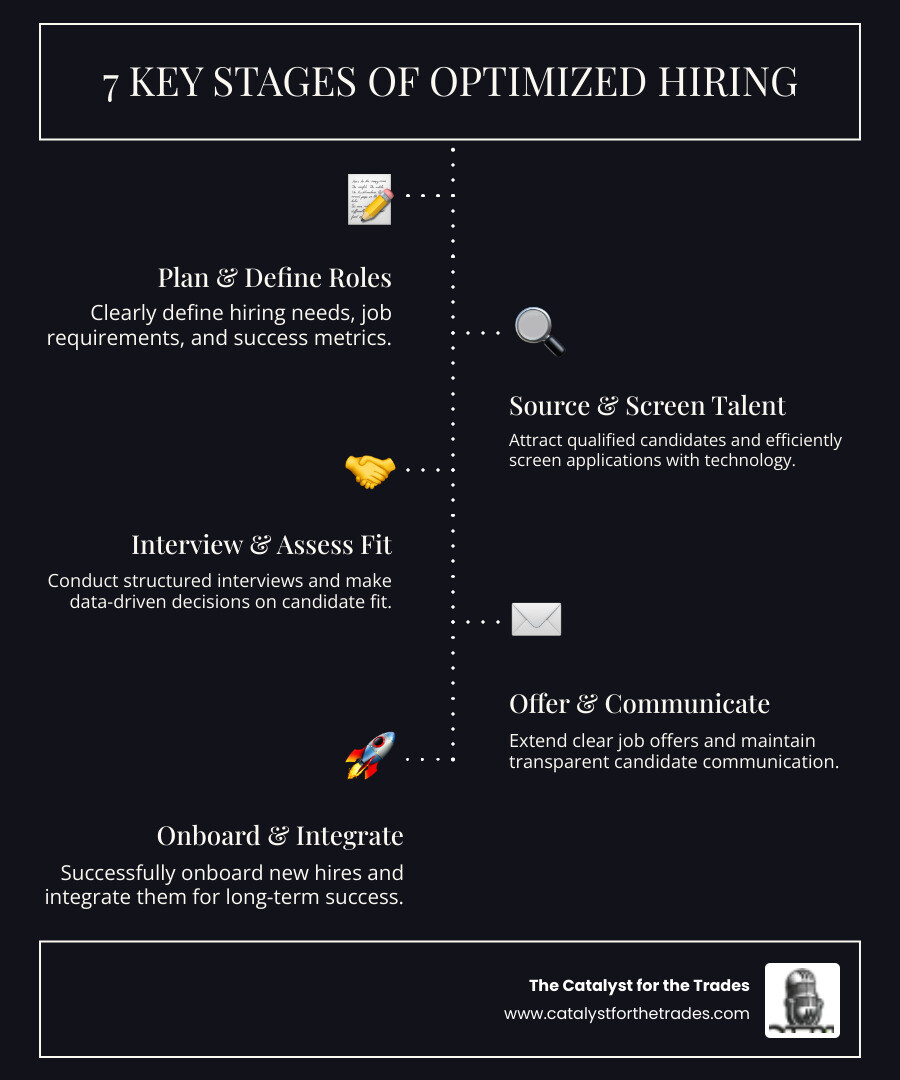
Key steps to optimize your hiring process:
- Audit your current workflow – Identify bottlenecks and gather feedback from hiring managers
- Define roles clearly – Create detailed job descriptions with specific qualifications and success metrics
- Leverage technology – Use an Applicant Tracking System (ATS) to automate screening and scheduling
- Structure your interviews – Implement standardized questions and evaluation criteria to reduce bias
- Track key metrics – Monitor time to hire, cost per hire, and quality of hire to identify improvements
- Improve candidate experience – Provide clear, timely communication throughout the process
- Onboard strategically – Set new hires up for success with comprehensive orientation and training
The stakes are high. According to SHRM, the average cost per hire is $4,700, and it takes 44 days to fill a position. But the real cost of a bad hire can reach tens of thousands of dollars when you factor in turnover, lost productivity, and team disruption. A 2024 Gallup study found that employees who had strong candidate experiences are three times more likely to be extremely satisfied with their work.
For trades businesses competing for skilled technicians, optimizing your hiring workflow isn’t just about efficiency—it’s about survival and growth. When you can identify the right person faster than your competitors, communicate more professionally throughout the process, and deliver a seamless experience from application to first day, you win the talent war.
The Foundation: Auditing and Strategizing Your Hiring Workflow
A hiring workflow is a structured series of steps that guides your recruitment process from start to finish. It defines how candidates progress through each stage, from the initial job requisition to the final offer. Optimizing this workflow is crucial for any organization because it directly impacts our ability to attract and secure the best talent, reduce operational costs, and foster a positive reputation. Essentially, it’s about making our hiring smarter, not just faster.
To truly begin hiring process optimization, we must first look inward. Effectively assessing our current recruitment workflow involves a systematic review of each step in the process to pinpoint inefficiencies and areas for improvement. This means evaluating everything from how a job requisition is initiated to how a new hire is onboarded. We need to identify bottlenecks—those points where the process slows down or breaks—and understand why they occur. For example, is there a delay between resume screening and the first interview? This could indicate a scheduling issue that could be resolved with automated programs.
Gathering feedback from all stakeholders is paramount. This includes hiring managers, recruiters, and even past candidates. Their insights can reveal pain points and shed light on aspects of the process that might not be obvious from an administrative perspective. The OPM Hiring Process Analysis Tool, for instance, offers a valuable framework by providing a generic benchmark for efficient, high-quality hiring. By comparing our actual hiring timelines against such models, we can diagnose areas of greatest need for improvement and adjust accordingly.
Defining our hiring needs effectively is the next critical step. This involves more than just identifying an open position; it requires a deep dive into skill gaps within our existing teams and a clear understanding of how new hires will align with our overarching business goals. We need to analyze required skill sets, considering both current demands and future growth. Collaborating closely with hiring managers to understand the specifics of the role and the team environment is essential. This proactive approach ensures we’re not just filling a seat, but strategically investing in talent that will drive our business forward.
Once we understand our needs, we can devise a strategic recruitment plan. This isn’t just a wish list; it’s a roadmap that details how we will attract, assess, and onboard candidates. It should leverage employee referrals, which are proven to reduce time-to-hire and improve retention, and consider whether external recruiters are needed for hard-to-fill or specialized roles. The plan also includes choosing the right platforms for job advertisements to reach our target audience effectively.
Finally, establishing a recruiting budget and a realistic hiring timeline contributes significantly to an efficient process. The budget should account for both direct costs (like advertising) and indirect costs (like recruiter time). The hiring timeline, ideally, should be set by working backward from the ideal start date, allowing enough time for each stage without unnecessary delays. This structured approach, outlined in our Talent Management Complete Guide, ensures that our efforts are organized and goal-oriented, paving the way for a smoother recruitment journey. For a deeper dive into analyzing your current process, consider exploring a Hiring Process Analysis Tool.
Crafting the Perfect Job Role and Description
The journey to an optimized hire begins with a well-defined destination: the job role. The importance of defining job roles and requirements accurately cannot be overstated. A vague job description is like a blurry map – it won’t lead us to the right person. This critical step requires close collaboration with our hiring managers. Together, we must clearly define responsibilities, required qualifications, and the specific skill sets needed, ensuring alignment with our company’s culture and long-term goals.
An effective job description is more than just a list of tasks; it’s a compelling invitation. It should include precise responsibilities, detail the team and organizational environment, outline the desired candidate profile, and, crucially, incorporate success metrics. What does success look like in this role after 30, 60, or 90 days? Providing this clarity not only attracts the right candidates but also sets clear expectations from day one.
We also optimize job descriptions for SEO (Search Engine Optimization). This means incorporating relevant keywords naturally, including the exact job title and specific skills candidates might search for. This improves visibility on job boards and search engines, helping qualified applicants find our openings more quickly. For instance, instead of a quirky title like “Customer Happiness Guru,” we might use “Customer Service Representative with a focus on client satisfaction in home services.”
To truly craft the perfect role, we leverage data from our top performers and managers. By understanding the qualities, skills, and values that make someone successful in a similar role within our organization, we can build more accurate candidate profiles. This data-driven approach helps us move beyond intuition and create job descriptions that resonate with high-potential candidates who are a true cultural and skills fit.
Attracting and Screening: Building a Robust Talent Pipeline
Once we know exactly who we’re looking for, the next step in hiring process optimization is to cast our net wide enough to attract the best, but strategically enough to catch the right fish. Sourcing and attracting top talent efficiently is a blend of art and science. We need to use multiple channels for candidate sourcing, from traditional job boards and professional networks to social media and industry-specific platforms.
One of the most powerful sourcing strategies is leveraging employee referrals. Our current team members are often our best recruiters; they know our culture, they understand the roles, and they can connect us with like-minded individuals. Statistics show that referred candidates have a significantly shorter time-to-hire—approximately 29 days compared to 55 days for traditional channels—and often boast higher retention rates. It’s a win-win!
We also proactively engage passive candidates—those who aren’t actively looking for a job but might be open to a new opportunity. This involves nurturing relationships and maintaining a talent pipeline, ensuring we have a pool of qualified individuals ready for future openings. Our goal is always to prioritize quality over quantity; it’s better to have a few highly qualified applicants than a flood of unsuitable ones. Developing a strong Employer Branding and value proposition is key here, as it communicates what makes our company a great place to work, drawing in those who align with our mission and values. This strategic approach to finding and engaging talent is a core component of effective Talent Acquisition. While SHRM data indicates the average cost per hire is $4,700 and time to hire is 44 days, optimizing our sourcing can bring these numbers down significantly, making our recruitment efforts more efficient and cost-effective.
Streamlining Screening with Technology and Best Practices
Once applications start rolling in, the next challenge is to efficiently and thoroughly screen applicants. This is where technology becomes our best friend in hiring process optimization. Leveraging an Applicant Tracking System (ATS) is a game-changer. An ATS centralizes the HR recruitment process, making it faster, more organized, and consistent. It can screen resumes efficiently for keywords and qualifications, simplify interview scheduling, and maintain a searchable candidate database. This frees up our recruiters to focus on more strategic tasks rather than administrative busywork.
Automated resume screening tools within an ATS can quickly filter candidates based on predefined criteria, ensuring that only the most relevant applications proceed. However, while automation improves speed and consistency, it’s most effective when paired with human insight. We always balance technology with human judgment to avoid missing out on great candidates who might not perfectly match keywords but possess invaluable skills.
Initial phone screens are another effective way to streamline the process. These brief conversations help us assess a candidate’s basic qualifications, communication skills, and cultural fit before investing in a full interview. We also use pre-employment assessments to evaluate specific skills and abilities relevant to the role. This could include psychometric tests to measure cognitive, behavioral, and interpersonal skills, or scenario-based exercises that mimic real-world job challenges. A thoughtful screening process goes beyond just checking boxes; it’s about truly understanding a candidate’s potential and suitability for the role.
The Core of Hiring Process Optimization: Interviews and Selection
The interview stage is often the most critical juncture in the hiring process, serving as a two-way street where both we and the candidate assess fit. Improving the Candidate Experience throughout this phase is paramount. A positive experience, even for those not hired, improves our employer brand and ensures a pipeline of potential future talent. Providing excellent and consistent candidate communication is vital. Candidates value transparency, timely feedback, and clear information about the process. Prompt, personalized responses at every touchpoint—from application receipts to progress updates—build strong relationships and leave a lasting positive impression. As a 2024 Gallup study highlighted, employees who had strong candidate experiences are three times more likely to be extremely satisfied with their work, a significant indicator of long-term retention.
We understand that for trades businesses, fostering trust and clear communication is particularly important, as discussed by experts like Mike Disney on How to Win in the Trades: Recruitment, AI, and Trust. The interview isn’t just about us; it’s about them feeling valued and respected.
Conducting Effective Interviews for Accurate Assessment
To ensure we don’t miss out on the best talent, we arrange multiple rounds of interviews with different profiles. This allows for a comprehensive assessment of a candidate’s personality, soft skills, professional values, and cultural fit with our organization.
Conducting more effective interviews involves several key strategies:
- Training Interviewers on Unbiased Techniques: Our interviewers are trained to recognize and mitigate unconscious biases, ensuring a fair and objective evaluation of all candidates.
- Using Structured Interview Questions: We develop structured interview questions and evaluation criteria, asking predetermined questions in a set order. This standardizes candidate evaluation, making comparisons objective and fair.
- Incorporating Behavioral and Situational Questions: To assess real-world capabilities, we ask questions like, “Tell me about a time you disagreed with a coworker and how you resolved it?” (behavioral) or “How would you handle a customer who is upset about a service delay?” (situational). These reveal problem-solving skills and resilience.
- Implementing Panel Interviews for Diverse Perspectives: Panel interviews allow us to gather insights from multiple team members simultaneously, reducing individual bias and providing a more holistic view of the candidate. While unstructured and panel interviews typically work best in person or one-on-one, structured, behavioral, and technical interviews are highly effective whether conducted via video conferencing or in person.
- Assessing for Skills, Values, and Cultural Fit: Beyond technical skills, we use interviews to gauge a candidate’s alignment with our company values and team dynamics. Additional assessments like psychometric tests or scenario-based exercises can be conducted if needed to further validate fit and readiness.
A great interview experience also means making candidates feel comfortable, communicating the timeline clearly, and following up promptly. It’s a two-way conversation, and our goal is to ensure candidates leave feeling positive about our company, regardless of the outcome. As Mike Disney emphasizes, building trust is key, even during the recruitment phase. You can learn more about this on Mike Disney on Building Trust, Recruiting Top Talent, Winning in the Trades.
Making Data-Driven Decisions for Better Hiring Outcomes
In the pursuit of hiring process optimization, intuition is a valuable tool, but it’s most powerful when backed by data. The role data plays in making informed hiring decisions is fundamental. We collect structured feedback from interviewers using standardized scorecards, which helps us gather objective data on candidate performance across key criteria. This approach reduces bias and ensures that our evaluations are consistent and fair.
We use this data and metrics to evaluate candidate fit and potential, rather than relying solely on subjective impressions. Before making a final decision, we conduct thorough reference and background checks. This due diligence helps us verify information, gain additional insights into a candidate’s work history, and ensure their suitability for the role.
Making the final selection involves balancing objective evaluation with professional intuition and cultural fit. While data provides a strong foundation, the human element of assessing how someone will integrate into our team and contribute to our unique culture remains crucial. Once a decision is made, we ensure offers are communicated clearly, detailing compensation, benefits, and start dates, setting the stage for a smooth transition. As the saying goes, recruiting without data is like navigating without a map; we need both to find the right destination.
Post-Hire Success: Onboarding and Continuous Improvement
Our commitment to hiring process optimization doesn’t end when a candidate accepts an offer; it extends into their first crucial months with our team. The importance of a successful onboarding and integration process for new hires cannot be overstated. It’s the bridge from recruitment to retention, ensuring our new team members feel welcomed, equipped, and engaged from day one.
A comprehensive onboarding program includes more than just paperwork. It should provide a thorough orientation, introduce new hires to our company culture, ensure access to necessary resources, and familiarize them with key policies. We set clear expectations and goals for new hires, defining their role and what success looks like. Crucially, we focus on facilitating team integration and relationship building, perhaps through mentorship programs or team introductions, helping them feel like a valued part of the family. Providing ongoing training and development opportunities demonstrates our investment in their growth. Finally, we actively solicit feedback on both the hiring and onboarding process. This continuous loop allows us to refine our approach and ensure each new hire has the best possible start. The average time a new employee takes to reach their Optimum Productivity Level (OPL) is 28 weeks, with costs in retail around $23,000 and IT over $37,000. A strong onboarding program can significantly reduce these times and costs.
Key Metrics for Continuous Hiring Process Optimization
Recruiting metrics are the backbone of data-driven hiring and are essential for continuous hiring process optimization. Without them, we’re simply guessing. These metrics help us evaluate our recruiting process, identify bottlenecks, measure efficiency, and ultimately, ensure we’re hiring the right people. While there are many metrics, focusing on the most relevant ones helps us make informed decisions without getting overwhelmed.
Here are some essential recruiting metrics we track:
- Time to Hire: This measures the duration from when a candidate first applies to when they accept an offer. A shorter time to hire often correlates with a better candidate experience and helps us secure top talent faster. For example, the global average time to hire for IT/Design roles is 27 days, while for customer service it’s 21 days. (Source: Source)
- Cost per Hire: This metric calculates the total internal and external costs associated with hiring a new employee, divided by the number of hires. It helps us understand the financial efficiency of our recruitment efforts.
- Quality of Hire: This is arguably the most important metric, assessing the long-term value a new hire brings to the organization. It’s often measured through performance reviews, retention rates, and hiring manager satisfaction.
- Source of Hire: This tells us which channels (e.g., job boards, referrals, social media) are most effective at producing qualified candidates. Knowing this helps us optimize our spending and focus on high-performing sources.
- Offer Acceptance Rate: The percentage of candidates who accept our job offers. A low rate might indicate issues with compensation, the length of our process, or the interview experience.
- Application Completion Rate: This measures how many applicants complete our application process versus those who start it. A low rate could signal a cumbersome or overly long application, driving away potential talent.
Regularly reviewing and adapting our recruitment process is crucial for continuous improvement. We use data to identify bottlenecks—perhaps a long delay between resume screening and phone interviews—and seek feedback from all stakeholders. This data-driven approach allows us to allocate resources strategically, such as investing in recruiter training, internal mobility programs, or talent acquisition software that automates repetitive tasks. By continuously monitoring and adjusting, we ensure our hiring process optimization efforts evolve with our company’s goals and the dynamic job market.
Frequently Asked Questions about Hiring Process Optimization
What is the difference between a hiring workflow and an HR recruitment process?
A hiring workflow is the specific, operational sequence of steps a candidate moves through, like “Applied > Screened > Interview > Offer.” It’s the practical, step-by-step journey. The HR recruitment process, however, is the broader strategic framework that encompasses the workflow. It includes elements like workforce planning, sourcing strategy, employer branding, compliance, and post-hire evaluation, in addition to the actual workflow. Think of it this way: the workflow is the “how” a candidate moves through the system, while the recruitment process is the “what and why” behind our overall talent acquisition strategy. The workflow is a component of the larger HR recruitment process.
How can technology like an Applicant Tracking System (ATS) improve hiring?
An Applicant Tracking System (ATS) is a powerful tool for hiring process optimization because it centralizes and streamlines nearly every aspect of recruitment. It excels at automating tedious tasks, such as initial resume screening for keywords and qualifications, which quickly filters suitable candidates. An ATS also simplifies interview scheduling, manages candidate communications, and maintains a searchable database of past applicants for future openings. This technological backbone saves significant time, improves organizational efficiency, ensures consistent communication, and provides valuable analytics on our hiring performance, allowing us to identify areas for continuous improvement.
What is the single most important factor in improving candidate experience?
Clear, consistent, and timely communication is, without a doubt, the single most important factor in improving candidate experience. Candidates crave transparency and respect throughout the hiring journey. They want to know their application status, understand the next steps in the process, and receive feedback, even if they aren’t selected. Prompt and respectful communication builds a positive employer brand, reduces anxiety for applicants, and leaves everyone with a good impression of our company, regardless of the outcome. It fosters trust and professionalism, which are invaluable assets in the competitive talent market.
Conclusion
We’ve journeyed through the intricacies of hiring process optimization, revealing its profound impact on our organization. By systematically refining our recruitment workflow, we open up a cascade of benefits: reduced costs, faster hiring cycles, and, most importantly, a higher quality of talent joining our ranks. This isn’t a one-time fix; it’s an ongoing, data-driven commitment to continuous improvement, ensuring our strategies evolve with the market and our business needs.
At The Catalyst for the Trades, we understand that building a strong team is the bedrock of success for any home services business. An optimized hiring process is your competitive edge, empowering you to attract, select, and retain the skilled professionals who will drive your growth and innovation.
Ready to transform your recruitment from a challenge into a strategic advantage? Transform your hiring strategy today.


