Uncover business evolution's journey from historical roots to digital future. Master adaptability, growth stages, and modern challenges.

Workforce planning is the systematic process of analyzing, forecasting, and aligning your staffing needs with your business goals—ensuring you have the right people with the right skills in the right roles at the right time.
Quick answer for trades business owners:
If you're struggling to find qualified technicians or scale without burning out your team, you're facing a workforce planning problem. Most home service companies react to staffing challenges, scrambling to fill gaps and losing knowledge when key people leave. The businesses that win plan proactively.
Ready to transform your people strategy into a competitive advantage? Start by exploring proven frameworks for organizational leadership, then find how The Catalyst for the Trades helps you build systems that scale.
Workforce planning isn't just an HR exercise; it's the difference between hoping you'll have the team you need and knowing you will. It connects your hiring, training, and retention efforts directly to revenue and profitability. When done right, it turns your people from an expense into your most strategic asset.
Companies that plan their workforce strategically see reduced labor costs, better employee retention, and higher productivity. They aren't caught flat-footed by retirements, new technologies, or market shifts because they have already mapped multiple scenarios and built the flexibility to adapt.
Handy workforce planning terms:
Workforce planning is a living process that connects your people to your goals. As your home service business evolves—landing bigger contracts or expanding services—you can't just hope the right people show up. A solid plan is essential.
The goal is to balance immediate staffing needs with long-term employee development. Instead of just scrambling to fill gaps, you prioritize the critical roles that drive success, like master technicians or operations managers. A proactive approach helps you identify risks before they become emergencies, such as seeing a retirement wave coming or spotting skill gaps before a new technology becomes standard.
This data-driven approach helps reduce labor costs, respond quickly to customer needs, and improve both retention and productivity. It's about building a team that grows with your business and supports sustainable performance. This strategic thinking is what separates good organizational leadership from great.
Workforce planning operates on two levels. Understanding the difference is key to your staffing decisions.
Strategic workforce planning is your three-to-five-year vision. It translates long-term business goals into people plans, anticipating retirements, planning for new service lines, and building a leadership bench for future scaling. It's proactive and tied to your company's competitive advantage. If you're serious about business development, this is non-negotiable.
Operational workforce planning keeps the lights on today. It's about ensuring you have enough technicians for this week's jobs, covering sick leave, and managing schedules during your busy season. It's tactical, responsive, and focused on immediate efficiency.
| Feature | Strategic Workforce Planning | Operational Workforce Planning |
|---|---|---|
| Time Horizon | Long-term (3-5 years) | Short-term (<1 year, often daily/weekly) |
| Focus | Future capabilities, long-term talent needs, organizational growth | Immediate staffing needs, daily operations, project assignments |
| Nature | Proactive, aligns with company vision | Reactive, addresses current gaps |
| Goal | Support company strategy and competitive advantage | Meet today's service demands and optimize resource use |
For workforce planning to work, follow these core principles.
Align with company objectives. Every people decision—a new hire, a training program—should connect directly to your business goals. If you're expanding your HVAC division, your plan should reflect that.
Think long-term. When filling an immediate need, consider if the candidate can grow into a future leadership role. Balance today's urgent needs with tomorrow's strategic demands.
Focus on critical roles first. Identify the positions that, if vacant, would genuinely hurt your business—like master electricians or key operations managers. Prioritize these roles in your planning and development.
Involve leadership. Workforce planning fails when it's just an HR exercise. Involve operations, finance, and senior technicians in the process early and often.
Build in flexibility. The economy, technology, and customer expectations change. Your plan needs to bend without breaking. Use scenario planning to prepare for multiple futures, like faster-than-expected growth or new market opportunities.
Invest in employee development. The best way to fill future skill gaps is to grow your own people. Training, mentorship, and clear career paths improve retention and build loyalty. This commitment is central to strong management development and long-term business health.
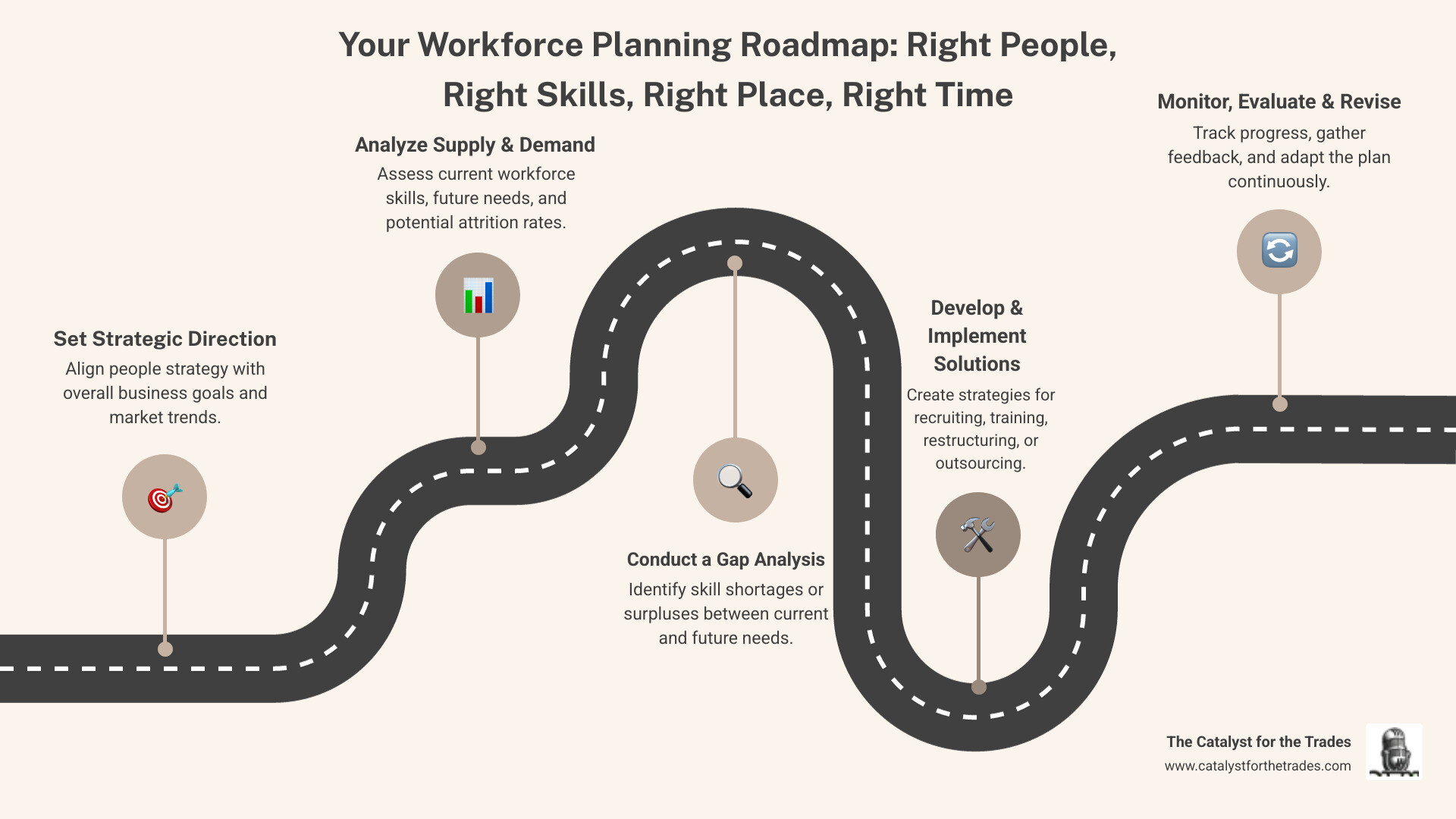
Workforce planning is a continuous cycle that keeps your business ahead of the curve. Instead of reacting to crises, you build an actionable framework that connects people decisions to your bottom line. This practical roadmap helps trades businesses stay competitive.
The process is continuous: what you learn in the final step feeds back into your strategic direction. This constant refinement, based on real-world results, is what makes it powerful.
Before you can determine who you need, you must know where your business is going. This step is about clarifying your strategic goals for the next three to five years. Review your Key Performance Indicators (KPIs) and conduct an environmental scan to understand market trends, new technologies, and regulatory changes that impact staffing.
For a home service business, this means analyzing anticipated growth in service calls, new construction projects, or shifts in customer preferences. This links your workforce planning directly to your business plan and sets you up for smoother business transition planning.
With your direction set, it's time to assess where you are and where you need to be. This involves understanding your current workforce (supply) and projecting future needs (demand).
Supply analysis is a hard look at your existing team. Analyze employee skills, demographics, and internal movement. Crucially, forecast how your workforce will evolve through retirements, attrition, and promotions. If your best technicians are nearing retirement, you need to know now.
Demand analysis projects your future workforce needs based on your strategic goals. Identify the number and type of workers required to hit your targets. For trades businesses, demand drivers include revenue growth, service call volume, or geographic expansion. This analysis is the foundation of effective talent management.
This is your reality check. By comparing your supply and demand analyses, you identify where you're short on people, where you have surpluses, and where critical competency gaps exist.
This diagnostic phase reveals your workforce's strengths and vulnerabilities. You might have plenty of entry-level technicians but a shortage of experienced project managers, or expertise in old systems but not the new technology customers demand. This step also helps you spot recruitment challenges and retention risks. Prioritize the gaps you identify based on their potential impact on your business strategy and performance. This is where effective performance management data is essential.
Now it's time to build bridges to close the gaps you've identified. This step involves developing specific strategies, often in combination, to address your unique situation.
Your solution toolkit might include:
Successful implementation requires organizational buy-in, clear resource allocation, and measurable performance indicators. Improving the candidate experience is also crucial for attracting top talent.
Ongoing evaluation separates smart planning from a one-time exercise. Your work begins in earnest once you implement solutions.
Regularly track key metrics, gather feedback, and assess whether your strategies are closing gaps and achieving objectives. This continuous monitoring ensures your plans remain current and relevant as markets, technologies, and customer preferences evolve. Ask tough questions: Are our assumptions still valid? Have new issues emerged? Did we achieve our targeted business outcomes?
This cycle of continuous improvement keeps your workforce aligned with your business strategy, much like the systems approach in EOS. Plan, execute, measure, adjust, and repeat to build a resilient workforce.
The only constant in business is change. For trades businesses, that change is accelerating with AI-powered tools, smart home integrations, and new energy-efficient systems. If your workforce planning doesn't account for these shifts, you're planning for a world that no longer exists.
The businesses that thrive build adaptability and agility into their people strategy. They anticipate how technology will reshape the skills their team needs and the services they deliver.
Technology has transformed workforce planning from a manual task into a strategic, data-driven discipline. HR analytics allows us to move beyond gut feelings and use hard data on turnover, performance, and skill inventories to make informed decisions about hiring and development.
Human Capital Management (HCM) systems strengthen workforce management across the employee lifecycle, from recruiting to succession planning. They automate data gathering and provide insights into productivity and skill gaps, making workforce planning scalable. When choosing an HCM system, look for flexible solutions that can run custom reports and map out multiple workforce scenarios. This kind of digital change is no longer optional, as explored in How to Lead Digital Transformation in Home Service Marketing and Why You Can't Wait.
Artificial intelligence is already changing how we work, and its impact on workforce planning is profound. In the trades, AI appears in diagnostic tools, scheduling systems, and predictive maintenance software. Your team must be ready to work with these systems.
As AI develops, demand will grow for workers who can collaborate with and manage AI systems. This means your workforce planning must shift from preparing for a single future to navigating a landscape where flexibility and continuous learning are essential.
AI can now be used for skill gap analysis, identifying emerging requirements with greater accuracy. Predictive attrition models help forecast which employees might leave, allowing for proactive retention strategies. Scenario planning with AI lets you simulate various futures—like rapid growth or economic downturns—to understand their workforce impact.
Most importantly, you must focus on upskilling for AI collaboration. Invest in training that prepares your team to work effectively with AI-powered tools. This human-AI partnership helps close talent gaps and accelerate knowledge transfer, which is key to how AI, bold leadership, and no-excuse execution are transforming home services.
What happens when your most experienced technician retires? Without a plan, their institutional knowledge and customer relationships walk out the door. Succession planning is a critical component of workforce planning that prevents this.
It's not just for executives; it's about identifying and developing employees to fill any key role, from lead technicians to dispatch managers. This proactive approach maintains business continuity and knowledge retention. By preparing internal candidates in advance, you ensure smooth transitions and reduce the risks of sudden departures.
Succession planning also boosts employee engagement and career development. When people see a clear path forward within your company, retention improves. This approach ensures you have replacements ready for positions that require a long development phase. Integrating succession planning into your broader workforce planning efforts builds a culture of continuous development and long-term stability, which is integral to our overall succession planning efforts and helps build the future of leadership.
We know diving into workforce planning can bring up questions, especially for a busy trades business. Here are answers to some common concerns.
Your workforce planning should be a living document. Think of it in layers:
Trades businesses face unique problems that make workforce planning essential.
Yes, and it's even more critical for smaller businesses where losing one key person has a larger impact. Workforce planning for a small business doesn't require a dedicated HR department or expensive software.
The goal is to move from reactive to proactive. Even basic workforce planning helps you anticipate needs rather than panicking when a problem arises.
Your people are the heart of your business. Every service call, complex repair, and happy customer comes down to having the right team. Workforce planning provides a strategic path to building a team that drives your business forward.
We've covered the essentials: from strategic versus operational planning to the five-step process that turns reactive scrambling into proactive preparation. We've seen how technology, AI, and succession planning are vital for any trades business that wants to protect its future.
The payoff is significant: reduced labor costs, improved retention, and increased productivity. You gain the ability to steer change with confidence, whether it comes from new technology, market shifts, or staff retirements.
Workforce planning is a continuous commitment to your team and your business. It requires flexibility and a connection to your strategic vision. The businesses that accept this process are the ones that scale successfully, weather economic storms, and build something that lasts.
At The Catalyst for the Trades, we help home service businesses move from hoping for the right team to knowing they have it. When you plan your workforce strategically, you're not just filling roles—you're building a resilient, adaptable business.
Ready to turn your people strategy into a competitive advantage? Explore our resources to build a more profitable and scalable trades business. Your future team is counting on the decisions you make today.
Workforce planning is the systematic process of analyzing, forecasting, and aligning your staffing needs with your business goals—ensuring you have the right people with the right skills in the right roles at the right time.
Quick answer for trades business owners:
If you're struggling to find qualified technicians or scale without burning out your team, you're facing a workforce planning problem. Most home service companies react to staffing challenges, scrambling to fill gaps and losing knowledge when key people leave. The businesses that win plan proactively.
Ready to transform your people strategy into a competitive advantage? Start by exploring proven frameworks for organizational leadership, then find how The Catalyst for the Trades helps you build systems that scale.
Workforce planning isn't just an HR exercise; it's the difference between hoping you'll have the team you need and knowing you will. It connects your hiring, training, and retention efforts directly to revenue and profitability. When done right, it turns your people from an expense into your most strategic asset.
Companies that plan their workforce strategically see reduced labor costs, better employee retention, and higher productivity. They aren't caught flat-footed by retirements, new technologies, or market shifts because they have already mapped multiple scenarios and built the flexibility to adapt.

Handy workforce planning terms:
Workforce planning is a living process that connects your people to your goals. As your home service business evolves—landing bigger contracts or expanding services—you can't just hope the right people show up. A solid plan is essential.
The goal is to balance immediate staffing needs with long-term employee development. Instead of just scrambling to fill gaps, you prioritize the critical roles that drive success, like master technicians or operations managers. A proactive approach helps you identify risks before they become emergencies, such as seeing a retirement wave coming or spotting skill gaps before a new technology becomes standard.
This data-driven approach helps reduce labor costs, respond quickly to customer needs, and improve both retention and productivity. It's about building a team that grows with your business and supports sustainable performance. This strategic thinking is what separates good organizational leadership from great.
Workforce planning operates on two levels. Understanding the difference is key to your staffing decisions.
Strategic workforce planning is your three-to-five-year vision. It translates long-term business goals into people plans, anticipating retirements, planning for new service lines, and building a leadership bench for future scaling. It's proactive and tied to your company's competitive advantage. If you're serious about business development, this is non-negotiable.
Operational workforce planning keeps the lights on today. It's about ensuring you have enough technicians for this week's jobs, covering sick leave, and managing schedules during your busy season. It's tactical, responsive, and focused on immediate efficiency.
| Feature | Strategic Workforce Planning | Operational Workforce Planning |
|---|---|---|
| Time Horizon | Long-term (3-5 years) | Short-term (<1 year, often daily/weekly) |
| Focus | Future capabilities, long-term talent needs, organizational growth | Immediate staffing needs, daily operations, project assignments |
| Nature | Proactive, aligns with company vision | Reactive, addresses current gaps |
| Goal | Support company strategy and competitive advantage | Meet today's service demands and optimize resource use |
For workforce planning to work, follow these core principles.
Align with company objectives. Every people decision—a new hire, a training program—should connect directly to your business goals. If you're expanding your HVAC division, your plan should reflect that.
Think long-term. When filling an immediate need, consider if the candidate can grow into a future leadership role. Balance today's urgent needs with tomorrow's strategic demands.
Focus on critical roles first. Identify the positions that, if vacant, would genuinely hurt your business—like master electricians or key operations managers. Prioritize these roles in your planning and development.
Involve leadership. Workforce planning fails when it's just an HR exercise. Involve operations, finance, and senior technicians in the process early and often.
Build in flexibility. The economy, technology, and customer expectations change. Your plan needs to bend without breaking. Use scenario planning to prepare for multiple futures, like faster-than-expected growth or new market opportunities.
Invest in employee development. The best way to fill future skill gaps is to grow your own people. Training, mentorship, and clear career paths improve retention and build loyalty. This commitment is central to strong management development and long-term business health.
Workforce planning is a continuous cycle that keeps your business ahead of the curve. Instead of reacting to crises, you build an actionable framework that connects people decisions to your bottom line. This practical roadmap helps trades businesses stay competitive.
The process is continuous: what you learn in the final step feeds back into your strategic direction. This constant refinement, based on real-world results, is what makes it powerful.
Before you can determine who you need, you must know where your business is going. This step is about clarifying your strategic goals for the next three to five years. Review your Key Performance Indicators (KPIs) and conduct an environmental scan to understand market trends, new technologies, and regulatory changes that impact staffing.
For a home service business, this means analyzing anticipated growth in service calls, new construction projects, or shifts in customer preferences. This links your workforce planning directly to your business plan and sets you up for smoother business transition planning.
With your direction set, it's time to assess where you are and where you need to be. This involves understanding your current workforce (supply) and projecting future needs (demand).
Supply analysis is a hard look at your existing team. Analyze employee skills, demographics, and internal movement. Crucially, forecast how your workforce will evolve through retirements, attrition, and promotions. If your best technicians are nearing retirement, you need to know now.
Demand analysis projects your future workforce needs based on your strategic goals. Identify the number and type of workers required to hit your targets. For trades businesses, demand drivers include revenue growth, service call volume, or geographic expansion. This analysis is the foundation of effective talent management.
This is your reality check. By comparing your supply and demand analyses, you identify where you're short on people, where you have surpluses, and where critical competency gaps exist.
This diagnostic phase reveals your workforce's strengths and vulnerabilities. You might have plenty of entry-level technicians but a shortage of experienced project managers, or expertise in old systems but not the new technology customers demand. This step also helps you spot recruitment challenges and retention risks. Prioritize the gaps you identify based on their potential impact on your business strategy and performance. This is where effective performance management data is essential.
Now it's time to build bridges to close the gaps you've identified. This step involves developing specific strategies, often in combination, to address your unique situation.
Your solution toolkit might include:
Successful implementation requires organizational buy-in, clear resource allocation, and measurable performance indicators. Improving the candidate experience is also crucial for attracting top talent.
Ongoing evaluation separates smart planning from a one-time exercise. Your work begins in earnest once you implement solutions.
Regularly track key metrics, gather feedback, and assess whether your strategies are closing gaps and achieving objectives. This continuous monitoring ensures your plans remain current and relevant as markets, technologies, and customer preferences evolve. Ask tough questions: Are our assumptions still valid? Have new issues emerged? Did we achieve our targeted business outcomes?
This cycle of continuous improvement keeps your workforce aligned with your business strategy, much like the systems approach in EOS. Plan, execute, measure, adjust, and repeat to build a resilient workforce.
The only constant in business is change. For trades businesses, that change is accelerating with AI-powered tools, smart home integrations, and new energy-efficient systems. If your workforce planning doesn't account for these shifts, you're planning for a world that no longer exists.
The businesses that thrive build adaptability and agility into their people strategy. They anticipate how technology will reshape the skills their team needs and the services they deliver.
Technology has transformed workforce planning from a manual task into a strategic, data-driven discipline. HR analytics allows us to move beyond gut feelings and use hard data on turnover, performance, and skill inventories to make informed decisions about hiring and development.
Human Capital Management (HCM) systems strengthen workforce management across the employee lifecycle, from recruiting to succession planning. They automate data gathering and provide insights into productivity and skill gaps, making workforce planning scalable. When choosing an HCM system, look for flexible solutions that can run custom reports and map out multiple workforce scenarios. This kind of digital change is no longer optional, as explored in How to Lead Digital Transformation in Home Service Marketing and Why You Can't Wait.
Artificial intelligence is already changing how we work, and its impact on workforce planning is profound. In the trades, AI appears in diagnostic tools, scheduling systems, and predictive maintenance software. Your team must be ready to work with these systems.
As AI develops, demand will grow for workers who can collaborate with and manage AI systems. This means your workforce planning must shift from preparing for a single future to navigating a landscape where flexibility and continuous learning are essential.
AI can now be used for skill gap analysis, identifying emerging requirements with greater accuracy. Predictive attrition models help forecast which employees might leave, allowing for proactive retention strategies. Scenario planning with AI lets you simulate various futures—like rapid growth or economic downturns—to understand their workforce impact.
Most importantly, you must focus on upskilling for AI collaboration. Invest in training that prepares your team to work effectively with AI-powered tools. This human-AI partnership helps close talent gaps and accelerate knowledge transfer, which is key to how AI, bold leadership, and no-excuse execution are transforming home services.
What happens when your most experienced technician retires? Without a plan, their institutional knowledge and customer relationships walk out the door. Succession planning is a critical component of workforce planning that prevents this.
It's not just for executives; it's about identifying and developing employees to fill any key role, from lead technicians to dispatch managers. This proactive approach maintains business continuity and knowledge retention. By preparing internal candidates in advance, you ensure smooth transitions and reduce the risks of sudden departures.
Succession planning also boosts employee engagement and career development. When people see a clear path forward within your company, retention improves. This approach ensures you have replacements ready for positions that require a long development phase. Integrating succession planning into your broader workforce planning efforts builds a culture of continuous development and long-term stability, which is integral to our overall succession planning efforts and helps build the future of leadership.
We know diving into workforce planning can bring up questions, especially for a busy trades business. Here are answers to some common concerns.
Your workforce planning should be a living document. Think of it in layers:
Trades businesses face unique problems that make workforce planning essential.
Yes, and it's even more critical for smaller businesses where losing one key person has a larger impact. Workforce planning for a small business doesn't require a dedicated HR department or expensive software.
The goal is to move from reactive to proactive. Even basic workforce planning helps you anticipate needs rather than panicking when a problem arises.
Your people are the heart of your business. Every service call, complex repair, and happy customer comes down to having the right team. Workforce planning provides a strategic path to building a team that drives your business forward.
We've covered the essentials: from strategic versus operational planning to the five-step process that turns reactive scrambling into proactive preparation. We've seen how technology, AI, and succession planning are vital for any trades business that wants to protect its future.
The payoff is significant: reduced labor costs, improved retention, and increased productivity. You gain the ability to steer change with confidence, whether it comes from new technology, market shifts, or staff retirements.
Workforce planning is a continuous commitment to your team and your business. It requires flexibility and a connection to your strategic vision. The businesses that accept this process are the ones that scale successfully, weather economic storms, and build something that lasts.
At The Catalyst for the Trades, we help home service businesses move from hoping for the right team to knowing they have it. When you plan your workforce strategically, you're not just filling roles—you're building a resilient, adaptable business.
Ready to turn your people strategy into a competitive advantage? Explore our resources to build a more profitable and scalable trades business. Your future team is counting on the decisions you make today.
Workforce planning is the systematic process of analyzing, forecasting, and aligning your staffing needs with your business goals—ensuring you have the right people with the right skills in the right roles at the right time.
Quick answer for trades business owners:
If you're struggling to find qualified technicians or scale without burning out your team, you're facing a workforce planning problem. Most home service companies react to staffing challenges, scrambling to fill gaps and losing knowledge when key people leave. The businesses that win plan proactively.
Ready to transform your people strategy into a competitive advantage? Start by exploring proven frameworks for organizational leadership, then find how The Catalyst for the Trades helps you build systems that scale.
Workforce planning isn't just an HR exercise; it's the difference between hoping you'll have the team you need and knowing you will. It connects your hiring, training, and retention efforts directly to revenue and profitability. When done right, it turns your people from an expense into your most strategic asset.
Companies that plan their workforce strategically see reduced labor costs, better employee retention, and higher productivity. They aren't caught flat-footed by retirements, new technologies, or market shifts because they have already mapped multiple scenarios and built the flexibility to adapt.

Handy workforce planning terms:
Workforce planning is a living process that connects your people to your goals. As your home service business evolves—landing bigger contracts or expanding services—you can't just hope the right people show up. A solid plan is essential.
The goal is to balance immediate staffing needs with long-term employee development. Instead of just scrambling to fill gaps, you prioritize the critical roles that drive success, like master technicians or operations managers. A proactive approach helps you identify risks before they become emergencies, such as seeing a retirement wave coming or spotting skill gaps before a new technology becomes standard.
This data-driven approach helps reduce labor costs, respond quickly to customer needs, and improve both retention and productivity. It's about building a team that grows with your business and supports sustainable performance. This strategic thinking is what separates good organizational leadership from great.
Workforce planning operates on two levels. Understanding the difference is key to your staffing decisions.
Strategic workforce planning is your three-to-five-year vision. It translates long-term business goals into people plans, anticipating retirements, planning for new service lines, and building a leadership bench for future scaling. It's proactive and tied to your company's competitive advantage. If you're serious about business development, this is non-negotiable.
Operational workforce planning keeps the lights on today. It's about ensuring you have enough technicians for this week's jobs, covering sick leave, and managing schedules during your busy season. It's tactical, responsive, and focused on immediate efficiency.
| Feature | Strategic Workforce Planning | Operational Workforce Planning |
|---|---|---|
| Time Horizon | Long-term (3-5 years) | Short-term (<1 year, often daily/weekly) |
| Focus | Future capabilities, long-term talent needs, organizational growth | Immediate staffing needs, daily operations, project assignments |
| Nature | Proactive, aligns with company vision | Reactive, addresses current gaps |
| Goal | Support company strategy and competitive advantage | Meet today's service demands and optimize resource use |
For workforce planning to work, follow these core principles.
Align with company objectives. Every people decision—a new hire, a training program—should connect directly to your business goals. If you're expanding your HVAC division, your plan should reflect that.
Think long-term. When filling an immediate need, consider if the candidate can grow into a future leadership role. Balance today's urgent needs with tomorrow's strategic demands.
Focus on critical roles first. Identify the positions that, if vacant, would genuinely hurt your business—like master electricians or key operations managers. Prioritize these roles in your planning and development.
Involve leadership. Workforce planning fails when it's just an HR exercise. Involve operations, finance, and senior technicians in the process early and often.
Build in flexibility. The economy, technology, and customer expectations change. Your plan needs to bend without breaking. Use scenario planning to prepare for multiple futures, like faster-than-expected growth or new market opportunities.
Invest in employee development. The best way to fill future skill gaps is to grow your own people. Training, mentorship, and clear career paths improve retention and build loyalty. This commitment is central to strong management development and long-term business health.
Workforce planning is a continuous cycle that keeps your business ahead of the curve. Instead of reacting to crises, you build an actionable framework that connects people decisions to your bottom line. This practical roadmap helps trades businesses stay competitive.
The process is continuous: what you learn in the final step feeds back into your strategic direction. This constant refinement, based on real-world results, is what makes it powerful.
Before you can determine who you need, you must know where your business is going. This step is about clarifying your strategic goals for the next three to five years. Review your Key Performance Indicators (KPIs) and conduct an environmental scan to understand market trends, new technologies, and regulatory changes that impact staffing.
For a home service business, this means analyzing anticipated growth in service calls, new construction projects, or shifts in customer preferences. This links your workforce planning directly to your business plan and sets you up for smoother business transition planning.
With your direction set, it's time to assess where you are and where you need to be. This involves understanding your current workforce (supply) and projecting future needs (demand).
Supply analysis is a hard look at your existing team. Analyze employee skills, demographics, and internal movement. Crucially, forecast how your workforce will evolve through retirements, attrition, and promotions. If your best technicians are nearing retirement, you need to know now.
Demand analysis projects your future workforce needs based on your strategic goals. Identify the number and type of workers required to hit your targets. For trades businesses, demand drivers include revenue growth, service call volume, or geographic expansion. This analysis is the foundation of effective talent management.
This is your reality check. By comparing your supply and demand analyses, you identify where you're short on people, where you have surpluses, and where critical competency gaps exist.
This diagnostic phase reveals your workforce's strengths and vulnerabilities. You might have plenty of entry-level technicians but a shortage of experienced project managers, or expertise in old systems but not the new technology customers demand. This step also helps you spot recruitment challenges and retention risks. Prioritize the gaps you identify based on their potential impact on your business strategy and performance. This is where effective performance management data is essential.
Now it's time to build bridges to close the gaps you've identified. This step involves developing specific strategies, often in combination, to address your unique situation.
Your solution toolkit might include:
Successful implementation requires organizational buy-in, clear resource allocation, and measurable performance indicators. Improving the candidate experience is also crucial for attracting top talent.
Ongoing evaluation separates smart planning from a one-time exercise. Your work begins in earnest once you implement solutions.
Regularly track key metrics, gather feedback, and assess whether your strategies are closing gaps and achieving objectives. This continuous monitoring ensures your plans remain current and relevant as markets, technologies, and customer preferences evolve. Ask tough questions: Are our assumptions still valid? Have new issues emerged? Did we achieve our targeted business outcomes?
This cycle of continuous improvement keeps your workforce aligned with your business strategy, much like the systems approach in EOS. Plan, execute, measure, adjust, and repeat to build a resilient workforce.
The only constant in business is change. For trades businesses, that change is accelerating with AI-powered tools, smart home integrations, and new energy-efficient systems. If your workforce planning doesn't account for these shifts, you're planning for a world that no longer exists.
The businesses that thrive build adaptability and agility into their people strategy. They anticipate how technology will reshape the skills their team needs and the services they deliver.
Technology has transformed workforce planning from a manual task into a strategic, data-driven discipline. HR analytics allows us to move beyond gut feelings and use hard data on turnover, performance, and skill inventories to make informed decisions about hiring and development.
Human Capital Management (HCM) systems strengthen workforce management across the employee lifecycle, from recruiting to succession planning. They automate data gathering and provide insights into productivity and skill gaps, making workforce planning scalable. When choosing an HCM system, look for flexible solutions that can run custom reports and map out multiple workforce scenarios. This kind of digital change is no longer optional, as explored in How to Lead Digital Transformation in Home Service Marketing and Why You Can't Wait.
Artificial intelligence is already changing how we work, and its impact on workforce planning is profound. In the trades, AI appears in diagnostic tools, scheduling systems, and predictive maintenance software. Your team must be ready to work with these systems.
As AI develops, demand will grow for workers who can collaborate with and manage AI systems. This means your workforce planning must shift from preparing for a single future to navigating a landscape where flexibility and continuous learning are essential.
AI can now be used for skill gap analysis, identifying emerging requirements with greater accuracy. Predictive attrition models help forecast which employees might leave, allowing for proactive retention strategies. Scenario planning with AI lets you simulate various futures—like rapid growth or economic downturns—to understand their workforce impact.
Most importantly, you must focus on upskilling for AI collaboration. Invest in training that prepares your team to work effectively with AI-powered tools. This human-AI partnership helps close talent gaps and accelerate knowledge transfer, which is key to how AI, bold leadership, and no-excuse execution are transforming home services.
What happens when your most experienced technician retires? Without a plan, their institutional knowledge and customer relationships walk out the door. Succession planning is a critical component of workforce planning that prevents this.
It's not just for executives; it's about identifying and developing employees to fill any key role, from lead technicians to dispatch managers. This proactive approach maintains business continuity and knowledge retention. By preparing internal candidates in advance, you ensure smooth transitions and reduce the risks of sudden departures.
Succession planning also boosts employee engagement and career development. When people see a clear path forward within your company, retention improves. This approach ensures you have replacements ready for positions that require a long development phase. Integrating succession planning into your broader workforce planning efforts builds a culture of continuous development and long-term stability, which is integral to our overall succession planning efforts and helps build the future of leadership.
We know diving into workforce planning can bring up questions, especially for a busy trades business. Here are answers to some common concerns.
Your workforce planning should be a living document. Think of it in layers:
Trades businesses face unique problems that make workforce planning essential.
Yes, and it's even more critical for smaller businesses where losing one key person has a larger impact. Workforce planning for a small business doesn't require a dedicated HR department or expensive software.
The goal is to move from reactive to proactive. Even basic workforce planning helps you anticipate needs rather than panicking when a problem arises.
Your people are the heart of your business. Every service call, complex repair, and happy customer comes down to having the right team. Workforce planning provides a strategic path to building a team that drives your business forward.
We've covered the essentials: from strategic versus operational planning to the five-step process that turns reactive scrambling into proactive preparation. We've seen how technology, AI, and succession planning are vital for any trades business that wants to protect its future.
The payoff is significant: reduced labor costs, improved retention, and increased productivity. You gain the ability to steer change with confidence, whether it comes from new technology, market shifts, or staff retirements.
Workforce planning is a continuous commitment to your team and your business. It requires flexibility and a connection to your strategic vision. The businesses that accept this process are the ones that scale successfully, weather economic storms, and build something that lasts.
At The Catalyst for the Trades, we help home service businesses move from hoping for the right team to knowing they have it. When you plan your workforce strategically, you're not just filling roles—you're building a resilient, adaptable business.
Ready to turn your people strategy into a competitive advantage? Explore our resources to build a more profitable and scalable trades business. Your future team is counting on the decisions you make today.

Discover how leading home‑service companies are leveraging AI, subscription models, and digital‑first strategies.
Learn why private equity, automation, and customer‑centric tech are reshaping the trades.

Uncover business evolution's journey from historical roots to digital future. Master adaptability, growth stages, and modern challenges.

Boost your home service business! Discover how customer service training drives loyalty, growth, and happy customers. Get your guide now.

Learn to boost output & reduce costs. Master operational efficiency with strategies, tools, and metrics for your trade business.