Discover 7 sales methodology types for trades businesses. Learn to choose, implement, and leverage AI for scalable growth.

Talent retention is the ability of your company to keep your best employees engaged, satisfied, and committed to staying long-term—rather than walking out the door to your competition. For home services business owners and managers, losing skilled technicians, dispatchers, or office staff isn't just inconvenient. It's expensive, disruptive, and can stall your growth plans entirely.
Here's what you need to know about talent retention:
Discover how to build a people-first culture that keeps your best team members engaged. If you're ready to scale your business and need expert guidance, explore how The Catalyst for the Trades helps leaders like you grow smarter.
The trades are facing a talent crunch. You can't afford to treat retention as an afterthought. Your best people are watching how you lead, how you treat them, and whether you're building a place worth staying. This guide will show you exactly why they leave, what makes them stay, and how to turn your business into a magnet for top talent.
Basic talent retention terms:
It’s tempting to think that a fatter paycheck is the golden ticket to keeping your team. While competitive compensation is certainly a piece of the puzzle, our research, and that of many others, tells a different story. Employees often leave for reasons far more nuanced than just money.
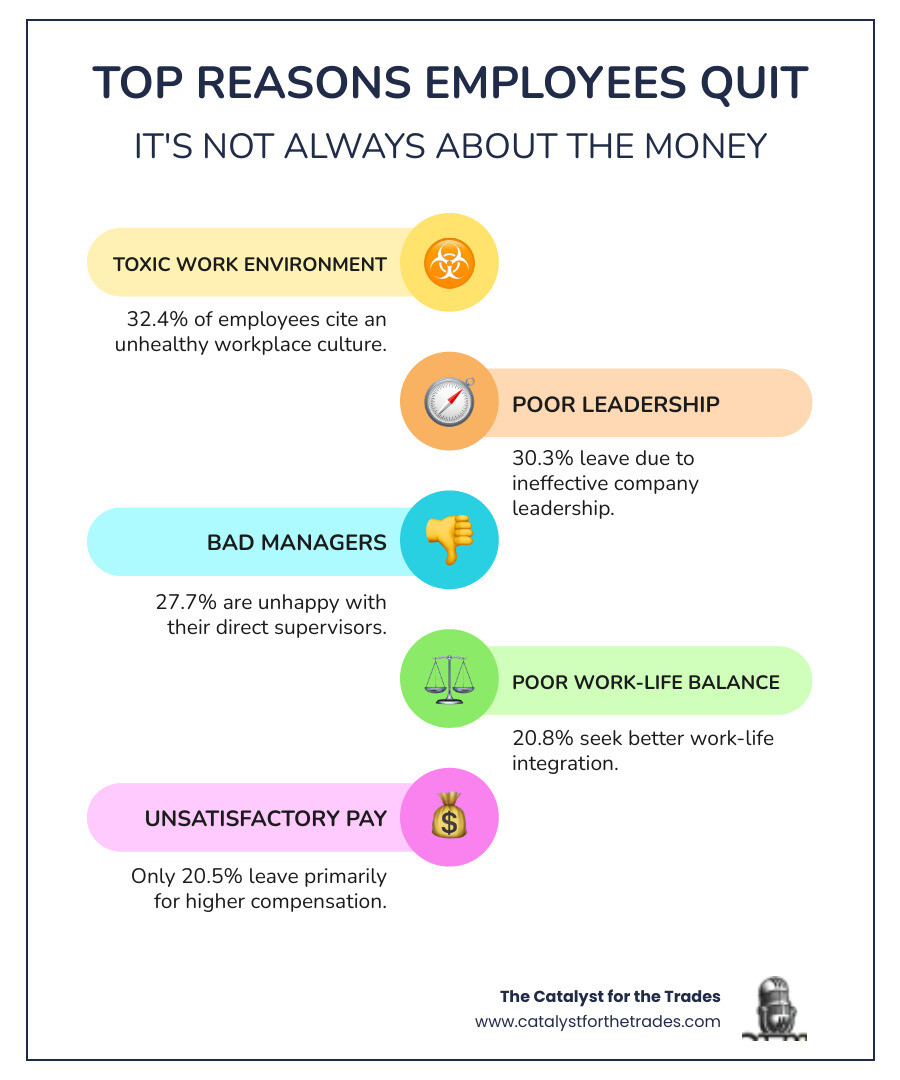
According to iHire's 2024 Talent Retention Report, the top reason employees voluntarily quit their jobs isn't pay. It's a toxic or negative work environment, cited by 32.4% of workers. This is closely followed by poor company leadership (30.3%) and unhappiness with their manager or supervisor (27.7%). Unsatisfactory pay actually ranks sixth at 20.5%. This tells us that a healthy, supportive workplace environment and strong leadership are often more powerful motivators than salary alone.
Crispina Wilson-Jones, a former People operations executive, wisely noted, "There are many reasons people leave their jobs, and most of the top reasons boil down to people being dissatisfied and disengaged with their work — or both." It's not just about the numbers; it's about the daily experience.
Managers aren't just bosses; they are the front-line ambassadors of your company culture. Their influence on talent retention cannot be overstated. A significant portion of employees (27.7%) leaving their jobs cite unhappiness with their manager or supervisor. This highlights a critical truth: people often leave managers, not companies.
Poor company leadership (30.3%) and micromanagement (73% of workers say it’s the #1 sign of a toxic workplace) can quickly erode trust and engagement. Conversely, great managers are linked with a 72% reduction in attrition risk and a 3.2X increase in employee retention, according to a Boston Consulting Group survey. Effective managers coach, support, and empower their teams, fostering an environment where individuals feel valued and can thrive. They set clear expectations, provide regular feedback, and act as mentors, not just taskmasters.
Explore the future of leadership to understand how to cultivate leaders who inspire loyalty and drive success in your trades business.
One of the most fascinating, and frankly, concerning, insights from the iHire report is the significant gap between what employers think employees leave for and the actual reasons employees provide. While employees point to toxic environments, poor leadership, and bad managers as primary drivers, employers often cite personal reasons (51.4%) or better career alignment (42.0%). Unsatisfactory pay is a common employer assumption (36.3%), but it's not the full story for employees.
This disconnect is a huge blind spot for many businesses. If you're not accurately diagnosing the problem, how can you possibly prescribe the right solution? It underscores the critical need to genuinely listen to your employees and gather candid feedback. Assuming "it's just for personal reasons" or "they found a better offer" can prevent you from addressing systemic issues that are driving your best talent away.
| Reason for Leaving | Employee Perception | Employer Perception |
|---|---|---|
| Toxic Work Environment | 32.4% | 15.3% |
| Poor Company Leadership | 30.3% | Not listed as top 3 |
| Unhappiness with Manager | 27.7% | Not listed as top 3 |
| Poor Work-Life Balance | 20.8% | Not listed as top 3 |
| Unsatisfactory Pay | 20.5% | 36.3% |
| Personal Reasons | Not listed as top 5 | 51.4% |
| Better Career Alignment | Not listed as top 5 | 42.0% |
(Data adapted from iHire's 2024 Talent Retention Report)
This table illustrates that while employers recognize pay as a factor, they often miss the deeper, more emotional and cultural reasons that cause employees to seek greener pastures. We need to bridge this perception gap to truly improve talent retention.
Discover how to build a people-first culture that aligns with what your employees truly value.
Your company culture is the invisible force that either draws people in or pushes them away. It's the sum of your values, traditions, beliefs, interactions, and attitudes. A strong, positive culture is not a perk; it's the bedrock of effective talent retention.
Employees today are actively seeking workplaces that offer more than just a job. They value a positive work environment (83.4%), a commitment to healthy work/life balance (68.1%), and mission, vision, and values that align with their own (48.7%). In fact, over half of employees (50.9%) would accept a job for a lower salary if it offered better work/life balance, and 44.6% would do so for an improved work environment or company culture. This is a clear signal: culture and well-being are non-negotiable for many.
While we've established that pay isn't always the primary reason for leaving, it remains a foundational element. Fair and competitive salaries are crucial for employee satisfaction. Beyond the paycheck, a robust benefits package is a powerful talent retention tool. Health insurance (68.1%) and retirement plans (59.9%) are top priorities for employees.
However, modern benefits extend beyond the traditional. Many employees are willing to trade salary for better work-life balance (50.9%) and improved work environments (44.6%). This means offering genuine flexibility, such as flextime or hybrid work options, is highly valued. Preventing burnout isn't just good for your team's health; it's a strategic move to keep them. We've seen that providing autonomy and choice empowers our team members and builds trust.
Here are some high-impact, low-cost benefits that can significantly boost retention:
A truly positive work environment is one where employees feel psychologically safe, respected, and that they belong. It's a place where open communication is the norm, not the exception. When employees feel safe to voice concerns, share ideas, and even make mistakes without fear of retribution, they are more engaged and committed.
Diversity, Equity, and Inclusion (DE&I) are not just buzzwords; they are essential components of a thriving workplace culture. Organizations that prioritize DE&I foster a sense of belonging for all team members, leading to greater engagement and loyalty. A 2023 Korn Ferry survey found that 65% of millennials would feel more inspired at a company with a good environmental, social, and governance (ESG) policy—and that they’d be more loyal. When our values align with our team members', it creates a powerful bond.
Build an unstoppable brand that attracts top talent by creating a culture that people are proud to be a part of.
Managers are the linchpin of talent retention. They are the daily face of the company for most employees, and their effectiveness directly impacts whether a team member stays or goes. We know that unhappiness with a manager is a top reason for employees leaving. This means investing in your managers is one of the smartest talent retention strategies you can implement.
Great managers don't just delegate tasks; they coach, mentor, and support their teams. They provide regular, constructive feedback, both positive and corrective, ensuring employees know where they stand and how they can grow. They set clear expectations, giving team members the autonomy to achieve goals while providing the necessary resources and guidance. They actively listen to concerns, advocate for their team, and foster an environment of trust and respect.
A Boston Consulting Group survey highlights that great managers are linked with a 72% reduction in attrition risk and a 3.2X increase in employee retention. This isn't magic; it's the result of equipping managers with the training, tools, insights, and incentives to effectively support their teams. We must empower our managers to be leaders who retain, not just supervise.
Invest in your team with management development to transform your supervisors into retention champions.
Top talent is ambitious talent. Your best employees are likely always looking for ways to grow, learn new skills, and advance their careers. If they don't see those opportunities within your organization, they will find them elsewhere. This is why professional development and career growth opportunities are critical for talent retention.
Employees want to know they have a future with your company. Offering clear career paths, skill-building opportunities, and challenging new projects keeps them engaged and invested. Employees at companies with internal mobility stay almost two times longer, according to LinkedIn’s 2021 Workforce Learning Report. While companies with low mobility saw a median tenure of just 2.9 years, high-mobility businesses were able to keep talent for a median of 5.4 years. This demonstrates the power of promoting from within and creating pathways for advancement.
We accept the "Three E's" of development: Education, Experience, and Exposure. This means providing access to learning resources, offering stretch assignments that build new skills, and giving employees visibility into different parts of the business or leadership. Many employees want to upskill to remain employable in the long term, and some want to move up the career ladder. By tailoring learning opportunities, we give them strong incentives to stay.
Create a culture of continuous learning where growth is not just encouraged, but actively supported.
Feeling valued and appreciated is a fundamental human need, and it's a powerful driver of talent retention. Employees recognized weekly are 9x more likely to recommend their company and 6x more likely to see a long-term future there. Recognition isn't just about big awards; it's about frequent, meaningful acknowledgment of effort and contributions.
It's crucial to praise our employees for a job well done. Employee recognition can take many different forms, like a wall of fame, an internal newsletter with kudos, or a bonus for achieving monthly goals. The key is consistency and sincerity.
Beyond recognition, ongoing performance conversations are vital. Too often, employees aren’t sure how they’re performing. A 2023 Pew Research Center study found that 51% of US workers aren’t satisfied with the amount of feedback from their supervisor. Regular check-ins, goal setting, and constructive feedback help employees understand their impact and feel supported in their roles. This continuous dialogue, rather than just annual reviews, fosters a sense of psychological safety and shows employees that their development is a priority.
Refine your performance management process to ensure your team members always feel seen, heard, and valued.
The employee experience begins long before their first day, but the onboarding process sets the tone for everything that follows. An employee’s first few weeks set the standard for the rest of their time at your company. Yet, only 12% of employees strongly agree their organization does a great job with onboarding. This is a missed opportunity, as nearly half of employees say they’ve had regrets or second thoughts about accepting their job offer within the first week.
A strong onboarding process goes beyond paperwork. It's about building early connections, clarifying expectations, and helping new hires feel like part of the team from day one. It should include:
When done right, onboarding can significantly improve talent retention by making new team members feel welcomed, supported, and confident in their decision to join your trades business.
Perfect your candidate experience from day one to lay the groundwork for long-term loyalty.
You can't fix what you don't understand. That's why gathering and acting on employee feedback is paramount for improving talent retention. We need to know why our best people stay and why others might be thinking of leaving.
Chelsea Stearns, Deputy Director of HR, advises, “Once you’ve surveyed or interviewed a sufficient number of departing employees, attempt to find trends and recurring themes in their feedback. This will determine your next move as a Human Resources team.” This data-driven approach allows us to make informed decisions that genuinely address our team's needs.
To effectively manage talent retention, we need to measure it. Without clear metrics, we're flying blind. Here are some essential KPIs for your trades business:
By regularly tracking these metrics, we can identify trends, pinpoint problem areas, and assess the effectiveness of our talent retention strategies.
The world of work is constantly evolving, and our talent retention strategies must evolve with it. Two major forces shaping the future are the rise of AI and the changing landscape of remote and hybrid work.
The pandemic showed us that telecommuting works, and many employees have grown accustomed to the convenience of flexible scheduling. We're seeing a trend where employees are willing to accept lower salaries for better work-life balance or improved work environment, with flexibility being a key component. 80% of employees said they’d be more loyal to their current employer if it offered flexible work arrangements.
For our office staff, especially, adapting to hybrid or remote models means:
The impact of AI on the workplace is undeniable, and it will play an increasing role in talent retention. While some employees express concern about AI replacing their jobs (13.3% are concerned), the majority are not. The key for us is to leverage AI to improve, not replace, our human talent.
AI can be a powerful tool for:
We must train our staff on best practices for utilizing AI tools to improve efficiency and set clear AI policies. When employees understand how AI can support their work and growth, rather than threaten their roles, it becomes a talent retention asset.
Learn how AI and digital tools are changing home services and get your contractor AI strategy right to stay ahead of the curve.
Talent retention isn't a one-time fix; it's an ongoing commitment, a continuous conversation, and a strategic imperative for any thriving trades business. We've seen that our best people don't just stick around for the paycheck. They stay for a positive work environment, supportive leadership, opportunities for growth, and a culture that values their well-being.
By prioritizing these human-centric elements—from competitive compensation and robust benefits to strong manager relationships and genuine flexibility—we can cultivate a workplace where our team members not only want to stay but enthusiastically advocate for. It requires a people-first leadership approach, where we actively listen, adapt, and invest in the growth and satisfaction of every individual.
The cost of ignoring talent retention is simply too high. Investing in your people means investing in the stability, productivity, and long-term success of your business. Let's make our businesses places where talent doesn't just work, but truly belongs and thrives.
Learn more about building a thriving trades business by exploring our resources and insights at The Catalyst for the Trades.
Talent retention is the ability of your company to keep your best employees engaged, satisfied, and committed to staying long-term—rather than walking out the door to your competition. For home services business owners and managers, losing skilled technicians, dispatchers, or office staff isn't just inconvenient. It's expensive, disruptive, and can stall your growth plans entirely.
Here's what you need to know about talent retention:
Discover how to build a people-first culture that keeps your best team members engaged. If you're ready to scale your business and need expert guidance, explore how The Catalyst for the Trades helps leaders like you grow smarter.
The trades are facing a talent crunch. You can't afford to treat retention as an afterthought. Your best people are watching how you lead, how you treat them, and whether you're building a place worth staying. This guide will show you exactly why they leave, what makes them stay, and how to turn your business into a magnet for top talent.

Basic talent retention terms:
It’s tempting to think that a fatter paycheck is the golden ticket to keeping your team. While competitive compensation is certainly a piece of the puzzle, our research, and that of many others, tells a different story. Employees often leave for reasons far more nuanced than just money.
According to iHire's 2024 Talent Retention Report, the top reason employees voluntarily quit their jobs isn't pay. It's a toxic or negative work environment, cited by 32.4% of workers. This is closely followed by poor company leadership (30.3%) and unhappiness with their manager or supervisor (27.7%). Unsatisfactory pay actually ranks sixth at 20.5%. This tells us that a healthy, supportive workplace environment and strong leadership are often more powerful motivators than salary alone.
Crispina Wilson-Jones, a former People operations executive, wisely noted, "There are many reasons people leave their jobs, and most of the top reasons boil down to people being dissatisfied and disengaged with their work — or both." It's not just about the numbers; it's about the daily experience.
Managers aren't just bosses; they are the front-line ambassadors of your company culture. Their influence on talent retention cannot be overstated. A significant portion of employees (27.7%) leaving their jobs cite unhappiness with their manager or supervisor. This highlights a critical truth: people often leave managers, not companies.
Poor company leadership (30.3%) and micromanagement (73% of workers say it’s the #1 sign of a toxic workplace) can quickly erode trust and engagement. Conversely, great managers are linked with a 72% reduction in attrition risk and a 3.2X increase in employee retention, according to a Boston Consulting Group survey. Effective managers coach, support, and empower their teams, fostering an environment where individuals feel valued and can thrive. They set clear expectations, provide regular feedback, and act as mentors, not just taskmasters.
Explore the future of leadership to understand how to cultivate leaders who inspire loyalty and drive success in your trades business.
One of the most fascinating, and frankly, concerning, insights from the iHire report is the significant gap between what employers think employees leave for and the actual reasons employees provide. While employees point to toxic environments, poor leadership, and bad managers as primary drivers, employers often cite personal reasons (51.4%) or better career alignment (42.0%). Unsatisfactory pay is a common employer assumption (36.3%), but it's not the full story for employees.
This disconnect is a huge blind spot for many businesses. If you're not accurately diagnosing the problem, how can you possibly prescribe the right solution? It underscores the critical need to genuinely listen to your employees and gather candid feedback. Assuming "it's just for personal reasons" or "they found a better offer" can prevent you from addressing systemic issues that are driving your best talent away.
| Reason for Leaving | Employee Perception | Employer Perception |
|---|---|---|
| Toxic Work Environment | 32.4% | 15.3% |
| Poor Company Leadership | 30.3% | Not listed as top 3 |
| Unhappiness with Manager | 27.7% | Not listed as top 3 |
| Poor Work-Life Balance | 20.8% | Not listed as top 3 |
| Unsatisfactory Pay | 20.5% | 36.3% |
| Personal Reasons | Not listed as top 5 | 51.4% |
| Better Career Alignment | Not listed as top 5 | 42.0% |
(Data adapted from iHire's 2024 Talent Retention Report)
This table illustrates that while employers recognize pay as a factor, they often miss the deeper, more emotional and cultural reasons that cause employees to seek greener pastures. We need to bridge this perception gap to truly improve talent retention.
Discover how to build a people-first culture that aligns with what your employees truly value.
Your company culture is the invisible force that either draws people in or pushes them away. It's the sum of your values, traditions, beliefs, interactions, and attitudes. A strong, positive culture is not a perk; it's the bedrock of effective talent retention.
Employees today are actively seeking workplaces that offer more than just a job. They value a positive work environment (83.4%), a commitment to healthy work/life balance (68.1%), and mission, vision, and values that align with their own (48.7%). In fact, over half of employees (50.9%) would accept a job for a lower salary if it offered better work/life balance, and 44.6% would do so for an improved work environment or company culture. This is a clear signal: culture and well-being are non-negotiable for many.
While we've established that pay isn't always the primary reason for leaving, it remains a foundational element. Fair and competitive salaries are crucial for employee satisfaction. Beyond the paycheck, a robust benefits package is a powerful talent retention tool. Health insurance (68.1%) and retirement plans (59.9%) are top priorities for employees.
However, modern benefits extend beyond the traditional. Many employees are willing to trade salary for better work-life balance (50.9%) and improved work environments (44.6%). This means offering genuine flexibility, such as flextime or hybrid work options, is highly valued. Preventing burnout isn't just good for your team's health; it's a strategic move to keep them. We've seen that providing autonomy and choice empowers our team members and builds trust.
Here are some high-impact, low-cost benefits that can significantly boost retention:
A truly positive work environment is one where employees feel psychologically safe, respected, and that they belong. It's a place where open communication is the norm, not the exception. When employees feel safe to voice concerns, share ideas, and even make mistakes without fear of retribution, they are more engaged and committed.
Diversity, Equity, and Inclusion (DE&I) are not just buzzwords; they are essential components of a thriving workplace culture. Organizations that prioritize DE&I foster a sense of belonging for all team members, leading to greater engagement and loyalty. A 2023 Korn Ferry survey found that 65% of millennials would feel more inspired at a company with a good environmental, social, and governance (ESG) policy—and that they’d be more loyal. When our values align with our team members', it creates a powerful bond.
Build an unstoppable brand that attracts top talent by creating a culture that people are proud to be a part of.
Managers are the linchpin of talent retention. They are the daily face of the company for most employees, and their effectiveness directly impacts whether a team member stays or goes. We know that unhappiness with a manager is a top reason for employees leaving. This means investing in your managers is one of the smartest talent retention strategies you can implement.
Great managers don't just delegate tasks; they coach, mentor, and support their teams. They provide regular, constructive feedback, both positive and corrective, ensuring employees know where they stand and how they can grow. They set clear expectations, giving team members the autonomy to achieve goals while providing the necessary resources and guidance. They actively listen to concerns, advocate for their team, and foster an environment of trust and respect.
A Boston Consulting Group survey highlights that great managers are linked with a 72% reduction in attrition risk and a 3.2X increase in employee retention. This isn't magic; it's the result of equipping managers with the training, tools, insights, and incentives to effectively support their teams. We must empower our managers to be leaders who retain, not just supervise.
Invest in your team with management development to transform your supervisors into retention champions.
Top talent is ambitious talent. Your best employees are likely always looking for ways to grow, learn new skills, and advance their careers. If they don't see those opportunities within your organization, they will find them elsewhere. This is why professional development and career growth opportunities are critical for talent retention.
Employees want to know they have a future with your company. Offering clear career paths, skill-building opportunities, and challenging new projects keeps them engaged and invested. Employees at companies with internal mobility stay almost two times longer, according to LinkedIn’s 2021 Workforce Learning Report. While companies with low mobility saw a median tenure of just 2.9 years, high-mobility businesses were able to keep talent for a median of 5.4 years. This demonstrates the power of promoting from within and creating pathways for advancement.
We accept the "Three E's" of development: Education, Experience, and Exposure. This means providing access to learning resources, offering stretch assignments that build new skills, and giving employees visibility into different parts of the business or leadership. Many employees want to upskill to remain employable in the long term, and some want to move up the career ladder. By tailoring learning opportunities, we give them strong incentives to stay.
Create a culture of continuous learning where growth is not just encouraged, but actively supported.
Feeling valued and appreciated is a fundamental human need, and it's a powerful driver of talent retention. Employees recognized weekly are 9x more likely to recommend their company and 6x more likely to see a long-term future there. Recognition isn't just about big awards; it's about frequent, meaningful acknowledgment of effort and contributions.
It's crucial to praise our employees for a job well done. Employee recognition can take many different forms, like a wall of fame, an internal newsletter with kudos, or a bonus for achieving monthly goals. The key is consistency and sincerity.
Beyond recognition, ongoing performance conversations are vital. Too often, employees aren’t sure how they’re performing. A 2023 Pew Research Center study found that 51% of US workers aren’t satisfied with the amount of feedback from their supervisor. Regular check-ins, goal setting, and constructive feedback help employees understand their impact and feel supported in their roles. This continuous dialogue, rather than just annual reviews, fosters a sense of psychological safety and shows employees that their development is a priority.
Refine your performance management process to ensure your team members always feel seen, heard, and valued.
The employee experience begins long before their first day, but the onboarding process sets the tone for everything that follows. An employee’s first few weeks set the standard for the rest of their time at your company. Yet, only 12% of employees strongly agree their organization does a great job with onboarding. This is a missed opportunity, as nearly half of employees say they’ve had regrets or second thoughts about accepting their job offer within the first week.
A strong onboarding process goes beyond paperwork. It's about building early connections, clarifying expectations, and helping new hires feel like part of the team from day one. It should include:
When done right, onboarding can significantly improve talent retention by making new team members feel welcomed, supported, and confident in their decision to join your trades business.
Perfect your candidate experience from day one to lay the groundwork for long-term loyalty.
You can't fix what you don't understand. That's why gathering and acting on employee feedback is paramount for improving talent retention. We need to know why our best people stay and why others might be thinking of leaving.
Chelsea Stearns, Deputy Director of HR, advises, “Once you’ve surveyed or interviewed a sufficient number of departing employees, attempt to find trends and recurring themes in their feedback. This will determine your next move as a Human Resources team.” This data-driven approach allows us to make informed decisions that genuinely address our team's needs.
To effectively manage talent retention, we need to measure it. Without clear metrics, we're flying blind. Here are some essential KPIs for your trades business:
By regularly tracking these metrics, we can identify trends, pinpoint problem areas, and assess the effectiveness of our talent retention strategies.
The world of work is constantly evolving, and our talent retention strategies must evolve with it. Two major forces shaping the future are the rise of AI and the changing landscape of remote and hybrid work.
The pandemic showed us that telecommuting works, and many employees have grown accustomed to the convenience of flexible scheduling. We're seeing a trend where employees are willing to accept lower salaries for better work-life balance or improved work environment, with flexibility being a key component. 80% of employees said they’d be more loyal to their current employer if it offered flexible work arrangements.
For our office staff, especially, adapting to hybrid or remote models means:
The impact of AI on the workplace is undeniable, and it will play an increasing role in talent retention. While some employees express concern about AI replacing their jobs (13.3% are concerned), the majority are not. The key for us is to leverage AI to improve, not replace, our human talent.
AI can be a powerful tool for:
We must train our staff on best practices for utilizing AI tools to improve efficiency and set clear AI policies. When employees understand how AI can support their work and growth, rather than threaten their roles, it becomes a talent retention asset.
Learn how AI and digital tools are changing home services and get your contractor AI strategy right to stay ahead of the curve.
Talent retention isn't a one-time fix; it's an ongoing commitment, a continuous conversation, and a strategic imperative for any thriving trades business. We've seen that our best people don't just stick around for the paycheck. They stay for a positive work environment, supportive leadership, opportunities for growth, and a culture that values their well-being.
By prioritizing these human-centric elements—from competitive compensation and robust benefits to strong manager relationships and genuine flexibility—we can cultivate a workplace where our team members not only want to stay but enthusiastically advocate for. It requires a people-first leadership approach, where we actively listen, adapt, and invest in the growth and satisfaction of every individual.
The cost of ignoring talent retention is simply too high. Investing in your people means investing in the stability, productivity, and long-term success of your business. Let's make our businesses places where talent doesn't just work, but truly belongs and thrives.
Learn more about building a thriving trades business by exploring our resources and insights at The Catalyst for the Trades.
Talent retention is the ability of your company to keep your best employees engaged, satisfied, and committed to staying long-term—rather than walking out the door to your competition. For home services business owners and managers, losing skilled technicians, dispatchers, or office staff isn't just inconvenient. It's expensive, disruptive, and can stall your growth plans entirely.
Here's what you need to know about talent retention:
Discover how to build a people-first culture that keeps your best team members engaged. If you're ready to scale your business and need expert guidance, explore how The Catalyst for the Trades helps leaders like you grow smarter.
The trades are facing a talent crunch. You can't afford to treat retention as an afterthought. Your best people are watching how you lead, how you treat them, and whether you're building a place worth staying. This guide will show you exactly why they leave, what makes them stay, and how to turn your business into a magnet for top talent.

Basic talent retention terms:
It’s tempting to think that a fatter paycheck is the golden ticket to keeping your team. While competitive compensation is certainly a piece of the puzzle, our research, and that of many others, tells a different story. Employees often leave for reasons far more nuanced than just money.
According to iHire's 2024 Talent Retention Report, the top reason employees voluntarily quit their jobs isn't pay. It's a toxic or negative work environment, cited by 32.4% of workers. This is closely followed by poor company leadership (30.3%) and unhappiness with their manager or supervisor (27.7%). Unsatisfactory pay actually ranks sixth at 20.5%. This tells us that a healthy, supportive workplace environment and strong leadership are often more powerful motivators than salary alone.
Crispina Wilson-Jones, a former People operations executive, wisely noted, "There are many reasons people leave their jobs, and most of the top reasons boil down to people being dissatisfied and disengaged with their work — or both." It's not just about the numbers; it's about the daily experience.
Managers aren't just bosses; they are the front-line ambassadors of your company culture. Their influence on talent retention cannot be overstated. A significant portion of employees (27.7%) leaving their jobs cite unhappiness with their manager or supervisor. This highlights a critical truth: people often leave managers, not companies.
Poor company leadership (30.3%) and micromanagement (73% of workers say it’s the #1 sign of a toxic workplace) can quickly erode trust and engagement. Conversely, great managers are linked with a 72% reduction in attrition risk and a 3.2X increase in employee retention, according to a Boston Consulting Group survey. Effective managers coach, support, and empower their teams, fostering an environment where individuals feel valued and can thrive. They set clear expectations, provide regular feedback, and act as mentors, not just taskmasters.
Explore the future of leadership to understand how to cultivate leaders who inspire loyalty and drive success in your trades business.
One of the most fascinating, and frankly, concerning, insights from the iHire report is the significant gap between what employers think employees leave for and the actual reasons employees provide. While employees point to toxic environments, poor leadership, and bad managers as primary drivers, employers often cite personal reasons (51.4%) or better career alignment (42.0%). Unsatisfactory pay is a common employer assumption (36.3%), but it's not the full story for employees.
This disconnect is a huge blind spot for many businesses. If you're not accurately diagnosing the problem, how can you possibly prescribe the right solution? It underscores the critical need to genuinely listen to your employees and gather candid feedback. Assuming "it's just for personal reasons" or "they found a better offer" can prevent you from addressing systemic issues that are driving your best talent away.
| Reason for Leaving | Employee Perception | Employer Perception |
|---|---|---|
| Toxic Work Environment | 32.4% | 15.3% |
| Poor Company Leadership | 30.3% | Not listed as top 3 |
| Unhappiness with Manager | 27.7% | Not listed as top 3 |
| Poor Work-Life Balance | 20.8% | Not listed as top 3 |
| Unsatisfactory Pay | 20.5% | 36.3% |
| Personal Reasons | Not listed as top 5 | 51.4% |
| Better Career Alignment | Not listed as top 5 | 42.0% |
(Data adapted from iHire's 2024 Talent Retention Report)
This table illustrates that while employers recognize pay as a factor, they often miss the deeper, more emotional and cultural reasons that cause employees to seek greener pastures. We need to bridge this perception gap to truly improve talent retention.
Discover how to build a people-first culture that aligns with what your employees truly value.
Your company culture is the invisible force that either draws people in or pushes them away. It's the sum of your values, traditions, beliefs, interactions, and attitudes. A strong, positive culture is not a perk; it's the bedrock of effective talent retention.
Employees today are actively seeking workplaces that offer more than just a job. They value a positive work environment (83.4%), a commitment to healthy work/life balance (68.1%), and mission, vision, and values that align with their own (48.7%). In fact, over half of employees (50.9%) would accept a job for a lower salary if it offered better work/life balance, and 44.6% would do so for an improved work environment or company culture. This is a clear signal: culture and well-being are non-negotiable for many.
While we've established that pay isn't always the primary reason for leaving, it remains a foundational element. Fair and competitive salaries are crucial for employee satisfaction. Beyond the paycheck, a robust benefits package is a powerful talent retention tool. Health insurance (68.1%) and retirement plans (59.9%) are top priorities for employees.
However, modern benefits extend beyond the traditional. Many employees are willing to trade salary for better work-life balance (50.9%) and improved work environments (44.6%). This means offering genuine flexibility, such as flextime or hybrid work options, is highly valued. Preventing burnout isn't just good for your team's health; it's a strategic move to keep them. We've seen that providing autonomy and choice empowers our team members and builds trust.
Here are some high-impact, low-cost benefits that can significantly boost retention:
A truly positive work environment is one where employees feel psychologically safe, respected, and that they belong. It's a place where open communication is the norm, not the exception. When employees feel safe to voice concerns, share ideas, and even make mistakes without fear of retribution, they are more engaged and committed.
Diversity, Equity, and Inclusion (DE&I) are not just buzzwords; they are essential components of a thriving workplace culture. Organizations that prioritize DE&I foster a sense of belonging for all team members, leading to greater engagement and loyalty. A 2023 Korn Ferry survey found that 65% of millennials would feel more inspired at a company with a good environmental, social, and governance (ESG) policy—and that they’d be more loyal. When our values align with our team members', it creates a powerful bond.
Build an unstoppable brand that attracts top talent by creating a culture that people are proud to be a part of.
Managers are the linchpin of talent retention. They are the daily face of the company for most employees, and their effectiveness directly impacts whether a team member stays or goes. We know that unhappiness with a manager is a top reason for employees leaving. This means investing in your managers is one of the smartest talent retention strategies you can implement.
Great managers don't just delegate tasks; they coach, mentor, and support their teams. They provide regular, constructive feedback, both positive and corrective, ensuring employees know where they stand and how they can grow. They set clear expectations, giving team members the autonomy to achieve goals while providing the necessary resources and guidance. They actively listen to concerns, advocate for their team, and foster an environment of trust and respect.
A Boston Consulting Group survey highlights that great managers are linked with a 72% reduction in attrition risk and a 3.2X increase in employee retention. This isn't magic; it's the result of equipping managers with the training, tools, insights, and incentives to effectively support their teams. We must empower our managers to be leaders who retain, not just supervise.
Invest in your team with management development to transform your supervisors into retention champions.
Top talent is ambitious talent. Your best employees are likely always looking for ways to grow, learn new skills, and advance their careers. If they don't see those opportunities within your organization, they will find them elsewhere. This is why professional development and career growth opportunities are critical for talent retention.
Employees want to know they have a future with your company. Offering clear career paths, skill-building opportunities, and challenging new projects keeps them engaged and invested. Employees at companies with internal mobility stay almost two times longer, according to LinkedIn’s 2021 Workforce Learning Report. While companies with low mobility saw a median tenure of just 2.9 years, high-mobility businesses were able to keep talent for a median of 5.4 years. This demonstrates the power of promoting from within and creating pathways for advancement.
We accept the "Three E's" of development: Education, Experience, and Exposure. This means providing access to learning resources, offering stretch assignments that build new skills, and giving employees visibility into different parts of the business or leadership. Many employees want to upskill to remain employable in the long term, and some want to move up the career ladder. By tailoring learning opportunities, we give them strong incentives to stay.
Create a culture of continuous learning where growth is not just encouraged, but actively supported.
Feeling valued and appreciated is a fundamental human need, and it's a powerful driver of talent retention. Employees recognized weekly are 9x more likely to recommend their company and 6x more likely to see a long-term future there. Recognition isn't just about big awards; it's about frequent, meaningful acknowledgment of effort and contributions.
It's crucial to praise our employees for a job well done. Employee recognition can take many different forms, like a wall of fame, an internal newsletter with kudos, or a bonus for achieving monthly goals. The key is consistency and sincerity.
Beyond recognition, ongoing performance conversations are vital. Too often, employees aren’t sure how they’re performing. A 2023 Pew Research Center study found that 51% of US workers aren’t satisfied with the amount of feedback from their supervisor. Regular check-ins, goal setting, and constructive feedback help employees understand their impact and feel supported in their roles. This continuous dialogue, rather than just annual reviews, fosters a sense of psychological safety and shows employees that their development is a priority.
Refine your performance management process to ensure your team members always feel seen, heard, and valued.
The employee experience begins long before their first day, but the onboarding process sets the tone for everything that follows. An employee’s first few weeks set the standard for the rest of their time at your company. Yet, only 12% of employees strongly agree their organization does a great job with onboarding. This is a missed opportunity, as nearly half of employees say they’ve had regrets or second thoughts about accepting their job offer within the first week.
A strong onboarding process goes beyond paperwork. It's about building early connections, clarifying expectations, and helping new hires feel like part of the team from day one. It should include:
When done right, onboarding can significantly improve talent retention by making new team members feel welcomed, supported, and confident in their decision to join your trades business.
Perfect your candidate experience from day one to lay the groundwork for long-term loyalty.
You can't fix what you don't understand. That's why gathering and acting on employee feedback is paramount for improving talent retention. We need to know why our best people stay and why others might be thinking of leaving.
Chelsea Stearns, Deputy Director of HR, advises, “Once you’ve surveyed or interviewed a sufficient number of departing employees, attempt to find trends and recurring themes in their feedback. This will determine your next move as a Human Resources team.” This data-driven approach allows us to make informed decisions that genuinely address our team's needs.
To effectively manage talent retention, we need to measure it. Without clear metrics, we're flying blind. Here are some essential KPIs for your trades business:
By regularly tracking these metrics, we can identify trends, pinpoint problem areas, and assess the effectiveness of our talent retention strategies.
The world of work is constantly evolving, and our talent retention strategies must evolve with it. Two major forces shaping the future are the rise of AI and the changing landscape of remote and hybrid work.
The pandemic showed us that telecommuting works, and many employees have grown accustomed to the convenience of flexible scheduling. We're seeing a trend where employees are willing to accept lower salaries for better work-life balance or improved work environment, with flexibility being a key component. 80% of employees said they’d be more loyal to their current employer if it offered flexible work arrangements.
For our office staff, especially, adapting to hybrid or remote models means:
The impact of AI on the workplace is undeniable, and it will play an increasing role in talent retention. While some employees express concern about AI replacing their jobs (13.3% are concerned), the majority are not. The key for us is to leverage AI to improve, not replace, our human talent.
AI can be a powerful tool for:
We must train our staff on best practices for utilizing AI tools to improve efficiency and set clear AI policies. When employees understand how AI can support their work and growth, rather than threaten their roles, it becomes a talent retention asset.
Learn how AI and digital tools are changing home services and get your contractor AI strategy right to stay ahead of the curve.
Talent retention isn't a one-time fix; it's an ongoing commitment, a continuous conversation, and a strategic imperative for any thriving trades business. We've seen that our best people don't just stick around for the paycheck. They stay for a positive work environment, supportive leadership, opportunities for growth, and a culture that values their well-being.
By prioritizing these human-centric elements—from competitive compensation and robust benefits to strong manager relationships and genuine flexibility—we can cultivate a workplace where our team members not only want to stay but enthusiastically advocate for. It requires a people-first leadership approach, where we actively listen, adapt, and invest in the growth and satisfaction of every individual.
The cost of ignoring talent retention is simply too high. Investing in your people means investing in the stability, productivity, and long-term success of your business. Let's make our businesses places where talent doesn't just work, but truly belongs and thrives.
Learn more about building a thriving trades business by exploring our resources and insights at The Catalyst for the Trades.

Discover how leading home‑service companies are leveraging AI, subscription models, and digital‑first strategies.
Learn why private equity, automation, and customer‑centric tech are reshaping the trades.

Discover 7 sales methodology types for trades businesses. Learn to choose, implement, and leverage AI for scalable growth.

Unlock powerful employee retention strategies. Build a loyal, engaged team with our expert guide to culture, growth, and leadership.

Empower your CSR with AI. Learn the playbook for successful ai csr implementation, driving impact, transparency, and sustainability.