Unlock growth! Discover 10 proven customer retention strategies for trades businesses & boost your profits.

System integration is the process of connecting different software applications and data sources so they work together as a single, unified system. Instead of your CRM, accounting software, and dispatch tools operating in isolation, integration allows them to share information automatically. The primary goal is to create a coordinated ecosystem where information flows seamlessly, eliminating manual data entry, reducing errors, and providing real-time visibility across your entire business.
If you're running a home services business, you're likely familiar with the frustration of disconnected systems. Technicians enter job details in one app, office staff manually transfers that data to QuickBooks, and your sales team is left in the dark. This creates data silos that slow everything down, increase the chance of costly mistakes, and cost you money, time, and growth opportunities.
Learn how to build a more efficient business with The Catalyst for the Trades, or schedule a consultation to discuss your specific integration needs.
Disconnected systems create an operational nightmare for trades business owners trying to scale. Your team wastes time on double data entry, customers get inconsistent information, and you can't get a clear picture of your business performance. System integration solves this by creating a connected business ecosystem where data flows automatically from the field to the office to accounting, giving you the unified view you need to make smart decisions and grow without chaos.
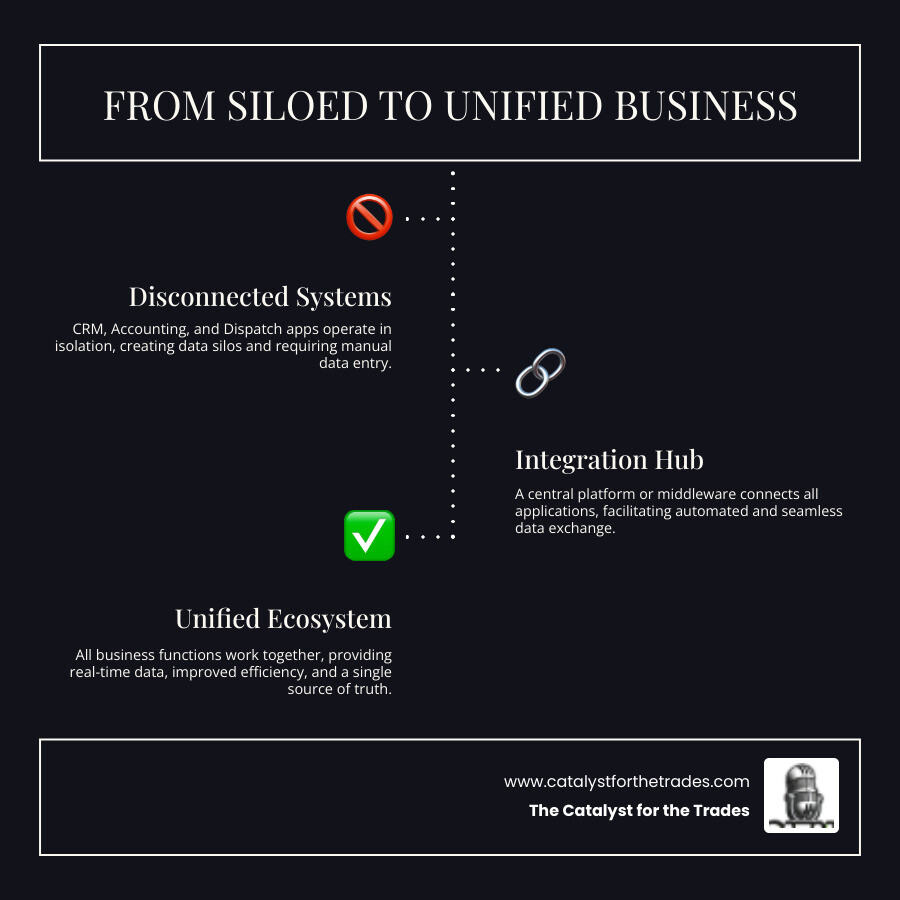
This infographic illustrates the change from disconnected business systems (separate boxes for CRM, Accounting Software, Dispatch System, and Field Service App with no connections) on the left side, flowing through a central integration hub in the middle, to a unified ecosystem on the right side where all four systems are interconnected with bidirectional arrows showing seamless data flow between all applications.
System integration terms to learn:
Picture this: A technician marks a job complete on their mobile app, and instantly, your accounting software generates an invoice, your CRM logs the service history, and your customer receives a thank-you email. No paperwork, no phone calls, and no manual data entry. That's system integration at work.

A business dashboard on a tablet showing unified analytics from sales, operations, and finance, with clean, professional graphics and a modern interface.
When your business systems talk to each other, everything changes. Here's what that means for your operations and bottom line.
Stop wasting time on busywork. The average worker spends 20 hours per week searching for information across disconnected systems. System integration eliminates this waste by automating the flow of information. When everything updates automatically, your team can focus on delivering great service instead of performing digital scavenger hunts. This is the foundation of effective process improvement.
See what's happening in your business. When data lives in different places, you're flying blind. Integrated systems provide a single source of truth where all your business data comes together in real time. As Forbes notes, a unified view of data is essential for making smart decisions. You can see which services are most profitable and which technicians are most efficient without wrestling with spreadsheets.
Become significantly more profitable. Every hour spent on manual data entry is an hour not generating revenue. System integration attacks inefficiency by reducing errors, cutting administrative overhead, and helping you do more with your existing team. When systems work together, money stops leaking out of your business through small inefficiencies.
Make your data more secure. Scattered customer information across multiple systems creates vulnerabilities. Integrating your systems allows you to implement consistent security measures like stronger encryption and centralized access controls. This also provides better audit trails that can help reduce potential fraud.
Build a business that can actually grow. Disconnected systems are bottlenecks that choke growth. When your systems are integrated, your business infrastructure can scale with you. Adding a new technician or launching a new service line becomes a simple process, not a complete overhaul. This flexibility allows you to scale without the chaos that often accompanies rapid growth.
The bottom line is simple: system integration transforms your business into a well-oiled machine where information flows automatically, decisions are based on real data, and your team can focus on what they do best.
Choosing the right approach to system integration can mean the difference between a streamlined operation and an expensive headache. Here's a breakdown of the key concepts.
While they often work together, their goals are different. System integration connects applications to automate processes (e.g., a completed job automatically triggers an invoice). Data integration consolidates information from various sources into a single view for analysis (e.g., combining service history and payment records for a full customer report).
The way you connect your systems matters. There are three main approaches:

An illustrative image visually differentiating Point-to-Point integration (direct lines between each system), Hub-and-Spoke integration (all systems connected to a central hub), and Enterprise Service Bus (ESB) integration (systems connecting to a bus, which handles communication and change).
Here's how these models stack up:
| Feature | Point-to-Point (Star/Spaghetti) | Hub-and-Spoke | Enterprise Service Bus (ESB) |
|---|---|---|---|
| Scalability | Low (quickly becomes complex) | Medium (better than point-to-point) | High (designed for enterprise scale) |
| Maintenance | High (complex dependencies) | Medium (centralized, but hub is critical) | Medium (complex setup, but flexible components) |
| Initial Setup | Low (simple direct connections) | Medium (hub configuration) | High (extensive design and configuration) |
| Flexibility | Low (tightly coupled) | Medium (systems loosely coupled to hub) | High (systems decoupled by bus) |
| Failure Point | Distributed | Single point (the hub) | Distributed (bus itself is resilient) |
| Best Use Case | 2-3 systems, quick, simple | Moderate number of systems, centralized needs | Large enterprises, complex on-premise integrations |
The cloud has made system integration more accessible than ever.
Integration Platform as a Service (iPaaS) is a cloud-based solution that provides tools to develop, execute, and manage integrations. These platforms often feature pre-built connectors and drag-and-drop interfaces, making them ideal for trades businesses using cloud applications. According to Gartner, prominent iPaaS providers include Workato, Boomi, Celigo, and Martini.
Hybrid Integration Platform (HIP) is designed to manage both cloud-based and on-premise integrations. This is the solution if you need to connect legacy systems in your office with newer cloud applications, bridging the gap between old and new. Top HIP vendors include Axway, Cleo, Software AG, and MuleSoft.
For most home service businesses, iPaaS solutions offer the perfect balance of power and simplicity.
Like any major project in the trades, a successful system integration comes down to having a solid plan. Breaking the project into four phases keeps it manageable.
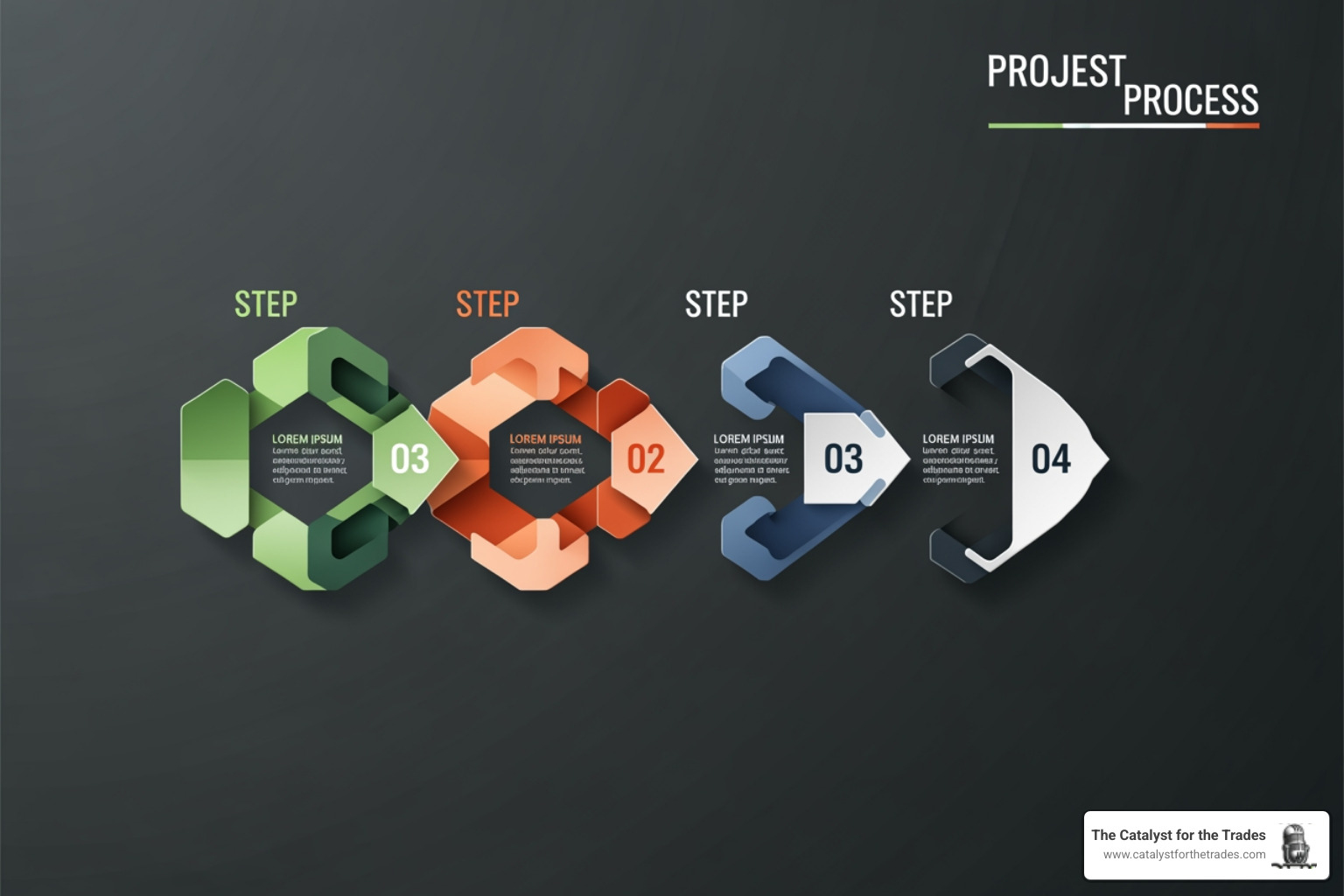
A clear, professional flowchart depicting the four essential steps of a system integration project: 1. Planning & Feasibility, 2. Architecture & Design, 3. Implementation & Testing, and 4. Deployment & Maintenance, with arrows indicating a sequential flow.
Be prepared for common challenges to ensure your project succeeds.
A system integrator is a specialist who plans, builds, and maintains integrated systems. They bring expertise that most trades businesses don't have in-house.
Consider hiring one for complex projects, when you lack in-house resources, or have tight time constraints. An integrator can accelerate the project and provide risk mitigation, helping you avoid costly mistakes. The Control System Integrators Association (CSIA) is one organization representing professionals in this field.
Connecting your business systems is a big step. Here are answers to the most common questions we hear from trades business owners.
The main goal of system integration is to make separate systems work together as a single, cohesive unit. This improves efficiency by automating tasks, boosts data accuracy by reducing manual entry, and provides the real-time visibility needed to make smart business decisions. For trades businesses, this means a smoother operation, a more productive team, and a company that can scale effectively.
System integration connects systems at a functional level to automate processes (e.g., a completed job automatically triggers an invoice). In contrast, data integration focuses on consolidating data from various sources into a single repository for analysis and reporting (e.g., creating a unified customer dashboard).
No, this is a common misconception. Modern cloud-based tools, especially Integration Platform as a Service (iPaaS), have made system integration accessible and affordable for businesses of all sizes. You don't need a massive IT department or budget to connect your apps. For home service businesses, this levels the playing field, allowing you to achieve the same operational efficiency as larger competitors. The question isn't if you're big enough, but whether you can afford not to integrate.
Running a home service business on disconnected systems is like trying to coordinate a team with faulty equipment—it makes everything harder than it needs to be. By connecting your CRM, dispatch software, and accounting tools into one seamless ecosystem with system integration, you're not just solving today's problems; you're building a foundation for tomorrow's growth.
The benefits are tangible: eliminating wasted hours on manual data entry, making smarter decisions with real-time data, and gaining the ability to scale without chaos. It means a technician finishes a job, and the invoice generates automatically. It means your team has the information they need, right when they need it. This creates the seamless customer experience that builds loyalty and referrals.
System integration gives you freedom. Freedom from data entry errors, inaccurate numbers, and the constant firefighting that holds you back. It gives you the freedom to focus on growing your business. At The Catalyst for the Trades, we help you build the systems that create this predictable freedom.
Whether you're just starting to explore your options or are ready to take the leap, the important thing is to start. You don't have to figure it all out alone.
Learn how to build a more efficient and scalable business with The Catalyst for the Trades. Let's talk about connecting your systems and open uping the growth you've been working toward.
System integration is the process of connecting different software applications and data sources so they work together as a single, unified system. Instead of your CRM, accounting software, and dispatch tools operating in isolation, integration allows them to share information automatically. The primary goal is to create a coordinated ecosystem where information flows seamlessly, eliminating manual data entry, reducing errors, and providing real-time visibility across your entire business.
If you're running a home services business, you're likely familiar with the frustration of disconnected systems. Technicians enter job details in one app, office staff manually transfers that data to QuickBooks, and your sales team is left in the dark. This creates data silos that slow everything down, increase the chance of costly mistakes, and cost you money, time, and growth opportunities.
Learn how to build a more efficient business with The Catalyst for the Trades, or schedule a consultation to discuss your specific integration needs.
Disconnected systems create an operational nightmare for trades business owners trying to scale. Your team wastes time on double data entry, customers get inconsistent information, and you can't get a clear picture of your business performance. System integration solves this by creating a connected business ecosystem where data flows automatically from the field to the office to accounting, giving you the unified view you need to make smart decisions and grow without chaos.

This infographic illustrates the change from disconnected business systems (separate boxes for CRM, Accounting Software, Dispatch System, and Field Service App with no connections) on the left side, flowing through a central integration hub in the middle, to a unified ecosystem on the right side where all four systems are interconnected with bidirectional arrows showing seamless data flow between all applications.
System integration terms to learn:
Picture this: A technician marks a job complete on their mobile app, and instantly, your accounting software generates an invoice, your CRM logs the service history, and your customer receives a thank-you email. No paperwork, no phone calls, and no manual data entry. That's system integration at work.

A business dashboard on a tablet showing unified analytics from sales, operations, and finance, with clean, professional graphics and a modern interface.
When your business systems talk to each other, everything changes. Here's what that means for your operations and bottom line.
Stop wasting time on busywork. The average worker spends 20 hours per week searching for information across disconnected systems. System integration eliminates this waste by automating the flow of information. When everything updates automatically, your team can focus on delivering great service instead of performing digital scavenger hunts. This is the foundation of effective process improvement.
See what's happening in your business. When data lives in different places, you're flying blind. Integrated systems provide a single source of truth where all your business data comes together in real time. As Forbes notes, a unified view of data is essential for making smart decisions. You can see which services are most profitable and which technicians are most efficient without wrestling with spreadsheets.
Become significantly more profitable. Every hour spent on manual data entry is an hour not generating revenue. System integration attacks inefficiency by reducing errors, cutting administrative overhead, and helping you do more with your existing team. When systems work together, money stops leaking out of your business through small inefficiencies.
Make your data more secure. Scattered customer information across multiple systems creates vulnerabilities. Integrating your systems allows you to implement consistent security measures like stronger encryption and centralized access controls. This also provides better audit trails that can help reduce potential fraud.
Build a business that can actually grow. Disconnected systems are bottlenecks that choke growth. When your systems are integrated, your business infrastructure can scale with you. Adding a new technician or launching a new service line becomes a simple process, not a complete overhaul. This flexibility allows you to scale without the chaos that often accompanies rapid growth.
The bottom line is simple: system integration transforms your business into a well-oiled machine where information flows automatically, decisions are based on real data, and your team can focus on what they do best.
Choosing the right approach to system integration can mean the difference between a streamlined operation and an expensive headache. Here's a breakdown of the key concepts.
While they often work together, their goals are different. System integration connects applications to automate processes (e.g., a completed job automatically triggers an invoice). Data integration consolidates information from various sources into a single view for analysis (e.g., combining service history and payment records for a full customer report).
The way you connect your systems matters. There are three main approaches:

An illustrative image visually differentiating Point-to-Point integration (direct lines between each system), Hub-and-Spoke integration (all systems connected to a central hub), and Enterprise Service Bus (ESB) integration (systems connecting to a bus, which handles communication and change).
Here's how these models stack up:
| Feature | Point-to-Point (Star/Spaghetti) | Hub-and-Spoke | Enterprise Service Bus (ESB) |
|---|---|---|---|
| Scalability | Low (quickly becomes complex) | Medium (better than point-to-point) | High (designed for enterprise scale) |
| Maintenance | High (complex dependencies) | Medium (centralized, but hub is critical) | Medium (complex setup, but flexible components) |
| Initial Setup | Low (simple direct connections) | Medium (hub configuration) | High (extensive design and configuration) |
| Flexibility | Low (tightly coupled) | Medium (systems loosely coupled to hub) | High (systems decoupled by bus) |
| Failure Point | Distributed | Single point (the hub) | Distributed (bus itself is resilient) |
| Best Use Case | 2-3 systems, quick, simple | Moderate number of systems, centralized needs | Large enterprises, complex on-premise integrations |
The cloud has made system integration more accessible than ever.
Integration Platform as a Service (iPaaS) is a cloud-based solution that provides tools to develop, execute, and manage integrations. These platforms often feature pre-built connectors and drag-and-drop interfaces, making them ideal for trades businesses using cloud applications. According to Gartner, prominent iPaaS providers include Workato, Boomi, Celigo, and Martini.
Hybrid Integration Platform (HIP) is designed to manage both cloud-based and on-premise integrations. This is the solution if you need to connect legacy systems in your office with newer cloud applications, bridging the gap between old and new. Top HIP vendors include Axway, Cleo, Software AG, and MuleSoft.
For most home service businesses, iPaaS solutions offer the perfect balance of power and simplicity.
Like any major project in the trades, a successful system integration comes down to having a solid plan. Breaking the project into four phases keeps it manageable.

A clear, professional flowchart depicting the four essential steps of a system integration project: 1. Planning & Feasibility, 2. Architecture & Design, 3. Implementation & Testing, and 4. Deployment & Maintenance, with arrows indicating a sequential flow.
Be prepared for common challenges to ensure your project succeeds.
A system integrator is a specialist who plans, builds, and maintains integrated systems. They bring expertise that most trades businesses don't have in-house.
Consider hiring one for complex projects, when you lack in-house resources, or have tight time constraints. An integrator can accelerate the project and provide risk mitigation, helping you avoid costly mistakes. The Control System Integrators Association (CSIA) is one organization representing professionals in this field.
Connecting your business systems is a big step. Here are answers to the most common questions we hear from trades business owners.
The main goal of system integration is to make separate systems work together as a single, cohesive unit. This improves efficiency by automating tasks, boosts data accuracy by reducing manual entry, and provides the real-time visibility needed to make smart business decisions. For trades businesses, this means a smoother operation, a more productive team, and a company that can scale effectively.
System integration connects systems at a functional level to automate processes (e.g., a completed job automatically triggers an invoice). In contrast, data integration focuses on consolidating data from various sources into a single repository for analysis and reporting (e.g., creating a unified customer dashboard).
No, this is a common misconception. Modern cloud-based tools, especially Integration Platform as a Service (iPaaS), have made system integration accessible and affordable for businesses of all sizes. You don't need a massive IT department or budget to connect your apps. For home service businesses, this levels the playing field, allowing you to achieve the same operational efficiency as larger competitors. The question isn't if you're big enough, but whether you can afford not to integrate.
Running a home service business on disconnected systems is like trying to coordinate a team with faulty equipment—it makes everything harder than it needs to be. By connecting your CRM, dispatch software, and accounting tools into one seamless ecosystem with system integration, you're not just solving today's problems; you're building a foundation for tomorrow's growth.
The benefits are tangible: eliminating wasted hours on manual data entry, making smarter decisions with real-time data, and gaining the ability to scale without chaos. It means a technician finishes a job, and the invoice generates automatically. It means your team has the information they need, right when they need it. This creates the seamless customer experience that builds loyalty and referrals.
System integration gives you freedom. Freedom from data entry errors, inaccurate numbers, and the constant firefighting that holds you back. It gives you the freedom to focus on growing your business. At The Catalyst for the Trades, we help you build the systems that create this predictable freedom.
Whether you're just starting to explore your options or are ready to take the leap, the important thing is to start. You don't have to figure it all out alone.
Learn how to build a more efficient and scalable business with The Catalyst for the Trades. Let's talk about connecting your systems and open uping the growth you've been working toward.
System integration is the process of connecting different software applications and data sources so they work together as a single, unified system. Instead of your CRM, accounting software, and dispatch tools operating in isolation, integration allows them to share information automatically. The primary goal is to create a coordinated ecosystem where information flows seamlessly, eliminating manual data entry, reducing errors, and providing real-time visibility across your entire business.
If you're running a home services business, you're likely familiar with the frustration of disconnected systems. Technicians enter job details in one app, office staff manually transfers that data to QuickBooks, and your sales team is left in the dark. This creates data silos that slow everything down, increase the chance of costly mistakes, and cost you money, time, and growth opportunities.
Learn how to build a more efficient business with The Catalyst for the Trades, or schedule a consultation to discuss your specific integration needs.
Disconnected systems create an operational nightmare for trades business owners trying to scale. Your team wastes time on double data entry, customers get inconsistent information, and you can't get a clear picture of your business performance. System integration solves this by creating a connected business ecosystem where data flows automatically from the field to the office to accounting, giving you the unified view you need to make smart decisions and grow without chaos.

This infographic illustrates the change from disconnected business systems (separate boxes for CRM, Accounting Software, Dispatch System, and Field Service App with no connections) on the left side, flowing through a central integration hub in the middle, to a unified ecosystem on the right side where all four systems are interconnected with bidirectional arrows showing seamless data flow between all applications.
System integration terms to learn:
Picture this: A technician marks a job complete on their mobile app, and instantly, your accounting software generates an invoice, your CRM logs the service history, and your customer receives a thank-you email. No paperwork, no phone calls, and no manual data entry. That's system integration at work.

A business dashboard on a tablet showing unified analytics from sales, operations, and finance, with clean, professional graphics and a modern interface.
When your business systems talk to each other, everything changes. Here's what that means for your operations and bottom line.
Stop wasting time on busywork. The average worker spends 20 hours per week searching for information across disconnected systems. System integration eliminates this waste by automating the flow of information. When everything updates automatically, your team can focus on delivering great service instead of performing digital scavenger hunts. This is the foundation of effective process improvement.
See what's happening in your business. When data lives in different places, you're flying blind. Integrated systems provide a single source of truth where all your business data comes together in real time. As Forbes notes, a unified view of data is essential for making smart decisions. You can see which services are most profitable and which technicians are most efficient without wrestling with spreadsheets.
Become significantly more profitable. Every hour spent on manual data entry is an hour not generating revenue. System integration attacks inefficiency by reducing errors, cutting administrative overhead, and helping you do more with your existing team. When systems work together, money stops leaking out of your business through small inefficiencies.
Make your data more secure. Scattered customer information across multiple systems creates vulnerabilities. Integrating your systems allows you to implement consistent security measures like stronger encryption and centralized access controls. This also provides better audit trails that can help reduce potential fraud.
Build a business that can actually grow. Disconnected systems are bottlenecks that choke growth. When your systems are integrated, your business infrastructure can scale with you. Adding a new technician or launching a new service line becomes a simple process, not a complete overhaul. This flexibility allows you to scale without the chaos that often accompanies rapid growth.
The bottom line is simple: system integration transforms your business into a well-oiled machine where information flows automatically, decisions are based on real data, and your team can focus on what they do best.
Choosing the right approach to system integration can mean the difference between a streamlined operation and an expensive headache. Here's a breakdown of the key concepts.
While they often work together, their goals are different. System integration connects applications to automate processes (e.g., a completed job automatically triggers an invoice). Data integration consolidates information from various sources into a single view for analysis (e.g., combining service history and payment records for a full customer report).
The way you connect your systems matters. There are three main approaches:

An illustrative image visually differentiating Point-to-Point integration (direct lines between each system), Hub-and-Spoke integration (all systems connected to a central hub), and Enterprise Service Bus (ESB) integration (systems connecting to a bus, which handles communication and change).
Here's how these models stack up:
| Feature | Point-to-Point (Star/Spaghetti) | Hub-and-Spoke | Enterprise Service Bus (ESB) |
|---|---|---|---|
| Scalability | Low (quickly becomes complex) | Medium (better than point-to-point) | High (designed for enterprise scale) |
| Maintenance | High (complex dependencies) | Medium (centralized, but hub is critical) | Medium (complex setup, but flexible components) |
| Initial Setup | Low (simple direct connections) | Medium (hub configuration) | High (extensive design and configuration) |
| Flexibility | Low (tightly coupled) | Medium (systems loosely coupled to hub) | High (systems decoupled by bus) |
| Failure Point | Distributed | Single point (the hub) | Distributed (bus itself is resilient) |
| Best Use Case | 2-3 systems, quick, simple | Moderate number of systems, centralized needs | Large enterprises, complex on-premise integrations |
The cloud has made system integration more accessible than ever.
Integration Platform as a Service (iPaaS) is a cloud-based solution that provides tools to develop, execute, and manage integrations. These platforms often feature pre-built connectors and drag-and-drop interfaces, making them ideal for trades businesses using cloud applications. According to Gartner, prominent iPaaS providers include Workato, Boomi, Celigo, and Martini.
Hybrid Integration Platform (HIP) is designed to manage both cloud-based and on-premise integrations. This is the solution if you need to connect legacy systems in your office with newer cloud applications, bridging the gap between old and new. Top HIP vendors include Axway, Cleo, Software AG, and MuleSoft.
For most home service businesses, iPaaS solutions offer the perfect balance of power and simplicity.
Like any major project in the trades, a successful system integration comes down to having a solid plan. Breaking the project into four phases keeps it manageable.

A clear, professional flowchart depicting the four essential steps of a system integration project: 1. Planning & Feasibility, 2. Architecture & Design, 3. Implementation & Testing, and 4. Deployment & Maintenance, with arrows indicating a sequential flow.
Be prepared for common challenges to ensure your project succeeds.
A system integrator is a specialist who plans, builds, and maintains integrated systems. They bring expertise that most trades businesses don't have in-house.
Consider hiring one for complex projects, when you lack in-house resources, or have tight time constraints. An integrator can accelerate the project and provide risk mitigation, helping you avoid costly mistakes. The Control System Integrators Association (CSIA) is one organization representing professionals in this field.
Connecting your business systems is a big step. Here are answers to the most common questions we hear from trades business owners.
The main goal of system integration is to make separate systems work together as a single, cohesive unit. This improves efficiency by automating tasks, boosts data accuracy by reducing manual entry, and provides the real-time visibility needed to make smart business decisions. For trades businesses, this means a smoother operation, a more productive team, and a company that can scale effectively.
System integration connects systems at a functional level to automate processes (e.g., a completed job automatically triggers an invoice). In contrast, data integration focuses on consolidating data from various sources into a single repository for analysis and reporting (e.g., creating a unified customer dashboard).
No, this is a common misconception. Modern cloud-based tools, especially Integration Platform as a Service (iPaaS), have made system integration accessible and affordable for businesses of all sizes. You don't need a massive IT department or budget to connect your apps. For home service businesses, this levels the playing field, allowing you to achieve the same operational efficiency as larger competitors. The question isn't if you're big enough, but whether you can afford not to integrate.
Running a home service business on disconnected systems is like trying to coordinate a team with faulty equipment—it makes everything harder than it needs to be. By connecting your CRM, dispatch software, and accounting tools into one seamless ecosystem with system integration, you're not just solving today's problems; you're building a foundation for tomorrow's growth.
The benefits are tangible: eliminating wasted hours on manual data entry, making smarter decisions with real-time data, and gaining the ability to scale without chaos. It means a technician finishes a job, and the invoice generates automatically. It means your team has the information they need, right when they need it. This creates the seamless customer experience that builds loyalty and referrals.
System integration gives you freedom. Freedom from data entry errors, inaccurate numbers, and the constant firefighting that holds you back. It gives you the freedom to focus on growing your business. At The Catalyst for the Trades, we help you build the systems that create this predictable freedom.
Whether you're just starting to explore your options or are ready to take the leap, the important thing is to start. You don't have to figure it all out alone.
Learn how to build a more efficient and scalable business with The Catalyst for the Trades. Let's talk about connecting your systems and open uping the growth you've been working toward.

Discover how leading home‑service companies are leveraging AI, subscription models, and digital‑first strategies.
Learn why private equity, automation, and customer‑centric tech are reshaping the trades.

Unlock growth! Discover 10 proven customer retention strategies for trades businesses & boost your profits.

Unlock growth! Discover 10 proven customer retention strategies for trades businesses & boost your profits.

Master seo for contractors to dominate local searches. Get more leads, boost visibility, and outrank competitors. Grow your business!