Episode
December 2, 2025

Beyond the Field: Comparing Leading Business Management and Automation Solutions

Why Field Service Management Software is Essential for Scaling Your Trades Business

Field service management (FSM) software is a digital platform that helps home service businesses manage scheduling, dispatching, work orders, and customer communication from one central hub. For any trades business—HVAC, plumbing, electrical, or otherwise—the daily struggles of missed appointments, disorganized technicians, and delayed invoices are more than just headaches; they are barriers to growth.

FSM software provides a comprehensive solution by:

  • Optimizing Scheduling & Dispatching: Assigning the right tech to the right job based on skills, location, and availability.
  • Enabling Mobile Access: Giving field crews instant access to job details, customer history, and inventory.
  • Automating Customer Communication: Sending appointment reminders and status updates.
  • Streamlining Invoicing & Payments: Allowing for on-site payment collection and accounting integration.
  • Providing Key Analytics: Tracking metrics like first-time fix rates and technician productivity.

The FSM market is projected to reach $4.1 billion by 2030, reflecting a major shift in the industry. Businesses using this technology report significant gains, including up to 40% increases in overall productivity. For owners ready to scale, FSM software replaces operational chaos with real-time visibility. Technicians arrive prepared, customers are kept informed, and invoices are paid promptly. The right FSM platform acts as the central nervous system for your business, connecting the office, field, and customer.
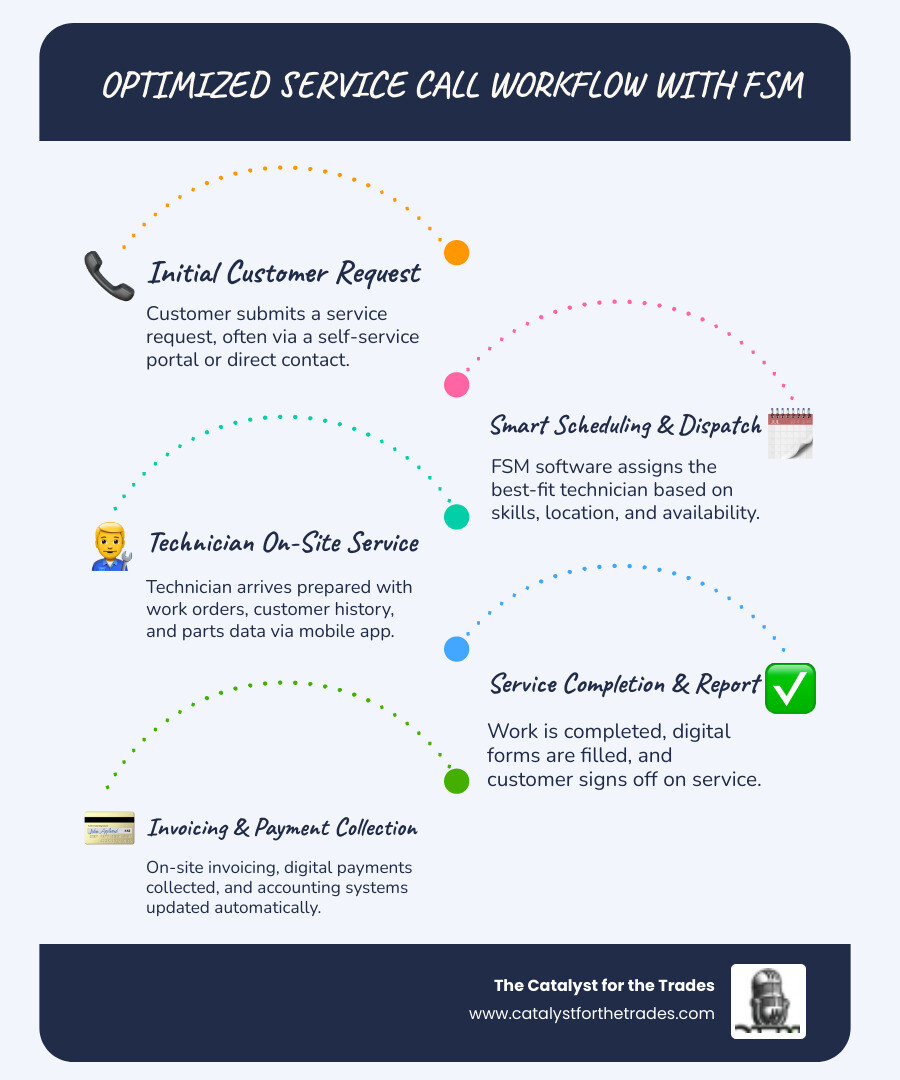
infographic showing the complete workflow of a service call using FSM software from initial customer request through scheduling and dispatch to technician arrival and service completion to invoicing and payment collection with automated customer notifications at each stage - field service management software infographic infographic-line-5-steps-blues-accent_colors

What is Field Service Management (FSM) and What Problems Does It Solve?

For many trades businesses, the daily reality is one of controlled chaos: whiteboards covered in appointments, technicians calling for job details, and customers wondering about arrival times. This reliance on manual systems, spreadsheets, and phone calls creates significant operational problems.

Field service management software replaces this chaos with a comprehensive digital platform that connects your entire operation. It acts as a central system of record, tracking where every technician is, what they are doing, and what needs to happen next.

The problems FSM software solves are critical to a business's health and scalability:

  • Scheduling Chaos: Manual scheduling often leads to inefficient routes, double-bookings, and gaps in the workday. FSM automates this process, matching technician skills, availability, and location to customer needs.
  • Inefficient Dispatching: Phone tag and miscommunication result in unprepared technicians and longer job times. FSM provides clear, digital work orders accessible on the go.
  • Communication Breakdowns: When the office, field team, and customers operate in silos, information gets lost. FSM creates a unified communication channel, providing real-time updates for everyone.
  • Lack of Visibility: Without a real-time overview, you can't spot bottlenecks or know which jobs are running behind. FSM provides a dashboard view of your entire operation.
  • Delayed Payments: Paper-based invoicing slows down cash flow. FSM enables on-site invoicing and digital payments, ensuring you get paid faster.
  • Inconsistent Customer Experience: The sum of these issues is an unpredictable service experience for customers. FSM standardizes processes to deliver consistently professional service.

By creating a single source of truth, FSM software shifts a business from reactive fire-fighting to proactive management. This transition is essential for growth, as effective Process Improvement builds a business that can scale without constant owner intervention.

Core Features of Modern field service management software

Modern field service management software is a business command center, handling everything from the initial customer call to final payment. Core functionalities include work order management for tracking jobs, asset tracking for monitoring customer equipment, mobile access for technicians, customer portals for self-service, and analytics for performance insights. These features work together to streamline your entire operation.
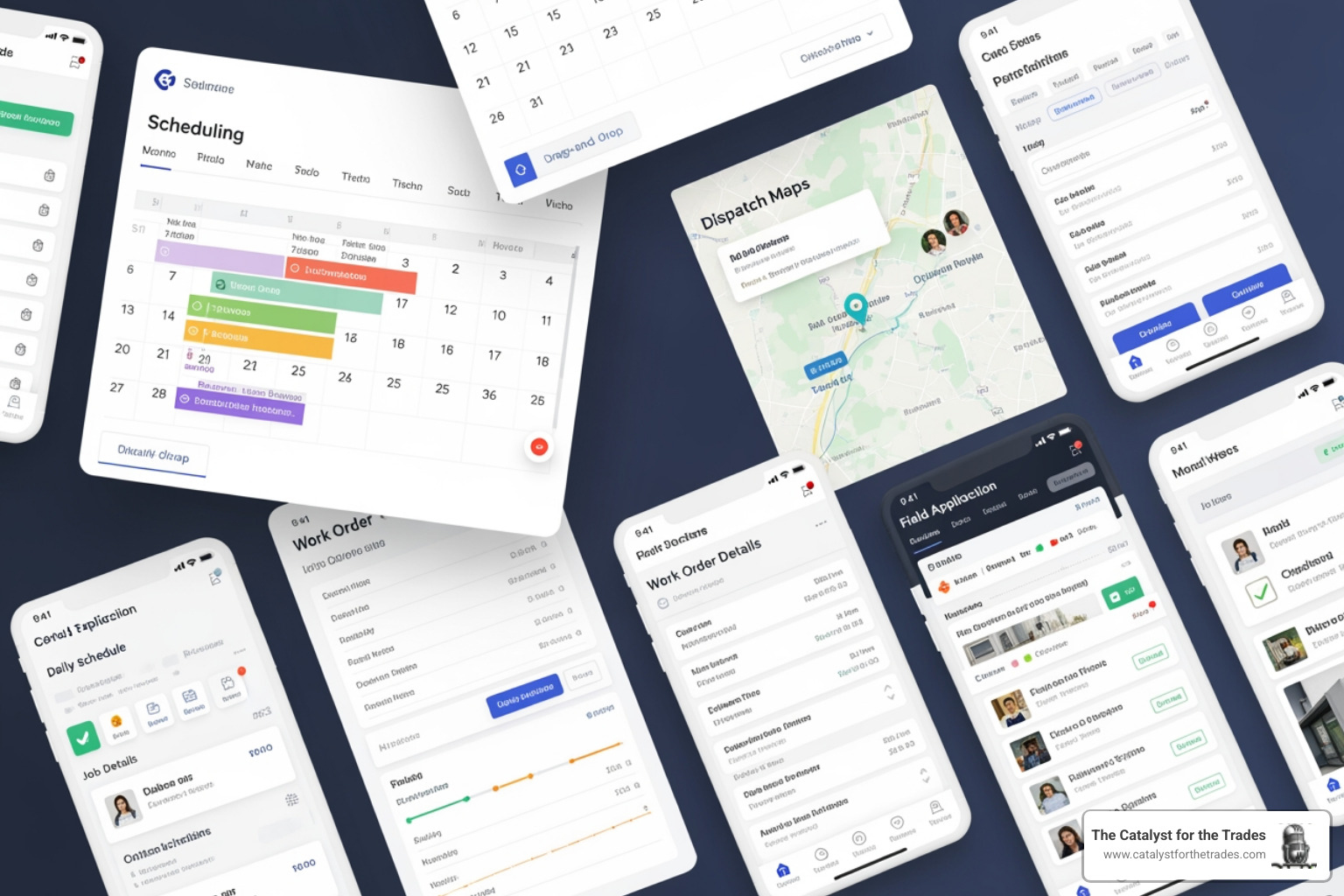
collage of FSM feature screens - field service management software

Scheduling, Dispatching, and Route Optimization

Intelligent scheduling replaces the chaotic whiteboard. Drag-and-drop calendars allow for easy adjustments, while skills-based assignment ensures the right technician is sent to every job. Real-time GPS tracking provides customers with accurate ETAs and gives dispatchers a complete view of their team's location for smarter emergency assignments. Furthermore, automated route planning considers traffic, job duration, and technician location to create the most efficient routes, reducing drive time. These tools help businesses Optimize scheduling to fit more productive work into each day.

Mobile App for Field Technicians

A powerful mobile app puts the office in your technician's pocket. It provides instant work order access with all necessary job details and customer history for better context on service calls. Digital forms replace paper checklists and allow for photo attachments and signature capture directly in the app. A crucial feature is parts inventory lookup, which shows what's on the truck and at the warehouse to prevent return trips. The best apps also offer offline access, allowing technicians to continue working in areas with poor connectivity and Access data offline and sync in real-time once a connection is restored.

Customer Management and Communication

FSM software helps build a strong reputation through professional, responsive service. Built-in CRM capabilities maintain detailed customer profiles, including service history and equipment details. Automated notifications keep customers informed with appointment confirmations and technician-on-the-way alerts. Many platforms also offer self-service booking portals, allowing customers to schedule appointments on their own time. Finally, post-service surveys provide immediate feedback to address issues quickly. These features combine to Build customer loyalty through transparency and convenience.

Invoicing, Payments, and Financial Integration

FSM software dramatically shortens the payment cycle. On-site invoicing allows technicians to generate an invoice immediately after a job is completed, eliminating delays and surprises. With digital payments, customers can pay on the spot via card or other electronic methods. The most powerful feature is accounting software integration, which automatically syncs every invoice with platforms like QuickBooks. This eliminates double entry and manual reconciliation, helping businesses Reduce DSO and secure your cash flow and improve financial health.

The Impact of FSM on Business Growth and Efficiency

Investing in field service management software is a strategic decision that transforms business operations, impacting everything from daily routes to quarterly profit margins.

graph showing upward trends in productivity and profit after FSM implementation - field service management software

The right FSM platform delivers measurable improvements. First-time fix rates climb as technicians arrive prepared. Resource utilization improves through smarter scheduling that eliminates wasted drive time. Operational costs drop as fuel consumption and administrative hours decrease. These benefits directly boost profitability and enable sustainable Home Service Business Growth.

Boosting Operational Efficiency and Productivity

FSM software helps your team get more done. Companies report productivity increases of up to 40%, allowing for more capacity without hiring additional staff. This boost comes from fewer unnecessary trips, as technicians are dispatched intelligently and arrive prepared. With streamlined digital workflows, technicians can complete more jobs per day, free from the delays of phone tag and paperwork. As detailed in How Systems Create Freedom: Mike Abramowitz's Blueprint for Trades Success, a business that runs on efficient processes is a business that is free to grow.

Financial Gains and Increased Profitability

The financial impact of FSM software is significant. Key benefits include reduced fuel costs from optimized routing and lower administrative overhead due to automation. The most transformative benefit is faster payment cycles. On-site invoicing and digital payments mean you're not waiting weeks or months to get paid, which dramatically improves cash flow. The return on investment can be staggering; one comprehensive study found a 346% ROI with a payback period of less than six months. You can read a study on the total economic impact of FSM software to see a detailed breakdown. This technology is an investment that pays for itself quickly.

Industry-Specific Advantages for the Trades

FSM software adapts to the unique needs of different trades:

  • HVAC contractors can manage preventative maintenance contracts, track equipment history, and ensure technicians are prepared for emergency calls, a key strategy discussed in How to Start, Scale, and Stand Out in HVAC: Jason Walker's Playbook for Modern Home Services.
  • Plumbing companies use mobile apps for photo documentation, creating a visual record of work that builds trust and serves as a reference for future calls.
  • Electrical contractors can coordinate complex projects, track progress against milestones, and ensure safety compliance across multiple job sites.
  • Telecommunications providers leverage FSM to meet strict Service Level Agreements (SLAs) by optimizing dispatch and providing real-time status visibility.

From locksmiths to appliance repair, FSM software streamlines workflows and creates a consistent, professional customer experience.

Artificial Intelligence (AI) is no longer a future concept; it's actively revolutionizing field service management software. AI and automation are elevating FSM platforms from simple scheduling tools to predictive systems that optimize operations at a scale humans cannot match. As we've explored in How Tech-Savvy Contractors Will Win: E-commerce, AI, and the Lean Business Revolution, contractors who adopt these tools are gaining a significant competitive edge.

How AI is Revolutionizing field service management software

AI is making a practical difference in trades businesses today through several key applications:

  • Predictive Scheduling: AI algorithms analyze historical data—job durations, traffic patterns, and technician skills—to predict how long future jobs will take, leading to more accurate schedules and fewer delays.
  • AI-Powered Dispatching: Instead of manual assignments, AI suggests the optimal technician for a job based on skills, location, and workload. Some platforms even offer autonomous agents that can dynamically optimize schedules without human intervention.
  • Intelligent Route Optimization: AI adjusts routes in real-time in response to traffic, cancellations, or emergency calls, ensuring technicians are always on the most efficient path.
  • AI Chatbots: Smart assistants can handle routine customer inquiries, book appointments, and provide status updates 24/7, freeing up office staff for more complex tasks.

AI is also directly driving revenue. For example, some AI answering features have helped businesses generate tens of thousands of dollars in a single month by capturing and converting leads. AI-powered copilot tools help technicians resolve issues faster by providing instant access to product manuals and generating professional customer communications. You can dive deeper into these AI capabilities for field service to see how they work.

The Future of Field Service: What's Next?

The next wave of FSM innovation will further transform service delivery:

  • IoT Predictive Maintenance: Sensors on customer equipment will monitor performance and automatically trigger a service request before a failure occurs, shifting service from reactive to proactive.
  • Augmented Reality (AR) Remote Assistance: Junior technicians will be able to connect with senior experts via AR glasses. The expert can see what the tech sees and provide real-time guidance, improving first-time fix rates and providing on-the-job training.
  • Advanced Data Analytics: Future FSM systems will not just report on what happened but will forecast future demand, identify service opportunities, and recommend operational adjustments.
  • Seamless Integration: Deeper integration with CRM, accounting, and inventory systems will create a unified ecosystem where data flows effortlessly across the entire business.

This vision aligns with the trends shaping The Future of Home Services: What Smart Companies Are Doing Now. Businesses that accept these technologies are setting new standards for service excellence.

How to Choose the Right FSM Solution for Your Business

Choosing the right field service management software is a critical decision, as this platform will become the backbone of your operation. The perfect solution for a small plumbing company may not suit a large HVAC operation, so evaluate options based on your specific needs, similar to the process of Choosing Right Vendors for any core business function.

Consider these key factors during your evaluation:

  • Scalability: The software must be able to grow with your business. Ensure it can handle more technicians, jobs, and complexity without requiring a complete overhaul.
  • Ease of Use: If the software is confusing for your office staff or technicians, it won't be adopted. Look for an intuitive interface that simplifies, rather than complicates, daily tasks.
  • Mobile Functionality: The mobile app is your technicians' primary tool. It must be reliable, provide full access to job information, and, critically, function offline so work can continue in areas with no cell service.
  • Integration Capabilities: Your FSM software must connect seamlessly with your other business systems, especially accounting and CRM platforms, to eliminate double data entry and create a single source of truth.
  • Industry Specialization: While general FSM platforms exist, solutions designed for specific trades often include custom features—like advanced asset tracking for HVAC or specialized forms for electrical work—that provide significant value.
  • Customer Support: When issues arise, you need responsive and knowledgeable support. Evaluate the vendor's training, onboarding process, and ongoing technical assistance.

Before committing, ask potential providers about implementation time, training programs, offline mobile capabilities, specific integrations, and customization options. A thorough evaluation ensures you select a system that feels built for your business.

Frequently Asked Questions about FSM Software

How does field service management software improve customer satisfaction?

FSM software boosts customer satisfaction by creating a transparent, efficient, and professional service experience. Key improvements include:

  • Automated Communication: Customers receive automatic appointment confirmations and "technician on the way" alerts, reducing uncertainty.
  • Real-time Technician Tracking: Many platforms allow customers to see their technician's ETA on a map, eliminating frustrating wait times.
  • Self-Service Portals: Customers can book appointments, check service status, and view history online at their convenience.
  • Faster Issue Resolution: Better preparation and scheduling lead to higher first-time fix rates, resolving customer problems more quickly.

How does FSM software facilitate better communication and collaboration?

FSM software acts as a central hub that connects the office, field technicians, and customers, breaking down communication silos.

  • Centralized Information: All job details, customer history, and notes are stored in one place, accessible to both office staff and technicians.
  • Real-time Updates: Technicians can update job statuses from the field, giving the office instant visibility into progress.
  • Direct Messaging: In-app chat features allow for quick communication between team members, reducing phone tag and speeding up problem-solving.

What is the difference between FSM software and a standard CRM?

While they both manage customer data, their functions are distinct.

  • A CRM (Customer Relationship Management) system focuses on the pre-sale journey: managing leads, sales pipelines, and marketing efforts to acquire and nurture customers. Learn more in How to Get Your CRM Right (And Why It Matters More Than You Think).
  • FSM (Field Service Management) software focuses on post-sale service delivery: scheduling, dispatching, work order management, and invoicing.

In short, a CRM helps you win the customer, while FSM helps you serve the customer. Many businesses integrate both for a complete end-to-end solution.

Conclusion

For modern trades businesses, field service management software is no longer an optional extra—it's the foundational tool for scaling successfully. It solves the daily operational headaches of scheduling, dispatching, and invoicing that drain time and prevent growth. The results are clear: significant productivity increases, improved cash flow, and higher first-time fix rates that lead to happier customers and a healthier bottom line.

As AI and other technologies make these platforms even smarter, the gap between businesses that adopt FSM and those that don't will only widen. Choosing the right solution requires careful consideration of scalability, ease of use, and integration, but the payoff is a business that runs on efficient systems, not constant effort.

At The Catalyst for the Trades, we believe technology should empower your team to focus on delivering exceptional service. FSM software handles the operational heavy lifting, freeing you to build customer relationships and strategically grow your business.

The trades industry is evolving rapidly. To learn more about future-proofing your business, explore our article on The AI Revolution in Home Services: How to Future-Proof Your Trades Business. The future is here—make sure your business is ready.

Why Field Service Management Software is Essential for Scaling Your Trades Business

Field service management (FSM) software is a digital platform that helps home service businesses manage scheduling, dispatching, work orders, and customer communication from one central hub. For any trades business—HVAC, plumbing, electrical, or otherwise—the daily struggles of missed appointments, disorganized technicians, and delayed invoices are more than just headaches; they are barriers to growth.

FSM software provides a comprehensive solution by:

  • Optimizing Scheduling & Dispatching: Assigning the right tech to the right job based on skills, location, and availability.
  • Enabling Mobile Access: Giving field crews instant access to job details, customer history, and inventory.
  • Automating Customer Communication: Sending appointment reminders and status updates.
  • Streamlining Invoicing & Payments: Allowing for on-site payment collection and accounting integration.
  • Providing Key Analytics: Tracking metrics like first-time fix rates and technician productivity.

The FSM market is projected to reach $4.1 billion by 2030, reflecting a major shift in the industry. Businesses using this technology report significant gains, including up to 40% increases in overall productivity. For owners ready to scale, FSM software replaces operational chaos with real-time visibility. Technicians arrive prepared, customers are kept informed, and invoices are paid promptly. The right FSM platform acts as the central nervous system for your business, connecting the office, field, and customer.

infographic showing the complete workflow of a service call using FSM software from initial customer request through scheduling and dispatch to technician arrival and service completion to invoicing and payment collection with automated customer notifications at each stage - field service management software infographic infographic-line-5-steps-blues-accent_colors

What is Field Service Management (FSM) and What Problems Does It Solve?

For many trades businesses, the daily reality is one of controlled chaos: whiteboards covered in appointments, technicians calling for job details, and customers wondering about arrival times. This reliance on manual systems, spreadsheets, and phone calls creates significant operational problems.

Field service management software replaces this chaos with a comprehensive digital platform that connects your entire operation. It acts as a central system of record, tracking where every technician is, what they are doing, and what needs to happen next.

The problems FSM software solves are critical to a business's health and scalability:

  • Scheduling Chaos: Manual scheduling often leads to inefficient routes, double-bookings, and gaps in the workday. FSM automates this process, matching technician skills, availability, and location to customer needs.
  • Inefficient Dispatching: Phone tag and miscommunication result in unprepared technicians and longer job times. FSM provides clear, digital work orders accessible on the go.
  • Communication Breakdowns: When the office, field team, and customers operate in silos, information gets lost. FSM creates a unified communication channel, providing real-time updates for everyone.
  • Lack of Visibility: Without a real-time overview, you can't spot bottlenecks or know which jobs are running behind. FSM provides a dashboard view of your entire operation.
  • Delayed Payments: Paper-based invoicing slows down cash flow. FSM enables on-site invoicing and digital payments, ensuring you get paid faster.
  • Inconsistent Customer Experience: The sum of these issues is an unpredictable service experience for customers. FSM standardizes processes to deliver consistently professional service.

By creating a single source of truth, FSM software shifts a business from reactive fire-fighting to proactive management. This transition is essential for growth, as effective Process Improvement builds a business that can scale without constant owner intervention.

Core Features of Modern field service management software

Modern field service management software is a business command center, handling everything from the initial customer call to final payment. Core functionalities include work order management for tracking jobs, asset tracking for monitoring customer equipment, mobile access for technicians, customer portals for self-service, and analytics for performance insights. These features work together to streamline your entire operation.

collage of FSM feature screens - field service management software

Scheduling, Dispatching, and Route Optimization

Intelligent scheduling replaces the chaotic whiteboard. Drag-and-drop calendars allow for easy adjustments, while skills-based assignment ensures the right technician is sent to every job. Real-time GPS tracking provides customers with accurate ETAs and gives dispatchers a complete view of their team's location for smarter emergency assignments. Furthermore, automated route planning considers traffic, job duration, and technician location to create the most efficient routes, reducing drive time. These tools help businesses Optimize scheduling to fit more productive work into each day.

Mobile App for Field Technicians

A powerful mobile app puts the office in your technician's pocket. It provides instant work order access with all necessary job details and customer history for better context on service calls. Digital forms replace paper checklists and allow for photo attachments and signature capture directly in the app. A crucial feature is parts inventory lookup, which shows what's on the truck and at the warehouse to prevent return trips. The best apps also offer offline access, allowing technicians to continue working in areas with poor connectivity and Access data offline and sync in real-time once a connection is restored.

Customer Management and Communication

FSM software helps build a strong reputation through professional, responsive service. Built-in CRM capabilities maintain detailed customer profiles, including service history and equipment details. Automated notifications keep customers informed with appointment confirmations and technician-on-the-way alerts. Many platforms also offer self-service booking portals, allowing customers to schedule appointments on their own time. Finally, post-service surveys provide immediate feedback to address issues quickly. These features combine to Build customer loyalty through transparency and convenience.

Invoicing, Payments, and Financial Integration

FSM software dramatically shortens the payment cycle. On-site invoicing allows technicians to generate an invoice immediately after a job is completed, eliminating delays and surprises. With digital payments, customers can pay on the spot via card or other electronic methods. The most powerful feature is accounting software integration, which automatically syncs every invoice with platforms like QuickBooks. This eliminates double entry and manual reconciliation, helping businesses Reduce DSO and secure your cash flow and improve financial health.

The Impact of FSM on Business Growth and Efficiency

Investing in field service management software is a strategic decision that transforms business operations, impacting everything from daily routes to quarterly profit margins.

graph showing upward trends in productivity and profit after FSM implementation - field service management software

The right FSM platform delivers measurable improvements. First-time fix rates climb as technicians arrive prepared. Resource utilization improves through smarter scheduling that eliminates wasted drive time. Operational costs drop as fuel consumption and administrative hours decrease. These benefits directly boost profitability and enable sustainable Home Service Business Growth.

Boosting Operational Efficiency and Productivity

FSM software helps your team get more done. Companies report productivity increases of up to 40%, allowing for more capacity without hiring additional staff. This boost comes from fewer unnecessary trips, as technicians are dispatched intelligently and arrive prepared. With streamlined digital workflows, technicians can complete more jobs per day, free from the delays of phone tag and paperwork. As detailed in How Systems Create Freedom: Mike Abramowitz's Blueprint for Trades Success, a business that runs on efficient processes is a business that is free to grow.

Financial Gains and Increased Profitability

The financial impact of FSM software is significant. Key benefits include reduced fuel costs from optimized routing and lower administrative overhead due to automation. The most transformative benefit is faster payment cycles. On-site invoicing and digital payments mean you're not waiting weeks or months to get paid, which dramatically improves cash flow. The return on investment can be staggering; one comprehensive study found a 346% ROI with a payback period of less than six months. You can read a study on the total economic impact of FSM software to see a detailed breakdown. This technology is an investment that pays for itself quickly.

Industry-Specific Advantages for the Trades

FSM software adapts to the unique needs of different trades:

  • HVAC contractors can manage preventative maintenance contracts, track equipment history, and ensure technicians are prepared for emergency calls, a key strategy discussed in How to Start, Scale, and Stand Out in HVAC: Jason Walker's Playbook for Modern Home Services.
  • Plumbing companies use mobile apps for photo documentation, creating a visual record of work that builds trust and serves as a reference for future calls.
  • Electrical contractors can coordinate complex projects, track progress against milestones, and ensure safety compliance across multiple job sites.
  • Telecommunications providers leverage FSM to meet strict Service Level Agreements (SLAs) by optimizing dispatch and providing real-time status visibility.

From locksmiths to appliance repair, FSM software streamlines workflows and creates a consistent, professional customer experience.

Artificial Intelligence (AI) is no longer a future concept; it's actively revolutionizing field service management software. AI and automation are elevating FSM platforms from simple scheduling tools to predictive systems that optimize operations at a scale humans cannot match. As we've explored in How Tech-Savvy Contractors Will Win: E-commerce, AI, and the Lean Business Revolution, contractors who adopt these tools are gaining a significant competitive edge.

How AI is Revolutionizing field service management software

AI is making a practical difference in trades businesses today through several key applications:

  • Predictive Scheduling: AI algorithms analyze historical data—job durations, traffic patterns, and technician skills—to predict how long future jobs will take, leading to more accurate schedules and fewer delays.
  • AI-Powered Dispatching: Instead of manual assignments, AI suggests the optimal technician for a job based on skills, location, and workload. Some platforms even offer autonomous agents that can dynamically optimize schedules without human intervention.
  • Intelligent Route Optimization: AI adjusts routes in real-time in response to traffic, cancellations, or emergency calls, ensuring technicians are always on the most efficient path.
  • AI Chatbots: Smart assistants can handle routine customer inquiries, book appointments, and provide status updates 24/7, freeing up office staff for more complex tasks.

AI is also directly driving revenue. For example, some AI answering features have helped businesses generate tens of thousands of dollars in a single month by capturing and converting leads. AI-powered copilot tools help technicians resolve issues faster by providing instant access to product manuals and generating professional customer communications. You can dive deeper into these AI capabilities for field service to see how they work.

The Future of Field Service: What's Next?

The next wave of FSM innovation will further transform service delivery:

  • IoT Predictive Maintenance: Sensors on customer equipment will monitor performance and automatically trigger a service request before a failure occurs, shifting service from reactive to proactive.
  • Augmented Reality (AR) Remote Assistance: Junior technicians will be able to connect with senior experts via AR glasses. The expert can see what the tech sees and provide real-time guidance, improving first-time fix rates and providing on-the-job training.
  • Advanced Data Analytics: Future FSM systems will not just report on what happened but will forecast future demand, identify service opportunities, and recommend operational adjustments.
  • Seamless Integration: Deeper integration with CRM, accounting, and inventory systems will create a unified ecosystem where data flows effortlessly across the entire business.

This vision aligns with the trends shaping The Future of Home Services: What Smart Companies Are Doing Now. Businesses that accept these technologies are setting new standards for service excellence.

How to Choose the Right FSM Solution for Your Business

Choosing the right field service management software is a critical decision, as this platform will become the backbone of your operation. The perfect solution for a small plumbing company may not suit a large HVAC operation, so evaluate options based on your specific needs, similar to the process of Choosing Right Vendors for any core business function.

Consider these key factors during your evaluation:

  • Scalability: The software must be able to grow with your business. Ensure it can handle more technicians, jobs, and complexity without requiring a complete overhaul.
  • Ease of Use: If the software is confusing for your office staff or technicians, it won't be adopted. Look for an intuitive interface that simplifies, rather than complicates, daily tasks.
  • Mobile Functionality: The mobile app is your technicians' primary tool. It must be reliable, provide full access to job information, and, critically, function offline so work can continue in areas with no cell service.
  • Integration Capabilities: Your FSM software must connect seamlessly with your other business systems, especially accounting and CRM platforms, to eliminate double data entry and create a single source of truth.
  • Industry Specialization: While general FSM platforms exist, solutions designed for specific trades often include custom features—like advanced asset tracking for HVAC or specialized forms for electrical work—that provide significant value.
  • Customer Support: When issues arise, you need responsive and knowledgeable support. Evaluate the vendor's training, onboarding process, and ongoing technical assistance.

Before committing, ask potential providers about implementation time, training programs, offline mobile capabilities, specific integrations, and customization options. A thorough evaluation ensures you select a system that feels built for your business.

Frequently Asked Questions about FSM Software

How does field service management software improve customer satisfaction?

FSM software boosts customer satisfaction by creating a transparent, efficient, and professional service experience. Key improvements include:

  • Automated Communication: Customers receive automatic appointment confirmations and "technician on the way" alerts, reducing uncertainty.
  • Real-time Technician Tracking: Many platforms allow customers to see their technician's ETA on a map, eliminating frustrating wait times.
  • Self-Service Portals: Customers can book appointments, check service status, and view history online at their convenience.
  • Faster Issue Resolution: Better preparation and scheduling lead to higher first-time fix rates, resolving customer problems more quickly.

How does FSM software facilitate better communication and collaboration?

FSM software acts as a central hub that connects the office, field technicians, and customers, breaking down communication silos.

  • Centralized Information: All job details, customer history, and notes are stored in one place, accessible to both office staff and technicians.
  • Real-time Updates: Technicians can update job statuses from the field, giving the office instant visibility into progress.
  • Direct Messaging: In-app chat features allow for quick communication between team members, reducing phone tag and speeding up problem-solving.

What is the difference between FSM software and a standard CRM?

While they both manage customer data, their functions are distinct.

  • A CRM (Customer Relationship Management) system focuses on the pre-sale journey: managing leads, sales pipelines, and marketing efforts to acquire and nurture customers. Learn more in How to Get Your CRM Right (And Why It Matters More Than You Think).
  • FSM (Field Service Management) software focuses on post-sale service delivery: scheduling, dispatching, work order management, and invoicing.

In short, a CRM helps you win the customer, while FSM helps you serve the customer. Many businesses integrate both for a complete end-to-end solution.

Conclusion

For modern trades businesses, field service management software is no longer an optional extra—it's the foundational tool for scaling successfully. It solves the daily operational headaches of scheduling, dispatching, and invoicing that drain time and prevent growth. The results are clear: significant productivity increases, improved cash flow, and higher first-time fix rates that lead to happier customers and a healthier bottom line.

As AI and other technologies make these platforms even smarter, the gap between businesses that adopt FSM and those that don't will only widen. Choosing the right solution requires careful consideration of scalability, ease of use, and integration, but the payoff is a business that runs on efficient systems, not constant effort.

At The Catalyst for the Trades, we believe technology should empower your team to focus on delivering exceptional service. FSM software handles the operational heavy lifting, freeing you to build customer relationships and strategically grow your business.

The trades industry is evolving rapidly. To learn more about future-proofing your business, explore our article on The AI Revolution in Home Services: How to Future-Proof Your Trades Business. The future is here—make sure your business is ready.

Why Field Service Management Software is Essential for Scaling Your Trades Business

Field service management (FSM) software is a digital platform that helps home service businesses manage scheduling, dispatching, work orders, and customer communication from one central hub. For any trades business—HVAC, plumbing, electrical, or otherwise—the daily struggles of missed appointments, disorganized technicians, and delayed invoices are more than just headaches; they are barriers to growth.

FSM software provides a comprehensive solution by:

  • Optimizing Scheduling & Dispatching: Assigning the right tech to the right job based on skills, location, and availability.
  • Enabling Mobile Access: Giving field crews instant access to job details, customer history, and inventory.
  • Automating Customer Communication: Sending appointment reminders and status updates.
  • Streamlining Invoicing & Payments: Allowing for on-site payment collection and accounting integration.
  • Providing Key Analytics: Tracking metrics like first-time fix rates and technician productivity.

The FSM market is projected to reach $4.1 billion by 2030, reflecting a major shift in the industry. Businesses using this technology report significant gains, including up to 40% increases in overall productivity. For owners ready to scale, FSM software replaces operational chaos with real-time visibility. Technicians arrive prepared, customers are kept informed, and invoices are paid promptly. The right FSM platform acts as the central nervous system for your business, connecting the office, field, and customer.

infographic showing the complete workflow of a service call using FSM software from initial customer request through scheduling and dispatch to technician arrival and service completion to invoicing and payment collection with automated customer notifications at each stage - field service management software infographic infographic-line-5-steps-blues-accent_colors

What is Field Service Management (FSM) and What Problems Does It Solve?

For many trades businesses, the daily reality is one of controlled chaos: whiteboards covered in appointments, technicians calling for job details, and customers wondering about arrival times. This reliance on manual systems, spreadsheets, and phone calls creates significant operational problems.

Field service management software replaces this chaos with a comprehensive digital platform that connects your entire operation. It acts as a central system of record, tracking where every technician is, what they are doing, and what needs to happen next.

The problems FSM software solves are critical to a business's health and scalability:

  • Scheduling Chaos: Manual scheduling often leads to inefficient routes, double-bookings, and gaps in the workday. FSM automates this process, matching technician skills, availability, and location to customer needs.
  • Inefficient Dispatching: Phone tag and miscommunication result in unprepared technicians and longer job times. FSM provides clear, digital work orders accessible on the go.
  • Communication Breakdowns: When the office, field team, and customers operate in silos, information gets lost. FSM creates a unified communication channel, providing real-time updates for everyone.
  • Lack of Visibility: Without a real-time overview, you can't spot bottlenecks or know which jobs are running behind. FSM provides a dashboard view of your entire operation.
  • Delayed Payments: Paper-based invoicing slows down cash flow. FSM enables on-site invoicing and digital payments, ensuring you get paid faster.
  • Inconsistent Customer Experience: The sum of these issues is an unpredictable service experience for customers. FSM standardizes processes to deliver consistently professional service.

By creating a single source of truth, FSM software shifts a business from reactive fire-fighting to proactive management. This transition is essential for growth, as effective Process Improvement builds a business that can scale without constant owner intervention.

Core Features of Modern field service management software

Modern field service management software is a business command center, handling everything from the initial customer call to final payment. Core functionalities include work order management for tracking jobs, asset tracking for monitoring customer equipment, mobile access for technicians, customer portals for self-service, and analytics for performance insights. These features work together to streamline your entire operation.

collage of FSM feature screens - field service management software

Scheduling, Dispatching, and Route Optimization

Intelligent scheduling replaces the chaotic whiteboard. Drag-and-drop calendars allow for easy adjustments, while skills-based assignment ensures the right technician is sent to every job. Real-time GPS tracking provides customers with accurate ETAs and gives dispatchers a complete view of their team's location for smarter emergency assignments. Furthermore, automated route planning considers traffic, job duration, and technician location to create the most efficient routes, reducing drive time. These tools help businesses Optimize scheduling to fit more productive work into each day.

Mobile App for Field Technicians

A powerful mobile app puts the office in your technician's pocket. It provides instant work order access with all necessary job details and customer history for better context on service calls. Digital forms replace paper checklists and allow for photo attachments and signature capture directly in the app. A crucial feature is parts inventory lookup, which shows what's on the truck and at the warehouse to prevent return trips. The best apps also offer offline access, allowing technicians to continue working in areas with poor connectivity and Access data offline and sync in real-time once a connection is restored.

Customer Management and Communication

FSM software helps build a strong reputation through professional, responsive service. Built-in CRM capabilities maintain detailed customer profiles, including service history and equipment details. Automated notifications keep customers informed with appointment confirmations and technician-on-the-way alerts. Many platforms also offer self-service booking portals, allowing customers to schedule appointments on their own time. Finally, post-service surveys provide immediate feedback to address issues quickly. These features combine to Build customer loyalty through transparency and convenience.

Invoicing, Payments, and Financial Integration

FSM software dramatically shortens the payment cycle. On-site invoicing allows technicians to generate an invoice immediately after a job is completed, eliminating delays and surprises. With digital payments, customers can pay on the spot via card or other electronic methods. The most powerful feature is accounting software integration, which automatically syncs every invoice with platforms like QuickBooks. This eliminates double entry and manual reconciliation, helping businesses Reduce DSO and secure your cash flow and improve financial health.

The Impact of FSM on Business Growth and Efficiency

Investing in field service management software is a strategic decision that transforms business operations, impacting everything from daily routes to quarterly profit margins.

graph showing upward trends in productivity and profit after FSM implementation - field service management software

The right FSM platform delivers measurable improvements. First-time fix rates climb as technicians arrive prepared. Resource utilization improves through smarter scheduling that eliminates wasted drive time. Operational costs drop as fuel consumption and administrative hours decrease. These benefits directly boost profitability and enable sustainable Home Service Business Growth.

Boosting Operational Efficiency and Productivity

FSM software helps your team get more done. Companies report productivity increases of up to 40%, allowing for more capacity without hiring additional staff. This boost comes from fewer unnecessary trips, as technicians are dispatched intelligently and arrive prepared. With streamlined digital workflows, technicians can complete more jobs per day, free from the delays of phone tag and paperwork. As detailed in How Systems Create Freedom: Mike Abramowitz's Blueprint for Trades Success, a business that runs on efficient processes is a business that is free to grow.

Financial Gains and Increased Profitability

The financial impact of FSM software is significant. Key benefits include reduced fuel costs from optimized routing and lower administrative overhead due to automation. The most transformative benefit is faster payment cycles. On-site invoicing and digital payments mean you're not waiting weeks or months to get paid, which dramatically improves cash flow. The return on investment can be staggering; one comprehensive study found a 346% ROI with a payback period of less than six months. You can read a study on the total economic impact of FSM software to see a detailed breakdown. This technology is an investment that pays for itself quickly.

Industry-Specific Advantages for the Trades

FSM software adapts to the unique needs of different trades:

  • HVAC contractors can manage preventative maintenance contracts, track equipment history, and ensure technicians are prepared for emergency calls, a key strategy discussed in How to Start, Scale, and Stand Out in HVAC: Jason Walker's Playbook for Modern Home Services.
  • Plumbing companies use mobile apps for photo documentation, creating a visual record of work that builds trust and serves as a reference for future calls.
  • Electrical contractors can coordinate complex projects, track progress against milestones, and ensure safety compliance across multiple job sites.
  • Telecommunications providers leverage FSM to meet strict Service Level Agreements (SLAs) by optimizing dispatch and providing real-time status visibility.

From locksmiths to appliance repair, FSM software streamlines workflows and creates a consistent, professional customer experience.

Artificial Intelligence (AI) is no longer a future concept; it's actively revolutionizing field service management software. AI and automation are elevating FSM platforms from simple scheduling tools to predictive systems that optimize operations at a scale humans cannot match. As we've explored in How Tech-Savvy Contractors Will Win: E-commerce, AI, and the Lean Business Revolution, contractors who adopt these tools are gaining a significant competitive edge.

How AI is Revolutionizing field service management software

AI is making a practical difference in trades businesses today through several key applications:

  • Predictive Scheduling: AI algorithms analyze historical data—job durations, traffic patterns, and technician skills—to predict how long future jobs will take, leading to more accurate schedules and fewer delays.
  • AI-Powered Dispatching: Instead of manual assignments, AI suggests the optimal technician for a job based on skills, location, and workload. Some platforms even offer autonomous agents that can dynamically optimize schedules without human intervention.
  • Intelligent Route Optimization: AI adjusts routes in real-time in response to traffic, cancellations, or emergency calls, ensuring technicians are always on the most efficient path.
  • AI Chatbots: Smart assistants can handle routine customer inquiries, book appointments, and provide status updates 24/7, freeing up office staff for more complex tasks.

AI is also directly driving revenue. For example, some AI answering features have helped businesses generate tens of thousands of dollars in a single month by capturing and converting leads. AI-powered copilot tools help technicians resolve issues faster by providing instant access to product manuals and generating professional customer communications. You can dive deeper into these AI capabilities for field service to see how they work.

The Future of Field Service: What's Next?

The next wave of FSM innovation will further transform service delivery:

  • IoT Predictive Maintenance: Sensors on customer equipment will monitor performance and automatically trigger a service request before a failure occurs, shifting service from reactive to proactive.
  • Augmented Reality (AR) Remote Assistance: Junior technicians will be able to connect with senior experts via AR glasses. The expert can see what the tech sees and provide real-time guidance, improving first-time fix rates and providing on-the-job training.
  • Advanced Data Analytics: Future FSM systems will not just report on what happened but will forecast future demand, identify service opportunities, and recommend operational adjustments.
  • Seamless Integration: Deeper integration with CRM, accounting, and inventory systems will create a unified ecosystem where data flows effortlessly across the entire business.

This vision aligns with the trends shaping The Future of Home Services: What Smart Companies Are Doing Now. Businesses that accept these technologies are setting new standards for service excellence.

How to Choose the Right FSM Solution for Your Business

Choosing the right field service management software is a critical decision, as this platform will become the backbone of your operation. The perfect solution for a small plumbing company may not suit a large HVAC operation, so evaluate options based on your specific needs, similar to the process of Choosing Right Vendors for any core business function.

Consider these key factors during your evaluation:

  • Scalability: The software must be able to grow with your business. Ensure it can handle more technicians, jobs, and complexity without requiring a complete overhaul.
  • Ease of Use: If the software is confusing for your office staff or technicians, it won't be adopted. Look for an intuitive interface that simplifies, rather than complicates, daily tasks.
  • Mobile Functionality: The mobile app is your technicians' primary tool. It must be reliable, provide full access to job information, and, critically, function offline so work can continue in areas with no cell service.
  • Integration Capabilities: Your FSM software must connect seamlessly with your other business systems, especially accounting and CRM platforms, to eliminate double data entry and create a single source of truth.
  • Industry Specialization: While general FSM platforms exist, solutions designed for specific trades often include custom features—like advanced asset tracking for HVAC or specialized forms for electrical work—that provide significant value.
  • Customer Support: When issues arise, you need responsive and knowledgeable support. Evaluate the vendor's training, onboarding process, and ongoing technical assistance.

Before committing, ask potential providers about implementation time, training programs, offline mobile capabilities, specific integrations, and customization options. A thorough evaluation ensures you select a system that feels built for your business.

Frequently Asked Questions about FSM Software

How does field service management software improve customer satisfaction?

FSM software boosts customer satisfaction by creating a transparent, efficient, and professional service experience. Key improvements include:

  • Automated Communication: Customers receive automatic appointment confirmations and "technician on the way" alerts, reducing uncertainty.
  • Real-time Technician Tracking: Many platforms allow customers to see their technician's ETA on a map, eliminating frustrating wait times.
  • Self-Service Portals: Customers can book appointments, check service status, and view history online at their convenience.
  • Faster Issue Resolution: Better preparation and scheduling lead to higher first-time fix rates, resolving customer problems more quickly.

How does FSM software facilitate better communication and collaboration?

FSM software acts as a central hub that connects the office, field technicians, and customers, breaking down communication silos.

  • Centralized Information: All job details, customer history, and notes are stored in one place, accessible to both office staff and technicians.
  • Real-time Updates: Technicians can update job statuses from the field, giving the office instant visibility into progress.
  • Direct Messaging: In-app chat features allow for quick communication between team members, reducing phone tag and speeding up problem-solving.

What is the difference between FSM software and a standard CRM?

While they both manage customer data, their functions are distinct.

  • A CRM (Customer Relationship Management) system focuses on the pre-sale journey: managing leads, sales pipelines, and marketing efforts to acquire and nurture customers. Learn more in How to Get Your CRM Right (And Why It Matters More Than You Think).
  • FSM (Field Service Management) software focuses on post-sale service delivery: scheduling, dispatching, work order management, and invoicing.

In short, a CRM helps you win the customer, while FSM helps you serve the customer. Many businesses integrate both for a complete end-to-end solution.

Conclusion

For modern trades businesses, field service management software is no longer an optional extra—it's the foundational tool for scaling successfully. It solves the daily operational headaches of scheduling, dispatching, and invoicing that drain time and prevent growth. The results are clear: significant productivity increases, improved cash flow, and higher first-time fix rates that lead to happier customers and a healthier bottom line.

As AI and other technologies make these platforms even smarter, the gap between businesses that adopt FSM and those that don't will only widen. Choosing the right solution requires careful consideration of scalability, ease of use, and integration, but the payoff is a business that runs on efficient systems, not constant effort.

At The Catalyst for the Trades, we believe technology should empower your team to focus on delivering exceptional service. FSM software handles the operational heavy lifting, freeing you to build customer relationships and strategically grow your business.

The trades industry is evolving rapidly. To learn more about future-proofing your business, explore our article on The AI Revolution in Home Services: How to Future-Proof Your Trades Business. The future is here—make sure your business is ready.

Episodes you may like

Connect and Conquer: Understanding CRM

Conquer growth! Learn how customer relationship management empowers home services with data, boosts efficiency, and delights customers.

Read more
Published
December 5, 2025
Beyond the Click: Strategies for Supercharging Lead Generation and Conversion

Boost sales! Discover top strategies for lead conversion optimization, leveraging nurturing, AI, and data-driven personalization.

Read more
Published
December 4, 2025
Grow Your Green: Investing in Professional Development

Invest in professional development to boost your trades team's skills, retention, and business growth. Future-proof your company today!

Read more
Published
December 3, 2025

Guests

Courtney Van Delden Supplee
VDWWS