Episode
January 30, 2026

The Path Forward: Choosing Your Ideal Career Development Program

What is Career Development and Why Does It Matter?

A professional thoughtfully planning their career path on a whiteboard - career development

Career development is the ongoing process of building knowledge, skills, and experience that helps you reach your professional goals. It's different from employee developmentcareer development is driven by what you want for your future, while employee development focuses on what benefits your current employer. For business owners and managers, understanding this distinction is critical when designing programs that both retain talent and advance organizational objectives.

Quick Answer: Key Elements of Career Development

  • Self-Assessment: Identify your strengths, values, and skill gaps
  • Goal Setting: Create specific, measurable career objectives (both short and long-term)
  • Skill Building: Acquire relevant competencies through training, education, or on-the-job experience
  • Networking: Build professional relationships and seek mentorship
  • Implementation: Take action on your plan and track progress
  • Adaptation: Regularly evaluate and adjust your strategy as circumstances change

Career development matters because it directly impacts retention, engagement, and performance. Employees who receive professional development opportunities are more engaged and yield higher retention compared to those who don't. For organizations facing the war for talentespecially in skilled trades and home servicesinvesting in career development isn't optional. It's a competitive necessity that helps you recruit, develop, and keep the skilled professionals your business needs to grow.

For individuals, career development provides clarity, increases earning potential, and creates long-term job satisfaction. For organizations, it builds a stronger workforce, improves employer branding, and directly supports succession planning and scalability.
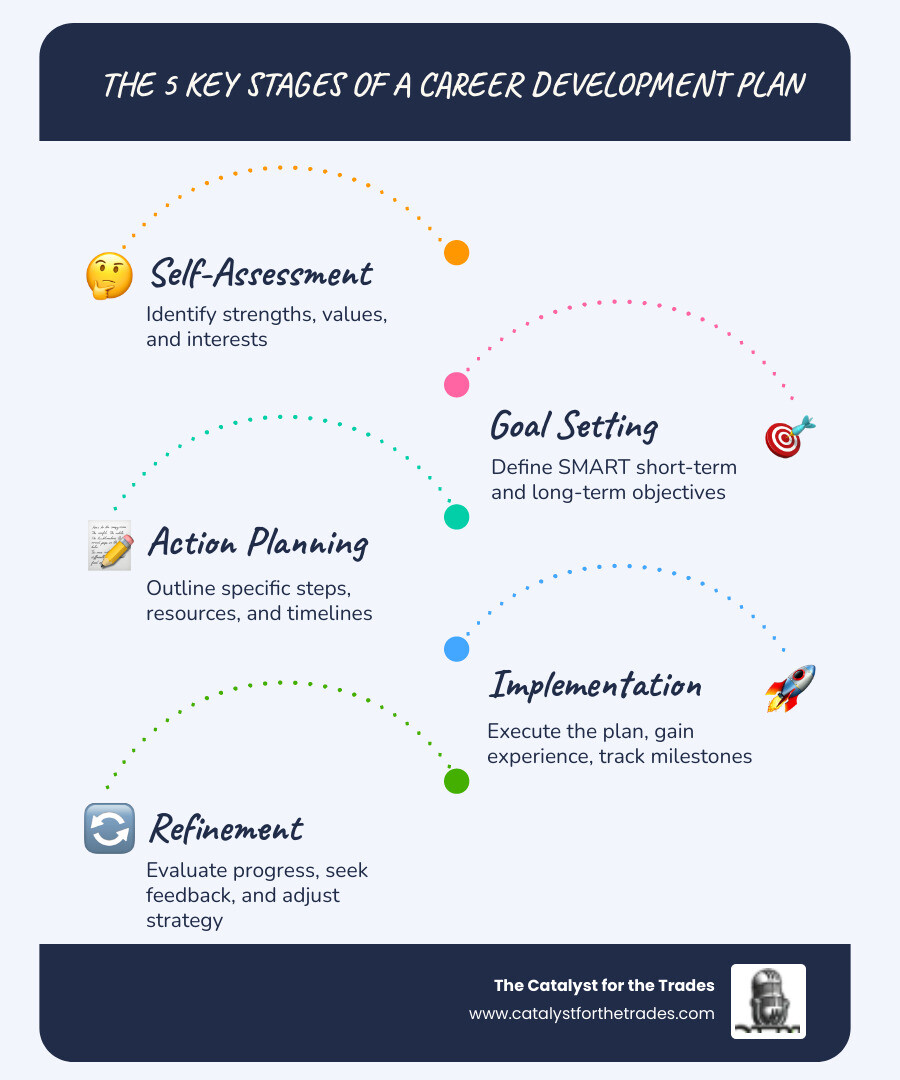
Infographic showing the five key stages of a career development plan: 1) Self-Assessment (identify strengths, values, interests), 2) Goal Setting (define SMART short-term and long-term objectives), 3) Action Planning (outline specific steps, resources, and timelines), 4) Implementation (execute the plan, gain experience, track milestones), and 5) Refinement (evaluate progress, seek feedback, adjust strategy) - career development infographic

Understanding the Core Concepts

At its heart, career development is a proactive, lifelong journey aimed at creating a meaningful professional path that aligns with your personal goals, values, and desired lifestyle. It's about taking intentional steps to define your professional objectives and build the competencies needed to advance. As one expert puts it, career development is "the progression of short-term steps taken to achieve long-term professional goals." It involves building role-specific skill sets, whether that means taking classes, networking, finding a mentor, or embracing new responsibilities in your current role.

The key distinction lies between career development and employee development. While both involve learning and growth, they serve different masters. Employee development is typically driven by an employer's needs, focusing on skills and experiences that directly benefit the organization. Think of it as refining a specific tool for a specific job. Career development, on the other hand, is guided by an individual's vision for their future. It's about shaping the entire toolbox, preparing for roles and opportunities that may extend beyond the current employer. It empowers individuals to hone in on specific skills they want to learn and actively use them, leading to a profound sense of reward and purpose. This personal focus is what makes it so vital for individual fulfillment and long-term success.

The Organizational Advantage

For businesses, particularly in the dynamic home services sector, fostering robust career development programs for our teams isn't just a perkit's a strategic imperative. We know that employees who are provided professional development opportunities at work are shown to be more engaged and yield a higher retention in comparison to those who arent. This engagement translates directly into increased productivity, better customer service, and a stronger company culture.

The "war for talent" is a very real challenge, creating pressure on organizations not only to recruit new talent but also to retain the valuable team members we already have. By investing in our employees' career development, we're not just helping them; we're building a resilient, skilled, and loyal workforce. This commitment strengthens our employer branding, making our organization more attractive to top talent and solidifying our reputation as a place where people can truly grow. Effective talent management strategies, which place career development at their core, are essential for navigating today's competitive landscape and securing our future success. After all, a team that sees a future with us is a team that stays with us.

Step 1: Laying the Foundation with Self-Assessment and Goal Setting

Before starting on any journey, it's wise to consult a map. For career development, that map begins with self-assessment. This crucial first step helps us understand where we are now, what truly drives us, and what skills we possess or need to acquire. It's about asking ourselves the big questions: "What kinds of things am I good at? What skills have I picked up that might apply to my career aspirations? What matters to me most in my career?"

The goal isn't just to identify our strengths, but also to recognize our values, passions, and even skill gaps. This comprehensive self-reflection forms the bedrock of a meaningful career development plan, ensuring that our efforts are aligned with our authentic selves. Think of it as digging deep to understand our unique professional DNA.

Once we have a clearer picture of ourselves, the next step is to translate that understanding into concrete objectives. Setting SMART goalsSpecific, Measurable, Achievable, Relevant, and Time-boundprovides the framework for turning aspirations into actionable plans. Whether we're setting short-term goals to learn a new software platform or long-term goals to achieve a leadership position, the SMART framework ensures our objectives are clear, trackable, and motivating.

The Role of Self-Assessment in Your Career Development

Self-assessment isn't just a feel-good exercise; it's a strategic tool. It helps us identify our core values, the things that truly matter to us in our work. It also brings our passions and interests into focus, guiding us toward roles and industries where we'll feel most engaged and fulfilled. Perhaps we find a passion for problem-solving that points toward a technical leadership role, or a knack for communication that opens doors in customer relations.

A thorough self-assessment also illuminates our strengths, allowing us to leverage them effectively. But just as importantly, it helps us pinpoint skill gaps. These aren't weaknesses to be ashamed of, but rather opportunities for growth. For instance, we might realize we have strong technical skills but need to improve our leadership skills to advance. Professional organizations and industry bodies can provide structured frameworks for evaluating our capabilities against industry standards, offering a roadmap for targeted skill development.

Crucially, self-assessment helps us identify our transferable skills. These are the competencieslike communication, problem-solving, or organizational skillsthat aren't tied to a specific job title but can be applied across various roles and industries. Recognizing these allows us to see how past experiences, even seemingly unrelated ones, have prepared us for future opportunities. It's a powerful way to build confidence and map out potential career shifts without feeling like we're starting from scratch.

How to Set and Achieve Your Career Goals

Once we've thoroughly assessed ourselves, it's time to set our sights on the future. Effective goal setting is the compass for our career development journey. We encourage setting both short-term and long-term goals, ensuring a balanced approach that provides immediate wins while working towards bigger aspirations.

Here are some examples of SMART goals:

  • Specific: "I will improve my project management skills by completing an online course."
  • Measurable: "I will complete the online project management course within the next six months."
  • Achievable: "I will dedicate two hours per week to coursework and complete all assignments."
  • Relevant: "Improving project management skills will prepare me for a team lead role within our organization."
  • Time-bound: "I will complete my project management course by December 31st of this year."

Setting these goals is just the beginning. The real magic happens with action planning. We need to break down our long-term goals into smaller, manageable milestones. For example, if our long-term goal is to become a managing partner in a home services business, our short-term goals might include leading a specific project, mentoring a new team member, or taking a specialized leadership development course.

This detailed planning culminates in creating a comprehensive Career Development Plan. This isn't a rigid contract, but rather a living document that outlines our objectives, the steps we'll take to achieve them, and a timeline for completion. Regularly tracking progress against our milestones allows us to celebrate successes, identify roadblocks, and adjust our strategy as needed. The path forward is rarely a straight line, and flexibility is our friend.

Step 2: Choosing Your Program Type: Formal vs. Informal Approaches

Navigating career development offers a rich mix of learning experiences. There isn't a one-size-fits-all solution; instead, the most effective approach often involves a blend of formal and informal strategies. Both have unique strengths and contribute differently to our professional growth.

Here's a quick look at how they compare:

FeatureFormal Career DevelopmentInformal Career Development
StructureStructured, curriculum-driven, scheduledFlexible, spontaneous, often self-directed
RecognitionOften leads to recognitions or badgesGained through experience, relationships, self-study
ExamplesCourses, advanced degrees, workshopsMentorship, networking, job shadowing, peer learning
Primary BenefitDeep knowledge, structured learningPractical skills, expanded network, personalized guidance
PaceSet by program, often academic or cohort-basedSelf-paced, responsive to immediate needs

Our ideal career development program will likely draw from both sides of this coin, creating a holistic approach to continuous learning and growth.

Formal Development Programs

Formal career development programs are structured learning opportunities designed to impart specific knowledge and skills, sometimes leading to recognized milestones. These programs provide a clear path for professional growth and are excellent for building foundational expertise or specializing in a new area.

Examples include:

  • Certifications: These can range from industry-specific technical certifications (like those for specialized software or equipment in home services) to broader professional certifications (e.g., project management, human resources). Getting certified in industry-standard software platforms, particularly for roles in marketing or data analysis, demonstrates a tangible skill set.
  • Advanced Degrees: Pursuing a master's degree or other postgraduate education can deepen expertise, open doors to research, or prepare individuals for senior management development roles.
  • Workshops and Seminars: These shorter, focused programs are ideal for acquiring targeted skills, staying updated on industry trends, or exploring new methodologies. They offer concentrated learning experiences that can be immediately applied.
  • Structured Training: Many organizations offer internal training programs, often designed to develop specific competencies needed for advancement within the company. These can include professional development courses on leadership, communication, or new technologies.

The benefits of formal programs are clear: they provide structured learning environments and often access to expert instructors and resources. They're particularly valuable when we need to acquire a new, complex skill set or validate existing knowledge for career progression.

Informal Development Opportunities

While formal programs lay crucial groundwork, informal career development opportunities are the connective tissue that truly enriches our professional journey. These are often less structured, highly personalized, and emerge organically through our daily work and relationships.

Key informal approaches include:

  • Mentoring: This involves a relationship with an experienced individual who provides guidance, direction, and career advice. As we've learned, mentoring and coaching are both valuable tools to aid personal and professional development. Mentors can offer invaluable insights, share lessons learned, and help us steer complex career decisions. The benefits of mentoring are well-documented, including increased employee performance, retention, commitment to the organization, and knowledge sharing.
  • Networking: Building and nurturing professional relationships is a cornerstone of career development. Networking opens the door to many different experiences and opportunities we might not even be aware of. It's about connecting with peers, industry leaders, and potential collaborators at events, conferences, or through online platforms.
  • Job Shadowing: Spending time observing someone in a role we aspire to can provide practical insights into the day-to-day realities, challenges, and rewards of that position. It's a fantastic way to explore interests and confirm if a particular path is right for us.
  • Peer Learning: Collaborating with colleagues, sharing knowledge, and learning from each other's experiences is a powerful, often overlooked, form of informal development.
  • Self-Study: This includes reading industry publications, listening to podcasts, watching webinars, and experimenting with new tools or techniques on our own. For those in leadership development, self-study can be a continuous process of refining our approach.

The beauty of informal development lies in its flexibility and real-world applicability. It allows us to tailor our learning to our immediate needs and leverage the rich experiences of those around us.

Step 3: Activating Your Plan with Essential Growth Strategies

A well-crafted career development plan is a powerful blueprint, but its true value lies in its activation. This is where we put our intentions into motion, embracing strategies that foster continuous growth, build meaningful connections, and leverage all available resources. For leaders in home services, driving this activation within our teams is a hallmark of strong organizational leadership.

The Power of Continuous Learning and Adaptation

In today's rapidly evolving professional landscape, especially with cutting-edge tech insights changing industries like home services, continuous learning isn't just an advantageit's a necessity. We must accept lifelong learning, constantly absorbing new information and investing in our intellectual capital. This means staying abreast of industry trends, understanding new technologies, and proactively seeking opportunities for upskilling (enhancing existing skills) and reskilling (learning entirely new skills).

Consider the pace of technological change: new software, AI tools, and smart home systems are constantly emerging in our sector. A commitment to technology adoption and continuous learning ensures that we, and our teams, remain relevant and competitive. It allows us to adapt strategically to market shifts, rather than being caught off guard. This strategic adaptation is crucial for both individual careers and the long-term success of our businesses. As we often discuss, the future belongs to those who are willing to learn and evolve.

Building Your Network and Finding a Mentor

While individual learning is vital, career development truly flourishes in community. Building a robust professional network and finding a mentor are two of the most impactful strategies for accelerating our growth.

Building Relationships: Networking isn't just about collecting business cards; it's about cultivating genuine relationships. This can happen at industry events, through professional organizations, or even informal meetups. The goal is to connect with people who can offer different perspectives, share opportunities, and provide support. Don't forget the power of informational interviewsthese are fantastic for learning about different career paths and building connections without the pressure of a job interview.

Mentorship: Finding a mentor is like having a seasoned guide for your professional journey. A mentor can offer personalized advice, help you steer challenges, and open doors you might not have found on your own. While mentoring focuses on guidance and career advice, coaching emphasizes maximizing potential by working on perceptions, self-confidence, and creative drive. Both are invaluable, but a mentor typically offers a broader, more long-term perspective.

Here are some questions to ask a potential mentor to ensure a good fit and productive relationship:

  • What were some of your biggest career development challenges, and how did you overcome them?
  • What skills do you believe are most critical for success in our industry today, and how can I develop them?
  • How do you approach professional decision-making, especially when facing uncertainty?
  • What resources (books, podcasts, courses) have been most influential in your career?
  • How do you recommend I expand my professional network effectively?
  • What are some common pitfalls you see professionals make early in their careers?
  • How can I best leverage my strengths to achieve my long-term goals?

The benefits of mentoring are significant, leading to increased employee performance, retention, commitment to the organization, and knowledge sharing. It's a win-win for both the individual and the organization.

Frequently Asked Questions about Career Development

We often encounter common questions when discussing the dynamic world of career development. Let's tackle some of these head-on.

What is the difference between career development and career growth?

This is a fantastic question that gets to the core of understanding our professional journey. Think of it this way: career development is the process—it's all the steps, the training, the initiatives, and the learning we undertake to improve our skills and advance our professional path. It's the intentional effort we put in.

Career growth, on the other hand, is the outcome or the result of that development. It's the actual progress we achieve, such as receiving a promotion, taking on increased responsibility, earning a higher salary, or gaining new expertise.

As a helpful resource explains, "Career development refers to the process — the steps, training, and initiatives you take to improve your skills and advance your career path. Career growth is the outcome — your actual progress, such as promotions, new responsibilities, or higher pay." While development drives growth, they are distinct concepts. You can be actively engaged in career development without immediately seeing "growth" in terms of a new title or pay raise, but the development is laying the groundwork for future growth.

How can I change careers without feeling like I'm starting over?

The idea of a career change can be daunting, but it doesn't have to mean hitting the reset button entirely. The key lies in leveraging your existing assets and strategically bridging any gaps.

First, identify your transferable skills. These are the competencies you've developed in previous roles—like communication, project management, customer service, or problem-solving—that are valuable across many different industries. For example, the organizational and communication skills honed in a retail management role can be incredibly valuable in a home services coordination position, as we've seen with leaders like Dana Staszkiewicz, who successfully transitioned from retail to the trades.

Next, pinpoint any skill gaps for your desired new career. You can bridge these through targeted certifications, online courses, or even short-term internships or volunteer work that provide relevant experience. Networking is also crucial here. Connect with people in your target industry; informational interviews can provide insights and open doors. By showcasing how your prior experience and newly acquired skills make you a valuable asset, you can transition smoothly rather than starting from scratch. It's about reframing your narrative to highlight continuity and evolution, not a complete restart.

How does effective career development improve work-life balance?

It might seem counterintuitive, but proactively managing your career development can significantly improve your work-life balance. When we invest in our professional journey, we're not just chasing titles or paychecks; we're also seeking alignment between our work and our personal values.

Here's how it helps:

  • Increased Job Satisfaction: When your work aligns with your skills, interests, and goals, you're more likely to feel fulfilled and engaged. This satisfaction can reduce stress and make the time you spend working feel more purposeful, leading to a better overall sense of well-being.
  • Preventing Burnout: A clear career development path helps prevent the feeling of being "stuck" or stagnant, which is a major contributor to burnout. By having achievable goals and a plan to reach them, you maintain motivation and a sense of progress. Balancing work and personal life is crucial for reaching long-term goals happily and healthily, preventing burnout, and ensuring overall satisfaction.
  • Aligning Career with Values: Through self-assessment, we identify what truly matters to us. This might include flexibility, impact, or a particular company culture. Effective career development allows us to steer our careers towards roles and organizations that honor these values, leading to greater personal fulfillment. For instance, if you value family time, a role in a company that supports flexible work arrangements, like how Trey McWilliams balances big growth with people-first leadership, could be a perfect fit.
  • Increased Autonomy and Control: As you develop skills and expertise, you often gain more autonomy in your role and more control over your professional choices. This can lead to better negotiation power for work-life boundaries, schedules, or even the type of projects you take on, ultimately contributing to a healthier balance.

Career development is about creating a professional life that supports, rather than detracts from, your overall well-being.

Charting Your Course for Lifelong Success

We've explored the multifaceted world of career development, from understanding its core concepts and laying a solid foundation with self-assessment and goal setting, to choosing between formal and informal development programs, and activating our plans with essential growth strategies. The message is clear: career development is not a one-time event, but a continuous, lifelong journey.

By taking a proactive approach, embracing continuous learning, building strong networks, and seeking mentorship, we empower ourselves to steer the ever-changing professional landscape with confidence and purpose. Regularly evaluating and adjusting our strategies ensures that we remain adaptable and resilient, ready to seize new opportunities as they arise.

Every step we take, every skill we acquire, and every connection we make contributes to our overall professional trajectory. The initiative we show today shapes the path we walk tomorrow.

For insights from industry leaders on growth and innovation, including how career development plays out across the trades, listen to The Catalyst for the Trades Podcast; https://www.catalystforthetrades.com/.

What is Career Development and Why Does It Matter?

A professional thoughtfully planning their career path on a whiteboard - career development

Career development is the ongoing process of building knowledge, skills, and experience that helps you reach your professional goals. It's different from employee developmentcareer development is driven by what you want for your future, while employee development focuses on what benefits your current employer. For business owners and managers, understanding this distinction is critical when designing programs that both retain talent and advance organizational objectives.

Quick Answer: Key Elements of Career Development

  • Self-Assessment: Identify your strengths, values, and skill gaps
  • Goal Setting: Create specific, measurable career objectives (both short and long-term)
  • Skill Building: Acquire relevant competencies through training, education, or on-the-job experience
  • Networking: Build professional relationships and seek mentorship
  • Implementation: Take action on your plan and track progress
  • Adaptation: Regularly evaluate and adjust your strategy as circumstances change

Career development matters because it directly impacts retention, engagement, and performance. Employees who receive professional development opportunities are more engaged and yield higher retention compared to those who don't. For organizations facing the war for talentespecially in skilled trades and home servicesinvesting in career development isn't optional. It's a competitive necessity that helps you recruit, develop, and keep the skilled professionals your business needs to grow.

For individuals, career development provides clarity, increases earning potential, and creates long-term job satisfaction. For organizations, it builds a stronger workforce, improves employer branding, and directly supports succession planning and scalability.

Infographic showing the five key stages of a career development plan: 1) Self-Assessment (identify strengths, values, interests), 2) Goal Setting (define SMART short-term and long-term objectives), 3) Action Planning (outline specific steps, resources, and timelines), 4) Implementation (execute the plan, gain experience, track milestones), and 5) Refinement (evaluate progress, seek feedback, adjust strategy) - career development infographic

Understanding the Core Concepts

At its heart, career development is a proactive, lifelong journey aimed at creating a meaningful professional path that aligns with your personal goals, values, and desired lifestyle. It's about taking intentional steps to define your professional objectives and build the competencies needed to advance. As one expert puts it, career development is "the progression of short-term steps taken to achieve long-term professional goals." It involves building role-specific skill sets, whether that means taking classes, networking, finding a mentor, or embracing new responsibilities in your current role.

The key distinction lies between career development and employee development. While both involve learning and growth, they serve different masters. Employee development is typically driven by an employer's needs, focusing on skills and experiences that directly benefit the organization. Think of it as refining a specific tool for a specific job. Career development, on the other hand, is guided by an individual's vision for their future. It's about shaping the entire toolbox, preparing for roles and opportunities that may extend beyond the current employer. It empowers individuals to hone in on specific skills they want to learn and actively use them, leading to a profound sense of reward and purpose. This personal focus is what makes it so vital for individual fulfillment and long-term success.

The Organizational Advantage

For businesses, particularly in the dynamic home services sector, fostering robust career development programs for our teams isn't just a perkit's a strategic imperative. We know that employees who are provided professional development opportunities at work are shown to be more engaged and yield a higher retention in comparison to those who arent. This engagement translates directly into increased productivity, better customer service, and a stronger company culture.

The "war for talent" is a very real challenge, creating pressure on organizations not only to recruit new talent but also to retain the valuable team members we already have. By investing in our employees' career development, we're not just helping them; we're building a resilient, skilled, and loyal workforce. This commitment strengthens our employer branding, making our organization more attractive to top talent and solidifying our reputation as a place where people can truly grow. Effective talent management strategies, which place career development at their core, are essential for navigating today's competitive landscape and securing our future success. After all, a team that sees a future with us is a team that stays with us.

Step 1: Laying the Foundation with Self-Assessment and Goal Setting

Before starting on any journey, it's wise to consult a map. For career development, that map begins with self-assessment. This crucial first step helps us understand where we are now, what truly drives us, and what skills we possess or need to acquire. It's about asking ourselves the big questions: "What kinds of things am I good at? What skills have I picked up that might apply to my career aspirations? What matters to me most in my career?"

The goal isn't just to identify our strengths, but also to recognize our values, passions, and even skill gaps. This comprehensive self-reflection forms the bedrock of a meaningful career development plan, ensuring that our efforts are aligned with our authentic selves. Think of it as digging deep to understand our unique professional DNA.

Once we have a clearer picture of ourselves, the next step is to translate that understanding into concrete objectives. Setting SMART goalsSpecific, Measurable, Achievable, Relevant, and Time-boundprovides the framework for turning aspirations into actionable plans. Whether we're setting short-term goals to learn a new software platform or long-term goals to achieve a leadership position, the SMART framework ensures our objectives are clear, trackable, and motivating.

The Role of Self-Assessment in Your Career Development

Self-assessment isn't just a feel-good exercise; it's a strategic tool. It helps us identify our core values, the things that truly matter to us in our work. It also brings our passions and interests into focus, guiding us toward roles and industries where we'll feel most engaged and fulfilled. Perhaps we find a passion for problem-solving that points toward a technical leadership role, or a knack for communication that opens doors in customer relations.

A thorough self-assessment also illuminates our strengths, allowing us to leverage them effectively. But just as importantly, it helps us pinpoint skill gaps. These aren't weaknesses to be ashamed of, but rather opportunities for growth. For instance, we might realize we have strong technical skills but need to improve our leadership skills to advance. Professional organizations and industry bodies can provide structured frameworks for evaluating our capabilities against industry standards, offering a roadmap for targeted skill development.

Crucially, self-assessment helps us identify our transferable skills. These are the competencieslike communication, problem-solving, or organizational skillsthat aren't tied to a specific job title but can be applied across various roles and industries. Recognizing these allows us to see how past experiences, even seemingly unrelated ones, have prepared us for future opportunities. It's a powerful way to build confidence and map out potential career shifts without feeling like we're starting from scratch.

How to Set and Achieve Your Career Goals

Once we've thoroughly assessed ourselves, it's time to set our sights on the future. Effective goal setting is the compass for our career development journey. We encourage setting both short-term and long-term goals, ensuring a balanced approach that provides immediate wins while working towards bigger aspirations.

Here are some examples of SMART goals:

  • Specific: "I will improve my project management skills by completing an online course."
  • Measurable: "I will complete the online project management course within the next six months."
  • Achievable: "I will dedicate two hours per week to coursework and complete all assignments."
  • Relevant: "Improving project management skills will prepare me for a team lead role within our organization."
  • Time-bound: "I will complete my project management course by December 31st of this year."

Setting these goals is just the beginning. The real magic happens with action planning. We need to break down our long-term goals into smaller, manageable milestones. For example, if our long-term goal is to become a managing partner in a home services business, our short-term goals might include leading a specific project, mentoring a new team member, or taking a specialized leadership development course.

This detailed planning culminates in creating a comprehensive Career Development Plan. This isn't a rigid contract, but rather a living document that outlines our objectives, the steps we'll take to achieve them, and a timeline for completion. Regularly tracking progress against our milestones allows us to celebrate successes, identify roadblocks, and adjust our strategy as needed. The path forward is rarely a straight line, and flexibility is our friend.

Step 2: Choosing Your Program Type: Formal vs. Informal Approaches

Navigating career development offers a rich mix of learning experiences. There isn't a one-size-fits-all solution; instead, the most effective approach often involves a blend of formal and informal strategies. Both have unique strengths and contribute differently to our professional growth.

Here's a quick look at how they compare:

FeatureFormal Career DevelopmentInformal Career Development
StructureStructured, curriculum-driven, scheduledFlexible, spontaneous, often self-directed
RecognitionOften leads to recognitions or badgesGained through experience, relationships, self-study
ExamplesCourses, advanced degrees, workshopsMentorship, networking, job shadowing, peer learning
Primary BenefitDeep knowledge, structured learningPractical skills, expanded network, personalized guidance
PaceSet by program, often academic or cohort-basedSelf-paced, responsive to immediate needs

Our ideal career development program will likely draw from both sides of this coin, creating a holistic approach to continuous learning and growth.

Formal Development Programs

Formal career development programs are structured learning opportunities designed to impart specific knowledge and skills, sometimes leading to recognized milestones. These programs provide a clear path for professional growth and are excellent for building foundational expertise or specializing in a new area.

Examples include:

  • Certifications: These can range from industry-specific technical certifications (like those for specialized software or equipment in home services) to broader professional certifications (e.g., project management, human resources). Getting certified in industry-standard software platforms, particularly for roles in marketing or data analysis, demonstrates a tangible skill set.
  • Advanced Degrees: Pursuing a master's degree or other postgraduate education can deepen expertise, open doors to research, or prepare individuals for senior management development roles.
  • Workshops and Seminars: These shorter, focused programs are ideal for acquiring targeted skills, staying updated on industry trends, or exploring new methodologies. They offer concentrated learning experiences that can be immediately applied.
  • Structured Training: Many organizations offer internal training programs, often designed to develop specific competencies needed for advancement within the company. These can include professional development courses on leadership, communication, or new technologies.

The benefits of formal programs are clear: they provide structured learning environments and often access to expert instructors and resources. They're particularly valuable when we need to acquire a new, complex skill set or validate existing knowledge for career progression.

Informal Development Opportunities

While formal programs lay crucial groundwork, informal career development opportunities are the connective tissue that truly enriches our professional journey. These are often less structured, highly personalized, and emerge organically through our daily work and relationships.

Key informal approaches include:

  • Mentoring: This involves a relationship with an experienced individual who provides guidance, direction, and career advice. As we've learned, mentoring and coaching are both valuable tools to aid personal and professional development. Mentors can offer invaluable insights, share lessons learned, and help us steer complex career decisions. The benefits of mentoring are well-documented, including increased employee performance, retention, commitment to the organization, and knowledge sharing.
  • Networking: Building and nurturing professional relationships is a cornerstone of career development. Networking opens the door to many different experiences and opportunities we might not even be aware of. It's about connecting with peers, industry leaders, and potential collaborators at events, conferences, or through online platforms.
  • Job Shadowing: Spending time observing someone in a role we aspire to can provide practical insights into the day-to-day realities, challenges, and rewards of that position. It's a fantastic way to explore interests and confirm if a particular path is right for us.
  • Peer Learning: Collaborating with colleagues, sharing knowledge, and learning from each other's experiences is a powerful, often overlooked, form of informal development.
  • Self-Study: This includes reading industry publications, listening to podcasts, watching webinars, and experimenting with new tools or techniques on our own. For those in leadership development, self-study can be a continuous process of refining our approach.

The beauty of informal development lies in its flexibility and real-world applicability. It allows us to tailor our learning to our immediate needs and leverage the rich experiences of those around us.

Step 3: Activating Your Plan with Essential Growth Strategies

A well-crafted career development plan is a powerful blueprint, but its true value lies in its activation. This is where we put our intentions into motion, embracing strategies that foster continuous growth, build meaningful connections, and leverage all available resources. For leaders in home services, driving this activation within our teams is a hallmark of strong organizational leadership.

The Power of Continuous Learning and Adaptation

In today's rapidly evolving professional landscape, especially with cutting-edge tech insights changing industries like home services, continuous learning isn't just an advantageit's a necessity. We must accept lifelong learning, constantly absorbing new information and investing in our intellectual capital. This means staying abreast of industry trends, understanding new technologies, and proactively seeking opportunities for upskilling (enhancing existing skills) and reskilling (learning entirely new skills).

Consider the pace of technological change: new software, AI tools, and smart home systems are constantly emerging in our sector. A commitment to technology adoption and continuous learning ensures that we, and our teams, remain relevant and competitive. It allows us to adapt strategically to market shifts, rather than being caught off guard. This strategic adaptation is crucial for both individual careers and the long-term success of our businesses. As we often discuss, the future belongs to those who are willing to learn and evolve.

Building Your Network and Finding a Mentor

While individual learning is vital, career development truly flourishes in community. Building a robust professional network and finding a mentor are two of the most impactful strategies for accelerating our growth.

Building Relationships: Networking isn't just about collecting business cards; it's about cultivating genuine relationships. This can happen at industry events, through professional organizations, or even informal meetups. The goal is to connect with people who can offer different perspectives, share opportunities, and provide support. Don't forget the power of informational interviewsthese are fantastic for learning about different career paths and building connections without the pressure of a job interview.

Mentorship: Finding a mentor is like having a seasoned guide for your professional journey. A mentor can offer personalized advice, help you steer challenges, and open doors you might not have found on your own. While mentoring focuses on guidance and career advice, coaching emphasizes maximizing potential by working on perceptions, self-confidence, and creative drive. Both are invaluable, but a mentor typically offers a broader, more long-term perspective.

Here are some questions to ask a potential mentor to ensure a good fit and productive relationship:

  • What were some of your biggest career development challenges, and how did you overcome them?
  • What skills do you believe are most critical for success in our industry today, and how can I develop them?
  • How do you approach professional decision-making, especially when facing uncertainty?
  • What resources (books, podcasts, courses) have been most influential in your career?
  • How do you recommend I expand my professional network effectively?
  • What are some common pitfalls you see professionals make early in their careers?
  • How can I best leverage my strengths to achieve my long-term goals?

The benefits of mentoring are significant, leading to increased employee performance, retention, commitment to the organization, and knowledge sharing. It's a win-win for both the individual and the organization.

Frequently Asked Questions about Career Development

We often encounter common questions when discussing the dynamic world of career development. Let's tackle some of these head-on.

What is the difference between career development and career growth?

This is a fantastic question that gets to the core of understanding our professional journey. Think of it this way: career development is the process—it's all the steps, the training, the initiatives, and the learning we undertake to improve our skills and advance our professional path. It's the intentional effort we put in.

Career growth, on the other hand, is the outcome or the result of that development. It's the actual progress we achieve, such as receiving a promotion, taking on increased responsibility, earning a higher salary, or gaining new expertise.

As a helpful resource explains, "Career development refers to the process — the steps, training, and initiatives you take to improve your skills and advance your career path. Career growth is the outcome — your actual progress, such as promotions, new responsibilities, or higher pay." While development drives growth, they are distinct concepts. You can be actively engaged in career development without immediately seeing "growth" in terms of a new title or pay raise, but the development is laying the groundwork for future growth.

How can I change careers without feeling like I'm starting over?

The idea of a career change can be daunting, but it doesn't have to mean hitting the reset button entirely. The key lies in leveraging your existing assets and strategically bridging any gaps.

First, identify your transferable skills. These are the competencies you've developed in previous roles—like communication, project management, customer service, or problem-solving—that are valuable across many different industries. For example, the organizational and communication skills honed in a retail management role can be incredibly valuable in a home services coordination position, as we've seen with leaders like Dana Staszkiewicz, who successfully transitioned from retail to the trades.

Next, pinpoint any skill gaps for your desired new career. You can bridge these through targeted certifications, online courses, or even short-term internships or volunteer work that provide relevant experience. Networking is also crucial here. Connect with people in your target industry; informational interviews can provide insights and open doors. By showcasing how your prior experience and newly acquired skills make you a valuable asset, you can transition smoothly rather than starting from scratch. It's about reframing your narrative to highlight continuity and evolution, not a complete restart.

How does effective career development improve work-life balance?

It might seem counterintuitive, but proactively managing your career development can significantly improve your work-life balance. When we invest in our professional journey, we're not just chasing titles or paychecks; we're also seeking alignment between our work and our personal values.

Here's how it helps:

  • Increased Job Satisfaction: When your work aligns with your skills, interests, and goals, you're more likely to feel fulfilled and engaged. This satisfaction can reduce stress and make the time you spend working feel more purposeful, leading to a better overall sense of well-being.
  • Preventing Burnout: A clear career development path helps prevent the feeling of being "stuck" or stagnant, which is a major contributor to burnout. By having achievable goals and a plan to reach them, you maintain motivation and a sense of progress. Balancing work and personal life is crucial for reaching long-term goals happily and healthily, preventing burnout, and ensuring overall satisfaction.
  • Aligning Career with Values: Through self-assessment, we identify what truly matters to us. This might include flexibility, impact, or a particular company culture. Effective career development allows us to steer our careers towards roles and organizations that honor these values, leading to greater personal fulfillment. For instance, if you value family time, a role in a company that supports flexible work arrangements, like how Trey McWilliams balances big growth with people-first leadership, could be a perfect fit.
  • Increased Autonomy and Control: As you develop skills and expertise, you often gain more autonomy in your role and more control over your professional choices. This can lead to better negotiation power for work-life boundaries, schedules, or even the type of projects you take on, ultimately contributing to a healthier balance.

Career development is about creating a professional life that supports, rather than detracts from, your overall well-being.

Charting Your Course for Lifelong Success

We've explored the multifaceted world of career development, from understanding its core concepts and laying a solid foundation with self-assessment and goal setting, to choosing between formal and informal development programs, and activating our plans with essential growth strategies. The message is clear: career development is not a one-time event, but a continuous, lifelong journey.

By taking a proactive approach, embracing continuous learning, building strong networks, and seeking mentorship, we empower ourselves to steer the ever-changing professional landscape with confidence and purpose. Regularly evaluating and adjusting our strategies ensures that we remain adaptable and resilient, ready to seize new opportunities as they arise.

Every step we take, every skill we acquire, and every connection we make contributes to our overall professional trajectory. The initiative we show today shapes the path we walk tomorrow.

For insights from industry leaders on growth and innovation, including how career development plays out across the trades, listen to The Catalyst for the Trades Podcast; https://www.catalystforthetrades.com/.

What is Career Development and Why Does It Matter?

A professional thoughtfully planning their career path on a whiteboard - career development

Career development is the ongoing process of building knowledge, skills, and experience that helps you reach your professional goals. It's different from employee developmentcareer development is driven by what you want for your future, while employee development focuses on what benefits your current employer. For business owners and managers, understanding this distinction is critical when designing programs that both retain talent and advance organizational objectives.

Quick Answer: Key Elements of Career Development

  • Self-Assessment: Identify your strengths, values, and skill gaps
  • Goal Setting: Create specific, measurable career objectives (both short and long-term)
  • Skill Building: Acquire relevant competencies through training, education, or on-the-job experience
  • Networking: Build professional relationships and seek mentorship
  • Implementation: Take action on your plan and track progress
  • Adaptation: Regularly evaluate and adjust your strategy as circumstances change

Career development matters because it directly impacts retention, engagement, and performance. Employees who receive professional development opportunities are more engaged and yield higher retention compared to those who don't. For organizations facing the war for talentespecially in skilled trades and home servicesinvesting in career development isn't optional. It's a competitive necessity that helps you recruit, develop, and keep the skilled professionals your business needs to grow.

For individuals, career development provides clarity, increases earning potential, and creates long-term job satisfaction. For organizations, it builds a stronger workforce, improves employer branding, and directly supports succession planning and scalability.

Infographic showing the five key stages of a career development plan: 1) Self-Assessment (identify strengths, values, interests), 2) Goal Setting (define SMART short-term and long-term objectives), 3) Action Planning (outline specific steps, resources, and timelines), 4) Implementation (execute the plan, gain experience, track milestones), and 5) Refinement (evaluate progress, seek feedback, adjust strategy) - career development infographic

Understanding the Core Concepts

At its heart, career development is a proactive, lifelong journey aimed at creating a meaningful professional path that aligns with your personal goals, values, and desired lifestyle. It's about taking intentional steps to define your professional objectives and build the competencies needed to advance. As one expert puts it, career development is "the progression of short-term steps taken to achieve long-term professional goals." It involves building role-specific skill sets, whether that means taking classes, networking, finding a mentor, or embracing new responsibilities in your current role.

The key distinction lies between career development and employee development. While both involve learning and growth, they serve different masters. Employee development is typically driven by an employer's needs, focusing on skills and experiences that directly benefit the organization. Think of it as refining a specific tool for a specific job. Career development, on the other hand, is guided by an individual's vision for their future. It's about shaping the entire toolbox, preparing for roles and opportunities that may extend beyond the current employer. It empowers individuals to hone in on specific skills they want to learn and actively use them, leading to a profound sense of reward and purpose. This personal focus is what makes it so vital for individual fulfillment and long-term success.

The Organizational Advantage

For businesses, particularly in the dynamic home services sector, fostering robust career development programs for our teams isn't just a perkit's a strategic imperative. We know that employees who are provided professional development opportunities at work are shown to be more engaged and yield a higher retention in comparison to those who arent. This engagement translates directly into increased productivity, better customer service, and a stronger company culture.

The "war for talent" is a very real challenge, creating pressure on organizations not only to recruit new talent but also to retain the valuable team members we already have. By investing in our employees' career development, we're not just helping them; we're building a resilient, skilled, and loyal workforce. This commitment strengthens our employer branding, making our organization more attractive to top talent and solidifying our reputation as a place where people can truly grow. Effective talent management strategies, which place career development at their core, are essential for navigating today's competitive landscape and securing our future success. After all, a team that sees a future with us is a team that stays with us.

Step 1: Laying the Foundation with Self-Assessment and Goal Setting

Before starting on any journey, it's wise to consult a map. For career development, that map begins with self-assessment. This crucial first step helps us understand where we are now, what truly drives us, and what skills we possess or need to acquire. It's about asking ourselves the big questions: "What kinds of things am I good at? What skills have I picked up that might apply to my career aspirations? What matters to me most in my career?"

The goal isn't just to identify our strengths, but also to recognize our values, passions, and even skill gaps. This comprehensive self-reflection forms the bedrock of a meaningful career development plan, ensuring that our efforts are aligned with our authentic selves. Think of it as digging deep to understand our unique professional DNA.

Once we have a clearer picture of ourselves, the next step is to translate that understanding into concrete objectives. Setting SMART goalsSpecific, Measurable, Achievable, Relevant, and Time-boundprovides the framework for turning aspirations into actionable plans. Whether we're setting short-term goals to learn a new software platform or long-term goals to achieve a leadership position, the SMART framework ensures our objectives are clear, trackable, and motivating.

The Role of Self-Assessment in Your Career Development

Self-assessment isn't just a feel-good exercise; it's a strategic tool. It helps us identify our core values, the things that truly matter to us in our work. It also brings our passions and interests into focus, guiding us toward roles and industries where we'll feel most engaged and fulfilled. Perhaps we find a passion for problem-solving that points toward a technical leadership role, or a knack for communication that opens doors in customer relations.

A thorough self-assessment also illuminates our strengths, allowing us to leverage them effectively. But just as importantly, it helps us pinpoint skill gaps. These aren't weaknesses to be ashamed of, but rather opportunities for growth. For instance, we might realize we have strong technical skills but need to improve our leadership skills to advance. Professional organizations and industry bodies can provide structured frameworks for evaluating our capabilities against industry standards, offering a roadmap for targeted skill development.

Crucially, self-assessment helps us identify our transferable skills. These are the competencieslike communication, problem-solving, or organizational skillsthat aren't tied to a specific job title but can be applied across various roles and industries. Recognizing these allows us to see how past experiences, even seemingly unrelated ones, have prepared us for future opportunities. It's a powerful way to build confidence and map out potential career shifts without feeling like we're starting from scratch.

How to Set and Achieve Your Career Goals

Once we've thoroughly assessed ourselves, it's time to set our sights on the future. Effective goal setting is the compass for our career development journey. We encourage setting both short-term and long-term goals, ensuring a balanced approach that provides immediate wins while working towards bigger aspirations.

Here are some examples of SMART goals:

  • Specific: "I will improve my project management skills by completing an online course."
  • Measurable: "I will complete the online project management course within the next six months."
  • Achievable: "I will dedicate two hours per week to coursework and complete all assignments."
  • Relevant: "Improving project management skills will prepare me for a team lead role within our organization."
  • Time-bound: "I will complete my project management course by December 31st of this year."

Setting these goals is just the beginning. The real magic happens with action planning. We need to break down our long-term goals into smaller, manageable milestones. For example, if our long-term goal is to become a managing partner in a home services business, our short-term goals might include leading a specific project, mentoring a new team member, or taking a specialized leadership development course.

This detailed planning culminates in creating a comprehensive Career Development Plan. This isn't a rigid contract, but rather a living document that outlines our objectives, the steps we'll take to achieve them, and a timeline for completion. Regularly tracking progress against our milestones allows us to celebrate successes, identify roadblocks, and adjust our strategy as needed. The path forward is rarely a straight line, and flexibility is our friend.

Step 2: Choosing Your Program Type: Formal vs. Informal Approaches

Navigating career development offers a rich mix of learning experiences. There isn't a one-size-fits-all solution; instead, the most effective approach often involves a blend of formal and informal strategies. Both have unique strengths and contribute differently to our professional growth.

Here's a quick look at how they compare:

FeatureFormal Career DevelopmentInformal Career Development
StructureStructured, curriculum-driven, scheduledFlexible, spontaneous, often self-directed
RecognitionOften leads to recognitions or badgesGained through experience, relationships, self-study
ExamplesCourses, advanced degrees, workshopsMentorship, networking, job shadowing, peer learning
Primary BenefitDeep knowledge, structured learningPractical skills, expanded network, personalized guidance
PaceSet by program, often academic or cohort-basedSelf-paced, responsive to immediate needs

Our ideal career development program will likely draw from both sides of this coin, creating a holistic approach to continuous learning and growth.

Formal Development Programs

Formal career development programs are structured learning opportunities designed to impart specific knowledge and skills, sometimes leading to recognized milestones. These programs provide a clear path for professional growth and are excellent for building foundational expertise or specializing in a new area.

Examples include:

  • Certifications: These can range from industry-specific technical certifications (like those for specialized software or equipment in home services) to broader professional certifications (e.g., project management, human resources). Getting certified in industry-standard software platforms, particularly for roles in marketing or data analysis, demonstrates a tangible skill set.
  • Advanced Degrees: Pursuing a master's degree or other postgraduate education can deepen expertise, open doors to research, or prepare individuals for senior management development roles.
  • Workshops and Seminars: These shorter, focused programs are ideal for acquiring targeted skills, staying updated on industry trends, or exploring new methodologies. They offer concentrated learning experiences that can be immediately applied.
  • Structured Training: Many organizations offer internal training programs, often designed to develop specific competencies needed for advancement within the company. These can include professional development courses on leadership, communication, or new technologies.

The benefits of formal programs are clear: they provide structured learning environments and often access to expert instructors and resources. They're particularly valuable when we need to acquire a new, complex skill set or validate existing knowledge for career progression.

Informal Development Opportunities

While formal programs lay crucial groundwork, informal career development opportunities are the connective tissue that truly enriches our professional journey. These are often less structured, highly personalized, and emerge organically through our daily work and relationships.

Key informal approaches include:

  • Mentoring: This involves a relationship with an experienced individual who provides guidance, direction, and career advice. As we've learned, mentoring and coaching are both valuable tools to aid personal and professional development. Mentors can offer invaluable insights, share lessons learned, and help us steer complex career decisions. The benefits of mentoring are well-documented, including increased employee performance, retention, commitment to the organization, and knowledge sharing.
  • Networking: Building and nurturing professional relationships is a cornerstone of career development. Networking opens the door to many different experiences and opportunities we might not even be aware of. It's about connecting with peers, industry leaders, and potential collaborators at events, conferences, or through online platforms.
  • Job Shadowing: Spending time observing someone in a role we aspire to can provide practical insights into the day-to-day realities, challenges, and rewards of that position. It's a fantastic way to explore interests and confirm if a particular path is right for us.
  • Peer Learning: Collaborating with colleagues, sharing knowledge, and learning from each other's experiences is a powerful, often overlooked, form of informal development.
  • Self-Study: This includes reading industry publications, listening to podcasts, watching webinars, and experimenting with new tools or techniques on our own. For those in leadership development, self-study can be a continuous process of refining our approach.

The beauty of informal development lies in its flexibility and real-world applicability. It allows us to tailor our learning to our immediate needs and leverage the rich experiences of those around us.

Step 3: Activating Your Plan with Essential Growth Strategies

A well-crafted career development plan is a powerful blueprint, but its true value lies in its activation. This is where we put our intentions into motion, embracing strategies that foster continuous growth, build meaningful connections, and leverage all available resources. For leaders in home services, driving this activation within our teams is a hallmark of strong organizational leadership.

The Power of Continuous Learning and Adaptation

In today's rapidly evolving professional landscape, especially with cutting-edge tech insights changing industries like home services, continuous learning isn't just an advantageit's a necessity. We must accept lifelong learning, constantly absorbing new information and investing in our intellectual capital. This means staying abreast of industry trends, understanding new technologies, and proactively seeking opportunities for upskilling (enhancing existing skills) and reskilling (learning entirely new skills).

Consider the pace of technological change: new software, AI tools, and smart home systems are constantly emerging in our sector. A commitment to technology adoption and continuous learning ensures that we, and our teams, remain relevant and competitive. It allows us to adapt strategically to market shifts, rather than being caught off guard. This strategic adaptation is crucial for both individual careers and the long-term success of our businesses. As we often discuss, the future belongs to those who are willing to learn and evolve.

Building Your Network and Finding a Mentor

While individual learning is vital, career development truly flourishes in community. Building a robust professional network and finding a mentor are two of the most impactful strategies for accelerating our growth.

Building Relationships: Networking isn't just about collecting business cards; it's about cultivating genuine relationships. This can happen at industry events, through professional organizations, or even informal meetups. The goal is to connect with people who can offer different perspectives, share opportunities, and provide support. Don't forget the power of informational interviewsthese are fantastic for learning about different career paths and building connections without the pressure of a job interview.

Mentorship: Finding a mentor is like having a seasoned guide for your professional journey. A mentor can offer personalized advice, help you steer challenges, and open doors you might not have found on your own. While mentoring focuses on guidance and career advice, coaching emphasizes maximizing potential by working on perceptions, self-confidence, and creative drive. Both are invaluable, but a mentor typically offers a broader, more long-term perspective.

Here are some questions to ask a potential mentor to ensure a good fit and productive relationship:

  • What were some of your biggest career development challenges, and how did you overcome them?
  • What skills do you believe are most critical for success in our industry today, and how can I develop them?
  • How do you approach professional decision-making, especially when facing uncertainty?
  • What resources (books, podcasts, courses) have been most influential in your career?
  • How do you recommend I expand my professional network effectively?
  • What are some common pitfalls you see professionals make early in their careers?
  • How can I best leverage my strengths to achieve my long-term goals?

The benefits of mentoring are significant, leading to increased employee performance, retention, commitment to the organization, and knowledge sharing. It's a win-win for both the individual and the organization.

Frequently Asked Questions about Career Development

We often encounter common questions when discussing the dynamic world of career development. Let's tackle some of these head-on.

What is the difference between career development and career growth?

This is a fantastic question that gets to the core of understanding our professional journey. Think of it this way: career development is the process—it's all the steps, the training, the initiatives, and the learning we undertake to improve our skills and advance our professional path. It's the intentional effort we put in.

Career growth, on the other hand, is the outcome or the result of that development. It's the actual progress we achieve, such as receiving a promotion, taking on increased responsibility, earning a higher salary, or gaining new expertise.

As a helpful resource explains, "Career development refers to the process — the steps, training, and initiatives you take to improve your skills and advance your career path. Career growth is the outcome — your actual progress, such as promotions, new responsibilities, or higher pay." While development drives growth, they are distinct concepts. You can be actively engaged in career development without immediately seeing "growth" in terms of a new title or pay raise, but the development is laying the groundwork for future growth.

How can I change careers without feeling like I'm starting over?

The idea of a career change can be daunting, but it doesn't have to mean hitting the reset button entirely. The key lies in leveraging your existing assets and strategically bridging any gaps.

First, identify your transferable skills. These are the competencies you've developed in previous roles—like communication, project management, customer service, or problem-solving—that are valuable across many different industries. For example, the organizational and communication skills honed in a retail management role can be incredibly valuable in a home services coordination position, as we've seen with leaders like Dana Staszkiewicz, who successfully transitioned from retail to the trades.

Next, pinpoint any skill gaps for your desired new career. You can bridge these through targeted certifications, online courses, or even short-term internships or volunteer work that provide relevant experience. Networking is also crucial here. Connect with people in your target industry; informational interviews can provide insights and open doors. By showcasing how your prior experience and newly acquired skills make you a valuable asset, you can transition smoothly rather than starting from scratch. It's about reframing your narrative to highlight continuity and evolution, not a complete restart.

How does effective career development improve work-life balance?

It might seem counterintuitive, but proactively managing your career development can significantly improve your work-life balance. When we invest in our professional journey, we're not just chasing titles or paychecks; we're also seeking alignment between our work and our personal values.

Here's how it helps:

  • Increased Job Satisfaction: When your work aligns with your skills, interests, and goals, you're more likely to feel fulfilled and engaged. This satisfaction can reduce stress and make the time you spend working feel more purposeful, leading to a better overall sense of well-being.
  • Preventing Burnout: A clear career development path helps prevent the feeling of being "stuck" or stagnant, which is a major contributor to burnout. By having achievable goals and a plan to reach them, you maintain motivation and a sense of progress. Balancing work and personal life is crucial for reaching long-term goals happily and healthily, preventing burnout, and ensuring overall satisfaction.
  • Aligning Career with Values: Through self-assessment, we identify what truly matters to us. This might include flexibility, impact, or a particular company culture. Effective career development allows us to steer our careers towards roles and organizations that honor these values, leading to greater personal fulfillment. For instance, if you value family time, a role in a company that supports flexible work arrangements, like how Trey McWilliams balances big growth with people-first leadership, could be a perfect fit.
  • Increased Autonomy and Control: As you develop skills and expertise, you often gain more autonomy in your role and more control over your professional choices. This can lead to better negotiation power for work-life boundaries, schedules, or even the type of projects you take on, ultimately contributing to a healthier balance.

Career development is about creating a professional life that supports, rather than detracts from, your overall well-being.

Charting Your Course for Lifelong Success

We've explored the multifaceted world of career development, from understanding its core concepts and laying a solid foundation with self-assessment and goal setting, to choosing between formal and informal development programs, and activating our plans with essential growth strategies. The message is clear: career development is not a one-time event, but a continuous, lifelong journey.

By taking a proactive approach, embracing continuous learning, building strong networks, and seeking mentorship, we empower ourselves to steer the ever-changing professional landscape with confidence and purpose. Regularly evaluating and adjusting our strategies ensures that we remain adaptable and resilient, ready to seize new opportunities as they arise.

Every step we take, every skill we acquire, and every connection we make contributes to our overall professional trajectory. The initiative we show today shapes the path we walk tomorrow.

For insights from industry leaders on growth and innovation, including how career development plays out across the trades, listen to The Catalyst for the Trades Podcast; https://www.catalystforthetrades.com/.

Episodes you may like

Your Content, Your Plan: A Step-by-Step Strategy Guide

Master your content marketing strategy. Learn to build, execute, and measure your plan for business growth and increased ROI.

Read more
Published
February 3, 2026
How Cortex AI SEO Transforms Your Digital Presence

Revolutionize your digital presence with Cortex AI SEO. Get 1000x faster optimization, dominate local search & future-proof your trades business.

Read more
Published
February 3, 2026
Grow Your Business Smarter: A Guide to Operations Keywords

Unlock home service growth. Learn essential business growth and operations keywords to boost efficiency & scale your business.

Read more
Published
January 31, 2026

Guests

Amanda Casteel
Cherry Blossom Plumbing