Episode
December 26, 2025

From Skeptic to Super-User: Navigating the Technology Adoption Curve

Why Understanding Technology Adoption Gives Your Home Service Business a Competitive Edge

Technology adoption is the process by which individuals and organizations decide to integrate new tools, systems, or innovations into their operations. Understanding how and why people adopt technology isn't just academic theory—it's a strategic advantage that can mean the difference between leading your market and struggling to keep up.

Here's what you need to know about technology adoption:

  • The S-Curve Pattern: Technology adoption follows a predictable S-shaped curve, accelerating from early innovators (2.5%) through early adopters (13.5%), reaching the mainstream majority (68%), and finally the laggards (16%)
  • Five Adopter Categories: People fall into distinct groups based on when they adopt—innovators, early adopters, early majority, late majority, and laggards—each with different motivations and risk tolerances
  • The Critical Chasm: Most technologies fail when trying to jump from early adopters to the early majority, a gap that requires different messaging and proof points
  • Key Adoption Factors: Five characteristics determine adoption speed—relative advantage, compatibility with existing systems, complexity, trialability, and observability of results
  • Accelerating Timeline: The telegraph took 80 years to peak adoption, while social media took just 12 years—technology adoption is speeding up, and home service businesses must adapt faster than ever

For home service business owners facing decisions about AI tools, field service software, or digital marketing platforms, understanding where your team and market sit on the adoption curve helps you invest wisely, train effectively, and avoid costly mistakes. Ready to master Strategic Adaptation in your business? Schedule a consultation to build your technology adoption roadmap.

The Diffusion of Innovations Theory by Everett Rogers shows adoption is influenced by social networks and the innovation's traits. Geoffrey Moore later highlighted the 'chasm' where many new technologies fail by not appealing to the mainstream market after early success. For home service businesses, this means a strategic approach is vital; simply copying competitors without considering your team's readiness or customer needs leads to wasted investment.

Consider the timeline: the telegraph took nearly 80 years to peak, while social media took just 12. This acceleration means home service businesses can't afford to be laggards. Winning companies understand not just what technology to adopt, but when and how to introduce it to their teams and customers.
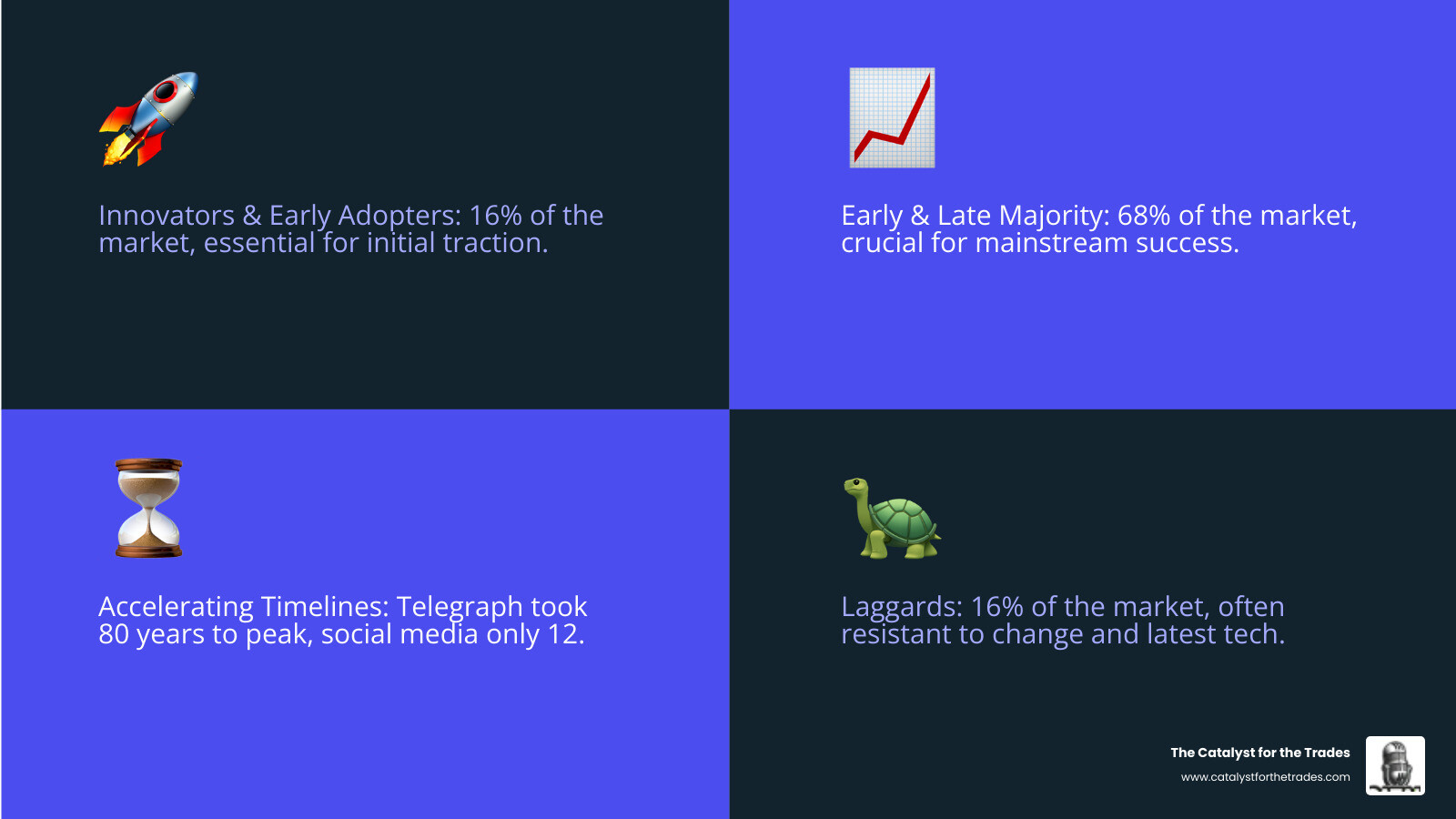
Infographic showing the five adopter categories as a bell curve: Innovators (2.5%) with wrench and laptop icon, Early Adopters (13.5%) with smartphone icon, Early Majority (34%) with tablet icon, Late Majority (34%) with desktop computer icon, and Laggards (16%) with paper clipboard icon, with timeline showing accelerating adoption rates from telegraph (80 years) to social media (12 years) - technology adoption infographic 4_facts_emoji_blue

Technology adoption terms at a glance:

The Technology Adoption Lifecycle: From Innovators to Laggards

Ever wondered why some folks jump on new tech the moment it drops, while others cling to their flip phones? That's the heart of technology adoption, explained by Everett Rogers' Diffusion of Innovations Theory. This theory is a roadmap for understanding how new ideas spread through any group, from your neighborhood to your entire industry.

Rogers' work shows adoption follows a predictable "S-curve" or "bell curve" pattern. It's driven by how people in a "social system" share information through "communication channels." For your business, this means how your team discusses new software or how customers learn about your latest services.

The Five Adopter Categories

Imagine a bell curve of different contractor personas. Rogers grouped people into five categories based on when they adopt new things. Knowing these groups—whether employees or customers—is key to rolling out new technology.

First up are the Innovators (2.5%). The pioneers who love risk and experimentation. They have the resources to try new things first, like a trades business owner testing AI for call handling before it's mainstream. They are driven by curiosity and the excitement of new possibilities.

Next, we have the Early Adopters (13.5%). Respected community leaders and visionaries. They carefully evaluate new ideas for their benefits before taking calculated risks. They inspire others, like a contractor who successfully uses a new field service app and becomes a trusted voice for its effectiveness.

Then comes the Early Majority (34%). The pragmatic mainstream. They are deliberate, not risk-takers, and need solid proof of benefits before committing. They adopt new ideas after seeing trusted early adopters succeed, making this group crucial for an innovation's widespread success.

Following them is the Late Majority (34%). The skeptics. Conservative and risk-averse, they adopt new technology only after it's widely accepted and proven, often due to peer pressure or necessity. They might switch to digital invoicing only when customers demand it or paper systems fail.

Finally, we have the Laggards (16%). The most traditional and change-resistant. They rely on past experiences and adopt new tech only as a last resort, such as when their old desktop software is no longer supported. They are the last to accept innovation.

Crossing the Chasm: The Critical Leap to Mainstream Success

A critical point for any business owner is the "chasm"—the gap between early adopters and the early majority, identified by Geoffrey Moore. This is where many promising innovations fail because the motivations of these two groups are vastly different.

To "cross the chasm," you must shift your strategy from what attracted early adopters. The pragmatic early majority needs proof of reliability, ease of use, and clear ROI—not just novelty. Building trust and minimizing perceived risk is key. This leap requires smart Strategic Adaptation and a solid Innovation Strategy to bridge these different expectations.

The Individual's Journey: The 5 Steps of Technology Adoption

Individuals also follow a process before accepting new technology. This journey typically involves five steps:

  1. Awareness: First, they hear about the innovation but lack details. This might be seeing an ad for a new AI scheduling tool.
  2. Interest: Curiosity piqued, they start seeking more information, perhaps through online searches or asking colleagues.
  3. Evaluation: They mentally weigh the pros and cons, considering if a new CRM would simplify or complicate their work.
  4. Trial: If evaluation is positive, they test it on a small scale, like a pilot program for new software with one team.
  5. Adoption: After a successful trial, they fully accept the technology, integrating it into their daily operations.

Guiding your team through these steps requires excellent Change Management to address concerns, provide support, and ensure a smooth transition.

The "Why" Behind the Curve: Key Factors Influencing Adoption

Why do some tools catch on while others fail? It comes down to the "perceived attributes of innovation." If a new tool seems valuable and low-risk, people are more likely to try it. The speed at which these positive attributes are shared determines the rate of adoption. Peer influence through social networks is a powerful driver, as explained by concepts like the Bass diffusion model. A trusted recommendation can significantly accelerate adoption.

Relative Advantage & Compatibility

These two big ideas are super powerful in driving technology adoption:

First, there's Relative Advantage. Simply put, is this new tool actually better than what you're using now? We're not just talking about shiny new features. It's about real, tangible benefits. For your home service business, a new routing software isn't just cool; it's a game-changer if it slashes your fuel costs, lets your technicians complete more jobs each day, or makes customers happier with spot-on arrival times. Sometimes, adopting a new tech can even give you "social prestige," making your company stand out as a modern, forward-thinking leader in the trades. We're always on the lookout for ways to boost Process Improvement, and finding a clear relative advantage is often the strongest push to make a change.

Then there's Compatibility. This asks: "Does this new innovation fit right in with how we already do things, our company values, and what our team is used to?" Imagine a new mobile payment system. If it works smoothly with your technicians' current workflow and doesn't demand a complete overhaul of your accounting, it's a much easier yes. It needs to feel like a natural extension, not a forced fit. As we often share, building strong systems is key to gaining freedom in your business. New technology should complement those systems, not complicate them. That's why we emphasize a solid plan, like the one discussed in How Systems Create Freedom: Mike Abramowitz's Blueprint for Trades Success.

Complexity, Trialability & Observability

These three factors are often the secret sauce behind how easy and fast technology adoption happens:

Let's talk about Complexity. How hard is this new tool to figure out and use? If it feels like you need a Ph.D. just to get started with a new diagnostic tool, you're going to hit a wall of resistance. While some powerful technologies might seem complex, developers can make them much simpler to use, and good training and support from your end can make all the difference. The goal is to make it feel less like a puzzle and more like a helpful hand.

Next up is Trialability. Can you give it a spin before you fully commit? Being able to "try before you buy" is huge because it takes away a lot of the risk. Think about running a small pilot program for a new scheduling app with just one team, or trying out a new AI chatbot for a few weeks. This lets your employees experience the benefits without feeling locked in. Here at Catalyst for the Trades, we often say, Want to Innovate Faster? Start Failing Smarter, and trialability is exactly that—a safe way to test new things and learn along the way.

Finally, there's Observability. Can everyone see the good results of this new technology? When the benefits are clear and visible, it's a powerful motivator for others to jump on board. If your technicians using a new tablet-based inspection system are suddenly finishing jobs quicker and getting rave reviews from customers, their colleagues will naturally want those same tools. The positive impact of a well-implemented CRM, for example, becomes obvious when customer service shines and sales numbers climb. That's why we often dive into topics like How to Get Your CRM Right (And Why It Matters More Than You Think)—its success is something you can truly see and measure.

Strategic Technology Adoption in the Trades: From Theory to Action

Understanding technology adoption theory is a playbook for gaining a competitive edge. Applying these principles helps you turn skeptics into super-users and ensure your investments pay off. The goal is modern efficiency, like a contractor confidently using a tablet to streamline their work.

Case Study: The Rise of AI in Home Services

Artificial Intelligence (AI) isn't just a futuristic concept anymore; it's rapidly emerging as a transformative force right here in the home services industry. From automating mundane tasks to providing deeper customer insights, AI tools are quickly moving along the adoption curve. So, what can the Diffusion of Innovations Theory teach us about successfully bringing AI into your business?

Let's look at how AI-powered tools are being adopted in a typical home service business. Take AI for Call Handling, for instance. Initially, you might have seen only the true Innovators or Early Adopters in the industry experimenting with AI chatbots or voice assistants for customer inquiries. They quickly recognized the "relative advantage" – the sheer benefit of handling overflow calls or answering common FAQs 24/7. Now, with more and more success stories emerging and customers expecting faster service, many businesses are moving into the Early Majority phase. Tools like those discussed by Brad Scruggs in How AI is Transforming Call Handling: Brad Scruggs on the Future of Home Service Communication are becoming a must-have.

Then there's AI for Marketing Automation. Early Adopters were quick to spot the "observability" of AI's power to create targeted ads and personalized customer messages. As AI models become less "complex" to set up and more "compatible" with existing marketing platforms, the Early Majority is now confidently using these tools to boost their campaigns and generate more leads. Here at Catalyst, we truly believe that The AI Revolution in Home Services: How to Future-Proof Your Trades Business isn't just talk; it's essential for staying competitive.

And let's not forget AI for Business Intelligence. While this might have seemed more complex at first glance, it offers a huge "relative advantage" by helping businesses make smarter, data-driven decisions. Think about using AI to predict demand, optimize your inventory, or truly understand customer feedback. Innovators and Early Adopters in larger organizations led the way. As these tools become more "trialable" – easier to test out – and the "observability" of their improved efficiency becomes undeniable, they're set to become much more widespread.

Of course, AI isn't without its quirks. One ongoing challenge is what some call its "quality-control problem"—the fact that generative AI can sometimes "make things up" or present "so many possibilities that it is hard to figure out which will be effective." This reminds us that thoughtful evaluation and smart implementation are absolutely key. Plus, it's worth remembering that many people are still more concerned than excited about AI's effects on daily life. This means building trust and clearly showing reliable, tangible benefits are crucial steps in the technology adoption journey.

Strategies for Accelerating Technology Adoption

To make sure your home service business thrives and doesn't get left behind, we've got some powerful strategies for accelerating technology adoption within your team and operations.

First up, create a clear framework for evaluating new tools. Don't just jump on the bandwagon! Develop simple, clear criteria based on the characteristics of innovation we discussed: relative advantage, compatibility, complexity, trialability, and observability. Ask yourself: Does this tool solve a real problem for us? Will it fit smoothly with what we already do? How easy is it to try out? And can we clearly see its impact on our business?

Next, identify the opinion leaders within your company. These are your internal Early Adopters – the tech-savvy technicians or office staff who are respected by their peers and genuinely excited to champion new tools. Empower them to experiment, share their positive experiences, and become your internal advocates. Their enthusiasm will be instrumental in influencing the Early Majority to come on board.

Crucially, provide effective training and ongoing support. This helps to reduce the "complexity" barrier. Don't just show your team how to click buttons; explain why this new technology will make their jobs easier and more rewarding. Offering hands-on training, clear guides, and fostering a culture where questions are always welcome is vital.

It's also essential to communicate the "why" clearly and consistently. Articulate the benefits and show how this new technology aligns perfectly with your company's bigger goals. Focus on the "relative advantage" for each individual employee and for the business as a whole. This proactive and transparent communication is a cornerstone of effective Technology Implementation.

We also recommend you start small and scale smart. Leverage the "trialability" factor by piloting new tools with just a small, enthusiastic group. Gather their feedback, refine your processes, and build some internal success stories before you do a full rollout. This smart approach minimizes risk and builds confidence across the entire team.

Finally, and perhaps most importantly, foster a culture of continuous learning. The world of innovation moves fast, meaning technology adoption isn't a one-and-done event. Encourage your team to stay curious, to accept new tools as opportunities for personal and professional growth. This kind of strong, forward-thinking leadership is absolutely essential, as we explore further in The Future of Leadership: How to Build a Team That Drives Growth.

Frequently Asked Questions about Technology Adoption

What's the difference between 'adoption' and 'diffusion'?

Adoption and diffusion are related but distinct. Understanding the difference helps with strategic implementation.

Adoption is the individual's psychological process of deciding to use an innovation. It's the personal journey from awareness to final acceptance, like a single technician deciding to use a new app.

Diffusion is the macro-level social process of how an innovation spreads through a group or industry over time. It's the collective result of many individual adoption decisions, shaped by communication and social networks. The S-curve of market penetration represents diffusion.

Is the Diffusion of Innovations Theory always accurate?

The Diffusion of Innovations Theory has been around since 1962, and it's incredibly useful for understanding technology adoption. But like any theory, it's not perfect, and it's worth knowing where it might fall short.

One major criticism is what researchers call pro-innovation bias. The theory tends to assume that all innovations are good and should be adopted by everyone. But that's not always true, is it? Sometimes the old way really is better, or the new technology just isn't right for your particular situation. Not adopting something isn't always a failure—sometimes it's the smartest business decision you can make.

There's also an individual blame bias built into the framework. When someone doesn't adopt a new technology, the theory can make it sound like it's their fault—they're "resistant to change" or they're a "laggard." But what if the technology itself is poorly designed? What if there are legitimate barriers like cost, lack of training, or incompatibility with existing systems? The theory sometimes overlooks these systemic issues.

And here's the big one: the theory was developed in a very different era. Today's digital technologies spread at lightning speed compared to the innovations Rogers studied in the 1960s. Social media reached widespread adoption in just over a decade. The telegraph took 80 years. The lines between adopter categories can blur when everyone's connected 24/7, and disruptions don't always follow that smooth S-curve pattern.

Despite these limitations, the core insights about adopter categories and innovation characteristics remain incredibly valuable. Just use the framework as a guide, not gospel. Apply it thoughtfully to your specific situation, and you'll find it's still one of the best tools we have for strategic technology adoption.

How does technology adoption impact the nature of work and customer relationships?

This is where theory meets reality in your everyday business operations. Technology adoption isn't just about buying new tools—it fundamentally changes how work gets done and how you connect with your customers.

Let's start with job roles. When you adopt automation tools or AI-powered systems, repetitive tasks start disappearing. Your CSRs might spend less time manually entering appointment data and more time actually solving customer problems. Your technicians might use diagnostic apps instead of relying solely on years of experience and trial-and-error. This doesn't mean people become less important—quite the opposite. It means their roles evolve toward higher-value activities that require human judgment, creativity, and relationship skills.

But here's the challenge: this shift creates new skill requirements across your entire team. Digital literacy isn't optional anymore. Your experienced field technicians need to be comfortable with tablets and apps. Your office staff needs to understand data and analytics. Your managers need to guide teams through constant change. And this isn't just about the younger generation picking things up naturally—seasoned veterans need support and training to build these new skills too.

Perhaps most importantly, customer expectations are changing fast. Your customers are shopping on Amazon, ordering Uber, and booking hotels on their phones. They expect the same seamless digital experience when they need their furnace fixed. They want online booking, text message updates, real-time tracking of when the technician will arrive, and digital payment options. If your business can't deliver these experiences, they'll find one that can.

As we explore in How to Stay Competitive as AI and Consumer Behavior Reshape Home Services, adapting to these shifts isn't just about staying current—it's about survival. The businesses winning today are those that recognize technology adoption as a way to strengthen both their internal operations and their customer relationships, not replace the human touch that makes home services work.

Conclusion

Wow, what a journey we've been on! We've explored the fascinating world of technology adoption, from the adventurous Innovators eager to try the latest AI tools for call handling, all the way to the steadfast Late Majority who eventually upgrade their trusty old software. Understanding this curve, and where your business and team fit within it, isn't just theory – it's your secret weapon for staying ahead.

The key takeaway? It's not about adopting every new gadget, but about strategic implementation. Remember those five powerful characteristics we talked about – relative advantage, compatibility, complexity, trialability, and observability? These are your compass for navigating the tech landscape. By truly understanding how a new tool offers benefits, fits your existing operations, how easy it is to try, and if its results are clear, you're setting yourself up for success.

When you create an environment that welcomes smart change, empowers your internal "Early Adopters" (your opinion leaders!), and provides fantastic support, you're not just adopting technology; you're accelerating your business's growth. Technology adoption isn't just about fancy software; it's about making your team more efficient, delighting your customers with better service, and ultimately, building a stronger, more resilient home service business.

Here at The Catalyst for the Trades, we believe technology is more than just a tool – it's a powerful catalyst for your growth, efficiency, and leadership in the industry. Ready to harness its full potential? We're here to help you make informed decisions and transform your business.

Empower your home service business with strategies for growth, innovation, and leadership.

Why Understanding Technology Adoption Gives Your Home Service Business a Competitive Edge

Technology adoption is the process by which individuals and organizations decide to integrate new tools, systems, or innovations into their operations. Understanding how and why people adopt technology isn't just academic theory—it's a strategic advantage that can mean the difference between leading your market and struggling to keep up.

Here's what you need to know about technology adoption:

  • The S-Curve Pattern: Technology adoption follows a predictable S-shaped curve, accelerating from early innovators (2.5%) through early adopters (13.5%), reaching the mainstream majority (68%), and finally the laggards (16%)
  • Five Adopter Categories: People fall into distinct groups based on when they adopt—innovators, early adopters, early majority, late majority, and laggards—each with different motivations and risk tolerances
  • The Critical Chasm: Most technologies fail when trying to jump from early adopters to the early majority, a gap that requires different messaging and proof points
  • Key Adoption Factors: Five characteristics determine adoption speed—relative advantage, compatibility with existing systems, complexity, trialability, and observability of results
  • Accelerating Timeline: The telegraph took 80 years to peak adoption, while social media took just 12 years—technology adoption is speeding up, and home service businesses must adapt faster than ever

For home service business owners facing decisions about AI tools, field service software, or digital marketing platforms, understanding where your team and market sit on the adoption curve helps you invest wisely, train effectively, and avoid costly mistakes. Ready to master Strategic Adaptation in your business? Schedule a consultation to build your technology adoption roadmap.

The Diffusion of Innovations Theory by Everett Rogers shows adoption is influenced by social networks and the innovation's traits. Geoffrey Moore later highlighted the 'chasm' where many new technologies fail by not appealing to the mainstream market after early success. For home service businesses, this means a strategic approach is vital; simply copying competitors without considering your team's readiness or customer needs leads to wasted investment.

Consider the timeline: the telegraph took nearly 80 years to peak, while social media took just 12. This acceleration means home service businesses can't afford to be laggards. Winning companies understand not just what technology to adopt, but when and how to introduce it to their teams and customers.

Infographic showing the five adopter categories as a bell curve: Innovators (2.5%) with wrench and laptop icon, Early Adopters (13.5%) with smartphone icon, Early Majority (34%) with tablet icon, Late Majority (34%) with desktop computer icon, and Laggards (16%) with paper clipboard icon, with timeline showing accelerating adoption rates from telegraph (80 years) to social media (12 years) - technology adoption infographic 4_facts_emoji_blue

Technology adoption terms at a glance:

The Technology Adoption Lifecycle: From Innovators to Laggards

Ever wondered why some folks jump on new tech the moment it drops, while others cling to their flip phones? That's the heart of technology adoption, explained by Everett Rogers' Diffusion of Innovations Theory. This theory is a roadmap for understanding how new ideas spread through any group, from your neighborhood to your entire industry.

Rogers' work shows adoption follows a predictable "S-curve" or "bell curve" pattern. It's driven by how people in a "social system" share information through "communication channels." For your business, this means how your team discusses new software or how customers learn about your latest services.

The Five Adopter Categories

Imagine a bell curve of different contractor personas. Rogers grouped people into five categories based on when they adopt new things. Knowing these groups—whether employees or customers—is key to rolling out new technology.

First up are the Innovators (2.5%). The pioneers who love risk and experimentation. They have the resources to try new things first, like a trades business owner testing AI for call handling before it's mainstream. They are driven by curiosity and the excitement of new possibilities.

Next, we have the Early Adopters (13.5%). Respected community leaders and visionaries. They carefully evaluate new ideas for their benefits before taking calculated risks. They inspire others, like a contractor who successfully uses a new field service app and becomes a trusted voice for its effectiveness.

Then comes the Early Majority (34%). The pragmatic mainstream. They are deliberate, not risk-takers, and need solid proof of benefits before committing. They adopt new ideas after seeing trusted early adopters succeed, making this group crucial for an innovation's widespread success.

Following them is the Late Majority (34%). The skeptics. Conservative and risk-averse, they adopt new technology only after it's widely accepted and proven, often due to peer pressure or necessity. They might switch to digital invoicing only when customers demand it or paper systems fail.

Finally, we have the Laggards (16%). The most traditional and change-resistant. They rely on past experiences and adopt new tech only as a last resort, such as when their old desktop software is no longer supported. They are the last to accept innovation.

Crossing the Chasm: The Critical Leap to Mainstream Success

A critical point for any business owner is the "chasm"—the gap between early adopters and the early majority, identified by Geoffrey Moore. This is where many promising innovations fail because the motivations of these two groups are vastly different.

To "cross the chasm," you must shift your strategy from what attracted early adopters. The pragmatic early majority needs proof of reliability, ease of use, and clear ROI—not just novelty. Building trust and minimizing perceived risk is key. This leap requires smart Strategic Adaptation and a solid Innovation Strategy to bridge these different expectations.

The Individual's Journey: The 5 Steps of Technology Adoption

Individuals also follow a process before accepting new technology. This journey typically involves five steps:

  1. Awareness: First, they hear about the innovation but lack details. This might be seeing an ad for a new AI scheduling tool.
  2. Interest: Curiosity piqued, they start seeking more information, perhaps through online searches or asking colleagues.
  3. Evaluation: They mentally weigh the pros and cons, considering if a new CRM would simplify or complicate their work.
  4. Trial: If evaluation is positive, they test it on a small scale, like a pilot program for new software with one team.
  5. Adoption: After a successful trial, they fully accept the technology, integrating it into their daily operations.

Guiding your team through these steps requires excellent Change Management to address concerns, provide support, and ensure a smooth transition.

The "Why" Behind the Curve: Key Factors Influencing Adoption

Why do some tools catch on while others fail? It comes down to the "perceived attributes of innovation." If a new tool seems valuable and low-risk, people are more likely to try it. The speed at which these positive attributes are shared determines the rate of adoption. Peer influence through social networks is a powerful driver, as explained by concepts like the Bass diffusion model. A trusted recommendation can significantly accelerate adoption.

Relative Advantage & Compatibility

These two big ideas are super powerful in driving technology adoption:

First, there's Relative Advantage. Simply put, is this new tool actually better than what you're using now? We're not just talking about shiny new features. It's about real, tangible benefits. For your home service business, a new routing software isn't just cool; it's a game-changer if it slashes your fuel costs, lets your technicians complete more jobs each day, or makes customers happier with spot-on arrival times. Sometimes, adopting a new tech can even give you "social prestige," making your company stand out as a modern, forward-thinking leader in the trades. We're always on the lookout for ways to boost Process Improvement, and finding a clear relative advantage is often the strongest push to make a change.

Then there's Compatibility. This asks: "Does this new innovation fit right in with how we already do things, our company values, and what our team is used to?" Imagine a new mobile payment system. If it works smoothly with your technicians' current workflow and doesn't demand a complete overhaul of your accounting, it's a much easier yes. It needs to feel like a natural extension, not a forced fit. As we often share, building strong systems is key to gaining freedom in your business. New technology should complement those systems, not complicate them. That's why we emphasize a solid plan, like the one discussed in How Systems Create Freedom: Mike Abramowitz's Blueprint for Trades Success.

Complexity, Trialability & Observability

These three factors are often the secret sauce behind how easy and fast technology adoption happens:

Let's talk about Complexity. How hard is this new tool to figure out and use? If it feels like you need a Ph.D. just to get started with a new diagnostic tool, you're going to hit a wall of resistance. While some powerful technologies might seem complex, developers can make them much simpler to use, and good training and support from your end can make all the difference. The goal is to make it feel less like a puzzle and more like a helpful hand.

Next up is Trialability. Can you give it a spin before you fully commit? Being able to "try before you buy" is huge because it takes away a lot of the risk. Think about running a small pilot program for a new scheduling app with just one team, or trying out a new AI chatbot for a few weeks. This lets your employees experience the benefits without feeling locked in. Here at Catalyst for the Trades, we often say, Want to Innovate Faster? Start Failing Smarter, and trialability is exactly that—a safe way to test new things and learn along the way.

Finally, there's Observability. Can everyone see the good results of this new technology? When the benefits are clear and visible, it's a powerful motivator for others to jump on board. If your technicians using a new tablet-based inspection system are suddenly finishing jobs quicker and getting rave reviews from customers, their colleagues will naturally want those same tools. The positive impact of a well-implemented CRM, for example, becomes obvious when customer service shines and sales numbers climb. That's why we often dive into topics like How to Get Your CRM Right (And Why It Matters More Than You Think)—its success is something you can truly see and measure.

Strategic Technology Adoption in the Trades: From Theory to Action

Understanding technology adoption theory is a playbook for gaining a competitive edge. Applying these principles helps you turn skeptics into super-users and ensure your investments pay off. The goal is modern efficiency, like a contractor confidently using a tablet to streamline their work.

Case Study: The Rise of AI in Home Services

Artificial Intelligence (AI) isn't just a futuristic concept anymore; it's rapidly emerging as a transformative force right here in the home services industry. From automating mundane tasks to providing deeper customer insights, AI tools are quickly moving along the adoption curve. So, what can the Diffusion of Innovations Theory teach us about successfully bringing AI into your business?

Let's look at how AI-powered tools are being adopted in a typical home service business. Take AI for Call Handling, for instance. Initially, you might have seen only the true Innovators or Early Adopters in the industry experimenting with AI chatbots or voice assistants for customer inquiries. They quickly recognized the "relative advantage" – the sheer benefit of handling overflow calls or answering common FAQs 24/7. Now, with more and more success stories emerging and customers expecting faster service, many businesses are moving into the Early Majority phase. Tools like those discussed by Brad Scruggs in How AI is Transforming Call Handling: Brad Scruggs on the Future of Home Service Communication are becoming a must-have.

Then there's AI for Marketing Automation. Early Adopters were quick to spot the "observability" of AI's power to create targeted ads and personalized customer messages. As AI models become less "complex" to set up and more "compatible" with existing marketing platforms, the Early Majority is now confidently using these tools to boost their campaigns and generate more leads. Here at Catalyst, we truly believe that The AI Revolution in Home Services: How to Future-Proof Your Trades Business isn't just talk; it's essential for staying competitive.

And let's not forget AI for Business Intelligence. While this might have seemed more complex at first glance, it offers a huge "relative advantage" by helping businesses make smarter, data-driven decisions. Think about using AI to predict demand, optimize your inventory, or truly understand customer feedback. Innovators and Early Adopters in larger organizations led the way. As these tools become more "trialable" – easier to test out – and the "observability" of their improved efficiency becomes undeniable, they're set to become much more widespread.

Of course, AI isn't without its quirks. One ongoing challenge is what some call its "quality-control problem"—the fact that generative AI can sometimes "make things up" or present "so many possibilities that it is hard to figure out which will be effective." This reminds us that thoughtful evaluation and smart implementation are absolutely key. Plus, it's worth remembering that many people are still more concerned than excited about AI's effects on daily life. This means building trust and clearly showing reliable, tangible benefits are crucial steps in the technology adoption journey.

Strategies for Accelerating Technology Adoption

To make sure your home service business thrives and doesn't get left behind, we've got some powerful strategies for accelerating technology adoption within your team and operations.

First up, create a clear framework for evaluating new tools. Don't just jump on the bandwagon! Develop simple, clear criteria based on the characteristics of innovation we discussed: relative advantage, compatibility, complexity, trialability, and observability. Ask yourself: Does this tool solve a real problem for us? Will it fit smoothly with what we already do? How easy is it to try out? And can we clearly see its impact on our business?

Next, identify the opinion leaders within your company. These are your internal Early Adopters – the tech-savvy technicians or office staff who are respected by their peers and genuinely excited to champion new tools. Empower them to experiment, share their positive experiences, and become your internal advocates. Their enthusiasm will be instrumental in influencing the Early Majority to come on board.

Crucially, provide effective training and ongoing support. This helps to reduce the "complexity" barrier. Don't just show your team how to click buttons; explain why this new technology will make their jobs easier and more rewarding. Offering hands-on training, clear guides, and fostering a culture where questions are always welcome is vital.

It's also essential to communicate the "why" clearly and consistently. Articulate the benefits and show how this new technology aligns perfectly with your company's bigger goals. Focus on the "relative advantage" for each individual employee and for the business as a whole. This proactive and transparent communication is a cornerstone of effective Technology Implementation.

We also recommend you start small and scale smart. Leverage the "trialability" factor by piloting new tools with just a small, enthusiastic group. Gather their feedback, refine your processes, and build some internal success stories before you do a full rollout. This smart approach minimizes risk and builds confidence across the entire team.

Finally, and perhaps most importantly, foster a culture of continuous learning. The world of innovation moves fast, meaning technology adoption isn't a one-and-done event. Encourage your team to stay curious, to accept new tools as opportunities for personal and professional growth. This kind of strong, forward-thinking leadership is absolutely essential, as we explore further in The Future of Leadership: How to Build a Team That Drives Growth.

Frequently Asked Questions about Technology Adoption

What's the difference between 'adoption' and 'diffusion'?

Adoption and diffusion are related but distinct. Understanding the difference helps with strategic implementation.

Adoption is the individual's psychological process of deciding to use an innovation. It's the personal journey from awareness to final acceptance, like a single technician deciding to use a new app.

Diffusion is the macro-level social process of how an innovation spreads through a group or industry over time. It's the collective result of many individual adoption decisions, shaped by communication and social networks. The S-curve of market penetration represents diffusion.

Is the Diffusion of Innovations Theory always accurate?

The Diffusion of Innovations Theory has been around since 1962, and it's incredibly useful for understanding technology adoption. But like any theory, it's not perfect, and it's worth knowing where it might fall short.

One major criticism is what researchers call pro-innovation bias. The theory tends to assume that all innovations are good and should be adopted by everyone. But that's not always true, is it? Sometimes the old way really is better, or the new technology just isn't right for your particular situation. Not adopting something isn't always a failure—sometimes it's the smartest business decision you can make.

There's also an individual blame bias built into the framework. When someone doesn't adopt a new technology, the theory can make it sound like it's their fault—they're "resistant to change" or they're a "laggard." But what if the technology itself is poorly designed? What if there are legitimate barriers like cost, lack of training, or incompatibility with existing systems? The theory sometimes overlooks these systemic issues.

And here's the big one: the theory was developed in a very different era. Today's digital technologies spread at lightning speed compared to the innovations Rogers studied in the 1960s. Social media reached widespread adoption in just over a decade. The telegraph took 80 years. The lines between adopter categories can blur when everyone's connected 24/7, and disruptions don't always follow that smooth S-curve pattern.

Despite these limitations, the core insights about adopter categories and innovation characteristics remain incredibly valuable. Just use the framework as a guide, not gospel. Apply it thoughtfully to your specific situation, and you'll find it's still one of the best tools we have for strategic technology adoption.

How does technology adoption impact the nature of work and customer relationships?

This is where theory meets reality in your everyday business operations. Technology adoption isn't just about buying new tools—it fundamentally changes how work gets done and how you connect with your customers.

Let's start with job roles. When you adopt automation tools or AI-powered systems, repetitive tasks start disappearing. Your CSRs might spend less time manually entering appointment data and more time actually solving customer problems. Your technicians might use diagnostic apps instead of relying solely on years of experience and trial-and-error. This doesn't mean people become less important—quite the opposite. It means their roles evolve toward higher-value activities that require human judgment, creativity, and relationship skills.

But here's the challenge: this shift creates new skill requirements across your entire team. Digital literacy isn't optional anymore. Your experienced field technicians need to be comfortable with tablets and apps. Your office staff needs to understand data and analytics. Your managers need to guide teams through constant change. And this isn't just about the younger generation picking things up naturally—seasoned veterans need support and training to build these new skills too.

Perhaps most importantly, customer expectations are changing fast. Your customers are shopping on Amazon, ordering Uber, and booking hotels on their phones. They expect the same seamless digital experience when they need their furnace fixed. They want online booking, text message updates, real-time tracking of when the technician will arrive, and digital payment options. If your business can't deliver these experiences, they'll find one that can.

As we explore in How to Stay Competitive as AI and Consumer Behavior Reshape Home Services, adapting to these shifts isn't just about staying current—it's about survival. The businesses winning today are those that recognize technology adoption as a way to strengthen both their internal operations and their customer relationships, not replace the human touch that makes home services work.

Conclusion

Wow, what a journey we've been on! We've explored the fascinating world of technology adoption, from the adventurous Innovators eager to try the latest AI tools for call handling, all the way to the steadfast Late Majority who eventually upgrade their trusty old software. Understanding this curve, and where your business and team fit within it, isn't just theory – it's your secret weapon for staying ahead.

The key takeaway? It's not about adopting every new gadget, but about strategic implementation. Remember those five powerful characteristics we talked about – relative advantage, compatibility, complexity, trialability, and observability? These are your compass for navigating the tech landscape. By truly understanding how a new tool offers benefits, fits your existing operations, how easy it is to try, and if its results are clear, you're setting yourself up for success.

When you create an environment that welcomes smart change, empowers your internal "Early Adopters" (your opinion leaders!), and provides fantastic support, you're not just adopting technology; you're accelerating your business's growth. Technology adoption isn't just about fancy software; it's about making your team more efficient, delighting your customers with better service, and ultimately, building a stronger, more resilient home service business.

Here at The Catalyst for the Trades, we believe technology is more than just a tool – it's a powerful catalyst for your growth, efficiency, and leadership in the industry. Ready to harness its full potential? We're here to help you make informed decisions and transform your business.

Empower your home service business with strategies for growth, innovation, and leadership.

Why Understanding Technology Adoption Gives Your Home Service Business a Competitive Edge

Technology adoption is the process by which individuals and organizations decide to integrate new tools, systems, or innovations into their operations. Understanding how and why people adopt technology isn't just academic theory—it's a strategic advantage that can mean the difference between leading your market and struggling to keep up.

Here's what you need to know about technology adoption:

  • The S-Curve Pattern: Technology adoption follows a predictable S-shaped curve, accelerating from early innovators (2.5%) through early adopters (13.5%), reaching the mainstream majority (68%), and finally the laggards (16%)
  • Five Adopter Categories: People fall into distinct groups based on when they adopt—innovators, early adopters, early majority, late majority, and laggards—each with different motivations and risk tolerances
  • The Critical Chasm: Most technologies fail when trying to jump from early adopters to the early majority, a gap that requires different messaging and proof points
  • Key Adoption Factors: Five characteristics determine adoption speed—relative advantage, compatibility with existing systems, complexity, trialability, and observability of results
  • Accelerating Timeline: The telegraph took 80 years to peak adoption, while social media took just 12 years—technology adoption is speeding up, and home service businesses must adapt faster than ever

For home service business owners facing decisions about AI tools, field service software, or digital marketing platforms, understanding where your team and market sit on the adoption curve helps you invest wisely, train effectively, and avoid costly mistakes. Ready to master Strategic Adaptation in your business? Schedule a consultation to build your technology adoption roadmap.

The Diffusion of Innovations Theory by Everett Rogers shows adoption is influenced by social networks and the innovation's traits. Geoffrey Moore later highlighted the 'chasm' where many new technologies fail by not appealing to the mainstream market after early success. For home service businesses, this means a strategic approach is vital; simply copying competitors without considering your team's readiness or customer needs leads to wasted investment.

Consider the timeline: the telegraph took nearly 80 years to peak, while social media took just 12. This acceleration means home service businesses can't afford to be laggards. Winning companies understand not just what technology to adopt, but when and how to introduce it to their teams and customers.

Infographic showing the five adopter categories as a bell curve: Innovators (2.5%) with wrench and laptop icon, Early Adopters (13.5%) with smartphone icon, Early Majority (34%) with tablet icon, Late Majority (34%) with desktop computer icon, and Laggards (16%) with paper clipboard icon, with timeline showing accelerating adoption rates from telegraph (80 years) to social media (12 years) - technology adoption infographic 4_facts_emoji_blue

Technology adoption terms at a glance:

The Technology Adoption Lifecycle: From Innovators to Laggards

Ever wondered why some folks jump on new tech the moment it drops, while others cling to their flip phones? That's the heart of technology adoption, explained by Everett Rogers' Diffusion of Innovations Theory. This theory is a roadmap for understanding how new ideas spread through any group, from your neighborhood to your entire industry.

Rogers' work shows adoption follows a predictable "S-curve" or "bell curve" pattern. It's driven by how people in a "social system" share information through "communication channels." For your business, this means how your team discusses new software or how customers learn about your latest services.

The Five Adopter Categories

Imagine a bell curve of different contractor personas. Rogers grouped people into five categories based on when they adopt new things. Knowing these groups—whether employees or customers—is key to rolling out new technology.

First up are the Innovators (2.5%). The pioneers who love risk and experimentation. They have the resources to try new things first, like a trades business owner testing AI for call handling before it's mainstream. They are driven by curiosity and the excitement of new possibilities.

Next, we have the Early Adopters (13.5%). Respected community leaders and visionaries. They carefully evaluate new ideas for their benefits before taking calculated risks. They inspire others, like a contractor who successfully uses a new field service app and becomes a trusted voice for its effectiveness.

Then comes the Early Majority (34%). The pragmatic mainstream. They are deliberate, not risk-takers, and need solid proof of benefits before committing. They adopt new ideas after seeing trusted early adopters succeed, making this group crucial for an innovation's widespread success.

Following them is the Late Majority (34%). The skeptics. Conservative and risk-averse, they adopt new technology only after it's widely accepted and proven, often due to peer pressure or necessity. They might switch to digital invoicing only when customers demand it or paper systems fail.

Finally, we have the Laggards (16%). The most traditional and change-resistant. They rely on past experiences and adopt new tech only as a last resort, such as when their old desktop software is no longer supported. They are the last to accept innovation.

Crossing the Chasm: The Critical Leap to Mainstream Success

A critical point for any business owner is the "chasm"—the gap between early adopters and the early majority, identified by Geoffrey Moore. This is where many promising innovations fail because the motivations of these two groups are vastly different.

To "cross the chasm," you must shift your strategy from what attracted early adopters. The pragmatic early majority needs proof of reliability, ease of use, and clear ROI—not just novelty. Building trust and minimizing perceived risk is key. This leap requires smart Strategic Adaptation and a solid Innovation Strategy to bridge these different expectations.

The Individual's Journey: The 5 Steps of Technology Adoption

Individuals also follow a process before accepting new technology. This journey typically involves five steps:

  1. Awareness: First, they hear about the innovation but lack details. This might be seeing an ad for a new AI scheduling tool.
  2. Interest: Curiosity piqued, they start seeking more information, perhaps through online searches or asking colleagues.
  3. Evaluation: They mentally weigh the pros and cons, considering if a new CRM would simplify or complicate their work.
  4. Trial: If evaluation is positive, they test it on a small scale, like a pilot program for new software with one team.
  5. Adoption: After a successful trial, they fully accept the technology, integrating it into their daily operations.

Guiding your team through these steps requires excellent Change Management to address concerns, provide support, and ensure a smooth transition.

The "Why" Behind the Curve: Key Factors Influencing Adoption

Why do some tools catch on while others fail? It comes down to the "perceived attributes of innovation." If a new tool seems valuable and low-risk, people are more likely to try it. The speed at which these positive attributes are shared determines the rate of adoption. Peer influence through social networks is a powerful driver, as explained by concepts like the Bass diffusion model. A trusted recommendation can significantly accelerate adoption.

Relative Advantage & Compatibility

These two big ideas are super powerful in driving technology adoption:

First, there's Relative Advantage. Simply put, is this new tool actually better than what you're using now? We're not just talking about shiny new features. It's about real, tangible benefits. For your home service business, a new routing software isn't just cool; it's a game-changer if it slashes your fuel costs, lets your technicians complete more jobs each day, or makes customers happier with spot-on arrival times. Sometimes, adopting a new tech can even give you "social prestige," making your company stand out as a modern, forward-thinking leader in the trades. We're always on the lookout for ways to boost Process Improvement, and finding a clear relative advantage is often the strongest push to make a change.

Then there's Compatibility. This asks: "Does this new innovation fit right in with how we already do things, our company values, and what our team is used to?" Imagine a new mobile payment system. If it works smoothly with your technicians' current workflow and doesn't demand a complete overhaul of your accounting, it's a much easier yes. It needs to feel like a natural extension, not a forced fit. As we often share, building strong systems is key to gaining freedom in your business. New technology should complement those systems, not complicate them. That's why we emphasize a solid plan, like the one discussed in How Systems Create Freedom: Mike Abramowitz's Blueprint for Trades Success.

Complexity, Trialability & Observability

These three factors are often the secret sauce behind how easy and fast technology adoption happens:

Let's talk about Complexity. How hard is this new tool to figure out and use? If it feels like you need a Ph.D. just to get started with a new diagnostic tool, you're going to hit a wall of resistance. While some powerful technologies might seem complex, developers can make them much simpler to use, and good training and support from your end can make all the difference. The goal is to make it feel less like a puzzle and more like a helpful hand.

Next up is Trialability. Can you give it a spin before you fully commit? Being able to "try before you buy" is huge because it takes away a lot of the risk. Think about running a small pilot program for a new scheduling app with just one team, or trying out a new AI chatbot for a few weeks. This lets your employees experience the benefits without feeling locked in. Here at Catalyst for the Trades, we often say, Want to Innovate Faster? Start Failing Smarter, and trialability is exactly that—a safe way to test new things and learn along the way.

Finally, there's Observability. Can everyone see the good results of this new technology? When the benefits are clear and visible, it's a powerful motivator for others to jump on board. If your technicians using a new tablet-based inspection system are suddenly finishing jobs quicker and getting rave reviews from customers, their colleagues will naturally want those same tools. The positive impact of a well-implemented CRM, for example, becomes obvious when customer service shines and sales numbers climb. That's why we often dive into topics like How to Get Your CRM Right (And Why It Matters More Than You Think)—its success is something you can truly see and measure.

Strategic Technology Adoption in the Trades: From Theory to Action

Understanding technology adoption theory is a playbook for gaining a competitive edge. Applying these principles helps you turn skeptics into super-users and ensure your investments pay off. The goal is modern efficiency, like a contractor confidently using a tablet to streamline their work.

Case Study: The Rise of AI in Home Services

Artificial Intelligence (AI) isn't just a futuristic concept anymore; it's rapidly emerging as a transformative force right here in the home services industry. From automating mundane tasks to providing deeper customer insights, AI tools are quickly moving along the adoption curve. So, what can the Diffusion of Innovations Theory teach us about successfully bringing AI into your business?

Let's look at how AI-powered tools are being adopted in a typical home service business. Take AI for Call Handling, for instance. Initially, you might have seen only the true Innovators or Early Adopters in the industry experimenting with AI chatbots or voice assistants for customer inquiries. They quickly recognized the "relative advantage" – the sheer benefit of handling overflow calls or answering common FAQs 24/7. Now, with more and more success stories emerging and customers expecting faster service, many businesses are moving into the Early Majority phase. Tools like those discussed by Brad Scruggs in How AI is Transforming Call Handling: Brad Scruggs on the Future of Home Service Communication are becoming a must-have.

Then there's AI for Marketing Automation. Early Adopters were quick to spot the "observability" of AI's power to create targeted ads and personalized customer messages. As AI models become less "complex" to set up and more "compatible" with existing marketing platforms, the Early Majority is now confidently using these tools to boost their campaigns and generate more leads. Here at Catalyst, we truly believe that The AI Revolution in Home Services: How to Future-Proof Your Trades Business isn't just talk; it's essential for staying competitive.

And let's not forget AI for Business Intelligence. While this might have seemed more complex at first glance, it offers a huge "relative advantage" by helping businesses make smarter, data-driven decisions. Think about using AI to predict demand, optimize your inventory, or truly understand customer feedback. Innovators and Early Adopters in larger organizations led the way. As these tools become more "trialable" – easier to test out – and the "observability" of their improved efficiency becomes undeniable, they're set to become much more widespread.

Of course, AI isn't without its quirks. One ongoing challenge is what some call its "quality-control problem"—the fact that generative AI can sometimes "make things up" or present "so many possibilities that it is hard to figure out which will be effective." This reminds us that thoughtful evaluation and smart implementation are absolutely key. Plus, it's worth remembering that many people are still more concerned than excited about AI's effects on daily life. This means building trust and clearly showing reliable, tangible benefits are crucial steps in the technology adoption journey.

Strategies for Accelerating Technology Adoption

To make sure your home service business thrives and doesn't get left behind, we've got some powerful strategies for accelerating technology adoption within your team and operations.

First up, create a clear framework for evaluating new tools. Don't just jump on the bandwagon! Develop simple, clear criteria based on the characteristics of innovation we discussed: relative advantage, compatibility, complexity, trialability, and observability. Ask yourself: Does this tool solve a real problem for us? Will it fit smoothly with what we already do? How easy is it to try out? And can we clearly see its impact on our business?

Next, identify the opinion leaders within your company. These are your internal Early Adopters – the tech-savvy technicians or office staff who are respected by their peers and genuinely excited to champion new tools. Empower them to experiment, share their positive experiences, and become your internal advocates. Their enthusiasm will be instrumental in influencing the Early Majority to come on board.

Crucially, provide effective training and ongoing support. This helps to reduce the "complexity" barrier. Don't just show your team how to click buttons; explain why this new technology will make their jobs easier and more rewarding. Offering hands-on training, clear guides, and fostering a culture where questions are always welcome is vital.

It's also essential to communicate the "why" clearly and consistently. Articulate the benefits and show how this new technology aligns perfectly with your company's bigger goals. Focus on the "relative advantage" for each individual employee and for the business as a whole. This proactive and transparent communication is a cornerstone of effective Technology Implementation.

We also recommend you start small and scale smart. Leverage the "trialability" factor by piloting new tools with just a small, enthusiastic group. Gather their feedback, refine your processes, and build some internal success stories before you do a full rollout. This smart approach minimizes risk and builds confidence across the entire team.

Finally, and perhaps most importantly, foster a culture of continuous learning. The world of innovation moves fast, meaning technology adoption isn't a one-and-done event. Encourage your team to stay curious, to accept new tools as opportunities for personal and professional growth. This kind of strong, forward-thinking leadership is absolutely essential, as we explore further in The Future of Leadership: How to Build a Team That Drives Growth.

Frequently Asked Questions about Technology Adoption

What's the difference between 'adoption' and 'diffusion'?

Adoption and diffusion are related but distinct. Understanding the difference helps with strategic implementation.

Adoption is the individual's psychological process of deciding to use an innovation. It's the personal journey from awareness to final acceptance, like a single technician deciding to use a new app.

Diffusion is the macro-level social process of how an innovation spreads through a group or industry over time. It's the collective result of many individual adoption decisions, shaped by communication and social networks. The S-curve of market penetration represents diffusion.

Is the Diffusion of Innovations Theory always accurate?

The Diffusion of Innovations Theory has been around since 1962, and it's incredibly useful for understanding technology adoption. But like any theory, it's not perfect, and it's worth knowing where it might fall short.

One major criticism is what researchers call pro-innovation bias. The theory tends to assume that all innovations are good and should be adopted by everyone. But that's not always true, is it? Sometimes the old way really is better, or the new technology just isn't right for your particular situation. Not adopting something isn't always a failure—sometimes it's the smartest business decision you can make.

There's also an individual blame bias built into the framework. When someone doesn't adopt a new technology, the theory can make it sound like it's their fault—they're "resistant to change" or they're a "laggard." But what if the technology itself is poorly designed? What if there are legitimate barriers like cost, lack of training, or incompatibility with existing systems? The theory sometimes overlooks these systemic issues.

And here's the big one: the theory was developed in a very different era. Today's digital technologies spread at lightning speed compared to the innovations Rogers studied in the 1960s. Social media reached widespread adoption in just over a decade. The telegraph took 80 years. The lines between adopter categories can blur when everyone's connected 24/7, and disruptions don't always follow that smooth S-curve pattern.

Despite these limitations, the core insights about adopter categories and innovation characteristics remain incredibly valuable. Just use the framework as a guide, not gospel. Apply it thoughtfully to your specific situation, and you'll find it's still one of the best tools we have for strategic technology adoption.

How does technology adoption impact the nature of work and customer relationships?

This is where theory meets reality in your everyday business operations. Technology adoption isn't just about buying new tools—it fundamentally changes how work gets done and how you connect with your customers.

Let's start with job roles. When you adopt automation tools or AI-powered systems, repetitive tasks start disappearing. Your CSRs might spend less time manually entering appointment data and more time actually solving customer problems. Your technicians might use diagnostic apps instead of relying solely on years of experience and trial-and-error. This doesn't mean people become less important—quite the opposite. It means their roles evolve toward higher-value activities that require human judgment, creativity, and relationship skills.

But here's the challenge: this shift creates new skill requirements across your entire team. Digital literacy isn't optional anymore. Your experienced field technicians need to be comfortable with tablets and apps. Your office staff needs to understand data and analytics. Your managers need to guide teams through constant change. And this isn't just about the younger generation picking things up naturally—seasoned veterans need support and training to build these new skills too.

Perhaps most importantly, customer expectations are changing fast. Your customers are shopping on Amazon, ordering Uber, and booking hotels on their phones. They expect the same seamless digital experience when they need their furnace fixed. They want online booking, text message updates, real-time tracking of when the technician will arrive, and digital payment options. If your business can't deliver these experiences, they'll find one that can.

As we explore in How to Stay Competitive as AI and Consumer Behavior Reshape Home Services, adapting to these shifts isn't just about staying current—it's about survival. The businesses winning today are those that recognize technology adoption as a way to strengthen both their internal operations and their customer relationships, not replace the human touch that makes home services work.

Conclusion

Wow, what a journey we've been on! We've explored the fascinating world of technology adoption, from the adventurous Innovators eager to try the latest AI tools for call handling, all the way to the steadfast Late Majority who eventually upgrade their trusty old software. Understanding this curve, and where your business and team fit within it, isn't just theory – it's your secret weapon for staying ahead.

The key takeaway? It's not about adopting every new gadget, but about strategic implementation. Remember those five powerful characteristics we talked about – relative advantage, compatibility, complexity, trialability, and observability? These are your compass for navigating the tech landscape. By truly understanding how a new tool offers benefits, fits your existing operations, how easy it is to try, and if its results are clear, you're setting yourself up for success.

When you create an environment that welcomes smart change, empowers your internal "Early Adopters" (your opinion leaders!), and provides fantastic support, you're not just adopting technology; you're accelerating your business's growth. Technology adoption isn't just about fancy software; it's about making your team more efficient, delighting your customers with better service, and ultimately, building a stronger, more resilient home service business.

Here at The Catalyst for the Trades, we believe technology is more than just a tool – it's a powerful catalyst for your growth, efficiency, and leadership in the industry. Ready to harness its full potential? We're here to help you make informed decisions and transform your business.

Empower your home service business with strategies for growth, innovation, and leadership.

Episodes you may like

The Efficiency Edge: Reducing Costs and Boosting Output

Learn to boost output & reduce costs. Master operational efficiency with strategies, tools, and metrics for your trade business.

Read more
Published
December 30, 2025
The Skill Set Upgrade: Boosting Your Team's Potential

Boost your team's potential! Learn how skill development drives growth, retention, and competitive advantage for your home service business.

Read more
Published
December 29, 2025
Stay Ahead of the Curve: A Guide to Future-Proofing Your Business

Master future-proofing business! Build resilience, leverage tech & AI, empower teams, and grow sustainably. Stay ahead of market changes.

Read more
Published
December 25, 2025

Guests

Gregg Schonhorn
SF&P Advisors