Learn · December 16, 2025
Customer Retention Strategies: 10 Unlocked Growth
Unlock growth! Discover 10 proven customer retention strategies for trades businesses & boost your profits.
By The Catalyst Editorial Team Operator education · 10 min read · Updated July 24, 2026

Why Customer Retention is the Smartest Business Move You’ll Make
Customer retention strategies are the tactics you use to keep your existing customers coming back instead of losing them to competitors. For trades businesses like HVAC, plumbing, and electrical companies, this means turning one-time service calls into long-term relationships that drive predictable revenue.
Quick answer: The most effective customer retention strategies include:
- Deliver exceptional customer experiences – Make every interaction memorable
- Use your CRM for personalized communication – Track preferences and service history
- Create loyalty programs – Reward repeat business with maintenance plans or discounts
- Act on customer feedback – Survey customers and close the loop on complaints
- Empower your CSRs – Train front-line staff to build relationships
- Automate follow-ups – Use AI tools for reminders and check-ins
- Perfect your onboarding – Set clear expectations from day one
- Build community – Engage customers on social media and in person
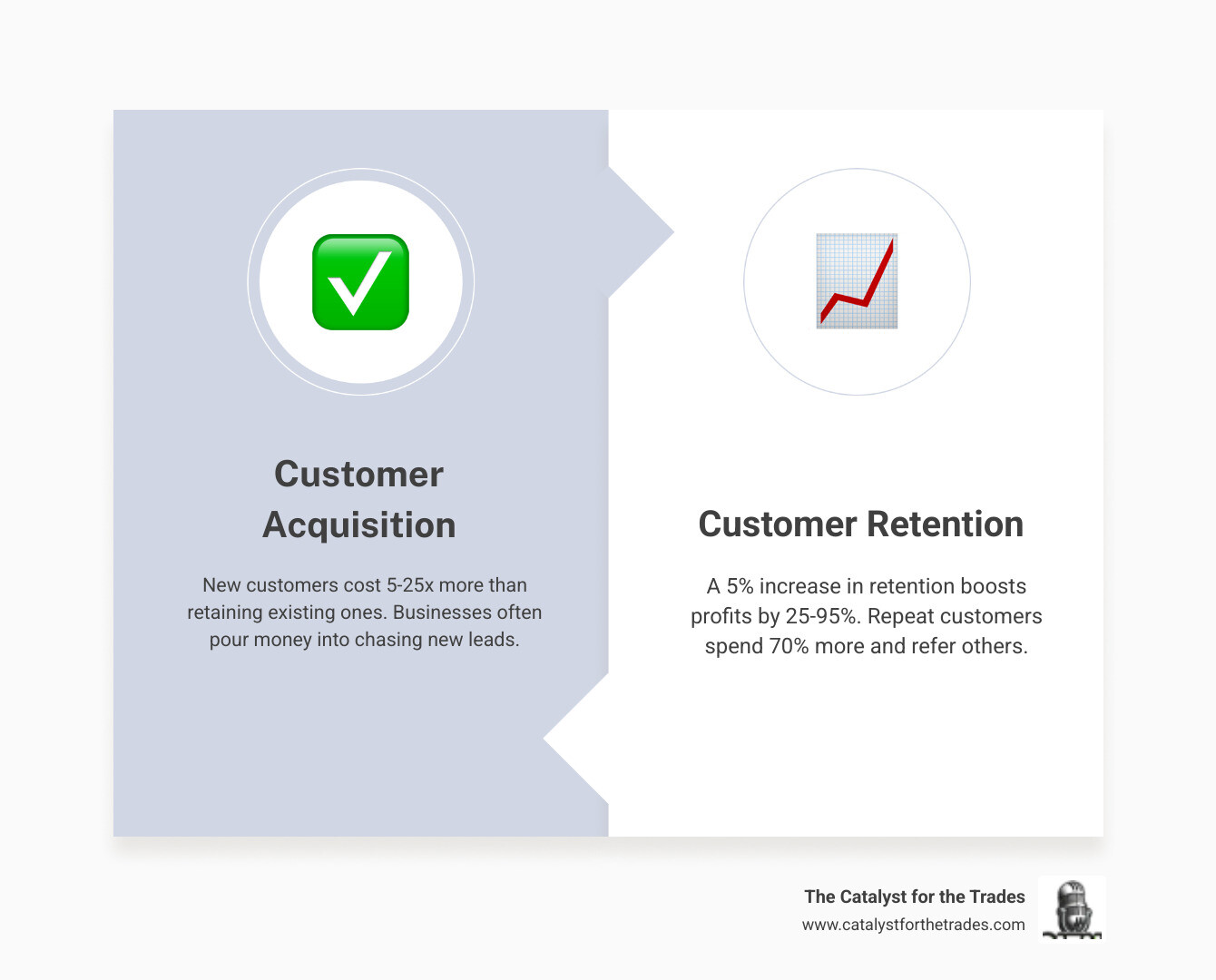
Here’s the reality: acquiring a new customer costs five to 25 times more than keeping an existing one. Yet most trades businesses pour money into chasing new leads while their past customers quietly slip away. Research shows that just a 5% increase in customer retention can boost profits by 25% to 95%. Those repeat customers also spend up to 70% more than new ones, and they’re far more likely to refer friends and family.
For trades business owners juggling tight margins and fierce competition, retention isn’t just nice to have – it’s your most reliable path to sustainable growth. Stop chasing new leads and start closing the ones you already have, then discover how to turn those customers into loyal advocates.
The strategies that follow aren’t theory – they’re proven tactics used by successful trades businesses to build customer loyalty that lasts. Whether you’re a solo operator or managing a growing team, these approaches will help you keep more of the customers you work so hard to earn.
Customer retention strategies basics:
- ai customer service
- ai customer service automation
- customer experience optimization
The High Cost of Churn: Why Retention is Your Growth Engine
Let’s be honest—landing a new customer feels amazing. There’s that rush of satisfaction when someone finally says yes, schedules the service, and becomes part of your customer base. But here’s the uncomfortable truth most trades business owners don’t want to face: if you’re not actively working to keep those customers, they’re quietly walking out the back door while you’re busy greeting new ones at the front.
This silent exodus is called customer churn, and it’s bleeding your business dry.
Think about how much you spend to acquire each new customer. Between advertising costs, lead generation, follow-up calls, and the time your team invests in converting prospects, the numbers add up fast. Now here’s the kicker: customer acquisition costs are typically four to five times higher than what it takes to keep an existing customer happy. Some research puts that figure as high as 25 times more expensive. That’s not a typo.
The math gets even more compelling when you look at what repeat customers actually mean for your bottom line. Studies show that loyal customers spend up to 70% more than new ones. Here’s a stat that should make you sit up straight: out of every 100 customers, only about 8 are repeat buyers. But those 8% generate a whopping 41% of total revenue, while the other 92% split the remaining 59%.
Let that sink in for a moment. Your smallest customer segment is driving nearly half your income.
The financial impact of ignoring retention is staggering. Customer churn drains American businesses of an estimated $168 billion every year. But here’s where it gets interesting—companies could save over $35 billion annually just by focusing on keeping existing customers satisfied. And we’re not just talking about saving money. Research from Bain & Company found that increasing your customer retention rate by a mere 5% can boost profitability by anywhere from 25% to 95%. For a trades business operating on tight margins, those numbers represent the difference between scraping by and thriving.
Beyond the dollars and cents, retained customers become something even more valuable: brand advocates. These are the folks who tell their neighbors about your reliable service, who recommend you in community Facebook groups, and who call you first when their friends need help. This word-of-mouth marketing doesn’t cost you a dime, yet it brings in high-quality leads that already trust you before you even pick up the phone. Stop chasing new leads and start nurturing the goldmine you’re sitting on.
For trades businesses, where trust and reliability aren’t just nice-to-haves but the foundation of everything we do, retention creates something invaluable: predictable revenue. When you know Mrs. Johnson will call you for her annual HVAC maintenance and Mr. Garcia trusts you for all his plumbing needs, you can forecast income more accurately. You can plan for growth. You can weather economic uncertainty without panic.
Sustainable growth doesn’t come from constantly filling a leaky bucket with new customers. It comes from plugging the holes and building a solid base of loyal clients who keep coming back—and bringing their friends along for the ride.
The best part? Implementing effective customer retention strategies is often simpler and more affordable than your next big marketing campaign. It just requires a shift in focus from always hunting for the next customer to truly valuing the ones you’ve already earned.
10 Proven Customer Retention Strategies for Trades Businesses
1. Deliver an Unforgettable Customer Experience
Here’s something we’ve learned after working with countless trades businesses: your customers aren’t just buying a repair or installation. They’re buying an experience. And that experience starts the moment they pick up the phone to call you and continues long after your technician drives away.
The numbers back this up. Research shows that 80% of customers say the experience a company provides is just as important as its products or services. In the trades, where you’re literally being invited into someone’s home during what’s often a stressful situation, this matters even more.
Customer journey mapping helps us understand every touchpoint where we interact with clients. That first phone call? Critical. How our technicians present themselves at the door? Essential. The way we explain the work and clean up afterward? All part of the experience. Think about it—when a homeowner calls about a broken furnace in January, they’re already anxious. Our job is to ease that anxiety at every step.
What really sets successful trades businesses apart is creating emotional connections with customers. A study by Deloitte found that these emotional bonds drive loyalty far more effectively than discount programs ever could. When customers feel genuinely cared for and respected—not just like another service ticket—they remember it. They tell their neighbors about it. And they call you first next time.
Being truly customer-centric means putting their needs first, even when it’s inconvenient. It means showing up on time, communicating clearly about what needs to be done, and treating their home like it’s your own. Forbes reports that customer-centric businesses see measurable increases in profits, customer loyalty, and customer lifetime value. That’s not just good ethics—it’s good business.
When you deliver an experience that makes customers feel valued and “wowed,” you’re not just completing a job. You’re building relationships based on trust and positive feelings. Those relationships become the foundation of your retention strategy. For more insights on creating these memorable moments, check out WOW Every Call: The Key to Customer Experience Excellence.

2. Leverage Your CRM for Personalized Communication
Let’s be honest—nobody wants to feel like just another number. Your customers certainly don’t. They want to feel known, understood, and valued. That’s where a solid CRM software system becomes your secret weapon for customer retention strategies that actually work.
The expectations are real: 81% of customers expect businesses to deliver personalized experiences. Even more telling, 80% of customers say they’re more likely to do business with a brand that personalizes their interactions. In the trades, this kind of personalization can be the difference between a one-time service call and a customer for life.
Here’s what a good CRM does for you. It tracks every interaction, every service history detail, every preference. Did Mrs. Johnson mention that her dog barks at strangers? Note it, and your tech can call ahead next time. Does Mr. Chen prefer morning appointments because he works nights? That’s in the system. Is the Anderson family’s water heater approaching ten years old? Your CRM can trigger a proactive maintenance reminder.
This isn’t about being intrusive—it’s about being helpful. When you use customer data thoughtfully, your communication becomes genuinely relevant. Instead of generic “schedule your maintenance” emails, you’re sending personalized follow-ups that reference their specific equipment, their home’s unique needs, and their preferred schedule. That’s the sweet spot where marketing stops feeling like marketing and starts feeling like genuine care.
Data implementation is where many trades businesses struggle, but it’s worth getting right. When your team actually uses the CRM to log notes and track interactions, you build a knowledge base that makes every future interaction smoother and more personal. A customer who doesn’t have to repeat their story every time they call? That’s a happy customer.
The payoff is significant. Targeted communication based on solid customer data builds deeper loyalty and trust. It shows customers you’re paying attention, that you remember them, and that you’re thinking about their needs even when they’re not calling you. To learn more about making your CRM work harder for your business, read How to Get Your CRM Right and Why It Matters More Than You Think and listen to CRM Success in the Trades: Celia Church’s Guide to Data Implementation and Next-Level Growth.
3. Implement a Value-Driven Loyalty Program
Want to know something interesting? Research shows that 57% of consumers spend more on brands they’re loyal to. And here’s the kicker—less than 8% say rewards aren’t important to their purchasing decisions. People appreciate being recognized and rewarded for their loyalty. It’s human nature.
For trades businesses, loyalty programs can take many forms beyond simple discounts. The key is offering genuine value that keeps customers connected to your brand. Think about what matters to your customers. Is it priority scheduling during emergencies? Discounted annual maintenance? Exclusive access to new services? All of these can be powerful motivators.
Let’s look at different approaches you might consider:
| Program Type | Description |
|---|---|
| Points-Based | Customers earn points for every service dollar spent, which they can redeem for discounts on future work, free maintenance visits, or upgrades. Simple to understand and track through your CRM. |
| Tiered | Create bronze, silver, and gold levels based on annual spending or years as a customer. Each tier open ups better perks like priority scheduling, extended warranties, or deeper discounts. Encourages customers to spend more to reach the next level. |
| VIP/Membership | Offer annual maintenance plans that include regular service, priority emergency response, and member-only benefits. Provides predictable revenue for you and peace of mind for customers. |
Maintenance plans are particularly effective in the trades. They give customers exclusive perks like skipping the line during peak season, guaranteed response times, and discounted repairs. More importantly, they keep you top-of-mind and bring customers back regularly before small issues become expensive emergencies.
The beauty of incentivizing loyalty this way is that it creates a win-win. Your customers get real value and feel appreciated. You get predictable revenue, regular touchpoints, and customers who are far less likely to call a competitor when something breaks. That’s what we mean by value-driven—everyone benefits.
When you implement customer rewards thoughtfully, you’re not just giving away discounts. You’re building a community of loyal customers who feel genuinely valued and connected to your business. And those customers become your most powerful advocates.


