Learn · March 13, 2026
Business Expansion Strategies for Trades: 5 Proven
Discover business expansion strategies for trades to scale sustainably without cash flow risks. Master low-risk tactics, digital tools & team building now!
By The Catalyst Editorial Team Operator education · 9 min read · Updated July 24, 2026

Why So Many Trades Businesses Stall Before They Scale

Business expansion strategies for trades are the difference between a business that thrives for decades and one that quietly burns out before its fifth anniversary. And that second outcome is more common than most owners want to admit — about half of all trade businesses don’t make it past five years, with unplanned growth, missing systems, and owner burnout leading the way.
Here are the core business expansion strategies for trades businesses to know:
- Market penetration – Sell more to your existing customers in your current area (lowest risk)
- Service diversification – Add complementary services like duct cleaning, gas fitting, or home automation
- Geographic expansion – Enter new suburbs, cities, or states using a focused “beachhead” approach
- Digital marketing and SEO – Get found on page one of local search (92% of customers never scroll past it)
- Systemize and automate – Build SOPs, CRM workflows, and scheduling tools before hiring more staff
- Strategic partnerships – Partner with remodelers, builders, or complementary trade contractors
- Acquisition – Buy an existing local business to fast-track market entry
The hard truth is that growth doesn’t crush trades businesses on its own — unmanaged growth does. When new jobs pour in faster than your systems, cash flow, and team can handle them, what feels like a win can quietly become a crisis. The good news? With the right strategy matched to your current stage, expansion doesn’t have to be a gamble.
This guide breaks down practical, proven approaches so you can grow your trade business without overextending, overspending, or burning yourself out.
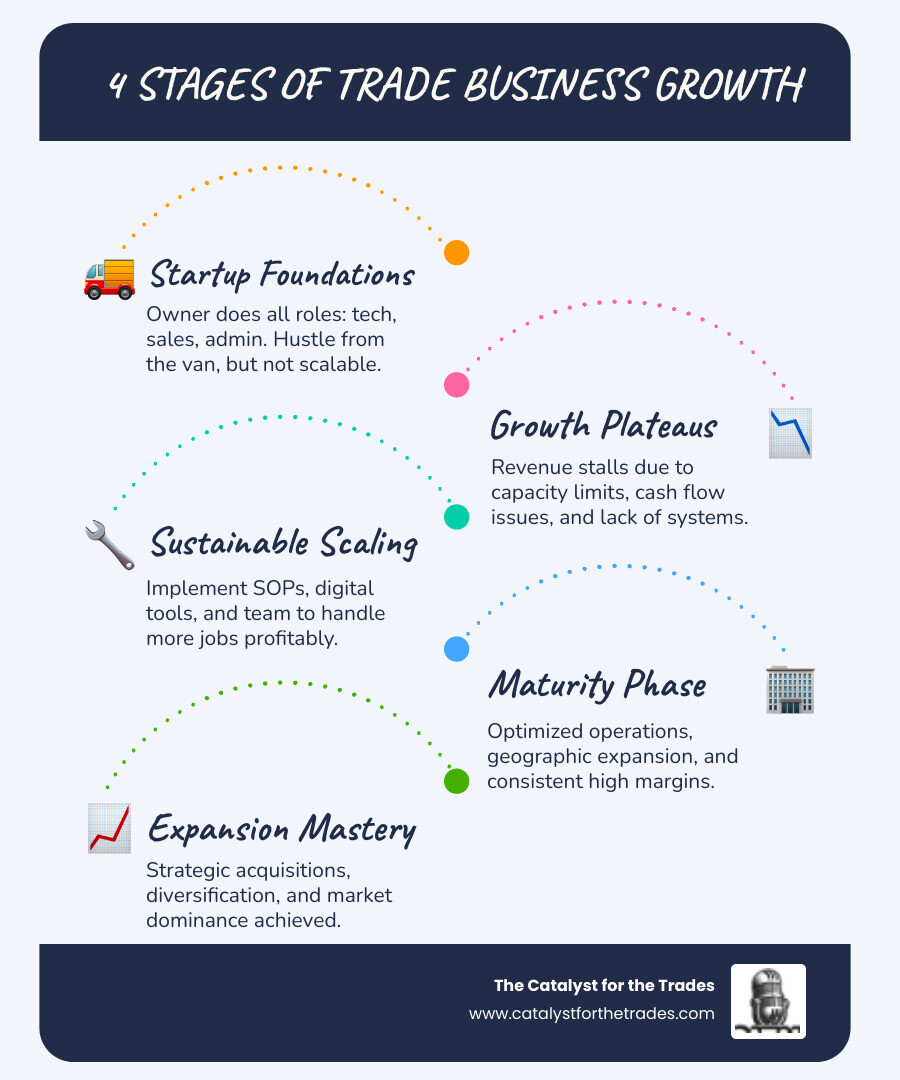
Mapping the Stages of Business Expansion Strategies for Trades
Expanding a trade business isn’t a single event; it’s a journey through distinct stages. Many of us start in the “Startup Foundations” phase, where we are the primary technician, the salesperson, and the bookkeeper. You might find yourself quoting jobs from the front seat of your van between service calls. While this hustle is necessary at first, it isn’t scalable.
As you move into the “Growth and Establishment” stage, the challenges shift. This is often where owners hit a wall. You’re too busy to do all the work yourself, but perhaps you haven’t yet built the systems to manage a team effectively. We often see contractors struggle with how to break through growth plateaus in the trades lessons from vince heusers journey because they try to solve every problem with more manual labor rather than better strategy.
Sustainable scaling happens in the “Expansion and Diversification” phase. This is where you move from “owning a job” to “owning a business.” You begin looking at from zero to 22 million vince heusers blueprint for explosive home service growth to understand how to delegate authority and implement high-level business growth strategies. Finally, the “Maturity” phase allows for a possible exit or a hands-off ownership model where the business runs profitably without your daily intervention.
Overcoming the “Growth Crush” Paradox
It sounds like a joke, but businesses are frequently “crushed” by their own success. This happens when your commitments (payroll, equipment, materials) grow faster than your collected cash. To avoid this, we recommend a “growth diagnosis.” Ask yourself: Do I have the capital to support new equipment? Am I collecting my receivables fast enough?
Standardizing your business growth strategies involves forecasting your requirements before you say “yes” to a massive new contract. If revenue growth requires additional working capital, you need to ensure those resources are available before you pull the trigger on expansion.
Measuring Success and Market Agility
How do you know if your expansion is actually working? Don’t just look at the total revenue. High revenue with zero profit is just “expensive busy work.” Instead, track these key metrics:
- Gross Margins: Is each job actually making money after labor and materials?
- Lead Conversion Rate: Are you winning the right kind of work?
- Quarterly Reviews: Sit down every 90 days to look at the data. If a new service line isn’t profitable, be agile enough to pivot or cut it loose.
Low-Risk Tactics to Dominate Your Local Market
Before you try to take over a new city, make sure you’ve “squeezed every drop” of opportunity out of your current backyard. This is called market penetration, and it’s the lowest-risk expansion strategy available.
Research shows that 80% of growth often comes from maximizing your core business. For example, if you are a plumbing company, are you reaching every homeowner in your primary zip codes? We’ve discussed show me some effective business growth strategies for a small plumbing company that focus on building repeat and referral revenue. Happy customers are your best sales team. By implementing a formal referral program, you can drive home service business growth without relying on high-spend advertising campaigns.
Digital Marketing as a Business Expansion Strategy for Trades
Your “storefront” is the first page of Google. Statistics tell us that 92% of customers pick a company from that first page. If you aren’t there, you basically don’t exist to them. Furthermore, 30% of customers won’t even consider your business if you don’t have a professional website.
Effective business development complete guide tactics include:
- Local SEO: Optimizing your Google Business Profile with photos and keywords.
- Review Management: 91% of consumers are influenced by online reviews. Responding to every review—even the bad ones—shows you care.
- Content Marketing: Nearly half of your potential clients will read three to five pieces of content (like blogs or “how-to” guides) before they call you.
Diversifying Services for Existing Clients
Once you have a foot in the door, why not offer more? This is service diversification. If you’re already at a customer’s house fixing a furnace, offering a duct cleaning service or a “Home Comfort Package” is a natural next step.
When considering new services, use a strategic planning process to pilot the idea. Don’t buy five new vans for a service you haven’t tested. Start with one technician, offer it to your best clients, and see if the demand is repeatable and profitable.
Scaling Your Internal Engine with Digital Tools and SOPs
If you want to scale, you have to stop being the “Chief Everything Officer.” This requires Standard Operating Procedures (SOPs). Think of them as the blueprints for your business. You wouldn’t wire a house without a plan; don’t try to grow a company without documented processes.
Using a contractor business strategy ultimate guide helps you identify which tasks can be automated. Digital tools and workflow automation allow you to maintain quality even when you aren’t on-site. This “scalable internal engine” is what separates a small shop from a regional powerhouse.
Implementing Digital Tools for Business Expansion Strategies for Trades
Digital tools aren’t just “nice to have” anymore—they are essential for survival. We’ve seen how george donaldson scaled a home services company to 100 million by leaning heavily into technology.
Key tools to consider include:
- CRM Integration: Keep track of every customer interaction so nothing falls through the cracks.
- Scheduling Automation: Reduce the “back and forth” phone calls and let AI-powered dispatching handle the routes.
- Digital Invoicing: Get paid faster by sending invoices and accepting payments on the spot.
- Real-Time Analytics: Use dashboards to see performance alerts. If a job is deviating from the plan, you need to know now, not next month.
Scaling leadership is just as important as scaling tools. As George Donaldson discusses in building a 100m business george donaldson on scaling leadership exit strategies in home services, your role must shift from doing the work to developing the people who do the work.
Performance Metrics for Sustainable Expansion
Sustainable business strategy development is rooted in data. You must monitor:
- Working Capital: Do you have enough assets to support your operations?
- Receivables: Are you managing your collection timelines effectively to maintain healthy cash flow?
- Stability: Is your growth built on a foundation of solid earnings and sustainable resources?
Strategic Geographic Expansion and Team Building
When you are ready to move into a new city or state, don’t just “spray and pray.” Use a beachhead strategy. This means picking one specific neighborhood or market segment—like luxury homes or commercial property—and dominating that small area before expanding further.
Entering New Cities and States
Expanding geographically brings a new set of hurdles. You need to research:
- Trade Accessibility and Licensing: Does the new state have licensing reciprocity, or do you need to start from scratch?
- Local Building Codes: Some cities have very specific requirements (like the depth of septic drains) that can trip up an outsider.
- Market Proximity: Can your current supply chain reach the new area, or do you need new local partners?
Interestingly, for those looking at the “big picture,” North America is a massive opportunity. Canada, the US, and Mexico form the largest free trade region in the world. With 15 free trade agreements covering 1.5 billion customers, the potential for high-level expansion is staggering for those with the systems to handle it.
| Strategy | Organic Expansion | Strategic Acquisition |
|---|---|---|
| Risk Level | Lower (Gradual growth) | Higher (Integration risks) |
| Speed | Slower | Faster |
| Resource Allocation | Spread over time | Significant upfront commitment |
| Culture | Easier to maintain | Harder to merge teams |
Building and Retaining a High-Performance Team
You can have the best business expansion strategies for trades, but without a team to execute them, you’re stuck. Recruiting local talent is vital when entering a new market because those workers already know the local codes and customers.
We recommend a mix of experienced technicians and apprentices. This allows you to grow your own talent while maintaining high standards. Use “technician scorecards” to track performance and offer incentives for quality work and customer reviews. Your team is the face of your brand—if they aren’t bought into your culture, your expansion will fail.
Frequently Asked Questions about Business Expansion Strategies for Trades
How do I know if my trade business is ready to expand?
Look for “signals of readiness.” Are you consistently profitable? Is your calendar booked out for weeks or months? Do you have a management layer that can handle the day-to-day without you? If you’re still putting out fires every hour, you aren’t ready to scale yet.
What are the biggest risks of expanding into a new state?
The biggest risks are unfamiliar regulations and a lack of local relationships. You might find that your marketing doesn’t resonate the same way, or that local building codes require specific material requirements. Always hire a local consultant or legal expert to ensure compliance.
Should I focus on market penetration or diversification first?
Always start with market penetration. It is the least risky way to grow. Maximizing your current market allows you to build the resources necessary to fund riskier ventures like service diversification or geographic expansion later on.
Conclusion
At The Catalyst for the Trades, we believe that every contractor has the potential to build a legacy business. Expansion shouldn’t be a source of stress—it should be a structured, exciting process of leveling up. By focusing on operational excellence, implementing the right digital tools, and following a documented plan, you can scale your business to new heights without losing your mind (or your shirt) in the process.
Ready to take the next step in your growth journey? Whether you’re looking to automate your workflows or dominate a new market, we’re here to help you lead with confidence.


