Learn · March 12, 2026
Financial Planning for Trade Businesses: 6 Steps
Master financial planning for trade businesses: Boost cash flow, cut risks, and drive profits with proven strategies for contractors.
By The Catalyst Editorial Team Operator education · 10 min read · Updated July 24, 2026

Why Financial Planning for Trade Businesses Determines Who Thrives and Who Struggles

Financial planning for trade businesses is the process of mapping out your income, expenses, cash flow, and growth goals so your business stays profitable — not just busy.
Here is what effective financial planning covers for trade businesses:
- Know your numbers – Track revenue, job costs, labor, materials, and overhead
- Forecast cash flow – Predict income and expenses monthly, with optimistic, realistic, and pessimistic scenarios
- Set SMART financial goals – Short-term targets (equipment, hiring) and long-term vision (growth, exit)
- Plan for contingencies – Emergency funds, lines of credit, and insurance coverage
- Arrange financing – Grants, loans, and incentive programs suited to trade businesses
- Monitor and adjust – Compare actual results to projections regularly and course-correct early
Most trade business owners are skilled at the work itself. The problem is that being great at plumbing, electrical, or HVAC does not automatically make you great at running the financial side of the business. And that gap is where profit quietly disappears.
You can be booked solid for months and still find yourself short on cash. You can land a big contract and somehow end up worse off than before. That is not bad luck — that is what happens when cash flow is unpredictable, costs are not tracked carefully, and there is no financial roadmap guiding decisions.
The good news is that financial planning is not just for large companies or people with accounting degrees. With the right framework, even a small trade operation can build a plan that brings clarity, reduces stress, and creates a path to real, lasting growth.
This guide walks you through exactly how to do that.
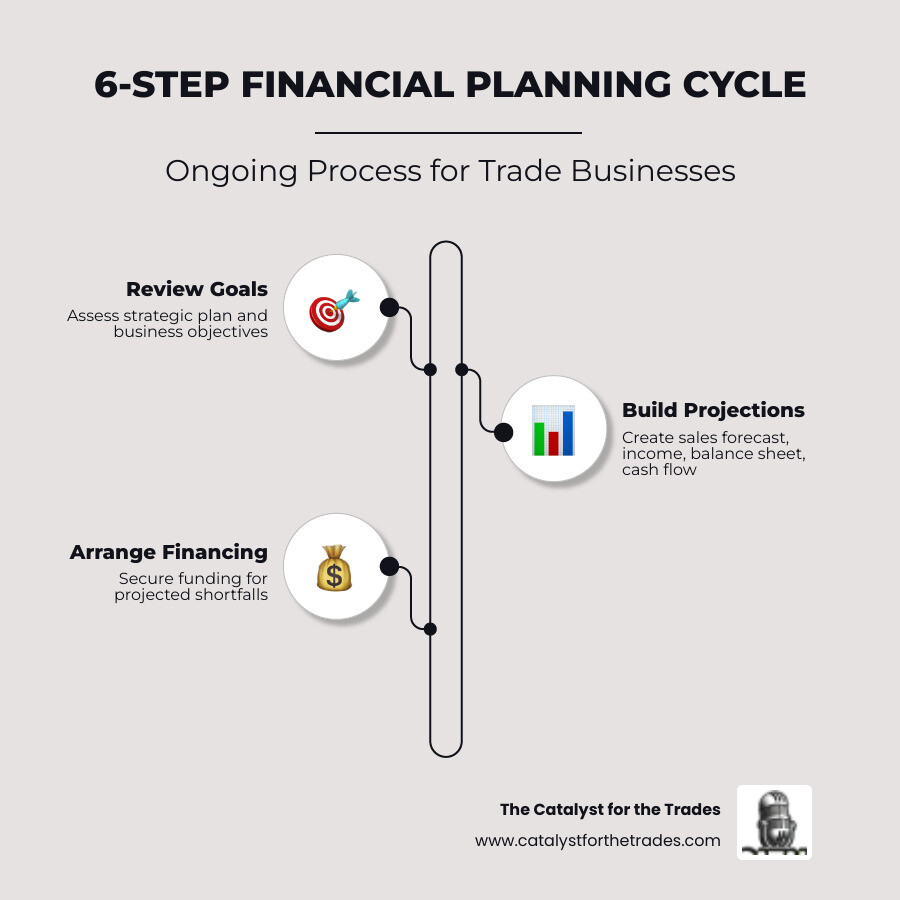
Foundations of Financial Planning for Trade Businesses
To build a skyscraper, you need a solid foundation. The same applies to your business. We often see contractors who are “flying blind,” making major purchases or hiring staff based on gut feeling rather than data. To truly scale, you must Know Your Numbers, Grow Your Business: Financial Strategies For Trades.
A financial plan isn’t just a document you show a banker to get a loan; it is a living strategic alignment tool. It ensures that every dollar you spend—whether on a new service van or a marketing campaign—is moving you toward your long-term goals. If you are just starting or looking to professionalize, Writing a business plan is your first step in defining how you will allocate resources to achieve long-term stability.
Why Financial Planning for Trade Businesses is Essential
Why bother with all this paperwork? Because it provides risk mitigation. In the trades, things go wrong—parts don’t arrive, clients delay payments, or a key piece of equipment fails. A plan ensures these hiccups don’t become catastrophes.
We are all driven by a profit motive. You didn’t start a business to just “break even”; you started it to build wealth. By Developing your business idea into a structured financial model, you gain the peace of mind that comes from knowing exactly where your money is going. Furthermore, your business structure (whether you are a sole proprietor or incorporated) significantly impacts your tax obligations and personal liability, making it a cornerstone of your financial strategy.
Setting SMART Goals for Financial Planning for Trade Businesses
Vague goals like “I want to make more money” rarely lead to success. Instead, use a Business plan template to set SMART goals: Specific, Measurable, Achievable, Relevant, and Time-bound.
- Short-term targets: These might include purchasing a specific piece of diagnostic equipment or hiring your first office manager within the next six months.
- Long-term vision: Where do you want to be in five years? Are you looking at expansion planning into a new city, or perhaps preparing the business for a future exit?
Setting these measurable outcomes allows us to track progress and celebrate the wins along the way.
Mastering Cash Flow and Sales Forecasting
Cash flow is the lifeblood of any trade business. You can have a million dollars in “booked” work, but if you can’t pay your suppliers on Friday, you’re in trouble. This is why Cash flow forecasting is non-negotiable.
We recommend using historical data to look for patterns. For example, if you’re in HVAC, your revenue likely spikes in the heat of summer and the depths of winter. Using a table to compare different scenarios helps you stay prepared for the unexpected.
| Scenario | Description | Action Plan |
|---|---|---|
| Optimistic | Sales exceed targets by 20% | Accelerate equipment upgrades or hiring |
| Realistic | Sales meet historical averages | Maintain standard operations and savings |
| Pessimistic | Sales drop 20% due to market shift | Freeze non-essential spending; use line of credit |
Understanding payment patterns—how long it actually takes for Mrs. Smith or a large commercial client to pay their invoice—is the secret to accurate forecasting.
Predicting Income for Established and New Businesses
If you’ve been in business for a few years, your best tool is your own history. Look at your sales cycles from the last 36 months. Are there “shoulder seasons” where you need to ramp up maintenance contracts to fill the gap?
For new businesses, you’ll need to rely on benchmarking data and Researching your target market to see what the average revenue looks like for your trade in your specific area. Seeking expert advice from an accountant who specializes in the trades can give you a realistic starting point.
Managing Receivables and Invoicing
The fastest way to fix a cash flow problem is to tighten up your invoicing. Prompt billing is essential; if you finish a job on Tuesday but don’t send the bill until Friday, you’ve already lost three days of liquidity.
Implement strict payment terms and don’t be afraid to follow up on late payments. Effective Risk and cash flow management involves constant expenditure control. Before you buy that shiny new truck, ask yourself if the current cash flow supports the monthly payment even during a slow month.
Essential Components of a Trade-Specific Financial Plan
A general financial plan won’t cut it for us. We need a plan built for the reality of the job site. Financial Management For Contractors requires deep-diving into job-specific costs.
Your plan must account for:
- Labor costs: Not just hourly wages, but taxes, benefits, and “unbillable” time spent driving or in training.
- Material overhead: Prices for copper, lumber, and refrigerants fluctuate. Your plan needs a buffer for these variations.
- Indirect expenses: Rent, insurance, and software subscriptions that keep the lights on regardless of how many jobs you run.
- Personnel planning: When will you need to add a new crew? How much will their onboarding cost?
Conducting a Break-Even Analysis
Do you know exactly how much you need to charge to keep the doors open? A break-even analysis determines your necessary markup strategy.
To calculate this, you must separate your fixed costs (rent, insurance) from your variable costs (materials, fuel). Once you know your break-even point, you can optimize your margins to ensure every project is contributing to your bottom line, not just covering its own costs.
Balancing Debt and Investment
Debt isn’t always a bad thing, but it must be managed. Many trade business owners benefit from the fact that business debt often carries tax-deductible interest. However, we must also focus on Smart Money Moves like building a personal safety net.
We often discuss the balance between investing back into the business and utilizing personal vehicles like an RRSP or TFSA. For incorporated owners, corporate-owned life insurance can be a tax-efficient way to protect your family and your business legacy simultaneously.
Strategic Financing and Maximizing Incentives
Sometimes, you need an injection of capital to reach the next level. Whether it’s for a new warehouse or a fleet of vehicles, knowing your options is key.
Understanding the different Types of business ownership is vital here, as your legal structure can dictate which loans or grants you qualify for.
Qualifying for the TD Wealth Financial Planning Award
For those looking to consolidate their wealth, there are often incentives available. For instance, the TD Wealth Financial Planning award offers a $500 incentive for clients who open two or more new eligible account types and transfer $150,000 or more in investable assets.
To qualify, you must work with a financial planner to initiate the transfer and meet specific holding period requirements (usually through February of the following year). This is an excellent way to get a little extra “bonus” while organizing your personal and business assets in one place.
Leveraging Government Grants and Loans
Don’t overlook government support. There are often regional development programs or start-up funding specifically for small businesses in the trades. If you are looking at international trade opportunities, there are specific guides and grants to help you navigate the increased risks and cash flow needs of working across borders. Always check for local green-energy grants, especially if your trade involves heat pumps or high-efficiency electrical systems.
Risk Management and Contingency Planning
In the trades, the question isn’t if something will go wrong, but when. A technician gets sick, a van breaks down, or a supplier goes bust.
One of the biggest risks is “overtrading”—taking on more work than your cash flow can support. To avoid this, review 10 ways to reduce overtrading risk. Having a line of credit or a dedicated emergency fund (typically 3-6 months of operating expenses) ensures that a bad week doesn’t end your business.
Insurance Strategies for Trade Businesses
Insurance is your first line of defense. Beyond standard liability coverage, consider:
- Health Spending Accounts (HSA): A tax-efficient way to provide healthcare for yourself and your team using pre-tax corporate dollars.
- Disability protection: In the trades, your body is your most valuable tool. If you can’t work, the income stops.
- Asset protection: Ensure your equipment and vehicles are covered for replacement value, not just actual cash value.
For more on keeping what you earn, check out our Year-End Tax Tips That Actually Work.
Planning for Seasonal Slowdowns
If your business is seasonal, your financial plan needs to act like a battery—storing energy (cash) during the busy months to power you through the slow ones.
Use slow periods for off-season maintenance on your own equipment or staff training. Business transition planning also happens best when you aren’t buried in service calls. Operational flexibility allows you to scale your costs down when the phone isn’t ringing as often.
Monitoring Growth and Avoiding Common Pitfalls
A plan is only useful if you actually look at it. We recommend comparing your “actuals” against your “projections” every single month. This helps with Business Valuation For Contractors because a business with clean, predictable books is worth significantly more when it comes time to sell.
Modern job management software (like Tradify or Xero) can automate much of this, giving you a real-time financial dashboard of your business health.
Frequency of Financial Reviews
- Monthly: Compare actual revenue and expenses against your budget.
- Six-month updates: Adjust your plan for any major life events or significant market shifts.
- Annual strategic planning: Set the “big picture” goals for the coming year.
Common Financial Mistakes to Avoid
The most common mistake? Mixing personal and business finances. It makes accounting a nightmare and can lead to legal issues. Other pitfalls include over-optimistic forecasting (assuming every quote will close) and a general lack of documentation.
When you ignore your business ratios, you miss the early warning signs of trouble. How Smart Accounting Transforms Chaos Into Opportunity by giving you the data you need to make brave decisions.
Frequently Asked Questions about Trade Business Finances
How do I separate personal and business finances effectively?
Open dedicated business bank accounts and credit cards immediately. Never pay for groceries with the company card. Pay yourself a consistent, scheduled salary or draw. This creates a “paper trail” that makes tax season simple and protects your personal assets.
What is the most important financial statement for a contractor?
While the Income Statement (P&L) tells you if you are profitable over time, the Cash Flow Statement is the most critical for daily survival. It tells you exactly how much “spendable” cash you have right now to cover payroll and materials.
How can I improve my profit margins on large projects?
Start with a thorough break-even analysis to ensure your markup is sufficient. Use job management software to track labor hours in real-time; labor “creep” is the #1 margin killer. Finally, negotiate with suppliers for bulk rates and ensure your change orders are documented and billed promptly.
Conclusion
At The Catalyst for the Trades, we believe that financial empowerment is the key to moving from a “job” to a “business.” By implementing a solid financial planning for trade businesses strategy, you aren’t just counting pennies—you are building a legacy.
Don’t let your hard-earned cash leak out through poor planning. Take control of your financial future today!


