Episode
December 10, 2025

The Crystal Ball: Uncovering Key Industry Trends and Insights

Why Understanding Your Market Landscape Matters for Home Service Businesses

Industry analysis is the process of evaluating the market conditions, competitive forces, and external factors that shape your business. For home service business owners, understanding this landscape is essential for making smart decisions about growth, technology, and staying ahead of competitors.

Quick Answer: How to Conduct Industry Analysis

  1. Define your industry scope - Identify your specific services, geographic market, and industry classification codes (NAICS/SIC).
  2. Gather reliable data - Collect information from government sources, trade associations, and market reports.
  3. Apply analytical frameworks - Use Porter's Five Forces, PEST analysis, and SWOT analysis to evaluate competitive dynamics.
  4. Translate insights into action - Identify opportunities, mitigate threats, and inform your business strategy.

Industry analysis provides the market intelligence to confidently tackle challenges like talent recruitment, service line expansion, or long-term growth planning. It helps you spot emerging trends like AI adoption, understand your competitive position, and identify untapped opportunities.

The research pays off. According to Michael Porter's foundational work, understanding the five forces that shape industry competition—rivalry, new entrants, buyer power, supplier power, and substitutes—explains why some businesses thrive while others struggle. For trades businesses, this means understanding everything from labor market dynamics to how smart home technology might disrupt traditional service models.
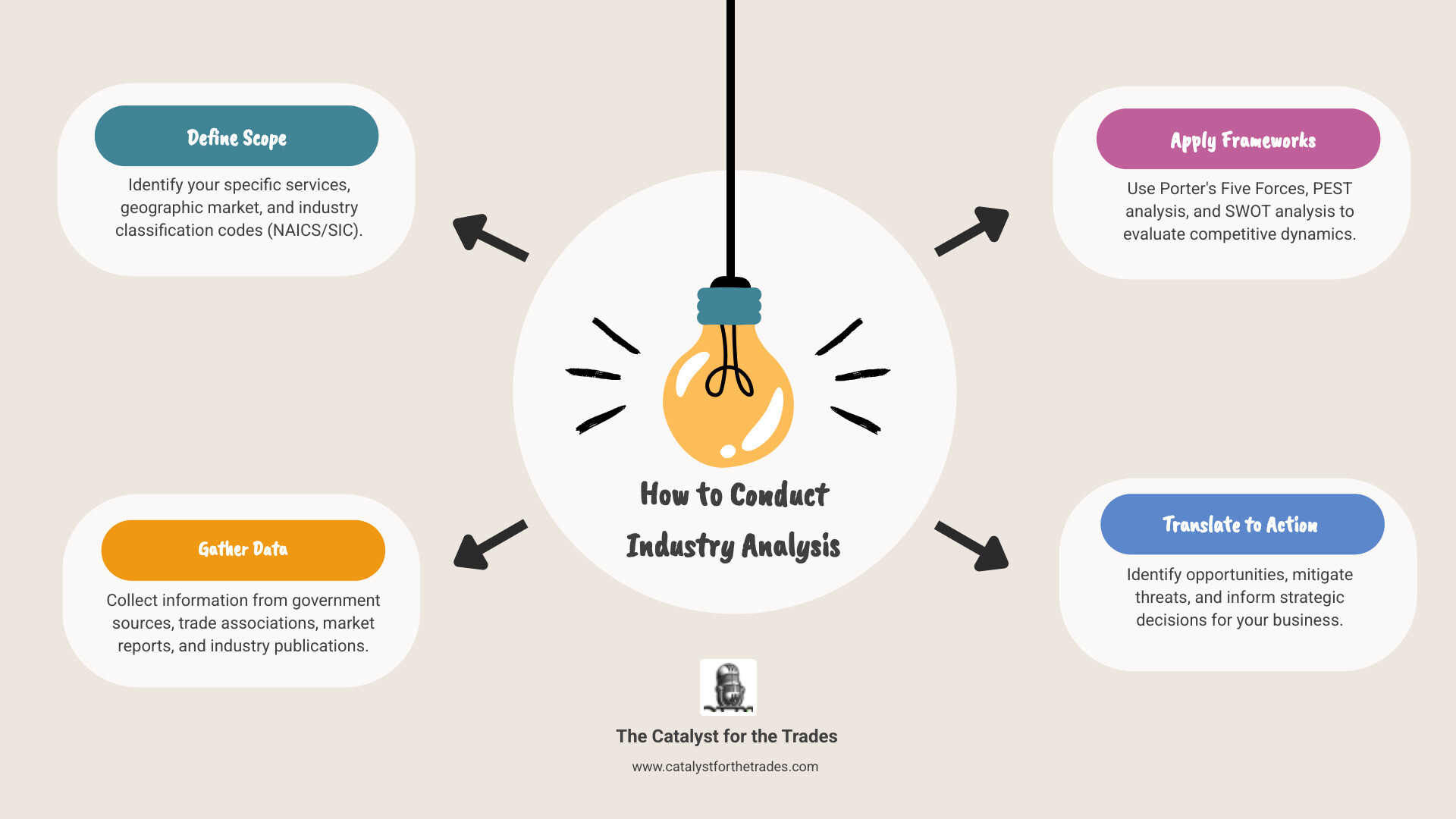
Infographic showing the four essential steps of industry analysis: 1) Define your industry scope with geographic boundaries and service categories, 2) Gather data from government sources, trade associations, and market reports, 3) Apply frameworks like Porter's Five Forces, PEST, and SWOT analysis, 4) Transform insights into strategic decisions for growth and competitive advantage - industry analysis infographic brainstorm-4-items

Quick look at industry analysis:

Step 1: Defining Your Battlefield - The Scope of Your Industry

Effective industry analysis starts with a clear definition of your industry. This crucial first step prevents scattered research and ensures your findings are relevant. Are you a "plumber" or a "residential water management solutions provider"? The distinction shapes how you see your market, competitors, and growth opportunities.
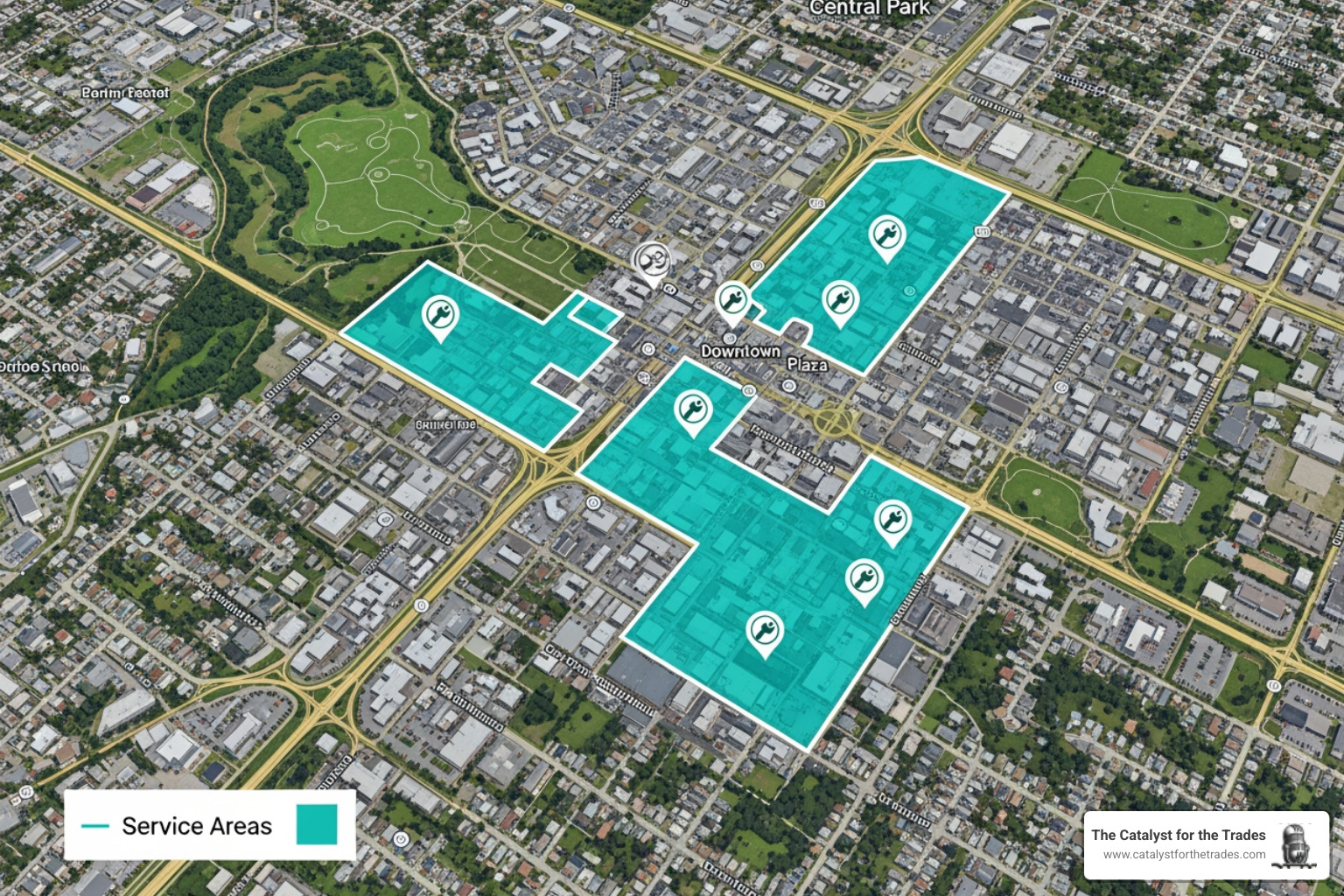
a map with highlighted service areas - industry analysis

Defining your scope means clarifying three things: the services you offer, your geographic service area, and your business's economic classification. This ensures you're comparing your business to the right competitors and using relevant market data.

Geography is especially critical for home services. A growing urban area has a different competitive landscape, customer base, and regulatory environment than a mature suburb. Be specific about your operational boundaries—neighborhood, city, or region.

Industry classification systems like the North American Industry Classification System (NAICS) and Standard Industrial Classification (SIC) codes are invaluable. These codes categorize businesses by their primary activities, open uping access to relevant statistics and reports. You can find your codes on the NAICS Association website and use NAICS & SIC Crosswalks to translate between systems.

How to Define Your Industry

First, pinpoint your main services, such as HVAC installation and repair or drain cleaning and pipe installation.

Next, brainstorm alternative keywords that describe the problem you solve. An HVAC company provides "indoor comfort systems," while a plumber handles "water management." This broader thinking uncovers related market data and opportunities.

Finally, use classification systems to find your official industry codes. Search by keyword at sources like Statistics Canada or Canadian Industry Statistics. These codes are a gateway to government data and economic statistics.

Why a Clear Definition is Crucial

A vague definition leads to vague analysis and poor decisions. A clear scope focuses your research, saving you from irrelevant data. It ensures accurate market understanding by preventing you from mixing disparate markets, like residential and commercial HVAC. This clarity also helps define your target market and what they value.

Most importantly, a sharp definition avoids overly broad analysis that leads to paralysis. Think of this step as the foundation for your entire analysis. A solid definition makes every subsequent step—from data gathering to strategic decision-making—easier and more valuable.

Step 2: Gathering Intelligence - Where to Find Reliable Data

With your industry defined, the next step is to gather reliable data. This information is the raw material for your industry analysis, providing the foundation for spotting opportunities, understanding threats, and making informed decisions.

list of key data sources for industry analysis - industry analysis

Key sources include government websites for free economic and regulatory data, trade associations for sector-specific reports, market research firms for deep-dive analyses, and trade publications for current trends. You can also analyze financial data from public companies in related sectors and gain valuable insights through networking with suppliers and customers.

Leveraging Public and Government Resources

Government bodies offer a wealth of free data on labor markets, economic trends, and industry patterns.

These sources provide the big-picture context for your home service business.

Tapping into Industry-Specific Sources

While government data provides a broad view, industry-specific sources offer details relevant to your trade.

  • Trade associations are goldmines for research and data. Use the ASAE Gateway to Associations Directory to find organizations in your field. They often provide newsletters and host events that are great for networking.
  • Trade publications and journals keep you current on industry news and trends. A tool like Ulrichsweb can help you find relevant periodicals.
  • Market research providers like BCC Research, which offers Global Markets Reports and Industry Analysis, and IBISWorld provide comprehensive reports on market size, growth projections, and competitive landscapes. You can watch the video to see how IBISWorld's reports work.

These reports contain detailed statistics that help you make informed decisions. By combining data from these varied sources, you build a solid foundation for your industry analysis and turn intelligence into a clear path forward.

Step 3: Applying the Lenses - Key Frameworks for Your Industry Analysis

Once you've gathered data, you need frameworks to make sense of it. These models act like different lenses, each providing a unique perspective on your industry. The three key frameworks for industry analysis are Porter's Five Forces, PEST Analysis, and SWOT Analysis.
table comparing Porter's Five Forces, PEST, and SWOT analysis - industry analysis

  • Porter's Five Forces reveals the competitive dynamics and profitability pressures within your industry.
  • PEST Analysis maps the broader external forces—Political, Economic, Social, and Technological—that shape your business environment.
  • SWOT Analysis synthesizes everything into a snapshot of your internal Strengths and Weaknesses alongside external Opportunities and Threats.

Using these models together moves you from simply collecting information to understanding what it means for your home service business.

Porter's Five Forces: Understanding Market Dynamics

Developed by Michael Porter, this framework analyzes five forces to determine an industry's attractiveness.

Porter's Five Forces diagram - industry analysis

  1. Intensity of Industry Rivalry: How fiercely do existing companies compete? In home services, high rivalry (many local competitors) often leads to price wars and lower profit margins.
  2. Threat of Potential Entrants: How easily can new competitors enter your market? Barriers for trades include licensing, equipment costs, and the need to build a reputation. Low barriers mean more potential competition.
  3. Bargaining Power of Buyers: How much leverage do customers have? If homeowners can easily choose between several plumbers, their power is high. If you offer a rare, specialized service, their power is lower.
  4. Bargaining Power of Suppliers: How much control do your suppliers have? This includes parts distributors and the labor market. A shortage of skilled technicians gives them more power to demand higher wages.
  5. Threat of Substitute Goods or Services: What alternatives from outside your industry meet the same customer need? For an HVAC company, a substitute could be improved home insulation that reduces heating and cooling demand.

PEST Analysis: Mapping the Macro-Environment

PEST analysis examines the big-picture forces that are beyond your control but require adaptation.

PEST analysis diagram showing the four factors - industry analysis

  • Political: Government policies, regulations, and tax laws. For trades, this includes building codes and energy efficiency mandates.
  • Economic: Factors like inflation, interest rates, and consumer spending. In a downturn, customers may defer large installations in favor of essential repairs.
  • Social: Demographic shifts, cultural trends, and consumer attitudes. An aging population might increase demand for accessible home modifications, while health consciousness could boost interest in indoor air quality solutions.
  • Technological: Innovations that impact your industry, from smart home devices to AI-driven diagnostic tools. As noted in reports like the 2026 Energy, Resources, and Industrials Outlooks, technology is reshaping industries, and home services must adapt.

SWOT Analysis: A Summary of Your Strategic Position

SWOT analysis synthesizes your findings into a clear, actionable summary.

  • Strengths (Internal): What gives you an advantage? (e.g., highly skilled technicians, strong reputation).
  • Weaknesses (Internal): What are your limitations? (e.g., outdated equipment, high operational costs).
  • Opportunities (External): What factors can you capitalize on? (e.g., growing demand for green tech, new government rebates). These often come from your PEST analysis.
  • Threats (External): What could harm your business? (e.g., new competitors, economic recession). These often come from your Porter's and PEST analyses.

SWOT bridges the gap between analysis and action, turning your industry analysis into a strategic roadmap.

Step 4: From Analysis to Action - Informing Your Business Strategy

The final step is to translate your analysis into actions that drive your business forward. Your industry analysis is a strategic compass, pointing toward opportunities and warning of threats. It helps you make smarter decisions, from forecasting demand and planning for growth to understanding your industry's lifecycle stage—whether it's growing, mature, or in decline.

a person at a whiteboard with strategic plans - industry analysis

While no analysis can predict the future perfectly, a solid one dramatically improves your odds of making the right strategic moves.

How to Use Industry Analysis for Strategic Planning

A thorough industry analysis provides concrete strategic direction.

  • Develop competitive advantages: Understanding the competitive landscape reveals opportunities. If rivals compete on price, you might differentiate with superior customer service or specialized expertise.
  • Explore new service lines: Your analysis can validate expansion. If PEST analysis shows growing interest in energy efficiency, adding energy audits becomes a logical move.
  • Prepare for market shifts: Proactive businesses adapt before they're forced to. If economic indicators soften, you can shift focus to maintenance and repairs over large installations.
  • Inform marketing strategy: Knowing what customers value helps you craft resonant messages. If they prioritize reliability over price, your marketing should highlight your track record and guarantees.
  • Assess investment opportunities: Your analysis provides context for major investments, like new equipment or an acquisition. As noted in resources like this Full Text Transcript Full Text Transcript-Executive Summary-Slides Presentation, this framework helps guide critical investment decisions.

Identifying Key Drivers of Profitability

Your industry analysis helps identify the factors that truly drive sustainable profit.

  • Cost Structure: Understand your major expenses (labor, materials, fuel) to find opportunities for efficiency, like route optimization or bulk purchasing.
  • Customer Value: Know what customers truly care about—speed, expertise, transparency—and deliver on it to command better pricing and build loyalty.
  • Technology Adoption: Accept technology to improve efficiency and service. Predictive maintenance tools or mobile software for technicians can boost customer satisfaction and profitability.
  • Service Differentiation: Create a unique offering, whether through specialization, a superior warranty, or exceptional training. This reduces price sensitivity.
  • Brand Reputation: A strong, trustworthy brand allows you to command premium pricing and attracts loyal customers and referrals.
  • Supplier Relationships: Strong partnerships can lead to better pricing, priority access to materials, and flexible terms, directly impacting your bottom line.

As this Executive Summary Full Text Transcript-Executive Summary-Slides Presentation explains, understanding these drivers is key to shaping a strategy for sustained profitability.

Frequently Asked Questions about Industry Analysis

Diving into industry analysis can bring up many questions. Here are answers to some of the most common ones we hear from home service businesses.

How often should I conduct an industry analysis?

Think of it as a regular health check-up, not a one-time event.

  • Initial Business Plan: A thorough analysis is essential when starting out to prove you understand your market.
  • Annual Review: Revisit your analysis yearly to update data and reassess your strategy.
  • Before Major Strategic Shifts: Conduct a fresh analysis before expanding services, entering new territories, or making a significant investment.
  • When Market Conditions Change Rapidly: Re-evaluate more frequently during times of technological disruption or economic shifts.

What is the biggest challenge in industry analysis?

While valuable, industry analysis has its challenges.

  • Data Collection: Finding accurate, relevant data for a specific niche and region can be time-consuming.
  • Subjectivity and Bias: It's easy to look for data that confirms what you already believe. Actively challenge your assumptions.
  • Translating Data into Action: The biggest hurdle is turning numbers and reports into clear, strategic decisions. Frameworks like PEST and SWOT are essential for this.
  • Keeping the Analysis Current: Markets are dynamic. What was true six months ago may not be today, requiring ongoing effort to stay informed.

Can a small business benefit from industry analysis?

Absolutely. It's arguably more critical for small businesses with limited resources.

  • Identify Niche Opportunities: Analysis helps you find underserved markets or specialized services that larger competitors overlook.
  • Understand Local Dynamics: It focuses you on what's happening in your specific service area, which is more important than national trends.
  • Secure Funding: A well-researched analysis shows lenders and investors you've done your homework and have a viable plan for growth.
  • Make Smarter Decisions: It provides the context to allocate your limited budget and time effectively, helping you decide whether to invest in marketing, equipment, or training based on market realities.

Conclusion

We've journeyed through the key steps of industry analysis, from defining your market to turning insights into actionable strategy. Understanding your industry isn't just about knowing what's happening now; it's about anticipating trends, identifying opportunities, and mitigating threats to secure your future.

The steps—defining your scope, gathering data, applying frameworks like Porter's, PEST, and SWOT, and informing your strategy—are a powerful toolkit for any home service business. This proactive approach is what separates thriving businesses from those that merely survive. It's how you gain a competitive edge by actively shaping your place in the market.

At The Catalyst for the Trades podcast, we empower home service businesses with strategies for growth and innovation. We believe combining tech insights with real-world experience is the recipe for success.

Ready to take your business to the next level?

Learn more about growing your trades business

Why Understanding Your Market Landscape Matters for Home Service Businesses

Industry analysis is the process of evaluating the market conditions, competitive forces, and external factors that shape your business. For home service business owners, understanding this landscape is essential for making smart decisions about growth, technology, and staying ahead of competitors.

Quick Answer: How to Conduct Industry Analysis

  1. Define your industry scope - Identify your specific services, geographic market, and industry classification codes (NAICS/SIC).
  2. Gather reliable data - Collect information from government sources, trade associations, and market reports.
  3. Apply analytical frameworks - Use Porter's Five Forces, PEST analysis, and SWOT analysis to evaluate competitive dynamics.
  4. Translate insights into action - Identify opportunities, mitigate threats, and inform your business strategy.

Industry analysis provides the market intelligence to confidently tackle challenges like talent recruitment, service line expansion, or long-term growth planning. It helps you spot emerging trends like AI adoption, understand your competitive position, and identify untapped opportunities.

The research pays off. According to Michael Porter's foundational work, understanding the five forces that shape industry competition—rivalry, new entrants, buyer power, supplier power, and substitutes—explains why some businesses thrive while others struggle. For trades businesses, this means understanding everything from labor market dynamics to how smart home technology might disrupt traditional service models.

Infographic showing the four essential steps of industry analysis: 1) Define your industry scope with geographic boundaries and service categories, 2) Gather data from government sources, trade associations, and market reports, 3) Apply frameworks like Porter's Five Forces, PEST, and SWOT analysis, 4) Transform insights into strategic decisions for growth and competitive advantage - industry analysis infographic brainstorm-4-items

Quick look at industry analysis:

Step 1: Defining Your Battlefield - The Scope of Your Industry

Effective industry analysis starts with a clear definition of your industry. This crucial first step prevents scattered research and ensures your findings are relevant. Are you a "plumber" or a "residential water management solutions provider"? The distinction shapes how you see your market, competitors, and growth opportunities.

a map with highlighted service areas - industry analysis

Defining your scope means clarifying three things: the services you offer, your geographic service area, and your business's economic classification. This ensures you're comparing your business to the right competitors and using relevant market data.

Geography is especially critical for home services. A growing urban area has a different competitive landscape, customer base, and regulatory environment than a mature suburb. Be specific about your operational boundaries—neighborhood, city, or region.

Industry classification systems like the North American Industry Classification System (NAICS) and Standard Industrial Classification (SIC) codes are invaluable. These codes categorize businesses by their primary activities, open uping access to relevant statistics and reports. You can find your codes on the NAICS Association website and use NAICS & SIC Crosswalks to translate between systems.

How to Define Your Industry

First, pinpoint your main services, such as HVAC installation and repair or drain cleaning and pipe installation.

Next, brainstorm alternative keywords that describe the problem you solve. An HVAC company provides "indoor comfort systems," while a plumber handles "water management." This broader thinking uncovers related market data and opportunities.

Finally, use classification systems to find your official industry codes. Search by keyword at sources like Statistics Canada or Canadian Industry Statistics. These codes are a gateway to government data and economic statistics.

Why a Clear Definition is Crucial

A vague definition leads to vague analysis and poor decisions. A clear scope focuses your research, saving you from irrelevant data. It ensures accurate market understanding by preventing you from mixing disparate markets, like residential and commercial HVAC. This clarity also helps define your target market and what they value.

Most importantly, a sharp definition avoids overly broad analysis that leads to paralysis. Think of this step as the foundation for your entire analysis. A solid definition makes every subsequent step—from data gathering to strategic decision-making—easier and more valuable.

Step 2: Gathering Intelligence - Where to Find Reliable Data

With your industry defined, the next step is to gather reliable data. This information is the raw material for your industry analysis, providing the foundation for spotting opportunities, understanding threats, and making informed decisions.

list of key data sources for industry analysis - industry analysis

Key sources include government websites for free economic and regulatory data, trade associations for sector-specific reports, market research firms for deep-dive analyses, and trade publications for current trends. You can also analyze financial data from public companies in related sectors and gain valuable insights through networking with suppliers and customers.

Leveraging Public and Government Resources

Government bodies offer a wealth of free data on labor markets, economic trends, and industry patterns.

These sources provide the big-picture context for your home service business.

Tapping into Industry-Specific Sources

While government data provides a broad view, industry-specific sources offer details relevant to your trade.

  • Trade associations are goldmines for research and data. Use the ASAE Gateway to Associations Directory to find organizations in your field. They often provide newsletters and host events that are great for networking.
  • Trade publications and journals keep you current on industry news and trends. A tool like Ulrichsweb can help you find relevant periodicals.
  • Market research providers like BCC Research, which offers Global Markets Reports and Industry Analysis, and IBISWorld provide comprehensive reports on market size, growth projections, and competitive landscapes. You can watch the video to see how IBISWorld's reports work.

These reports contain detailed statistics that help you make informed decisions. By combining data from these varied sources, you build a solid foundation for your industry analysis and turn intelligence into a clear path forward.

Step 3: Applying the Lenses - Key Frameworks for Your Industry Analysis

Once you've gathered data, you need frameworks to make sense of it. These models act like different lenses, each providing a unique perspective on your industry. The three key frameworks for industry analysis are Porter's Five Forces, PEST Analysis, and SWOT Analysis.

table comparing Porter's Five Forces, PEST, and SWOT analysis - industry analysis

  • Porter's Five Forces reveals the competitive dynamics and profitability pressures within your industry.
  • PEST Analysis maps the broader external forces—Political, Economic, Social, and Technological—that shape your business environment.
  • SWOT Analysis synthesizes everything into a snapshot of your internal Strengths and Weaknesses alongside external Opportunities and Threats.

Using these models together moves you from simply collecting information to understanding what it means for your home service business.

Porter's Five Forces: Understanding Market Dynamics

Developed by Michael Porter, this framework analyzes five forces to determine an industry's attractiveness.

Porter's Five Forces diagram - industry analysis

  1. Intensity of Industry Rivalry: How fiercely do existing companies compete? In home services, high rivalry (many local competitors) often leads to price wars and lower profit margins.
  2. Threat of Potential Entrants: How easily can new competitors enter your market? Barriers for trades include licensing, equipment costs, and the need to build a reputation. Low barriers mean more potential competition.
  3. Bargaining Power of Buyers: How much leverage do customers have? If homeowners can easily choose between several plumbers, their power is high. If you offer a rare, specialized service, their power is lower.
  4. Bargaining Power of Suppliers: How much control do your suppliers have? This includes parts distributors and the labor market. A shortage of skilled technicians gives them more power to demand higher wages.
  5. Threat of Substitute Goods or Services: What alternatives from outside your industry meet the same customer need? For an HVAC company, a substitute could be improved home insulation that reduces heating and cooling demand.

PEST Analysis: Mapping the Macro-Environment

PEST analysis examines the big-picture forces that are beyond your control but require adaptation.

PEST analysis diagram showing the four factors - industry analysis

  • Political: Government policies, regulations, and tax laws. For trades, this includes building codes and energy efficiency mandates.
  • Economic: Factors like inflation, interest rates, and consumer spending. In a downturn, customers may defer large installations in favor of essential repairs.
  • Social: Demographic shifts, cultural trends, and consumer attitudes. An aging population might increase demand for accessible home modifications, while health consciousness could boost interest in indoor air quality solutions.
  • Technological: Innovations that impact your industry, from smart home devices to AI-driven diagnostic tools. As noted in reports like the 2026 Energy, Resources, and Industrials Outlooks, technology is reshaping industries, and home services must adapt.

SWOT Analysis: A Summary of Your Strategic Position

SWOT analysis synthesizes your findings into a clear, actionable summary.

  • Strengths (Internal): What gives you an advantage? (e.g., highly skilled technicians, strong reputation).
  • Weaknesses (Internal): What are your limitations? (e.g., outdated equipment, high operational costs).
  • Opportunities (External): What factors can you capitalize on? (e.g., growing demand for green tech, new government rebates). These often come from your PEST analysis.
  • Threats (External): What could harm your business? (e.g., new competitors, economic recession). These often come from your Porter's and PEST analyses.

SWOT bridges the gap between analysis and action, turning your industry analysis into a strategic roadmap.

Step 4: From Analysis to Action - Informing Your Business Strategy

The final step is to translate your analysis into actions that drive your business forward. Your industry analysis is a strategic compass, pointing toward opportunities and warning of threats. It helps you make smarter decisions, from forecasting demand and planning for growth to understanding your industry's lifecycle stage—whether it's growing, mature, or in decline.

a person at a whiteboard with strategic plans - industry analysis

While no analysis can predict the future perfectly, a solid one dramatically improves your odds of making the right strategic moves.

How to Use Industry Analysis for Strategic Planning

A thorough industry analysis provides concrete strategic direction.

  • Develop competitive advantages: Understanding the competitive landscape reveals opportunities. If rivals compete on price, you might differentiate with superior customer service or specialized expertise.
  • Explore new service lines: Your analysis can validate expansion. If PEST analysis shows growing interest in energy efficiency, adding energy audits becomes a logical move.
  • Prepare for market shifts: Proactive businesses adapt before they're forced to. If economic indicators soften, you can shift focus to maintenance and repairs over large installations.
  • Inform marketing strategy: Knowing what customers value helps you craft resonant messages. If they prioritize reliability over price, your marketing should highlight your track record and guarantees.
  • Assess investment opportunities: Your analysis provides context for major investments, like new equipment or an acquisition. As noted in resources like this Full Text Transcript Full Text Transcript-Executive Summary-Slides Presentation, this framework helps guide critical investment decisions.

Identifying Key Drivers of Profitability

Your industry analysis helps identify the factors that truly drive sustainable profit.

  • Cost Structure: Understand your major expenses (labor, materials, fuel) to find opportunities for efficiency, like route optimization or bulk purchasing.
  • Customer Value: Know what customers truly care about—speed, expertise, transparency—and deliver on it to command better pricing and build loyalty.
  • Technology Adoption: Accept technology to improve efficiency and service. Predictive maintenance tools or mobile software for technicians can boost customer satisfaction and profitability.
  • Service Differentiation: Create a unique offering, whether through specialization, a superior warranty, or exceptional training. This reduces price sensitivity.
  • Brand Reputation: A strong, trustworthy brand allows you to command premium pricing and attracts loyal customers and referrals.
  • Supplier Relationships: Strong partnerships can lead to better pricing, priority access to materials, and flexible terms, directly impacting your bottom line.

As this Executive Summary Full Text Transcript-Executive Summary-Slides Presentation explains, understanding these drivers is key to shaping a strategy for sustained profitability.

Frequently Asked Questions about Industry Analysis

Diving into industry analysis can bring up many questions. Here are answers to some of the most common ones we hear from home service businesses.

How often should I conduct an industry analysis?

Think of it as a regular health check-up, not a one-time event.

  • Initial Business Plan: A thorough analysis is essential when starting out to prove you understand your market.
  • Annual Review: Revisit your analysis yearly to update data and reassess your strategy.
  • Before Major Strategic Shifts: Conduct a fresh analysis before expanding services, entering new territories, or making a significant investment.
  • When Market Conditions Change Rapidly: Re-evaluate more frequently during times of technological disruption or economic shifts.

What is the biggest challenge in industry analysis?

While valuable, industry analysis has its challenges.

  • Data Collection: Finding accurate, relevant data for a specific niche and region can be time-consuming.
  • Subjectivity and Bias: It's easy to look for data that confirms what you already believe. Actively challenge your assumptions.
  • Translating Data into Action: The biggest hurdle is turning numbers and reports into clear, strategic decisions. Frameworks like PEST and SWOT are essential for this.
  • Keeping the Analysis Current: Markets are dynamic. What was true six months ago may not be today, requiring ongoing effort to stay informed.

Can a small business benefit from industry analysis?

Absolutely. It's arguably more critical for small businesses with limited resources.

  • Identify Niche Opportunities: Analysis helps you find underserved markets or specialized services that larger competitors overlook.
  • Understand Local Dynamics: It focuses you on what's happening in your specific service area, which is more important than national trends.
  • Secure Funding: A well-researched analysis shows lenders and investors you've done your homework and have a viable plan for growth.
  • Make Smarter Decisions: It provides the context to allocate your limited budget and time effectively, helping you decide whether to invest in marketing, equipment, or training based on market realities.

Conclusion

We've journeyed through the key steps of industry analysis, from defining your market to turning insights into actionable strategy. Understanding your industry isn't just about knowing what's happening now; it's about anticipating trends, identifying opportunities, and mitigating threats to secure your future.

The steps—defining your scope, gathering data, applying frameworks like Porter's, PEST, and SWOT, and informing your strategy—are a powerful toolkit for any home service business. This proactive approach is what separates thriving businesses from those that merely survive. It's how you gain a competitive edge by actively shaping your place in the market.

At The Catalyst for the Trades podcast, we empower home service businesses with strategies for growth and innovation. We believe combining tech insights with real-world experience is the recipe for success.

Ready to take your business to the next level?

Learn more about growing your trades business

Why Understanding Your Market Landscape Matters for Home Service Businesses

Industry analysis is the process of evaluating the market conditions, competitive forces, and external factors that shape your business. For home service business owners, understanding this landscape is essential for making smart decisions about growth, technology, and staying ahead of competitors.

Quick Answer: How to Conduct Industry Analysis

  1. Define your industry scope - Identify your specific services, geographic market, and industry classification codes (NAICS/SIC).
  2. Gather reliable data - Collect information from government sources, trade associations, and market reports.
  3. Apply analytical frameworks - Use Porter's Five Forces, PEST analysis, and SWOT analysis to evaluate competitive dynamics.
  4. Translate insights into action - Identify opportunities, mitigate threats, and inform your business strategy.

Industry analysis provides the market intelligence to confidently tackle challenges like talent recruitment, service line expansion, or long-term growth planning. It helps you spot emerging trends like AI adoption, understand your competitive position, and identify untapped opportunities.

The research pays off. According to Michael Porter's foundational work, understanding the five forces that shape industry competition—rivalry, new entrants, buyer power, supplier power, and substitutes—explains why some businesses thrive while others struggle. For trades businesses, this means understanding everything from labor market dynamics to how smart home technology might disrupt traditional service models.

Infographic showing the four essential steps of industry analysis: 1) Define your industry scope with geographic boundaries and service categories, 2) Gather data from government sources, trade associations, and market reports, 3) Apply frameworks like Porter's Five Forces, PEST, and SWOT analysis, 4) Transform insights into strategic decisions for growth and competitive advantage - industry analysis infographic brainstorm-4-items

Quick look at industry analysis:

Step 1: Defining Your Battlefield - The Scope of Your Industry

Effective industry analysis starts with a clear definition of your industry. This crucial first step prevents scattered research and ensures your findings are relevant. Are you a "plumber" or a "residential water management solutions provider"? The distinction shapes how you see your market, competitors, and growth opportunities.

a map with highlighted service areas - industry analysis

Defining your scope means clarifying three things: the services you offer, your geographic service area, and your business's economic classification. This ensures you're comparing your business to the right competitors and using relevant market data.

Geography is especially critical for home services. A growing urban area has a different competitive landscape, customer base, and regulatory environment than a mature suburb. Be specific about your operational boundaries—neighborhood, city, or region.

Industry classification systems like the North American Industry Classification System (NAICS) and Standard Industrial Classification (SIC) codes are invaluable. These codes categorize businesses by their primary activities, open uping access to relevant statistics and reports. You can find your codes on the NAICS Association website and use NAICS & SIC Crosswalks to translate between systems.

How to Define Your Industry

First, pinpoint your main services, such as HVAC installation and repair or drain cleaning and pipe installation.

Next, brainstorm alternative keywords that describe the problem you solve. An HVAC company provides "indoor comfort systems," while a plumber handles "water management." This broader thinking uncovers related market data and opportunities.

Finally, use classification systems to find your official industry codes. Search by keyword at sources like Statistics Canada or Canadian Industry Statistics. These codes are a gateway to government data and economic statistics.

Why a Clear Definition is Crucial

A vague definition leads to vague analysis and poor decisions. A clear scope focuses your research, saving you from irrelevant data. It ensures accurate market understanding by preventing you from mixing disparate markets, like residential and commercial HVAC. This clarity also helps define your target market and what they value.

Most importantly, a sharp definition avoids overly broad analysis that leads to paralysis. Think of this step as the foundation for your entire analysis. A solid definition makes every subsequent step—from data gathering to strategic decision-making—easier and more valuable.

Step 2: Gathering Intelligence - Where to Find Reliable Data

With your industry defined, the next step is to gather reliable data. This information is the raw material for your industry analysis, providing the foundation for spotting opportunities, understanding threats, and making informed decisions.

list of key data sources for industry analysis - industry analysis

Key sources include government websites for free economic and regulatory data, trade associations for sector-specific reports, market research firms for deep-dive analyses, and trade publications for current trends. You can also analyze financial data from public companies in related sectors and gain valuable insights through networking with suppliers and customers.

Leveraging Public and Government Resources

Government bodies offer a wealth of free data on labor markets, economic trends, and industry patterns.

These sources provide the big-picture context for your home service business.

Tapping into Industry-Specific Sources

While government data provides a broad view, industry-specific sources offer details relevant to your trade.

  • Trade associations are goldmines for research and data. Use the ASAE Gateway to Associations Directory to find organizations in your field. They often provide newsletters and host events that are great for networking.
  • Trade publications and journals keep you current on industry news and trends. A tool like Ulrichsweb can help you find relevant periodicals.
  • Market research providers like BCC Research, which offers Global Markets Reports and Industry Analysis, and IBISWorld provide comprehensive reports on market size, growth projections, and competitive landscapes. You can watch the video to see how IBISWorld's reports work.

These reports contain detailed statistics that help you make informed decisions. By combining data from these varied sources, you build a solid foundation for your industry analysis and turn intelligence into a clear path forward.

Step 3: Applying the Lenses - Key Frameworks for Your Industry Analysis

Once you've gathered data, you need frameworks to make sense of it. These models act like different lenses, each providing a unique perspective on your industry. The three key frameworks for industry analysis are Porter's Five Forces, PEST Analysis, and SWOT Analysis.

table comparing Porter's Five Forces, PEST, and SWOT analysis - industry analysis

  • Porter's Five Forces reveals the competitive dynamics and profitability pressures within your industry.
  • PEST Analysis maps the broader external forces—Political, Economic, Social, and Technological—that shape your business environment.
  • SWOT Analysis synthesizes everything into a snapshot of your internal Strengths and Weaknesses alongside external Opportunities and Threats.

Using these models together moves you from simply collecting information to understanding what it means for your home service business.

Porter's Five Forces: Understanding Market Dynamics

Developed by Michael Porter, this framework analyzes five forces to determine an industry's attractiveness.

Porter's Five Forces diagram - industry analysis

  1. Intensity of Industry Rivalry: How fiercely do existing companies compete? In home services, high rivalry (many local competitors) often leads to price wars and lower profit margins.
  2. Threat of Potential Entrants: How easily can new competitors enter your market? Barriers for trades include licensing, equipment costs, and the need to build a reputation. Low barriers mean more potential competition.
  3. Bargaining Power of Buyers: How much leverage do customers have? If homeowners can easily choose between several plumbers, their power is high. If you offer a rare, specialized service, their power is lower.
  4. Bargaining Power of Suppliers: How much control do your suppliers have? This includes parts distributors and the labor market. A shortage of skilled technicians gives them more power to demand higher wages.
  5. Threat of Substitute Goods or Services: What alternatives from outside your industry meet the same customer need? For an HVAC company, a substitute could be improved home insulation that reduces heating and cooling demand.

PEST Analysis: Mapping the Macro-Environment

PEST analysis examines the big-picture forces that are beyond your control but require adaptation.

PEST analysis diagram showing the four factors - industry analysis

  • Political: Government policies, regulations, and tax laws. For trades, this includes building codes and energy efficiency mandates.
  • Economic: Factors like inflation, interest rates, and consumer spending. In a downturn, customers may defer large installations in favor of essential repairs.
  • Social: Demographic shifts, cultural trends, and consumer attitudes. An aging population might increase demand for accessible home modifications, while health consciousness could boost interest in indoor air quality solutions.
  • Technological: Innovations that impact your industry, from smart home devices to AI-driven diagnostic tools. As noted in reports like the 2026 Energy, Resources, and Industrials Outlooks, technology is reshaping industries, and home services must adapt.

SWOT Analysis: A Summary of Your Strategic Position

SWOT analysis synthesizes your findings into a clear, actionable summary.

  • Strengths (Internal): What gives you an advantage? (e.g., highly skilled technicians, strong reputation).
  • Weaknesses (Internal): What are your limitations? (e.g., outdated equipment, high operational costs).
  • Opportunities (External): What factors can you capitalize on? (e.g., growing demand for green tech, new government rebates). These often come from your PEST analysis.
  • Threats (External): What could harm your business? (e.g., new competitors, economic recession). These often come from your Porter's and PEST analyses.

SWOT bridges the gap between analysis and action, turning your industry analysis into a strategic roadmap.

Step 4: From Analysis to Action - Informing Your Business Strategy

The final step is to translate your analysis into actions that drive your business forward. Your industry analysis is a strategic compass, pointing toward opportunities and warning of threats. It helps you make smarter decisions, from forecasting demand and planning for growth to understanding your industry's lifecycle stage—whether it's growing, mature, or in decline.

a person at a whiteboard with strategic plans - industry analysis

While no analysis can predict the future perfectly, a solid one dramatically improves your odds of making the right strategic moves.

How to Use Industry Analysis for Strategic Planning

A thorough industry analysis provides concrete strategic direction.

  • Develop competitive advantages: Understanding the competitive landscape reveals opportunities. If rivals compete on price, you might differentiate with superior customer service or specialized expertise.
  • Explore new service lines: Your analysis can validate expansion. If PEST analysis shows growing interest in energy efficiency, adding energy audits becomes a logical move.
  • Prepare for market shifts: Proactive businesses adapt before they're forced to. If economic indicators soften, you can shift focus to maintenance and repairs over large installations.
  • Inform marketing strategy: Knowing what customers value helps you craft resonant messages. If they prioritize reliability over price, your marketing should highlight your track record and guarantees.
  • Assess investment opportunities: Your analysis provides context for major investments, like new equipment or an acquisition. As noted in resources like this Full Text Transcript Full Text Transcript-Executive Summary-Slides Presentation, this framework helps guide critical investment decisions.

Identifying Key Drivers of Profitability

Your industry analysis helps identify the factors that truly drive sustainable profit.

  • Cost Structure: Understand your major expenses (labor, materials, fuel) to find opportunities for efficiency, like route optimization or bulk purchasing.
  • Customer Value: Know what customers truly care about—speed, expertise, transparency—and deliver on it to command better pricing and build loyalty.
  • Technology Adoption: Accept technology to improve efficiency and service. Predictive maintenance tools or mobile software for technicians can boost customer satisfaction and profitability.
  • Service Differentiation: Create a unique offering, whether through specialization, a superior warranty, or exceptional training. This reduces price sensitivity.
  • Brand Reputation: A strong, trustworthy brand allows you to command premium pricing and attracts loyal customers and referrals.
  • Supplier Relationships: Strong partnerships can lead to better pricing, priority access to materials, and flexible terms, directly impacting your bottom line.

As this Executive Summary Full Text Transcript-Executive Summary-Slides Presentation explains, understanding these drivers is key to shaping a strategy for sustained profitability.

Frequently Asked Questions about Industry Analysis

Diving into industry analysis can bring up many questions. Here are answers to some of the most common ones we hear from home service businesses.

How often should I conduct an industry analysis?

Think of it as a regular health check-up, not a one-time event.

  • Initial Business Plan: A thorough analysis is essential when starting out to prove you understand your market.
  • Annual Review: Revisit your analysis yearly to update data and reassess your strategy.
  • Before Major Strategic Shifts: Conduct a fresh analysis before expanding services, entering new territories, or making a significant investment.
  • When Market Conditions Change Rapidly: Re-evaluate more frequently during times of technological disruption or economic shifts.

What is the biggest challenge in industry analysis?

While valuable, industry analysis has its challenges.

  • Data Collection: Finding accurate, relevant data for a specific niche and region can be time-consuming.
  • Subjectivity and Bias: It's easy to look for data that confirms what you already believe. Actively challenge your assumptions.
  • Translating Data into Action: The biggest hurdle is turning numbers and reports into clear, strategic decisions. Frameworks like PEST and SWOT are essential for this.
  • Keeping the Analysis Current: Markets are dynamic. What was true six months ago may not be today, requiring ongoing effort to stay informed.

Can a small business benefit from industry analysis?

Absolutely. It's arguably more critical for small businesses with limited resources.

  • Identify Niche Opportunities: Analysis helps you find underserved markets or specialized services that larger competitors overlook.
  • Understand Local Dynamics: It focuses you on what's happening in your specific service area, which is more important than national trends.
  • Secure Funding: A well-researched analysis shows lenders and investors you've done your homework and have a viable plan for growth.
  • Make Smarter Decisions: It provides the context to allocate your limited budget and time effectively, helping you decide whether to invest in marketing, equipment, or training based on market realities.

Conclusion

We've journeyed through the key steps of industry analysis, from defining your market to turning insights into actionable strategy. Understanding your industry isn't just about knowing what's happening now; it's about anticipating trends, identifying opportunities, and mitigating threats to secure your future.

The steps—defining your scope, gathering data, applying frameworks like Porter's, PEST, and SWOT, and informing your strategy—are a powerful toolkit for any home service business. This proactive approach is what separates thriving businesses from those that merely survive. It's how you gain a competitive edge by actively shaping your place in the market.

At The Catalyst for the Trades podcast, we empower home service businesses with strategies for growth and innovation. We believe combining tech insights with real-world experience is the recipe for success.

Ready to take your business to the next level?

Learn more about growing your trades business

Episodes you may like

The Change-Up: Mastering Organizational Evolution

Navigate organizational change effectively. Discover leadership strategies to overcome resistance, boost employee investment, and ensure growth.

Read more
Published
December 11, 2025
From Journeyman to Juggernaut: Cultivating Leadership in the Trades

Unlock your potential! Discover essential skills and programs for trades leadership development to advance your career and impact the industry.

Read more
Published
December 9, 2025
Future-Proof Your Business: A Guide to Developing Your Technology Strategy

Develop a winning technology strategy to future-proof your business. Align tech with goals, implement effectively, and leverage AI for growth.

Read more
Published
December 8, 2025

Guests

Crystal Willams
Lemon Seed Marketing