Learn · January 22, 2026
Sales Team Development: Master 4 Phases for Success
Unlock predictable revenue! This guide helps you master sales team development from hiring to nurturing for peak performance.
By The Catalyst Editorial Team Operator education · 17 min read · Updated July 24, 2026

Why Building a High-Performing Sales Team Matters
Sales team development is the strategic process of recruiting, training, and nurturing salespeople to consistently generate predictable revenue and drive business growth. For home service business owners looking to scale, this isn’t just about filling seats—it’s about building a revenue engine that works.
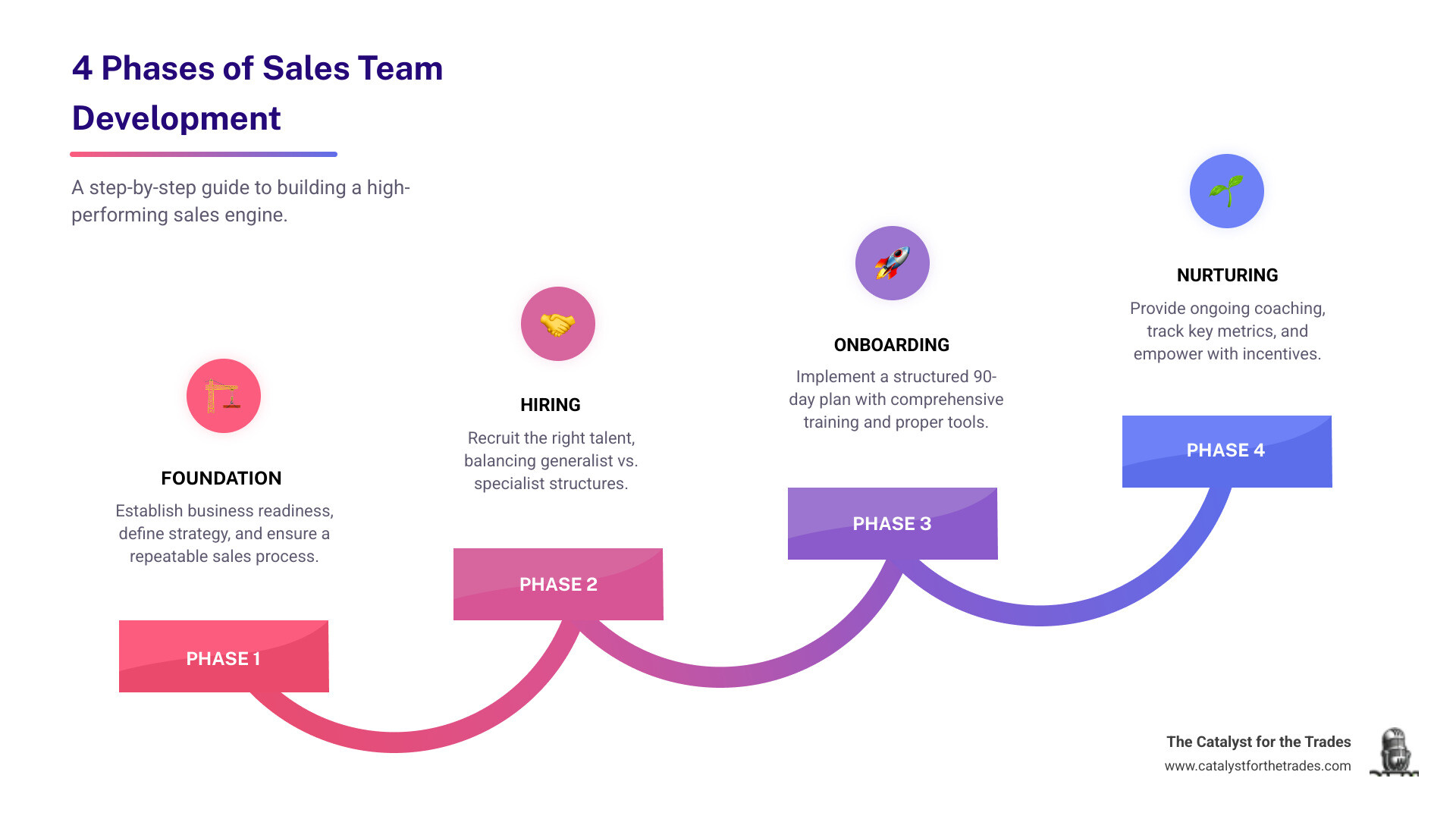
Quick Answer: The 4 Phases of Sales Team Development
- Foundation – Establish business readiness, define your sales strategy, and ensure you have a repeatable sales process before hiring
- Hiring – Recruit the right talent with the right DNA, choosing between generalist vs. specialist structures based on your growth stage
- Onboarding – Implement a structured 90-day plan with comprehensive training, clear expectations, and proper tools (CRM, sales enablement)
- Nurturing – Provide ongoing coaching, track key metrics, foster a learning culture, and empower your team with the right incentives and support
Here’s the challenge most home service business owners face: they hire their first salesperson hoping it will magically generate revenue, only to watch them struggle without the right foundation, training, or support. Research shows that companies with structured sales team development programs are 28% more likely to hit their sales goals than those winging it.
The difference between good and great sales teams isn’t luck—it’s strategy. Companies that distinguish between different sales roles (like SDRs who prospect versus AEs who close) see a 10-15% increase in quota attainment. Those with dedicated Sales Development Reps generate 400% more qualified leads than teams where everyone does everything.
This guide walks you through each phase of building a sales team from scratch, whether you’re hiring your first rep or scaling an existing team. You’ll learn when to hire, who to hire, how to structure roles, and how to develop your team for long-term success—without the costly mistakes that trip up most growing businesses.
Quick sales team development terms:
- customer experience optimization
- customer relationship management
- customer retention strategies
Phase 1: Laying the Foundation Before You Hire
Before you even think about interviewing your first salesperson, we need to talk about readiness. Many business owners, especially in the home services industry, make the common and costly mistake of hiring a salesperson too early. It’s like building a beautiful house on a shaky foundation—it’s destined for problems. Our goal in this phase of sales team development is to ensure your business is truly ready to support and benefit from a sales team.
Why is this so important? Salespeople are geared to sell, not to test products or develop strategy. If your company’s direction is constantly shifting, it’s incredibly difficult for them to qualify prospects and prioritize their efforts effectively. If we bring in a sales rep before we have a viable product, a clear market opportunity, or a repeatable sales process, we’re setting them—and ourselves—up for frustration, pain, and significant cost. Self-managing salespeople and teams are as rare as purple unicorns, so having management support and a clear strategy is non-negotiable.
Essential Prerequisites for Successful Sales Team Development
To build a strong foundation, we must address several prerequisites:
- Viable Product or Service: We need to have a proven service that genuinely solves a customer problem. For home service businesses, this means we’ve successfully delivered our service to a number of customers and received positive feedback. We know our offering works.
- Market Opportunity: Is there a clear and sufficient demand for our services? We should have a good understanding of our target market and its size.
- Founder Closing Initial Deals: Before hiring a dedicated salesperson, the founder or leadership team should ideally have personally closed 10-20 deals. This isn’t just about proving the service can sell; it’s about understanding the customer, the sales cycle, and the common objections. This experience is invaluable for later training new hires.
- Documented Sales Process: We need a clear, repeatable process for how we acquire customers. This includes everything from initial lead generation to closing the deal and follow-up. Without a documented process, every new hire will be starting from scratch, leading to inconsistency and inefficiency.
- Budget Availability: Can we afford to hire capable salespeople away from other employers? Mediocre salespeople are far more expensive than strong ones because they consume an inordinate amount of management and training time and squander valuable leads. We need to budget adequately for competitive salaries and potential commissions to attract top talent.
- Management Capacity: Who has the ability and time to manage the sales team? Salespeople, especially early hires, require coaching, guidance, and support. If the founder is already stretched thin, it might be better to delay hiring until dedicated sales management can be put in place.
Defining Your Core Sales Strategy
Once we’ve established our readiness, the next critical step in sales team development is to clearly define our sales strategy. This acts as our roadmap, guiding every sales activity and decision.
- Revenue and Customer Acquisition Goals: What specific revenue targets are we aiming for, and how many new customers do we need to acquire to reach those targets? These goals should be clear, measurable, and realistic. We’ll work backward from these to set individual sales targets.
- Target Customer Profile (ICP): Who is our ideal customer for our home services? This goes beyond basic demographics. We need to define their pain points, their needs, their purchasing triggers, and how our service fits into their lives. Understanding our ICP allows us to focus our efforts and resources effectively.
- Qualified Prospect Criteria: How do we define a “qualified prospect” for our home service business? This is crucial for sales and marketing alignment. A qualified lead definition typically includes:
- Demographic qualifiers: Specific criteria like location, type of home, income bracket, or specific equipment they might have (e.g., aging HVAC system).
- Behavioral qualifiers: Indicators of interest, such as filling out a contact form, requesting a quote, calling the office, or expressing a specific pain point our service addresses. A mandatory requirement should be the prospect’s willingness to meet or engage with our sales team.
- Sales Process Stages: We need to map out the distinct stages of our sales process, from initial contact to closing and beyond. This provides a structured approach for our sales team and helps us track progress.
By carefully laying this groundwork, we ensure that our future sales team has a clear path to success, rather than being thrown into the deep end without a paddle. This proactive approach saves time, money, and headaches in the long run.
Phase 2: Hiring the Right Talent for Your Sales Team Development
Now that our foundation is solid, it’s time for the exciting part: bringing in the people who will execute our sales strategy. Hiring the right talent is paramount; the opportunity cost of a mis-hire can be substantial. It’s not just about the salary and benefits; it’s about lost sales, wasted leads, reduced team productivity, and the time spent managing an underperforming individual. Research suggests that a bad sales hire can cost 30-150% of their annual salary. We want to avoid that!
Choosing the Right Sales Team Structure
The way we structure our sales team will significantly impact our efficiency and growth. As our home service business scales, we might move from a generalist approach to more specialized roles.
Here’s a look at different sales team structures:
| Structure Type | Description | Best For | Pros | Cons |
|---|---|---|---|---|
| Generalist (Island Model) | Each rep handles all aspects: prospecting, qualifying, closing, and sometimes account management. | Very early-stage startups, businesses with simple sales cycles, small teams (1-4 reps). | Simplicity, full ownership of client relationships, lower initial overhead. | Less efficient, reps spread thin, difficult to scale, can lead to burnout. |
| Specialist (Assembly Line Model) | Roles are specialized: SDRs for prospecting/qualifying, AEs for closing, CSMs for post-sale. | Growing businesses with increasing lead volume, longer sales cycles, and 5+ reps. | Increased efficiency, better conversion rates, higher quota attainment (10-15% increase), reps focus on strengths. | Requires more coordination, potential for handoff issues, higher overhead. |
| POD Model (Team-Based) | Small, self-contained units (PODs) of specialized roles (e.g., 1 SDR + 2 AEs) work together on a specific market, region, or segment. | Scaling businesses, complex sales, need for agile market penetration, 10+ reps. | Highly scalable, agile, fosters collaboration, improved unit economics, can set up 40-60 meetings/month per POD. | Requires strong leadership within PODs, careful balancing of resources, potential for internal competition. |
For many home service businesses starting out, a generalist model is common. However, as we grow, specialization becomes crucial. Companies with sales specialization experience 15% faster revenue growth. The “Assembly Line” model, separating lead generation from closing, is highly effective. Teams with dedicated Sales Development Reps (SDRs) for prospecting and qualifying, and Account Executives (AEs) for demos and closing, generate a remarkable 400% more qualified leads. The optimal number of SDRs to sales reps is often around 1 SDR to 3 sales reps.
Hiring for a Startup: The ‘Builder’ vs. ‘Rockstar’
When it comes to hiring our first few salespeople, especially in an early-stage home service business, we face a unique challenge. Selling for a startup is very different from selling for an established company. Startups lack brand recognition, a stable offering, and extensive support infrastructure. This means our salespeople will encounter more objections and resistance.
This brings us to the “Builder” vs. “Rockstar” dilemma:
- The ‘Rockstar’: This candidate often has a flashy resume, a history of hitting big quotas at well-known companies, and expects a perfect system to walk into. They thrive when processes are established and support is abundant.
- The ‘Builder’: This candidate might not have the most glamorous resume, but they’ve shown a knack for thriving in ambiguity, creating processes where none exist, and being comfortable with constant change. They understand that their role is to help build the sales engine, not just operate it.
For an early-stage home service business, we almost always want to hire a “Builder.” Why? Because we’re still figuring things out! We need someone who can help us refine our processes, adapt to new challenges, and isn’t afraid to get their hands dirty. The right DNA is often the biggest predictor of sales success in this environment.
Key personality traits for high-achieving new business development representatives in home service startups include:
- Ambition: A strong desire to achieve and excel.
- Perseverance: The ability to push through rejection and setbacks.
- Confidence: Belief in themselves and the value of our service.
- Optimism: A positive outlook, even when things are tough.
- Sense of Urgency: A drive to get things done efficiently.
- Desire to Influence: A natural ability to persuade and guide others.
- Flexibility: Adaptability to changing strategies and market conditions.
- Ability to Deal with Uncertainty: Comfort with an evolving environment.
Great salespeople are often busy selling, not looking at job ads. This means we need to be proactive. We should look everywhere: social networks, industry events, and referrals. Our job postings should stand out, highlighting the impact they can make and the career growth opportunities, not just listing qualifications. We’re offering a career, not just a job, and we need to sell our company vision with enthusiasm.
Effective Interviewing and Selection
Our interview process is where we truly assess if a candidate has the “Builder” DNA and the skills we need.
- Interview Techniques: Go beyond standard questions. We should use structured interviews with consistent scoring to objectively compare candidates.
- ‘Reversing’ Technique: This is a powerful technique where we ask candidates what they are looking for in a role, a manager, and a company. Their questions and priorities can reveal a lot about their true motivations and fit. For example, if they only ask about commission structure and not about the sales process or product, it might be a red flag for a “Builder” role.
- Involving the Team: If we have existing sales or customer service team members, involve them in the hiring process. They can provide valuable insights into cultural fit and assess practical skills, plus it fosters a sense of ownership.
- Candidate Exercises: For home service roles, practical exercises are invaluable. This could include presenting a mock sales pitch for one of our services, handling common objections, or even a role-play of a cold call. This shows us their ability to tell stories and demonstrate how our service can improve a prospect’s life.
- Reference Checks: Always check two or three references thoroughly. Ask specific questions about their performance in previous roles, especially regarding the traits we’ve identified for “Builders.”
Phase 3: Onboarding and Continuous Training
Congratulations, we’ve hired a fantastic sales rep! But the journey of sales team development doesn’t end there; it’s just beginning. The first 90 days are critical for a new sales rep’s success. This is where we set them up to thrive, not just survive.
Structuring a Winning Onboarding Process
A comprehensive and structured onboarding process is vital. Research shows that salespeople forget approximately 70% of what is taught during training within 24 hours without reinforcement. We need to combat this “forgetting curve” with continuous, practical learning.
Our 90-day onboarding plan should look something like this:
- Week 1-2: Immersion and Foundation
- Comprehensive Training: Dive deep into our services, our company values, and our mission. This includes product knowledge (e.g., how an HVAC system works, common plumbing issues), market dynamics (who our competitors are, industry trends), and customer personas (who we serve and why).
- Tools and Systems: Ensure all necessary tools and systems are in place from day one. This means a working computer, phone, access to our CRM, and any specialized sales enablement software. Our CRM is the central nervous system of our sales operations, enforcing processes and providing visibility.
- Shadowing: Have them shadow experienced technicians or customer service reps to understand the delivery of our services and customer interactions firsthand.
- Week 3-4: Sales Process and Practice
- Sales Process Deep Dive: Walk through our documented sales process step-by-step.
- Role-Playing Scenarios: Conduct extensive role-playing sessions for common sales calls, objection handling, and closing techniques relevant to home services. This is where they practice their ability to tell stories and frame our services as solutions.
- Setting Clear Expectations: Revisit the job profile and clearly outline performance expectations, key metrics, and activities.
- Month 2-3: Active Selling and Coaching
- Ramp-Up Timeline: Gradually introduce them to real leads and prospecting activities. The typical ramp-up timeline for a new sales rep involves a period of learning before full productivity. We need to support them at each stage.
- Continuous Coaching: Provide regular one-on-one coaching sessions. Managers should spend at least 20% of their time coaching, a characteristic of high-performing teams.
- Feedback Loops: Encourage continuous feedback, both from the manager to the rep and vice-versa.
Designing Effective Sales Compensation Plans
A well-designed compensation plan is crucial for attracting and retaining top sales talent. Money may not be everything to everyone, but it is top of mind for most salespeople.
- Attracting and Retaining Talent: Our compensation structure needs to be competitive within the home services industry.
- Base Salary vs. Commission: A balanced approach is often best. For new business development positions, a 50/50 split of base and commission is common. The base salary provides stability, while commission incentivizes performance.
- Balanced Compensation Structures: Ensure the plan rewards both new customer acquisition and potentially upsells or repeat business, aligning with our business goals.
- Performance Accelerators: Consider implementing performance accelerators for exceeding targets, which can significantly motivate high achievers.
- Non-Monetary Rewards: Don’t underestimate the power of non-monetary rewards such as recognition, career growth opportunities, flexible work arrangements, or extra time off. Offering careers, not just jobs, helps attract the best.
- Supporting Ongoing Development and Training: Link compensation or career progression to continuous learning and skill development.
Phase 4: Nurturing and Empowering for Peak Performance
The final phase of sales team development is about continuously nurturing and empowering our sales team to achieve peak performance. This involves strong leadership, clear communication, effective tools, and a healthy company culture.
Key Metrics for the Nurturing Phase of Sales Team Development
“What gets measured gets managed,” as the old saying goes, and it’s especially true in sales. We need to track the right metrics to understand performance and identify areas for improvement.
- Activity Metrics: These measure the effort put in. For home services, this might include:
- Number of outbound calls/dials made: It can take 60-90 dials to get an appointment, and 22.5 dials for a meaningful conversation.
- Number of meaningful conversations.
- Number of appointments set/conducted.
- Number of quotes delivered.
- Outcome Metrics: These measure the results achieved:
- Win Rate: The percentage of proposals that convert into closed deals.
- Sales Cycle Length: The average time it takes to close a deal.
- Pipeline Development: The value and quantity of new opportunities generated.
- Quota Attainment: The percentage of the sales target achieved.
- Leading vs. Lagging Indicators: Activity metrics are often leading indicators (they predict future results), while outcome metrics are lagging indicators (they show past results). For long sales cycles, focusing on leading indicators in the early stages is crucial. For example, if we have a very good lead-to-opportunity conversion rate of 30%, it means 70% of leads contacted won’t turn into anything—so we need volume and effective qualification.
Communication, Tools, and Incentives
To truly nurture and empower our team, we need more than just metrics.
- Regular Communication and Feedback: Consistent communication is key. This includes regular one-on-one meetings to discuss performance, challenges, and career goals. Managers should actively listen to their sales team and incorporate their feedback into processes.
- Time-Saving and Efficiency Tools: Equip our team with the right technology to make their jobs easier and more effective.
- CRM Automation: Our CRM (Customer Relationship Management) system is critical. It should automate routine tasks, manage contacts, track interactions, and provide insights into our sales pipeline.
- AI Sales Tools: Agentic AI (autonomous AI agents) is beginning to transform sales operations by automating routine tasks like lead qualification, data entry, and follow-up sequences. AI can also provide data-driven coaching and conversation intelligence, helping reps improve their calls.
- Meaningful Incentives: Beyond compensation, thoughtful incentives can motivate our team. This could be public recognition, special projects, professional development opportunities, or team-building events. A healthy company culture, where 30-50% of company market value is attributed to culture, leads to lower turnover and higher engagement. We need to establish and maintain this, especially if our team works remotely.
Building a high-performing sales team for a home service business is an ongoing journey of strategic planning, thoughtful hiring, rigorous training, and continuous support. By following these phases, we can transform our sales efforts from good to great.
Frequently Asked Questions about Building a Sales Team
When is the right time to hire my first salesperson?
The right time to hire your first salesperson is when you (the founder or business owner) are spending 20-25% or more of your time on sales activities, and you have personally closed 10-20 deals. This means you have a repeatable sales process, understand your target customers, and can effectively train a new hire. Hiring too early, before you have this proof of concept, can be a costly mistake.
What is the best structure for a small but growing sales team?
For a small but growing home service sales team, the “Assembly Line” model is often the best. This involves separating lead generation from closing. You would hire Sales Development Representatives (SDRs) for prospecting and qualifying leads, and Account Executives (AEs) for conducting demos (if applicable) and closing deals. This specialization drives efficiency and expertise, and companies using this model see faster revenue growth and more qualified leads. Once you hit 5-8 reps, hiring a dedicated sales manager becomes crucial to provide coaching and support.
How can I ensure my sales team is set up for long-term success?
Ensuring long-term success requires a multi-faceted approach:
- Solid Foundation: Start with a clear sales strategy, defined target customers, and a repeatable sales process.
- Right Hires: Focus on hiring “Builders” who can thrive in an evolving environment and possess key personality traits like perseverance and flexibility.
- Effective Onboarding: Implement a comprehensive 90-day onboarding plan with structured training, necessary tools (especially a robust CRM), and clear expectations.
- Continuous Development: Foster a culture of continuous learning and professional development through ongoing coaching, regular feedback, and access to sales enablement resources.
- Meaningful Metrics & Incentives: Track relevant activity and outcome metrics, and design compensation plans and incentives that attract, motivate, and retain top talent.
- Strong Leadership: Provide consistent sales management and leadership that listens to the team, offers support, and empowers them with the right tools and technology, including AI sales tools.
Conclusion
Building a high-performing sales team from the ground up is indeed an art, but it’s an art we can master through strategic sales team development. We’ve explored the critical phases, from laying a solid foundation with clear strategy and readiness, to carefully hiring “Builders” with the right DNA. We’ve emphasized the importance of structured onboarding, continuous training, and designing compensation that attracts and retains top talent. Finally, we’ve highlighted how nurturing and empowering our team through effective leadership, meaningful metrics, cutting-edge tools, and a healthy culture drives peak performance.
This journey requires commitment and a strategic mindset, but the rewards are predictable revenue, sustained growth, and a thriving home service business.
At The Catalyst for the Trades, we believe in empowering home service businesses like ours with the strategies for growth, innovation, and leadership. We’re here to help you combine cutting-edge insights with real-world industry experience to achieve your goals.


