Why Talent Pipeline Development Is Critical for Trades Businesses
Talent pipeline development is the strategic process of identifying, engaging, and nurturing potential candidates before a position opens. For home services businesses, this means building relationships with skilled technicians and leaders so you're not scrambling to fill a gap when a hiring need arises.
Here's how to develop a talent pipeline:
- Define your ideal candidate personas - Know exactly who you're looking for.
- Source candidates proactively - Use referrals, social media, and community events.
- Integrate diversity strategies - Expand your reach to underrepresented communities.
- Nurture relationships consistently - Keep candidates engaged with personalized communication.
- Leverage internal talent - Upskill current employees and create clear career paths.
With nearly 7 in 10 organizations reporting recruiting difficulties, the trades face acute skilled labor shortages. The old reactive approach—posting a job and hoping for the best—is no longer effective. A proactive strategy is essential, treating talent acquisition like a supply chain with consistent sourcing and nurturing.
If you're struggling to find qualified technicians and leaders when you need them, you're not alone. But you can get ahead of the problem. Discover proven strategies for scaling your business with the right team or explore how The Catalyst for the Trades can help you build a winning workforce.
Talent pipeline development glossary:
The Foundations of a Proactive Talent Strategy
Running a home services business means facing sudden talent needs. A key technician gives notice, you land a major contract, and you need people now. A proactive talent strategy avoids this scramble by having qualified candidates ready. Instead of reacting to talent shortages, you build relationships before you need them. This approach reduces your time to hire and transforms how you think about Employee Loyalty, sustainability, and long-term growth.

The numbers tell the story: nearly 7 in 10 organizations still report difficulty recruiting for full-time roles. For trades businesses, this challenge is even greater. Your ability to serve customers and grow depends on having the right people ready.
Why is a Talent Pipeline Crucial?
Reactive recruiting in the trades—posting a job and hoping for the best—often leads to choosing between a less-than-ideal candidate or leaving a role unfilled. Talent pipeline development flips this script. By anticipating needs caused by market volatility, growth spurts, or retirements, you avoid emergencies.
This proactive approach is essential for succession planning and identifying future leaders early. It connects directly to effective Performance Management, where you're not just evaluating current performance but preparing people for their next role.
Furthermore, with technology reshaping our industries, by 2030, 59% of employees will need to be retrained. A talent pipeline isn't just about filling today's jobs; it's about building a competitive edge with people who have tomorrow's skills.
Key Benefits for Your Trades Business
Committing to talent pipeline development fundamentally strengthens your business.
Faster hiring cycles: With a pipeline of pre-qualified candidates who know your company, hiring can take weeks or days, not months.
Improved candidate quality: Building relationships over time allows you to connect with top-tier talent, including passive candidates who aren't actively job hunting.
Stronger employer brand: Engaging with potential candidates, even when not hiring, builds a reputation as a company that values people and offers real career opportunities.
Increased Employee Loyalty: When current employees see clear paths for advancement, they are more likely to stay and grow with the company.
Better workforce planning: A pipeline enables smarter decisions about training and resource allocation, allowing you to strategically build the team you need for sustained growth.
Which Roles Need a Pipeline?
You can't build pipelines for every role, especially in a smaller operation. Prioritize positions that offer the biggest return on your investment.
Start with your hard-to-fill roles, where a long vacancy hurts your bottom line.
High-turnover positions also need attention. A pipeline ensures you're never caught flat-footed when someone leaves.
Critical leadership roles like operations managers and service supervisors absolutely require a pipeline to ensure smooth transitions.
Think about your frequently hired roles as well. A pipeline keeps the hiring process for new technicians or installers smooth and consistent.
Don't forget about future skill requirements. A pipeline helps you identify and develop talent with emerging capabilities like smart home integration before you desperately need them.
Use your own hiring and attrition data to guide these decisions. Ask which vacancies hurt most and which skills you'll need in the next three to five years. Those answers will tell you where to focus your talent pipeline development efforts.
The 5 Essential Steps for Talent Pipeline Development
Building a robust talent pipeline development system requires a structured approach. Think of your talent strategy like a supply chain: just as you manage parts and equipment, you must apply the same principles to finding and nurturing great people. The Building the Talent Pipeline: An Implementation Guide breaks down this approach, and here's how to make it work for your business.
Step 1: Define Your Ideal Candidate Personas
Many businesses fail by jumping straight to job postings without knowing who they're looking for. Go deeper than a basic job description by creating detailed candidate personas. A persona is a sketch of your perfect team member, including not just technical skills but also their values, work style, and career aspirations.
Map out the skills and competencies, experience levels, and cultural fit for your target roles. To build these personas, interview your top performers and hiring managers. This data-driven approach identifies real success criteria and beats guesswork every time.
Step 2: Source and Fill Your Pipeline
With personas defined, it's time to proactively source candidates. Instead of waiting for applications, use direct or "slow" sourcing to build relationships with talented people, including those not actively job hunting.
Tap into existing talent pools:
- Silver medalists: Strong candidates who almost got hired previously.
- Past applicants: Individuals in your ATS who might fit a new role.
- Referrals: Recommendations from current and former employees are invaluable. Alumni referrals have a 40% higher retention rate.
Expand your reach through social media accounts like LinkedIn and by hosting talent attraction events (online or in-person) to showcase your company culture.
Step 3: Integrate Diversity and Inclusion
A diverse talent pipeline is smart business. It builds stronger, more creative teams that better serve customers. Be intentional about where and how you source candidates.
Expand your network by partnering with institutions like Historically Black Colleges and Universities, Hispanic-Serving Institutions, and Tribal Colleges and Universities. While 9% of Black college students attend an HBCU, talented candidates from underrepresented groups are everywhere, so cast a wide net.
Review your inclusive job descriptions to ensure they focus on essential skills and use neutral language. Invest in unconscious bias training for your hiring team to promote fair evaluations based on a candidate's potential.
Step 4: Nurture and Engage Candidates
Finding candidates is just the start. The key to talent pipeline development is nurturing those relationships over time so you're top of mind when an opportunity arises.
Candidates are busy and may not be ready to move. Be patient and consistent; Forrester research suggests it can take up to eight brand touchpoints to influence a decision. Use personalized communication, not generic messages. Share relevant content marketing, such as industry insights or company news, through a newsletter or webinar.
Every interaction is part of the Candidate Experience. Respect boundaries by asking about communication preferences. Transparency about your intentions is key to building trust and upholding ethical considerations.
Step 5: Leverage Internal Talent
Don't forget your internal talent. Current employees are often your best source for future leaders and specialists.
Upskilling and reskilling programs, as highlighted by the American Upskilling Study, boost satisfaction and competitiveness while showing employees they have a future with your company.
Provide high-potential employees with Management Development opportunities and create transparent career pathing to show clear routes for advancement. Mentorship programs transfer knowledge, and encouraging internal mobility helps you find hidden talent within your organization.
Denise Swafford's journey, From the Call Center to the C-Suite: Denise Swafford's Journey of Scaling Success in the Trades, perfectly illustrates what's possible when you invest in the people already on your team.
Technology and Measurement in Your Talent Pipeline Strategy
Managing a talent pipeline development strategy without the right technology is inefficient and prone to error. The right systems automate tasks, provide deeper insights, and improve your recruiting ROI. As Mike Disney shared on Building Trust, Recruiting Top Talent, and Winning in the Trades, the right tools can be a game-changer.

The Role of Technology: CRMs and ATS
Many business owners confuse an Applicant Tracking System (ATS) with a Candidate Relationship Management (CRM) system. An ATS is for managing active applications (transactions), not for nurturing long-term relationships.
A recruiting CRM is your secret weapon for nurturing relationships over time, even with passive candidates. A CRM allows you to store and organize candidate data, automate personalized outreach, and track all interactions for a consistent candidate experience. Modern CRMs also use features like Advanced AI-Assisted Search and Projects to help identify high-potential candidates you might otherwise miss.
The ideal setup is a CRM that integrates with your ATS, creating a single source of truth for all candidate data.
Measuring Success: KPIs for talent pipeline development
You can't improve what you don't measure. Tracking key performance indicators (KPIs) is essential for understanding your pipeline's effectiveness and ROI.
- Time-to-fill: This metric often shows the most dramatic improvement, as filling roles from your pipeline is significantly faster and reduces operational downtime.
- Quality of hire: Track if pipeline candidates perform better, stay longer, and contribute more effectively than hires from other sources.
- Source of hire: Understand which sourcing channels (e.g., referrals, trade schools) yield the best candidates so you know where to invest your energy.
- Pipeline conversion rates: These rates reveal bottlenecks by showing the percentage of candidates who move from one stage to the next (e.g., from pipeline to interview).
Broader talent management key performance indicators, like retention and satisfaction scores, show the long-term business impact. Also, be realistic about your team capacity using tools like Glen Cathey's handy calculator to ensure your strategy is executable.
Aligning with Future Business Needs
A talent pipeline is strategic, not just tactical. It prepares you for future business challenges and opportunities.
Strategic workforce planning involves aligning your talent strategy with business goals like expansion or adopting new technologies. Don't wait until you're in the middle of a change to start recruiting.
Leadership development is critical. As explored in The Future of Leadership: How to Build a Team That Drives Growth, you must identify and develop future leaders early. Attending Leadership Conferences can also provide valuable insights.
Skill forecasting means anticipating future needs, like smart home integration or new energy systems, and building relationships with candidates who already have those skills. This proactive mindset transforms your talent strategy from a reactive scramble into a true competitive advantage.
Frequently Asked Questions about Talent Pipeline Development
How does a talent pipeline differ from a talent pool?
While the terms sound similar, there's a key distinction.
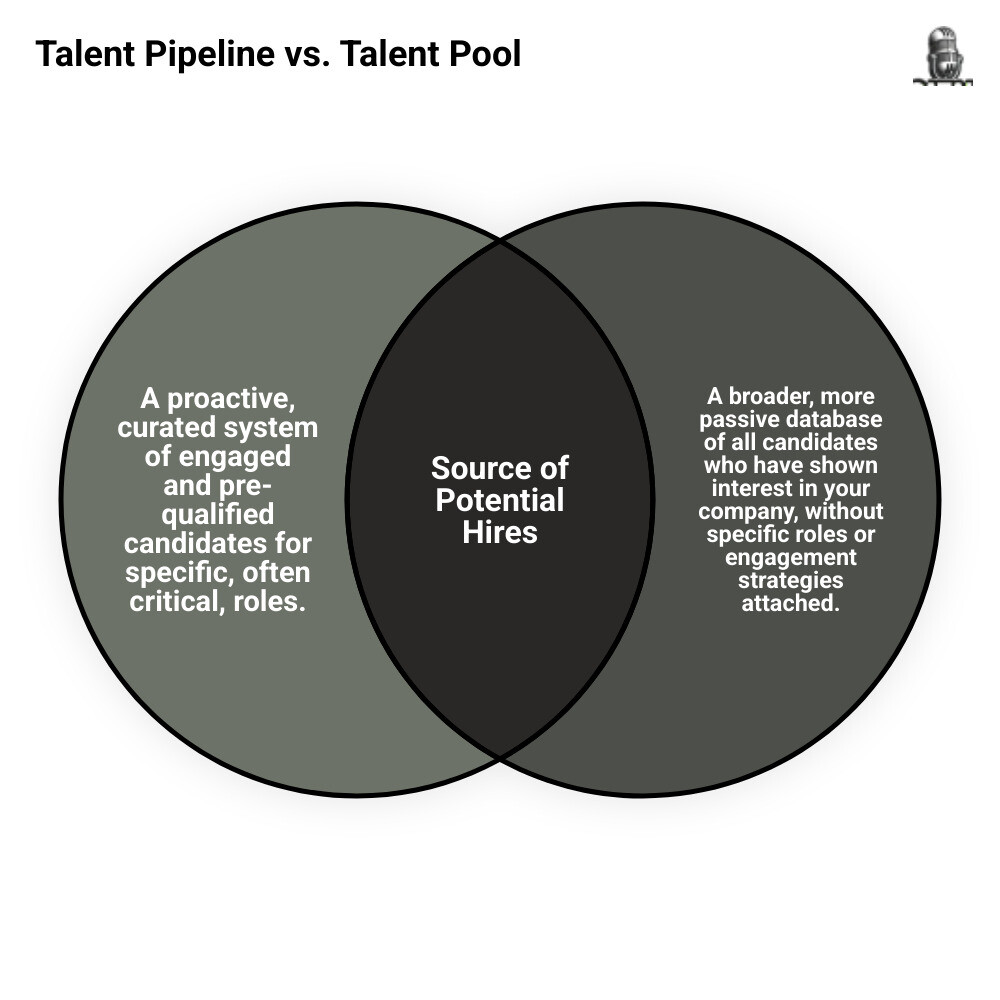
A talent pipeline is a proactive, curated system of engaged candidates for specific, critical roles. You are actively building relationships with these individuals, nurturing them toward specific opportunities.
A talent pool is a broader, more passive database of anyone who has shown interest in your company, like past applicants or job fair attendees.
The practical difference: a pipeline contains warm leads for specific roles, while a pool is a general archive to search from. Both are valuable, but the pipeline provides the strategic advantage.
How long does it take to build an effective talent pipeline?
Building a robust talent pipeline is a long-term strategy, not an overnight solution. It typically takes several months to a year to establish strong relationships and see a significant impact on hiring metrics.
The timeline depends on consistent sourcing, nurturing, and engagement. Building real relationships, especially with passive candidates, takes time. You will likely see smaller wins early on, but the key is patience and persistent action. The long-term rewards—faster hiring and better candidates—are worth the investment. With 59% of employees needing retraining by 2030, starting now puts you ahead.
Can a small trades business really build a talent pipeline?
Yes, absolutely. You don't need a large HR department or expensive software to implement talent pipeline development.
The fundamentals work for any size company. Small businesses often have advantages like agility and the ability to build more personal relationships with candidates.
Start simple:
- Re-engage strong past candidates who almost got hired.
- Encourage employee referrals and follow up on them.
- Build relationships in your local community through trade associations and vocational schools.
- Use a simple spreadsheet or CRM to track potential hires.
The commitment to proactive talent planning is what matters, not your budget. Spending even an hour a week on this puts you miles ahead of businesses still reacting to hiring needs.
Conclusion
In the fast-moving home services industry, businesses that think ahead thrive. Talent pipeline development isn't just an HR buzzword; it's the foundation of a resilient business that can weather talent shortages and seize new opportunities.
Shifting from reactive hiring to proactive relationship-building transforms how you grow. By knowing who you're looking for and how to engage them, you take control of your future instead of being at the mercy of the labor market.
This is not a set-it-and-forget-it strategy. The most effective talent pipelines evolve with your business. Continuous improvement—refining personas, testing sourcing channels, and measuring results—ensures your pipeline remains a competitive advantage.
This approach benefits everyone: candidates get a better experience, current employees see growth paths (strengthening Employee Loyalty), and hiring managers spend less time in crisis mode. Your business gains the stability to pursue growth and establish true Industry Leadership.
At The Catalyst for the Trades, we've seen how the right people strategy can transform a business. The principles are simple: be proactive, be consistent, and invest in relationships.
Your next great hire may not be looking today. But with a strong pipeline, you'll be their first call when they are ready.
Ready to build a team that drives real growth? Explore our resources and start building your winning workforce today.
Why Talent Pipeline Development Is Critical for Trades Businesses
Talent pipeline development is the strategic process of identifying, engaging, and nurturing potential candidates before a position opens. For home services businesses, this means building relationships with skilled technicians and leaders so you're not scrambling to fill a gap when a hiring need arises.
Here's how to develop a talent pipeline:
- Define your ideal candidate personas - Know exactly who you're looking for.
- Source candidates proactively - Use referrals, social media, and community events.
- Integrate diversity strategies - Expand your reach to underrepresented communities.
- Nurture relationships consistently - Keep candidates engaged with personalized communication.
- Leverage internal talent - Upskill current employees and create clear career paths.
With nearly 7 in 10 organizations reporting recruiting difficulties, the trades face acute skilled labor shortages. The old reactive approach—posting a job and hoping for the best—is no longer effective. A proactive strategy is essential, treating talent acquisition like a supply chain with consistent sourcing and nurturing.
If you're struggling to find qualified technicians and leaders when you need them, you're not alone. But you can get ahead of the problem. Discover proven strategies for scaling your business with the right team or explore how The Catalyst for the Trades can help you build a winning workforce.
Talent pipeline development glossary:
The Foundations of a Proactive Talent Strategy
Running a home services business means facing sudden talent needs. A key technician gives notice, you land a major contract, and you need people now. A proactive talent strategy avoids this scramble by having qualified candidates ready. Instead of reacting to talent shortages, you build relationships before you need them. This approach reduces your time to hire and transforms how you think about Employee Loyalty, sustainability, and long-term growth.
The numbers tell the story: nearly 7 in 10 organizations still report difficulty recruiting for full-time roles. For trades businesses, this challenge is even greater. Your ability to serve customers and grow depends on having the right people ready.
Why is a Talent Pipeline Crucial?
Reactive recruiting in the trades—posting a job and hoping for the best—often leads to choosing between a less-than-ideal candidate or leaving a role unfilled. Talent pipeline development flips this script. By anticipating needs caused by market volatility, growth spurts, or retirements, you avoid emergencies.
This proactive approach is essential for succession planning and identifying future leaders early. It connects directly to effective Performance Management, where you're not just evaluating current performance but preparing people for their next role.
Furthermore, with technology reshaping our industries, by 2030, 59% of employees will need to be retrained. A talent pipeline isn't just about filling today's jobs; it's about building a competitive edge with people who have tomorrow's skills.
Key Benefits for Your Trades Business
Committing to talent pipeline development fundamentally strengthens your business.
Faster hiring cycles: With a pipeline of pre-qualified candidates who know your company, hiring can take weeks or days, not months.
Improved candidate quality: Building relationships over time allows you to connect with top-tier talent, including passive candidates who aren't actively job hunting.
Stronger employer brand: Engaging with potential candidates, even when not hiring, builds a reputation as a company that values people and offers real career opportunities.
Increased Employee Loyalty: When current employees see clear paths for advancement, they are more likely to stay and grow with the company.
Better workforce planning: A pipeline enables smarter decisions about training and resource allocation, allowing you to strategically build the team you need for sustained growth.
Which Roles Need a Pipeline?
You can't build pipelines for every role, especially in a smaller operation. Prioritize positions that offer the biggest return on your investment.
Start with your hard-to-fill roles, where a long vacancy hurts your bottom line.
High-turnover positions also need attention. A pipeline ensures you're never caught flat-footed when someone leaves.
Critical leadership roles like operations managers and service supervisors absolutely require a pipeline to ensure smooth transitions.
Think about your frequently hired roles as well. A pipeline keeps the hiring process for new technicians or installers smooth and consistent.
Don't forget about future skill requirements. A pipeline helps you identify and develop talent with emerging capabilities like smart home integration before you desperately need them.
Use your own hiring and attrition data to guide these decisions. Ask which vacancies hurt most and which skills you'll need in the next three to five years. Those answers will tell you where to focus your talent pipeline development efforts.
The 5 Essential Steps for Talent Pipeline Development
Building a robust talent pipeline development system requires a structured approach. Think of your talent strategy like a supply chain: just as you manage parts and equipment, you must apply the same principles to finding and nurturing great people. The Building the Talent Pipeline: An Implementation Guide breaks down this approach, and here's how to make it work for your business.
Step 1: Define Your Ideal Candidate Personas
Many businesses fail by jumping straight to job postings without knowing who they're looking for. Go deeper than a basic job description by creating detailed candidate personas. A persona is a sketch of your perfect team member, including not just technical skills but also their values, work style, and career aspirations.
Map out the skills and competencies, experience levels, and cultural fit for your target roles. To build these personas, interview your top performers and hiring managers. This data-driven approach identifies real success criteria and beats guesswork every time.
Step 2: Source and Fill Your Pipeline
With personas defined, it's time to proactively source candidates. Instead of waiting for applications, use direct or "slow" sourcing to build relationships with talented people, including those not actively job hunting.
Tap into existing talent pools:
- Silver medalists: Strong candidates who almost got hired previously.
- Past applicants: Individuals in your ATS who might fit a new role.
- Referrals: Recommendations from current and former employees are invaluable. Alumni referrals have a 40% higher retention rate.
Expand your reach through social media accounts like LinkedIn and by hosting talent attraction events (online or in-person) to showcase your company culture.
Step 3: Integrate Diversity and Inclusion
A diverse talent pipeline is smart business. It builds stronger, more creative teams that better serve customers. Be intentional about where and how you source candidates.
Expand your network by partnering with institutions like Historically Black Colleges and Universities, Hispanic-Serving Institutions, and Tribal Colleges and Universities. While 9% of Black college students attend an HBCU, talented candidates from underrepresented groups are everywhere, so cast a wide net.
Review your inclusive job descriptions to ensure they focus on essential skills and use neutral language. Invest in unconscious bias training for your hiring team to promote fair evaluations based on a candidate's potential.
Step 4: Nurture and Engage Candidates
Finding candidates is just the start. The key to talent pipeline development is nurturing those relationships over time so you're top of mind when an opportunity arises.
Candidates are busy and may not be ready to move. Be patient and consistent; Forrester research suggests it can take up to eight brand touchpoints to influence a decision. Use personalized communication, not generic messages. Share relevant content marketing, such as industry insights or company news, through a newsletter or webinar.
Every interaction is part of the Candidate Experience. Respect boundaries by asking about communication preferences. Transparency about your intentions is key to building trust and upholding ethical considerations.
Step 5: Leverage Internal Talent
Don't forget your internal talent. Current employees are often your best source for future leaders and specialists.
Upskilling and reskilling programs, as highlighted by the American Upskilling Study, boost satisfaction and competitiveness while showing employees they have a future with your company.
Provide high-potential employees with Management Development opportunities and create transparent career pathing to show clear routes for advancement. Mentorship programs transfer knowledge, and encouraging internal mobility helps you find hidden talent within your organization.
Denise Swafford's journey, From the Call Center to the C-Suite: Denise Swafford's Journey of Scaling Success in the Trades, perfectly illustrates what's possible when you invest in the people already on your team.
Technology and Measurement in Your Talent Pipeline Strategy
Managing a talent pipeline development strategy without the right technology is inefficient and prone to error. The right systems automate tasks, provide deeper insights, and improve your recruiting ROI. As Mike Disney shared on Building Trust, Recruiting Top Talent, and Winning in the Trades, the right tools can be a game-changer.
The Role of Technology: CRMs and ATS
Many business owners confuse an Applicant Tracking System (ATS) with a Candidate Relationship Management (CRM) system. An ATS is for managing active applications (transactions), not for nurturing long-term relationships.
A recruiting CRM is your secret weapon for nurturing relationships over time, even with passive candidates. A CRM allows you to store and organize candidate data, automate personalized outreach, and track all interactions for a consistent candidate experience. Modern CRMs also use features like Advanced AI-Assisted Search and Projects to help identify high-potential candidates you might otherwise miss.
The ideal setup is a CRM that integrates with your ATS, creating a single source of truth for all candidate data.
Measuring Success: KPIs for talent pipeline development
You can't improve what you don't measure. Tracking key performance indicators (KPIs) is essential for understanding your pipeline's effectiveness and ROI.
- Time-to-fill: This metric often shows the most dramatic improvement, as filling roles from your pipeline is significantly faster and reduces operational downtime.
- Quality of hire: Track if pipeline candidates perform better, stay longer, and contribute more effectively than hires from other sources.
- Source of hire: Understand which sourcing channels (e.g., referrals, trade schools) yield the best candidates so you know where to invest your energy.
- Pipeline conversion rates: These rates reveal bottlenecks by showing the percentage of candidates who move from one stage to the next (e.g., from pipeline to interview).
Broader talent management key performance indicators, like retention and satisfaction scores, show the long-term business impact. Also, be realistic about your team capacity using tools like Glen Cathey's handy calculator to ensure your strategy is executable.
Aligning with Future Business Needs
A talent pipeline is strategic, not just tactical. It prepares you for future business challenges and opportunities.
Strategic workforce planning involves aligning your talent strategy with business goals like expansion or adopting new technologies. Don't wait until you're in the middle of a change to start recruiting.
Leadership development is critical. As explored in The Future of Leadership: How to Build a Team That Drives Growth, you must identify and develop future leaders early. Attending Leadership Conferences can also provide valuable insights.
Skill forecasting means anticipating future needs, like smart home integration or new energy systems, and building relationships with candidates who already have those skills. This proactive mindset transforms your talent strategy from a reactive scramble into a true competitive advantage.
Frequently Asked Questions about Talent Pipeline Development
How does a talent pipeline differ from a talent pool?
While the terms sound similar, there's a key distinction.
A talent pipeline is a proactive, curated system of engaged candidates for specific, critical roles. You are actively building relationships with these individuals, nurturing them toward specific opportunities.
A talent pool is a broader, more passive database of anyone who has shown interest in your company, like past applicants or job fair attendees.
The practical difference: a pipeline contains warm leads for specific roles, while a pool is a general archive to search from. Both are valuable, but the pipeline provides the strategic advantage.
How long does it take to build an effective talent pipeline?
Building a robust talent pipeline is a long-term strategy, not an overnight solution. It typically takes several months to a year to establish strong relationships and see a significant impact on hiring metrics.
The timeline depends on consistent sourcing, nurturing, and engagement. Building real relationships, especially with passive candidates, takes time. You will likely see smaller wins early on, but the key is patience and persistent action. The long-term rewards—faster hiring and better candidates—are worth the investment. With 59% of employees needing retraining by 2030, starting now puts you ahead.
Can a small trades business really build a talent pipeline?
Yes, absolutely. You don't need a large HR department or expensive software to implement talent pipeline development.
The fundamentals work for any size company. Small businesses often have advantages like agility and the ability to build more personal relationships with candidates.
Start simple:
- Re-engage strong past candidates who almost got hired.
- Encourage employee referrals and follow up on them.
- Build relationships in your local community through trade associations and vocational schools.
- Use a simple spreadsheet or CRM to track potential hires.
The commitment to proactive talent planning is what matters, not your budget. Spending even an hour a week on this puts you miles ahead of businesses still reacting to hiring needs.
Conclusion
In the fast-moving home services industry, businesses that think ahead thrive. Talent pipeline development isn't just an HR buzzword; it's the foundation of a resilient business that can weather talent shortages and seize new opportunities.
Shifting from reactive hiring to proactive relationship-building transforms how you grow. By knowing who you're looking for and how to engage them, you take control of your future instead of being at the mercy of the labor market.
This is not a set-it-and-forget-it strategy. The most effective talent pipelines evolve with your business. Continuous improvement—refining personas, testing sourcing channels, and measuring results—ensures your pipeline remains a competitive advantage.
This approach benefits everyone: candidates get a better experience, current employees see growth paths (strengthening Employee Loyalty), and hiring managers spend less time in crisis mode. Your business gains the stability to pursue growth and establish true Industry Leadership.
At The Catalyst for the Trades, we've seen how the right people strategy can transform a business. The principles are simple: be proactive, be consistent, and invest in relationships.
Your next great hire may not be looking today. But with a strong pipeline, you'll be their first call when they are ready.
Ready to build a team that drives real growth? Explore our resources and start building your winning workforce today.
Why Talent Pipeline Development Is Critical for Trades Businesses
Talent pipeline development is the strategic process of identifying, engaging, and nurturing potential candidates before a position opens. For home services businesses, this means building relationships with skilled technicians and leaders so you're not scrambling to fill a gap when a hiring need arises.
Here's how to develop a talent pipeline:
- Define your ideal candidate personas - Know exactly who you're looking for.
- Source candidates proactively - Use referrals, social media, and community events.
- Integrate diversity strategies - Expand your reach to underrepresented communities.
- Nurture relationships consistently - Keep candidates engaged with personalized communication.
- Leverage internal talent - Upskill current employees and create clear career paths.
With nearly 7 in 10 organizations reporting recruiting difficulties, the trades face acute skilled labor shortages. The old reactive approach—posting a job and hoping for the best—is no longer effective. A proactive strategy is essential, treating talent acquisition like a supply chain with consistent sourcing and nurturing.
If you're struggling to find qualified technicians and leaders when you need them, you're not alone. But you can get ahead of the problem. Discover proven strategies for scaling your business with the right team or explore how The Catalyst for the Trades can help you build a winning workforce.
Talent pipeline development glossary:
The Foundations of a Proactive Talent Strategy
Running a home services business means facing sudden talent needs. A key technician gives notice, you land a major contract, and you need people now. A proactive talent strategy avoids this scramble by having qualified candidates ready. Instead of reacting to talent shortages, you build relationships before you need them. This approach reduces your time to hire and transforms how you think about Employee Loyalty, sustainability, and long-term growth.
The numbers tell the story: nearly 7 in 10 organizations still report difficulty recruiting for full-time roles. For trades businesses, this challenge is even greater. Your ability to serve customers and grow depends on having the right people ready.
Why is a Talent Pipeline Crucial?
Reactive recruiting in the trades—posting a job and hoping for the best—often leads to choosing between a less-than-ideal candidate or leaving a role unfilled. Talent pipeline development flips this script. By anticipating needs caused by market volatility, growth spurts, or retirements, you avoid emergencies.
This proactive approach is essential for succession planning and identifying future leaders early. It connects directly to effective Performance Management, where you're not just evaluating current performance but preparing people for their next role.
Furthermore, with technology reshaping our industries, by 2030, 59% of employees will need to be retrained. A talent pipeline isn't just about filling today's jobs; it's about building a competitive edge with people who have tomorrow's skills.
Key Benefits for Your Trades Business
Committing to talent pipeline development fundamentally strengthens your business.
Faster hiring cycles: With a pipeline of pre-qualified candidates who know your company, hiring can take weeks or days, not months.
Improved candidate quality: Building relationships over time allows you to connect with top-tier talent, including passive candidates who aren't actively job hunting.
Stronger employer brand: Engaging with potential candidates, even when not hiring, builds a reputation as a company that values people and offers real career opportunities.
Increased Employee Loyalty: When current employees see clear paths for advancement, they are more likely to stay and grow with the company.
Better workforce planning: A pipeline enables smarter decisions about training and resource allocation, allowing you to strategically build the team you need for sustained growth.
Which Roles Need a Pipeline?
You can't build pipelines for every role, especially in a smaller operation. Prioritize positions that offer the biggest return on your investment.
Start with your hard-to-fill roles, where a long vacancy hurts your bottom line.
High-turnover positions also need attention. A pipeline ensures you're never caught flat-footed when someone leaves.
Critical leadership roles like operations managers and service supervisors absolutely require a pipeline to ensure smooth transitions.
Think about your frequently hired roles as well. A pipeline keeps the hiring process for new technicians or installers smooth and consistent.
Don't forget about future skill requirements. A pipeline helps you identify and develop talent with emerging capabilities like smart home integration before you desperately need them.
Use your own hiring and attrition data to guide these decisions. Ask which vacancies hurt most and which skills you'll need in the next three to five years. Those answers will tell you where to focus your talent pipeline development efforts.
The 5 Essential Steps for Talent Pipeline Development
Building a robust talent pipeline development system requires a structured approach. Think of your talent strategy like a supply chain: just as you manage parts and equipment, you must apply the same principles to finding and nurturing great people. The Building the Talent Pipeline: An Implementation Guide breaks down this approach, and here's how to make it work for your business.
Step 1: Define Your Ideal Candidate Personas
Many businesses fail by jumping straight to job postings without knowing who they're looking for. Go deeper than a basic job description by creating detailed candidate personas. A persona is a sketch of your perfect team member, including not just technical skills but also their values, work style, and career aspirations.
Map out the skills and competencies, experience levels, and cultural fit for your target roles. To build these personas, interview your top performers and hiring managers. This data-driven approach identifies real success criteria and beats guesswork every time.
Step 2: Source and Fill Your Pipeline
With personas defined, it's time to proactively source candidates. Instead of waiting for applications, use direct or "slow" sourcing to build relationships with talented people, including those not actively job hunting.
Tap into existing talent pools:
- Silver medalists: Strong candidates who almost got hired previously.
- Past applicants: Individuals in your ATS who might fit a new role.
- Referrals: Recommendations from current and former employees are invaluable. Alumni referrals have a 40% higher retention rate.
Expand your reach through social media accounts like LinkedIn and by hosting talent attraction events (online or in-person) to showcase your company culture.
Step 3: Integrate Diversity and Inclusion
A diverse talent pipeline is smart business. It builds stronger, more creative teams that better serve customers. Be intentional about where and how you source candidates.
Expand your network by partnering with institutions like Historically Black Colleges and Universities, Hispanic-Serving Institutions, and Tribal Colleges and Universities. While 9% of Black college students attend an HBCU, talented candidates from underrepresented groups are everywhere, so cast a wide net.
Review your inclusive job descriptions to ensure they focus on essential skills and use neutral language. Invest in unconscious bias training for your hiring team to promote fair evaluations based on a candidate's potential.
Step 4: Nurture and Engage Candidates
Finding candidates is just the start. The key to talent pipeline development is nurturing those relationships over time so you're top of mind when an opportunity arises.
Candidates are busy and may not be ready to move. Be patient and consistent; Forrester research suggests it can take up to eight brand touchpoints to influence a decision. Use personalized communication, not generic messages. Share relevant content marketing, such as industry insights or company news, through a newsletter or webinar.
Every interaction is part of the Candidate Experience. Respect boundaries by asking about communication preferences. Transparency about your intentions is key to building trust and upholding ethical considerations.
Step 5: Leverage Internal Talent
Don't forget your internal talent. Current employees are often your best source for future leaders and specialists.
Upskilling and reskilling programs, as highlighted by the American Upskilling Study, boost satisfaction and competitiveness while showing employees they have a future with your company.
Provide high-potential employees with Management Development opportunities and create transparent career pathing to show clear routes for advancement. Mentorship programs transfer knowledge, and encouraging internal mobility helps you find hidden talent within your organization.
Denise Swafford's journey, From the Call Center to the C-Suite: Denise Swafford's Journey of Scaling Success in the Trades, perfectly illustrates what's possible when you invest in the people already on your team.
Technology and Measurement in Your Talent Pipeline Strategy
Managing a talent pipeline development strategy without the right technology is inefficient and prone to error. The right systems automate tasks, provide deeper insights, and improve your recruiting ROI. As Mike Disney shared on Building Trust, Recruiting Top Talent, and Winning in the Trades, the right tools can be a game-changer.
The Role of Technology: CRMs and ATS
Many business owners confuse an Applicant Tracking System (ATS) with a Candidate Relationship Management (CRM) system. An ATS is for managing active applications (transactions), not for nurturing long-term relationships.
A recruiting CRM is your secret weapon for nurturing relationships over time, even with passive candidates. A CRM allows you to store and organize candidate data, automate personalized outreach, and track all interactions for a consistent candidate experience. Modern CRMs also use features like Advanced AI-Assisted Search and Projects to help identify high-potential candidates you might otherwise miss.
The ideal setup is a CRM that integrates with your ATS, creating a single source of truth for all candidate data.
Measuring Success: KPIs for talent pipeline development
You can't improve what you don't measure. Tracking key performance indicators (KPIs) is essential for understanding your pipeline's effectiveness and ROI.
- Time-to-fill: This metric often shows the most dramatic improvement, as filling roles from your pipeline is significantly faster and reduces operational downtime.
- Quality of hire: Track if pipeline candidates perform better, stay longer, and contribute more effectively than hires from other sources.
- Source of hire: Understand which sourcing channels (e.g., referrals, trade schools) yield the best candidates so you know where to invest your energy.
- Pipeline conversion rates: These rates reveal bottlenecks by showing the percentage of candidates who move from one stage to the next (e.g., from pipeline to interview).
Broader talent management key performance indicators, like retention and satisfaction scores, show the long-term business impact. Also, be realistic about your team capacity using tools like Glen Cathey's handy calculator to ensure your strategy is executable.
Aligning with Future Business Needs
A talent pipeline is strategic, not just tactical. It prepares you for future business challenges and opportunities.
Strategic workforce planning involves aligning your talent strategy with business goals like expansion or adopting new technologies. Don't wait until you're in the middle of a change to start recruiting.
Leadership development is critical. As explored in The Future of Leadership: How to Build a Team That Drives Growth, you must identify and develop future leaders early. Attending Leadership Conferences can also provide valuable insights.
Skill forecasting means anticipating future needs, like smart home integration or new energy systems, and building relationships with candidates who already have those skills. This proactive mindset transforms your talent strategy from a reactive scramble into a true competitive advantage.
Frequently Asked Questions about Talent Pipeline Development
How does a talent pipeline differ from a talent pool?
While the terms sound similar, there's a key distinction.
A talent pipeline is a proactive, curated system of engaged candidates for specific, critical roles. You are actively building relationships with these individuals, nurturing them toward specific opportunities.
A talent pool is a broader, more passive database of anyone who has shown interest in your company, like past applicants or job fair attendees.
The practical difference: a pipeline contains warm leads for specific roles, while a pool is a general archive to search from. Both are valuable, but the pipeline provides the strategic advantage.
How long does it take to build an effective talent pipeline?
Building a robust talent pipeline is a long-term strategy, not an overnight solution. It typically takes several months to a year to establish strong relationships and see a significant impact on hiring metrics.
The timeline depends on consistent sourcing, nurturing, and engagement. Building real relationships, especially with passive candidates, takes time. You will likely see smaller wins early on, but the key is patience and persistent action. The long-term rewards—faster hiring and better candidates—are worth the investment. With 59% of employees needing retraining by 2030, starting now puts you ahead.
Can a small trades business really build a talent pipeline?
Yes, absolutely. You don't need a large HR department or expensive software to implement talent pipeline development.
The fundamentals work for any size company. Small businesses often have advantages like agility and the ability to build more personal relationships with candidates.
Start simple:
- Re-engage strong past candidates who almost got hired.
- Encourage employee referrals and follow up on them.
- Build relationships in your local community through trade associations and vocational schools.
- Use a simple spreadsheet or CRM to track potential hires.
The commitment to proactive talent planning is what matters, not your budget. Spending even an hour a week on this puts you miles ahead of businesses still reacting to hiring needs.
Conclusion
In the fast-moving home services industry, businesses that think ahead thrive. Talent pipeline development isn't just an HR buzzword; it's the foundation of a resilient business that can weather talent shortages and seize new opportunities.
Shifting from reactive hiring to proactive relationship-building transforms how you grow. By knowing who you're looking for and how to engage them, you take control of your future instead of being at the mercy of the labor market.
This is not a set-it-and-forget-it strategy. The most effective talent pipelines evolve with your business. Continuous improvement—refining personas, testing sourcing channels, and measuring results—ensures your pipeline remains a competitive advantage.
This approach benefits everyone: candidates get a better experience, current employees see growth paths (strengthening Employee Loyalty), and hiring managers spend less time in crisis mode. Your business gains the stability to pursue growth and establish true Industry Leadership.
At The Catalyst for the Trades, we've seen how the right people strategy can transform a business. The principles are simple: be proactive, be consistent, and invest in relationships.
Your next great hire may not be looking today. But with a strong pipeline, you'll be their first call when they are ready.
Ready to build a team that drives real growth? Explore our resources and start building your winning workforce today.
Jennifer Bagley
Jennifer Bagley is the CEO and founder of CI Web Group, an AI-enabled marketing agency helping home service businesses achieve exceptional growth. With over 15 years of experience, she has led companies to significantly increase their leads and revenue through innovative strategies and emerging technologies. Her 12 Step Roadmap to Accelerated Results is a trusted framework for HVAC, plumbing, and electrical companies looking to expand their markets and achieve lasting success.
Chuck Staszkiewicz
Chuck is an accomplished entrepreneur and growth strategist, renowned for scaling All Hours Plumbing into a $20 million industry leader before its successful sale in 2023. A co-founder of The Opus & Golds Group, he helps companies grow through innovative strategies and operational excellence. Through his work, Chuck continues to inspire entrepreneurs to achieve their highest potential.
Episodes you may like
Know Your Numbers, Grow Your Business: Financial Strategies for Trades
For many trade business owners, the word "accounting" can trigger a headache. But what if your financials could be transformed from a source of stress into your most powerful tool for growth?
The Change-Up: Mastering Organizational Evolution
Navigate organizational change effectively. Discover leadership strategies to overcome resistance, boost employee investment, and ensure growth.
The Crystal Ball: Uncovering Key Industry Trends and Insights
Master industry analysis for home service success. Learn 4 steps to uncover trends, gather data, and apply frameworks for strategic growth.
.png)