Episode
December 11, 2025

The Change-Up: Mastering Organizational Evolution

Why Organizational Change Is the Defining Challenge for Trades Businesses

Organizational change is the process of altering a company's structure, culture, or processes to adapt, grow, or solve problems. For home services business owners, managing change isn't optional—it's essential for survival and growth. How you manage transitions like new software rollouts or team restructuring determines whether your business thrives or stalls.

Here's what you need to know:

  • What it is: Any significant shift in how your business operates.
  • Why it matters: 70% of change initiatives fail, often due to employee resistance.
  • The key to success: When employees are invested, change is 30% more likely to succeed.
  • Common types: Strategic, structural, technological, people-centric, and unplanned changes.
  • Critical factors: Clear communication, leadership alignment, and measurable goals.

Despite its importance, change is a major challenge. Only 25% of workers believe their organization manages change effectively, with many reporting increased stress and workload during transitions. For trades companies trying to scale, these failures are existential threats.

The good news is that companies with excellent change management are seven times more likely to achieve their goals. The difference isn't luck—it's a structured, people-first approach.

If you're looking to build the leadership skills needed to guide your team through change, check out our proven strategies for scaling trades businesses, and when you're ready to take the next step, let's talk about transforming your business.
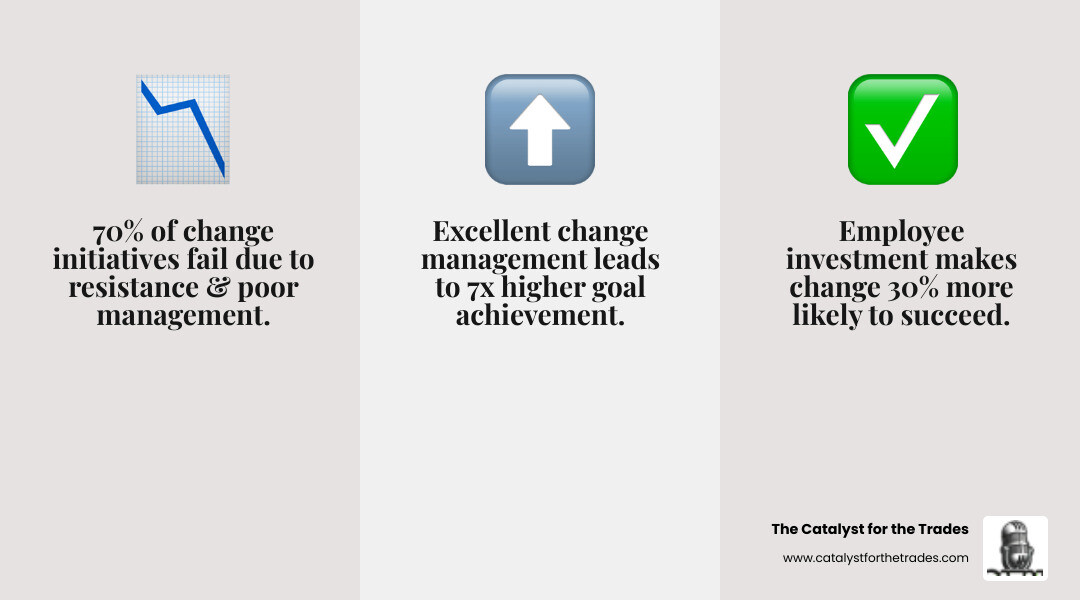
Infographic showing two paths: Left side displays "70% of change programs fail" with icons representing employee resistance, lack of support, and stress. Right side shows "30% higher success rate" with icons for employee investment, clear communication, and leadership alignment. Center shows a balance scale tipping toward success when people are prioritized in the change process. - organizational change infographic 3_facts_emoji_grey

Organizational change terms simplified:

The Anatomy of Change: Understanding the Different Types

In the home services industry, nothing stays the same. From new diagnostic software to smart home installations, businesses are constantly evolving. The question isn't whether change will happen, but whether you can manage it effectively. Understanding the type of change you're facing is the first step.

Strategic change reshapes your business's fundamental direction, like shifting from a repair-focused model to offering maintenance plans or entering a new niche. These moves require careful planning and Strategic Adaptation to market demands.

Structural change affects your organization's hierarchy, roles, and team configurations. This could mean restructuring your dispatch team to eliminate bottlenecks or merging field teams to optimize service routes.

Technological change is changing the trades faster than ever. Implementing a new CRM, adopting advanced diagnostic tools, or leveraging AI for marketing all fall into this category. As we've discussed, The AI Revolution in Home Services: How to Future-Proof Your Trades Business is happening now.

People-centric change focuses on your team's skills, culture, and mindset. This includes new training programs, initiatives to strengthen a customer-first culture, or improving collaboration between office and field staff.

Unplanned change occurs due to sudden market shifts, new regulations, or unexpected competition. While unpredictable, you can build the agility to respond effectively.

Remedial change is about fixing a problem, such as tanking customer satisfaction scores or high callback rates. The goal is to implement a solution and measure its effectiveness.

diagram showing interconnected gears labeled with different change types - organizational change

Changeal vs. Incremental Change

Beyond the type of change, you must consider its scale.

Changeal change is a large-scale, disruptive shift that fundamentally alters your business. Think of overhauling your digital presence or pivoting to a new specialty. These initiatives require significant resources, carry higher risk, and demand a new vision, which is why it's critical to Lead Digital Transformation in Home Service Marketing and Why You Can't Wait.

Incremental change is the steady drumbeat of continuous improvement. It involves smaller, less disruptive adjustments like updating training modules or refining dispatch protocols. These changes are about optimization, not a complete overhaul.

FeatureChangeal ChangeIncremental Change
Scale & ScopeLarge-scale, fundamental shift in operations, culture, or structure. Often involves a new vision.Small, gradual adjustments to existing processes or systems.
ImpactSignificant, often disruptive, aiming for substantial benefits and a new way of doing business.Less disruptive, focuses on continuous improvement and optimization.
ResourcesRequires considerable investment in time, money, and effort.Generally requires fewer resources and is easier to implement.
RiskHigher risk due to the magnitude of the change and potential for resistance.Lower risk, as changes are minor and easier to reverse if needed.
Examples (Trades)Pivoting from general HVAC to specialized geothermal installations; fully digitizing all field operations; merging with another service provider.Updating technician training modules; refining dispatch protocols; implementing a new customer feedback loop.
When to UseWhen facing significant market shifts, needing a competitive edge, or aiming for breakthrough growth.For ongoing optimization, addressing minor inefficiencies, or adapting to small market shifts.

Most successful trades businesses need both. Incremental changes keep operations efficient, while changeal changes position you for breakthrough growth. The key is knowing which approach fits the situation and having the leadership to guide your team through it.

Even well-planned organizational change is difficult. The struggle isn't usually about what needs to change, but how to make it happen. With 70% of change programs failing due to employee resistance and lack of management support, understanding the common obstacles is critical.

team collaborating to solve a puzzle - organizational change

Here are the obstacles that trip up home services businesses:

  • Employee resistance and uncertainty: Change disrupts comfort zones, triggering anxiety about job security, new responsibilities, or the unknown. This fear often leads to pushback.
  • Change fatigue: Constant new initiatives can burn out your team. They become cynical and tired of adapting, causing even good ideas to be met with resistance.
  • Insufficient resources and training: Rolling out new systems or services without proper training, tools, or budget leads to declining productivity, poor work quality, and frustrated employees.
  • Lack of clear communication: When leaders don't explain the "why" behind a change, employees fill the void with speculation and worst-case scenarios, eroding trust.
  • Cultural barriers: If a proposed change clashes with the company's established culture—the unspoken "way we do things"—it will struggle to take root.
  • Leadership alignment issues: If the leadership team isn't visibly united and committed, employees won't buy in. Mixed signals breed confusion and skepticism.

These challenges directly impact Employee Loyalty and must be addressed head-on.

Managing the Employee Sentiment Spectrum

Only 33% of workers feel their voice matters during change. To fix this, you must understand the employee sentiment spectrum.

  • Champions: These early adopters are excited by new possibilities. Identify them early, empower them, and let them help train others and spread enthusiasm.
  • Neutral or unaware employees: Most employees fall here. They aren't resisting, but they aren't on board yet. They need clear communication, success stories, and reassurance to become active participants.
  • Active resistance: These employees openly question the change, often for legitimate reasons like fear of losing skills or past negative experiences. Don't dismiss them. Engage in honest dialogue, listen to their concerns, and involve them in finding solutions. Their feedback can reveal flaws in your plan and help you improve the process.

As we learned from Jazmin Ramirez: How Real Leadership Powers Change in the Trades, real leadership means meeting people where they are. Managing the sentiment spectrum creates space for authentic buy-in across the team.

The Leader's Playbook: Strategies for Successful Change

For organizational change to succeed, your leadership team must be the driving force. Leaders don't just manage change—they model it, champion it, and live it daily.

leader at a whiteboard with a team - organizational change

Leadership alignment is the starting point. If your leadership team isn't speaking with one voice, employees will sense the hesitation. Leaders must be visibly committed, understand the "why," and participate in the transition.

Build a guiding coalition with cross-functional teams. Including voices from dispatch, field service, and operations brings real-world perspectives, helps spot problems early, and translates strategy into action. This collaborative approach is key to building The Future of Leadership: How to Build a Team That Drives Growth.

Communicate the 'why' clearly and consistently. Your team needs to understand the reasons for the change and its tangible benefits, such as better efficiency or more predictable schedules. This requires an ongoing conversation, not a single announcement.

Involve your team in the process. Instead of dictating changes, create opportunities for discussion and feedback. When people feel heard, they develop a sense of ownership. This is the essence of Embracing Change: The Future of Leadership.

Connect change to daily work. Help technicians and office staff understand exactly how the change affects their specific tasks. Bridge the gap between big-picture strategy and day-to-day reality to make change feel manageable.

Key Frameworks for Managing Organizational Change

You don't have to reinvent the wheel. Proven frameworks can guide you through complex transitions.

  • Kotter's 8-Step Process: A comprehensive model that walks you through creating urgency, building a coalition, implementing the change, and making it stick.
  • Kurt Lewin's Change Model: A simple three-stage approach: Unfreeze (prepare for change), Change (implement new processes), and Refreeze (solidify the new habits). It's great for more contained changes.
  • The ADKAR Model: This model focuses on individual adoption through five elements: Awareness, Desire, Knowledge, Ability, and Reinforcement. It's useful for ensuring every team member successfully adopts new tools or skills.
  • The McKinsey 7-S Framework: This holistic model examines seven interconnected elements: Structure, Strategy, Systems, Skills, Staff, Style, and Shared Values. It's valuable for major strategic shifts, ensuring all parts of the business are aligned, similar to the thinking in How EOS Helps You Scale Without the Chaos.

The right framework depends on your goals. The key is to have a structured roadmap instead of just winging it.

Measuring What Matters: From Implementation to ROI

Implementing organizational change without measuring its impact is like running service calls without tracking results. To ensure change drives growth, you must measure what matters.
dashboard showing KPIs like adoption rate and productivity - organizational change

To accelerate ROI, focus on getting your team proficient quickly. Since most learning is hands-on, provide real-time practice and in-app guidance. This "learning in the flow of work" approach helps solve problems as they arise. Monitor adoption and user behavior through data to spot issues early. If technicians aren't using a new system, it's feedback that something needs to be fixed.

Before launching, define clear, measurable objectives using the SMART framework (Specific, Measurable, Achievable, Relevant, Time-bound). Key metrics for trades businesses include:

  • Productivity improvements: e.g., reducing average service call duration.
  • Customer satisfaction: e.g., targeting higher post-service survey scores.
  • Operational cost reductions: e.g., cutting fuel expenses by optimizing routes.
  • Employee adoption rates: e.g., tracking login frequency and feature usage.

Always establish baseline data before the change to accurately measure progress. This systematic approach is key to effective Process Improvement.

Monitoring Adoption and Gathering Feedback

Combine hard data with human insights to understand how change is landing.

Behavioral monitoring involves observing how your team works with new tools. Ride along on service calls or walk the floor to see if new processes are being used correctly. This reveals nuances that system analytics miss.

Gather employee feedback through multiple channels. Since only 33% of workers feel their input matters, this is a huge opportunity. Use anonymous surveys, one-on-one interviews, or focus groups to uncover roadblocks and ideas for improvement.

Finally, turn information into action. Compare results against your original objectives. If you see discrepancies—like improved customer satisfaction but lower employee engagement—investigate the cause. Use data to make adjustments, recognizing that change management is an ongoing process of learning and refining. This commitment to feedback is the foundation of building systems that work for your team, as detailed in How Systems Create Freedom: Mike Abramowitz's Blueprint for Trades Success.

Conclusion

Here's the truth about organizational change: it's never really finished. In the home services world, where customer expectations shift, technology evolves, and market conditions fluctuate, change isn't a destination—it's the journey itself. From that first conversation about "what if we tried something new?" to the moment a new process becomes second nature to your team, every step requires patience, strategy, and genuine care for the people doing the work.

Throughout this guide, we've walked through the landscape of change together. We've examined the different types of change your business might face, from strategic pivots to technological upgrades. We've acknowledged the very real obstacles—the resistance, the fatigue, the resource constraints—that can make even well-planned initiatives feel impossible. And we've explored proven frameworks and strategies that turn those challenges into opportunities.

But if there's one thing to take away, it's this: successful organizational change rests on three interconnected pillars. First, your people—because no system, software, or strategy works without the humans who bring it to life. Second, your leadership—the unified, visible commitment that gives your team the confidence to move forward. And third, your clear strategy—the roadmap that connects the big vision to the daily realities of running service calls, managing dispatch, and delighting customers.

When we get these three elements right, something remarkable happens. Change stops feeling like disruption and starts feeling like progress. Your team becomes more efficient, your customers more satisfied, and your business more resilient. Effective change management isn't just about surviving transitions—it's about using them as springboards for growth, innovation, and market leadership.

At The Catalyst for the Trades, we're passionate about helping businesses like yours steer these waters with confidence. Whether you're considering your first major change or refining your approach after past attempts, you don't have to figure it out alone. Explore more leadership strategies for your trades business, and when you're ready to turn your next change initiative into your greatest success story, we're here to help you make it happen.

Why Organizational Change Is the Defining Challenge for Trades Businesses

Organizational change is the process of altering a company's structure, culture, or processes to adapt, grow, or solve problems. For home services business owners, managing change isn't optional—it's essential for survival and growth. How you manage transitions like new software rollouts or team restructuring determines whether your business thrives or stalls.

Here's what you need to know:

  • What it is: Any significant shift in how your business operates.
  • Why it matters: 70% of change initiatives fail, often due to employee resistance.
  • The key to success: When employees are invested, change is 30% more likely to succeed.
  • Common types: Strategic, structural, technological, people-centric, and unplanned changes.
  • Critical factors: Clear communication, leadership alignment, and measurable goals.

Despite its importance, change is a major challenge. Only 25% of workers believe their organization manages change effectively, with many reporting increased stress and workload during transitions. For trades companies trying to scale, these failures are existential threats.

The good news is that companies with excellent change management are seven times more likely to achieve their goals. The difference isn't luck—it's a structured, people-first approach.

If you're looking to build the leadership skills needed to guide your team through change, check out our proven strategies for scaling trades businesses, and when you're ready to take the next step, let's talk about transforming your business.

Infographic showing two paths: Left side displays "70% of change programs fail" with icons representing employee resistance, lack of support, and stress. Right side shows "30% higher success rate" with icons for employee investment, clear communication, and leadership alignment. Center shows a balance scale tipping toward success when people are prioritized in the change process. - organizational change infographic 3_facts_emoji_grey

Organizational change terms simplified:

The Anatomy of Change: Understanding the Different Types

In the home services industry, nothing stays the same. From new diagnostic software to smart home installations, businesses are constantly evolving. The question isn't whether change will happen, but whether you can manage it effectively. Understanding the type of change you're facing is the first step.

Strategic change reshapes your business's fundamental direction, like shifting from a repair-focused model to offering maintenance plans or entering a new niche. These moves require careful planning and Strategic Adaptation to market demands.

Structural change affects your organization's hierarchy, roles, and team configurations. This could mean restructuring your dispatch team to eliminate bottlenecks or merging field teams to optimize service routes.

Technological change is changing the trades faster than ever. Implementing a new CRM, adopting advanced diagnostic tools, or leveraging AI for marketing all fall into this category. As we've discussed, The AI Revolution in Home Services: How to Future-Proof Your Trades Business is happening now.

People-centric change focuses on your team's skills, culture, and mindset. This includes new training programs, initiatives to strengthen a customer-first culture, or improving collaboration between office and field staff.

Unplanned change occurs due to sudden market shifts, new regulations, or unexpected competition. While unpredictable, you can build the agility to respond effectively.

Remedial change is about fixing a problem, such as tanking customer satisfaction scores or high callback rates. The goal is to implement a solution and measure its effectiveness.

diagram showing interconnected gears labeled with different change types - organizational change

Changeal vs. Incremental Change

Beyond the type of change, you must consider its scale.

Changeal change is a large-scale, disruptive shift that fundamentally alters your business. Think of overhauling your digital presence or pivoting to a new specialty. These initiatives require significant resources, carry higher risk, and demand a new vision, which is why it's critical to Lead Digital Transformation in Home Service Marketing and Why You Can't Wait.

Incremental change is the steady drumbeat of continuous improvement. It involves smaller, less disruptive adjustments like updating training modules or refining dispatch protocols. These changes are about optimization, not a complete overhaul.

FeatureChangeal ChangeIncremental Change
Scale & ScopeLarge-scale, fundamental shift in operations, culture, or structure. Often involves a new vision.Small, gradual adjustments to existing processes or systems.
ImpactSignificant, often disruptive, aiming for substantial benefits and a new way of doing business.Less disruptive, focuses on continuous improvement and optimization.
ResourcesRequires considerable investment in time, money, and effort.Generally requires fewer resources and is easier to implement.
RiskHigher risk due to the magnitude of the change and potential for resistance.Lower risk, as changes are minor and easier to reverse if needed.
Examples (Trades)Pivoting from general HVAC to specialized geothermal installations; fully digitizing all field operations; merging with another service provider.Updating technician training modules; refining dispatch protocols; implementing a new customer feedback loop.
When to UseWhen facing significant market shifts, needing a competitive edge, or aiming for breakthrough growth.For ongoing optimization, addressing minor inefficiencies, or adapting to small market shifts.

Most successful trades businesses need both. Incremental changes keep operations efficient, while changeal changes position you for breakthrough growth. The key is knowing which approach fits the situation and having the leadership to guide your team through it.

Even well-planned organizational change is difficult. The struggle isn't usually about what needs to change, but how to make it happen. With 70% of change programs failing due to employee resistance and lack of management support, understanding the common obstacles is critical.

team collaborating to solve a puzzle - organizational change

Here are the obstacles that trip up home services businesses:

  • Employee resistance and uncertainty: Change disrupts comfort zones, triggering anxiety about job security, new responsibilities, or the unknown. This fear often leads to pushback.
  • Change fatigue: Constant new initiatives can burn out your team. They become cynical and tired of adapting, causing even good ideas to be met with resistance.
  • Insufficient resources and training: Rolling out new systems or services without proper training, tools, or budget leads to declining productivity, poor work quality, and frustrated employees.
  • Lack of clear communication: When leaders don't explain the "why" behind a change, employees fill the void with speculation and worst-case scenarios, eroding trust.
  • Cultural barriers: If a proposed change clashes with the company's established culture—the unspoken "way we do things"—it will struggle to take root.
  • Leadership alignment issues: If the leadership team isn't visibly united and committed, employees won't buy in. Mixed signals breed confusion and skepticism.

These challenges directly impact Employee Loyalty and must be addressed head-on.

Managing the Employee Sentiment Spectrum

Only 33% of workers feel their voice matters during change. To fix this, you must understand the employee sentiment spectrum.

  • Champions: These early adopters are excited by new possibilities. Identify them early, empower them, and let them help train others and spread enthusiasm.
  • Neutral or unaware employees: Most employees fall here. They aren't resisting, but they aren't on board yet. They need clear communication, success stories, and reassurance to become active participants.
  • Active resistance: These employees openly question the change, often for legitimate reasons like fear of losing skills or past negative experiences. Don't dismiss them. Engage in honest dialogue, listen to their concerns, and involve them in finding solutions. Their feedback can reveal flaws in your plan and help you improve the process.

As we learned from Jazmin Ramirez: How Real Leadership Powers Change in the Trades, real leadership means meeting people where they are. Managing the sentiment spectrum creates space for authentic buy-in across the team.

The Leader's Playbook: Strategies for Successful Change

For organizational change to succeed, your leadership team must be the driving force. Leaders don't just manage change—they model it, champion it, and live it daily.

leader at a whiteboard with a team - organizational change

Leadership alignment is the starting point. If your leadership team isn't speaking with one voice, employees will sense the hesitation. Leaders must be visibly committed, understand the "why," and participate in the transition.

Build a guiding coalition with cross-functional teams. Including voices from dispatch, field service, and operations brings real-world perspectives, helps spot problems early, and translates strategy into action. This collaborative approach is key to building The Future of Leadership: How to Build a Team That Drives Growth.

Communicate the 'why' clearly and consistently. Your team needs to understand the reasons for the change and its tangible benefits, such as better efficiency or more predictable schedules. This requires an ongoing conversation, not a single announcement.

Involve your team in the process. Instead of dictating changes, create opportunities for discussion and feedback. When people feel heard, they develop a sense of ownership. This is the essence of Embracing Change: The Future of Leadership.

Connect change to daily work. Help technicians and office staff understand exactly how the change affects their specific tasks. Bridge the gap between big-picture strategy and day-to-day reality to make change feel manageable.

Key Frameworks for Managing Organizational Change

You don't have to reinvent the wheel. Proven frameworks can guide you through complex transitions.

  • Kotter's 8-Step Process: A comprehensive model that walks you through creating urgency, building a coalition, implementing the change, and making it stick.
  • Kurt Lewin's Change Model: A simple three-stage approach: Unfreeze (prepare for change), Change (implement new processes), and Refreeze (solidify the new habits). It's great for more contained changes.
  • The ADKAR Model: This model focuses on individual adoption through five elements: Awareness, Desire, Knowledge, Ability, and Reinforcement. It's useful for ensuring every team member successfully adopts new tools or skills.
  • The McKinsey 7-S Framework: This holistic model examines seven interconnected elements: Structure, Strategy, Systems, Skills, Staff, Style, and Shared Values. It's valuable for major strategic shifts, ensuring all parts of the business are aligned, similar to the thinking in How EOS Helps You Scale Without the Chaos.

The right framework depends on your goals. The key is to have a structured roadmap instead of just winging it.

Measuring What Matters: From Implementation to ROI

Implementing organizational change without measuring its impact is like running service calls without tracking results. To ensure change drives growth, you must measure what matters.

dashboard showing KPIs like adoption rate and productivity - organizational change

To accelerate ROI, focus on getting your team proficient quickly. Since most learning is hands-on, provide real-time practice and in-app guidance. This "learning in the flow of work" approach helps solve problems as they arise. Monitor adoption and user behavior through data to spot issues early. If technicians aren't using a new system, it's feedback that something needs to be fixed.

Before launching, define clear, measurable objectives using the SMART framework (Specific, Measurable, Achievable, Relevant, Time-bound). Key metrics for trades businesses include:

  • Productivity improvements: e.g., reducing average service call duration.
  • Customer satisfaction: e.g., targeting higher post-service survey scores.
  • Operational cost reductions: e.g., cutting fuel expenses by optimizing routes.
  • Employee adoption rates: e.g., tracking login frequency and feature usage.

Always establish baseline data before the change to accurately measure progress. This systematic approach is key to effective Process Improvement.

Monitoring Adoption and Gathering Feedback

Combine hard data with human insights to understand how change is landing.

Behavioral monitoring involves observing how your team works with new tools. Ride along on service calls or walk the floor to see if new processes are being used correctly. This reveals nuances that system analytics miss.

Gather employee feedback through multiple channels. Since only 33% of workers feel their input matters, this is a huge opportunity. Use anonymous surveys, one-on-one interviews, or focus groups to uncover roadblocks and ideas for improvement.

Finally, turn information into action. Compare results against your original objectives. If you see discrepancies—like improved customer satisfaction but lower employee engagement—investigate the cause. Use data to make adjustments, recognizing that change management is an ongoing process of learning and refining. This commitment to feedback is the foundation of building systems that work for your team, as detailed in How Systems Create Freedom: Mike Abramowitz's Blueprint for Trades Success.

Conclusion

Here's the truth about organizational change: it's never really finished. In the home services world, where customer expectations shift, technology evolves, and market conditions fluctuate, change isn't a destination—it's the journey itself. From that first conversation about "what if we tried something new?" to the moment a new process becomes second nature to your team, every step requires patience, strategy, and genuine care for the people doing the work.

Throughout this guide, we've walked through the landscape of change together. We've examined the different types of change your business might face, from strategic pivots to technological upgrades. We've acknowledged the very real obstacles—the resistance, the fatigue, the resource constraints—that can make even well-planned initiatives feel impossible. And we've explored proven frameworks and strategies that turn those challenges into opportunities.

But if there's one thing to take away, it's this: successful organizational change rests on three interconnected pillars. First, your people—because no system, software, or strategy works without the humans who bring it to life. Second, your leadership—the unified, visible commitment that gives your team the confidence to move forward. And third, your clear strategy—the roadmap that connects the big vision to the daily realities of running service calls, managing dispatch, and delighting customers.

When we get these three elements right, something remarkable happens. Change stops feeling like disruption and starts feeling like progress. Your team becomes more efficient, your customers more satisfied, and your business more resilient. Effective change management isn't just about surviving transitions—it's about using them as springboards for growth, innovation, and market leadership.

At The Catalyst for the Trades, we're passionate about helping businesses like yours steer these waters with confidence. Whether you're considering your first major change or refining your approach after past attempts, you don't have to figure it out alone. Explore more leadership strategies for your trades business, and when you're ready to turn your next change initiative into your greatest success story, we're here to help you make it happen.

Why Organizational Change Is the Defining Challenge for Trades Businesses

Organizational change is the process of altering a company's structure, culture, or processes to adapt, grow, or solve problems. For home services business owners, managing change isn't optional—it's essential for survival and growth. How you manage transitions like new software rollouts or team restructuring determines whether your business thrives or stalls.

Here's what you need to know:

  • What it is: Any significant shift in how your business operates.
  • Why it matters: 70% of change initiatives fail, often due to employee resistance.
  • The key to success: When employees are invested, change is 30% more likely to succeed.
  • Common types: Strategic, structural, technological, people-centric, and unplanned changes.
  • Critical factors: Clear communication, leadership alignment, and measurable goals.

Despite its importance, change is a major challenge. Only 25% of workers believe their organization manages change effectively, with many reporting increased stress and workload during transitions. For trades companies trying to scale, these failures are existential threats.

The good news is that companies with excellent change management are seven times more likely to achieve their goals. The difference isn't luck—it's a structured, people-first approach.

If you're looking to build the leadership skills needed to guide your team through change, check out our proven strategies for scaling trades businesses, and when you're ready to take the next step, let's talk about transforming your business.

Infographic showing two paths: Left side displays "70% of change programs fail" with icons representing employee resistance, lack of support, and stress. Right side shows "30% higher success rate" with icons for employee investment, clear communication, and leadership alignment. Center shows a balance scale tipping toward success when people are prioritized in the change process. - organizational change infographic 3_facts_emoji_grey

Organizational change terms simplified:

The Anatomy of Change: Understanding the Different Types

In the home services industry, nothing stays the same. From new diagnostic software to smart home installations, businesses are constantly evolving. The question isn't whether change will happen, but whether you can manage it effectively. Understanding the type of change you're facing is the first step.

Strategic change reshapes your business's fundamental direction, like shifting from a repair-focused model to offering maintenance plans or entering a new niche. These moves require careful planning and Strategic Adaptation to market demands.

Structural change affects your organization's hierarchy, roles, and team configurations. This could mean restructuring your dispatch team to eliminate bottlenecks or merging field teams to optimize service routes.

Technological change is changing the trades faster than ever. Implementing a new CRM, adopting advanced diagnostic tools, or leveraging AI for marketing all fall into this category. As we've discussed, The AI Revolution in Home Services: How to Future-Proof Your Trades Business is happening now.

People-centric change focuses on your team's skills, culture, and mindset. This includes new training programs, initiatives to strengthen a customer-first culture, or improving collaboration between office and field staff.

Unplanned change occurs due to sudden market shifts, new regulations, or unexpected competition. While unpredictable, you can build the agility to respond effectively.

Remedial change is about fixing a problem, such as tanking customer satisfaction scores or high callback rates. The goal is to implement a solution and measure its effectiveness.

diagram showing interconnected gears labeled with different change types - organizational change

Changeal vs. Incremental Change

Beyond the type of change, you must consider its scale.

Changeal change is a large-scale, disruptive shift that fundamentally alters your business. Think of overhauling your digital presence or pivoting to a new specialty. These initiatives require significant resources, carry higher risk, and demand a new vision, which is why it's critical to Lead Digital Transformation in Home Service Marketing and Why You Can't Wait.

Incremental change is the steady drumbeat of continuous improvement. It involves smaller, less disruptive adjustments like updating training modules or refining dispatch protocols. These changes are about optimization, not a complete overhaul.

FeatureChangeal ChangeIncremental Change
Scale & ScopeLarge-scale, fundamental shift in operations, culture, or structure. Often involves a new vision.Small, gradual adjustments to existing processes or systems.
ImpactSignificant, often disruptive, aiming for substantial benefits and a new way of doing business.Less disruptive, focuses on continuous improvement and optimization.
ResourcesRequires considerable investment in time, money, and effort.Generally requires fewer resources and is easier to implement.
RiskHigher risk due to the magnitude of the change and potential for resistance.Lower risk, as changes are minor and easier to reverse if needed.
Examples (Trades)Pivoting from general HVAC to specialized geothermal installations; fully digitizing all field operations; merging with another service provider.Updating technician training modules; refining dispatch protocols; implementing a new customer feedback loop.
When to UseWhen facing significant market shifts, needing a competitive edge, or aiming for breakthrough growth.For ongoing optimization, addressing minor inefficiencies, or adapting to small market shifts.

Most successful trades businesses need both. Incremental changes keep operations efficient, while changeal changes position you for breakthrough growth. The key is knowing which approach fits the situation and having the leadership to guide your team through it.

Even well-planned organizational change is difficult. The struggle isn't usually about what needs to change, but how to make it happen. With 70% of change programs failing due to employee resistance and lack of management support, understanding the common obstacles is critical.

team collaborating to solve a puzzle - organizational change

Here are the obstacles that trip up home services businesses:

  • Employee resistance and uncertainty: Change disrupts comfort zones, triggering anxiety about job security, new responsibilities, or the unknown. This fear often leads to pushback.
  • Change fatigue: Constant new initiatives can burn out your team. They become cynical and tired of adapting, causing even good ideas to be met with resistance.
  • Insufficient resources and training: Rolling out new systems or services without proper training, tools, or budget leads to declining productivity, poor work quality, and frustrated employees.
  • Lack of clear communication: When leaders don't explain the "why" behind a change, employees fill the void with speculation and worst-case scenarios, eroding trust.
  • Cultural barriers: If a proposed change clashes with the company's established culture—the unspoken "way we do things"—it will struggle to take root.
  • Leadership alignment issues: If the leadership team isn't visibly united and committed, employees won't buy in. Mixed signals breed confusion and skepticism.

These challenges directly impact Employee Loyalty and must be addressed head-on.

Managing the Employee Sentiment Spectrum

Only 33% of workers feel their voice matters during change. To fix this, you must understand the employee sentiment spectrum.

  • Champions: These early adopters are excited by new possibilities. Identify them early, empower them, and let them help train others and spread enthusiasm.
  • Neutral or unaware employees: Most employees fall here. They aren't resisting, but they aren't on board yet. They need clear communication, success stories, and reassurance to become active participants.
  • Active resistance: These employees openly question the change, often for legitimate reasons like fear of losing skills or past negative experiences. Don't dismiss them. Engage in honest dialogue, listen to their concerns, and involve them in finding solutions. Their feedback can reveal flaws in your plan and help you improve the process.

As we learned from Jazmin Ramirez: How Real Leadership Powers Change in the Trades, real leadership means meeting people where they are. Managing the sentiment spectrum creates space for authentic buy-in across the team.

The Leader's Playbook: Strategies for Successful Change

For organizational change to succeed, your leadership team must be the driving force. Leaders don't just manage change—they model it, champion it, and live it daily.

leader at a whiteboard with a team - organizational change

Leadership alignment is the starting point. If your leadership team isn't speaking with one voice, employees will sense the hesitation. Leaders must be visibly committed, understand the "why," and participate in the transition.

Build a guiding coalition with cross-functional teams. Including voices from dispatch, field service, and operations brings real-world perspectives, helps spot problems early, and translates strategy into action. This collaborative approach is key to building The Future of Leadership: How to Build a Team That Drives Growth.

Communicate the 'why' clearly and consistently. Your team needs to understand the reasons for the change and its tangible benefits, such as better efficiency or more predictable schedules. This requires an ongoing conversation, not a single announcement.

Involve your team in the process. Instead of dictating changes, create opportunities for discussion and feedback. When people feel heard, they develop a sense of ownership. This is the essence of Embracing Change: The Future of Leadership.

Connect change to daily work. Help technicians and office staff understand exactly how the change affects their specific tasks. Bridge the gap between big-picture strategy and day-to-day reality to make change feel manageable.

Key Frameworks for Managing Organizational Change

You don't have to reinvent the wheel. Proven frameworks can guide you through complex transitions.

  • Kotter's 8-Step Process: A comprehensive model that walks you through creating urgency, building a coalition, implementing the change, and making it stick.
  • Kurt Lewin's Change Model: A simple three-stage approach: Unfreeze (prepare for change), Change (implement new processes), and Refreeze (solidify the new habits). It's great for more contained changes.
  • The ADKAR Model: This model focuses on individual adoption through five elements: Awareness, Desire, Knowledge, Ability, and Reinforcement. It's useful for ensuring every team member successfully adopts new tools or skills.
  • The McKinsey 7-S Framework: This holistic model examines seven interconnected elements: Structure, Strategy, Systems, Skills, Staff, Style, and Shared Values. It's valuable for major strategic shifts, ensuring all parts of the business are aligned, similar to the thinking in How EOS Helps You Scale Without the Chaos.

The right framework depends on your goals. The key is to have a structured roadmap instead of just winging it.

Measuring What Matters: From Implementation to ROI

Implementing organizational change without measuring its impact is like running service calls without tracking results. To ensure change drives growth, you must measure what matters.

dashboard showing KPIs like adoption rate and productivity - organizational change

To accelerate ROI, focus on getting your team proficient quickly. Since most learning is hands-on, provide real-time practice and in-app guidance. This "learning in the flow of work" approach helps solve problems as they arise. Monitor adoption and user behavior through data to spot issues early. If technicians aren't using a new system, it's feedback that something needs to be fixed.

Before launching, define clear, measurable objectives using the SMART framework (Specific, Measurable, Achievable, Relevant, Time-bound). Key metrics for trades businesses include:

  • Productivity improvements: e.g., reducing average service call duration.
  • Customer satisfaction: e.g., targeting higher post-service survey scores.
  • Operational cost reductions: e.g., cutting fuel expenses by optimizing routes.
  • Employee adoption rates: e.g., tracking login frequency and feature usage.

Always establish baseline data before the change to accurately measure progress. This systematic approach is key to effective Process Improvement.

Monitoring Adoption and Gathering Feedback

Combine hard data with human insights to understand how change is landing.

Behavioral monitoring involves observing how your team works with new tools. Ride along on service calls or walk the floor to see if new processes are being used correctly. This reveals nuances that system analytics miss.

Gather employee feedback through multiple channels. Since only 33% of workers feel their input matters, this is a huge opportunity. Use anonymous surveys, one-on-one interviews, or focus groups to uncover roadblocks and ideas for improvement.

Finally, turn information into action. Compare results against your original objectives. If you see discrepancies—like improved customer satisfaction but lower employee engagement—investigate the cause. Use data to make adjustments, recognizing that change management is an ongoing process of learning and refining. This commitment to feedback is the foundation of building systems that work for your team, as detailed in How Systems Create Freedom: Mike Abramowitz's Blueprint for Trades Success.

Conclusion

Here's the truth about organizational change: it's never really finished. In the home services world, where customer expectations shift, technology evolves, and market conditions fluctuate, change isn't a destination—it's the journey itself. From that first conversation about "what if we tried something new?" to the moment a new process becomes second nature to your team, every step requires patience, strategy, and genuine care for the people doing the work.

Throughout this guide, we've walked through the landscape of change together. We've examined the different types of change your business might face, from strategic pivots to technological upgrades. We've acknowledged the very real obstacles—the resistance, the fatigue, the resource constraints—that can make even well-planned initiatives feel impossible. And we've explored proven frameworks and strategies that turn those challenges into opportunities.

But if there's one thing to take away, it's this: successful organizational change rests on three interconnected pillars. First, your people—because no system, software, or strategy works without the humans who bring it to life. Second, your leadership—the unified, visible commitment that gives your team the confidence to move forward. And third, your clear strategy—the roadmap that connects the big vision to the daily realities of running service calls, managing dispatch, and delighting customers.

When we get these three elements right, something remarkable happens. Change stops feeling like disruption and starts feeling like progress. Your team becomes more efficient, your customers more satisfied, and your business more resilient. Effective change management isn't just about surviving transitions—it's about using them as springboards for growth, innovation, and market leadership.

At The Catalyst for the Trades, we're passionate about helping businesses like yours steer these waters with confidence. Whether you're considering your first major change or refining your approach after past attempts, you don't have to figure it out alone. Explore more leadership strategies for your trades business, and when you're ready to turn your next change initiative into your greatest success story, we're here to help you make it happen.

Episodes you may like

The Crystal Ball: Uncovering Key Industry Trends and Insights

Master industry analysis for home service success. Learn 4 steps to uncover trends, gather data, and apply frameworks for strategic growth.

Read more
Published
December 10, 2025
From Journeyman to Juggernaut: Cultivating Leadership in the Trades

Unlock your potential! Discover essential skills and programs for trades leadership development to advance your career and impact the industry.

Read more
Published
December 9, 2025
Future-Proof Your Business: A Guide to Developing Your Technology Strategy

Develop a winning technology strategy to future-proof your business. Align tech with goals, implement effectively, and leverage AI for growth.

Read more
Published
December 8, 2025

Guests

Remy Skerjanz
Sales Blaster AI