Learn · March 9, 2026
5-Year Business Roadmap for Contractors: Ultimate Guide
Build your 5-year business roadmap for contractors: Achieve strategic growth, financial stability, and long-term success with proven steps.
By The Catalyst Editorial Team Operator education · 10 min read · Updated July 24, 2026

Why Most Contractors Stay Stuck — and How a 5-Year Roadmap Changes That

A 5-year business roadmap for contractors is a strategic, visual plan that maps where your trade business is today, where you want it to be in five years, and the specific steps, milestones, and resources needed to get there.
Here is what a solid contractor roadmap typically covers:
- Vision and goals – A clear picture of your service standards, team structure, and customer experience targets by year five
- Service delivery foundations – Scheduling readiness, quality control, and a consistent customer journey
- Operations and team – Hiring plans, process documentation, and capacity growth
- Customer relationships – Lead handling, customer retention, and brand positioning
- Risk management – Contingency planning, payment workflows, and market adaptation
- KPI tracking – Monthly and quarterly performance reviews to keep the plan on course
Most contractors are skilled at the work. The problem is not talent — it is what happens between jobs. Reactive hiring, unpredictable schedules, and no clear growth target trap even experienced trade business owners in a cycle of firefighting instead of building something lasting.
Research consistently shows that organizations with a structured strategic plan covering three to five years make better decisions around people, systems, and priorities. Yet most small and mid-size contractors are running without one.
The difference between a business that scales and one that stalls often comes down to one thing: intention. A five-year roadmap gives your business a destination, a timeline, and the structure to actually get there — without guessing.
This guide walks you through exactly how to build one.
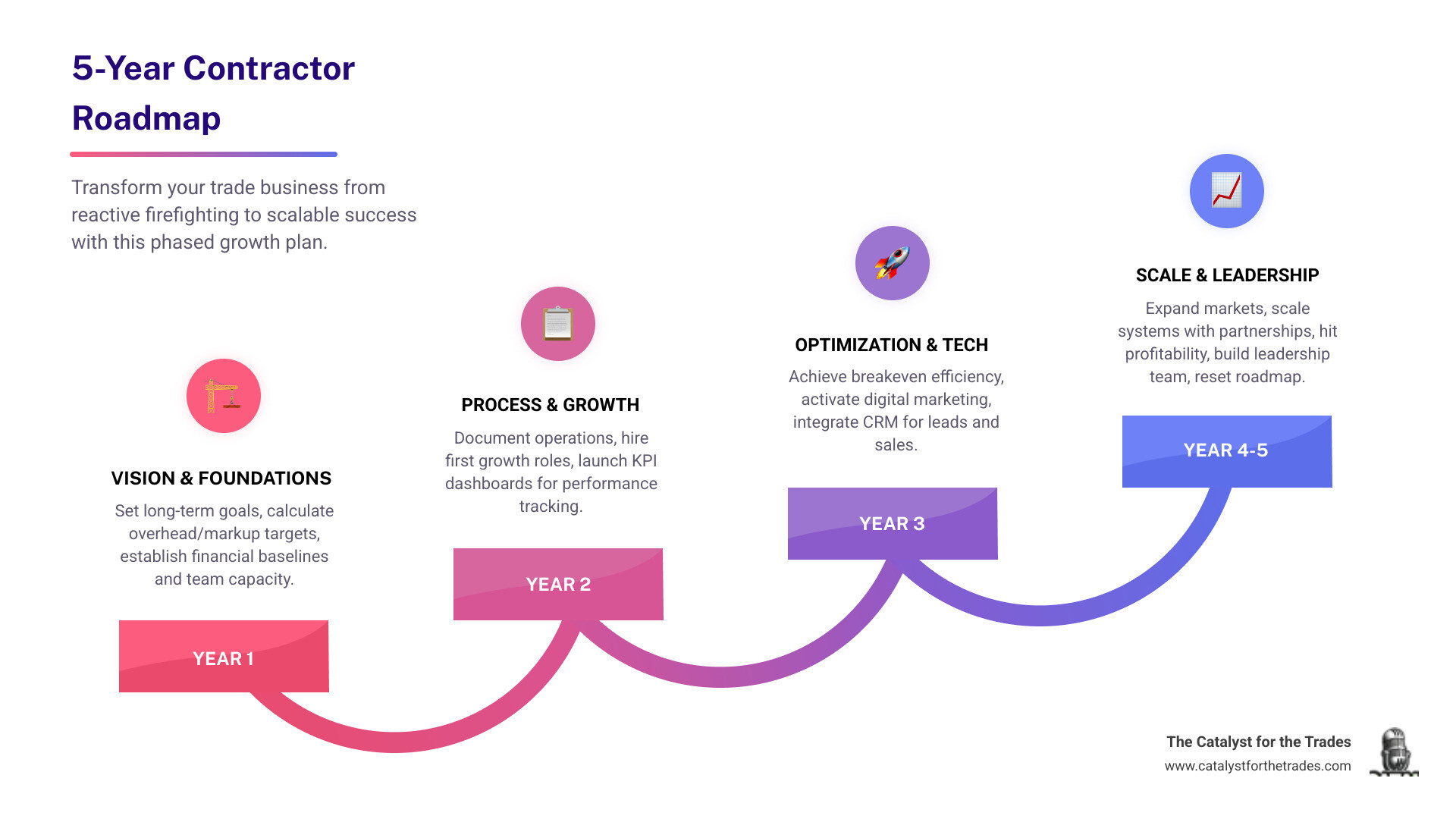
Defining the 5-Year Business Roadmap for Contractors
When we talk about a 5-year business roadmap for contractors, we aren’t just talking about a dusty document sitting in a drawer. We are talking about a living, breathing visual tool that aligns your daily grit with your long-term dreams. While a business plan explains what your company is, the roadmap visualizes how you will evolve over time.
For many in the trades, the biggest hurdle isn’t the technical work; it’s being trapped in “reactive mode.” You take the jobs that come in, hire whoever is available when you’re desperate, and hope the bank account looks okay at the end of the month. A roadmap shifts you into “proactive mode.” It allows you to see dependencies—like knowing you need to hire an estimator in Year 2 so you can double your project volume by Year 4.
This alignment is the secret sauce of business strategy development. It moves your company from a state of “unorganized hustle” to “organizational maturity,” where systems, not just your personal effort, drive the business forward.
Strategic Objectives for Long-Term Stability
To build a roadmap that actually lasts five years, you need clear strategic objectives. These aren’t just vague wishes like “I want to be bigger.” They are specific pillars that support your growth.
- The Vision Statement: This is your “North Star.” It defines where you want to be and why it matters. Are you the premier luxury custom home builder in your region, or the most efficient high-volume HVAC service provider?
- Core Values: These are your non-negotiables. They dictate who you hire and how you treat customers.
- Scalability: A roadmap must address how the business functions when you aren’t the one holding the wrench or the clipboard. This involves contractor business strategy that focuses on building a “sellable” or self-sustaining entity.
- Competitive Advantage: Why should a developer or homeowner pick you over the guy down the street? Your roadmap should include steps to sharpen this edge, whether through specialized certifications or superior technology.
Financial Foundations: Profit Margins and Cash Flow
If the vision is the destination, the financials are the fuel. You can have the best blueprint in the world, but if you run out of gas, you aren’t going anywhere. Many contractors confuse “vanity turnover” (total revenue) with actual success. In reality, profit is what you keep, and cash flow is what keeps you alive.
| Feature | Profit | Cash Flow |
|---|---|---|
| Definition | Money left after all project costs and overhead are paid. | The timing of money moving in and out of your business monthly. |
| Focus | Long-term sustainability and business valuation. | Immediate ability to pay bills, payroll, and suppliers. |
| Goal | To ensure the business is actually making money on paper. | To ensure you don’t go broke while waiting for a check to clear. |
A common industry benchmark is the “10 and 10” rule: aiming for 10% overhead and 10% net profit. However, a 2019 NAHB survey found that many residential builders actually see overhead exceeding 11%, leaving profit margins thinner than expected. To hit a true 10% profit goal, your math has to be precise.
Planning for Sustainable Profitability
One of the most frequent mistakes we see is improper markup. If you want a 10% profit after 10% overhead, you cannot simply add 20% to your job costs. Why? Because overhead is a percentage of the final bid, not the base cost.
To hit that “10 and 10” target, you generally need to apply a 25% markup to your base job costs. For example, if a job costs $10,000 in labor and materials, a 25% markup brings the bid to $12,500. From that $12,500, 10% ($1,250) covers overhead, leaving exactly 10% ($1,250) as net profit.
Sustainable growth requires business growth strategies that include:
- Rigorous Job Costing: Tracking every nail and hour to ensure your estimates match reality.
- Regular Financial Reporting: You should be looking at your P&L statement monthly, not just at tax time.
- Building Cash Reserves: Aim for a “minimum cash cushion.” For a scaling general contractor, this might mean having several months of operating expenses in the bank to survive the gap between project start-up costs and the first major draw.
A Step-By-Step Process for Building Your Roadmap
Building a 5-year business roadmap for contractors from scratch doesn’t have to be overwhelming. We recommend breaking it down using a Work Breakdown Structure (WBS)—the same way you’d break down a massive construction project into manageable phases.
The strategic planning process involves five core steps:
- Create the 5-Year Plan: Define your high-level vision and revenue targets.
- Identify Tasks: What needs to happen to reach those targets? (e.g., “Implement a new CRM,” “Hire a Lead Foreman”).
- Build a Visual Timeline: Use a Gantt chart to sequence these tasks. You can’t scale your marketing if you don’t have the crew to handle the leads.
- Set Milestones: These are your “checkpoints” to celebrate progress and ensure you’re on track.
- Estimate Resources: Determine the capital and people required for each phase.
Phase 1: Establishing a Vision
The first phase is all about future-proofing your business. You need to look at market trends. For instance, did you know that over 67% of construction firms are now actively seeking eco-friendly options? If your 5-year plan doesn’t include sustainable practices, you might be left behind.
Once you have the big picture, don’t try to do it all at once. We advocate for 90-day sprints. While the roadmap looks five years out, your team works in 13-week blocks. This keeps the long-term goal from feeling like a fantasy and makes the immediate tasks feel urgent.
Scaling Operations and Integrating Technology
As you move into Years 2 and 3 of your roadmap, the focus shifts from “survival” to “efficiency.” This is where many contractors hit a plateau. They try to manage 20 people using the same paper-and-pen methods they used when it was just two guys in a truck.
Operational efficiency is built on two things: Process Documentation and Technology Integration. You need a “playbook” for everything—from how an inquiry is handled to how a job site is cleaned up. This ensures consistency as you scale.
Technology strategy is no longer optional. Integrating a Field Service Management (FSM) tool or a CRM allows you to track customer relationships and project status in real-time. Furthermore, an AI strategy for contractors can help with automated scheduling, predictive maintenance, and even more accurate bidding.
Leveraging Digital Marketing in Your Roadmap
Marketing shouldn’t be a “faucet” you turn on only when the phone stops ringing. It should be a core component of your long-term growth. In the early stages, you might rely on referrals, but to reach Year 5 targets, you need a predictable lead-generation engine.
Your home service business growth plan should integrate:
- Brand Positioning: Clearly defining your UVP (Unique Value Proposition).
- Content Strategy: Showing off your expertise through project galleries and helpful videos.
- Customer Relationship Management (CRM): Turning one-time customers into lifelong advocates who provide those high-value referrals.
- Sales Execution: Training your team to not just “give quotes,” but to solve problems for the customer.
Risk Management and Performance Tracking
A roadmap that doesn’t account for risk is just a wish list. The construction industry is famous for fluctuating material costs, labor shortages, and payment delays. Your roadmap needs “risk triggers”—pre-planned actions you take if things go sideways.
One of the most powerful tools for protecting your business is proactive payment management. Using preliminary notices and tracking mechanics lien deadlines ensures you actually get paid for the work you do. Strategic adaptation means having a “Plan B” (and Plan C) for supply chain shocks or economic downturns.
Key Performance Indicators for Long-Term Success
How do you know if the roadmap is working? You track the numbers that matter. While revenue is important, it doesn’t tell the whole story. You need a mix of financial and operational KPIs:
- Win Rate: What percentage of your bids are turning into contracts?
- Project Delivery: Are jobs being completed on time and on budget?
- Employee Retention: Is your team growing with you, or are you a “revolving door” for talent? Effective workforce planning is cheaper than constant recruiting.
- Customer Acquisition Cost (CAC): How much does it cost you to get a new lead? As you scale, you want to see this number stabilize or drop.
We recommend quarterly reviews where you ask three questions: What moved? Why did it move? And what are we going to do about it?
Frequently Asked Questions about Contractor Roadmaps
What is the difference between a business plan and a strategic roadmap?
A business plan is typically a formal, comprehensive document created at the start of a business or during a major pivot. It outlines the “who, what, and where” of the company. A 5-year business roadmap for contractors is a visual, high-level execution plan. It focuses on the “how and when,” mapping out specific initiatives and milestones over a multi-year timeline. Think of the business plan as the destination and the roadmap as the GPS.
How often should a contractor review their 5-year roadmap?
While the horizon is five years, the review cycle should be much shorter. We suggest a “deep-dive” review every quarter (every 90 days). This allows you to adjust for market shifts—like a sudden spike in material costs or a new competitor entering the area—while ensuring your daily actions still align with that 5-year vision.
Why is the “10 and 10” rule important for long-term planning?
The “10 and 10” rule (10% overhead and 10% net profit) provides a healthy benchmark for a sustainable business. If your profit is lower than 10%, you may not have enough capital to reinvest in the business, buy new equipment, or weather an economic storm. By planning your roadmap around these margins, you ensure that as you grow, you are actually becoming more stable, not just busier.
Conclusion
Building a 5-year business roadmap for contractors is about more than just numbers on a spreadsheet; it is about a leadership mindset. It is the transition from being a “worker who owns a business” to a “business owner who leads a team.”
Strategic evolution takes time, and it requires the humility to admit that what got you to where you are today might not be what gets you to where you want to be in five years. By focusing on financial foundations, operational efficiency, and proactive risk management, you can build a business that provides not just an income, but a legacy.
At The Catalyst for the Trades, we are dedicated to helping home service professionals bridge the gap between technical expertise and strategic mastery. Whether it’s through cutting-edge AI insights or real-world operational scaling, our goal is to empower you to build a business that lasts. Learn more about our mission and how we can help you turn your 5-year vision into a reality.


