Episode
December 25, 2025

Stay Ahead of the Curve: A Guide to Future-Proofing Your Business

Why Future-Proofing Business is Essential for Long-Term Survival

Future-proofing your business is essential for staying competitive in an unpredictable market. As a trades business owner, you face pressures like recruiting talent, adopting new tech like AI, managing cash flow, and planning for growth. The reality is stark: 45% of CEOs worldwide believe their companies won't survive the next decade without significant reinvention, especially with climate disruption, tech advancements, and economic volatility.

What is Future-Proofing?

Future-proofing means building resilience and adaptability into your business so you can withstand unpredictable changes and thrive through disruption. It's not about predicting the future but creating an organization that can sense, respond, and evolve when new challenges arise.

Key Elements of a Future-Proof Business:

  • Resilience – Your ability to withstand and recover from disruptions
  • Adaptability – Your capacity to evolve your strategy, operations, and culture
  • Proactive Leadership – Making strategic decisions today that protect tomorrow
  • Continuous Learning – Building a workforce that grows with changing demands
  • Strategic Technology – Leveraging automation, AI, and data to stay ahead

The difference between "future-proof" and "future-ready" is crucial. You can't make your business immune to change, but you can prepare your people, processes, and systems to adapt quickly when disruption hits.

Ready to build a more resilient operation? Explore our guide on Strategic Adaptation to understand how to evolve your business model, or schedule a consultation to discuss your specific growth challenges.
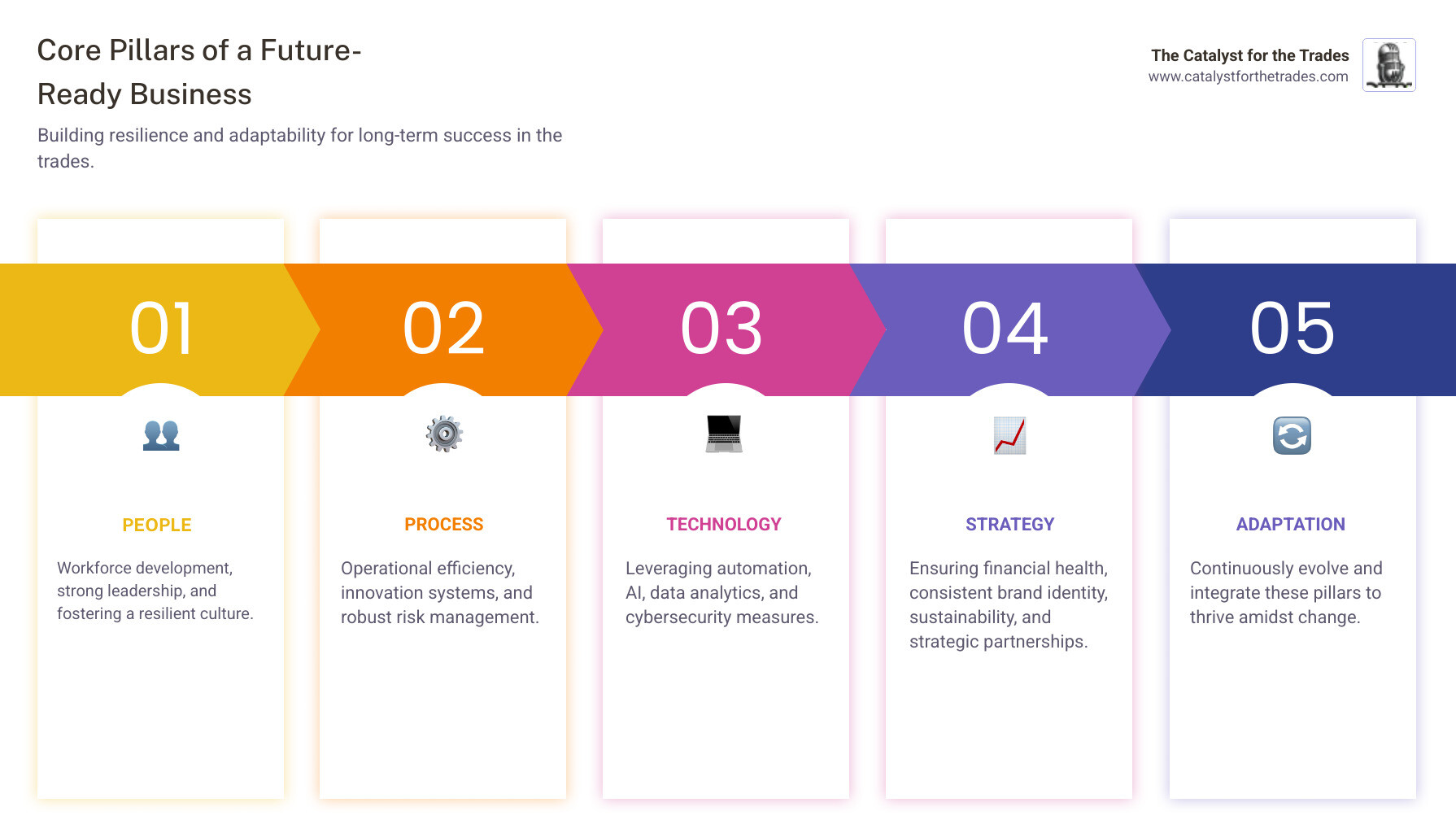
Infographic explaining the core pillars of a future-ready business: People (workforce development, leadership, culture), Process (operational efficiency, innovation systems, risk management), Technology (automation, AI, data analytics, cybersecurity), and Strategy (financial health, brand identity, sustainability, partnerships). Each pillar includes key metrics and actionable steps for trades businesses to build resilience and adaptability. - future-proofing business infographic pillar-5-steps

Basic future-proofing business terms:

The Foundation: Building a Resilient and Adaptable Organization

strong, rooted tree weathering a storm, symbolizing business resilience - future-proofing business

A future-ready business is like a strong tree, bending in storms but never breaking. This foundation of resilience and adaptability isn't just about survival; companies with high 'Future FITness' see a +33% increase in profitability compared to their competitors. For home services contractors, this means having the financial health to weather slow seasons, the strategic vision to spot opportunities, and the leadership qualities to guide your team through uncertainty. It's about building a business that gets stronger through change. This requires thoughtful Business Strategy Development and a commitment to Strategic Adaptation—anticipating shifts rather than scrambling to catch up.

Cultivating an 'Anti-Fragile' Culture

Go beyond resilience with an anti-fragile mindset, where your business doesn't just bounce back from problems but actually benefits from them. Like muscles rebuilding after a workout, an anti-fragile organization grows stronger with each challenge. The key is letting change be the norm instead of treating disruption like a crisis. Welcome small shocks—a new competitor, a key employee departure, or shifting customer preferences—as opportunities to adapt and improve.

Creating this culture requires psychological safety, where your team feels comfortable trying new approaches, even if they don't always work. As we explore in Want to Innovate Faster? Start Failing Smarter, the businesses that innovate fastest learn from their missteps and adjust quickly.

When you normalize change through effective Change Management, your team stops fearing the unknown and starts seeing every challenge as a chance to level up. That's how you build an anti-fragile culture.

Securing Your Financial Core for Long-Term Viability

Without solid finances, even the best ideas remain dreams. A healthy financial core is essential for future-proofing business operations, focusing on strategic investment, cash flow management, and profitability. In a tough economy, these are critical, as noted in these 16 tips to future-proof during a tough economy.

Strategic investment isn't just about expansion; it's about building redundancies like backup equipment, diverse supplier relationships, or a healthy cash reserve. For example, having alternative suppliers lined up protects you from disruptions.

Your approach to Financial Management: Contractors needs to balance growth with stability. As we discuss in How Smart Accounting Transforms Chaos Into Opportunity, the right financial systems don't just track numbers—they reveal opportunities and warn you about risks before they become problems.

For home services businesses, this might mean diversifying your service offerings or investing in technology that improves efficiency. The goal is building financial resilience that supports long-term viability.

Balancing Innovation with a Consistent Brand Identity

Growing businesses face a key tension: innovating to stay competitive while preserving the brand identity that earned customer trust. While new technologies and processes are vital for a future-proofing business strategy, your core values and brand identity build lasting relationships. As one expert notes, "consistency of vision is essential" during rapid change.

Your customers hired you because they trust your quality, reliability, and service. When you adopt new tools or expand offerings, those fundamental promises must remain rock-solid. Brand consistency doesn't mean never changing—it means your customers always know what to expect from you.

Whether you're implementing AI for scheduling or adding new service lines, the customer experience—professionalism, clear communication, quality work—should remain consistently excellent. That's how you build lasting customer trust.

Learning How to Build an Unstoppable Brand and Avoid the Contractor Trap will help you understand this balance. And for a great example, check out Branding That Works: Crystal Williams on Contractor Growth Strategy & Accountability.

The businesses that thrive long-term evolve without losing their essence. They innovate in how they deliver their promise, but the promise itself stays true.

The Engine: A Guide to Future-Proofing Your Business with Technology and Data

dashboard showing business intelligence analytics - future-proofing business

Technology and data are the engine powering your home services business. No longer just nice-to-haves, they are essential for growth, with 79% of companies now depending on digital tools for their future. For trades businesses, IT infrastructure, cybersecurity, automation, and data analytics are fundamental to any future-proofing business strategy. Our guide on The AI Revolution in Home Services: How to Future-Proof Your Trades Business explores this change, and understanding Technology Implementation is crucial for making these changes work.

The Critical Roles of IT and Security

Cybersecurity is critical. The average cost of a data breach hit $4.88 million in 2024, a catastrophic figure for any home services business that would shatter customer trust. Your IT and security are no longer background operations; they are foundational pillars. Shift from an outdated 'build a wall' approach to a zero-trust security model, which verifies every access attempt through robust identity authentication and continuous monitoring.

Proactive security is essential. This includes regular security audits, ongoing employee training, and potentially partnering with managed IT services. With regulations like the US SEC cybersecurity disclosure rule requiring companies to report cyber incidents, data protection is also a compliance issue.

Your CRM system, which holds sensitive customer information, is a prime example of why this matters. Protecting this data is fundamental to maintaining trust, which is why How to Get Your CRM Right and Why It Matters More Than You Think emphasizes security alongside functionality.

Leveraging Automation and AI to Mitigate Risk and Boost Efficiency

With AI computing power doubling every three months, the question for a future-proofing business isn't if you should adopt AI and automation, but how to do it strategically. The landscape has evolved to 'agentic AI'—systems that can plan and act with less human oversight. Already, 80% of organizations use generative AI regularly.

For home services, this opens up remarkable opportunities. Imagine AI handling initial customer inquiries, scheduling appointments, or optimizing service routes. AI customer service automation is already reducing case-handling times significantly. How AI is Transforming Call Handling explores how this technology is reshaping customer communication in the trades.

Here are key operational areas where automation can transform your business:

  • Customer Service & Communication: AI chatbots, automated reminders, and personalized follow-ups
  • Scheduling & Dispatch: Smart routing that considers traffic, skills, and job priority
  • Lead Management: Automatic lead scoring, nurturing, and assignment
  • Inventory Management: Predictive ordering and low-stock alerts
  • Financial Processes: Streamlined expense reporting, billing, and payroll
  • Data Backups: Scheduled automatic backups to protect critical information
  • Marketing: Automated email campaigns, social media posting, and targeted ads
  • Reporting & Analytics: Real-time performance dashboards without manual data entry

The power of automation lies in freeing your team to focus on complex problem-solving, customer relationships, and strategic growth, as explored in Adapting to Consumer Behavior: Leveraging AI and Digital Tools in the Trades.

Data analytics is the next best thing to a crystal ball. For any future-proofing business, moving from gut feelings to data-driven decisions is transformative. Your business generates constant data from service calls, website visits, and customer reviews. By strategically interpreting this information, you can anticipate trends before competitors. As one expert puts it, we must "recognize soft demand signals" and act on them early.

For example, if your data shows an uptick in inquiries about smart thermostats, that's your signal to explore adding these services before the demand is obvious. By the time a trend is undeniable, you're already playing catch-up.

Implementing robust AI Business Intelligence tools transforms raw numbers into actionable insights. Your CRM is a goldmine of customer behavior patterns and seasonal trends. CRM Success in the Trades: Celia Church's Guide to Data Implementation and Next-Level Growth provides excellent guidance on optimizing your CRM for these insights.

The businesses that thrive won't be the ones with the most data—they'll be the ones who know how to listen to it and act decisively.

The People: Fostering a Forward-Thinking and Adaptable Workforce
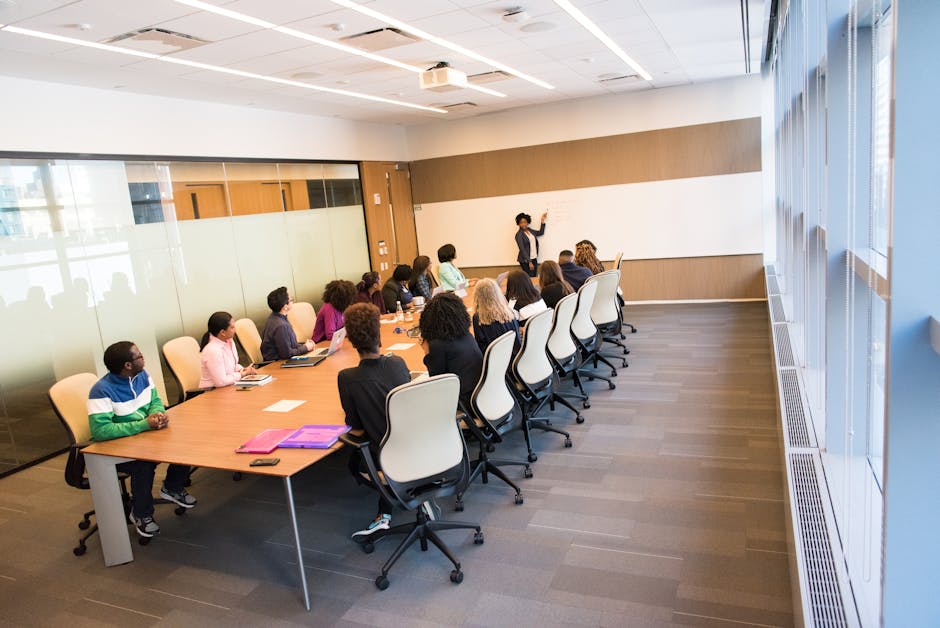
diverse team collaborating and learning together - future-proofing business

Technology and strategy matter, but people truly make or break a business. In home services, future-proofing business means building a workforce ready for what's next. We're in "The Future of Work is Now", a period marked by "The Great Resignation", skill shortages, and changing expectations. Your team must be adaptable, engaged, and always growing. Our Talent Management: Complete Guide is essential for contractors serious about long-term success.

Essential Leadership Qualities for a Future-Ready Organization

In a shifting landscape, strong leadership is our anchor. Yesterday's leadership styles won't work today; future-ready organizations need visionaries who inspire confidence and steer uncertainty. As one expert notes, we must "celebrate the human element." This means choosing connection over control and leading with a unifying vision.

What does this look like? Empathetic leadership means understanding your team's challenges. Visionary communication involves painting a clear picture of where you're headed. Adaptability requires scanning other industries for insights and being willing to pivot. The best leaders ask the right questions, listen deeply, and create safe spaces for their teams to grow. They build "confidence in motion"—the ability to move forward decisively without all the answers.

To develop these qualities, our guides on The Future of Leadership: How to Build a Team That Drives Growth and How to Lead, Serve, and Grow in the Trades With Raul Rodriguez offer practical wisdom.

Key strategies for a future-proofing business workforce

A forward-thinking workforce is built intentionally through continuous learning and a culture of innovation. This means making learning a daily practice, not a rare event. Investing in your team's growth builds skills, loyalty, and the capacity to handle future challenges.

The magic happens when we "tap into the collective creative potential" of our entire team. Innovation shouldn't be exclusive to owners; the best ideas often come from technicians, CSRs, and office staff. Creating internal learning labs and listening to suggestions from all levels transforms your organization into a problem-solving powerhouse.

Practical approaches include upskilling/reskilling programs for new tech, mentorship and coaching to transfer knowledge, innovation challenges to source new ideas, and strong feedback loops for continuous improvement. Crucially, celebrate learning efforts, not just outcomes, to signal that growth is a core value.

This commitment strengthens our Employer Branding and deepens Employee Loyalty, making us a place where talented people want to build careers. Our approach to Continuous Learning becomes a competitive advantage.

Proactively Addressing Skill Gaps and Workforce Dynamics

Finding and keeping great people has never been harder. The skilled trades face serious workforce challenges, from retiring baby boomers to fewer young people entering the field. The competition for talent is fierce, but a proactive future-proofing business approach makes all the difference.

First, "Proactively retain your top talent because they drive your business forward." Focus on their growth, development, and satisfaction. Your best people have options, so invest in their future with competitive compensation, clear career paths, and a valued work environment.

On the Talent Acquisition front, hire for tomorrow's needs. Look for people with adaptability, curiosity, and a willingness to accept new technologies. A candidate with a great learning mindset can be more valuable than one with more experience but a fixed approach.

Global events also impact workforce planning. Having contingency plans, cross-training team members, and maintaining strong communication during uncertain times is key. How Mike Disney Builds Trust, Recruits Top Talent, and Wins in the Trades offers real-world strategies for mastering this balance.

The Ecosystem: Expanding Your Influence and Opportunity
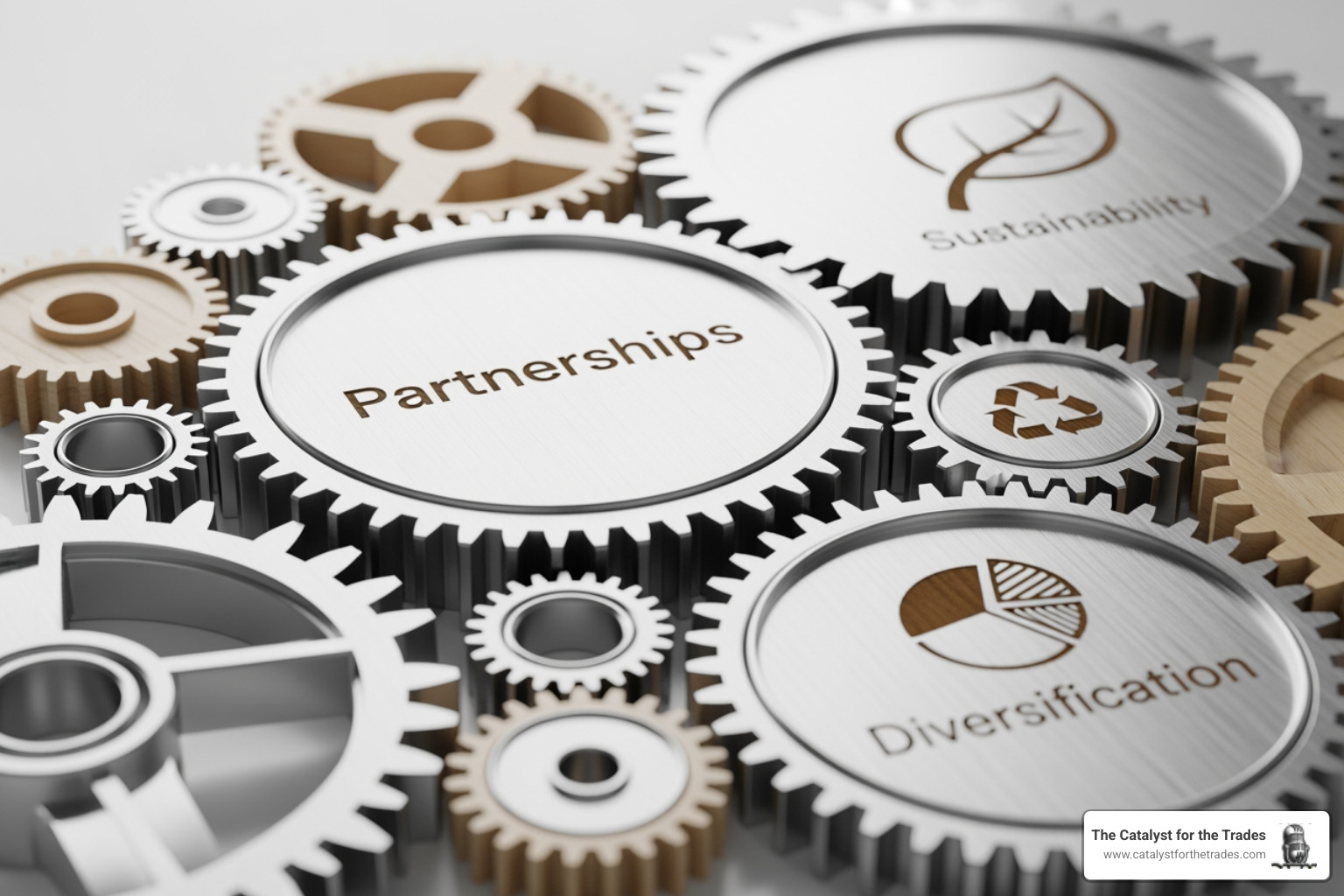
interconnected gears representing partnerships, sustainability, and diversification - future-proofing business

Your business doesn't exist in a vacuum; its success is connected to your community, partners, and the planet. For home services, considering your business ecosystem means expanding influence through relationships and responsible practices. Here, future-proofing business is about connection, not just protection.

The 6 resilience strategies for a disruptive world emphasize that thriving requires us to think bigger. We need to accept sustainability, build smart partnerships, and diversify our offerings. These are essential Business Growth Strategies that will determine our long-term success.

The Growing Role of Sustainability in a future-proofing business model

Sustainability is no longer optional; it's urgent. The numbers are compelling: 60% of consumers have heightened climate change concerns and are making purchasing decisions accordingly. In B2B, over a third of customers will switch suppliers if sustainability needs aren't met—a figure expected to jump to nearly 60% in three years.

For home services, this shift is an opportunity. Integrating eco-friendly practices—like offering energy-efficient systems or reducing waste—meets customer expectations and protects your bottom line. PwC research shows that 55% of global GDP relies on nature, meaning environmental and economic health are intertwined.

An ESG (Environmental, Social, and Governance) strategy isn't just corporate buzz; it's about building a business that attracts the right customers and talent. The Future-Proof Business | WBCSD guide offers insights into weaving sustainability into your future-proofing business model. By accepting sustainability, you strengthen your brand and ensure long-term viability.

Growth Through Collaboration and Service Diversification

Relying on a single revenue stream is risky. As one expert states, "Revenue diversification is critical," especially in volatile markets. The smartest path forward involves both strategic collaboration and thoughtful service expansion.

Strategic partnerships can transform your reach. Think about collaborating with complementary service providers—a plumber partnering with an electrician, or an HVAC company with a home energy auditor. These Strategic Partnerships create a network that can serve customers more comprehensively and open new markets.

Service diversification is your other growth lever. This means expanding your service lines in ways that complement your core business. An HVAC company might add indoor air quality testing, while a plumbing business could branch into water treatment. The key is meeting emerging customer needs. How Karen Sager Is Using Innovation to Disrupt the Gutter Guard Industry shows how owning a niche can be a competitive advantage.

By building partnerships and diversifying services, you create multiple revenue streams that buffer against market fluctuations, making your business more adaptable and resilient.

Conclusion

This guide to future-proofing business operations covered building a resilient foundation, using technology as a growth engine, nurturing your people, and expanding your ecosystem through partnerships and sustainability. Each piece is critical.

Future-proofing isn't a one-time project; it's a mindset. It's a commitment to being curious, adaptable, and ready for what's next. It means accepting constant change and choosing to be "future-ready" instead of trying to predict the unpredictable.

Think of it this way: we're not building a fortress to keep change out. We're building a dynamic organization that can sense market shifts, respond quickly, and grow stronger through challenges. That's the anti-fragile culture, continuous learning, and strategic leadership we've discussed.

At The Catalyst for the Trades, we've seen businesses transform when they adopt these principles. When they invest in their people, leverage smart technology, protect their financial core, and stay true to their brand while innovating—that's when lasting success happens. It requires dedication, but the payoff is a business that thrives in the next decade, not just survives.

So where do you go from here? Start with one pillar. Maybe it's securing your financial foundation or implementing that CRM system. Perhaps it's creating a culture where it's safe to experiment. Whatever it is, take that first step today.

Ready to make your home services business truly future-ready? Explore more strategies for your home service business and find how we can help you build a thriving, resilient future. Let's do this together.

Why Future-Proofing Business is Essential for Long-Term Survival

Future-proofing your business is essential for staying competitive in an unpredictable market. As a trades business owner, you face pressures like recruiting talent, adopting new tech like AI, managing cash flow, and planning for growth. The reality is stark: 45% of CEOs worldwide believe their companies won't survive the next decade without significant reinvention, especially with climate disruption, tech advancements, and economic volatility.

What is Future-Proofing?

Future-proofing means building resilience and adaptability into your business so you can withstand unpredictable changes and thrive through disruption. It's not about predicting the future but creating an organization that can sense, respond, and evolve when new challenges arise.

Key Elements of a Future-Proof Business:

  • Resilience – Your ability to withstand and recover from disruptions
  • Adaptability – Your capacity to evolve your strategy, operations, and culture
  • Proactive Leadership – Making strategic decisions today that protect tomorrow
  • Continuous Learning – Building a workforce that grows with changing demands
  • Strategic Technology – Leveraging automation, AI, and data to stay ahead

The difference between "future-proof" and "future-ready" is crucial. You can't make your business immune to change, but you can prepare your people, processes, and systems to adapt quickly when disruption hits.

Ready to build a more resilient operation? Explore our guide on Strategic Adaptation to understand how to evolve your business model, or schedule a consultation to discuss your specific growth challenges.

Infographic explaining the core pillars of a future-ready business: People (workforce development, leadership, culture), Process (operational efficiency, innovation systems, risk management), Technology (automation, AI, data analytics, cybersecurity), and Strategy (financial health, brand identity, sustainability, partnerships). Each pillar includes key metrics and actionable steps for trades businesses to build resilience and adaptability. - future-proofing business infographic pillar-5-steps

Basic future-proofing business terms:

The Foundation: Building a Resilient and Adaptable Organization

strong, rooted tree weathering a storm, symbolizing business resilience - future-proofing business

A future-ready business is like a strong tree, bending in storms but never breaking. This foundation of resilience and adaptability isn't just about survival; companies with high 'Future FITness' see a +33% increase in profitability compared to their competitors. For home services contractors, this means having the financial health to weather slow seasons, the strategic vision to spot opportunities, and the leadership qualities to guide your team through uncertainty. It's about building a business that gets stronger through change. This requires thoughtful Business Strategy Development and a commitment to Strategic Adaptation—anticipating shifts rather than scrambling to catch up.

Cultivating an 'Anti-Fragile' Culture

Go beyond resilience with an anti-fragile mindset, where your business doesn't just bounce back from problems but actually benefits from them. Like muscles rebuilding after a workout, an anti-fragile organization grows stronger with each challenge. The key is letting change be the norm instead of treating disruption like a crisis. Welcome small shocks—a new competitor, a key employee departure, or shifting customer preferences—as opportunities to adapt and improve.

Creating this culture requires psychological safety, where your team feels comfortable trying new approaches, even if they don't always work. As we explore in Want to Innovate Faster? Start Failing Smarter, the businesses that innovate fastest learn from their missteps and adjust quickly.

When you normalize change through effective Change Management, your team stops fearing the unknown and starts seeing every challenge as a chance to level up. That's how you build an anti-fragile culture.

Securing Your Financial Core for Long-Term Viability

Without solid finances, even the best ideas remain dreams. A healthy financial core is essential for future-proofing business operations, focusing on strategic investment, cash flow management, and profitability. In a tough economy, these are critical, as noted in these 16 tips to future-proof during a tough economy.

Strategic investment isn't just about expansion; it's about building redundancies like backup equipment, diverse supplier relationships, or a healthy cash reserve. For example, having alternative suppliers lined up protects you from disruptions.

Your approach to Financial Management: Contractors needs to balance growth with stability. As we discuss in How Smart Accounting Transforms Chaos Into Opportunity, the right financial systems don't just track numbers—they reveal opportunities and warn you about risks before they become problems.

For home services businesses, this might mean diversifying your service offerings or investing in technology that improves efficiency. The goal is building financial resilience that supports long-term viability.

Balancing Innovation with a Consistent Brand Identity

Growing businesses face a key tension: innovating to stay competitive while preserving the brand identity that earned customer trust. While new technologies and processes are vital for a future-proofing business strategy, your core values and brand identity build lasting relationships. As one expert notes, "consistency of vision is essential" during rapid change.

Your customers hired you because they trust your quality, reliability, and service. When you adopt new tools or expand offerings, those fundamental promises must remain rock-solid. Brand consistency doesn't mean never changing—it means your customers always know what to expect from you.

Whether you're implementing AI for scheduling or adding new service lines, the customer experience—professionalism, clear communication, quality work—should remain consistently excellent. That's how you build lasting customer trust.

Learning How to Build an Unstoppable Brand and Avoid the Contractor Trap will help you understand this balance. And for a great example, check out Branding That Works: Crystal Williams on Contractor Growth Strategy & Accountability.

The businesses that thrive long-term evolve without losing their essence. They innovate in how they deliver their promise, but the promise itself stays true.

The Engine: A Guide to Future-Proofing Your Business with Technology and Data

dashboard showing business intelligence analytics - future-proofing business

Technology and data are the engine powering your home services business. No longer just nice-to-haves, they are essential for growth, with 79% of companies now depending on digital tools for their future. For trades businesses, IT infrastructure, cybersecurity, automation, and data analytics are fundamental to any future-proofing business strategy. Our guide on The AI Revolution in Home Services: How to Future-Proof Your Trades Business explores this change, and understanding Technology Implementation is crucial for making these changes work.

The Critical Roles of IT and Security

Cybersecurity is critical. The average cost of a data breach hit $4.88 million in 2024, a catastrophic figure for any home services business that would shatter customer trust. Your IT and security are no longer background operations; they are foundational pillars. Shift from an outdated 'build a wall' approach to a zero-trust security model, which verifies every access attempt through robust identity authentication and continuous monitoring.

Proactive security is essential. This includes regular security audits, ongoing employee training, and potentially partnering with managed IT services. With regulations like the US SEC cybersecurity disclosure rule requiring companies to report cyber incidents, data protection is also a compliance issue.

Your CRM system, which holds sensitive customer information, is a prime example of why this matters. Protecting this data is fundamental to maintaining trust, which is why How to Get Your CRM Right and Why It Matters More Than You Think emphasizes security alongside functionality.

Leveraging Automation and AI to Mitigate Risk and Boost Efficiency

With AI computing power doubling every three months, the question for a future-proofing business isn't if you should adopt AI and automation, but how to do it strategically. The landscape has evolved to 'agentic AI'—systems that can plan and act with less human oversight. Already, 80% of organizations use generative AI regularly.

For home services, this opens up remarkable opportunities. Imagine AI handling initial customer inquiries, scheduling appointments, or optimizing service routes. AI customer service automation is already reducing case-handling times significantly. How AI is Transforming Call Handling explores how this technology is reshaping customer communication in the trades.

Here are key operational areas where automation can transform your business:

  • Customer Service & Communication: AI chatbots, automated reminders, and personalized follow-ups
  • Scheduling & Dispatch: Smart routing that considers traffic, skills, and job priority
  • Lead Management: Automatic lead scoring, nurturing, and assignment
  • Inventory Management: Predictive ordering and low-stock alerts
  • Financial Processes: Streamlined expense reporting, billing, and payroll
  • Data Backups: Scheduled automatic backups to protect critical information
  • Marketing: Automated email campaigns, social media posting, and targeted ads
  • Reporting & Analytics: Real-time performance dashboards without manual data entry

The power of automation lies in freeing your team to focus on complex problem-solving, customer relationships, and strategic growth, as explored in Adapting to Consumer Behavior: Leveraging AI and Digital Tools in the Trades.

Data analytics is the next best thing to a crystal ball. For any future-proofing business, moving from gut feelings to data-driven decisions is transformative. Your business generates constant data from service calls, website visits, and customer reviews. By strategically interpreting this information, you can anticipate trends before competitors. As one expert puts it, we must "recognize soft demand signals" and act on them early.

For example, if your data shows an uptick in inquiries about smart thermostats, that's your signal to explore adding these services before the demand is obvious. By the time a trend is undeniable, you're already playing catch-up.

Implementing robust AI Business Intelligence tools transforms raw numbers into actionable insights. Your CRM is a goldmine of customer behavior patterns and seasonal trends. CRM Success in the Trades: Celia Church's Guide to Data Implementation and Next-Level Growth provides excellent guidance on optimizing your CRM for these insights.

The businesses that thrive won't be the ones with the most data—they'll be the ones who know how to listen to it and act decisively.

The People: Fostering a Forward-Thinking and Adaptable Workforce

diverse team collaborating and learning together - future-proofing business

Technology and strategy matter, but people truly make or break a business. In home services, future-proofing business means building a workforce ready for what's next. We're in "The Future of Work is Now", a period marked by "The Great Resignation", skill shortages, and changing expectations. Your team must be adaptable, engaged, and always growing. Our Talent Management: Complete Guide is essential for contractors serious about long-term success.

Essential Leadership Qualities for a Future-Ready Organization

In a shifting landscape, strong leadership is our anchor. Yesterday's leadership styles won't work today; future-ready organizations need visionaries who inspire confidence and steer uncertainty. As one expert notes, we must "celebrate the human element." This means choosing connection over control and leading with a unifying vision.

What does this look like? Empathetic leadership means understanding your team's challenges. Visionary communication involves painting a clear picture of where you're headed. Adaptability requires scanning other industries for insights and being willing to pivot. The best leaders ask the right questions, listen deeply, and create safe spaces for their teams to grow. They build "confidence in motion"—the ability to move forward decisively without all the answers.

To develop these qualities, our guides on The Future of Leadership: How to Build a Team That Drives Growth and How to Lead, Serve, and Grow in the Trades With Raul Rodriguez offer practical wisdom.

Key strategies for a future-proofing business workforce

A forward-thinking workforce is built intentionally through continuous learning and a culture of innovation. This means making learning a daily practice, not a rare event. Investing in your team's growth builds skills, loyalty, and the capacity to handle future challenges.

The magic happens when we "tap into the collective creative potential" of our entire team. Innovation shouldn't be exclusive to owners; the best ideas often come from technicians, CSRs, and office staff. Creating internal learning labs and listening to suggestions from all levels transforms your organization into a problem-solving powerhouse.

Practical approaches include upskilling/reskilling programs for new tech, mentorship and coaching to transfer knowledge, innovation challenges to source new ideas, and strong feedback loops for continuous improvement. Crucially, celebrate learning efforts, not just outcomes, to signal that growth is a core value.

This commitment strengthens our Employer Branding and deepens Employee Loyalty, making us a place where talented people want to build careers. Our approach to Continuous Learning becomes a competitive advantage.

Proactively Addressing Skill Gaps and Workforce Dynamics

Finding and keeping great people has never been harder. The skilled trades face serious workforce challenges, from retiring baby boomers to fewer young people entering the field. The competition for talent is fierce, but a proactive future-proofing business approach makes all the difference.

First, "Proactively retain your top talent because they drive your business forward." Focus on their growth, development, and satisfaction. Your best people have options, so invest in their future with competitive compensation, clear career paths, and a valued work environment.

On the Talent Acquisition front, hire for tomorrow's needs. Look for people with adaptability, curiosity, and a willingness to accept new technologies. A candidate with a great learning mindset can be more valuable than one with more experience but a fixed approach.

Global events also impact workforce planning. Having contingency plans, cross-training team members, and maintaining strong communication during uncertain times is key. How Mike Disney Builds Trust, Recruits Top Talent, and Wins in the Trades offers real-world strategies for mastering this balance.

The Ecosystem: Expanding Your Influence and Opportunity

interconnected gears representing partnerships, sustainability, and diversification - future-proofing business

Your business doesn't exist in a vacuum; its success is connected to your community, partners, and the planet. For home services, considering your business ecosystem means expanding influence through relationships and responsible practices. Here, future-proofing business is about connection, not just protection.

The 6 resilience strategies for a disruptive world emphasize that thriving requires us to think bigger. We need to accept sustainability, build smart partnerships, and diversify our offerings. These are essential Business Growth Strategies that will determine our long-term success.

The Growing Role of Sustainability in a future-proofing business model

Sustainability is no longer optional; it's urgent. The numbers are compelling: 60% of consumers have heightened climate change concerns and are making purchasing decisions accordingly. In B2B, over a third of customers will switch suppliers if sustainability needs aren't met—a figure expected to jump to nearly 60% in three years.

For home services, this shift is an opportunity. Integrating eco-friendly practices—like offering energy-efficient systems or reducing waste—meets customer expectations and protects your bottom line. PwC research shows that 55% of global GDP relies on nature, meaning environmental and economic health are intertwined.

An ESG (Environmental, Social, and Governance) strategy isn't just corporate buzz; it's about building a business that attracts the right customers and talent. The Future-Proof Business | WBCSD guide offers insights into weaving sustainability into your future-proofing business model. By accepting sustainability, you strengthen your brand and ensure long-term viability.

Growth Through Collaboration and Service Diversification

Relying on a single revenue stream is risky. As one expert states, "Revenue diversification is critical," especially in volatile markets. The smartest path forward involves both strategic collaboration and thoughtful service expansion.

Strategic partnerships can transform your reach. Think about collaborating with complementary service providers—a plumber partnering with an electrician, or an HVAC company with a home energy auditor. These Strategic Partnerships create a network that can serve customers more comprehensively and open new markets.

Service diversification is your other growth lever. This means expanding your service lines in ways that complement your core business. An HVAC company might add indoor air quality testing, while a plumbing business could branch into water treatment. The key is meeting emerging customer needs. How Karen Sager Is Using Innovation to Disrupt the Gutter Guard Industry shows how owning a niche can be a competitive advantage.

By building partnerships and diversifying services, you create multiple revenue streams that buffer against market fluctuations, making your business more adaptable and resilient.

Conclusion

This guide to future-proofing business operations covered building a resilient foundation, using technology as a growth engine, nurturing your people, and expanding your ecosystem through partnerships and sustainability. Each piece is critical.

Future-proofing isn't a one-time project; it's a mindset. It's a commitment to being curious, adaptable, and ready for what's next. It means accepting constant change and choosing to be "future-ready" instead of trying to predict the unpredictable.

Think of it this way: we're not building a fortress to keep change out. We're building a dynamic organization that can sense market shifts, respond quickly, and grow stronger through challenges. That's the anti-fragile culture, continuous learning, and strategic leadership we've discussed.

At The Catalyst for the Trades, we've seen businesses transform when they adopt these principles. When they invest in their people, leverage smart technology, protect their financial core, and stay true to their brand while innovating—that's when lasting success happens. It requires dedication, but the payoff is a business that thrives in the next decade, not just survives.

So where do you go from here? Start with one pillar. Maybe it's securing your financial foundation or implementing that CRM system. Perhaps it's creating a culture where it's safe to experiment. Whatever it is, take that first step today.

Ready to make your home services business truly future-ready? Explore more strategies for your home service business and find how we can help you build a thriving, resilient future. Let's do this together.

Why Future-Proofing Business is Essential for Long-Term Survival

Future-proofing your business is essential for staying competitive in an unpredictable market. As a trades business owner, you face pressures like recruiting talent, adopting new tech like AI, managing cash flow, and planning for growth. The reality is stark: 45% of CEOs worldwide believe their companies won't survive the next decade without significant reinvention, especially with climate disruption, tech advancements, and economic volatility.

What is Future-Proofing?

Future-proofing means building resilience and adaptability into your business so you can withstand unpredictable changes and thrive through disruption. It's not about predicting the future but creating an organization that can sense, respond, and evolve when new challenges arise.

Key Elements of a Future-Proof Business:

  • Resilience – Your ability to withstand and recover from disruptions
  • Adaptability – Your capacity to evolve your strategy, operations, and culture
  • Proactive Leadership – Making strategic decisions today that protect tomorrow
  • Continuous Learning – Building a workforce that grows with changing demands
  • Strategic Technology – Leveraging automation, AI, and data to stay ahead

The difference between "future-proof" and "future-ready" is crucial. You can't make your business immune to change, but you can prepare your people, processes, and systems to adapt quickly when disruption hits.

Ready to build a more resilient operation? Explore our guide on Strategic Adaptation to understand how to evolve your business model, or schedule a consultation to discuss your specific growth challenges.

Infographic explaining the core pillars of a future-ready business: People (workforce development, leadership, culture), Process (operational efficiency, innovation systems, risk management), Technology (automation, AI, data analytics, cybersecurity), and Strategy (financial health, brand identity, sustainability, partnerships). Each pillar includes key metrics and actionable steps for trades businesses to build resilience and adaptability. - future-proofing business infographic pillar-5-steps

Basic future-proofing business terms:

The Foundation: Building a Resilient and Adaptable Organization

strong, rooted tree weathering a storm, symbolizing business resilience - future-proofing business

A future-ready business is like a strong tree, bending in storms but never breaking. This foundation of resilience and adaptability isn't just about survival; companies with high 'Future FITness' see a +33% increase in profitability compared to their competitors. For home services contractors, this means having the financial health to weather slow seasons, the strategic vision to spot opportunities, and the leadership qualities to guide your team through uncertainty. It's about building a business that gets stronger through change. This requires thoughtful Business Strategy Development and a commitment to Strategic Adaptation—anticipating shifts rather than scrambling to catch up.

Cultivating an 'Anti-Fragile' Culture

Go beyond resilience with an anti-fragile mindset, where your business doesn't just bounce back from problems but actually benefits from them. Like muscles rebuilding after a workout, an anti-fragile organization grows stronger with each challenge. The key is letting change be the norm instead of treating disruption like a crisis. Welcome small shocks—a new competitor, a key employee departure, or shifting customer preferences—as opportunities to adapt and improve.

Creating this culture requires psychological safety, where your team feels comfortable trying new approaches, even if they don't always work. As we explore in Want to Innovate Faster? Start Failing Smarter, the businesses that innovate fastest learn from their missteps and adjust quickly.

When you normalize change through effective Change Management, your team stops fearing the unknown and starts seeing every challenge as a chance to level up. That's how you build an anti-fragile culture.

Securing Your Financial Core for Long-Term Viability

Without solid finances, even the best ideas remain dreams. A healthy financial core is essential for future-proofing business operations, focusing on strategic investment, cash flow management, and profitability. In a tough economy, these are critical, as noted in these 16 tips to future-proof during a tough economy.

Strategic investment isn't just about expansion; it's about building redundancies like backup equipment, diverse supplier relationships, or a healthy cash reserve. For example, having alternative suppliers lined up protects you from disruptions.

Your approach to Financial Management: Contractors needs to balance growth with stability. As we discuss in How Smart Accounting Transforms Chaos Into Opportunity, the right financial systems don't just track numbers—they reveal opportunities and warn you about risks before they become problems.

For home services businesses, this might mean diversifying your service offerings or investing in technology that improves efficiency. The goal is building financial resilience that supports long-term viability.

Balancing Innovation with a Consistent Brand Identity

Growing businesses face a key tension: innovating to stay competitive while preserving the brand identity that earned customer trust. While new technologies and processes are vital for a future-proofing business strategy, your core values and brand identity build lasting relationships. As one expert notes, "consistency of vision is essential" during rapid change.

Your customers hired you because they trust your quality, reliability, and service. When you adopt new tools or expand offerings, those fundamental promises must remain rock-solid. Brand consistency doesn't mean never changing—it means your customers always know what to expect from you.

Whether you're implementing AI for scheduling or adding new service lines, the customer experience—professionalism, clear communication, quality work—should remain consistently excellent. That's how you build lasting customer trust.

Learning How to Build an Unstoppable Brand and Avoid the Contractor Trap will help you understand this balance. And for a great example, check out Branding That Works: Crystal Williams on Contractor Growth Strategy & Accountability.

The businesses that thrive long-term evolve without losing their essence. They innovate in how they deliver their promise, but the promise itself stays true.

The Engine: A Guide to Future-Proofing Your Business with Technology and Data

dashboard showing business intelligence analytics - future-proofing business

Technology and data are the engine powering your home services business. No longer just nice-to-haves, they are essential for growth, with 79% of companies now depending on digital tools for their future. For trades businesses, IT infrastructure, cybersecurity, automation, and data analytics are fundamental to any future-proofing business strategy. Our guide on The AI Revolution in Home Services: How to Future-Proof Your Trades Business explores this change, and understanding Technology Implementation is crucial for making these changes work.

The Critical Roles of IT and Security

Cybersecurity is critical. The average cost of a data breach hit $4.88 million in 2024, a catastrophic figure for any home services business that would shatter customer trust. Your IT and security are no longer background operations; they are foundational pillars. Shift from an outdated 'build a wall' approach to a zero-trust security model, which verifies every access attempt through robust identity authentication and continuous monitoring.

Proactive security is essential. This includes regular security audits, ongoing employee training, and potentially partnering with managed IT services. With regulations like the US SEC cybersecurity disclosure rule requiring companies to report cyber incidents, data protection is also a compliance issue.

Your CRM system, which holds sensitive customer information, is a prime example of why this matters. Protecting this data is fundamental to maintaining trust, which is why How to Get Your CRM Right and Why It Matters More Than You Think emphasizes security alongside functionality.

Leveraging Automation and AI to Mitigate Risk and Boost Efficiency

With AI computing power doubling every three months, the question for a future-proofing business isn't if you should adopt AI and automation, but how to do it strategically. The landscape has evolved to 'agentic AI'—systems that can plan and act with less human oversight. Already, 80% of organizations use generative AI regularly.

For home services, this opens up remarkable opportunities. Imagine AI handling initial customer inquiries, scheduling appointments, or optimizing service routes. AI customer service automation is already reducing case-handling times significantly. How AI is Transforming Call Handling explores how this technology is reshaping customer communication in the trades.

Here are key operational areas where automation can transform your business:

  • Customer Service & Communication: AI chatbots, automated reminders, and personalized follow-ups
  • Scheduling & Dispatch: Smart routing that considers traffic, skills, and job priority
  • Lead Management: Automatic lead scoring, nurturing, and assignment
  • Inventory Management: Predictive ordering and low-stock alerts
  • Financial Processes: Streamlined expense reporting, billing, and payroll
  • Data Backups: Scheduled automatic backups to protect critical information
  • Marketing: Automated email campaigns, social media posting, and targeted ads
  • Reporting & Analytics: Real-time performance dashboards without manual data entry

The power of automation lies in freeing your team to focus on complex problem-solving, customer relationships, and strategic growth, as explored in Adapting to Consumer Behavior: Leveraging AI and Digital Tools in the Trades.

Data analytics is the next best thing to a crystal ball. For any future-proofing business, moving from gut feelings to data-driven decisions is transformative. Your business generates constant data from service calls, website visits, and customer reviews. By strategically interpreting this information, you can anticipate trends before competitors. As one expert puts it, we must "recognize soft demand signals" and act on them early.

For example, if your data shows an uptick in inquiries about smart thermostats, that's your signal to explore adding these services before the demand is obvious. By the time a trend is undeniable, you're already playing catch-up.

Implementing robust AI Business Intelligence tools transforms raw numbers into actionable insights. Your CRM is a goldmine of customer behavior patterns and seasonal trends. CRM Success in the Trades: Celia Church's Guide to Data Implementation and Next-Level Growth provides excellent guidance on optimizing your CRM for these insights.

The businesses that thrive won't be the ones with the most data—they'll be the ones who know how to listen to it and act decisively.

The People: Fostering a Forward-Thinking and Adaptable Workforce

diverse team collaborating and learning together - future-proofing business

Technology and strategy matter, but people truly make or break a business. In home services, future-proofing business means building a workforce ready for what's next. We're in "The Future of Work is Now", a period marked by "The Great Resignation", skill shortages, and changing expectations. Your team must be adaptable, engaged, and always growing. Our Talent Management: Complete Guide is essential for contractors serious about long-term success.

Essential Leadership Qualities for a Future-Ready Organization

In a shifting landscape, strong leadership is our anchor. Yesterday's leadership styles won't work today; future-ready organizations need visionaries who inspire confidence and steer uncertainty. As one expert notes, we must "celebrate the human element." This means choosing connection over control and leading with a unifying vision.

What does this look like? Empathetic leadership means understanding your team's challenges. Visionary communication involves painting a clear picture of where you're headed. Adaptability requires scanning other industries for insights and being willing to pivot. The best leaders ask the right questions, listen deeply, and create safe spaces for their teams to grow. They build "confidence in motion"—the ability to move forward decisively without all the answers.

To develop these qualities, our guides on The Future of Leadership: How to Build a Team That Drives Growth and How to Lead, Serve, and Grow in the Trades With Raul Rodriguez offer practical wisdom.

Key strategies for a future-proofing business workforce

A forward-thinking workforce is built intentionally through continuous learning and a culture of innovation. This means making learning a daily practice, not a rare event. Investing in your team's growth builds skills, loyalty, and the capacity to handle future challenges.

The magic happens when we "tap into the collective creative potential" of our entire team. Innovation shouldn't be exclusive to owners; the best ideas often come from technicians, CSRs, and office staff. Creating internal learning labs and listening to suggestions from all levels transforms your organization into a problem-solving powerhouse.

Practical approaches include upskilling/reskilling programs for new tech, mentorship and coaching to transfer knowledge, innovation challenges to source new ideas, and strong feedback loops for continuous improvement. Crucially, celebrate learning efforts, not just outcomes, to signal that growth is a core value.

This commitment strengthens our Employer Branding and deepens Employee Loyalty, making us a place where talented people want to build careers. Our approach to Continuous Learning becomes a competitive advantage.

Proactively Addressing Skill Gaps and Workforce Dynamics

Finding and keeping great people has never been harder. The skilled trades face serious workforce challenges, from retiring baby boomers to fewer young people entering the field. The competition for talent is fierce, but a proactive future-proofing business approach makes all the difference.

First, "Proactively retain your top talent because they drive your business forward." Focus on their growth, development, and satisfaction. Your best people have options, so invest in their future with competitive compensation, clear career paths, and a valued work environment.

On the Talent Acquisition front, hire for tomorrow's needs. Look for people with adaptability, curiosity, and a willingness to accept new technologies. A candidate with a great learning mindset can be more valuable than one with more experience but a fixed approach.

Global events also impact workforce planning. Having contingency plans, cross-training team members, and maintaining strong communication during uncertain times is key. How Mike Disney Builds Trust, Recruits Top Talent, and Wins in the Trades offers real-world strategies for mastering this balance.

The Ecosystem: Expanding Your Influence and Opportunity

interconnected gears representing partnerships, sustainability, and diversification - future-proofing business

Your business doesn't exist in a vacuum; its success is connected to your community, partners, and the planet. For home services, considering your business ecosystem means expanding influence through relationships and responsible practices. Here, future-proofing business is about connection, not just protection.

The 6 resilience strategies for a disruptive world emphasize that thriving requires us to think bigger. We need to accept sustainability, build smart partnerships, and diversify our offerings. These are essential Business Growth Strategies that will determine our long-term success.

The Growing Role of Sustainability in a future-proofing business model

Sustainability is no longer optional; it's urgent. The numbers are compelling: 60% of consumers have heightened climate change concerns and are making purchasing decisions accordingly. In B2B, over a third of customers will switch suppliers if sustainability needs aren't met—a figure expected to jump to nearly 60% in three years.

For home services, this shift is an opportunity. Integrating eco-friendly practices—like offering energy-efficient systems or reducing waste—meets customer expectations and protects your bottom line. PwC research shows that 55% of global GDP relies on nature, meaning environmental and economic health are intertwined.

An ESG (Environmental, Social, and Governance) strategy isn't just corporate buzz; it's about building a business that attracts the right customers and talent. The Future-Proof Business | WBCSD guide offers insights into weaving sustainability into your future-proofing business model. By accepting sustainability, you strengthen your brand and ensure long-term viability.

Growth Through Collaboration and Service Diversification

Relying on a single revenue stream is risky. As one expert states, "Revenue diversification is critical," especially in volatile markets. The smartest path forward involves both strategic collaboration and thoughtful service expansion.

Strategic partnerships can transform your reach. Think about collaborating with complementary service providers—a plumber partnering with an electrician, or an HVAC company with a home energy auditor. These Strategic Partnerships create a network that can serve customers more comprehensively and open new markets.

Service diversification is your other growth lever. This means expanding your service lines in ways that complement your core business. An HVAC company might add indoor air quality testing, while a plumbing business could branch into water treatment. The key is meeting emerging customer needs. How Karen Sager Is Using Innovation to Disrupt the Gutter Guard Industry shows how owning a niche can be a competitive advantage.

By building partnerships and diversifying services, you create multiple revenue streams that buffer against market fluctuations, making your business more adaptable and resilient.

Conclusion

This guide to future-proofing business operations covered building a resilient foundation, using technology as a growth engine, nurturing your people, and expanding your ecosystem through partnerships and sustainability. Each piece is critical.

Future-proofing isn't a one-time project; it's a mindset. It's a commitment to being curious, adaptable, and ready for what's next. It means accepting constant change and choosing to be "future-ready" instead of trying to predict the unpredictable.

Think of it this way: we're not building a fortress to keep change out. We're building a dynamic organization that can sense market shifts, respond quickly, and grow stronger through challenges. That's the anti-fragile culture, continuous learning, and strategic leadership we've discussed.

At The Catalyst for the Trades, we've seen businesses transform when they adopt these principles. When they invest in their people, leverage smart technology, protect their financial core, and stay true to their brand while innovating—that's when lasting success happens. It requires dedication, but the payoff is a business that thrives in the next decade, not just survives.

So where do you go from here? Start with one pillar. Maybe it's securing your financial foundation or implementing that CRM system. Perhaps it's creating a culture where it's safe to experiment. Whatever it is, take that first step today.

Ready to make your home services business truly future-ready? Explore more strategies for your home service business and find how we can help you build a thriving, resilient future. Let's do this together.

Episodes you may like

The Efficiency Edge: Reducing Costs and Boosting Output

Learn to boost output & reduce costs. Master operational efficiency with strategies, tools, and metrics for your trade business.

Read more
Published
December 30, 2025
The Skill Set Upgrade: Boosting Your Team's Potential

Boost your team's potential! Learn how skill development drives growth, retention, and competitive advantage for your home service business.

Read more
Published
December 29, 2025
From Skeptic to Super-User: Navigating the Technology Adoption Curve

Master technology adoption in home services. Navigate the S-curve, overcome skepticism, and gain a competitive edge for business growth.

Read more
Published
December 26, 2025

Guests

Gregg Schonhorn
SF&P Advisors