Learn · March 20, 2026
Best CRM for HVAC Companies: #1 Choice
Discover the best crm for hvac companies: Boost leads, efficiency & repeat business with top features, AI & integrations!
By The Catalyst Editorial Team Operator education · 8 min read · Updated July 24, 2026

The Best CRM for HVAC Companies: Quick Answer

The best CRM for HVAC companies is the one that fits your workflow and helps your team deliver fast, reliable service from the first call to the final follow-up.
Running an HVAC business today means you are constantly juggling service calls, scheduling technicians, keeping customer history organized, and making sure no request gets missed. For most shop owners, that chaos starts small — a missed callback here, a forgotten follow-up there. But as your job volume grows, those small cracks turn into real service problems and lost opportunities.
This guide breaks down what an HVAC CRM is, the features that matter most in the field, and how the right system helps you stay organized, communicate clearly, and deliver a smoother customer experience.
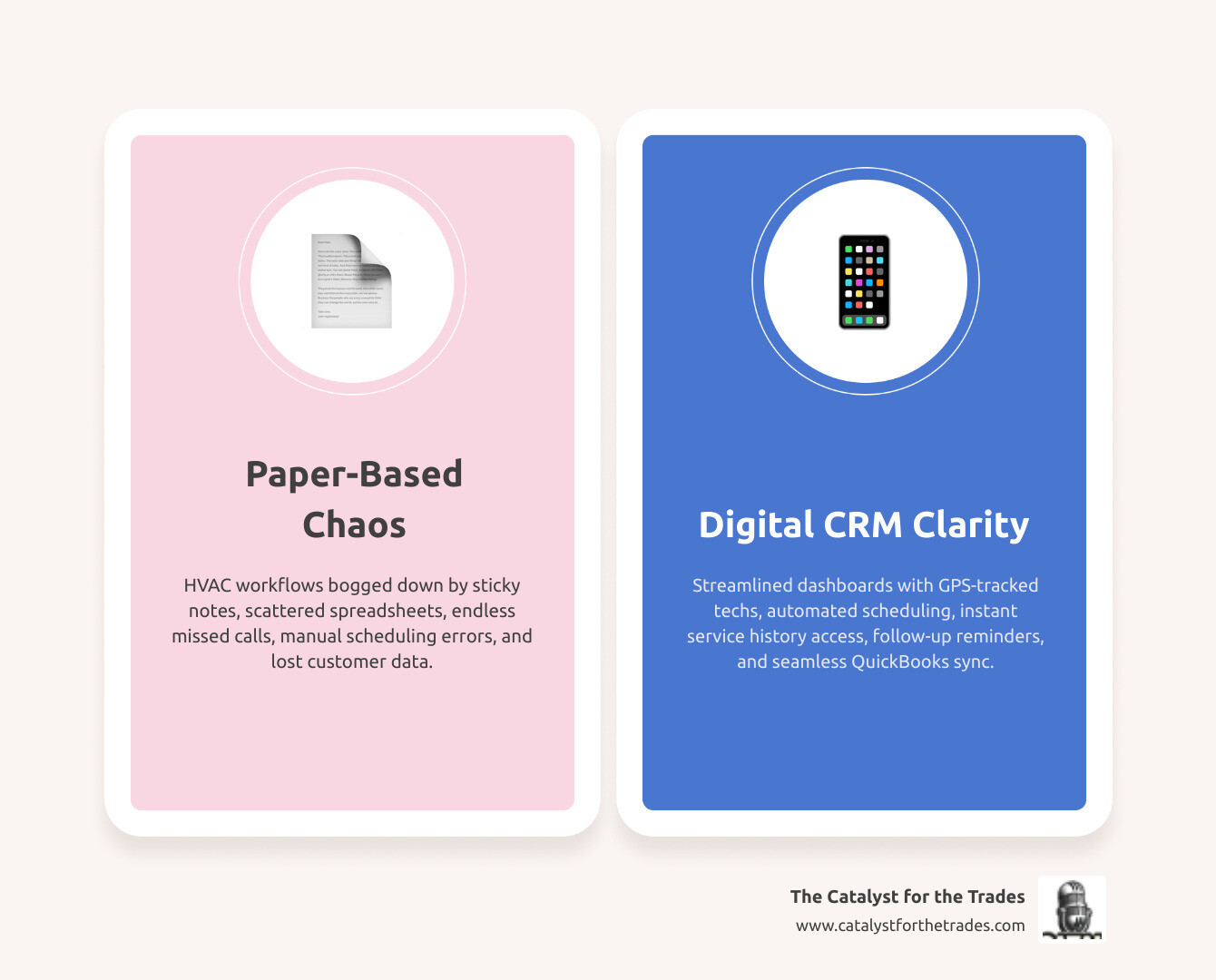
Defining the HVAC CRM: Why Your Business Needs a Digital Backbone
In heating, ventilation, and air conditioning, your reputation is built on reliability. But how reliable can you be if your customer data is trapped in a filing cabinet or scattered across three different spreadsheets? An HVAC CRM (Customer Relationship Management) system is more than just a digital Rolodex; it is the central nervous system of your business.
At its core, the best CRM for HVAC companies centralizes every interaction you have with a homeowner or building manager. When a customer calls at 8:00 PM because their furnace died in a blizzard, your dispatcher shouldn’t be asking, “Wait, what unit do you have again?” They should already see the service history, the model and serial numbers, and which technician was there last spring.
As we discuss in our hvac-business-operations-guide, scaling a team requires a digital backbone. Without one, you face “data silos”—where the office doesn’t know what the field is doing, and the field doesn’t know what the office promised. A dedicated CRM eliminates this by providing:
- Centralized Data: One source of truth for every lead, job, and invoice.
- Job Volume Management: The ability to handle 15 to 500+ jobs a week without losing track of a single work order.
- Seamless Team Scaling: Onboarding new technicians becomes easier when the “system” tells them where to go and what to do, rather than relying on tribal knowledge.
- Detailed Service History: Tracking refrigerant logs, equipment age, and past repairs to drive “pull-through” revenue.
The Essential Features of the Best CRM for HVAC Companies
When you are hunting for the best CRM for HVAC companies, it is easy to get blinded by flashy marketing. However, for a trade business, specific “boots-on-the-ground” features matter far more than a pretty interface. Here is what we consider the non-negotiables:
- Mobile App Functionality: Your technicians are your primary data collectors. If the mobile app is clunky or doesn’t work offline in a basement with no service, your data will be garbage. A top-tier app allows techs to upload photos, log parts, and create “Good, Better, Best” proposals right at the kitchen table.
- GPS Tracking & Automated Dispatching: Real-time fleet tracking isn’t about playing “Big Brother.” It’s about efficiency. The best systems use GPS to send the closest tech to an emergency call and provide customers with “On My Way” texts featuring the technician’s bio and photo.
- QuickBooks & Accounting Integration: Double data entry is a profit killer. Your CRM must sync seamlessly with tools like QuickBooks or Sage so that an invoice closed in the field automatically reflects in your books.
- Payment Processing: The faster you get paid, the healthier your cash flow. Look for CRMs that allow technicians to take credit cards or offer financing options on-site.
- Automated Follow-ups: Most HVAC leads die because of a lack of follow-up. Automation ensures that if a quote isn’t signed within 24 hours, the customer gets a friendly nudge without you lifting a finger.
For more on how these tools change the game, check out our deep dive into customer-relationship-management.
Evaluating the Best CRM for HVAC Companies Based on Business Size
One size definitely does not fit all in the HVAC world. A “Chuck-in-a-truck” operation has vastly different needs than a multi-state commercial mechanical firm.
Residential Service vs. Commercial Operations
Residential shops thrive on speed, volume, and customer experience. They need “set it and forget it” automations and easy-to-read dashboards. Commercial operations, on the other hand, require robust asset management. They need to track 50 different rooftop units (RTUs) across a sprawling campus, manage complex preventative maintenance (PM) contracts, and handle multi-stage progress billing.
| Feature Need | Small Residential (1-5 Techs) | Mid-to-Large Commercial (10+ Techs) |
|---|---|---|
| Primary Focus | Speed of booking & invoicing | Asset tracking & contract management |
| Scheduling | Simple drag-and-drop | Multi-day project management |
| Marketing | Review generation & local SEO | Sales pipeline & RFP management |
| Reporting | Basic revenue per job | Technician efficiency & PM profitability |
Choosing the wrong fit can be a costly mistake. If you buy a massive enterprise system for a three-person shop, you’ll spend more time managing the software than fixing ACs. Conversely, outgrowing a basic tool can lead to operational paralysis. We explore these nuances further in our guide on how-to-get-your-crm-right-and-why-it-matters-more-than-you-think.
Trade-Specific vs. General-Purpose CRM Solutions
You might be tempted to use a general-purpose CRM because they are household names. While general-purpose platforms can be fantastic for lead nurturing and high-level sales pipelines, they often lack the “Field Service Management” (FSM) capabilities that HVAC pros need.
General-purpose CRMs don’t typically come out of the box with “refrigerant tracking,” “equipment service history,” or “emergency dispatching boards.” Trade-specific solutions are built for the realities of the industry—like the 10 PM emergency call or the technician who forgets to mark a job as “complete.” A trade-specific CRM is the custom-fit wrench you actually need for the job. For more on this debate, listen to our hvac-business-podcast.
How the Best CRM for HVAC Companies Boosts Repeat Business
The most expensive thing in your business is acquiring a new customer. The most profitable thing is keeping an old one. The best CRM for HVAC companies turns one-time emergency repairs into lifelong maintenance clients.
Customer Retention and Service Agreements
Service agreements (or maintenance plans) are the lifeblood of a stable HVAC business. They provide predictable recurring revenue during the “shoulder seasons” when the phones stop ringing. A good CRM automates the entire lifecycle of these agreements:
- Automatic Reminders: It emails or texts the customer when it’s time for their spring tune-up.
- Renewal Notifications: It alerts the office when a contract is about to expire.
- Priority Status: It flags “Member” status on the dispatch board so your best customers get moved to the front of the line during heatwaves.
Review Generation
In 2026, your Google Business Profile is your digital storefront. The best CRMs have “Review Multipliers” built-in. The moment a technician collects payment and closes the job, the system sends a text to the homeowner with a direct link to leave a five-star review. Research shows that even a small increase in your average rating can boost lead conversion significantly.
For more expert advice on using data to drive growth, don’t miss crm-success-in-the-trades-celia-churchs-guide-to-data-implementation-and-next-level-growth.
The Role of AI and Automation in Modern HVAC Operations
We are entering the era of the “AI-powered shop.” Automation is no longer just about sending emails; it’s about making intelligent decisions.
- AI Dispatching: Modern platforms use AI to look at your schedule and automatically assign the right tech to the right job based on their skill set, current location, and even the parts they have on their truck.
- Predictive Maintenance: By analyzing equipment data, some CRMs can now predict when a component is likely to fail, allowing you to reach out to the customer before they are stuck in a cold house.
- AI Call Assistants: AI-powered tools can handle after-hours booking, answering basic questions and slotting appointments into your calendar while you sleep.
Frequently Asked Questions About HVAC CRMs
When is the right time for an HVAC business to invest in a CRM?
If you have more than four technicians, over 25 active clients, or find yourself running more than 15 jobs a week, you are likely already losing money through manual errors. However, even solo operators should consider a basic CRM early on to automate repetitive tasks and build a clean database from day one.
What are the most important software integrations for HVAC contractors?
At a minimum, you need a sync with your accounting software. Beyond that, look for integrations with payment processors, Google Calendar, and marketing tools for lead nurturing.
How does a mobile CRM app improve field technician performance?
A mobile app puts the entire office in the technician’s pocket. It reduces “phone tag” with dispatchers, provides instant access to equipment manuals and photos, and allows for professional, digital quoting that increases the average ticket size through tiered pricing options.
Conclusion
Choosing the best CRM for HVAC companies is one of the most significant strategic moves you can make for your business. It is the difference between a shop that is constantly “putting out fires” and a shop that is built for operational excellence and long-term growth.
At The Catalyst for the Trades, we believe that the right technology, paired with strong leadership and innovation, is the key to dominating your local market. Whether you are a small residential crew or a massive commercial enterprise, your CRM should empower your team, delight your customers, and protect your bottom line.
Don’t let another lead fall through the cracks. It’s time to stop guessing and start growing. Learn more about our mission to empower the trades and join a community of contractors who are redefining what it means to be a pro.


