Boost sales! Discover top strategies for lead conversion optimization, leveraging nurturing, AI, and data-driven personalization.

Customer relationship management (CRM) is a system for managing, tracking, and improving every customer interaction. For home service businesses, a CRM acts as a central hub for customer data, process automation, and actionable insights that fuel growth and profitability.
What CRM Does for Your Business:
As your plumbing, HVAC, or electrical business grows, managing customer relationships becomes more complex. Spreadsheets and scattered notes lead to missed opportunities, inconsistent service, and wasted time. A proper CRM system prevents these issues, ensuring your team can deliver exceptional service every time.
Discover how to build systems that scale your trades business and learn proven strategies to close more of the leads you already have.
This guide explains what CRM is, why it matters for home service businesses, and how it can become your competitive advantage.
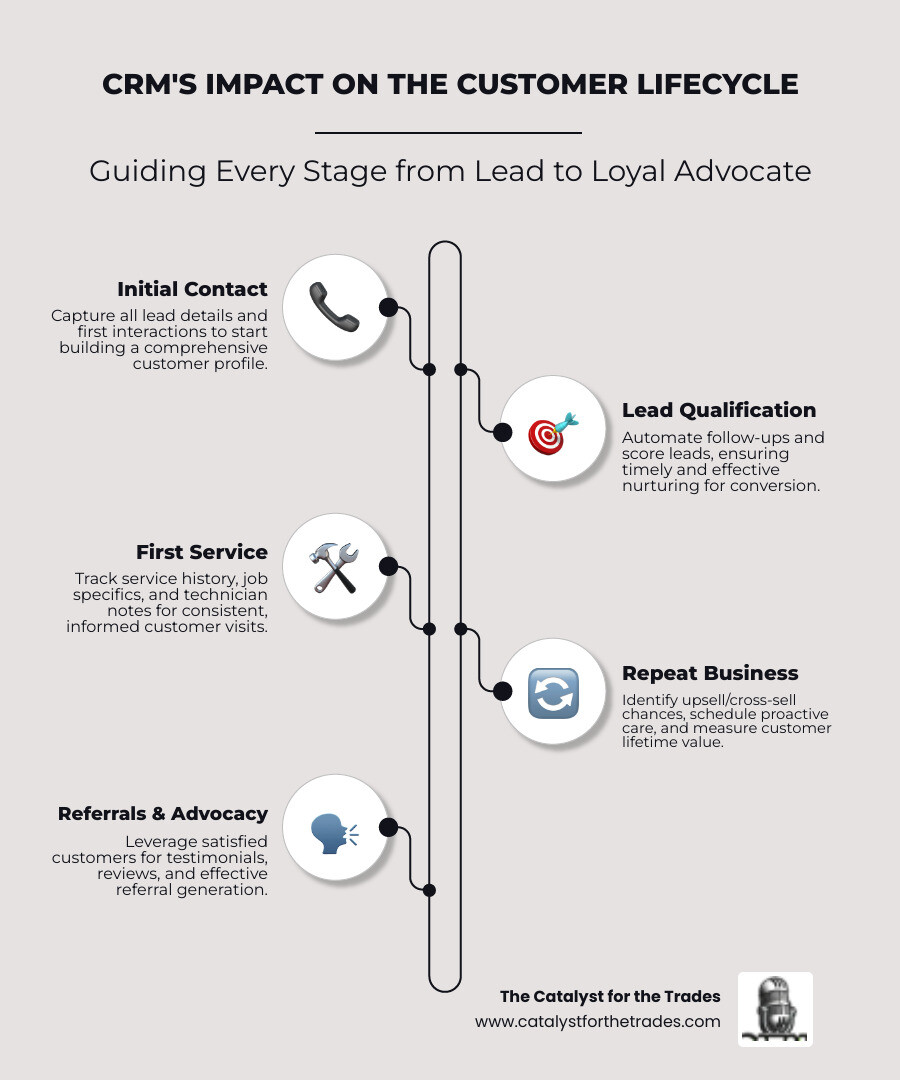
Basic customer relationship management terms:
Customer relationship management is more than software; it's a strategy combining technology and smart business practices to build stronger, more profitable customer relationships.
Think of it as your digital command center for engaging and delighting every client. Modern CRM platforms consolidate data from your website, phone calls, emails, and texts, giving you a deep understanding of your customers. This is why businesses are rapidly adopting CRM—they recognize that effective relationship management is essential for scaling. Learn how to build systems that support sustainable growth in your home service business.
For home service businesses, a CRM centralizes customer information so your entire team—dispatchers, technicians, and office staff—has access to the same up-to-date data. When a customer calls, you have their complete history instantly, allowing you to provide a faster, more informed service. Discover why getting your CRM strategy right matters more than you might think.
The purpose of a CRM goes beyond organizing contacts. It's about using data and automation to achieve revenue goals and create loyal customers who become advocates for your business.
A CRM creates a unified view of every customer, tracking their entire journey with your company. This comprehensive view allows you to deliver a consistent, exceptional experience at every touchpoint.
Data centralization ensures your entire team works from the same playbook, eliminating information silos. Automation handles repetitive but crucial tasks like appointment reminders, follow-up emails, and lead routing. This saves time and ensures every customer receives timely, consistent attention.
This integrated approach aligns your sales, marketing, and service teams around the shared goal of creating happy, profitable customers. It enables data-driven decisions and frees your team to focus on building human connections. Listen to Celia Church's insights on CRM success and data implementation for trades businesses.
Implementing a CRM system directly impacts your bottom line in several key ways.
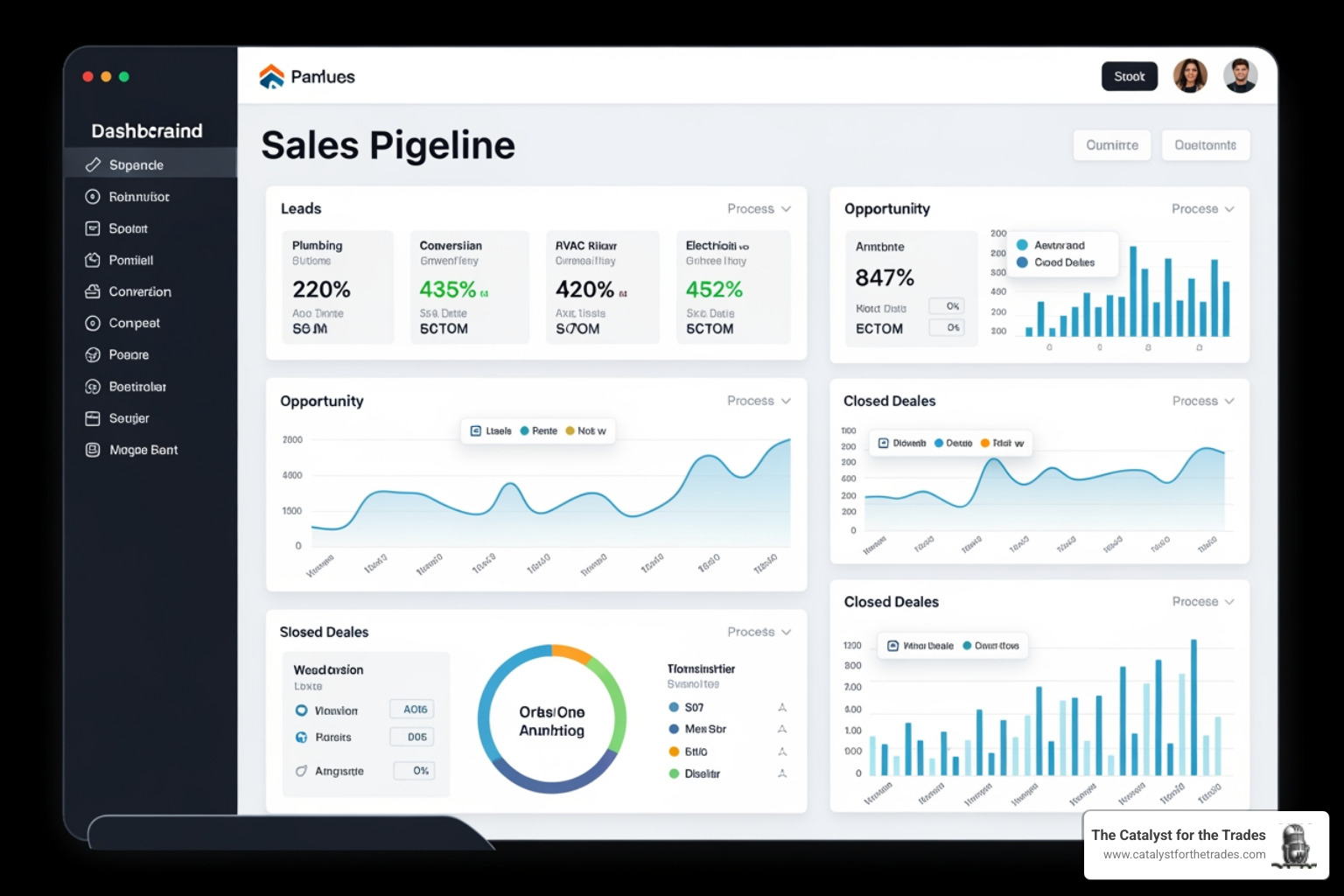
Improved sales efficiency: Your CRM organizes your sales pipeline, showing where every lead stands. Your team can focus on selling instead of administrative work, leading to higher win rates because you never let a hot lead go cold. Stop chasing new leads and start closing the ones you already have.
Improved customer satisfaction: A 360-degree customer view means you can offer personalized service. When someone calls, you see their full history, allowing you to resolve issues faster and make customers feel understood.
Better data insights: Your CRM is a strategic asset that analyzes business data. You can identify profitable services, understand customer behavior, and make informed decisions about marketing and growth based on hard data, not just gut feelings.
Increased customer retention: CRM helps you keep the customers you have. Automated, personalized communication keeps you top-of-mind. Since retaining customers is more cost-effective than acquiring new ones, even a small increase in retention can significantly boost profits.
Streamlined operations: CRM automates and integrates daily tasks like scheduling, dispatching, and invoicing. This reduces manual errors, increases efficiency, and allows your team to focus on delivering exceptional service.
A modern CRM is an ecosystem of integrated features that support every customer interaction. The foundation is contact management—storing all customer details in one accessible place. Beyond that, a CRM tracks leads, automates tasks, provides analytics, and offers mobile access for field technicians. The goal is to centralize customer information so your team can deliver exceptional service. These features are typically grouped into three core components: operational, analytical, and collaborative. For a deeper dive, check out CRM Success in the Trades: Celia Church's Guide to Data Implementation and Next-Level Growth.
Operational CRM streamlines your daily, customer-facing tasks to improve efficiency. Sales force automation manages your sales cycle from lead to close. Marketing automation handles campaigns like seasonal reminders. Service automation helps your team resolve issues quickly with instant access to customer histories. For home services, task management and scheduling are crucial, helping you optimize technician routes and manage appointments seamlessly.

While operational CRM handles the "how," analytical CRM tackles the "why." This is where customer relationship management transforms data into a strategic asset. Key functions include customer segmentation to tailor your marketing, sales forecasting for better planning, and performance metrics to track KPIs like customer lifetime value. By using data mining to uncover trends, you can proactively offer relevant services and make smarter business decisions that drive growth.
Collaborative CRM is the connective tissue that unifies your team around customer relationship management. It eliminates information silos by sharing customer data across all departments. Key features include shared customer data for a consistent experience, call center integration for informed support, and mobile access for technicians to update records in real-time from the field. The result is a seamless customer journey, no matter who the customer interacts with. This unified approach builds the loyalty that is invaluable in the home service industry.
Customer relationship management is key to building lasting relationships that fuel sustainable growth. Instead of constantly chasing new business, you can focus on nurturing existing customers and increasing their customer lifetime value. A homeowner who trusts you for years is your most valuable asset.
A CRM makes personalized communication effortless, allowing you to send timely, relevant messages based on a customer's service history. This data also reveals natural upselling and cross-selling opportunities that feel helpful, not pushy. Finally, you can systematically gather and act on customer feedback to continuously improve your service and build trust. Sometimes the smartest growth strategy is keeping the customers you've worked so hard to win. For more on this, check out Stop Chasing New Leads, Start Closing the Ones You Already Have and explore strategies for Home Service Business Growth.
Exceptional customer experiences are built on systems that support your team. A CRM provides a 360-degree customer view, putting every detail—service history, equipment specs, past conversations—at your team's fingertips. This enables proactive service, where you can anticipate needs, like scheduling maintenance before a busy season or suggesting a replacement for aging equipment. It also allows for personalized marketing with offers that are genuinely relevant to the customer. Most importantly, it leads to quick issue resolution, as your team has the context to solve problems efficiently, turning a potential negative into a positive experience. For insights on leveraging social media, see How to Turn Social Media Into a Growth Engine for Your Home Service Business.
The future of customer relationship management is intelligent, with AI and cloud technology changing home services. Cloud computing gives your team real-time access to customer data from anywhere. AI integration takes this further by helping you make smarter decisions. Predictive analytics can forecast which customers are likely to need service, allowing you to be proactive. Automated lead management uses AI to score and route leads, so your sales team focuses on the best opportunities. The rise of AI-powered customer service, including chatbots, handles routine inquiries 24/7, freeing up your team for more complex issues. Leading CRM platforms are embedding these tools to automate tasks and provide real-time insights, giving forward-thinking companies a significant advantage. Explore these topics further in The Future of Home Services: What Smart Companies Are Doing Now, How AI is Transforming Call Handling: Brad Scruggs on the Future of Home Service Communication, and Unlocking Efficiency: AI Lead Management Automation.

Here are answers to some of the most common questions we hear from home service business owners about customer relationship management.
For a small business, a CRM acts like a highly organized assistant. Instead of using scattered notes and spreadsheets, all customer information, service history, and preferences are in one place. This level of organization was once only possible with a large administrative team. A CRM automates follow-ups and reminders, ensuring nothing slips through the cracks. This allows you to work smarter, not just harder, and provides the efficiency and insights needed to operate effectively in your market.
Implementing a customer relationship management system has three common challenges. The first is user adoption; your team must be trained on not just how to use the system, but why it makes their jobs easier. The second is data cleanliness. You need clear protocols for data entry to avoid duplicates and inaccuracies, as a CRM is only as good as its data. Finally, integration with your existing software (like accounting or scheduling tools) requires careful planning to ensure all your systems work together seamlessly.
Customer relationship management makes automation a practical tool for improving service. It automatically handles routine communications like service reminders and follow-up emails, which builds loyalty. More powerfully, when a customer calls, your team has their complete history instantly. This context allows for faster, more personalized problem-solving without asking the customer to repeat information. With AI integration, automation can handle initial inquiries 24/7, routing complex issues to a human agent with all the necessary context, making your team more efficient and your customers happier. For more on this topic, check out AI Customer Service Automation: Complete Guide and AI Customer Service.
Success in the home service industry is about building relationships. Customer relationship management is the foundation for those connections. A CRM centralizes information, automates repetitive tasks, and provides data-driven insights to help you make smarter decisions. It allows you to streamline operations and unify your team around a single goal: delivering an exceptional customer experience.
With the rise of AI and cloud technology, CRM is becoming an even more powerful tool for predicting customer needs and personalizing service at scale. These are tools available now that forward-thinking businesses are using to their advantage.
Implementing a CRM is a commitment to putting your customers first. When you get it right, customers stay loyal, refer others, and your business achieves sustainable growth.
Ready to take your home service business to the next level? The Catalyst for the Trades is here to help you steer every step of your growth journey, from implementing the right systems to mastering the strategies that drive real results.
Customer relationship management (CRM) is a system for managing, tracking, and improving every customer interaction. For home service businesses, a CRM acts as a central hub for customer data, process automation, and actionable insights that fuel growth and profitability.
What CRM Does for Your Business:
As your plumbing, HVAC, or electrical business grows, managing customer relationships becomes more complex. Spreadsheets and scattered notes lead to missed opportunities, inconsistent service, and wasted time. A proper CRM system prevents these issues, ensuring your team can deliver exceptional service every time.
Discover how to build systems that scale your trades business and learn proven strategies to close more of the leads you already have.
This guide explains what CRM is, why it matters for home service businesses, and how it can become your competitive advantage.

Basic customer relationship management terms:
Customer relationship management is more than software; it's a strategy combining technology and smart business practices to build stronger, more profitable customer relationships.
Think of it as your digital command center for engaging and delighting every client. Modern CRM platforms consolidate data from your website, phone calls, emails, and texts, giving you a deep understanding of your customers. This is why businesses are rapidly adopting CRM—they recognize that effective relationship management is essential for scaling. Learn how to build systems that support sustainable growth in your home service business.
For home service businesses, a CRM centralizes customer information so your entire team—dispatchers, technicians, and office staff—has access to the same up-to-date data. When a customer calls, you have their complete history instantly, allowing you to provide a faster, more informed service. Discover why getting your CRM strategy right matters more than you might think.
The purpose of a CRM goes beyond organizing contacts. It's about using data and automation to achieve revenue goals and create loyal customers who become advocates for your business.
A CRM creates a unified view of every customer, tracking their entire journey with your company. This comprehensive view allows you to deliver a consistent, exceptional experience at every touchpoint.
Data centralization ensures your entire team works from the same playbook, eliminating information silos. Automation handles repetitive but crucial tasks like appointment reminders, follow-up emails, and lead routing. This saves time and ensures every customer receives timely, consistent attention.
This integrated approach aligns your sales, marketing, and service teams around the shared goal of creating happy, profitable customers. It enables data-driven decisions and frees your team to focus on building human connections. Listen to Celia Church's insights on CRM success and data implementation for trades businesses.
Implementing a CRM system directly impacts your bottom line in several key ways.

Improved sales efficiency: Your CRM organizes your sales pipeline, showing where every lead stands. Your team can focus on selling instead of administrative work, leading to higher win rates because you never let a hot lead go cold. Stop chasing new leads and start closing the ones you already have.
Improved customer satisfaction: A 360-degree customer view means you can offer personalized service. When someone calls, you see their full history, allowing you to resolve issues faster and make customers feel understood.
Better data insights: Your CRM is a strategic asset that analyzes business data. You can identify profitable services, understand customer behavior, and make informed decisions about marketing and growth based on hard data, not just gut feelings.
Increased customer retention: CRM helps you keep the customers you have. Automated, personalized communication keeps you top-of-mind. Since retaining customers is more cost-effective than acquiring new ones, even a small increase in retention can significantly boost profits.
Streamlined operations: CRM automates and integrates daily tasks like scheduling, dispatching, and invoicing. This reduces manual errors, increases efficiency, and allows your team to focus on delivering exceptional service.
A modern CRM is an ecosystem of integrated features that support every customer interaction. The foundation is contact management—storing all customer details in one accessible place. Beyond that, a CRM tracks leads, automates tasks, provides analytics, and offers mobile access for field technicians. The goal is to centralize customer information so your team can deliver exceptional service. These features are typically grouped into three core components: operational, analytical, and collaborative. For a deeper dive, check out CRM Success in the Trades: Celia Church's Guide to Data Implementation and Next-Level Growth.
Operational CRM streamlines your daily, customer-facing tasks to improve efficiency. Sales force automation manages your sales cycle from lead to close. Marketing automation handles campaigns like seasonal reminders. Service automation helps your team resolve issues quickly with instant access to customer histories. For home services, task management and scheduling are crucial, helping you optimize technician routes and manage appointments seamlessly.

While operational CRM handles the "how," analytical CRM tackles the "why." This is where customer relationship management transforms data into a strategic asset. Key functions include customer segmentation to tailor your marketing, sales forecasting for better planning, and performance metrics to track KPIs like customer lifetime value. By using data mining to uncover trends, you can proactively offer relevant services and make smarter business decisions that drive growth.
Collaborative CRM is the connective tissue that unifies your team around customer relationship management. It eliminates information silos by sharing customer data across all departments. Key features include shared customer data for a consistent experience, call center integration for informed support, and mobile access for technicians to update records in real-time from the field. The result is a seamless customer journey, no matter who the customer interacts with. This unified approach builds the loyalty that is invaluable in the home service industry.
Customer relationship management is key to building lasting relationships that fuel sustainable growth. Instead of constantly chasing new business, you can focus on nurturing existing customers and increasing their customer lifetime value. A homeowner who trusts you for years is your most valuable asset.
A CRM makes personalized communication effortless, allowing you to send timely, relevant messages based on a customer's service history. This data also reveals natural upselling and cross-selling opportunities that feel helpful, not pushy. Finally, you can systematically gather and act on customer feedback to continuously improve your service and build trust. Sometimes the smartest growth strategy is keeping the customers you've worked so hard to win. For more on this, check out Stop Chasing New Leads, Start Closing the Ones You Already Have and explore strategies for Home Service Business Growth.
Exceptional customer experiences are built on systems that support your team. A CRM provides a 360-degree customer view, putting every detail—service history, equipment specs, past conversations—at your team's fingertips. This enables proactive service, where you can anticipate needs, like scheduling maintenance before a busy season or suggesting a replacement for aging equipment. It also allows for personalized marketing with offers that are genuinely relevant to the customer. Most importantly, it leads to quick issue resolution, as your team has the context to solve problems efficiently, turning a potential negative into a positive experience. For insights on leveraging social media, see How to Turn Social Media Into a Growth Engine for Your Home Service Business.
The future of customer relationship management is intelligent, with AI and cloud technology changing home services. Cloud computing gives your team real-time access to customer data from anywhere. AI integration takes this further by helping you make smarter decisions. Predictive analytics can forecast which customers are likely to need service, allowing you to be proactive. Automated lead management uses AI to score and route leads, so your sales team focuses on the best opportunities. The rise of AI-powered customer service, including chatbots, handles routine inquiries 24/7, freeing up your team for more complex issues. Leading CRM platforms are embedding these tools to automate tasks and provide real-time insights, giving forward-thinking companies a significant advantage. Explore these topics further in The Future of Home Services: What Smart Companies Are Doing Now, How AI is Transforming Call Handling: Brad Scruggs on the Future of Home Service Communication, and Unlocking Efficiency: AI Lead Management Automation.

Here are answers to some of the most common questions we hear from home service business owners about customer relationship management.
For a small business, a CRM acts like a highly organized assistant. Instead of using scattered notes and spreadsheets, all customer information, service history, and preferences are in one place. This level of organization was once only possible with a large administrative team. A CRM automates follow-ups and reminders, ensuring nothing slips through the cracks. This allows you to work smarter, not just harder, and provides the efficiency and insights needed to operate effectively in your market.
Implementing a customer relationship management system has three common challenges. The first is user adoption; your team must be trained on not just how to use the system, but why it makes their jobs easier. The second is data cleanliness. You need clear protocols for data entry to avoid duplicates and inaccuracies, as a CRM is only as good as its data. Finally, integration with your existing software (like accounting or scheduling tools) requires careful planning to ensure all your systems work together seamlessly.
Customer relationship management makes automation a practical tool for improving service. It automatically handles routine communications like service reminders and follow-up emails, which builds loyalty. More powerfully, when a customer calls, your team has their complete history instantly. This context allows for faster, more personalized problem-solving without asking the customer to repeat information. With AI integration, automation can handle initial inquiries 24/7, routing complex issues to a human agent with all the necessary context, making your team more efficient and your customers happier. For more on this topic, check out AI Customer Service Automation: Complete Guide and AI Customer Service.
Success in the home service industry is about building relationships. Customer relationship management is the foundation for those connections. A CRM centralizes information, automates repetitive tasks, and provides data-driven insights to help you make smarter decisions. It allows you to streamline operations and unify your team around a single goal: delivering an exceptional customer experience.
With the rise of AI and cloud technology, CRM is becoming an even more powerful tool for predicting customer needs and personalizing service at scale. These are tools available now that forward-thinking businesses are using to their advantage.
Implementing a CRM is a commitment to putting your customers first. When you get it right, customers stay loyal, refer others, and your business achieves sustainable growth.
Ready to take your home service business to the next level? The Catalyst for the Trades is here to help you steer every step of your growth journey, from implementing the right systems to mastering the strategies that drive real results.
Customer relationship management (CRM) is a system for managing, tracking, and improving every customer interaction. For home service businesses, a CRM acts as a central hub for customer data, process automation, and actionable insights that fuel growth and profitability.
What CRM Does for Your Business:
As your plumbing, HVAC, or electrical business grows, managing customer relationships becomes more complex. Spreadsheets and scattered notes lead to missed opportunities, inconsistent service, and wasted time. A proper CRM system prevents these issues, ensuring your team can deliver exceptional service every time.
Discover how to build systems that scale your trades business and learn proven strategies to close more of the leads you already have.
This guide explains what CRM is, why it matters for home service businesses, and how it can become your competitive advantage.

Basic customer relationship management terms:
Customer relationship management is more than software; it's a strategy combining technology and smart business practices to build stronger, more profitable customer relationships.
Think of it as your digital command center for engaging and delighting every client. Modern CRM platforms consolidate data from your website, phone calls, emails, and texts, giving you a deep understanding of your customers. This is why businesses are rapidly adopting CRM—they recognize that effective relationship management is essential for scaling. Learn how to build systems that support sustainable growth in your home service business.
For home service businesses, a CRM centralizes customer information so your entire team—dispatchers, technicians, and office staff—has access to the same up-to-date data. When a customer calls, you have their complete history instantly, allowing you to provide a faster, more informed service. Discover why getting your CRM strategy right matters more than you might think.
The purpose of a CRM goes beyond organizing contacts. It's about using data and automation to achieve revenue goals and create loyal customers who become advocates for your business.
A CRM creates a unified view of every customer, tracking their entire journey with your company. This comprehensive view allows you to deliver a consistent, exceptional experience at every touchpoint.
Data centralization ensures your entire team works from the same playbook, eliminating information silos. Automation handles repetitive but crucial tasks like appointment reminders, follow-up emails, and lead routing. This saves time and ensures every customer receives timely, consistent attention.
This integrated approach aligns your sales, marketing, and service teams around the shared goal of creating happy, profitable customers. It enables data-driven decisions and frees your team to focus on building human connections. Listen to Celia Church's insights on CRM success and data implementation for trades businesses.
Implementing a CRM system directly impacts your bottom line in several key ways.

Improved sales efficiency: Your CRM organizes your sales pipeline, showing where every lead stands. Your team can focus on selling instead of administrative work, leading to higher win rates because you never let a hot lead go cold. Stop chasing new leads and start closing the ones you already have.
Improved customer satisfaction: A 360-degree customer view means you can offer personalized service. When someone calls, you see their full history, allowing you to resolve issues faster and make customers feel understood.
Better data insights: Your CRM is a strategic asset that analyzes business data. You can identify profitable services, understand customer behavior, and make informed decisions about marketing and growth based on hard data, not just gut feelings.
Increased customer retention: CRM helps you keep the customers you have. Automated, personalized communication keeps you top-of-mind. Since retaining customers is more cost-effective than acquiring new ones, even a small increase in retention can significantly boost profits.
Streamlined operations: CRM automates and integrates daily tasks like scheduling, dispatching, and invoicing. This reduces manual errors, increases efficiency, and allows your team to focus on delivering exceptional service.
A modern CRM is an ecosystem of integrated features that support every customer interaction. The foundation is contact management—storing all customer details in one accessible place. Beyond that, a CRM tracks leads, automates tasks, provides analytics, and offers mobile access for field technicians. The goal is to centralize customer information so your team can deliver exceptional service. These features are typically grouped into three core components: operational, analytical, and collaborative. For a deeper dive, check out CRM Success in the Trades: Celia Church's Guide to Data Implementation and Next-Level Growth.
Operational CRM streamlines your daily, customer-facing tasks to improve efficiency. Sales force automation manages your sales cycle from lead to close. Marketing automation handles campaigns like seasonal reminders. Service automation helps your team resolve issues quickly with instant access to customer histories. For home services, task management and scheduling are crucial, helping you optimize technician routes and manage appointments seamlessly.

While operational CRM handles the "how," analytical CRM tackles the "why." This is where customer relationship management transforms data into a strategic asset. Key functions include customer segmentation to tailor your marketing, sales forecasting for better planning, and performance metrics to track KPIs like customer lifetime value. By using data mining to uncover trends, you can proactively offer relevant services and make smarter business decisions that drive growth.
Collaborative CRM is the connective tissue that unifies your team around customer relationship management. It eliminates information silos by sharing customer data across all departments. Key features include shared customer data for a consistent experience, call center integration for informed support, and mobile access for technicians to update records in real-time from the field. The result is a seamless customer journey, no matter who the customer interacts with. This unified approach builds the loyalty that is invaluable in the home service industry.
Customer relationship management is key to building lasting relationships that fuel sustainable growth. Instead of constantly chasing new business, you can focus on nurturing existing customers and increasing their customer lifetime value. A homeowner who trusts you for years is your most valuable asset.
A CRM makes personalized communication effortless, allowing you to send timely, relevant messages based on a customer's service history. This data also reveals natural upselling and cross-selling opportunities that feel helpful, not pushy. Finally, you can systematically gather and act on customer feedback to continuously improve your service and build trust. Sometimes the smartest growth strategy is keeping the customers you've worked so hard to win. For more on this, check out Stop Chasing New Leads, Start Closing the Ones You Already Have and explore strategies for Home Service Business Growth.
Exceptional customer experiences are built on systems that support your team. A CRM provides a 360-degree customer view, putting every detail—service history, equipment specs, past conversations—at your team's fingertips. This enables proactive service, where you can anticipate needs, like scheduling maintenance before a busy season or suggesting a replacement for aging equipment. It also allows for personalized marketing with offers that are genuinely relevant to the customer. Most importantly, it leads to quick issue resolution, as your team has the context to solve problems efficiently, turning a potential negative into a positive experience. For insights on leveraging social media, see How to Turn Social Media Into a Growth Engine for Your Home Service Business.
The future of customer relationship management is intelligent, with AI and cloud technology changing home services. Cloud computing gives your team real-time access to customer data from anywhere. AI integration takes this further by helping you make smarter decisions. Predictive analytics can forecast which customers are likely to need service, allowing you to be proactive. Automated lead management uses AI to score and route leads, so your sales team focuses on the best opportunities. The rise of AI-powered customer service, including chatbots, handles routine inquiries 24/7, freeing up your team for more complex issues. Leading CRM platforms are embedding these tools to automate tasks and provide real-time insights, giving forward-thinking companies a significant advantage. Explore these topics further in The Future of Home Services: What Smart Companies Are Doing Now, How AI is Transforming Call Handling: Brad Scruggs on the Future of Home Service Communication, and Unlocking Efficiency: AI Lead Management Automation.

Here are answers to some of the most common questions we hear from home service business owners about customer relationship management.
For a small business, a CRM acts like a highly organized assistant. Instead of using scattered notes and spreadsheets, all customer information, service history, and preferences are in one place. This level of organization was once only possible with a large administrative team. A CRM automates follow-ups and reminders, ensuring nothing slips through the cracks. This allows you to work smarter, not just harder, and provides the efficiency and insights needed to operate effectively in your market.
Implementing a customer relationship management system has three common challenges. The first is user adoption; your team must be trained on not just how to use the system, but why it makes their jobs easier. The second is data cleanliness. You need clear protocols for data entry to avoid duplicates and inaccuracies, as a CRM is only as good as its data. Finally, integration with your existing software (like accounting or scheduling tools) requires careful planning to ensure all your systems work together seamlessly.
Customer relationship management makes automation a practical tool for improving service. It automatically handles routine communications like service reminders and follow-up emails, which builds loyalty. More powerfully, when a customer calls, your team has their complete history instantly. This context allows for faster, more personalized problem-solving without asking the customer to repeat information. With AI integration, automation can handle initial inquiries 24/7, routing complex issues to a human agent with all the necessary context, making your team more efficient and your customers happier. For more on this topic, check out AI Customer Service Automation: Complete Guide and AI Customer Service.
Success in the home service industry is about building relationships. Customer relationship management is the foundation for those connections. A CRM centralizes information, automates repetitive tasks, and provides data-driven insights to help you make smarter decisions. It allows you to streamline operations and unify your team around a single goal: delivering an exceptional customer experience.
With the rise of AI and cloud technology, CRM is becoming an even more powerful tool for predicting customer needs and personalizing service at scale. These are tools available now that forward-thinking businesses are using to their advantage.
Implementing a CRM is a commitment to putting your customers first. When you get it right, customers stay loyal, refer others, and your business achieves sustainable growth.
Ready to take your home service business to the next level? The Catalyst for the Trades is here to help you steer every step of your growth journey, from implementing the right systems to mastering the strategies that drive real results.

Discover how leading home‑service companies are leveraging AI, subscription models, and digital‑first strategies.
Learn why private equity, automation, and customer‑centric tech are reshaping the trades.

Boost sales! Discover top strategies for lead conversion optimization, leveraging nurturing, AI, and data-driven personalization.

Invest in professional development to boost your trades team's skills, retention, and business growth. Future-proof your company today!

Unlock efficiency & growth with field service management software. Explore features, AI, and choose the best solution for your business.