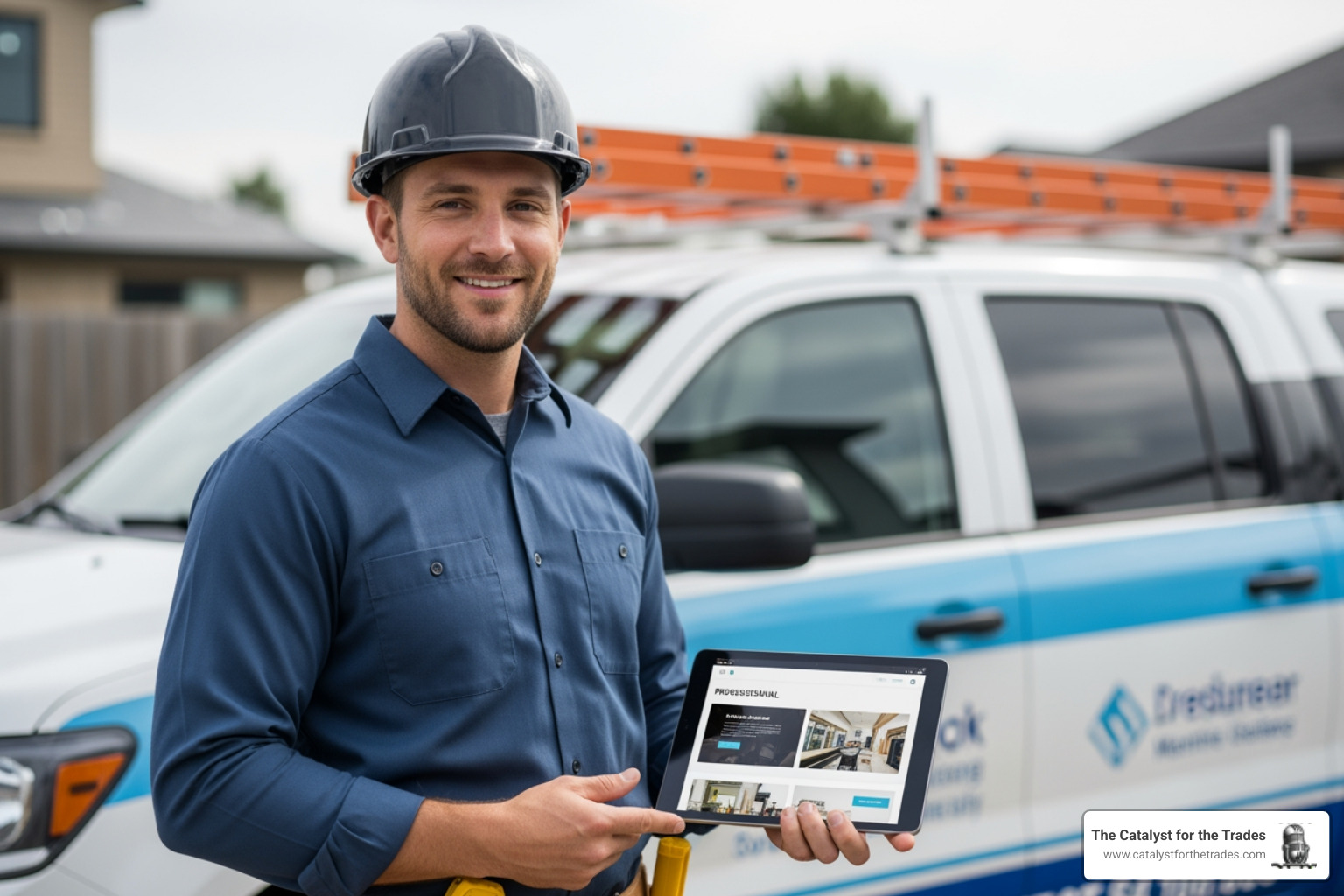
Master your contractor marketing strategy. Discover how to build your brand, get leads online, and grow your construction business.


A contractor marketing strategy is a structured plan designed to attract, engage, and convert potential customers through a mix of digital and traditional marketing channels. In today's competitive landscape, where 97% of people learn about local companies via the internet, relying solely on word-of-mouth is no longer enough to sustain growth. Home services business owners and managers need a comprehensive marketing approach that builds brand visibility, establishes trust, and creates a consistent pipeline of high-quality leads.
Key components of an effective contractor marketing strategy include:
For businesses looking to scale operations and improve profitability, a well-executed contractor marketing strategy bridges the gap between traditional word-of-mouth and modern digital-first customer acquisition. Learn more about business strategy development and find how The Catalyst for the Trades can help you implement these strategies.
The construction industry is home to over 3.7 million businesses in the U.S. alone, making differentiation critical. Your marketing strategy isn't just about getting your name out there—it's about positioning your business as the trusted expert in your service area, attracting the right customers, and building systems that convert leads into loyal clients. Whether you're a startup contractor building your first website or an established company looking to modernize your approach, the fundamentals remain the same: be visible where your customers are searching, prove your expertise, and make it easy for them to choose you.

Important contractor marketing strategy terms:
Before we lay a single brick of our marketing strategy, we need a solid foundation. This means understanding who we serve and what makes us special. Many contractors make the mistake of trying to be everything to everyone, but the most successful businesses know their niche and their ideal client.
Our brand identity is more than just a logo; it's the visual and emotional representation of our business. It commands respect, much like a well-fitted uniform, and establishes us as an authority in our field. A strong brand includes a consistent logo, color palette, and messaging that resonates with our target audience. This professionalism builds immediate trust and sets us apart.
When crafting our pitch to potential clients, we must understand their needs, highlight our expertise, and be clear and concise. It’s about communicating value, not just listing services. Sharing testimonials and offering guarantees can further build trust, ensuring our pitch is not only compelling but also trustworthy. We also explore the importance of employer branding as a reflection of our overall brand.
To market effectively, we need to know exactly who we're talking to. This involves identifying our target audience and creating detailed buyer personas. We look beyond basic demographics to understand psychographics—what motivates our customers, what their pain points are, and how they make purchasing decisions.
Analyzing our past projects can reveal valuable insights. Which projects were most profitable? Which clients were a joy to work with? This "project profitability analysis" helps us identify our ideal customer and refine our focus. For instance, if we specialize in kitchen remodels for smaller homes, our marketing should speak directly to that specific need. This focused approach allows us to develop a unique value proposition (UVP) that clearly articulates what separates us from the competition and why we are the best choice for a specific client's needs. Understanding our customer is also key to effective customer relationship management.
In an age where 93% of all online experiences start with a search engine, our digital presence isn't just a luxury; it's our primary salesperson, working 24/7. As the home services market continues its expected annual growth rate of 18.91% through 2026, a robust online presence is non-negotiable. In fact, 56% of people stated they won't trust a business without a website.
A professional website serves as our digital storefront, showcasing our work, detailing our experience, and providing an easy way for potential clients to contact us. It must be mobile-friendly, as more than half of the world’s web traffic comes from mobile devices. Every extra second a website takes to load can result in a 7% decrease in conversions, so speed is critical. Clear calls-to-action (CTAs) should guide visitors at every stage, whether they're just browsing our portfolio or ready to book a consultation. For more insights on this, consider how to lead digital transformation in home service marketing and why you can't wait.
When a homeowner's kitchen faucet starts doing its impression of Niagara Falls at 2 AM, they're not flipping through the Yellow Pages. They're grabbing their phone and searching "emergency plumber near me." This is where local SEO (Search Engine Optimization) becomes our superpower. Local SEO focuses on optimizing our online presence to attract more business from relevant local searches. Since 92% of all online searches begin on Google, ranking highly in local search results is crucial for generating leads. We can explore further details on SEO for contractors.
Our Google Business Profile (GBP) is our digital storefront on Google Search and Maps. It's often the first thing potential customers see. We must claim and fully optimize it by including accurate contact information, a detailed business description, service areas, and high-quality photos of our team and completed projects. Regularly updating our GBP with new photos and posts, and actively responding to customer Q&A, signals to Google that we're an active and trustworthy business. Creating dedicated service area pages on our website for key towns and neighborhoods also helps us target local searches more effectively. Consistent NAP (Name, Address, Phone number) information across all online directories is vital for improving our local search rankings.
Content marketing is our way of showcasing expertise and attracting organic traffic by providing value. This includes informative blog posts, how-to guides, and detailed case studies that address our target customers' pain points and questions. By sharing valuable knowledge, we position ourselves as authorities in our field.
Video marketing is particularly powerful in our industry. According to Syndicast, 52% of marketing professionals worldwide name video as the type of content with the best ROI. Videos provide an immersive experience, allowing potential clients to see our work in action. We can use before-and-after videos, project time-lapses, and short explainer videos to demonstrate our capabilities. Testimonial videos, where happy clients narrate their positive experiences, are incredibly impactful for building trust. Even a simple 1-minute video shot on a phone can be repurposed across various platforms, making video content accessible and highly effective.
Social media isn't just for viral dance trends; it's a powerful tool for contractors to build brand awareness, showcase work, and engage with our audience. Platforms like Facebook, Instagram, and even Nextdoor offer different audience reaches and opportunities. For example, Instagram's visual nature makes it ideal for sharing project updates and showcasing our craftsmanship, while Nextdoor is an incredible tool for local recommendations—think word-of-mouth in a digital space. We can find more tips on how to turn social media into a growth engine for your home service business and learn from experts like Jen McKee on how to stand out online with social media tips for contractors.
The key is consistent posting, using strong visuals, and actively engaging with comments and messages. We can share project updates, introduce our team, offer industry insights, and even run targeted Facebook ads for as little as $5 to reach specific demographics in our service areas.
While SEO and content marketing build long-term organic growth, paid advertising offers immediate visibility and lead generation. This is where we can truly accelerate our pipeline.
Pay-Per-Click (PPC) advertising, such as Google Ads, allows us to target specific keywords and demographics, placing our business at the top of search results when potential clients are actively looking for our services. We pay only when someone clicks on our ad, making it a highly measurable form of advertising.
Google Local Services Ads (LSAs) are a game-changer for contractors. These ads appear right at the top of search results for high-intent queries like "general contractor near me," often even above traditional PPC ads. LSAs come with a "Google Guarantee" badge, which covers customers up to $2,000 if they're not satisfied with the work. We only pay for qualified leads who contact us directly through the ad, providing excellent lead conversion optimization.
Social media ads on platforms like Facebook and Instagram allow for highly targeted campaigns based on demographics, interests, and even location. We can use these to build brand awareness or retarget website visitors who didn't convert, keeping our business top-of-mind during their often-long decision-making process. Learning about lead conversion optimization can help us maximize the impact of our paid ad spend.
In the trades, trust is currency. Customers are making significant investments in their homes, and they need to feel confident in our abilities and integrity. This is where social proof becomes invaluable.
Customer reviews are the digital equivalent of word-of-mouth, and they are incredibly powerful. Over 80% of consumers reported that reviews are 'important' or 'very important' when deciding on service businesses and tradespersons. What's more, 97% of B2B customers said testimonials and peer recommendations are the most reliable type of content.
We must actively encourage satisfied customers to leave reviews on platforms like Google, Yelp, and Nextdoor. But it's not enough to just collect them; we need to manage them. Nearly 90% of consumers are ‘highly’ or ‘fairly’ likely to go with a business that responds to all of its online reviews, both positive and negative. Responding courteously and professionally to negative feedback shows our commitment to customer satisfaction and can even make our overall review profile seem more authentic—68% of people don’t trust a 5-star rating unless there are more reviews that aren’t 5-star. Displaying glowing testimonials prominently on our website and social media further reinforces our credibility. This proactive approach is a core part of online reputation management.
While digital marketing brings in new leads, our existing customers are our most valuable asset. It's 5x easier (and cheaper) to sell to someone we've already worked with, and a 5% boost in retention can increase profits by at least 25%. This is why building a robust referral program is so critical.
People are 90% more likely to trust and buy from a brand that a friend recommends. We can formalize a referral program by offering incentives to happy customers who refer new business. Making the referral process easy—perhaps with pre-written templates or shareable links—and promptly rewarding both the referrer and the new client encourages participation. Promoting our referral program on our website, invoices, and social media ensures everyone knows how to become our champion. This strategy is also closely tied to customer retention strategies.
While digital is dominant, traditional marketing still holds significant weight, especially in local communities. These offline efforts complement our digital strategy and build a tangible presence.
These offline touches, when integrated thoughtfully with our digital efforts, create a well-rounded and powerful contractor marketing strategy.
The world of marketing is evolving faster than ever, and Artificial Intelligence (AI) is at the forefront of this change. For contractors, AI isn't a threat; it's a powerful tool that can amplify our marketing efforts and automate repetitive tasks, freeing up our time for what we do best: serving clients. Embracing AI is a key part of future-proofing our business and developing a robust contractor AI strategy.
AI tools can significantly improve our content creation process. We can use AI to draft blog post outlines, generate social media captions, or even analyze social media interactions and competitors. While AI can create content posts, it's crucial that we always review and edit for our unique brand voice and authenticity. Our goal is to scale our content production without stripping away our human touch.
In customer service, AI-powered chatbots can provide immediate responses to customer inquiries at any hour of the day on our websites or social media. This means potential clients get answers instantly, improving their experience and ensuring we don't miss leads, especially for after-hours emergencies. These chatbots can also analyze customer interactions, providing us with valuable insights to tailor our offerings more effectively. Explore more about AI customer acquisition and how AI voice and chat are changing the home service game.
A challenge for contractors is often not a lead problem, but a follow-up problem. Automation, powered by AI, can be our silent teammate in solving this. We can set up automated email sequences that nurture leads, sending valuable information and reminders at key points in the customer journey. Integrating our CRM (Customer Relationship Management) system allows us to centralize lead management, track interactions, and automate workflows.
For instance, we can automate service reminders, job follow-ups, and even review requests. Speed-to-lead is critical; responding to inquiries within five minutes can double our chance of booking a job. Smart forms on our website can pre-qualify leads by asking about budget, project type, and urgency, ensuring we focus on high-quality prospects. Appointment scheduling widgets can allow potential clients to book consultations instantly, making it easier for them to take the next step. These automations help us stop chasing new leads and start closing the ones we already have, optimizing our sales process.
The most effective approach involves a strategic blend of digital and offline channels. A professional, mobile-friendly website, optimized for local search, and a complete Google Business Profile are foundational. These ensure we are visible when customers are actively searching. Social media platforms, customer reviews, and robust referral programs are excellent for building trust and community engagement. Additionally, targeted paid ads, such as Google Local Services Ads and social media campaigns, can provide immediate lead generation.
While there's no one-size-fits-all answer, a common guideline is to allocate a percentage of our revenue to marketing. For many growing businesses, this might range from 5% to 10% or more, especially when launching new initiatives. The key is to start small, carefully track our return on investment (ROI) for each channel, and then scale what works. We should prioritize foundational elements like our website and Google Business Profile first, as they offer the highest long-term value and most reliable ROI.
One of the most common mistakes is neglecting our online presence, either by not having a professional website or by failing to optimize it for search engines and mobile devices. Another significant error is inconsistent marketing efforts; "set it and forget it" campaigns rarely yield results. Many contractors also fail to actively ask for and manage customer reviews, missing out on crucial social proof. Poor lead follow-up processes, ignoring the power of our existing customer base for repeat business and referrals, and failing to track results are also frequent pitfalls that can hinder growth.
As we've seen, building a successful contractor marketing strategy is like constructing a well-designed building: it requires a solid blueprint, quality materials, and consistent effort. It's about combining the timeless wisdom of word-of-mouth with the cutting-edge tools of the digital age, leveraging everything from local SEO and social media to AI and automation.
Marketing isn't an expense; it's an investment that yields substantial returns, ensuring our sales pipeline remains full and our business thrives. By defining our brand, understanding our audience, mastering essential online channels, cementing trust through reviews and referrals, and embracing future-proof tools like AI, we can build a resilient business that stands out in a competitive market. We encourage you to build a smarter, stronger marketing engine for your business and lay the foundation for lasting success.

A contractor marketing strategy is a structured plan designed to attract, engage, and convert potential customers through a mix of digital and traditional marketing channels. In today's competitive landscape, where 97% of people learn about local companies via the internet, relying solely on word-of-mouth is no longer enough to sustain growth. Home services business owners and managers need a comprehensive marketing approach that builds brand visibility, establishes trust, and creates a consistent pipeline of high-quality leads.
Key components of an effective contractor marketing strategy include:
For businesses looking to scale operations and improve profitability, a well-executed contractor marketing strategy bridges the gap between traditional word-of-mouth and modern digital-first customer acquisition. Learn more about business strategy development and find how The Catalyst for the Trades can help you implement these strategies.
The construction industry is home to over 3.7 million businesses in the U.S. alone, making differentiation critical. Your marketing strategy isn't just about getting your name out there—it's about positioning your business as the trusted expert in your service area, attracting the right customers, and building systems that convert leads into loyal clients. Whether you're a startup contractor building your first website or an established company looking to modernize your approach, the fundamentals remain the same: be visible where your customers are searching, prove your expertise, and make it easy for them to choose you.

Important contractor marketing strategy terms:
Before we lay a single brick of our marketing strategy, we need a solid foundation. This means understanding who we serve and what makes us special. Many contractors make the mistake of trying to be everything to everyone, but the most successful businesses know their niche and their ideal client.
Our brand identity is more than just a logo; it's the visual and emotional representation of our business. It commands respect, much like a well-fitted uniform, and establishes us as an authority in our field. A strong brand includes a consistent logo, color palette, and messaging that resonates with our target audience. This professionalism builds immediate trust and sets us apart.
When crafting our pitch to potential clients, we must understand their needs, highlight our expertise, and be clear and concise. It’s about communicating value, not just listing services. Sharing testimonials and offering guarantees can further build trust, ensuring our pitch is not only compelling but also trustworthy. We also explore the importance of employer branding as a reflection of our overall brand.
To market effectively, we need to know exactly who we're talking to. This involves identifying our target audience and creating detailed buyer personas. We look beyond basic demographics to understand psychographics—what motivates our customers, what their pain points are, and how they make purchasing decisions.
Analyzing our past projects can reveal valuable insights. Which projects were most profitable? Which clients were a joy to work with? This "project profitability analysis" helps us identify our ideal customer and refine our focus. For instance, if we specialize in kitchen remodels for smaller homes, our marketing should speak directly to that specific need. This focused approach allows us to develop a unique value proposition (UVP) that clearly articulates what separates us from the competition and why we are the best choice for a specific client's needs. Understanding our customer is also key to effective customer relationship management.
In an age where 93% of all online experiences start with a search engine, our digital presence isn't just a luxury; it's our primary salesperson, working 24/7. As the home services market continues its expected annual growth rate of 18.91% through 2026, a robust online presence is non-negotiable. In fact, 56% of people stated they won't trust a business without a website.
A professional website serves as our digital storefront, showcasing our work, detailing our experience, and providing an easy way for potential clients to contact us. It must be mobile-friendly, as more than half of the world’s web traffic comes from mobile devices. Every extra second a website takes to load can result in a 7% decrease in conversions, so speed is critical. Clear calls-to-action (CTAs) should guide visitors at every stage, whether they're just browsing our portfolio or ready to book a consultation. For more insights on this, consider how to lead digital transformation in home service marketing and why you can't wait.
When a homeowner's kitchen faucet starts doing its impression of Niagara Falls at 2 AM, they're not flipping through the Yellow Pages. They're grabbing their phone and searching "emergency plumber near me." This is where local SEO (Search Engine Optimization) becomes our superpower. Local SEO focuses on optimizing our online presence to attract more business from relevant local searches. Since 92% of all online searches begin on Google, ranking highly in local search results is crucial for generating leads. We can explore further details on SEO for contractors.
Our Google Business Profile (GBP) is our digital storefront on Google Search and Maps. It's often the first thing potential customers see. We must claim and fully optimize it by including accurate contact information, a detailed business description, service areas, and high-quality photos of our team and completed projects. Regularly updating our GBP with new photos and posts, and actively responding to customer Q&A, signals to Google that we're an active and trustworthy business. Creating dedicated service area pages on our website for key towns and neighborhoods also helps us target local searches more effectively. Consistent NAP (Name, Address, Phone number) information across all online directories is vital for improving our local search rankings.
Content marketing is our way of showcasing expertise and attracting organic traffic by providing value. This includes informative blog posts, how-to guides, and detailed case studies that address our target customers' pain points and questions. By sharing valuable knowledge, we position ourselves as authorities in our field.
Video marketing is particularly powerful in our industry. According to Syndicast, 52% of marketing professionals worldwide name video as the type of content with the best ROI. Videos provide an immersive experience, allowing potential clients to see our work in action. We can use before-and-after videos, project time-lapses, and short explainer videos to demonstrate our capabilities. Testimonial videos, where happy clients narrate their positive experiences, are incredibly impactful for building trust. Even a simple 1-minute video shot on a phone can be repurposed across various platforms, making video content accessible and highly effective.
Social media isn't just for viral dance trends; it's a powerful tool for contractors to build brand awareness, showcase work, and engage with our audience. Platforms like Facebook, Instagram, and even Nextdoor offer different audience reaches and opportunities. For example, Instagram's visual nature makes it ideal for sharing project updates and showcasing our craftsmanship, while Nextdoor is an incredible tool for local recommendations—think word-of-mouth in a digital space. We can find more tips on how to turn social media into a growth engine for your home service business and learn from experts like Jen McKee on how to stand out online with social media tips for contractors.
The key is consistent posting, using strong visuals, and actively engaging with comments and messages. We can share project updates, introduce our team, offer industry insights, and even run targeted Facebook ads for as little as $5 to reach specific demographics in our service areas.
While SEO and content marketing build long-term organic growth, paid advertising offers immediate visibility and lead generation. This is where we can truly accelerate our pipeline.
Pay-Per-Click (PPC) advertising, such as Google Ads, allows us to target specific keywords and demographics, placing our business at the top of search results when potential clients are actively looking for our services. We pay only when someone clicks on our ad, making it a highly measurable form of advertising.
Google Local Services Ads (LSAs) are a game-changer for contractors. These ads appear right at the top of search results for high-intent queries like "general contractor near me," often even above traditional PPC ads. LSAs come with a "Google Guarantee" badge, which covers customers up to $2,000 if they're not satisfied with the work. We only pay for qualified leads who contact us directly through the ad, providing excellent lead conversion optimization.
Social media ads on platforms like Facebook and Instagram allow for highly targeted campaigns based on demographics, interests, and even location. We can use these to build brand awareness or retarget website visitors who didn't convert, keeping our business top-of-mind during their often-long decision-making process. Learning about lead conversion optimization can help us maximize the impact of our paid ad spend.
In the trades, trust is currency. Customers are making significant investments in their homes, and they need to feel confident in our abilities and integrity. This is where social proof becomes invaluable.
Customer reviews are the digital equivalent of word-of-mouth, and they are incredibly powerful. Over 80% of consumers reported that reviews are 'important' or 'very important' when deciding on service businesses and tradespersons. What's more, 97% of B2B customers said testimonials and peer recommendations are the most reliable type of content.
We must actively encourage satisfied customers to leave reviews on platforms like Google, Yelp, and Nextdoor. But it's not enough to just collect them; we need to manage them. Nearly 90% of consumers are ‘highly’ or ‘fairly’ likely to go with a business that responds to all of its online reviews, both positive and negative. Responding courteously and professionally to negative feedback shows our commitment to customer satisfaction and can even make our overall review profile seem more authentic—68% of people don’t trust a 5-star rating unless there are more reviews that aren’t 5-star. Displaying glowing testimonials prominently on our website and social media further reinforces our credibility. This proactive approach is a core part of online reputation management.
While digital marketing brings in new leads, our existing customers are our most valuable asset. It's 5x easier (and cheaper) to sell to someone we've already worked with, and a 5% boost in retention can increase profits by at least 25%. This is why building a robust referral program is so critical.
People are 90% more likely to trust and buy from a brand that a friend recommends. We can formalize a referral program by offering incentives to happy customers who refer new business. Making the referral process easy—perhaps with pre-written templates or shareable links—and promptly rewarding both the referrer and the new client encourages participation. Promoting our referral program on our website, invoices, and social media ensures everyone knows how to become our champion. This strategy is also closely tied to customer retention strategies.
While digital is dominant, traditional marketing still holds significant weight, especially in local communities. These offline efforts complement our digital strategy and build a tangible presence.
These offline touches, when integrated thoughtfully with our digital efforts, create a well-rounded and powerful contractor marketing strategy.
The world of marketing is evolving faster than ever, and Artificial Intelligence (AI) is at the forefront of this change. For contractors, AI isn't a threat; it's a powerful tool that can amplify our marketing efforts and automate repetitive tasks, freeing up our time for what we do best: serving clients. Embracing AI is a key part of future-proofing our business and developing a robust contractor AI strategy.
AI tools can significantly improve our content creation process. We can use AI to draft blog post outlines, generate social media captions, or even analyze social media interactions and competitors. While AI can create content posts, it's crucial that we always review and edit for our unique brand voice and authenticity. Our goal is to scale our content production without stripping away our human touch.
In customer service, AI-powered chatbots can provide immediate responses to customer inquiries at any hour of the day on our websites or social media. This means potential clients get answers instantly, improving their experience and ensuring we don't miss leads, especially for after-hours emergencies. These chatbots can also analyze customer interactions, providing us with valuable insights to tailor our offerings more effectively. Explore more about AI customer acquisition and how AI voice and chat are changing the home service game.
A challenge for contractors is often not a lead problem, but a follow-up problem. Automation, powered by AI, can be our silent teammate in solving this. We can set up automated email sequences that nurture leads, sending valuable information and reminders at key points in the customer journey. Integrating our CRM (Customer Relationship Management) system allows us to centralize lead management, track interactions, and automate workflows.
For instance, we can automate service reminders, job follow-ups, and even review requests. Speed-to-lead is critical; responding to inquiries within five minutes can double our chance of booking a job. Smart forms on our website can pre-qualify leads by asking about budget, project type, and urgency, ensuring we focus on high-quality prospects. Appointment scheduling widgets can allow potential clients to book consultations instantly, making it easier for them to take the next step. These automations help us stop chasing new leads and start closing the ones we already have, optimizing our sales process.
The most effective approach involves a strategic blend of digital and offline channels. A professional, mobile-friendly website, optimized for local search, and a complete Google Business Profile are foundational. These ensure we are visible when customers are actively searching. Social media platforms, customer reviews, and robust referral programs are excellent for building trust and community engagement. Additionally, targeted paid ads, such as Google Local Services Ads and social media campaigns, can provide immediate lead generation.
While there's no one-size-fits-all answer, a common guideline is to allocate a percentage of our revenue to marketing. For many growing businesses, this might range from 5% to 10% or more, especially when launching new initiatives. The key is to start small, carefully track our return on investment (ROI) for each channel, and then scale what works. We should prioritize foundational elements like our website and Google Business Profile first, as they offer the highest long-term value and most reliable ROI.
One of the most common mistakes is neglecting our online presence, either by not having a professional website or by failing to optimize it for search engines and mobile devices. Another significant error is inconsistent marketing efforts; "set it and forget it" campaigns rarely yield results. Many contractors also fail to actively ask for and manage customer reviews, missing out on crucial social proof. Poor lead follow-up processes, ignoring the power of our existing customer base for repeat business and referrals, and failing to track results are also frequent pitfalls that can hinder growth.
As we've seen, building a successful contractor marketing strategy is like constructing a well-designed building: it requires a solid blueprint, quality materials, and consistent effort. It's about combining the timeless wisdom of word-of-mouth with the cutting-edge tools of the digital age, leveraging everything from local SEO and social media to AI and automation.
Marketing isn't an expense; it's an investment that yields substantial returns, ensuring our sales pipeline remains full and our business thrives. By defining our brand, understanding our audience, mastering essential online channels, cementing trust through reviews and referrals, and embracing future-proof tools like AI, we can build a resilient business that stands out in a competitive market. We encourage you to build a smarter, stronger marketing engine for your business and lay the foundation for lasting success.

A contractor marketing strategy is a structured plan designed to attract, engage, and convert potential customers through a mix of digital and traditional marketing channels. In today's competitive landscape, where 97% of people learn about local companies via the internet, relying solely on word-of-mouth is no longer enough to sustain growth. Home services business owners and managers need a comprehensive marketing approach that builds brand visibility, establishes trust, and creates a consistent pipeline of high-quality leads.
Key components of an effective contractor marketing strategy include:
For businesses looking to scale operations and improve profitability, a well-executed contractor marketing strategy bridges the gap between traditional word-of-mouth and modern digital-first customer acquisition. Learn more about business strategy development and find how The Catalyst for the Trades can help you implement these strategies.
The construction industry is home to over 3.7 million businesses in the U.S. alone, making differentiation critical. Your marketing strategy isn't just about getting your name out there—it's about positioning your business as the trusted expert in your service area, attracting the right customers, and building systems that convert leads into loyal clients. Whether you're a startup contractor building your first website or an established company looking to modernize your approach, the fundamentals remain the same: be visible where your customers are searching, prove your expertise, and make it easy for them to choose you.

Important contractor marketing strategy terms:
Before we lay a single brick of our marketing strategy, we need a solid foundation. This means understanding who we serve and what makes us special. Many contractors make the mistake of trying to be everything to everyone, but the most successful businesses know their niche and their ideal client.
Our brand identity is more than just a logo; it's the visual and emotional representation of our business. It commands respect, much like a well-fitted uniform, and establishes us as an authority in our field. A strong brand includes a consistent logo, color palette, and messaging that resonates with our target audience. This professionalism builds immediate trust and sets us apart.
When crafting our pitch to potential clients, we must understand their needs, highlight our expertise, and be clear and concise. It’s about communicating value, not just listing services. Sharing testimonials and offering guarantees can further build trust, ensuring our pitch is not only compelling but also trustworthy. We also explore the importance of employer branding as a reflection of our overall brand.
To market effectively, we need to know exactly who we're talking to. This involves identifying our target audience and creating detailed buyer personas. We look beyond basic demographics to understand psychographics—what motivates our customers, what their pain points are, and how they make purchasing decisions.
Analyzing our past projects can reveal valuable insights. Which projects were most profitable? Which clients were a joy to work with? This "project profitability analysis" helps us identify our ideal customer and refine our focus. For instance, if we specialize in kitchen remodels for smaller homes, our marketing should speak directly to that specific need. This focused approach allows us to develop a unique value proposition (UVP) that clearly articulates what separates us from the competition and why we are the best choice for a specific client's needs. Understanding our customer is also key to effective customer relationship management.
In an age where 93% of all online experiences start with a search engine, our digital presence isn't just a luxury; it's our primary salesperson, working 24/7. As the home services market continues its expected annual growth rate of 18.91% through 2026, a robust online presence is non-negotiable. In fact, 56% of people stated they won't trust a business without a website.
A professional website serves as our digital storefront, showcasing our work, detailing our experience, and providing an easy way for potential clients to contact us. It must be mobile-friendly, as more than half of the world’s web traffic comes from mobile devices. Every extra second a website takes to load can result in a 7% decrease in conversions, so speed is critical. Clear calls-to-action (CTAs) should guide visitors at every stage, whether they're just browsing our portfolio or ready to book a consultation. For more insights on this, consider how to lead digital transformation in home service marketing and why you can't wait.
When a homeowner's kitchen faucet starts doing its impression of Niagara Falls at 2 AM, they're not flipping through the Yellow Pages. They're grabbing their phone and searching "emergency plumber near me." This is where local SEO (Search Engine Optimization) becomes our superpower. Local SEO focuses on optimizing our online presence to attract more business from relevant local searches. Since 92% of all online searches begin on Google, ranking highly in local search results is crucial for generating leads. We can explore further details on SEO for contractors.
Our Google Business Profile (GBP) is our digital storefront on Google Search and Maps. It's often the first thing potential customers see. We must claim and fully optimize it by including accurate contact information, a detailed business description, service areas, and high-quality photos of our team and completed projects. Regularly updating our GBP with new photos and posts, and actively responding to customer Q&A, signals to Google that we're an active and trustworthy business. Creating dedicated service area pages on our website for key towns and neighborhoods also helps us target local searches more effectively. Consistent NAP (Name, Address, Phone number) information across all online directories is vital for improving our local search rankings.
Content marketing is our way of showcasing expertise and attracting organic traffic by providing value. This includes informative blog posts, how-to guides, and detailed case studies that address our target customers' pain points and questions. By sharing valuable knowledge, we position ourselves as authorities in our field.
Video marketing is particularly powerful in our industry. According to Syndicast, 52% of marketing professionals worldwide name video as the type of content with the best ROI. Videos provide an immersive experience, allowing potential clients to see our work in action. We can use before-and-after videos, project time-lapses, and short explainer videos to demonstrate our capabilities. Testimonial videos, where happy clients narrate their positive experiences, are incredibly impactful for building trust. Even a simple 1-minute video shot on a phone can be repurposed across various platforms, making video content accessible and highly effective.
Social media isn't just for viral dance trends; it's a powerful tool for contractors to build brand awareness, showcase work, and engage with our audience. Platforms like Facebook, Instagram, and even Nextdoor offer different audience reaches and opportunities. For example, Instagram's visual nature makes it ideal for sharing project updates and showcasing our craftsmanship, while Nextdoor is an incredible tool for local recommendations—think word-of-mouth in a digital space. We can find more tips on how to turn social media into a growth engine for your home service business and learn from experts like Jen McKee on how to stand out online with social media tips for contractors.
The key is consistent posting, using strong visuals, and actively engaging with comments and messages. We can share project updates, introduce our team, offer industry insights, and even run targeted Facebook ads for as little as $5 to reach specific demographics in our service areas.
While SEO and content marketing build long-term organic growth, paid advertising offers immediate visibility and lead generation. This is where we can truly accelerate our pipeline.
Pay-Per-Click (PPC) advertising, such as Google Ads, allows us to target specific keywords and demographics, placing our business at the top of search results when potential clients are actively looking for our services. We pay only when someone clicks on our ad, making it a highly measurable form of advertising.
Google Local Services Ads (LSAs) are a game-changer for contractors. These ads appear right at the top of search results for high-intent queries like "general contractor near me," often even above traditional PPC ads. LSAs come with a "Google Guarantee" badge, which covers customers up to $2,000 if they're not satisfied with the work. We only pay for qualified leads who contact us directly through the ad, providing excellent lead conversion optimization.
Social media ads on platforms like Facebook and Instagram allow for highly targeted campaigns based on demographics, interests, and even location. We can use these to build brand awareness or retarget website visitors who didn't convert, keeping our business top-of-mind during their often-long decision-making process. Learning about lead conversion optimization can help us maximize the impact of our paid ad spend.
In the trades, trust is currency. Customers are making significant investments in their homes, and they need to feel confident in our abilities and integrity. This is where social proof becomes invaluable.
Customer reviews are the digital equivalent of word-of-mouth, and they are incredibly powerful. Over 80% of consumers reported that reviews are 'important' or 'very important' when deciding on service businesses and tradespersons. What's more, 97% of B2B customers said testimonials and peer recommendations are the most reliable type of content.
We must actively encourage satisfied customers to leave reviews on platforms like Google, Yelp, and Nextdoor. But it's not enough to just collect them; we need to manage them. Nearly 90% of consumers are ‘highly’ or ‘fairly’ likely to go with a business that responds to all of its online reviews, both positive and negative. Responding courteously and professionally to negative feedback shows our commitment to customer satisfaction and can even make our overall review profile seem more authentic—68% of people don’t trust a 5-star rating unless there are more reviews that aren’t 5-star. Displaying glowing testimonials prominently on our website and social media further reinforces our credibility. This proactive approach is a core part of online reputation management.
While digital marketing brings in new leads, our existing customers are our most valuable asset. It's 5x easier (and cheaper) to sell to someone we've already worked with, and a 5% boost in retention can increase profits by at least 25%. This is why building a robust referral program is so critical.
People are 90% more likely to trust and buy from a brand that a friend recommends. We can formalize a referral program by offering incentives to happy customers who refer new business. Making the referral process easy—perhaps with pre-written templates or shareable links—and promptly rewarding both the referrer and the new client encourages participation. Promoting our referral program on our website, invoices, and social media ensures everyone knows how to become our champion. This strategy is also closely tied to customer retention strategies.
While digital is dominant, traditional marketing still holds significant weight, especially in local communities. These offline efforts complement our digital strategy and build a tangible presence.
These offline touches, when integrated thoughtfully with our digital efforts, create a well-rounded and powerful contractor marketing strategy.
The world of marketing is evolving faster than ever, and Artificial Intelligence (AI) is at the forefront of this change. For contractors, AI isn't a threat; it's a powerful tool that can amplify our marketing efforts and automate repetitive tasks, freeing up our time for what we do best: serving clients. Embracing AI is a key part of future-proofing our business and developing a robust contractor AI strategy.
AI tools can significantly improve our content creation process. We can use AI to draft blog post outlines, generate social media captions, or even analyze social media interactions and competitors. While AI can create content posts, it's crucial that we always review and edit for our unique brand voice and authenticity. Our goal is to scale our content production without stripping away our human touch.
In customer service, AI-powered chatbots can provide immediate responses to customer inquiries at any hour of the day on our websites or social media. This means potential clients get answers instantly, improving their experience and ensuring we don't miss leads, especially for after-hours emergencies. These chatbots can also analyze customer interactions, providing us with valuable insights to tailor our offerings more effectively. Explore more about AI customer acquisition and how AI voice and chat are changing the home service game.
A challenge for contractors is often not a lead problem, but a follow-up problem. Automation, powered by AI, can be our silent teammate in solving this. We can set up automated email sequences that nurture leads, sending valuable information and reminders at key points in the customer journey. Integrating our CRM (Customer Relationship Management) system allows us to centralize lead management, track interactions, and automate workflows.
For instance, we can automate service reminders, job follow-ups, and even review requests. Speed-to-lead is critical; responding to inquiries within five minutes can double our chance of booking a job. Smart forms on our website can pre-qualify leads by asking about budget, project type, and urgency, ensuring we focus on high-quality prospects. Appointment scheduling widgets can allow potential clients to book consultations instantly, making it easier for them to take the next step. These automations help us stop chasing new leads and start closing the ones we already have, optimizing our sales process.
The most effective approach involves a strategic blend of digital and offline channels. A professional, mobile-friendly website, optimized for local search, and a complete Google Business Profile are foundational. These ensure we are visible when customers are actively searching. Social media platforms, customer reviews, and robust referral programs are excellent for building trust and community engagement. Additionally, targeted paid ads, such as Google Local Services Ads and social media campaigns, can provide immediate lead generation.
While there's no one-size-fits-all answer, a common guideline is to allocate a percentage of our revenue to marketing. For many growing businesses, this might range from 5% to 10% or more, especially when launching new initiatives. The key is to start small, carefully track our return on investment (ROI) for each channel, and then scale what works. We should prioritize foundational elements like our website and Google Business Profile first, as they offer the highest long-term value and most reliable ROI.
One of the most common mistakes is neglecting our online presence, either by not having a professional website or by failing to optimize it for search engines and mobile devices. Another significant error is inconsistent marketing efforts; "set it and forget it" campaigns rarely yield results. Many contractors also fail to actively ask for and manage customer reviews, missing out on crucial social proof. Poor lead follow-up processes, ignoring the power of our existing customer base for repeat business and referrals, and failing to track results are also frequent pitfalls that can hinder growth.
As we've seen, building a successful contractor marketing strategy is like constructing a well-designed building: it requires a solid blueprint, quality materials, and consistent effort. It's about combining the timeless wisdom of word-of-mouth with the cutting-edge tools of the digital age, leveraging everything from local SEO and social media to AI and automation.
Marketing isn't an expense; it's an investment that yields substantial returns, ensuring our sales pipeline remains full and our business thrives. By defining our brand, understanding our audience, mastering essential online channels, cementing trust through reviews and referrals, and embracing future-proof tools like AI, we can build a resilient business that stands out in a competitive market. We encourage you to build a smarter, stronger marketing engine for your business and lay the foundation for lasting success.

Discover how leading home‑service companies are leveraging AI, subscription models, and digital‑first strategies.
Learn why private equity, automation, and customer‑centric tech are reshaping the trades.

Master your contractor marketing strategy. Discover how to build your brand, get leads online, and grow your construction business.

Unify your business with a cortex business platform. Solve data silos, automate workflows & leverage AI for competitive advantage.

Master your content marketing strategy. Learn to build, execute, and measure your plan for business growth and increased ROI.