Learn to boost output & reduce costs. Master operational efficiency with strategies, tools, and metrics for your trade business.

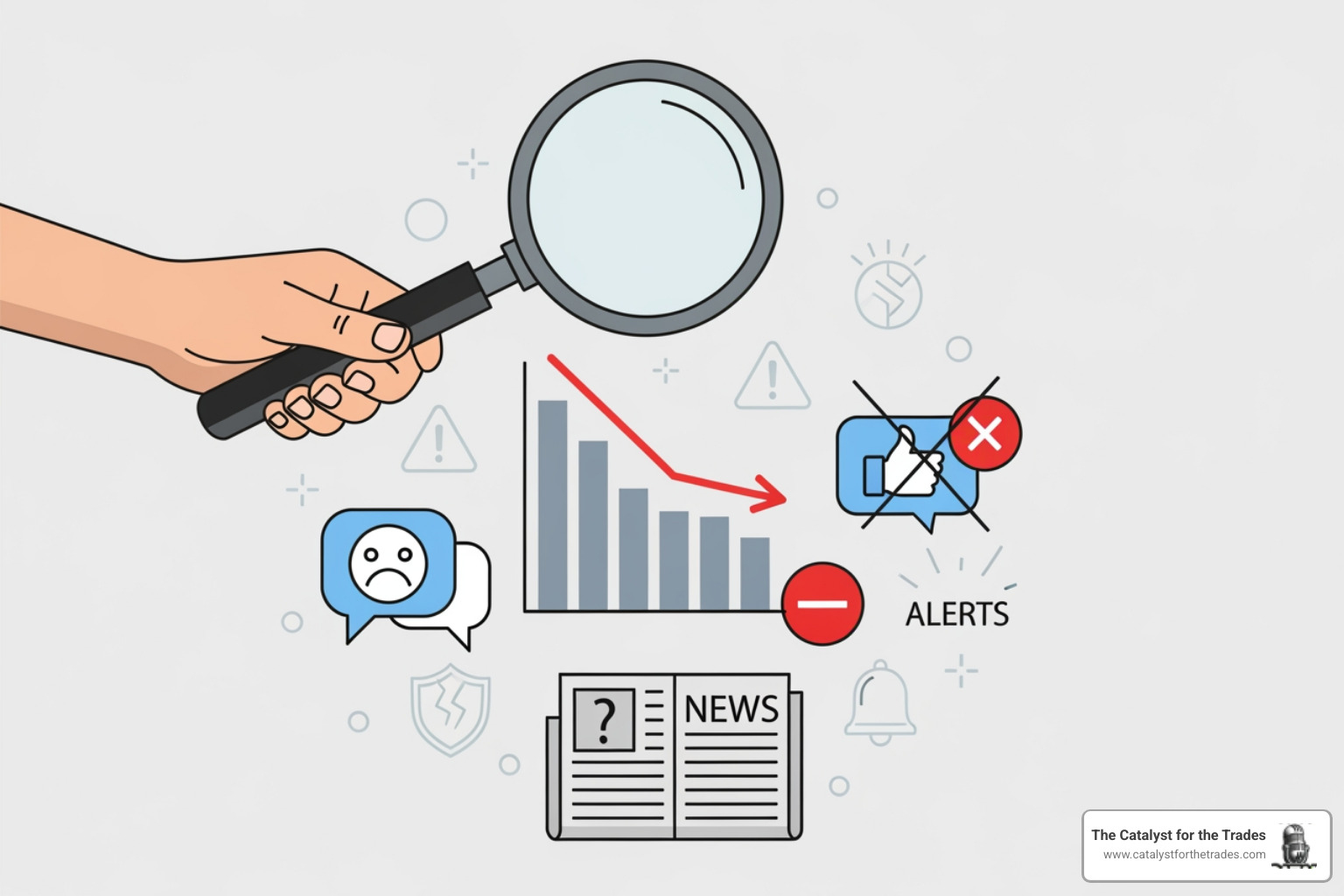
Online reputation management is the process of monitoring and shaping how your business appears online. Every search result, review, and social media comment creates a digital first impression that influences whether a homeowner calls you or a competitor. For trades businesses, where trust is paramount, your digital reputation directly impacts your bottom line.
Here's what effective online reputation management delivers:
Discover how top contractors win with mindset, AI, and showing up, and learn strategies to protect your profit and lead with purpose.
Proactive reputation management means building a strong presence before problems arise, while reactive means fixing damage after it happens. Smart businesses focus on proactive strategies—like creating positive content and earning great reviews—to protect themselves when negative feedback appears.

At its core, online reputation management (ORM) is about taking control of your digital narrative. It’s the strategic process of monitoring and influencing how your home service business is perceived online. This involves shaping what potential customers find in search results, customer reviews, and on social media.
Our goal with ORM is to ensure your business is represented fairly and positively, building a strong online image that reflects the quality of your work and your commitment to customer satisfaction. It's about being intentional with your digital presence, rather than letting it be defined by chance.
Digital word-of-mouth is the new standard. Consumers turn to the web for research before making decisions, meaning your online reputation is the crucial first impression that can win or lose business.
A strong online reputation is essential for several reasons:

The internet has fundamentally changed how people talk about your business. What used to be a private conversation between neighbors is now a public discussion that anyone can find with a quick search. This shift brings incredible opportunities to connect with customers, but it also introduces real challenges that every home service business needs to understand.
No matter how great your work is, reputation challenges are inevitable. Understanding these threats helps you prepare before they become major problems.
Negative customer reviews are the most visible threat. A consumer is 21% more likely to leave a negative review than a positive one, meaning unhappy customers are more motivated to share their experiences. Whether legitimate or not, these reviews on sites like Google and Yelp can shake a potential customer's confidence.
Misinformation and outdated information, such as an old address or phone number, create frustration and make your business look unreliable. These inaccurate listings across online directories can deter customers, even if the errors are unintentional.
Unprofessional social media interactions can spiral out of control. In an age where screenshots live forever, one poorly worded response or an employee's questionable post can cause serious damage. We've all witnessed social media meltdowns that turn into cautionary tales. Jen McKee shares valuable insights on standing out online and avoiding these pitfalls.
Former employee complaints on sites like Glassdoor can impact more than just hiring—they also influence how potential customers perceive your business culture. And with Google's newer "discussions and forums" search feature highlighting personal experiences from platforms like Reddit, negative press or forum discussions can gain unexpected visibility, appearing right alongside official reviews.
While both online reputation management and marketing aim to strengthen your brand, they work in fundamentally different ways.
Traditional marketing is typically proactive and campaign-focused, broadcasting a message to attract customers. Online reputation management, on the other hand, requires both proactive building (creating positive content) and reactive problem-solving (addressing issues as they arise). Building systems that create freedom helps you manage both aspects effectively.
Another key difference: marketing can be a one-way broadcast, while ORM thrives on two-way conversation. It's not enough to tell people how great you are. You need to listen to what customers are saying, respond to their feedback, and build genuine relationships. This ongoing dialogue creates trust in a way that traditional advertising simply can't match.
Perhaps the biggest shift is the focus on user-generated content. Traditional marketing gives you complete control over the message. With ORM, you're dealing with content created by customers, former employees, and others online. You don't control these messages, but you have significant power to influence the narrative through thoughtful responses and consistent positive actions.
Finally, while marketing campaigns have start and end dates, ORM is an ongoing process. Your online reputation evolves daily, requiring continuous monitoring and maintenance. It's a long-term strategy focused on building trust and credibility rather than immediate sales. This approach helps you protect your profit and lead with purpose over the long haul.

A strong online reputation requires getting ahead of problems before they start. Like equipment maintenance, this proactive approach to online reputation management prevents major issues down the road.
Being proactive creates a buffer of positive content and interactions that can weather the occasional storm. This involves creating valuable content, managing reviews, and keeping listings sharp. It's about building systems that work for you while you focus on running your business. As we explore in Mike Abramowitz's blueprint for trades success, the right systems create freedom.
When a homeowner searches for your services, you want them to find you—and find good things about you. That's where smart content creation and SEO come in. Your goal is to own the first page of search results for your business and services.
Create helpful blog content by answering common customer questions (e.g., 'When should I replace my water heater?'). This positions you as an expert and improves search rankings.
Video testimonials from happy customers build instant trust. Paired with before-and-after project photos, they provide compelling visual proof of your expertise.
When you're actively answering customer questions on your Google Business Profile and website, you're helping people find information while showing search engines that you're a valuable resource. We're constantly adapting our approach, as discussed in Reinventing SEO & Web Strategy: AI Transformation with Seth Humble.
The technical side matters too. Ensure your website loads quickly, works smoothly on mobile devices, and provides a great user experience. These factors don't just make customers happy—they directly impact your search rankings.
Customers are 21% more likely to leave a negative review than a positive one. That's why you need a system for encouraging satisfied customers to share their experiences.
The best time to ask is right after a successful job. A simple text or email requesting a review on Google, Yelp, or other platforms can make all the difference.
Crucially, you must respond to all feedback. Thank customers for positive reviews. For critical reviews, respond promptly and professionally. Acknowledge the issue, apologize if appropriate, and offer to make things right offline. This shows potential customers you care about satisfaction. This approach aligns with what we discuss in Wow Every Call: The Key to Customer Experience Excellence.
Every review is valuable feedback. Use this information to improve your services, processes, or communication. When you make changes based on customer input, it shows you're listening.
Essential online profiles every trades business should claim:
Your local listings and social media are often a customer's first encounter with your business. Getting these right is non-negotiable for effective online reputation management.
Claim your Google Business Profile and other key platforms like Yelp. Ensure every detail—address, phone, website, hours, services—is accurate and consistent across all platforms. Inconsistencies confuse customers and can hurt local search rankings.
Consistent branding across all profiles makes your business instantly recognizable. Use the same logo, similar images, and a consistent voice.
Social media is a conversation. Engage with your audience by responding to comments and answering questions. Share helpful seasonal tips, behind-the-scenes looks at your team, and community involvement. This valuable content builds relationships and trust.
Monitoring tools help you catch mentions of your business even when you're not tagged. When you integrate review and social media monitoring with your CRM, nothing falls through the cracks. Getting your CRM right creates a seamless system that keeps your reputation strong.

Manually tracking every brand mention, analyzing review sentiment, and crafting responses is overwhelming. Artificial intelligence (AI) acts as a tireless digital assistant, turning online reputation management from a reactive scramble into a strategic advantage.
AI makes reputation management smarter, not just faster. It can monitor brand mentions in real-time, understand the sentiment of customer feedback, and predict potential crises. For busy home service businesses juggling daily operations, AI provides a significant competitive edge. The AI revolution in home services is fundamentally changing how we protect and build our brands online.
Think of AI as a team member who never sleeps and can read thousands of reviews and social media posts simultaneously. That's the power of AI-powered monitoring.
Real-time mention tracking means you'll know the instant someone talks about your business online. This immediate awareness lets you engage in conversations while they're still fresh, showing customers you're responsive.
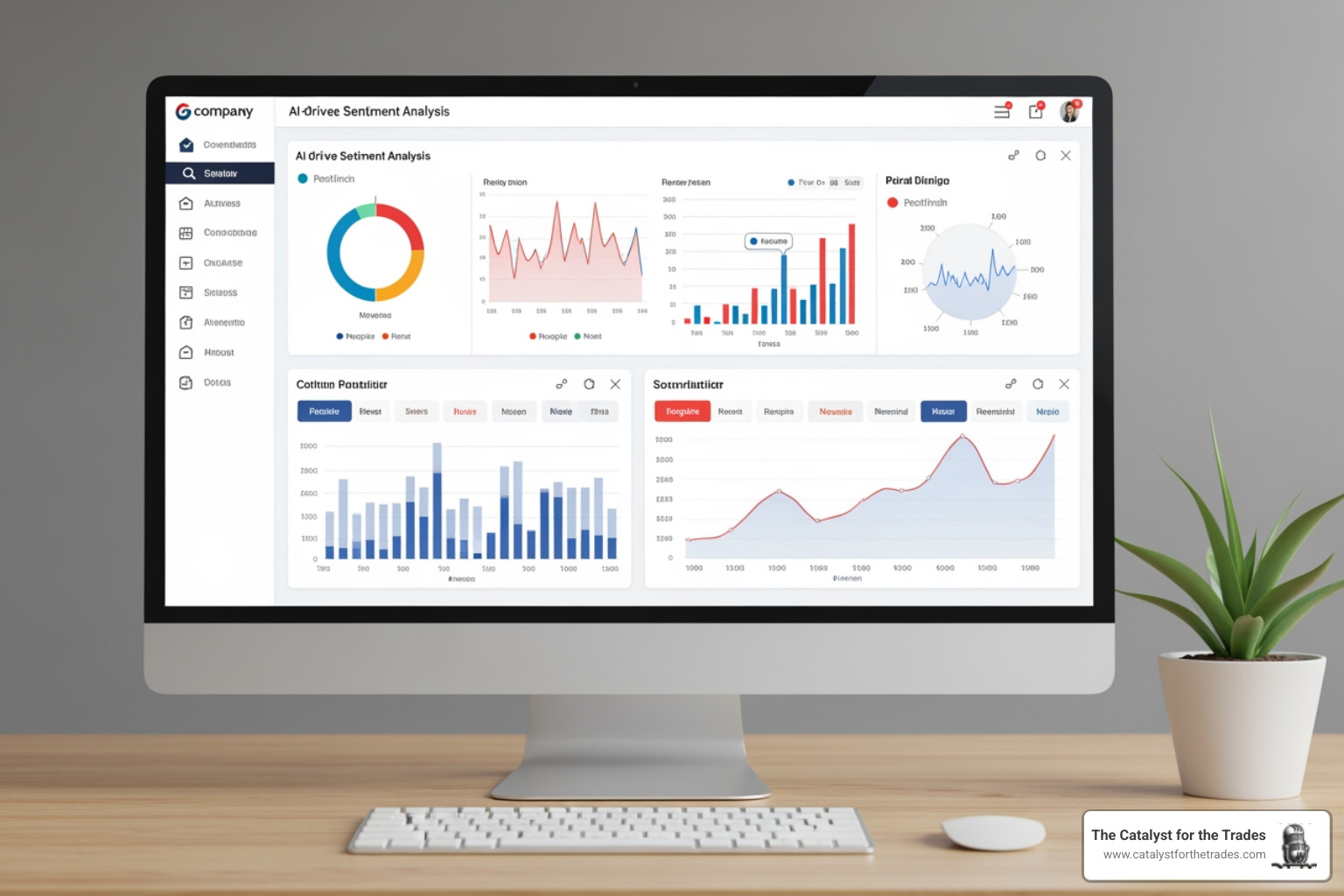
Through sentiment analysis, AI reads between the lines of customer feedback to determine if comments are positive, negative, or neutral. It analyzes the specific words used, understanding nuance and emotion at scale to give you a 360-degree view of customer feelings.
Perhaps most valuable is AI's ability to identify trends and spot potential crises early. Is there a recurring complaint about response times? Are customers raving about a particular technician? AI catches these patterns quickly, giving you actionable insights. Its anomaly detection acts as an early warning system for sudden spikes in negative mentions, letting you address problems before they snowball. These capabilities are what make AI business intelligence and AI decision-making tools so powerful.
AI even offers predictive analytics, helping you anticipate customer needs. It can suggest location-specific improvements based on regional feedback, allowing you to stay ahead of expectations.
Speed matters online. A customer who leaves a review expects acknowledgment. AI transforms how quickly and effectively you can respond to every interaction.
AI-powered response suggestions analyze reviews and generate appropriate, on-brand replies in seconds. Modern AI understands context, suggesting personalized messages that feel genuine. You maintain final control, but the initial heavy lifting is done for you. This dramatically improves response times, a cornerstone of excellent AI customer service.
For routine questions, AI chatbots can provide instant answers on your website or collect information for follow-up. Your team stays focused on complex issues, while customers get immediate assistance 24/7.
Personalized follow-ups become effortless with AI. Based on a customer's history, AI can help you send custom check-ins, maintenance reminders, or relevant service suggestions.
The result is significantly faster response times. When customers feel heard quickly, trust builds naturally. Following customer service automation best practices with AI is truly changing the home service game, making every customer interaction smoother.
Negative reviews sting, but your response can turn a challenge into a reputation-building opportunity.
Respond promptly and professionally. A quick, thoughtful response shows you care. Keep your tone calm, even if the review feels unfair. Never delete negative comments, as this can look like you're hiding something and escalate the situation.
Acknowledge the customer's experience first. Start by validating their feelings with phrases like "We're sorry to hear about your experience" or "We understand your frustration." This shows you're listening.
Apologize when appropriate. If your business made a mistake, a sincere apology goes a long way. Take responsibility without making excuses.
Take the conversation offline to resolve the issue. This is key. Provide a direct phone number or email and invite them to discuss the matter further. This demonstrates your commitment to a solution and prevents a public argument.
Focus on a solution, not an argument. Your goal is to resolve the customer's problem and show others that you're responsive. Ask how you can make things right. Often, customers who have a negative experience resolved professionally become loyal advocates.
Repairing a damaged online reputation management presence isn't a quick fix; it's a marathon, not a sprint. It's important to set realistic expectations.
The timeline varies significantly by situation. The severity and volume of negative content play a major role. A single negative review can be addressed relatively quickly, while multiple negative articles could take considerably longer.
Patience and persistence are essential. Suppressing negative search results and building a positive presence typically takes six to twelve months, or longer in challenging cases. Each situation is unique and requires a custom combination of tactics.
Consistent, long-term effort is non-negotiable. The internet has a long memory. Pushing down negative content requires a steady stream of new, positive content to outrank it, including ongoing SEO, review generation, and social engagement.
Proactive management builds resilience. The best way to "repair" a damaged reputation is to have built a strong one before problems arise. When you've invested in proactive strategies, your business is less vulnerable to individual negative incidents.
The simple, honest answer is that permanent removal of online content is difficult and often impossible.
The internet has a long memory. Once something is published, it's extremely hard to erase. While some platforms might remove content for specific violations (like copyright infringement or defamation), these are exceptions. You can always contact the site's webmaster to politely request removal, but success isn't guaranteed.
Suppression is the realistic strategy. For most negative content, the goal of effective online reputation management isn't removal but suppression. This means creating and promoting so much positive, relevant content about your business that the negative results are pushed down in search results, where most people won't see them.
Pushing negative results off the first page of Google is the primary goal. The vast majority of users never click past the first page of Google. By consistently generating and optimizing new content—blog posts, video testimonials, positive reviews, and social media activity—we can effectively "bury the bad." When potential customers search for you, they'll encounter your positive information first.
Your online reputation is the digital foundation of your business. Every review, search result, and social media comment shapes whether homeowners trust you enough to call. In the home service trades, where decisions are based on online feedback, effective online reputation management is the difference between thriving and surviving.
The good news is you have the tools to take control. We've covered the proactive steps to build a strong reputation: creating valuable content, managing reviews, optimizing local listings, and leveraging AI. These are the building blocks of a resilient brand that can weather any storm.
Online reputation management is an ongoing journey, not a destination. It requires weaving together technology with genuine, exceptional customer service. When you combine AI-powered insights with the human touch that makes your business special, you create a brand that customers trust and negative feedback can't easily damage. This integration of smart contractor AI strategy with real-world service excellence is what future-proofs your legacy.
At The Catalyst for the Trades, we get it. We understand the unique pressures and opportunities facing home service businesses. Jennifer brings the AI and marketing innovation, Chuck brings decades of operational scaling wisdom, and together we're committed to helping you steer this complex digital landscape with confidence.
Your brand's legacy deserves to be one of trust and quality. The time to start building that legacy is now. Learn how to empower your home service business with strategies for growth, innovation, and leadership that turn your online reputation into your most powerful competitive advantage.
Online reputation management is the process of monitoring and shaping how your business appears online. Every search result, review, and social media comment creates a digital first impression that influences whether a homeowner calls you or a competitor. For trades businesses, where trust is paramount, your digital reputation directly impacts your bottom line.
Here's what effective online reputation management delivers:
Discover how top contractors win with mindset, AI, and showing up, and learn strategies to protect your profit and lead with purpose.
Proactive reputation management means building a strong presence before problems arise, while reactive means fixing damage after it happens. Smart businesses focus on proactive strategies—like creating positive content and earning great reviews—to protect themselves when negative feedback appears.

At its core, online reputation management (ORM) is about taking control of your digital narrative. It’s the strategic process of monitoring and influencing how your home service business is perceived online. This involves shaping what potential customers find in search results, customer reviews, and on social media.
Our goal with ORM is to ensure your business is represented fairly and positively, building a strong online image that reflects the quality of your work and your commitment to customer satisfaction. It's about being intentional with your digital presence, rather than letting it be defined by chance.
Digital word-of-mouth is the new standard. Consumers turn to the web for research before making decisions, meaning your online reputation is the crucial first impression that can win or lose business.
A strong online reputation is essential for several reasons:

The internet has fundamentally changed how people talk about your business. What used to be a private conversation between neighbors is now a public discussion that anyone can find with a quick search. This shift brings incredible opportunities to connect with customers, but it also introduces real challenges that every home service business needs to understand.
No matter how great your work is, reputation challenges are inevitable. Understanding these threats helps you prepare before they become major problems.
Negative customer reviews are the most visible threat. A consumer is 21% more likely to leave a negative review than a positive one, meaning unhappy customers are more motivated to share their experiences. Whether legitimate or not, these reviews on sites like Google and Yelp can shake a potential customer's confidence.
Misinformation and outdated information, such as an old address or phone number, create frustration and make your business look unreliable. These inaccurate listings across online directories can deter customers, even if the errors are unintentional.
Unprofessional social media interactions can spiral out of control. In an age where screenshots live forever, one poorly worded response or an employee's questionable post can cause serious damage. We've all witnessed social media meltdowns that turn into cautionary tales. Jen McKee shares valuable insights on standing out online and avoiding these pitfalls.
Former employee complaints on sites like Glassdoor can impact more than just hiring—they also influence how potential customers perceive your business culture. And with Google's newer "discussions and forums" search feature highlighting personal experiences from platforms like Reddit, negative press or forum discussions can gain unexpected visibility, appearing right alongside official reviews.
While both online reputation management and marketing aim to strengthen your brand, they work in fundamentally different ways.
Traditional marketing is typically proactive and campaign-focused, broadcasting a message to attract customers. Online reputation management, on the other hand, requires both proactive building (creating positive content) and reactive problem-solving (addressing issues as they arise). Building systems that create freedom helps you manage both aspects effectively.
Another key difference: marketing can be a one-way broadcast, while ORM thrives on two-way conversation. It's not enough to tell people how great you are. You need to listen to what customers are saying, respond to their feedback, and build genuine relationships. This ongoing dialogue creates trust in a way that traditional advertising simply can't match.
Perhaps the biggest shift is the focus on user-generated content. Traditional marketing gives you complete control over the message. With ORM, you're dealing with content created by customers, former employees, and others online. You don't control these messages, but you have significant power to influence the narrative through thoughtful responses and consistent positive actions.
Finally, while marketing campaigns have start and end dates, ORM is an ongoing process. Your online reputation evolves daily, requiring continuous monitoring and maintenance. It's a long-term strategy focused on building trust and credibility rather than immediate sales. This approach helps you protect your profit and lead with purpose over the long haul.

A strong online reputation requires getting ahead of problems before they start. Like equipment maintenance, this proactive approach to online reputation management prevents major issues down the road.
Being proactive creates a buffer of positive content and interactions that can weather the occasional storm. This involves creating valuable content, managing reviews, and keeping listings sharp. It's about building systems that work for you while you focus on running your business. As we explore in Mike Abramowitz's blueprint for trades success, the right systems create freedom.
When a homeowner searches for your services, you want them to find you—and find good things about you. That's where smart content creation and SEO come in. Your goal is to own the first page of search results for your business and services.
Create helpful blog content by answering common customer questions (e.g., 'When should I replace my water heater?'). This positions you as an expert and improves search rankings.
Video testimonials from happy customers build instant trust. Paired with before-and-after project photos, they provide compelling visual proof of your expertise.
When you're actively answering customer questions on your Google Business Profile and website, you're helping people find information while showing search engines that you're a valuable resource. We're constantly adapting our approach, as discussed in Reinventing SEO & Web Strategy: AI Transformation with Seth Humble.
The technical side matters too. Ensure your website loads quickly, works smoothly on mobile devices, and provides a great user experience. These factors don't just make customers happy—they directly impact your search rankings.
Customers are 21% more likely to leave a negative review than a positive one. That's why you need a system for encouraging satisfied customers to share their experiences.
The best time to ask is right after a successful job. A simple text or email requesting a review on Google, Yelp, or other platforms can make all the difference.
Crucially, you must respond to all feedback. Thank customers for positive reviews. For critical reviews, respond promptly and professionally. Acknowledge the issue, apologize if appropriate, and offer to make things right offline. This shows potential customers you care about satisfaction. This approach aligns with what we discuss in Wow Every Call: The Key to Customer Experience Excellence.
Every review is valuable feedback. Use this information to improve your services, processes, or communication. When you make changes based on customer input, it shows you're listening.
Essential online profiles every trades business should claim:
Your local listings and social media are often a customer's first encounter with your business. Getting these right is non-negotiable for effective online reputation management.
Claim your Google Business Profile and other key platforms like Yelp. Ensure every detail—address, phone, website, hours, services—is accurate and consistent across all platforms. Inconsistencies confuse customers and can hurt local search rankings.
Consistent branding across all profiles makes your business instantly recognizable. Use the same logo, similar images, and a consistent voice.
Social media is a conversation. Engage with your audience by responding to comments and answering questions. Share helpful seasonal tips, behind-the-scenes looks at your team, and community involvement. This valuable content builds relationships and trust.
Monitoring tools help you catch mentions of your business even when you're not tagged. When you integrate review and social media monitoring with your CRM, nothing falls through the cracks. Getting your CRM right creates a seamless system that keeps your reputation strong.

Manually tracking every brand mention, analyzing review sentiment, and crafting responses is overwhelming. Artificial intelligence (AI) acts as a tireless digital assistant, turning online reputation management from a reactive scramble into a strategic advantage.
AI makes reputation management smarter, not just faster. It can monitor brand mentions in real-time, understand the sentiment of customer feedback, and predict potential crises. For busy home service businesses juggling daily operations, AI provides a significant competitive edge. The AI revolution in home services is fundamentally changing how we protect and build our brands online.
Think of AI as a team member who never sleeps and can read thousands of reviews and social media posts simultaneously. That's the power of AI-powered monitoring.
Real-time mention tracking means you'll know the instant someone talks about your business online. This immediate awareness lets you engage in conversations while they're still fresh, showing customers you're responsive.
Through sentiment analysis, AI reads between the lines of customer feedback to determine if comments are positive, negative, or neutral. It analyzes the specific words used, understanding nuance and emotion at scale to give you a 360-degree view of customer feelings.
Perhaps most valuable is AI's ability to identify trends and spot potential crises early. Is there a recurring complaint about response times? Are customers raving about a particular technician? AI catches these patterns quickly, giving you actionable insights. Its anomaly detection acts as an early warning system for sudden spikes in negative mentions, letting you address problems before they snowball. These capabilities are what make AI business intelligence and AI decision-making tools so powerful.
AI even offers predictive analytics, helping you anticipate customer needs. It can suggest location-specific improvements based on regional feedback, allowing you to stay ahead of expectations.
Speed matters online. A customer who leaves a review expects acknowledgment. AI transforms how quickly and effectively you can respond to every interaction.
AI-powered response suggestions analyze reviews and generate appropriate, on-brand replies in seconds. Modern AI understands context, suggesting personalized messages that feel genuine. You maintain final control, but the initial heavy lifting is done for you. This dramatically improves response times, a cornerstone of excellent AI customer service.
For routine questions, AI chatbots can provide instant answers on your website or collect information for follow-up. Your team stays focused on complex issues, while customers get immediate assistance 24/7.
Personalized follow-ups become effortless with AI. Based on a customer's history, AI can help you send custom check-ins, maintenance reminders, or relevant service suggestions.
The result is significantly faster response times. When customers feel heard quickly, trust builds naturally. Following customer service automation best practices with AI is truly changing the home service game, making every customer interaction smoother.
Negative reviews sting, but your response can turn a challenge into a reputation-building opportunity.
Respond promptly and professionally. A quick, thoughtful response shows you care. Keep your tone calm, even if the review feels unfair. Never delete negative comments, as this can look like you're hiding something and escalate the situation.
Acknowledge the customer's experience first. Start by validating their feelings with phrases like "We're sorry to hear about your experience" or "We understand your frustration." This shows you're listening.
Apologize when appropriate. If your business made a mistake, a sincere apology goes a long way. Take responsibility without making excuses.
Take the conversation offline to resolve the issue. This is key. Provide a direct phone number or email and invite them to discuss the matter further. This demonstrates your commitment to a solution and prevents a public argument.
Focus on a solution, not an argument. Your goal is to resolve the customer's problem and show others that you're responsive. Ask how you can make things right. Often, customers who have a negative experience resolved professionally become loyal advocates.
Repairing a damaged online reputation management presence isn't a quick fix; it's a marathon, not a sprint. It's important to set realistic expectations.
The timeline varies significantly by situation. The severity and volume of negative content play a major role. A single negative review can be addressed relatively quickly, while multiple negative articles could take considerably longer.
Patience and persistence are essential. Suppressing negative search results and building a positive presence typically takes six to twelve months, or longer in challenging cases. Each situation is unique and requires a custom combination of tactics.
Consistent, long-term effort is non-negotiable. The internet has a long memory. Pushing down negative content requires a steady stream of new, positive content to outrank it, including ongoing SEO, review generation, and social engagement.
Proactive management builds resilience. The best way to "repair" a damaged reputation is to have built a strong one before problems arise. When you've invested in proactive strategies, your business is less vulnerable to individual negative incidents.
The simple, honest answer is that permanent removal of online content is difficult and often impossible.
The internet has a long memory. Once something is published, it's extremely hard to erase. While some platforms might remove content for specific violations (like copyright infringement or defamation), these are exceptions. You can always contact the site's webmaster to politely request removal, but success isn't guaranteed.
Suppression is the realistic strategy. For most negative content, the goal of effective online reputation management isn't removal but suppression. This means creating and promoting so much positive, relevant content about your business that the negative results are pushed down in search results, where most people won't see them.
Pushing negative results off the first page of Google is the primary goal. The vast majority of users never click past the first page of Google. By consistently generating and optimizing new content—blog posts, video testimonials, positive reviews, and social media activity—we can effectively "bury the bad." When potential customers search for you, they'll encounter your positive information first.
Your online reputation is the digital foundation of your business. Every review, search result, and social media comment shapes whether homeowners trust you enough to call. In the home service trades, where decisions are based on online feedback, effective online reputation management is the difference between thriving and surviving.
The good news is you have the tools to take control. We've covered the proactive steps to build a strong reputation: creating valuable content, managing reviews, optimizing local listings, and leveraging AI. These are the building blocks of a resilient brand that can weather any storm.
Online reputation management is an ongoing journey, not a destination. It requires weaving together technology with genuine, exceptional customer service. When you combine AI-powered insights with the human touch that makes your business special, you create a brand that customers trust and negative feedback can't easily damage. This integration of smart contractor AI strategy with real-world service excellence is what future-proofs your legacy.
At The Catalyst for the Trades, we get it. We understand the unique pressures and opportunities facing home service businesses. Jennifer brings the AI and marketing innovation, Chuck brings decades of operational scaling wisdom, and together we're committed to helping you steer this complex digital landscape with confidence.
Your brand's legacy deserves to be one of trust and quality. The time to start building that legacy is now. Learn how to empower your home service business with strategies for growth, innovation, and leadership that turn your online reputation into your most powerful competitive advantage.
Online reputation management is the process of monitoring and shaping how your business appears online. Every search result, review, and social media comment creates a digital first impression that influences whether a homeowner calls you or a competitor. For trades businesses, where trust is paramount, your digital reputation directly impacts your bottom line.
Here's what effective online reputation management delivers:
Discover how top contractors win with mindset, AI, and showing up, and learn strategies to protect your profit and lead with purpose.
Proactive reputation management means building a strong presence before problems arise, while reactive means fixing damage after it happens. Smart businesses focus on proactive strategies—like creating positive content and earning great reviews—to protect themselves when negative feedback appears.

At its core, online reputation management (ORM) is about taking control of your digital narrative. It’s the strategic process of monitoring and influencing how your home service business is perceived online. This involves shaping what potential customers find in search results, customer reviews, and on social media.
Our goal with ORM is to ensure your business is represented fairly and positively, building a strong online image that reflects the quality of your work and your commitment to customer satisfaction. It's about being intentional with your digital presence, rather than letting it be defined by chance.
Digital word-of-mouth is the new standard. Consumers turn to the web for research before making decisions, meaning your online reputation is the crucial first impression that can win or lose business.
A strong online reputation is essential for several reasons:

The internet has fundamentally changed how people talk about your business. What used to be a private conversation between neighbors is now a public discussion that anyone can find with a quick search. This shift brings incredible opportunities to connect with customers, but it also introduces real challenges that every home service business needs to understand.
No matter how great your work is, reputation challenges are inevitable. Understanding these threats helps you prepare before they become major problems.
Negative customer reviews are the most visible threat. A consumer is 21% more likely to leave a negative review than a positive one, meaning unhappy customers are more motivated to share their experiences. Whether legitimate or not, these reviews on sites like Google and Yelp can shake a potential customer's confidence.
Misinformation and outdated information, such as an old address or phone number, create frustration and make your business look unreliable. These inaccurate listings across online directories can deter customers, even if the errors are unintentional.
Unprofessional social media interactions can spiral out of control. In an age where screenshots live forever, one poorly worded response or an employee's questionable post can cause serious damage. We've all witnessed social media meltdowns that turn into cautionary tales. Jen McKee shares valuable insights on standing out online and avoiding these pitfalls.
Former employee complaints on sites like Glassdoor can impact more than just hiring—they also influence how potential customers perceive your business culture. And with Google's newer "discussions and forums" search feature highlighting personal experiences from platforms like Reddit, negative press or forum discussions can gain unexpected visibility, appearing right alongside official reviews.
While both online reputation management and marketing aim to strengthen your brand, they work in fundamentally different ways.
Traditional marketing is typically proactive and campaign-focused, broadcasting a message to attract customers. Online reputation management, on the other hand, requires both proactive building (creating positive content) and reactive problem-solving (addressing issues as they arise). Building systems that create freedom helps you manage both aspects effectively.
Another key difference: marketing can be a one-way broadcast, while ORM thrives on two-way conversation. It's not enough to tell people how great you are. You need to listen to what customers are saying, respond to their feedback, and build genuine relationships. This ongoing dialogue creates trust in a way that traditional advertising simply can't match.
Perhaps the biggest shift is the focus on user-generated content. Traditional marketing gives you complete control over the message. With ORM, you're dealing with content created by customers, former employees, and others online. You don't control these messages, but you have significant power to influence the narrative through thoughtful responses and consistent positive actions.
Finally, while marketing campaigns have start and end dates, ORM is an ongoing process. Your online reputation evolves daily, requiring continuous monitoring and maintenance. It's a long-term strategy focused on building trust and credibility rather than immediate sales. This approach helps you protect your profit and lead with purpose over the long haul.

A strong online reputation requires getting ahead of problems before they start. Like equipment maintenance, this proactive approach to online reputation management prevents major issues down the road.
Being proactive creates a buffer of positive content and interactions that can weather the occasional storm. This involves creating valuable content, managing reviews, and keeping listings sharp. It's about building systems that work for you while you focus on running your business. As we explore in Mike Abramowitz's blueprint for trades success, the right systems create freedom.
When a homeowner searches for your services, you want them to find you—and find good things about you. That's where smart content creation and SEO come in. Your goal is to own the first page of search results for your business and services.
Create helpful blog content by answering common customer questions (e.g., 'When should I replace my water heater?'). This positions you as an expert and improves search rankings.
Video testimonials from happy customers build instant trust. Paired with before-and-after project photos, they provide compelling visual proof of your expertise.
When you're actively answering customer questions on your Google Business Profile and website, you're helping people find information while showing search engines that you're a valuable resource. We're constantly adapting our approach, as discussed in Reinventing SEO & Web Strategy: AI Transformation with Seth Humble.
The technical side matters too. Ensure your website loads quickly, works smoothly on mobile devices, and provides a great user experience. These factors don't just make customers happy—they directly impact your search rankings.
Customers are 21% more likely to leave a negative review than a positive one. That's why you need a system for encouraging satisfied customers to share their experiences.
The best time to ask is right after a successful job. A simple text or email requesting a review on Google, Yelp, or other platforms can make all the difference.
Crucially, you must respond to all feedback. Thank customers for positive reviews. For critical reviews, respond promptly and professionally. Acknowledge the issue, apologize if appropriate, and offer to make things right offline. This shows potential customers you care about satisfaction. This approach aligns with what we discuss in Wow Every Call: The Key to Customer Experience Excellence.
Every review is valuable feedback. Use this information to improve your services, processes, or communication. When you make changes based on customer input, it shows you're listening.
Essential online profiles every trades business should claim:
Your local listings and social media are often a customer's first encounter with your business. Getting these right is non-negotiable for effective online reputation management.
Claim your Google Business Profile and other key platforms like Yelp. Ensure every detail—address, phone, website, hours, services—is accurate and consistent across all platforms. Inconsistencies confuse customers and can hurt local search rankings.
Consistent branding across all profiles makes your business instantly recognizable. Use the same logo, similar images, and a consistent voice.
Social media is a conversation. Engage with your audience by responding to comments and answering questions. Share helpful seasonal tips, behind-the-scenes looks at your team, and community involvement. This valuable content builds relationships and trust.
Monitoring tools help you catch mentions of your business even when you're not tagged. When you integrate review and social media monitoring with your CRM, nothing falls through the cracks. Getting your CRM right creates a seamless system that keeps your reputation strong.

Manually tracking every brand mention, analyzing review sentiment, and crafting responses is overwhelming. Artificial intelligence (AI) acts as a tireless digital assistant, turning online reputation management from a reactive scramble into a strategic advantage.
AI makes reputation management smarter, not just faster. It can monitor brand mentions in real-time, understand the sentiment of customer feedback, and predict potential crises. For busy home service businesses juggling daily operations, AI provides a significant competitive edge. The AI revolution in home services is fundamentally changing how we protect and build our brands online.
Think of AI as a team member who never sleeps and can read thousands of reviews and social media posts simultaneously. That's the power of AI-powered monitoring.
Real-time mention tracking means you'll know the instant someone talks about your business online. This immediate awareness lets you engage in conversations while they're still fresh, showing customers you're responsive.
Through sentiment analysis, AI reads between the lines of customer feedback to determine if comments are positive, negative, or neutral. It analyzes the specific words used, understanding nuance and emotion at scale to give you a 360-degree view of customer feelings.
Perhaps most valuable is AI's ability to identify trends and spot potential crises early. Is there a recurring complaint about response times? Are customers raving about a particular technician? AI catches these patterns quickly, giving you actionable insights. Its anomaly detection acts as an early warning system for sudden spikes in negative mentions, letting you address problems before they snowball. These capabilities are what make AI business intelligence and AI decision-making tools so powerful.
AI even offers predictive analytics, helping you anticipate customer needs. It can suggest location-specific improvements based on regional feedback, allowing you to stay ahead of expectations.
Speed matters online. A customer who leaves a review expects acknowledgment. AI transforms how quickly and effectively you can respond to every interaction.
AI-powered response suggestions analyze reviews and generate appropriate, on-brand replies in seconds. Modern AI understands context, suggesting personalized messages that feel genuine. You maintain final control, but the initial heavy lifting is done for you. This dramatically improves response times, a cornerstone of excellent AI customer service.
For routine questions, AI chatbots can provide instant answers on your website or collect information for follow-up. Your team stays focused on complex issues, while customers get immediate assistance 24/7.
Personalized follow-ups become effortless with AI. Based on a customer's history, AI can help you send custom check-ins, maintenance reminders, or relevant service suggestions.
The result is significantly faster response times. When customers feel heard quickly, trust builds naturally. Following customer service automation best practices with AI is truly changing the home service game, making every customer interaction smoother.
Negative reviews sting, but your response can turn a challenge into a reputation-building opportunity.
Respond promptly and professionally. A quick, thoughtful response shows you care. Keep your tone calm, even if the review feels unfair. Never delete negative comments, as this can look like you're hiding something and escalate the situation.
Acknowledge the customer's experience first. Start by validating their feelings with phrases like "We're sorry to hear about your experience" or "We understand your frustration." This shows you're listening.
Apologize when appropriate. If your business made a mistake, a sincere apology goes a long way. Take responsibility without making excuses.
Take the conversation offline to resolve the issue. This is key. Provide a direct phone number or email and invite them to discuss the matter further. This demonstrates your commitment to a solution and prevents a public argument.
Focus on a solution, not an argument. Your goal is to resolve the customer's problem and show others that you're responsive. Ask how you can make things right. Often, customers who have a negative experience resolved professionally become loyal advocates.
Repairing a damaged online reputation management presence isn't a quick fix; it's a marathon, not a sprint. It's important to set realistic expectations.
The timeline varies significantly by situation. The severity and volume of negative content play a major role. A single negative review can be addressed relatively quickly, while multiple negative articles could take considerably longer.
Patience and persistence are essential. Suppressing negative search results and building a positive presence typically takes six to twelve months, or longer in challenging cases. Each situation is unique and requires a custom combination of tactics.
Consistent, long-term effort is non-negotiable. The internet has a long memory. Pushing down negative content requires a steady stream of new, positive content to outrank it, including ongoing SEO, review generation, and social engagement.
Proactive management builds resilience. The best way to "repair" a damaged reputation is to have built a strong one before problems arise. When you've invested in proactive strategies, your business is less vulnerable to individual negative incidents.
The simple, honest answer is that permanent removal of online content is difficult and often impossible.
The internet has a long memory. Once something is published, it's extremely hard to erase. While some platforms might remove content for specific violations (like copyright infringement or defamation), these are exceptions. You can always contact the site's webmaster to politely request removal, but success isn't guaranteed.
Suppression is the realistic strategy. For most negative content, the goal of effective online reputation management isn't removal but suppression. This means creating and promoting so much positive, relevant content about your business that the negative results are pushed down in search results, where most people won't see them.
Pushing negative results off the first page of Google is the primary goal. The vast majority of users never click past the first page of Google. By consistently generating and optimizing new content—blog posts, video testimonials, positive reviews, and social media activity—we can effectively "bury the bad." When potential customers search for you, they'll encounter your positive information first.
Your online reputation is the digital foundation of your business. Every review, search result, and social media comment shapes whether homeowners trust you enough to call. In the home service trades, where decisions are based on online feedback, effective online reputation management is the difference between thriving and surviving.
The good news is you have the tools to take control. We've covered the proactive steps to build a strong reputation: creating valuable content, managing reviews, optimizing local listings, and leveraging AI. These are the building blocks of a resilient brand that can weather any storm.
Online reputation management is an ongoing journey, not a destination. It requires weaving together technology with genuine, exceptional customer service. When you combine AI-powered insights with the human touch that makes your business special, you create a brand that customers trust and negative feedback can't easily damage. This integration of smart contractor AI strategy with real-world service excellence is what future-proofs your legacy.
At The Catalyst for the Trades, we get it. We understand the unique pressures and opportunities facing home service businesses. Jennifer brings the AI and marketing innovation, Chuck brings decades of operational scaling wisdom, and together we're committed to helping you steer this complex digital landscape with confidence.
Your brand's legacy deserves to be one of trust and quality. The time to start building that legacy is now. Learn how to empower your home service business with strategies for growth, innovation, and leadership that turn your online reputation into your most powerful competitive advantage.

Discover how leading home‑service companies are leveraging AI, subscription models, and digital‑first strategies.
Learn why private equity, automation, and customer‑centric tech are reshaping the trades.

Learn to boost output & reduce costs. Master operational efficiency with strategies, tools, and metrics for your trade business.

Boost your team's potential! Learn how skill development drives growth, retention, and competitive advantage for your home service business.

Master technology adoption in home services. Navigate the S-curve, overcome skepticism, and gain a competitive edge for business growth.