Learn · May 1, 2026
6 Cash Flow Strategies for Contractors
Master cash flow management for contractors with 6 proven strategies. Optimize receivables, forecast accurately, and leverage tech for stability.
By The Catalyst Editorial Team Operator education · 10 min read · Updated July 24, 2026

Why Cash Flow Management for Contractors Can Make or Break Your Business
Cash flow management for contractors is the practice of controlling when money comes in and goes out of your business — so you can pay your team, cover materials, and keep projects moving without running dry.
Here are the 6 core strategies covered in this guide:
- Accelerate receivables – Invoice immediately and accept online payments to get paid faster
- Use milestone billing – Tie payments to project phases, not just completion
- Negotiate vendor terms – Push payment deadlines out to align with when clients pay you
- Build a cash reserve – Keep 3-12 months of operating expenses set aside
- Forecast weekly – Use a 13-week cash forecast to spot shortfalls before they hit
- Manage retainage proactively – Negotiate terms upfront and track withheld funds closely
You can run a profitable construction or trades business and still wake up unable to make payroll. That’s not a hypothetical — it’s a reality that trips up thousands of contractors every year.
The core problem is timing. You front the cost of labor, materials, and equipment long before a client pays you. Payment cycles in construction routinely stretch 60 to 90 days. And only 8% of construction businesses report that their customers always pay on time.
That gap between what you spend and what you collect is where businesses quietly bleed out. A profitable job on paper doesn’t mean there’s cash in your account when the bills are due. As one industry insight puts it plainly: construction firms rarely fail because they lack projects or skills — they fail because they misunderstand the rhythm of cash moving through their business.
This guide breaks down six practical strategies to close that gap, build real reserves, and stop managing your business by whatever happens to be in your bank account this week.
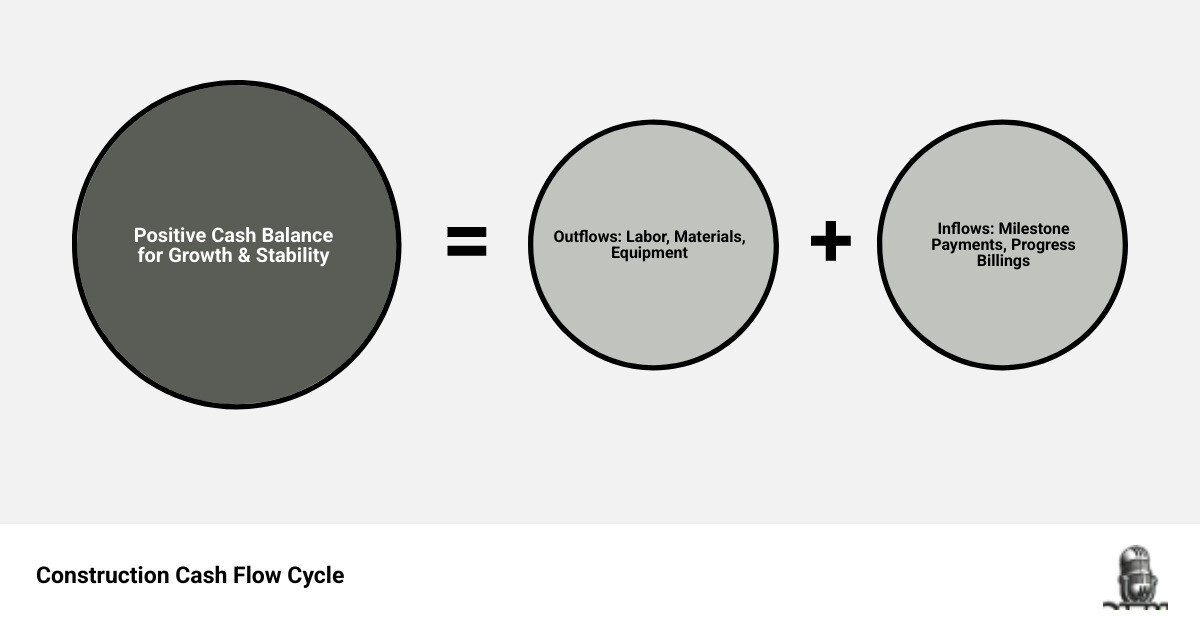
Basic cash flow management for contractors glossary:
Understanding Cash Flow Management for Contractors
In the trades, we often hear the phrase “cash is king,” but we don’t always talk about why. For a contractor, cash isn’t just a number on a screen; it’s the fuel that keeps your trucks on the road and your crew on the job site. Effective cash flow management for contractors is about maintaining enough working capital to bridge the gap between paying for today’s expenses and receiving tomorrow’s checks.
Working capital is essentially your business’s “breathing room.” It is calculated by taking your current assets (cash, accounts receivable) and subtracting your current liabilities (bills, payroll, debt payments). Because construction requires massive upfront investments in materials and labor before a single progress payment is ever cut, your working capital can vanish quickly if you aren’t careful.
Many business owners confuse profit with cash flow. This is a dangerous mistake. You can find more details on this in our guide on financial management for contractors. To visualize the difference, look at how these two metrics interact:
| Metric | Net Profit | Operating Cash Flow |
|---|---|---|
| Definition | Revenue minus all expenses over a period. | Actual money moving in and out of the bank. |
| Timing | Recorded when the job is invoiced. | Recorded when the payment actually clears. |
| Purpose | Shows if your pricing is right. | Shows if you can pay your bills today. |
| Risk | Can be high even if the bank account is $0. | If negative, the business risks insolvency. |
A healthy business needs both. Profit provides the long-term growth capital you need to buy new equipment or expand your team, but cash flow is what ensures your survival during the “lean” phases of a project.
Common Pitfalls in the Construction Cash Flow Cycle
The construction cash flow cycle is unique and, frankly, a bit punishing. Unlike a retail store where a customer pays before they walk out with the goods, we often perform weeks of work before we see a dime. This “front-loading” of costs creates several common leaks that can sink even the best firms.
One of the biggest hurdles is retainage. It’s industry standard for clients to hold back 5% to 10% of every payment until the very end of the project. If your profit margin is 10%, that means your entire profit for the job is sitting in the client’s bank account, not yours, until the final walkthrough is signed off.
Other common pitfalls include:
- Underbilling: Failing to bill for the full value of the work completed during a phase.
- Unapproved Change Orders: Doing extra work without a signed agreement, which often leads to payment disputes or delays. You can learn how to avoid these traps in our article on knowing your numbers to grow your business.
- Material Price Volatility: If material costs spike after you’ve signed a fixed-price contract, your cash outflows will jump while your inflows stay the same.
- High Overhead: Rent, insurance, and administrative salaries don’t stop just because a project is delayed by weather.
Nearly four in ten small businesses have less than a month of cash on hand. In the trades, where one delayed $50,000 check can halt an entire project, that lack of a safety net is a recipe for disaster.
6 Proven Strategies to Optimize Your Cash Position
To keep your business afloat, you have to move from a reactive “check the bank balance” mindset to a proactive strategy. This starts with how you structure your jobs and your payments.
1. Implement Milestone and Progress Billing
Don’t wait until the end of a job to get paid. Use milestone billing to tie payments to specific, verifiable phases of work (e.g., “Rough-in complete,” “Equipment delivered”). This ensures that cash is flowing in as you are spending it.
2. Negotiate Better Vendor Terms
If your clients pay you in 30 days, but your suppliers demand payment in 15, you have a 15-day “cash gap” you have to fund yourself. Try to negotiate vendor terms that align with your client payment cycles. Some contractors even secure discounts for early payments, which can effectively act as a 36% annualized return on that cash.
3. Utilize Mobilization Fees
Ask for a deposit or “mobilization fee” before the project begins. This covers the initial costs of permits, planning, and getting equipment to the site, so you aren’t starting every job in the red. For more on this, check out our financial planning for trade businesses guide.
4. Categorize Your Expenses
Not all expenses are created equal. Separate your direct costs (labor and materials for a specific job) from your indirect costs (rent, office staff). This allows for more accurate job costing and ensures you aren’t overspending on “nice-to-haves” when cash is tight. For year-end optimization, see our tax tips for contractors.
5. Accelerate Receivables with Digital Tools
The faster you send the invoice, the faster you get paid. It sounds simple, but many contractors wait until Friday or the end of the month to “do the books.” By then, you’ve already lost days of cash velocity.
6. Build a Strategic Reserve
Treat your cash reserve like a non-negotiable bill. Setting aside a percentage of every check into a separate “Rainy Day” account creates a buffer for seasonal slowdowns or unexpected equipment repairs.
Accelerate Receivables with Digital Cash Flow Management for Contractors
Technology has changed the game for collections. Research shows that contractors who use online payments get paid an average of 16 days faster than those who wait for manual checks (26 days vs. 42 days). When you reduce the friction of payment, clients are more likely to settle their bills immediately.
Digital cash flow management for contractors involves more than just accepting credit cards. It’s about:
- Immediate Invoicing: Sending the bill from the field the second the job is done.
- Automated Reminders: Letting a software system send “friendly nudges” at 7, 15, and 30 days so you don’t have to play the role of the “bad guy.”
- Collection Discipline: Establishing a firm policy that no new work starts if an invoice is more than 15 days overdue.
As discussed in our podcast episode on smart accounting moves with Devin Nordgran, reducing your Days Sales Outstanding (DSO) is the fastest way to inject cash into your business without taking on debt.
Mastering Forecasting and Cash Flow Management for Contractors
Forecasting is the art of looking through the windshield instead of the rearview mirror. While your Profit & Loss statement tells you what happened last month, a 13-week cash forecast tells you what will happen to your bank account three months from now.
To build a reliable forecast, you need to track:
- Upcoming Inflows: When are progress payments actually expected to hit?
- Predictable Outflows: Payroll, rent, and loan payments.
- Variable Outflows: Upcoming material orders for new projects.
We recommend a 3-account system to keep things organized:
- Operating Account: For daily expenses and payroll.
- Tax Account: Set aside 15-20% of revenue so you aren’t scrambled at tax time.
- Profit/Reserve Account: Set aside 5-10% for long-term stability.
By separating these funds, you gain a clearer picture of what you actually have available to spend. This level of clarity is what transforms financial chaos into opportunity.
Leveraging Technology for Financial Stability
If you are still managing your multi-million dollar business on a yellow legal pad or a basic spreadsheet, you are leaving your financial health to chance. Modern contractors are increasingly turning to integrated project management and ERP (Enterprise Resource Planning) systems to gain real-time visibility.
In fact, 46% of engineering and construction firms now use integrated systems across all their projects. The benefits are clear: 33% of professionals report that increased data usage has directly reduced their costs.
Technology helps by:
- Connecting the Field to the Office: When a tech finishes a job, the office knows instantly, and the invoice goes out automatically.
- Real-Time Dashboards: Seeing your “Cash Position” at a glance every morning.
- Job Costing Accuracy: Tracking labor hours and material receipts against the original estimate to catch overruns before they eat your profit.
For more insights on how to simplify these systems, listen to our episode on contractor accounting made simple with Meaghan Likes. Proper tech integration also makes it easier to maximize your deductions, keeping more of your hard-earned cash in the business.
Frequently Asked Questions about Contractor Finances
Why is my business profitable but my bank account empty?
This is the most common frustration in the trades. It usually comes down to timing mismatches and work-in-progress (WIP) traps. You might have $100,000 in “profit” coming your way, but if it’s tied up in accounts receivable or unbilled labor, you can’t use it to pay your mortgage today. Profit is a theory; cash is a fact. To learn how to protect that profit, see our guide on leading with purpose in home services.
How much cash reserve should a contractor maintain?
A good rule of thumb is to maintain 3 to 12 months of average monthly operating expenses. If your overhead (rent, insurance, base payroll) is $20,000 a month, you should aim for a reserve of at least $60,000. This protects you against seasonal fluctuations and gives you the leverage to negotiate better deals with vendors. It also significantly increases your business valuation if you ever decide to sell.
What is the best way to handle project retainage?
Negotiate! Don’t just accept a 10% holdback as a given. Try to negotiate a step-down schedule where retainage drops to 5% once the project is 50% complete. You can also request a “milestone release,” where portions of the held funds are released as major phases are signed off. This keeps your cash flow from being strangled at the very end of a job.
Conclusion
Mastering cash flow management for contractors isn’t just about survival; it’s about creating the freedom to grow. When you aren’t stressed about making payroll on Friday, you can focus on operational scaling, leadership, and providing a better experience for your customers.
At The Catalyst for the Trades, we are dedicated to helping home service businesses navigate these financial waters. Whether you are looking to build a sellable trades business or just want to stop the “money roller coaster,” the strategies outlined here are your roadmap to stability.
Take control of your numbers today so they don’t control you tomorrow. Learn more about our mission to empower the trades with the tools and tech they need to lead.


