Learn · March 16, 2026
Building a Legacy Business: 7 Secrets
Learn building a legacy business: systems, succession, team culture & exit strategies for enduring success.
By The Catalyst Editorial Team Operator education · 10 min read · Updated July 24, 2026

What It Really Means to Build a Business That Lasts

Building a legacy business means creating a company that can thrive long after you step away — one rooted in clear values, strong systems, and a purpose that goes beyond the next invoice.
Here’s a quick snapshot of what that looks like in practice:
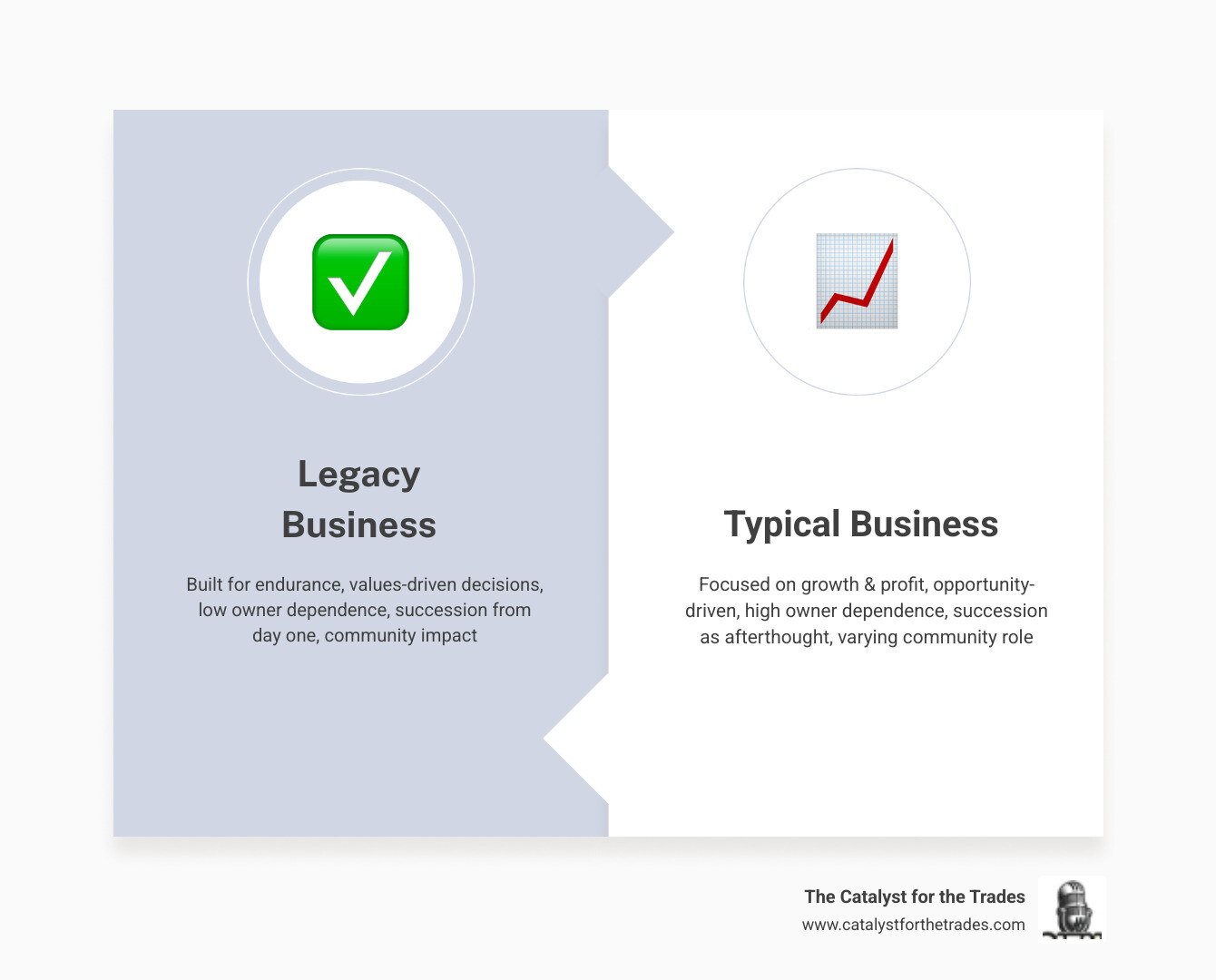
| Element | Legacy Business | Typical Business |
|---|---|---|
| Primary goal | Endurance and impact | Growth and profit |
| Decision-making | Values-driven | Opportunity-driven |
| Owner dependence | Low — systems run it | High — owner runs it |
| Succession plan | Built in from day one | Often an afterthought |
| Community role | Active contributor | Varies |
| Measure of success | What keeps working when you’re gone | Revenue and margins |
If you own a home services business — HVAC, plumbing, electrical — you’ve probably poured years of hard work into building something real. But here’s a question worth sitting with: if you stepped away for six months, would your business keep running, or would it fall apart?
The uncomfortable truth is that most businesses don’t outlive their founders. Only about 30% of small to mid-sized businesses make it to a second generation, and just 13% of family businesses survive to the third. That’s not because the owners didn’t work hard enough. It’s because hard work alone doesn’t build a legacy — intention does.
A legacy business isn’t just a successful one. It’s a transferable one. It’s built on documented systems, a team that shares your values, a vision that inspires beyond you personally, and a plan that protects what you’ve built. It’s the difference between owning a business and owning a job.
For trades business owners, this distinction matters more than ever. The industry is evolving fast — new technology, tighter labor markets, and increasing competition mean that building for the long term isn’t optional anymore. It’s the smartest growth strategy you can have.
This guide walks you through exactly how to make that shift.
What is a Legacy Business and Why Does It Matter?
A legacy business is an organization designed for endurance. While many companies focus on the next quarterly statement, a legacy-minded owner asks, “How will this business serve my family and community fifty years from now?” It is about moving beyond survival and into the realm of lasting impact.
In the home services industry, your reputation is your most valuable intangible inheritance. It outlives your tools and your trucks. When we talk about Building Your Business with an Exit in Mind: Strategic Insights for Home Service Entrepreneurs, we are discussing the creation of a “self-sustaining engine.”
The statistics are sobering: 70% of family businesses believe in the importance of maintaining a family legacy, yet the average lifespan of a family-owned business is a mere 24 years. By focusing on legacy, you aren’t just building wealth for yourself; you are creating a foundation for generational wealth and community stability.
The Difference Between a Startup and Building a Legacy Business
There is a fundamental shift in mindset between a typical startup and building a legacy business. Startups are often built for speed, disruption, and a quick “exit” to the highest bidder. They ask, “How fast can we grow?”
In contrast, a legacy business asks, “How long can we last?” This approach prioritizes resilience over rapid, unstable growth. It is purpose-driven rather than just opportunity-driven. If you Want to Build a More Profitable Business? Start with the End in Mind, you must realize that stability is what actually creates long-term value. A business that can survive an economic downturn because it has deep roots in its community and diversified revenue streams is far more valuable than a “flash in the pan” company that burns out after five years.
Overcoming the Legacy Paradox in Family Business
One of the greatest challenges in family-owned trades businesses is the “legacy paradox.” This happens when a deep respect for “how we’ve always done it” prevents the business from innovating. While tradition provides the values and identity of the company, it can also become a cage that hinders modernization.
To build a business that stands the test of time, we must balance tradition with strategic pivots. This might mean keeping the founder’s commitment to “handshake integrity” while implementing AI-driven scheduling or modern digital marketing. Future-proofing your business requires the courage to honor the past while aggressively preparing for the future.
The Essential Ingredients for Building a Legacy Business
Building a business that lasts doesn’t happen by accident. It requires specific “ingredients” that work together to create a sustainable whole. We’ve seen that when owners learn How Mark Evans Built Real Wealth by Working Less and Thinking Bigger, they often find that the secret lies in shifting from “doing the work” to “designing the business.”
Essential components include:
- Profit with Purpose: Sustainability isn’t just about the environment; it’s about a business model that is profitable enough to reinvest in its people and its future.
- SME Agility: Small and medium enterprises have the unique advantage of being able to pivot quickly, allowing them to lead the way in service innovation.
Establishing a Vision That Outlasts the Founder
A vision is more than a mission statement on a breakroom wall. It is a tangible, inspiring picture of the future that makes employees want to stay and customers want to return. When you look at Building a $100M Business: George Donaldson on Scaling, Leadership & Exit Strategies in Home Services, you see that a $100 million company isn’t built on one person’s charisma. It’s built on a roadmap that everyone in the company understands.
Your vision should provide an identity for the business that is separate from your own. If the business is you, it ends with you. If the business is a vision, it can live forever.
Cultivating the Right Team and Culture
You cannot build a legacy alone. You need a team that shares your values and is committed to the long-term roadmap. This involves moving from a “boss” mentality to a “leadership development” mentality.
Consider How George Donaldson Scaled a Home Services Company to $100 Million. The key was building a culture of trust and continuous growth. When your technicians and office staff feel empowered to make decisions and grow within the company, they become stakeholders in your legacy. Open communication and values alignment are the glue that holds a multi-generational business together.
Creating Systems and Transferability for Long-Term Success
The ultimate test of a legacy business is the “six-month no contact” test. If you were to vanish for half a year, would your customers still receive the same quality of service? Would your bills get paid? If the answer is no, you haven’t built a legacy; you’ve built a very demanding job.
Transferability is the core requirement for a business to outlive its founder. This is a major theme when discussing How to Build a Sellable Trades Business: Insights from a $3.7 Billion Advisor. A business is only truly “sellable” or “transferable” if it operates independently of the owner’s daily input.
Escaping the Founder Trap with Documented Systems
Most founders fall into the “founder trap”—they are the bottleneck for every decision. To escape this, you must embed your processes into the company’s DNA through Standard Operating Procedures (SOPs).
When you Build a Sellable Home Service Business: What Actually Works, you focus on repeatability. Every task—from how a service call is booked to how a furnace is inspected—should be documented. This ensures consistency and allows new team members to step in and succeed without you having to hover over them.
Financial Health and Business Valuation for Contractors
A legacy business must be financially “clean.” This means having transparent books, diversified revenue streams, and a clear understanding of your Business Valuation Contractors.
Clean financials aren’t just for the taxman; they are a roadmap for reinvestment. By consistently reinvesting profits back into the company’s technology, training, and asset protection, you ensure the business remains a “well-oiled machine” for the next generation.
Succession Planning: Ensuring a Smooth Generational Transfer
Succession planning is the process of preparing for the day you hand over the keys. It is often complex and emotional, which is why many owners put it off until it’s too late. However, a formal Succession Planning strategy is what separates the 13% who make it to the third generation from the 87% who don’t.
Practical Steps for Building a Legacy Business Succession Plan
A successful transfer requires more than just a handshake. It involves:
- Leadership Identification: Determining who has the skills and the heart to lead next.
- Ownership Transfer: Deciding on the legal and financial structures for the hand-off.
- Business Transition Planning: Creating a timeline that allows for a gradual shift in responsibilities.
We can learn a lot From Startup to Successful Exit in 4 Years: How Ray Reyes Did It. Even if your timeline is forty years rather than four, the principle is the same: you must have legally binding agreements and a clear buyout process in place to prevent family or professional disputes from sinking the ship.
Overcoming Common Barriers for SMEs
Many small and medium-sized business owners feel they are “too small” for formal succession planning or that the cost is too high. In reality, the cost of not planning is much higher.
SMEs can overcome these barriers by:
- Starting Small: You don’t need a 500-page legal document on day one. Start with a simple vision and basic SOPs.
- Seeking Professional Guidance: Using experts to help with tax planning and valuations can save thousands in the long run.
- Focusing on Agility: Use your size to your advantage. You can implement changes and mentor successors more personally than a massive corporation ever could.
Frequently Asked Questions about Legacy Businesses
Is my business too small to leave a legacy?
Absolutely not. Legacy isn’t about the size of your warehouse; it’s about the depth of your impact. A local plumbing company that has served the same families for three generations and sponsors the local little league has a more profound legacy than many faceless corporations. Small businesses are the backbone of the community, and your “local influence” is a powerful foundation for a legacy.
How do I balance tradition with innovation?
This is the heart of the legacy paradox. The key is to separate your values from your methods. Your value might be “unbeatable customer service.” In 1980, that meant a polite phone call. Today, it might mean a text notification when the tech is five minutes away and an AI-powered follow-up. By modernizing your methods while staying true to your core identity, you remain relevant without losing your soul.
When should I start planning for my exit?
The best time to start was the day you opened your doors. The second best time is today. As discussed in the episode with Gregg Schonhorn on Maximizing Business Value in the Trades: Preparing to Sell, AI, and Building for the Future, building for an exit makes your business better now. It forces you to create systems, develop leaders, and clean up your finances—all things that make your business more profitable and less stressful today.
Conclusion
At The Catalyst for the Trades, we believe that your business should be a vehicle for freedom, not a cage. Building a legacy business is the ultimate path to that freedom. It is about creating something that stands the test of time, provides for your family, and serves your community long after your final service call.
To start building your personal legacy today, try these journal prompts:
- “What do I want people to say about this business at my retirement party?”
- “If I could only work one hour a week, what systems would I need to have in place?”
- “What is the one value I hope my great-grandchildren still see in this company?”
Don’t leave your legacy to chance. Start building the future you want to see by taking the first step toward a transferable, sustainable, and purpose-driven business.


