Learn · March 17, 2026
Building Scalable Service Operations: 5 Keys to Sanity
Scale your service sanely! Discover frameworks for building scalable service operations, leveraging tech, and leading for sustainable growth.
By The Catalyst Editorial Team Operator education · 10 min read · Updated July 24, 2026

Why Building Scalable Service Operations Is the Difference Between Growing and Drowning

Building scalable service operations is the process of designing your systems, people, and processes so your business can handle more work — without more chaos, more burnout, or more dropped balls.
Here’s a quick breakdown of what it takes:
- Build repeatable processes – Document and standardize what works before you grow
- Automate what you do more than twice – Reduce manual tasks to free up your team
- Design your service model intentionally – Segment clients, define service tiers, plan capacity
- Put the right people in the right seats – Hire for fit and delegate decisions clearly
- Strengthen financial resilience – Use financial tools weekly, not just at year-end
- Monitor, measure, and iterate – Track performance and fix problems before they compound
Most home service businesses don’t fail because they lack customers. They fail because growth outpaces their infrastructure. You land more clients, add more technicians, and suddenly the wheels start coming off — missed appointments, inconsistent service, exhausted staff, and a calendar that controls you instead of the other way around.
The hard truth? More sales without solid systems doesn’t create a bigger business. It creates bigger problems. As one operational expert puts it, throwing more people at inefficiency doesn’t fix it — it just makes the inefficiency more expensive.
Research backs this up: roughly 80% of operations issues originate in design and development, not in day-to-day execution. That means most scaling problems are baked in long before your phone starts ringing off the hook. And yet, less than 2% of growing businesses actively use the basic financial tools they need to scale sustainably.
The good news is that scalability isn’t reserved for large enterprises with big budgets. It’s a discipline — and it’s one that any trades business owner can build, one system at a time.
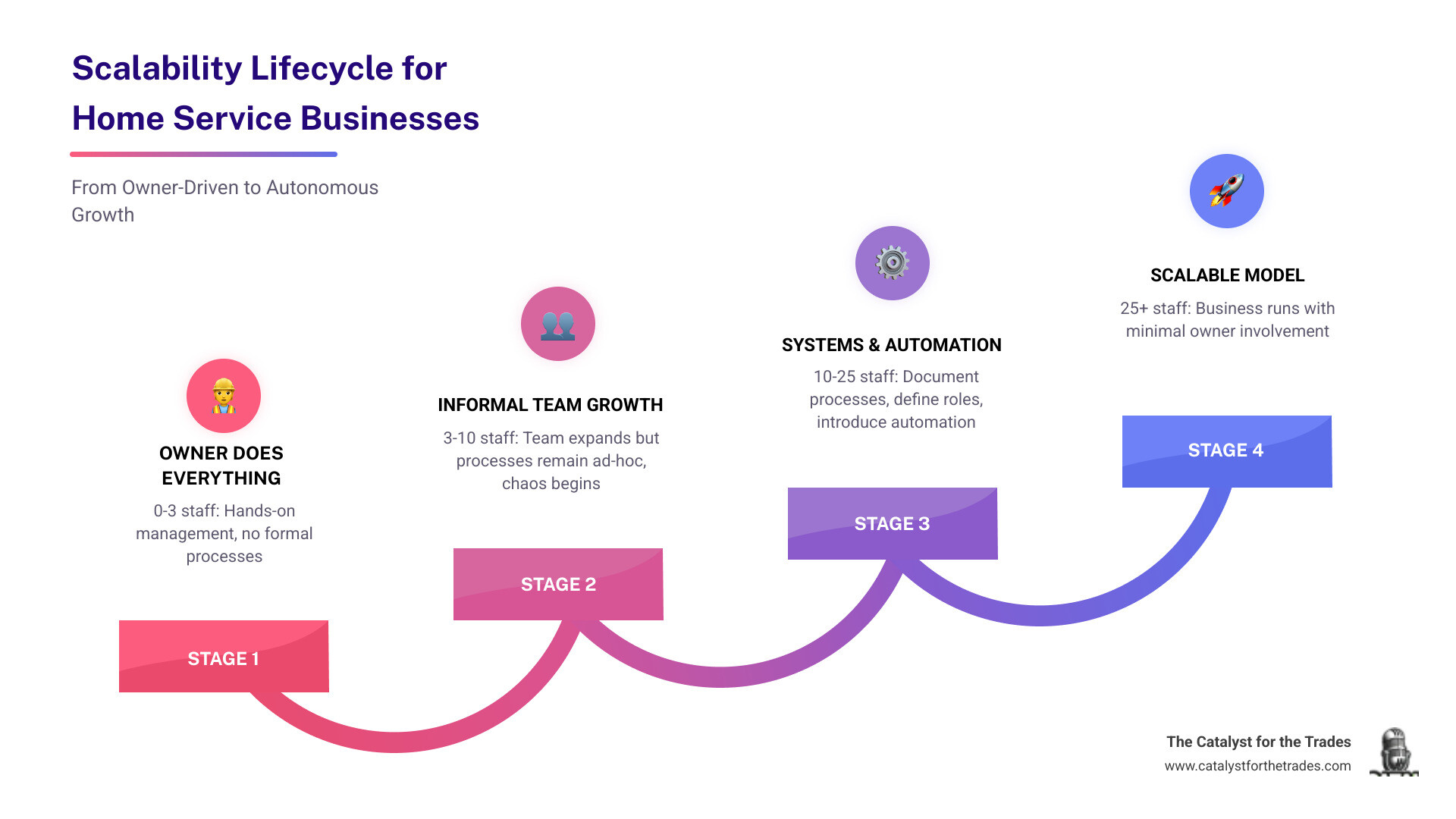
Building Scalable Service Operations: A Framework for Success
When we talk about building scalable service operations, we aren’t just talking about getting bigger. We’re talking about getting better. Scaling is the ability of your business to handle an increased workload—say, jumping from 50 HVAC calls a week to 500—without a proportional increase in your stress levels or overhead costs.
In the modern service landscape, scalability is a necessity. Customer expectations are shifting; they want real-time updates, seamless booking, and instant communication. To meet these demands, savvy business leaders are turning toward integrated service management platforms that allow for a “composable” architecture—meaning you can add features as you grow without tearing down the whole house.
The Foundation: Repeatable Processes and the “Automate Twice” Rule
The first step in our framework is simple: stop reinventing the wheel. If you or your team are doing a task more than twice, it needs to be documented, turned into a repeatable process, and eventually automated. This is the “automate twice” rule.
Why does this matter? Because human error is the enemy of scale. When processes live only in your head (or the head of your lead technician), they can’t be replicated. By focusing on process improvement, you create a “company way” of doing things. This leads to operational efficiency where your systems do the heavy lifting.
Consider the “system-to-administrator” ratio. In smaller, manual operations, you might need one office person for every two technicians (a 2:1 ratio). In highly automated, industry-leading services, that ratio can reach 2,500:1. While you might not need to manage thousands of techs, the lesson is clear: automation allows your team to focus on high-value work instead of data entry. As noted in the seminal paper On Designing and Deploying Internet-Scale Services, 80% of operational issues start in the design phase. If you design for automation today, you prevent the nightmares of tomorrow.
Designing a Service Model for Sustainable Growth
A common mistake in the trades is trying to provide “personalized everything” to everyone. While that sounds like great customer service, it’s actually a recipe for burnout. To scale, you must move toward “intentional service.”
This starts with client segmentation. Not every customer requires the same level of touch. By using an HVAC business operations guide, you can define service tiers. High-value maintenance agreement members might get proactive priority scheduling, while one-off repair callers receive a standardized (but still excellent) digital experience.
Capacity planning is the other half of this equation. You need to know your “N+2” configuration—can your team handle the workload if one person is sick and another is on a planned vacation? By designing your model around these metrics, you protect your team from exhaustion and ensure quality control remains high, even during the peak summer or winter rushes.
Leveraging Technology in Building Scalable Service Operations
Technology is the engine of scalability. In the trades, this often centers on field service management software. But the software alone isn’t a silver bullet; it requires system integration to be truly effective.
Your CRM should talk to your accounting software, which should talk to your GPS tracking and inventory management. This “connected ecosystem” provides real-time insights. Imagine an IoT-connected furnace that alerts your office to a failing part before the homeowner even knows there’s a problem. That’s the level of efficient operations that allows for massive growth.
Following Google SRE: Production Services Best Practices, we should aim for “progressive rollouts” of new tech. Don’t try to change every system overnight. Implement one tool, monitor its impact, and then move to the next. This ensures your “infrastructure as code”—or in our case, “infrastructure as systems”—remains stable.
Strategic Leadership: Preparing People and Systems for Scale
Scaling a business is as much a mental game as it is a technical one. As a leader, your role changes from the “Chief Doer” to the “Chief Architect.” You have to build a framework where the business can run without you making every single decision.
Five Key Actions for Every Business Leader
To prepare your business for the next level, focus on these five pillars:
- Build Repeatable Processes: If it’s done more than twice, automate or document it.
- Strengthen Financial Resilience: Use a financial model to make proactive decisions.
- Put the Right People in the Right Seats: Hire for fit, chemistry, and character over just raw skill.
- Create a Decision-Making Framework: Delegate authority so you aren’t the bottleneck.
- Plan for Growth Before It Happens: Evolve your mindset and your model six months before you think you need to.
Understanding how EOS helps you scale without the chaos is a great starting point. The Entrepreneurial Operating System (EOS) provides a “vision traction organizer” that keeps everyone aligned. When your team knows the vision, they can make decisions that align with it, leading to building predictable freedom for you as the owner.
Financial Resilience and Growth Planning
Scaling costs money, and if you don’t have a handle on your cash flow, growth can actually kill your business. It’s a shocking statistic, but less than 2% of small business owners know the true value of their business. This is a major issue considering the “Silver Tsunami”—the massive wave of business owners reaching retirement age. In Canada alone, 76% of owners plan to exit in the next decade, yet most have no plan.
Financial modeling isn’t just for tax season. You should be looking at your tools weekly to anticipate cash flow gaps. If you’re planning to hire three new technicians and buy three new trucks, your model should tell you exactly how many leads you need to generate to break even on that investment. This proactive planning ensures that your growth is profitable, not just “busy.”
Maintaining Team Motivation During Rapid Change
Rapid growth is stressful for employees. They see the schedule filling up and fear they’ll be worked to the bone. To keep the team engaged, you must transition from chaos to clarity.
Communication is your best tool. Be transparent about where the company is going and why. Build a “culture of reliability” where technicians feel supported by the office, and the office feels supported by the field. Following Google SRE – IT Service Management principles, we recommend a “blame-free” culture. When a mistake happens—and they will during growth—focus on fixing the process, not the person. This builds trust and encourages the team to innovate rather than hide errors.
Operational Excellence: Monitoring, Alerting, and Resilience
Once your systems are in place, you need a way to make sure they’re actually working. This is where “operational excellence” comes in. It’s not a one-time setup; it’s a continuous loop of auditing and improving.
The Power of Observability and SLOs
In the tech world, they use Service Level Objectives (SLOs) to measure success. You can do the same. An SLO might be: “95% of emergency calls are responded to within two hours.” By tracking this, you gain “observability” into your business. You aren’t just guessing how things are going; you have the data.
Using tools like the Operational excellence quick links or the AWS Well-Architected Framework can give you a checklist for maturity. Are your SOPs documented? Is your data backed up? Do you have an “error budget”—a calculated amount of “allowable” mistakes that lets you take risks and try new things without fear of total failure?
Managing Spikes with Admission Control and Graceful Degradation
Every service business faces “workload spikes”—the first day of 90-degree weather or the first freeze of the year. If you try to handle every single call at 100% capacity during these times, your system will melt down.
This is where “graceful degradation” and “admission control” come in. In the Tenets of SRE, this is often called the “big red switch.” For a trades business, this might mean:
- Admission Control: During extreme peaks, you only accept calls from existing maintenance members.
- Graceful Degradation: You stop offering “non-essential” services (like duct cleaning or estimates for new installs) to focus 100% of your manpower on emergency repairs.
- Metered Admission: You use an automated waitlist or AI chatbot to set realistic expectations for callback times, preventing your office staff from being buried under a mountain of angry voicemails.
Avoiding Pitfalls While Building Scalable Service Operations
The road to scaling is littered with common traps. The biggest is the misconception that “Selling = Scaling.” If you sell more than you can fulfill, you aren’t scaling; you’re digging a hole.
Other pitfalls include:
- The “Fix It Later” Mentality: Thinking you’ll organize your files once you’re bigger. Spoiler: you won’t. The mess just gets bigger.
- Throwing People at Problems: Hiring more staff to fix a broken process is like pouring water into a leaky bucket. Fix the leak first.
- Over-Automation: Don’t lose the human touch. Customers still want to feel like a person is looking out for them.
- Lack of Engagement: If your team doesn’t understand how systems create freedom, they will see new processes as “micromanagement” rather than the tools for success they truly are.
Frequently Asked Questions about Scaling Operations
Why does scalability matter for business growth?
Scalability allows a business to handle increased volume and complexity without a total system overhaul. This ensures that as you grow, your profit margins stay healthy and your customer experience remains consistent. Without scalability, growth usually leads to a decline in quality and an increase in owner burnout.
What is the “automate twice” rule?
The “automate twice” rule is a simple heuristic: if you find yourself performing a manual task (like sending a follow-up email, generating a specific report, or scheduling a recurring maintenance visit) more than twice, it’s time to find a way to automate it. This reduces human error and frees up your team’s “mental bandwidth” for higher-value tasks that require a human touch.
How do you balance automation with human oversight?
Effective scaling uses automation for repetitive, low-risk, and predictable tasks (like appointment reminders or status updates). However, you must maintain human oversight for complex problem-solving, high-stakes customer complaints, and strategic decision-making. The goal of automation is to empower your people, not to replace them.
Conclusion
Building scalable service operations is a journey, not a destination. It requires a shift in mindset from being the person who does the work to being the person who builds the system that does the work. By focusing on repeatable processes, leveraging integrated technology, and leading your team with a clear vision, you can grow your business to heights you never thought possible—all while keeping your sanity intact.
At The Catalyst for the Trades, we’ve seen how the right combination of technology and operational discipline can transform a chaotic shop into a streamlined, profitable powerhouse. Whether you’re just starting to document your first SOP or you’re looking to implement advanced AI-driven dispatching, the principles remain the same: simplify, automate, and empower.
Ready to take the next step in your scaling journey? Learn more about our mission and how we help trades professionals like you build predictable freedom. Your future self—and your team—will thank you.


