Learn · March 3, 2026
Business Networking: Top 5 Power Strategies
Master business networking: Build strategic partnerships, leverage referrals, and grow like an executive with proven strategies.
By The Catalyst Editorial Team Operator education · 10 min read · Updated July 24, 2026

Why Business Networking Is the Foundation of Professional Success

Business networking is the strategic practice of building mutually beneficial relationships with other professionals, clients, and industry leaders to expand your knowledge, generate referrals, and accelerate business growth. Whether you’re a home services business owner looking to scale operations, find quality vendors, or stay ahead of industry trends, mastering professional relationship-building is essential for long-term success.
Quick Answer: What Is Business Networking?
- Definition: Exchanging information and resources with professionals who share common interests or industries
- Primary Goal: Create relationships that lead to referrals, partnerships, and business opportunities
- Key Methods: In-person events (conferences, trade shows, local mixers) and online platforms (LinkedIn, industry forums)
- Success Factor: Consistent follow-up and genuine mutual value exchange
- ROI Impact: Approximately 50% of jobs in the USA are found through networking connections
- Quality Advantage: Networking referrals are pre-qualified and built on trust, unlike cold leads
If you’re ready to master strategic partnerships that drive growth or want to explore how The Catalyst for the Trades can accelerate your business, you’re in the right place.
The reality is simple: people do business with people they know and like. For home services business owners, networking isn’t just about collecting business cards at Chamber of Commerce mixers—it’s about building a strategic web of relationships that becomes your competitive advantage. Research shows that BNI members globally generated over $26 billion in revenue from 17 million referrals in just 12 months, proving that structured networking systems deliver measurable results.
But effective networking requires more than showing up. It demands intentional strategy, consistent effort, and a genuine commitment to helping others succeed. The good news? Networking gets easier with practice, and the compound returns—much like compound interest—grow exponentially as your relationships deepen over time.
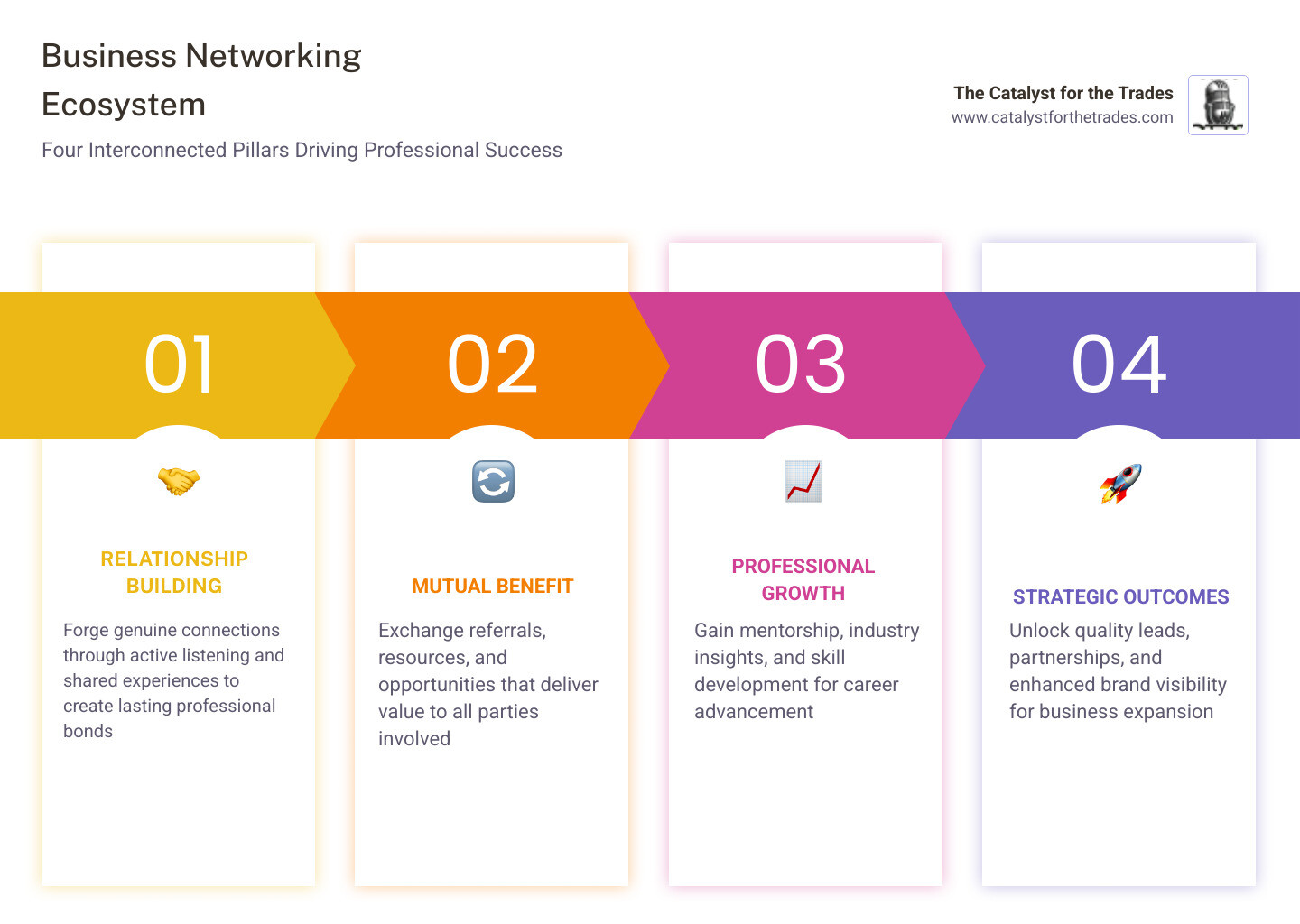
Easy business networking word list:
The Strategic Power of Business Networking for Growth
When we talk about business networking, we aren’t just talking about social hour. For those of us in the trades, it is a high-octane marketing activity. The benefits are numerous, but they all funnel into one primary result: sustainable business growth.
The most immediate benefit is the generation of high-quality referrals. Unlike cold leads from a random Facebook ad, referrals born from networking are often pre-qualified. Because they come through a trusted source, the “know, like, and trust” factor is already established before you even pick up the phone. This significantly shortens the sales cycle and increases your closing ratio.
Beyond just finding new customers, networking opens the door to strategic partnerships. Imagine an HVAC owner networking with a local roofing contractor or a master plumber. These aren’t competitors; they are complementary service providers. By building these bonds, you create a referral loop that keeps your schedule full year-round. You might even find opportunities for joint ventures, where two companies pool resources to tackle a massive municipal contract or a large-scale housing development.
Networking also serves as a vital source of industry intelligence. By staying connected with other owners, you can stay on top of industry trends, from new heat pump technology to the latest in digital dispatch software. We often see that the most successful owners are those who act as an HVAC trailblazer networking with peers to solve common operational headaches.
Finally, don’t underestimate the power of raising your professional profile. When you are active in your local Chamber of Commerce or trade association, you aren’t just another service truck on the road. You become a recognized industry leader. This brand awareness makes it easier to recruit top-tier talent, secure better terms with suppliers, and even attract potential investors if you are looking to exit or expand.
Mastering the Art of In-Person and Online Connections
Business networking is a hybrid game. You cannot afford to ignore either the handshake or the digital “like.” Face-to-face interactions remain the gold standard for building deep trust, but digital platforms allow us to maintain those connections at scale.
In-person networking typically happens at trade shows, local mixers, or leadership conferences. There is something about seeing someone face-to-face that makes a relationship 10 times more powerful than an online-only interaction. It allows for spontaneous conversations—what some call the “elevator pitch” moments—where you can share your vision in 20 seconds or less.
However, online networking is equally critical for the modern executive. It allows for global reach and 24/7 visibility. Platforms like LinkedIn and specialized industry forums allow you to build “social capital”—the value derived from your social networks.
| Feature | In-Person Networking | Online Networking |
|---|---|---|
| Trust Building | High (Body language, eye contact) | Moderate (Requires consistent content) |
| Reach | Local/Regional | Global |
| Cost | Travel, tickets, and time | Low to Moderate |
| Speed of Connection | Fast and deep | Slower to build rapport |
| Scalability | Low | High |
For home service professionals, community building is the bridge between these two worlds. By attending local events and then nurturing those leads online, you create a robust ecosystem for your business.
Building a Digital Presence through Business Networking
If you aren’t active on LinkedIn, you are leaving money on the table. With more than 1 billion users in over 200 countries, it is the world’s largest professional network. For a trades business owner, this isn’t just a place to post a resume; it’s a place to share your expertise.
By sharing content about how you solved a complex indoor air quality issue or how you’ve optimized your fleet management, you demonstrate authority. This makes choosing right vendors easier for other businesses who might need your services. You can join industry-specific groups, follow thought leaders, and even use filters to find property managers or general contractors in your specific zip code.
Virtual rapport is built through consistency. Like a small comment on a post, a congratulatory note on a work anniversary, or sharing a helpful article. These small digital “touches” keep you top-of-mind so that when a big project arises, you are the first person they call.
Proven Strategies to Network Like an Executive
To network like a boss, you have to move past the “what’s in it for me?” mindset. True executive networking is rooted in the “Givers Gain” philosophy. Here are the core strategies we recommend:
- The 20-Second Elevator Pitch: You must be able to explain who you are, what your business does, and the specific value you provide in the time it takes to ride an elevator. For example: “We help homeowners in the tri-state area reduce their energy bills by 30% through high-efficiency HVAC retrofits and smart home integration.”
- Active Listening: This is the most underrated networking skill. Instead of waiting for your turn to talk, listen for the other person’s pain points. If a property manager mentions they are struggling with unreliable contractors, you’ve just identified an opportunity to be the solution.
- Proactive Outreach: Don’t wait for the phone to ring. Set a goal to reach out to one new contact a week. This could be a coffee invite or a simple LinkedIn message.
- The 48-Hour Follow-Up: A connection made at an event is useless if you don’t follow up. Send a personalized email or a handwritten note within 48 hours. Reference something specific from your conversation to show you were actually paying attention.
- Mutual Value: Always ask, “How can I help you?” Building a network is about creating a “bank” of favors. When you help a fellow owner find a great bookkeeper, they will be much more likely to recommend your services to their high-net-worth clients.
These strategies are essential when developing vendor management strategies. By treating your suppliers and vendors as networking partners rather than just line items, you secure better service and more reliable supply chains.
Leveraging Structured Business Networking Groups
For those who want a more disciplined approach, structured groups are a game-changer. Organizations like Business Networking International (BNI) operate on a referral-based growth model. BNI chapters typically allow only one person per industry, meaning if you are the HVAC guy in that group, every HVAC lead generated by the other 30-40 members goes directly to you. In the last year alone, BNI members generated over 17 million referrals.
The Chamber of Commerce is another staple. They advocate for local business policies and host community events that are perfect for raising your local profile. If you are a newer owner, SCORE (Service Corps of Retired Executives) provides free mentoring and networking opportunities. In 2024, SCORE mentors helped start nearly 60,000 new businesses, and 94% of their clients stayed in business.
When you unlock the power of community, you realize you don’t have to reinvent the wheel. Professional associations like the International Janitorial Cleaning Services Association (IJCSA) or the Professional Beauty Association (PBA) offer local chapters where you can network with others who face the exact same challenges you do.
Overcoming Challenges and Ethical Problems
While business networking is powerful, it isn’t without its problems. A challenge is the “old boys’ network” phenomenon, which can create discrimination barriers for underrepresented groups. Research has shown that Black LinkedIn profiles, for instance, sometimes receive fewer connection acceptances than white ones despite identical credentials. As executives, we have a responsibility to build inclusive networks that prioritize merit and genuine rapport over superficial similarities.
Ethical hiring is another area where networking can get murky. There is a fine line between hiring a trusted recommendation and falling into cronyism. While it’s estimated that half of all jobs in the USA are found via networking, we must ensure that our hiring processes remain fair and that we aren’t just hiring people because they are “friends of friends.”
Then there is the personal challenge: networking anxiety. Many high-performing tradespeople are introverts by nature. The thought of walking into a room of 100 strangers can be petrifying. Our advice? Start small. Set a goal to talk to just three people. Focus on asking questions rather than performing. The goal is to build long-term relationships, not to close a sale on the spot. Over time, the more you do it, the less “icky” or scary it feels.
Frequently Asked Questions about Business Networking
How do I start networking on a small budget?
You don’t need a massive marketing budget to network effectively. Start with free resources like SCORE mentoring or local business workshops. Join free Facebook groups like “Small Business Networking,” which has nearly 300,000 members. LinkedIn is free to use, and many local mixers have very low entry fees. Even taking a local hobby class (like cooking or improv) can be a great way to meet local professionals in a low-pressure environment.
Why are networking referrals higher quality than cold leads?
Networking referrals are pre-qualified. When a trusted contact recommends you, they are essentially vouching for your work. This transfers a level of trust to you before you even meet the client. Furthermore, because the referrer knows both you and the client, they are unlikely to send you a “bad” lead that doesn’t fit your service profile. This mutual accountability keeps the lead quality high.
How has the history of networking evolved for modern trades?
Networking has deep roots. Before the Industrial Revolution, guilds were the primary way craftsmen protected their trade and shared knowledge. In the 1700s, the first Chambers of Commerce appeared, followed by service clubs like Rotary International in the early 20th century. Today, we have seen a digital shift. While the core principles of mutual benefit remain the same, the speed and scale at which we can network have exploded thanks to social media and global organizations like BNI. Strategic networks today are less about “who you know” in a gatekeeping sense and more about “how you can help” on a global scale.
Conclusion
At The Catalyst for the Trades, we believe that your network is your net worth. Whether you are listening to Jennifer Bagley discuss the latest in AI marketing or Chuck Staszkiewicz on operational scaling, the underlying theme is always the same: you cannot grow in a vacuum.
Business networking provides the advice, positive influence, and increased confidence needed to steer the complexities of the home services industry. It offers the personal satisfaction of helping others and the professional legacy of building a business that lasts. By consistently investing in your professional relationships, you aren’t just looking for your next job or client—you are building an asset that will pay dividends for the rest of your career.
Are you ready to stop “random acts of networking” and start building a strategic engine for growth? It’s time to master your growth strategy and join a community of like-minded pros who are elevating the trades every single day. Let’s get to work.


