Learn · April 17, 2026
KPI Tracking for Home Services: Top 7 Secrets
Scale your home services business with KPI tracking for home services. Master sales, ops & finance metrics, benchmarks, and build a high-performance culture.
By The Catalyst Editorial Team Operator education · 9 min read · Updated July 24, 2026

Why Every Home Service Business Needs KPI Tracking to Grow
KPI tracking for home services is the practice of measuring specific, goal-aligned numbers across your business — from technician performance and call booking rates to gross margins and customer satisfaction — so you can make faster, smarter decisions instead of relying on gut feel.
Here are the core KPIs every home service business should be monitoring:
| Category | Key KPIs to Track |
|---|---|
| Sales | Average ticket, closing percentage, revenue growth rate |
| Operations | Jobs per tech, callback rate, on-time percentage, $0 jobs |
| Customer Service | CSAT score, call conversion rate, call abandonment rate |
| Finance | Gross margin, operating cash flow, accounts receivable |
| Marketing | Customer acquisition cost (CAC), lead-to-close ratio, cost per lead |
Here’s the uncomfortable truth: a full schedule doesn’t mean a profitable business.
Many home service owners are running hard — phones ringing, trucks rolling, techs dispatched — and still wondering why margins are thin or growth has stalled. The problem usually isn’t effort. It’s visibility.
Without tracking the right numbers, you’re making pricing decisions, staffing calls, and marketing investments based on feel rather than fact. And in a market where customers expect fast service, clear communication, and professional follow-through, that gap between what you think is happening and what’s actually happening can cost you — a lot.
KPIs close that gap. They turn the daily chaos of dispatches, calls, and service tickets into a clear picture of where your business stands and where it needs to go. As one widely cited principle in the trades puts it: what gets measured and recognized gets improved.
This guide breaks down exactly which KPIs matter most for home service businesses, how to calculate them, what benchmarks to aim for, and how to build a culture where your whole team is working from the same set of facts.
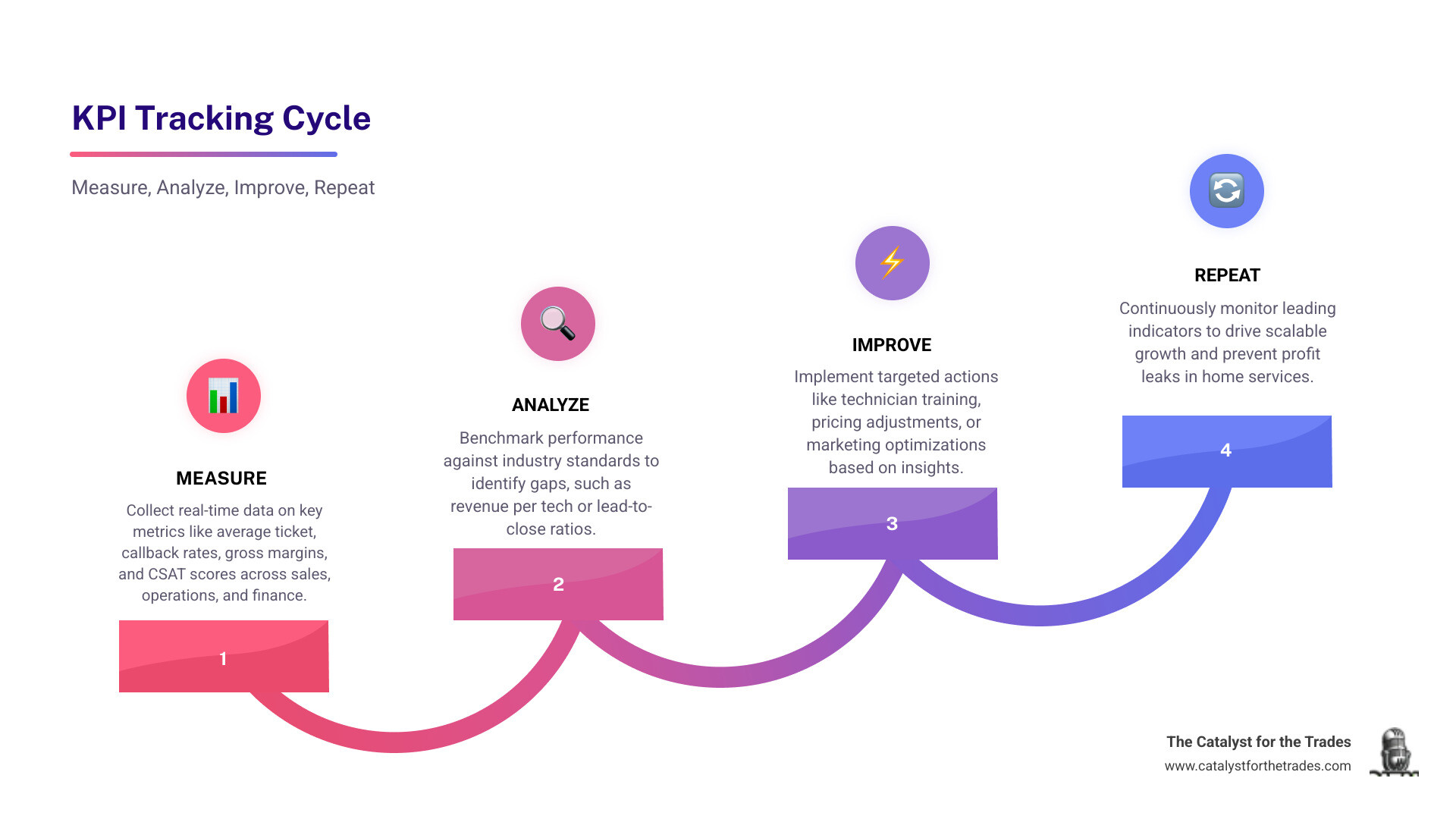
Why KPI Tracking for Home Services is the Secret to Scaling
Scaling a home service business is about moving from “doing the work” to “managing the system.” When we rely on gut feelings, we often mistake activity for achievement. You might feel successful because the trucks are out of the parking lot by 7:30 AM, but without objective evidence, you might not realize that your drive times are eating your profits or your callback rate is eroding your reputation.
KPIs provide that objective evidence. They act as the “check engine light” for your business, alerting you to issues before they lead to a total breakdown. Effective Performance Management relies on understanding the difference between leading and lagging indicators. A lagging indicator, like net profit, tells you what happened last month. A leading indicator, like the number of outbound maintenance calls made today, tells you what your revenue will look like next month.
By embracing a culture of accountability, we shift the focus from “who is to blame” to “what does the data say.” This approach turns numbers into a shared language for the whole team. When everyone understands the scoreboard, they play harder to win. To truly scale, you must Know Your Numbers Grow Your Business Financial Strategies for Trades to ensure every truck on the road is contributing to the bottom line.
Defining KPI Tracking for Home Services Success
Effective kpi tracking for home services isn’t about tracking 100 different things; it’s about tracking the right things that influence your specific goals.
- Goal Alignment: Every metric you track should tie back to a larger business objective, whether that’s increasing market share or improving net profitability.
- Measurable Milestones: Break down big annual goals into monthly or weekly targets. If you want $2 million in revenue this year, how many service calls do you need to book this week?
- Data Transparency: When the team sees the numbers, they understand the “why” behind management decisions.
- Real-Time Visibility: Waiting for an end-of-month P&L statement is too late. Real-time dashboards allow for mid-course corrections.
- Strategic Planning: Use historical data to predict seasonal surges—like the summer AC rush—and staff accordingly.
Essential Metrics Categorized by Department
To manage a trade business effectively, we categorize metrics into buckets. This allows department heads to focus on what they can actually control.
| Department | Primary Focus | Key Metric Example |
|---|---|---|
| Sales | Revenue & Conversion | Closing Percentage |
| Operations | Efficiency & Quality | Callback Rate |
| Finance | Profitability & Cash | Gross Margin % |
Sales and Marketing KPI Tracking for Home Services
Your sales and marketing efforts are the fuel for your business engine. We need to know not just how many leads are coming in, but how much they cost and how well we turn them into jobs.
- Average Ticket: This is the total revenue divided by the number of jobs. For HVAC service technicians, a target of ≥$375 is often the gold standard, while plumbing service usually aims for ≥$500.
- Closing Percentage: For comfort advisers or sales techs, you should aim for a closing ratio of >65% on average. If this dips, it usually signals a need for better sales training or a breakdown in the lead-qualification process.
- Customer Acquisition Cost (CAC): Calculated by taking your total marketing and sales expenses and dividing them by the number of new customers. If your CAC is higher than the profit from a first-time job, you need to look at your Marketing Attribution to see which channels are underperforming.
- Lead-to-Close Ratio: This measures the efficiency of your entire funnel. Out of 100 people who called, how many actually paid for a service?
- Digital Marketing ROI: Tracking the Digital Marketing ROI ensures that your 6-10% marketing budget is actually returning 4:1 or better in revenue.
Operational and Technician Performance
Operations is where the money is either made or lost. You can sell a job for a great price, but if the labor hours blow out, your margin disappears.
- Labor as a Percentage of Revenue: In HVAC service, your labor target should be ≤20%. If it’s higher, you likely have an efficiency problem or are underpricing your services.
- Callback Rate: The goal is ≤1%. High callbacks are “profit killers”—they cost you fuel, labor, and customer trust without bringing in new revenue.
- $0 Jobs: These are jobs where a tech went out but didn’t collect a dime. While some are inevitable (warranty work), a high percentage of $0 jobs often points to issues with diagnostic skills or the ability to present options to the customer.
- Effective Bill Rate: Total revenue from billable hours divided by total billable hours. This tells you what you are actually making per hour that a tech is on-site.
- Retention Metrics: It’s much cheaper to keep a customer than to find a new one. Tracking Retention Metrics through maintenance agreements is the key to steady cash flow during “shoulder seasons.”
Industry Benchmarks and Target Ranges for the Trades
Knowing your numbers is step one; knowing if those numbers are good is step two. Benchmarking allows us to compare our performance against the best in the industry.
- HVAC Service Gross Margin: Aim for ≥72% for service specifically, with an overall company target of 50-55%.
- Replacement Systems: For HVAC residential replacements, aim for a gross margin of ≥50% after support wages and commissions. A high-performing comfort adviser should see an average install ticket of >$7,700.
- CSR Call Conversion: Your Customer Service Representatives are the “First Impressions Officers.” They should aim for a call booking/conversion ratio of ≥90%.
- Service Coordinator On-Time Percentage: To keep customers happy, your dispatchers should ensure techs arrive on time ≥95% of the time.
- Revenue per Team Member: A healthy, scaling business should target ≥$170,000 in revenue per year for every single person on the payroll (including office staff).
- EBITDA: Your earnings before interest, taxes, depreciation, and amortization should be >12%, with a long-term goal of >20% for a truly “best-in-class” operation.
How to Build a High-Performance Culture with Data
Numbers shouldn’t be used as a hammer; they should be used as a spotlight. When we implement kpi tracking for home services, the goal is to empower the team to own their results.
One of the most effective ways to do this is through gamification. Imagine your shop with a digital scoreboard—much like a pro sports arena. When a technician sees they are only one membership sale away from “Tech of the Week,” they are naturally motivated to give that extra effort.
Using tools like Cortex Pulse Analytics and Searchlight Digital Analytics allows us to pull data directly from field service software and display it in real-time. This eliminates the “I didn’t know” excuse and replaces it with “How can I improve?”
- Smart Alerts: Set up notifications that flag a job if the gross margin dips below a certain percentage. This allows managers to coach in real-time rather than discovering a loss weeks later.
- Daily Huddles: Use 5-minute morning meetings to review yesterday’s “wins” and today’s targets. Keep it focused on the facts.
- Recognition Programs: Celebrate the behaviors you want to see repeated. If a CSR hits a 95% booking rate, shout it from the rooftops.
Frequently Asked Questions about Home Service KPIs
What is a good gross margin for HVAC and plumbing?
In the trades, gross margin is what’s left after you pay for the direct labor and materials for a job. For HVAC service and maintenance, you want to be at 72% or higher. Plumbing service and maintenance should also target labor costs of ≤20% of the job price.
The secret to maintaining these margins is strict Financial Management and Profitability Keywords tracking. You must account for every foot of copper and every hour of drive time. If your material costs are creeping above 25% of the job total, it’s time to renegotiate with vendors or raise your prices.
How do you calculate Customer Satisfaction (CSAT)?
Customer satisfaction is the foundation of your referral network. To calculate your CSAT score, send a simple survey after every job asking: “On a scale of 1 to 10, how satisfied were you with our service today?”
- The Formula: (Number of Satisfied Respondents [scoring 8-10] / Total Respondents) x 100.
- Net Promoter Score (NPS): This goes a step further by asking how likely they are to recommend you. Promoters (9-10) minus Detractors (0-6) gives you your score.
- Review Volume: Your Google Business Profile is your resume. Aim for a steady stream of 5-star reviews to keep your lead flow high.
Why is the “Average Ticket” metric so important?
The average ticket is a pulse check on your pricing strength and your technicians’ ability to communicate value. If your average ticket is low, it usually means one of three things:
- Your base prices are too low.
- Your techs are “order takers” rather than “problem solvers” (failing to offer necessary upgrades or maintenance).
- You are attracting “low-value” leads through discount-heavy marketing.
By tracking this, you can identify which technicians need more training on how to present options and which marketing campaigns are actually bringing in the “big fish” jobs.
Conclusion
At The Catalyst for the Trades, we believe that data is the ultimate equalizer. It doesn’t matter if you have five trucks or fifty; the businesses that win are the ones that know their numbers and act on them with speed. By implementing consistent kpi tracking for home services, you move from a reactive state of “putting out fires” to a proactive state of strategic leadership.
Innovation in the trades isn’t just about the latest heat pump technology; it’s about the technology you use to manage your people, your profits, and your growth. Don’t let your business run you—take the wheel and start your journey to operational excellence today. Turn your data into your greatest competitive advantage.


