Learn · April 15, 2026
Top 5 Exit Strategies for HVAC Business Owners
Discover exit strategies for HVAC business owners: Maximize valuation, avoid pitfalls, and plan stress-free transitions with expert insights.
By The Catalyst Editorial Team Operator education · 9 min read · Updated July 24, 2026

What Are Exit Strategies for HVAC Business Owners?
Exit strategies for HVAC business owners are structured plans that define how you’ll transition out of your business — whether through a sale, succession, merger, or other path — while protecting the financial value and legacy you’ve built.
Here are the most common exit strategies to consider:
- Sell to a strategic or financial buyer (M&A) – Typically yields the highest payout, with HVAC businesses selling for 5x to 8x EBITDA
- Family succession – Transfer ownership to a family member over time, preserving your legacy
- Management buyout (MBO) – Sell to a trusted employee or leadership team, often financed through SBA loans
- Merge with another business – Combine with a competitor or complementary company for mutual growth
- Liquidation – Sell off assets individually; best used as a last resort when other options aren’t viable
- Sell to an acquaintance – A “friendly buyer” transition that minimizes disruption
- Acqui-hire – A buyer purchases your business primarily for your skilled team
Every HVAC business owner will eventually step away. The question isn’t if you’ll exit — it’s how well-prepared you’ll be when you do.
Here’s the reality: about 40% of commercial HVAC business owners have no exit plan at all, and roughly 52% of HVAC companies that go to market never actually sell. That’s not a small gap — that’s millions of dollars in potential value left on the table, and years of hard work not getting the payoff they deserve.
The good news? With the right plan and enough lead time, the outcome can look very different. Research consistently shows that starting your exit planning at least three years before your target date can increase your business valuation by more than 70%. That’s not a minor improvement — that’s a transformational difference in what you walk away with.
This guide walks through the key exit strategies available to HVAC business owners, what buyers actually look for, how to maximize your valuation, and how to make the transition as smooth as possible for your team, your customers, and yourself.
Glossary for exit strategies for hvac business owners:
Why You Need Proactive Exit Strategies for HVAC Business Owners
Planning an exit isn’t just about the day you hand over the keys; it’s about building your business with an exit in mind. For many of us in the trades, our business is our largest financial asset. Yet, failing to plan for the eventual transfer of that asset can lead to a massive loss in valuation.
When we talk about proactive exit strategies for HVAC business owners, we are addressing the “owner dependency” trap. If the phone only rings because customers know your personal cell number, or if the “secret sauce” for complex installs is only in your head, the business has very little value to a buyer. A proactive plan forces you to build a company that can run without you.
Statistics show that 40% of commercial HVAC owners lack a formal plan, which often results in leaving millions on the table. Whether you are looking at succession planning for your children or a high-multiple sale to private equity, business transition planning ensures your retirement goals are met while your legacy stays intact.
The Risks of Waiting Too Late
Waiting until you are “done” or burnt out to start thinking about an exit is a recipe for a low valuation. Market volatility can shift the landscape quickly, and if you’re forced to sell due to health issues or sudden exhaustion, you lose all your negotiating leverage.
As noted in insights from a $3.7 billion advisor, a “forced” sale often leads to “fire sale” prices. Buyers can smell desperation. If you haven’t cleaned up your books or diversified your customer base, you might find yourself among the 52% of HVAC companies that fail to find a buyer at all.
Benefits of Long-Term Planning
On the flip side, long-term planning—ideally 3 to 10 years out—allows you to command higher multiples. You have time to optimize your tax strategy, ensure employee retention through the transition, and implement the systems that build a sellable home service business. When you aren’t in a rush, you can wait for the right buyer who values your culture as much as your cash flow.
Top Exit Strategies for HVAC Business Owners to Consider
Choosing the right path depends on your personal goals. Do you want the biggest check possible, or is it more important that your long-time technicians are taken care of?
| Strategy | Primary Benefit | Typical Timeline | Payout Potential |
|---|---|---|---|
| M&A (Strategic) | Highest cash payout | 6–12 Months | High (Premium Multiples) |
| Private Equity | Growth capital / “Second bite” | 6–12 Months | High (Rollover Equity) |
| Family Succession | Legacy preservation | 2–5+ Years | Varies (Often gradual) |
| Management Buyout | Smooth transition | 1–3 Years | Moderate (SBA/Seller Fin.) |
| Liquidation | Speed | 3–6 Months | Low (Asset value only) |
From scaling to $100M to planning an exit, the most successful owners weigh these options early.
Strategic Mergers and Acquisitions (M&A)
In the current market, M&A activity is surging. Strategic buyers—often larger HVAC companies looking to expand into your territory—will pay a premium because of “synergies.” They aren’t just buying your profit; they are buying your customer list, your technicians, and your market share.
As Denise Swafford emphasizes regarding growth and tech, modernizing your operations makes you a much more attractive M&A target. Companies with clean digital records and high-tech dispatching are easier to integrate, leading to faster closes and higher prices.
Internal Succession and Management Buyouts
If you want to keep the business “in the family” or reward the team that helped you build it, internal succession planning is the way to go.
Management buyouts (MBOs) are increasingly common. Often, these are funded through SBA loans where the buyer only needs 10% down, and you, the seller, can receive up to 100% of the proceeds at closing. This avoids the long-term risk of “seller financing,” where you have to hope the new owner doesn’t tank the business while they still owe you money.
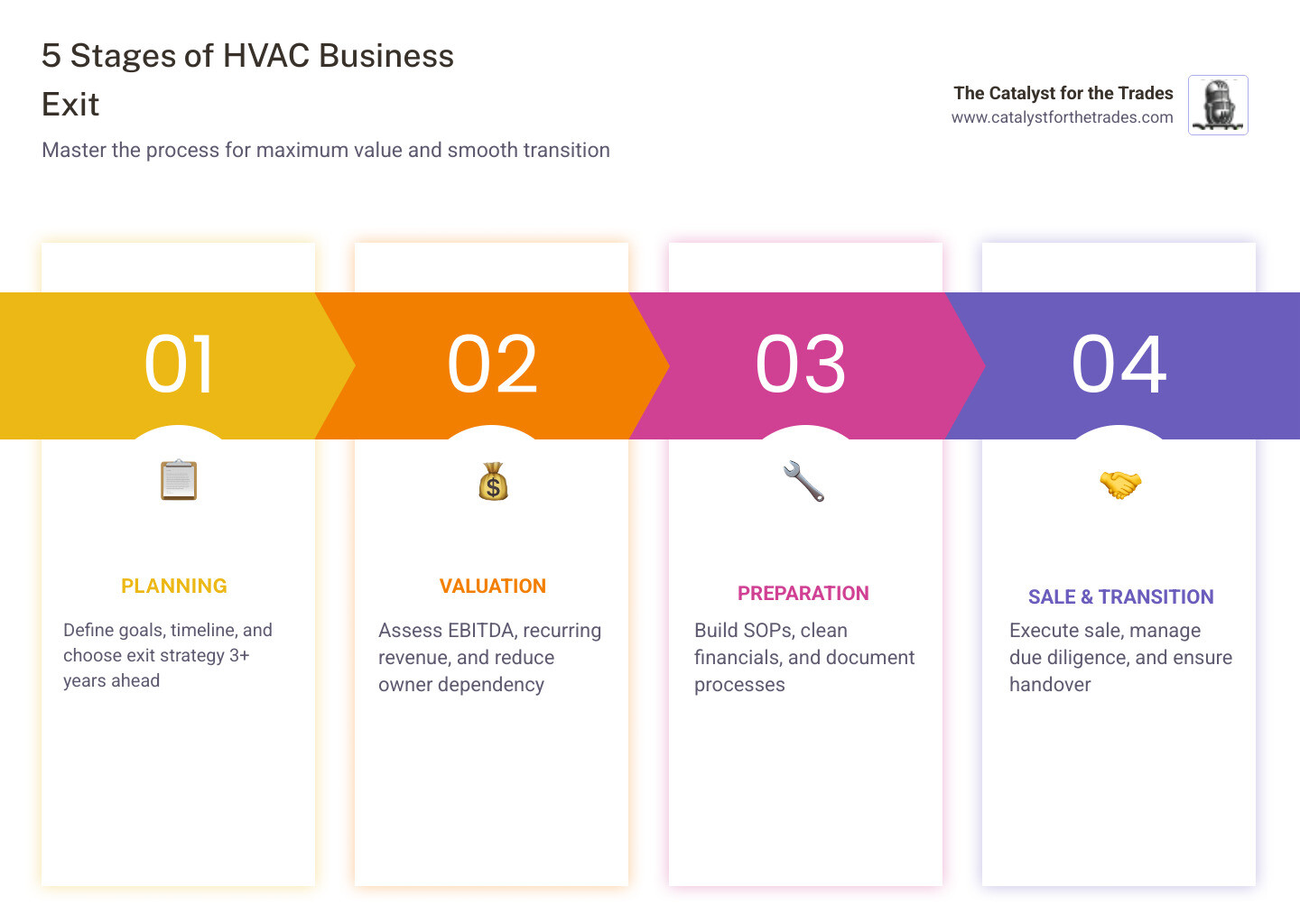
How to Maximize Your HVAC Business Valuation Before the Sale
Valuation in the HVAC world is typically driven by a multiple of EBITDA (Earnings Before Interest, Taxes, Depreciation, and Amortization). While the median multiple for a small shop might be around 3x, larger companies with strong systems can see 7x or even higher.
To get those higher numbers, you need to work with business valuation contractors who understand the industry. Key factors include:
- Clean Financials: No more running your personal truck or family vacations through the business account. Buyers want “normalized” earnings.
- Accrual Accounting: Most sophisticated buyers require accrual-based books to see the true timing of your revenue and expenses.
- Tech Adoption: Using AI and modern CRM tools, as Gregg Schornhorn discusses, proves your business is built for the future.
Reducing Owner Dependency through SOPs
A business that relies on the owner to quote every job is just a high-paying job, not a sellable asset. To maximize value, you must document everything. Standard Operating Procedures (SOPs) for service calls, installations, and customer service allow a buyer to see that the machine will keep humming after you leave. This is a core pillar of what actually works when building a sellable business.
Building Recurring Revenue for Higher Multiples
Nothing excites a buyer more than a “membership” base. HVAC businesses with a high percentage of recurring revenue from maintenance agreements often command a 20% premium on their valuation. These contracts provide predictable cash flow and “pull-through” work (repair and replacement leads) that keeps your technicians busy year-round. This predictability is the ultimate strategic insight for home service entrepreneurs.
Navigating the Sales Process and Due Diligence
Once you find a buyer, the real work begins. This is the due diligence phase, where the buyer “looks under the hood” to verify everything you’ve claimed. You’ll need a team of experts: an M&A advisor or broker, a specialized lawyer, and a CPA.
A common hurdle is the “Quality of Earnings” (QofE) report. This is an independent audit that verifies your EBITDA is accurate. If your books are messy, this is where deals go to die. You may also encounter “Earnouts”—where a portion of the sale price (typically 10-15%) is paid only if the business hits certain goals after you leave.
Preparing Your Financial and Legal Documentation
You should have at least three years of clean financial history ready. This includes:
- Federal tax returns
- Profit & Loss statements and Balance Sheets
- Detailed equipment inventory
- Customer lists (with a focus on diversity—no single customer should represent more than 10% of revenue)
- Litigation history and insurance records
Having these ready, as suggested by valuation experts, speeds up the process and builds trust with the buyer.
Managing the Post-Sale Transition
A successful exit isn’t just about the check; it’s about the transition planning. You need a communication plan for your employees to prevent a mass exodus of technicians who might feel uncertain about new ownership.
Most buyers will want you to stay on for a “handover period”—anywhere from three months to a year—to train them on the nuances of your local market and specific operations. During this time, you’ll likely sign a non-compete clause, ensuring you don’t start a new HVAC shop across the street the following week.
Frequently Asked Questions about HVAC Business Exits
How long does it typically take to sell an HVAC business?
From the moment you list the business to the day you close, the process usually takes 6 to 12 months. However, the preparation phase should ideally start 3 years in advance to ensure the financials and operations are optimized for the best price.
What is the average EBITDA multiple for an HVAC company?
Multiples vary by size and revenue type.
- Under $1M EBITDA: 3x – 4x
- $1M – $5M EBITDA: 4x – 6x
- $5M+ EBITDA: 7x+Companies with high recurring revenue (maintenance contracts) consistently sit at the higher end of these ranges.
What are the most common pitfalls to avoid during an exit?
The biggest mistake is staying too involved in daily operations. If you are the primary salesperson or lead tech, the business’s value drops significantly. Other pitfalls include poor bookkeeping, failing to document SOPs, and letting emotions cloud your judgment during negotiations.
Conclusion
At The Catalyst for the Trades, we know that building a business is a marathon, but the exit is your victory lap. By implementing these exit strategies for HVAC business owners early, you aren’t just planning for the end—you’re building a better, more profitable business today.
Whether you’re looking to scale for a massive private equity exit or transition the business to the next generation, the key is proactive, strategic growth. Don’t leave your legacy to chance. Start your journey toward a successful exit today and ensure that your years of hard work result in the financial freedom you deserve.


