Learn · April 14, 2026
Improving Operational Efficiency: 7 Steps
Boost your trade business by improving operational efficiency: cut waste, leverage tech, measure KPIs & scale smarter!
By The Catalyst Editorial Team Operator education · 10 min read · Updated July 24, 2026

Why Improving Operational Efficiency Is the Key to Scaling Your Trade Business

Improving operational efficiency is the process of getting more value out of your existing resources — your people, your time, and your tools — without burning anyone out or cutting corners on quality.
For home service business owners, that means:
- Less time wasted on tasks that don’t move the needle
- Fewer bottlenecks slowing down your techs in the field
- Lower operating costs without sacrificing the quality your customers expect
- More capacity to grow without just throwing more bodies at the problem
Here’s the hard truth: the average worker spends less than three hours a day on truly productive tasks, and only 27% of their time on work that actually matches their skills. In a trade business, that kind of waste adds up fast — in missed jobs, delayed invoices, and frustrated crews.
The good news? Companies that actively work on operational improvements see up to 25% higher productivity and 20% lower operating costs than businesses that don’t. That’s not a small edge — that’s the difference between a business that scales and one that stalls.
This guide walks you through exactly how to find the waste in your operation, fix it, and build systems that keep improving over time.
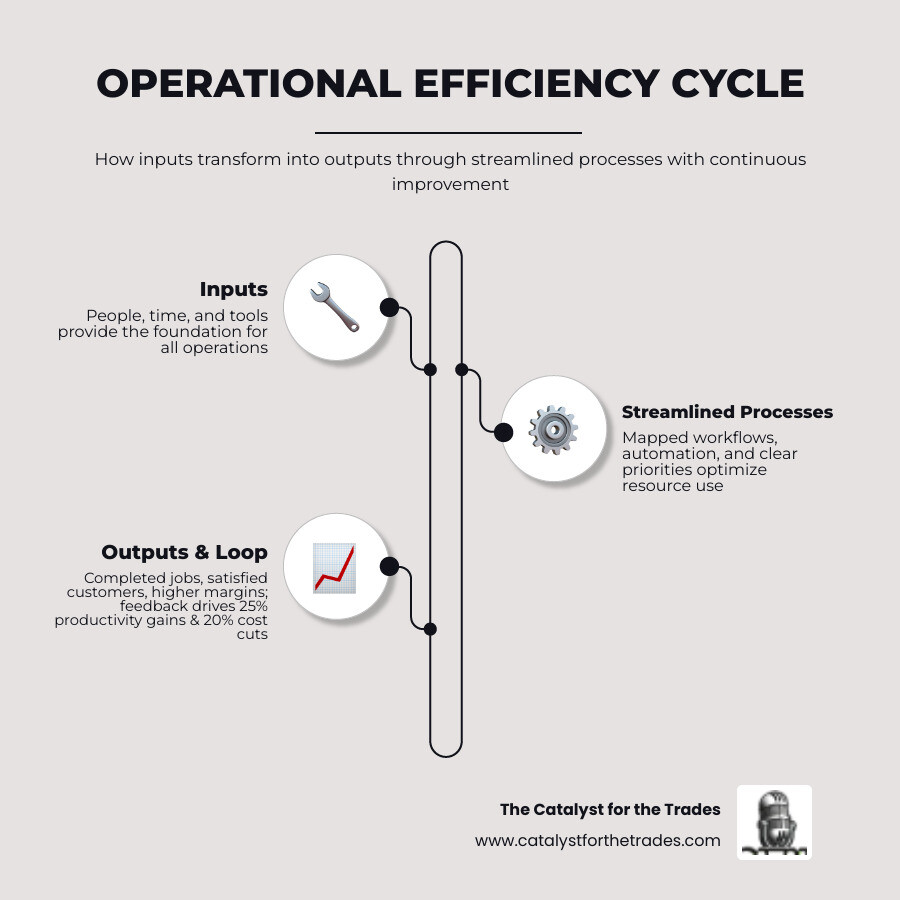
Defining Operational Efficiency in the Modern Trade Industry
In HVAC, plumbing, and electrical work, we often hear the words “efficiency,” “productivity,” and “effectiveness” thrown around as if they mean the same thing. They don’t. Understanding the difference is the first step toward improving operational efficiency.
Think of it this way:
- Productivity is about volume. It’s how many units you produce or how many service calls your team completes in a day.
- Effectiveness is about the result. Did you fix the customer’s AC? Is the customer happy? Did you meet your goal?
- Operational Efficiency is the “how.” It is the relationship between your inputs (labor hours, fuel, parts) and your outputs (revenue, completed jobs).
According to McKinsey, companies that invest in operational improvements see 25% higher productivity and 20% lower operating costs than their peers. For a trade business, this means doing the job right the first time, with the least amount of wasted effort.
| Term | Focus | Goal |
|---|---|---|
| Productivity | Quantity | Do more |
| Effectiveness | Quality/Outcome | Do the right things |
| Operational Efficiency | Resource Optimization | Do things right (minimal waste) |
By focusing on operational efficiency, we aren’t just asking our techs to work harder; we are asking our systems to work smarter. This reduces the “friction” in a workday—those annoying moments where a tech is waiting for a part, driving back to the warehouse for a tool they forgot, or sitting in the truck because the dispatch software glitched.
Why Efficiency Matters for Scaling
Scaling a business is like building a house. If your foundation (your operations) is shaky, the whole thing will crack as you add more weight. Improving operational efficiency provides the “agility” needed to grow.
When your processes are streamlined, you can handle a sudden heatwave or a cold snap without your office staff having a collective meltdown. It leads to higher profit margins because you are squeezing more value out of every dollar spent on overhead. Most importantly, it improves customer satisfaction. A business that is efficient is a business that shows up on time, has the parts ready, and communicates clearly. To dive deeper into how this looks in the field, check out our HVAC business operations guide.
How to Measure and Benchmark Your Performance
You can’t fix what you don’t measure. In the trades, we often rely on “gut feelings”—feeling like the day was busy, so it must have been profitable. But data tells a different story.
The primary metric to track is the Operational Efficiency Ratio. This is calculated by adding your operating expenses and your Cost of Goods Sold (COGS), then dividing that total by your net sales.
- Formula: (Operating Expenses + COGS) / Net Sales
In many industries, an efficiency ratio of 50% or less is considered the “gold standard.” If your ratio is climbing, it means you are spending more to earn every dollar of revenue.
Beyond the main ratio, we look at:
- Inventory Turnover: How quickly are you using the parts on your shelves? If parts sit for months, that’s “dead money.”
- Accounts Receivable Turnover: How fast are you getting paid? Cash flow is the lifeblood of efficiency.
- First Pass Yield (FPY): This is a big one for us. What percentage of your jobs are completed correctly on the first visit without a callback? Callbacks are the ultimate efficiency killers.
To start turning these numbers around, you need a plan for process improvement.
Key Performance Indicators for Field Services
For field service businesses, we need to look at specific “frontline” KPIs:
- Workforce Productivity: Are your techs spending 8 hours on billable work, or are they spending 4 hours driving and 4 hours working?
- Task Completion Rate: How many assigned tickets are closed out daily versus rolled over?
- Cycle Time: From the moment a customer calls to the moment the invoice is paid, how long does the process take?
- Capacity Use Rate: If you have 10 trucks, are they all running, or is half your fleet sitting idle?
We also distinguish between lagging indicators (like monthly profit) and leading indicators (like daily task completion). Leading indicators tell you what will happen, allowing you to be proactive rather than reactive.
Practical Steps for Improving Operational Efficiency
Ready to get to work? Improving operational efficiency starts with Process Mapping. This sounds fancy, but it just means writing down every single step of a job, from the first phone call to the final “thank you” email.
When you map your processes, you’ll start to see the “8 Wastes” of lean operations:
- Defects: Callbacks and errors.
- Overproduction: Doing more than the customer asked for or ordered.
- Waiting: Techs waiting for dispatch or parts.
- Non-Utilized Talent: Having a master plumber doing basic data entry.
- Transportation: Unnecessary driving or poor routing.
- Inventory: Too much stock taking up space and money.
- Motion: Techs walking back and forth to the truck because it’s disorganized.
- Extra Processing: Asking the customer for the same info three times.
One of the best ways to tackle these wastes is to ensure your “brain” is working correctly. This means getting your CRM right. If your customer data is a mess, your efficiency will be, too.
Eliminating Silos and Bottlenecks
A “silo” happens when your office staff doesn’t talk to your field techs, or your sales team doesn’t talk to your installers. Research shows that 28% of employees cite poor communication as the reason they can’t deliver work on time.
When information is trapped in one person’s head or a single department’s spreadsheet, you get bottlenecks. Centralizing your data is the cure. When everyone looks at the same “source of truth,” the friction disappears. This is where system integration becomes your best friend.
Improving operational efficiency through Workplace Culture
You can have the best software in the world, but if your team is miserable, you won’t be efficient. The World Health Organization (WHO) officially classified burnout as an “occupational phenomenon” in 2019. In fact, over 40% of workers are considering leaving their employers in the next year.
Improving operational efficiency requires a culture of trust and autonomy. When you empower your techs to make decisions on-site without calling the office for every minor approval, you speed up the job and make them feel valued. A healthy culture reduces turnover, and as we all know, hiring and training new staff is one of the least efficient (and most expensive) things a business can do. For a structured approach to building this culture, see how EOS helps you scale.
Leveraging Technology and Automation for Growth
In the modern trade industry, “pen and paper” is a recipe for stagnation. To truly move the needle, we have to embrace technology.
Enterprise Resource Planning (ERP) software and field service management tools are the backbone of efficient scaling. They allow for:
- Automated Scheduling: No more manual whiteboards.
- Instant Invoicing: Getting paid before the tech even leaves the driveway.
- Real-time GPS Tracking: Reducing fuel costs and improving ETAs.
If you are hesitant to switch, technology adoption is no longer optional; it’s a survival skill. You can find the right tools by looking into field service management software specifically designed for the trades.
Improving operational efficiency with AI and Automation
Artificial Intelligence isn’t just for tech giants. Roughly 78% of businesses are already using AI for at least one task. For us, that looks like:
- Predictive Maintenance: Using data to tell a customer their furnace is likely to fail before it happens.
- Route Optimization: AI can calculate the most efficient path for 20 trucks in seconds, saving thousands in fuel.
- Chatbots: Handling basic customer queries at 2:00 AM so your office staff can sleep.
Check out our AI tech implementation guide to see how to start small without breaking the bank.
Digitizing the Frontline Experience
Your techs are the face of your company. If they are bogged down by clunky paperwork, they can’t focus on the “skill-related” work they were hired for. By digitizing the frontline—using mobile apps for task management and photo attachments—you gain real-time visibility into every job.
Better data management isn’t just about being “high-tech”; it saves money. McKinsey research found that improving data architecture can cut annual data spend by 5% to 15%. That is money that goes straight back into your pocket. For more on the “how-to” of this transition, see technology implementation.
Sustaining Long-Term Success and Continuous Improvement
Efficiency isn’t a destination; it’s a habit. Once you fix a bottleneck, a new one will eventually appear as you grow. This is the heart of Kaizen—the Japanese philosophy of continuous improvement.
One fun (and highly effective) way to find inefficiencies is the “Undercover Boss” method. You don’t need a wig and a fake mustache, but you should spend time riding along with your techs or sitting in the dispatch chair. You’ll quickly notice things that look fine on a report but are a nightmare in reality—like a mobile app that requires 15 clicks just to close a job.
We talk about this transition from “firefighting” to “system-running” in our podcast episode, From chaos to clarity.
Real-World Success Stories
We’ve seen these principles work wonders across different sectors:
- Safety and Incidents: One logistics pilot saw a 54% drop in recordable incidents just by improving frontline communication and training.
- Retail Speed: A grocery retailer used mobile goal-tracking to significantly speed up restocking and task execution.
- Profit Margins: Professional service firms that focus on financial analysis of projects often see operating profit margins between 25% and 40%.
These aren’t just numbers; they represent businesses that are less stressed and more profitable.
Frequently Asked Questions about Operational Efficiency
What is the difference between operational efficiency and productivity?
Productivity is about how much you do (e.g., “We did 10 service calls today”). Operational efficiency is about how well you used your resources to do it (e.g., “We did 10 service calls using 20% less fuel and zero callbacks”). You can be productive but inefficient if you are wasting money to get the work done.
How can a small trade business start measuring efficiency?
Start with the Efficiency Ratio: (Total Expenses + COGS) / Net Sales. Then, track your First Pass Yield—how many jobs are done right the first time. These two numbers will give you a clear picture of where you stand without needing complex software.
What are the most common causes of operational waste?
The “Big Three” in the trades are Waiting (techs waiting for parts or info), Transportation (poor routing), and Defects (callbacks). Fixing just these three can often boost your bottom line by 10-15% almost immediately.
Conclusion
At The Catalyst for the Trades, we believe that your business should serve you, not the other way around. Improving operational efficiency is the only way to stop the “chaos” and start building a legacy. By combining the right people, the right processes, and the latest technology, you can create a business that is agile, profitable, and ready for whatever the market throws at it.
Don’t let another day go by wasting those precious three hours of productivity. Start mapping your processes, talk to your team, and embrace the tools that make scaling possible.


