Learn · April 9, 2026
Growth Mindset for Service Entrepreneurs: 7 Keys
Discover growth mindset for service entrepreneurs: Overcome plateaus, build resilient teams, and drive business growth with proven strategies.
By The Catalyst Editorial Team Operator education · 9 min read · Updated July 24, 2026

The Power of a Growth Mindset for Service Entrepreneurs

A growth mindset for service entrepreneurs means believing your abilities can develop through dedication and hard work, seeing challenges as opportunities to learn, and embracing continuous improvement. It helps you adapt to changing customer needs, innovate with new technologies like AI, and build stronger, more resilient teams. This mindset is crucial for thriving in a competitive home services industry, allowing you to turn setbacks into steps forward for your business.
Running a successful home services business in today’s local markets, whether you’re an HVAC technician, plumber, or general contractor, comes with unique pressures. From rising customer expectations and fierce competition to staffing shortages and the rapid integration of new technologies like AI, owners often feel stretched thin. Many struggle to scale operations, improve profitability, and effectively plan for long-term growth. Without the right approach, these challenges can feel like roadblocks, leading to stagnation. This guide will show you how to overcome these hurdles.
Find out how we help home service businesses grow and contact us today to get started.
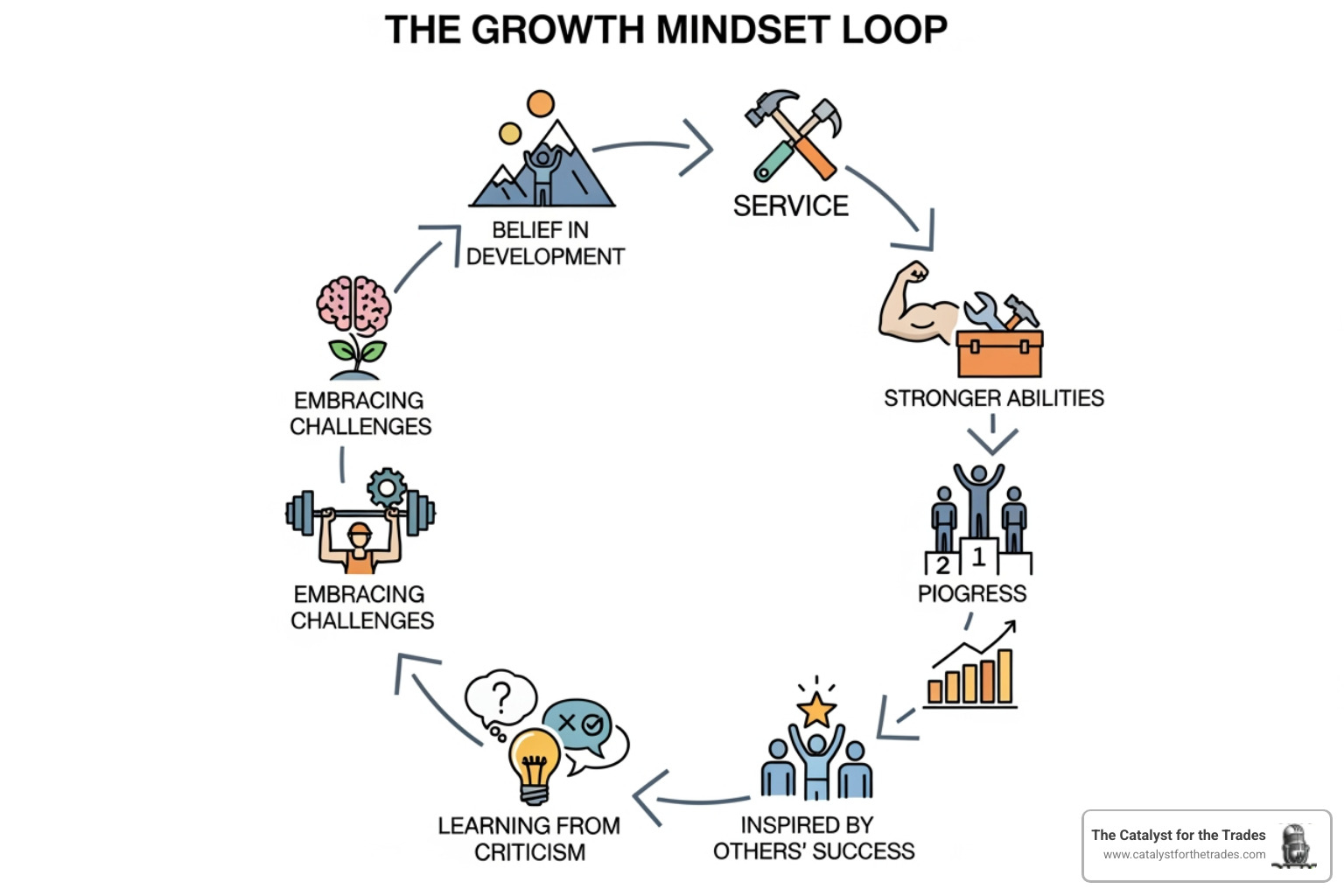
Defining the growth mindset for service entrepreneurs
At its core, the concept of a growth mindset—pioneered by psychologist Carol Dweck—revolves around the belief that our most basic abilities can be developed through dedication and hard work. For those of us in the trades, this is a shift. It moves us away from the idea that you are either “born a natural leader” or you aren’t. Instead, it posits that intelligence and talent are just the starting point.
In home services, a growth mindset for service entrepreneurs is the engine behind continuous learning. It’s what drives a plumber to master new tankless technology or an HVAC owner to dive into digital marketing. When we prioritize professional development, we aren’t just gaining skills; we are increasing our “entrepreneurial self-efficacy”—our belief in our own ability to succeed.
To understand where you stand, look at how you view these common traits:
| Feature | Fixed Mindset | Growth Mindset |
|---|---|---|
| Challenges | Avoids them to stay safe | Embraces them as a way to learn |
| Obstacles | Gives up easily | Persists despite setbacks |
| Effort | Sees it as fruitless or “low talent” | Sees it as the path to mastery |
| Criticism | Ignores useful negative feedback | Learns from criticism |
| Success of Others | Feels threatened | Finds lessons and inspiration |
Why a growth mindset for service entrepreneurs beats technical skill alone
We’ve all seen the “best technician” start a business and fail within two years. Why? Because technical skill is a baseline, not a ceiling. Research shows that growth mindset training can increase entrepreneurial action by up to one-third. It turns “necessity entrepreneurs” (those who start a business because they need a job) into “opportunity entrepreneurs” (those who build systems to capture market share).
A key part of trades leadership development is the “brain-as-muscle” analogy. Just as you train your body to handle heavy equipment, you must train your brain to handle business complexity. Many in the trades come from backgrounds where a fixed mindset was a survival mechanism. Breaking through those poverty-driven mindsets requires realizing that failure isn’t a permanent label—it’s just data.
Shifting from an employee mindset to entrepreneurial leadership
One of the hardest transitions is moving from “doing the work” to “building the system.” If you are still the one answering every emergency call at 2 AM, you have a job, not a business. To scale, you must learn how to break through growth plateaus in the trades lessons from vince heusers journey.
This shift requires moving away from low-leverage tasks (like micromanaging a van’s inventory) to high-leverage tasks (like refining your sales process or training a lead tech). Breaking revenue plateaus isn’t about working more hours; it’s about thinking differently. When you adopt an ownership culture, you stop inspecting every job and start building quality control systems that empower your team to own the outcome.
The 7 attributes of high-growth service companies
What separates the shop with two vans from the regional powerhouse with fifty? It often comes down to seven fundamental attributes that a growth mindset helps you cultivate:
- Large Addressable Market: You aren’t just “fixing pipes”; you’re providing home wellness.
- Strong Product-Market Fit: Your services solve the exact pains your local community feels.
- Clear Positioning: You aren’t the cheapest; you’re the most reliable or the most tech-forward.
- Limited Competition (through Excellence): You out-service everyone else so thoroughly that price becomes secondary.
- Talented Team: You hire for mindset and train for skill.
- Strong Alignment: Everyone knows the goal for the week.
- Strong Founder Mindset: You lead with vision, not just a wrench.
By applying business growth strategies, you can ensure your home service business growth is sustainable. This leads to “talent efficiency”—the ability to grow revenue faster than you grow your headcount.
Leveraging AI and automation with a growth mindset for service entrepreneurs
The “old school” way of thinking sees AI as a threat. The growth mindset sees it as a superpower. We are seeing a massive evolution in how customer success is managed. We’ve moved from reactive support to proactive retention.
Today, how top contractors win mindset ai and showing up in the trades involves using AI-automated agents to handle 75% of basic customer inquiries or debt collection. This isn’t about replacing people; it’s about CSM (Customer Success Manager) productivity. It allows your human staff to focus on building real relationships while the machines handle the mundane scheduling and follow-ups.
Building a team that drives growth through alignment
You cannot scale a business alone. You need “talent multiplication.” This happens when you stop being the “genius with a thousand helpers” and start building a team of thinkers. The future of leadership how to build a team that drives growth relies on shared metrics and feedback loops.
Consider the “Googler-to-Googler” model: 80% of their training is peer-to-peer. In your shop, this could mean having your senior lead tech run a weekly “lessons learned” session. When your team sees that you value learning over “being right,” they will start taking more initiative.
Practical rituals to foster agility and customer health
A mindset is just a philosophy until you turn it into a ritual. To stay agile, we recommend implementing “light” OKRs (Objectives and Key Results). Instead of vague goals like “get more customers,” try: “Increase net dollar retention by 10% through a new preventative maintenance program.”
We also encourage defining “debatable values.” Most companies have boring values like “Integrity.” A debatable value might be “Speed over Perfection” or “Customer Delight over Short-term Profit.” These help your team make decisions when you aren’t in the room. This is a core part of leadership development programs and the broader strategic planning process.
Improving customer relationships and net dollar retention with a growth mindset for service entrepreneurs
In the service world, the “law of gravity” is churn. Customers will naturally forget about you unless you stay relevant. A growth mindset pushes you to move beyond the one-time fix and into “maturity curves” for your customers.
By using business growth and operations keywords to track customer health, you can see who is likely to leave before they actually do. Value delivery dashboards—even simple ones that show a homeowner how much they saved on energy bills thanks to your HVAC tune-up—build the kind of trust that drives long-term retention.
Using empowering language and stretch goals
The language we use in the shop matters. The most powerful word in a growth mindset for service entrepreneurs is “Yet.”
- “We don’t know how to run digital ads… yet.”
- “We haven’t hit $2M in revenue… yet.”
This simple shift rewired the brain to look for a solution rather than accepting a defeat. When you audit your limiting beliefs, you often find they are just old habits. Setting a “stretch goal”—like a 5-year business roadmap for contractors—gives you a target that forces you to grow into the person capable of hitting it.
Overcoming barriers: From fear of failure to warrior strength
Leadership in the trades requires four dimensions:
- Awareness: Knowing your triggers and when you’re slipping into a fixed mindset.
- Connection: Building deep trust with your crew and customers.
- Confidence: The inspiration to try new things.
- Warrior Strength: The grit to keep going when a major project goes sideways.
This is where change management and organizational change become personal. It’s about more than just software; it’s about your internal resilience.
Managing high-stakes service environments without burnout
High-stakes environments—like a heatwave where every customer is angry—can easily trigger a fixed mindset of “I just need to survive this.” But to build a profitable business, you must want to build a more profitable business start with the end in mind.
Servant leadership is a key tool here. By focusing on the growth of your team, you actually reduce your own stress. When you disrupt unproductive habits—like checking emails at dinner or jumping into the field to “save” a tech—you create space for your own mental health and the business’s strategic growth.
Frequently Asked Questions about Growth Mindsets
How do I identify a fixed mindset in my service team?
Look for “blame language.” If a tech says, “The customer was just difficult,” or “This equipment is just junk,” without looking for a way to improve the interaction or the install, they are likely stuck in a fixed mindset. They see the situation as unchangeable rather than a problem to be solved.
What are the best metrics to measure mindset impact on business?
While mindset is internal, its effects are external. Track your “Employee Initiative Rate” (how many improvements are suggested by staff) and your “Net Dollar Retention.” If your team is growing in their mindset, you’ll also see a decrease in “callback rates” as technicians take more ownership of their work.
Can growth mindset training really increase entrepreneurial action?
Absolutely. Studies on entrepreneurs have shown that even a half-day of growth mindset training—focusing on brain plasticity and learning from failure—leads to a significant increase in the number of business actions taken. People who believe they can improve are simply more likely to try.
Conclusion
The journey from a “job owner” to a true service entrepreneur is paved with mindset shifts. It requires a commitment to strategic evolution and the humility to realize that what got you to six figures won’t get you to seven or eight. By adopting a growth mindset for service entrepreneurs, you aren’t just improving your bottom line; you’re improving your life and the lives of your team members.
At The Catalyst for the Trades, we are dedicated to helping you bridge the gap between technical expertise and operational excellence. Whether it’s through AI integration or leadership coaching, we believe every trade professional has the potential to build a legacy.
Learn more about our mission and start your journey toward a growth-driven future today.


