Learn · January 24, 2026
Leadership Development Programs: 1 Blueprint for Success
Design impactful leadership development programs to cultivate future leaders. Learn to build, tailor, and measure ROI for sustained success.
By The Catalyst Editorial Team Operator education · 18 min read · Updated July 24, 2026

Why Leadership Development Programs Are Your Most Strategic Investment
Leadership development programs are structured initiatives designed to build the skills, mindsets, and capabilities needed for effective leadership at every level of an organization. For home services business owners looking to scale, these programs are the foundation for sustainable growth, better profitability, and a team that can run without constant micromanagement.
What Leadership Development Programs Offer:
- Skill Development: Communication, strategic thinking, problem-solving, and team management
- Career Pathways: Clear advancement opportunities that retain top talent
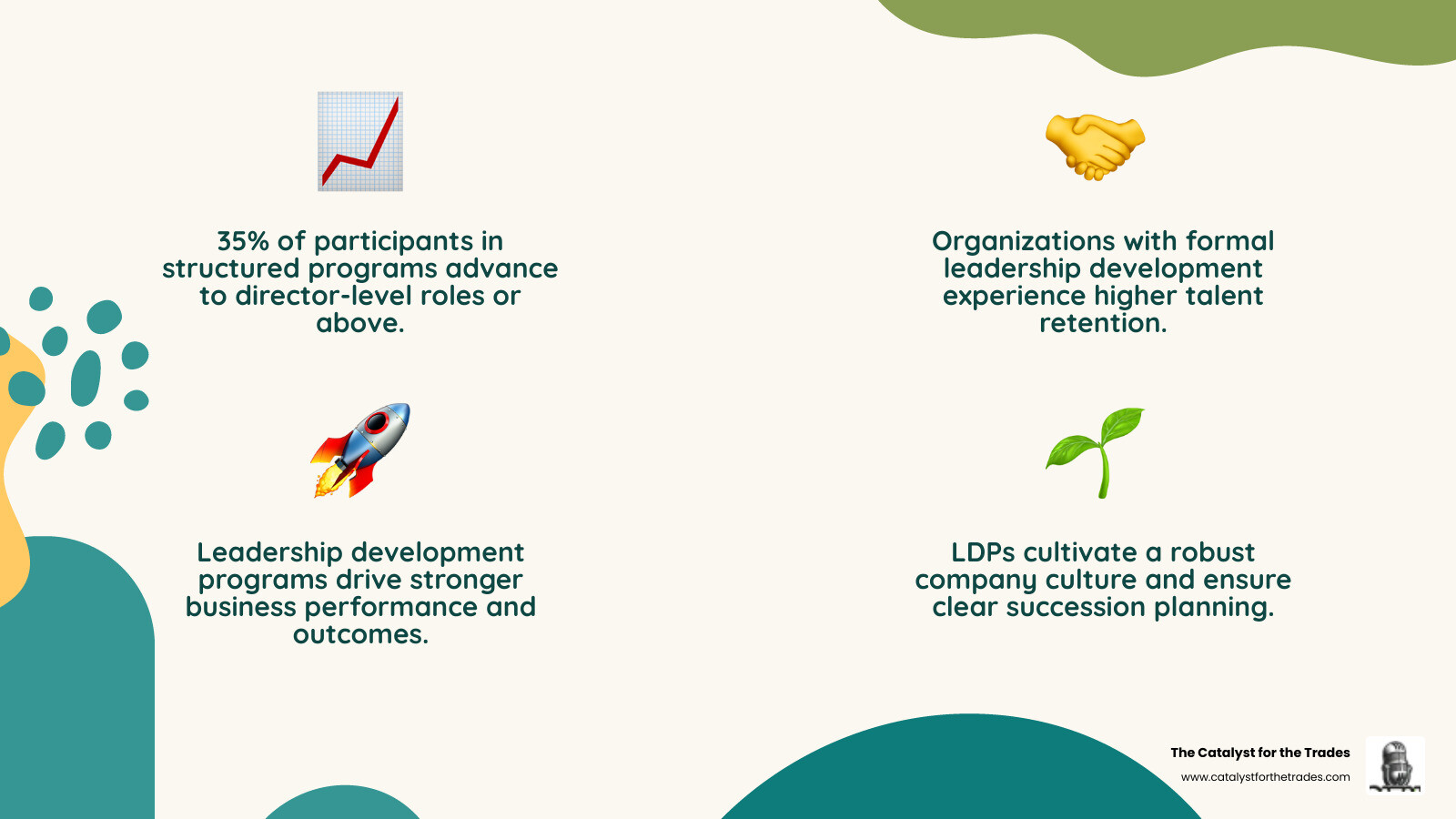
- Business Impact: 35% of participants in structured programs advance to director-level roles or above
- Culture Building: Shared values and leadership standards across your organization
- Succession Planning: A pipeline of leaders ready to step up as you grow or exit
If you’re struggling to find qualified managers, watching good technicians leave for competitors, or feeling stuck as the only person who can make decisions, you need a systematic approach to developing leaders. Without one, you’re not building a business—you’re building a job for yourself.
Strengthen your company’s foundation with company culture development and explore how The Catalyst for the Trades can help you build a scalable leadership system.
Data shows organizations with formal leadership development see higher retention, faster promotion rates, and stronger business outcomes. In the trades, where talent is scarce, that advantage isn’t optional—it’s survival.
Leadership development programs further reading:
- continuous learning
- professional development
- talent pipeline development
The Blueprint: Designing High-Impact Leadership Development Programs
Designing leadership development programs isn’t about throwing a few workshops together and hoping for the best. It’s about crafting a strategic blueprint that aligns with our business’s unique needs and aspirations. As organizations evolve, driven by technological advancements and shifting market dynamics, the ability to keep learning becomes our greatest leadership asset. If we expect our leaders to grow, our organizational culture must be ready to accept and support that evolution.
The process begins with a foundational question: What business priority is driving the need for leadership development? This isn’t just about general improvement; it’s about focusing on performance outcomes that directly support our key objectives, whether that’s increasing revenue, improving customer satisfaction, or enhancing operational efficiency. Without this clear alignment, even the best-intentioned programs can yield generic, uninspiring results.
We believe in a data-driven approach, collecting information before, during, and after the program to measure progress and optimize for impact. This ensures that our investment isn’t just a cost, but a strategic asset generating tangible returns. A well-defined strategic planning process is key to setting these programs up for success right from the start.
Step 1: Aligning Development with Business Goals
The most critical step in designing effective leadership development programs is aligning them with your business goals. Generic programs yield generic results. Instead, we must ask ourselves: what do we want our leaders (and their teams) to do differently as a result of this program? What specific business priority is this development meant to address?
For instance, if our goal is to improve customer retention in our home services business, our leadership program might focus on developing skills in empathetic communication, conflict resolution, and proactive problem-solving for our service managers. By defining specific performance outcomes, we can then establish clear success indicators, metrics, and methods for measurement. This ensures that the learning isn’t just “interesting,” but directly contributes to our business growth strategies.
Learning experiences are most effective when they concentrate on a few key outcomes. This targeted approach links learning directly to company performance and makes the “what’s in it for me?” clear for every participant. When employees understand how their personal growth contributes to the larger business priority, they are far more likely to prioritize their learning and apply new behaviors.
Step 2: Identifying the Essential Components for a Successful Program
Once our business goals are clear, we can focus on building the core components that will make our leadership development programs truly impactful. Effective programs are not just about lectures; they are rich, engaging experiences designed for real-world application.
Here are some essential components we integrate:
- Curriculum Design Custom to Levels: We understand that the needs of an early-career professional are different from those of a seasoned executive. As experts suggest, “less is more” with learning content, ensuring learners aren’t overwhelmed and can focus on key goals.
- Experiential Learning: Leaders learn best by doing. Our programs incorporate practical exercises, case studies relevant to the trades, and even business simulations. This hands-on approach ensures that participants can apply concepts directly to their daily challenges, fostering a mindset of “analysis to action.”
- 360-Degree Assessments: Nearly all top-tier programs leverage 360 assessments to give leaders comprehensive feedback on their strengths and areas for growth. This individualized insight is crucial for self-awareness and targeted development plans.
- Peer Learning Groups: Creating a psychologically safe environment where leaders can share challenges and insights with their peers is invaluable. Programs often use “Masterminds” or peer coaching circles, allowing participants to learn from each other’s experiences and support one another. Our leadership circles guide emphasizes the power of these collaborative settings.
- Action Projects: To ensure learning sticks, we often integrate individual projects that address real business challenges. This allows participants to immediately apply new skills and strategies, demonstrating tangible results and reinforcing their learning.
- Blended Learning: Combining virtual modules with in-person sessions offers flexibility and maximizes engagement. Pre-program online coursework can prepare participants, while intensive in-person segments foster deeper connections and experiential learning. Post-program resources and coaching then sustain the learning journey.
By weaving these components together, we create leadership development programs that are not only comprehensive but also highly personalized and effective.
Step 3: The Crucial Role of Mentorship and Coaching
In any robust leadership development program, the human element of guidance and support is non-negotiable. This is where mentorship and coaching step in, playing distinct yet complementary roles in shaping our future leaders.
Mentorship typically involves an experienced leader sharing their wisdom, career insights, and offering guidance based on their journey. It’s often a long-term relationship focused on overall career growth and navigating organizational complexities. Think of it as having a seasoned guide who has walked the path before you, offering perspective and encouragement. Many successful LDPs emphasize mentorship from experienced leaders to help participants grow faster and avoid detours.
Coaching, on the other hand, is a more focused, often short-term, relationship aimed at improving specific performance, achieving desired metrics, or developing particular skills. A leadership coach helps leaders clarify their goals, identify obstacles, and develop strategies to overcome them, all while holding them accountable. As Gallup defines it, “Leadership coaching is the act of guiding, advising, encouraging, challenging or developing an organizational leader to improve their performance, achieve desired metrics or reach organizational outcomes.” It’s about having the right conversations to help leaders live out their purpose and accomplish their goals.
Integrating both mentorship and coaching into our leadership development programs offers a powerful synergy:
- Selecting Mentors: We identify senior leaders who embody our company values and have a genuine desire to invest in the next generation. These relationships are often organic but can also be formally structured.
- Structuring Coaching Sessions: Professional coaching can be provided internally or externally, with regular one-on-one sessions focused on individual development plans derived from assessments like 360-degree feedback.
- Building a Feedback Culture: Both mentors and coaches are instrumental in fostering a culture where constructive feedback is welcomed and seen as a gift for growth. Learning how to give feedback—especially when you’re dreading it is a critical skill for both givers and receivers.
- Accountability: Coaching, in particular, builds accountability. By setting clear goals and regularly reviewing progress, leaders are more likely to implement what they’ve learned and achieve tangible results.
The presence of senior leaders as teachers, sponsors, and mentors significantly increases the relevance and engagement in our development programs. They provide invaluable context, share their own stories, and help connect the learning to real-world scenarios within our home services environment.
Tailoring Your Program for Maximum Relevance
One size rarely fits all in leadership development. For leadership development programs to resonate and drive impact, they must be customized to participant needs and your industry’s unique context. This personalization ensures that the learning is not just theoretical but immediately applicable to the challenges our team members face every day.
The touchstone for content curation should always be learner relevance. This means understanding the distinct responsibilities, needs, and expectations of different leadership levels within our home services business. A program designed for an emerging team lead will look very different from one crafted for a division head. This targeted approach is a cornerstone of effective professional development.
Customizing for Different Career Levels and Industries
Our home services industry has its own unique demands, from managing field technicians to optimizing customer service and overseeing complex operations. Therefore, our leadership development programs must speak directly to these realities, while also accounting for the varying experience levels of our team.
- Early-Career Professionals: For those just starting out or moving into their first leadership role, the focus is on foundational skills. Rotational programs can offer immersive roles with real responsibility, allowing participants to gain practical business experience across different functional areas. This helps them broaden their understanding of the business and develop core leadership and communication skills.
- Mid-Level Managers: These are the leaders “in the middle,” often bridging the gap between strategic vision and day-to-day execution. Management development for this group might emphasize conflict resolution, team motivation, project management, and cross-functional collaboration. Programs for mid-level leaders are crucial for fostering innovation and ensuring efficient operations.
- Senior Executives: At the highest levels, leadership development programs shift towards strategic thinking, organizational leadership, innovation, and navigating complex market dynamics. For our industry, this might mean developing leaders who can drive technology adoption, expand into new service areas, or optimize large-scale operations.
The specific context of the trades, with its emphasis on technical expertise and hands-on problem-solving, also informs our approach. Trades leadership development must integrate these practical realities. As Raul Rodriguez emphasizes, learning how to lead, serve, and grow in the trades requires a unique blend of business savvy and industry-specific insight.
Structuring Programs to Attract and Develop Top Talent
To build a strong pipeline of leaders, our leadership development programs must be designed not only to develop existing talent but also to attract high-potential individuals to our organization. In a competitive talent landscape, a clear path for growth is a powerful draw.
- Rotational Opportunities: Offering participants the chance to experience different functional areas—be it finance, HR, marketing, or operations—provides a holistic understanding of the business. This exposure helps them develop a broader skillset and identify where their strengths can best contribute. Offering LDPs across a wide range of functions demonstrates the value of diverse experience.
- Highlighting Career Growth: We need to clearly articulate the career progression that an LDP can offer. Adobe’s Leadership Circles program, for example, successfully diversified its leadership pipeline, with an impressive 35% of participants being promoted to Director-level positions or above. This kind of tangible career advancement is a strong motivator.
- Real Work, Real Impact: Top talent isn’t looking for simulations; they want to contribute to real projects with meaningful responsibilities. Lockheed Martin’s LDPs are built on the philosophy of “real work, real leaders, real edge,” ensuring participants are engaged in high-impact projects from day one. This approach not only develops skills but also builds confidence and a sense of ownership.
- Visibility and Networking: Programs should provide opportunities for participants to network with senior leaders and peers, gaining support and opening doors. This fosters a sense of belonging and helps individuals build critical professional relationships.
By structuring our leadership development programs to offer these rich experiences and clear growth pathways, we can effectively attract, develop, and retain the kind of talent that, like Trey McWilliams, can balance big growth with people-first leadership.
Implementation and Measuring the ROI of Leadership Development Programs
Even the best-designed leadership development programs require thoughtful implementation and rigorous measurement. This phase ensures your investment translates into tangible results for your home services business.
Effective implementation involves more than just scheduling sessions. It requires strong executive involvement, a clear communication plan, and seamless logistical support. Senior leaders, beyond just providing buy-in, can act as teachers, sponsors, and mentors, significantly increasing the program’s relevance and engagement. They help contextualize the learning, connecting it directly to our business’s strategic vision.
A robust communication strategy is also key. We need to clearly articulate the program’s alignment with our business strategy and highlight the “what’s in it for me?” for each participant. This helps foster enthusiasm and commitment, especially when navigating change management within the organization.
How to Measure Program Success and Impact
Measuring the success and ROI of leadership development programs is crucial for demonstrating their value and continuously improving them. This requires data, not guesswork.
Here are key metrics we consider:
- Learner Engagement and Satisfaction: Surveys and feedback sessions during and after the program can gauge how engaged participants are and their perceived value of the training. This helps us refine content and delivery.
- Skill Acquisition and Behavioral Change: Pre- and post-program assessments, including 360-degree feedback, can measure improvements in specific leadership competencies. Feedback from supervisors and peers on observed behavioral changes is also invaluable.
- Business Impact: This is where the rubber meets the road. We look for tangible improvements in business metrics tied to our initial goals. For example:
- Increased customer satisfaction scores
- Improved team productivity or efficiency
- Reduction in employee turnover within participating teams
- Successful completion of strategic projects led by program alumni
- Promotion and Retention Rates: Tracking the career progression of program participants is a powerful indicator. Adobe’s program saw 35% of participants promoted to Director-level or above, a clear sign of impact. High retention rates among program alumni also signal success.
- Calculating ROI: While challenging, ROI can be estimated by comparing the monetary benefits derived from the program’s impact (e.g., increased revenue, cost savings from reduced turnover) against the total cost of the program. Gallup emphasizes that leadership development is vital for driving business outcomes.
By establishing clear KPIs and consistently collecting data, we can prove the value of our leadership development programs and make informed decisions about future investments.
The Importance of a Supportive Company Culture
Even the most brilliant leadership development program can fall flat if the organizational culture isn’t ready to accept the changes it fosters. As Harvard Business Review wisely states, “If you expect leaders to evolve, the broader organizational culture must welcome and support it.” If our entrenched systems or norms disincentivize leaders from applying new skills, our investment in training will be wasted.
A supportive culture does several things:
- Welcomes Change: It creates an environment where experimentation, learning from mistakes, and adopting new approaches are encouraged, not punished. This is vital for any organizational change initiative.
- Rewards Learning and Growth: We need to actively celebrate our employees’ commitment to learning and growth, as many feel their companies don’t provide enough recognition for it. This isn’t just about promotions; it’s about acknowledging effort and progress.
- Avoids Stagnation: A culture that values continuous learning helps prevent stagnation, ensuring our leaders and our business remain agile and responsive to market demands.
- Psychological Safety: Leaders need to feel safe to try new things, ask questions, and even admit when they don’t know something. This psychological safety is a cornerstone of effective learning environments.
We must ensure that our company culture doesn’t stifle leadership development. By actively nurturing an environment that values continuous learning and growth, we create the fertile ground necessary for our leadership development programs to truly flourish and drive lasting impact.
The Future of Leadership Development
The landscape of leadership is constantly shifting, and our leadership development programs must evolve alongside it. As organizations respond to technological advancements and market shifts, the drive to keep learning becomes our most invaluable leadership asset. The future of leadership is about adaptability, resilience, and a commitment to continuous growth.
At The Catalyst for the Trades, we recognize that building a team that drives growth means embracing these changes and proactively preparing our leaders for what’s next.
Emerging Trends and Best Practices in Leadership Development Programs
We’re seeing exciting trends that are reshaping how we approach leadership development programs:
- Self-Led Learning & Micro-Learning: For instance, some companies offer self-led training with workshops and “booster sessions.” This empowers leaders to learn at their own pace and focus on relevant areas. Micro-learning, delivered in bite-sized chunks, fits seamlessly into busy schedules, making continuous learning more accessible.
- AI in Development: While a coming wave of low-quality AI-generated content poses a challenge, AI can also personalize learning paths, provide instant feedback, and automate administrative tasks, making leadership development programs more efficient and effective.
- Focus on Soft Skills: Beyond technical competence, the emphasis is increasingly on critical soft skills like emotional intelligence, complex problem-solving, critical thinking, creativity, and communication. These are the skills that enable leaders to steer ambiguity and inspire their teams.
- Resilience and Agility: Today’s leaders manage volatility while maintaining long-term vision. Programs like CCL’s “Resilience Advantage” focus on preventing burnout and building leaders who can thrive amidst change. Similarly, “Collective Agility” programs equip leaders to respond effectively to uncertainty, aligning with the need for embracing change in the future of leadership.
- Psychological Safety: Creating environments where leaders feel safe to experiment, take risks, and be vulnerable is paramount. This fosters innovation and stronger team dynamics.
- Upskilling for Shared Prosperity: As the World Economic Forum highlights, upskilling is crucial for organizations to realize “extraordinary potential” and ensure shared prosperity in an evolving global economy.
These emerging trends allow us to create more dynamic, personalized, and impactful leadership development programs that truly prepare our leaders for the complexities of the modern world.
Building a Continuous Learning Culture
The future of leadership development programs isn’t about one-off events; it’s about fostering a culture of continuous learning. Learning isn’t something that happens only in a classroom; it’s an ongoing journey integrated into the fabric of our organization.
Key strategies for building such a culture include:
- Beyond the Program: Once a formal program concludes, the learning shouldn’t stop. Provide alumni networks, ongoing resources, and opportunities for continued engagement to foster continued growth among participants.
- Fostering Autonomous Learning: Empowering employees to take ownership of their development by offering personalized and relevant resources, and supporting self-directed learning with convenient, accessible platforms. This might include curated content libraries, online courses, or self-assessment tools.
- Social Learning: Encouraging peer-to-peer learning, knowledge-sharing, and collaborative problem-solving. This can happen through formal communities of practice, informal mentorships, or even dedicated social learning platforms. As Jazmin Ramirez demonstrates, real leadership powers change in the trades by fostering collaborative and supportive environments.
- Data-Driven Insights: Continuously collecting, understanding, and using data to ensure our learning efforts are impactful. This allows us to adapt our approaches based on what’s working and what’s not, ensuring our programs remain relevant and effective.
By embedding learning into our daily operations and making it an integral part of our company culture, we ensure that our leaders are always growing, adapting, and driving our business forward.
Frequently Asked Questions about Leadership Development Programs
We often hear common questions when discussing leadership development programs. Let’s tackle a few of them.
How long should a leadership development program be?
The duration of a leadership development program varies based on its goals and the participant’s career level. Programs can range from a few intensive days to multi-year rotational commitments. Executive leadership programs might involve several modules spread over many months.
The focus should be on the continuous journey of development, not just a single event. A successful program integrates pre-work, intensive learning, and post-program support (like coaching and alumni networks) to ensure sustained behavioral change, regardless of its core length.
What’s the difference between leadership development and management training?
While often used interchangeably, there’s a crucial distinction between leadership development programs and management training:
- Management Training typically focuses on the “how-to” of running a team or department. It emphasizes tasks, processes, and efficiency, covering skills like budgeting, planning, organizing, delegating, and performance reviews. It’s about maintaining the status quo and achieving operational goals.
- Leadership Development focuses on the “why” and the “who.” It’s about inspiring, influencing, motivating, and guiding people through change. It emphasizes vision, strategic thinking, innovation, emotional intelligence, and building relationships. It’s about shaping the future and empowering others.
Both are essential for robust organizational leadership. Managers ensure things run smoothly today, while leaders prepare the organization for tomorrow. A truly effective organization needs individuals who can do both.
How do you select participants for a leadership program?
Selecting the right participants is critical for the success of any leadership development program. A common approach is to use a multi-faceted process:
- Senior Leader Nominations: Senior leaders are often best positioned to identify high-potential individuals who demonstrate strong aptitude and a desire for growth. This method can also be used to nominate candidates to help diversify the leadership pipeline.
- High-Potential Identification: Organizations often have formal processes to identify “HiPos”—employees with the potential, ability, and aspiration for advancement. These individuals are prime candidates.
- Assessment Centers: These involve a series of exercises, simulations, and interviews designed to evaluate leadership competencies and potential in a standardized way.
- Self-Nomination and Application: Allowing individuals to apply or self-nominate can also be effective, especially when combined with a rigorous screening process. This demonstrates initiative and commitment.
- Ensuring a Diverse Pipeline: We actively work to ensure our selection processes promote diversity and inclusion. Programs like Adobe’s Leadership Circles specifically aim to diversify the leadership pipeline by empowering high-potential women, recognizing that diverse perspectives strengthen leadership.
The goal is to identify individuals who are not only ready for leadership but also eager to contribute to the growth and future of our home services business.
Conclusion: Build Your Next Generation of Leaders
Investing in leadership development programs is no longer a luxury; it’s a strategic imperative for any home services business aiming for sustainable growth and long-term success. We’ve explored how aligning these programs with clear business goals, designing them with essential components like experiential learning and peer coaching, and tailoring them to different career levels can create high-impact results.
The success of these initiatives hinges not just on their design, but also on thoughtful implementation, rigorous measurement of ROI, and a supportive company culture that celebrates learning. By embracing emerging trends like self-led learning, a focus on soft skills, and building a continuous learning environment, we can future-proof our leadership pipeline.
At The Catalyst for the Trades, we believe in the power of investing in our people to build a resilient, innovative, and thriving organization. By crafting robust leadership development programs, we’re not just training individuals; we’re cultivating the next generation of leaders who will drive our success.
Learn more about building your team and growing your business.


