Learn · April 10, 2026
Ultimate Follow-Up Strategies for Contractors: 5-12 Touches
Master follow-up strategies for contractors: Boost conversions with proven timing, multi-channel tactics, and automation to close 80% more deals.
By The Catalyst Editorial Team Operator education · 11 min read · Updated July 24, 2026

The Follow-Up Gap That’s Costing Contractors Thousands
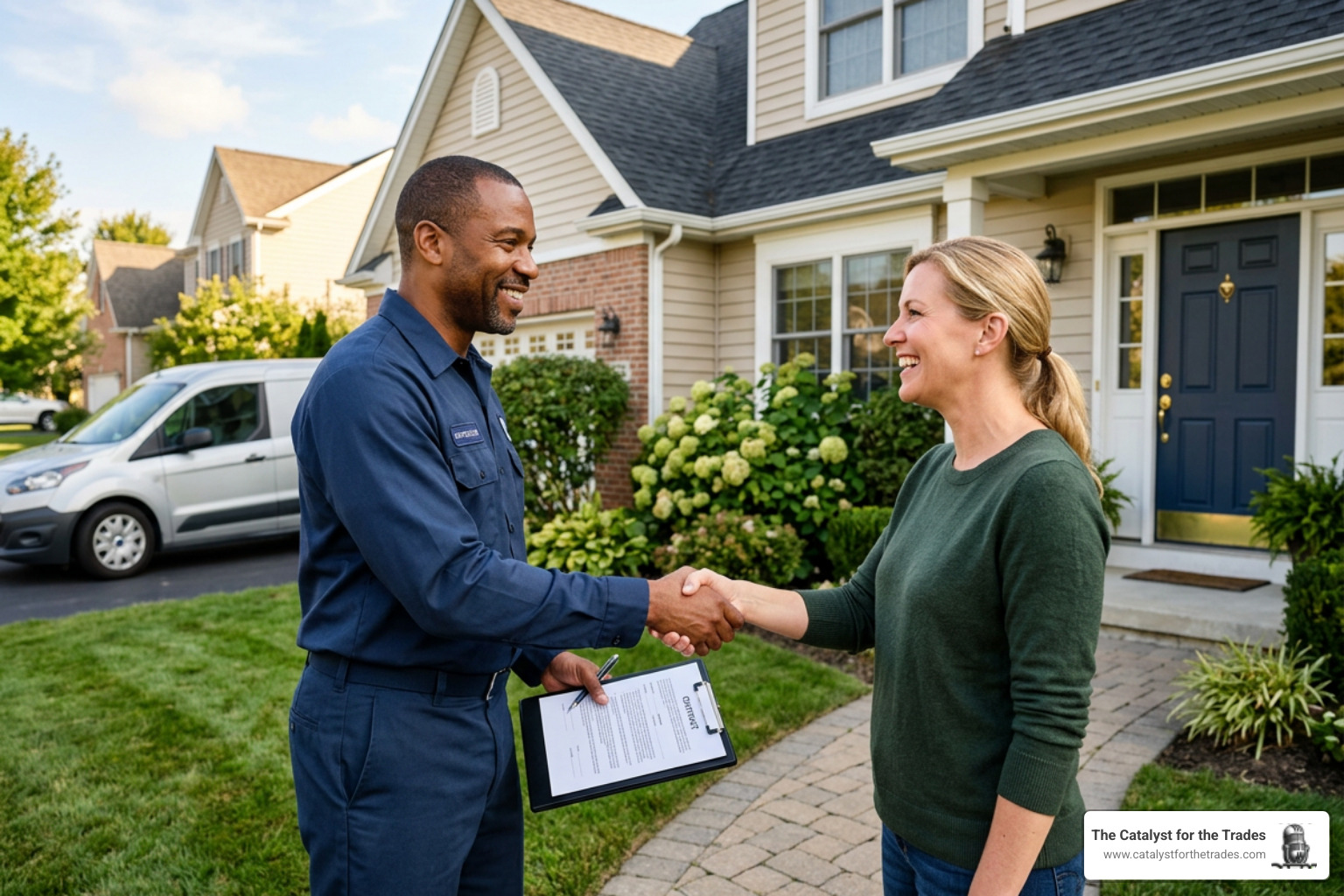
Follow-up strategies for contractors are the single biggest lever most home service businesses aren’t pulling. Here’s the short answer if you need it fast:
Quick-start follow-up framework:
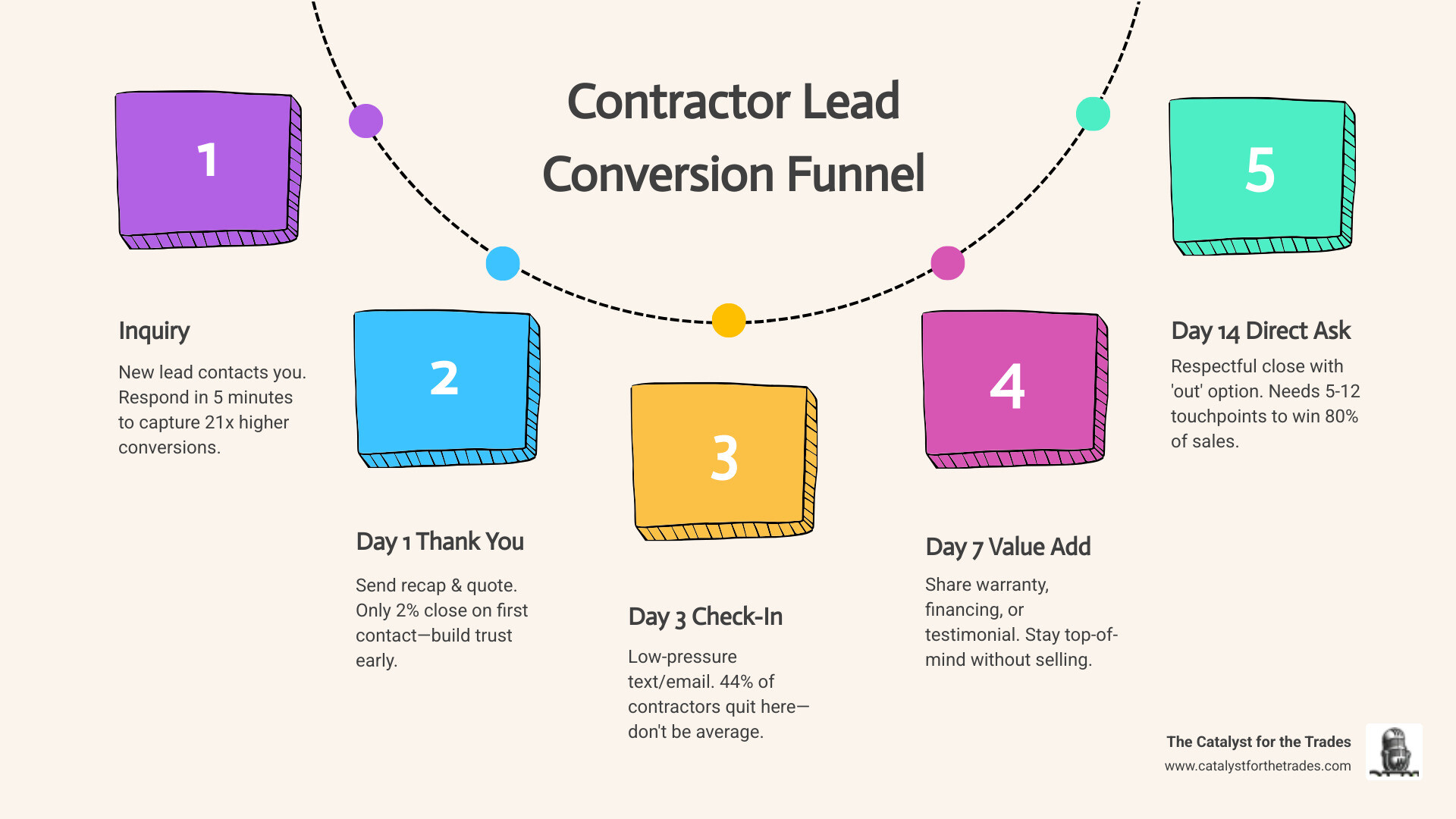
- Respond within 5 minutes of a new inquiry
- Day 1 – Send a thank-you and recap your quote
- Day 3 – Check in with a low-pressure text or email
- Day 7 – Add value (warranty info, financing, testimonial)
- Day 14 – Make a direct ask with a respectful “out”
- Day 30 – Soft re-engagement if still no response
- Repeat across channels – mix calls, texts, and emails
The data is hard to ignore. Only 2% of sales close on the first contact. That means 98% of your potential revenue depends entirely on what happens after you send the quote. Yet nearly half of all sales professionals never follow up at all, and 44% quit after just one attempt.
Most contractors don’t lose jobs because of their work quality or pricing. They lose them because a competitor simply stayed in touch longer.
It takes anywhere from 5 to 12 touchpoints to close a typical contractor quote. The average contractor makes one or two attempts, then moves on. That gap – between what it takes and what most contractors actually do – is where thousands of dollars in revenue quietly disappear every month.
The good news? This is one of the most controllable factor in your entire sales process. You don’t need a bigger marketing budget. You need a smarter, more consistent follow-up system.
Why Follow-Up Strategies for Contractors are the Key to Closing Deals
When we talk about follow-up strategies for contractors, we aren’t just talking about being persistent; we’re talking about building a foundation of trust. In the home services industry, homeowners aren’t just buying a new HVAC system or a kitchen remodel—they are buying peace of mind. They are inviting a stranger into their home to perform high-stakes work.
The initial meeting or quote is just the introduction. Research shows that 80% of successful sales require at least five follow-up contacts before the deal is officially inked. If you stop after the first or second attempt, you are essentially handing your leads over to the competition.
Building Trust Through Professionalism
Consistency is the most visible form of professionalism. When we follow up reliably, we demonstrate to the homeowner that we are organized, attentive, and dependable. If a contractor can’t be bothered to send a follow-up email, how can a homeowner trust them to show up on time for a three-week renovation?
Effective lead-conversion-optimization is about staying top-of-mind during the homeowner’s decision journey. This journey typically moves through several stages:
- Awareness: They realize they have a problem (the AC is making a weird noise).
- Consideration: They research solutions and call for quotes.
- Decision: They compare contractors and look for the best value (not always the lowest price).
- Conversion: They sign the contract.
Most contractors fall off during the “Decision” phase. By maintaining a structured sales-process-optimization-complete-guide, we ensure that when the homeowner is finally ready to pull the trigger, our name is at the top of their inbox or call log.
The 98% Opportunity
If only 2% of sales happen on the first contact, then 98% of your business is waiting in the follow-up. Think about the marketing dollars spent to generate a single lead. When we fail to follow up, we are essentially throwing that money away. In a competitive market where 63% of homeowners get three or more quotes, the contractor who stays engaged is the one who wins. It’s a simple competitive advantage that requires zero extra marketing spend—just a commitment to the process.
The Ideal Timing and Cadence for Contractor Outreach
Timing isn’t just a detail; it’s the difference between a booked job and a “ghosted” lead. The “Speed to Lead” rule is the most critical metric in modern sales. Research indicates that you are nine times more likely to convert a sale if you follow up with a lead within five minutes of their initial inquiry.
The 5-Minute Response Rule
When a homeowner submits a request on your website, they are at their peak level of interest. They are likely sitting at their computer or on their phone, actively looking for a solution. If you wait an hour, they’ve already moved on to the next contractor on Google. If you wait until the next day, they might not even remember which form they filled out.
Responding within minutes—even if it’s just a quick text saying, “We received your request and are looking at it now”—sets you apart as the most responsive pro in the market. 35% to 50% of sales go to the first responder. In the trades, being first is often more important than being the cheapest.
The Standard Follow-Up Sequence
Once the quote is sent, the real work begins. We recommend a cadence that balances persistence with professionalism. You want to stay on their radar without becoming a nuisance.
- Initial Acknowledgement (Day 0): Immediately after the visit or inquiry, send a “Thanks for having us out” message.
- The Quote Follow-Up (Day 1-2): Follow up within 24 to 48 hours of sending the estimate. This is the window where the project is still fresh in their mind. Ask if they have any questions about the scope of work.
- The Gentle Nudge (Day 4-5): If you haven’t heard back, send a low-pressure check-in. “Just making sure you received everything okay!”
- The Value Add (Day 7-10): Instead of just “checking in,” provide something useful. Share a testimonial from a similar project or a helpful guide on maintenance. This shifts the conversation from “Are you going to pay me?” to “I am here to help.”
- The Direct Ask (Day 14): By two weeks, it’s time to be direct. Ask if they are still interested in moving forward or if the project has been put on hold.
This structured approach prevents us from stop-chasing-new-leads-start-closing-the-ones-you-already-have and allows us to focus on the leads that are actually moving toward a “yes.”
Implementing a Multi-Channel Follow-Up Strategy for Contractors
Using only one communication channel is a mistake. Some people live in their email inboxes, while others never check them but will reply to a text within seconds.
Research shows that using both email and text messages makes your strategy 2.4 times more effective than using just one. Here’s how to mix them:
- Email: Best for sending quotes, detailed project scopes, and “Value Add” content like articles or testimonials. 83% of customers prefer email for business communication.
- Text (SMS): Perfect for quick confirmations, “I’m on my way” messages, or “Did you get my email?” nudges. Texts have a nearly 100% open rate.
- Phone Calls: Still the gold standard for closing. If a lead hasn’t responded to a text or email, a friendly phone call can often clear up any lingering hesitations.
In our experience, as discussed in relentless-growth-sam-wakefields-sales-transformation-follow-up-tactics-for-the-trades, the key is to ask the homeowner their preferred method of contact early on. If they say “text me,” then text them. If they prefer calls, pick up the phone.
Leveraging Automation and CRM in Follow-Up Strategies for Contractors
If you are trying to manage 50 leads in your head or on a legal pad, things will fall through the cracks. This is where Customer Relationship Management (CRM) tools and automation become your best friends.
Automation doesn’t mean being “robotic.” It means setting up systems that ensure you never forget to send that Day 3 check-in.
- Smart Triggers: When a quote is marked as “Sent” in your CRM, it should automatically schedule reminders for your sales team to follow up.
- AI Insights: Modern tools can track when a homeowner opens your estimate email. That is the perfect time to give them a call—while they are literally looking at your price.
- Database Mining: Don’t forget your existing customers. We can use sales-training-contractors to teach teams how to re-engage past clients for seasonal maintenance or new projects.
- Lead Segmentation: Not all leads are created equal. A “hot” lead who needs an emergency furnace replacement needs a different follow-up speed than a “cold” lead looking for a kitchen remodel six months from now.
By utilizing sales-team-development-complete-guide, we can build a culture where every lead is tracked and nurtured until they either buy or tell us to stop.
How to Follow Up Without Sounding Pushy or Salesy
The biggest fear contractors have is “annoying” the customer. We’ve all been on the receiving end of a pushy salesperson, and we don’t want to be that guy. However, there is a massive difference between being persistent and being pushy.
Pushy is about your needs (closing the sale). Value-added is about their needs (solving their problem).
The “Value-Added” Language Shift
The words we choose matter. Instead of asking “Are you ready to sign yet?”, try positioning yourself as a resource.
| Pushy Language | Value-Added Language |
|---|---|
| “Just calling to see if you made a decision.” | “I wanted to follow up and see if any new questions came up after you reviewed the quote.” |
| “I haven’t heard back from you, are we doing this job?” | “I’m updating our schedule for next month and wanted to see if you wanted to reserve a spot for your project.” |
| “Our price is only good for another 24 hours.” | “I noticed you were interested in [feature], I thought you might find this case study helpful.” |
| “Why haven’t you replied to my emails?” | “I understand this is a big decision. Is there anything specific holding you back that I can clarify?” |
The “Permission to Say No” Technique
One of the most effective follow-up strategies for contractors is actually giving the client permission to say no. When a lead ghosts you, they often do it because they feel guilty or awkward about saying they aren’t ready.
Try sending a message like this: “Hi [Name], I haven’t heard back on the quote for the [Project]. Usually, when this happens, it means the timing isn’t right or you’ve gone in a different direction. Is it okay if I close this file for now?”
Counter-intuitively, this often prompts a response like, “Oh no, I’ve just been busy! I still want to do it, can we talk Thursday?” It removes the pressure and re-opens the lines of communication.
Active Listening and Empathy
Great sales is 80% listening and 20% talking. In our sales-team-development sessions, we emphasize uncovering the “why” behind the hesitation. Is it the price? The timeline? Are they waiting to talk to a spouse? By using empathy, we can address these concerns directly rather than just repeating our sales pitch.
Common Mistakes and Metrics to Track
Even the best follow-up strategies for contractors will fail if they aren’t executed consistently. Here are the pitfalls we see most often:
- Quitting Too Early: 44% of salespeople quit after one follow-up. If you make it to attempt number five, you’ve already outlasted nearly all of your competitors.
- Generic Messaging: “Checking in” is the most boring phrase in sales. Always include a specific detail about their project or a previous conversation to show you were paying attention.
- No Tracking: If you don’t measure it, you can’t improve it. You need to know your numbers.
Key Metrics for Success
To scale your business, you need to track the following:
- Response Time: How many minutes does it take your team to respond to a new lead?
- Touches Per Close: On average, how many times do you have to contact a lead before they sign?
- Lead Drop-off Points: Where in your sequence do people stop responding? Is it after the first quote or the third follow-up?
- ROI per Channel: Are leads from Facebook converting better than leads from your website?
Contractors who make 12 contact attempts perform roughly 20% better than those who stop at eight. It’s a game of inches, and those extra attempts are where the profit is made.
Frequently Asked Questions about Contractor Follow-Ups
How many follow-ups are typically needed to convert a lead?
Statistically, 80% of sales happen between the 5th and 12th contact. While it might feel like a lot, remember the “Rule of 7″—most people need to hear your message seven times before they truly trust it. Persistence is a sign of a healthy business, not a desperate one.
What is the best timing for the first follow-up after a quote?
The sweet spot is 24 to 48 hours. This shows you are organized and eager for the work without looking like you’re hovering over their shoulder. If you wait longer than 48 hours, you risk the homeowner feeling like they aren’t a priority for you.
When should a contractor stop following up on a lead?
We generally recommend a “4-touch rule” over 14 days for high-intensity follow-up, followed by a transition into a long-term nurture phase. If they haven’t responded after 30 days and multiple attempts across different channels, it’s okay to send a “Permission to close” email and move them to a monthly newsletter list. Never truly “delete” a lead unless they ask; sometimes “no” just means “not right now.”
Conclusion
At The Catalyst for the Trades, we believe that the difference between a struggling contractor and a seven-figure business often comes down to the systems they have in place. Following up isn’t just a sales tactic; it’s a customer service philosophy. It’s about showing the homeowner that you care about their project from the first click to the final handshake.
By implementing these follow-up strategies for contractors, you aren’t just closing more deals—you are building long-term client relationships that lead to referrals and repeat business. You’re moving from “chasing work” to “managing a pipeline.”
Ready to stop letting revenue slip through the cracks and start scaling your operations? Learn more about our growth strategies and how we help trades businesses innovate and lead in their local markets. The fortune is waiting—you just have to follow up.


