
Ultimate Guide to Technician Communication Skills
Discover how the communication style of your technicians affects customer retention and learn proven strategies to boost loyalty and reduce churn.
Read more
Published
July 15, 2026
.png)

Retention metrics measure how well you keep both customers and employees engaged with your business over time. If you're running an HVAC, plumbing, or home service company, these numbers tell you whether people are sticking around or walking out the door—and why.
Quick Answer: The Most Important Retention Metrics
Here's the reality: acquiring a new customer costs significantly more than keeping an existing one. That gap is often the difference between struggling and thriving. Current customers also tend to spend more than new ones, and a large share of your revenue usually comes from people who've already hired you before.
The same logic applies to your team. When a good technician or CSR walks out, you're not just losing a person—you are losing their knowledge, their relationships with customers, and the time it takes to get someone new up to speed.
For home service businesses trying to scale, retention metrics aren't just numbers on a dashboard. They're early warning signals. A dropping customer retention rate means something is broken in your service delivery. Rising employee turnover means your culture, leadership, or compensation structure needs attention. Both problems drain profit and make growth much harder.
Once you know which metrics to track and how to calculate them, you can spot problems early and fix them before they cost you serious money. You can identify your most valuable customers and employees, then focus your energy on keeping them engaged. You can stop pouring resources into acquisition while watching revenue leak out the back door.
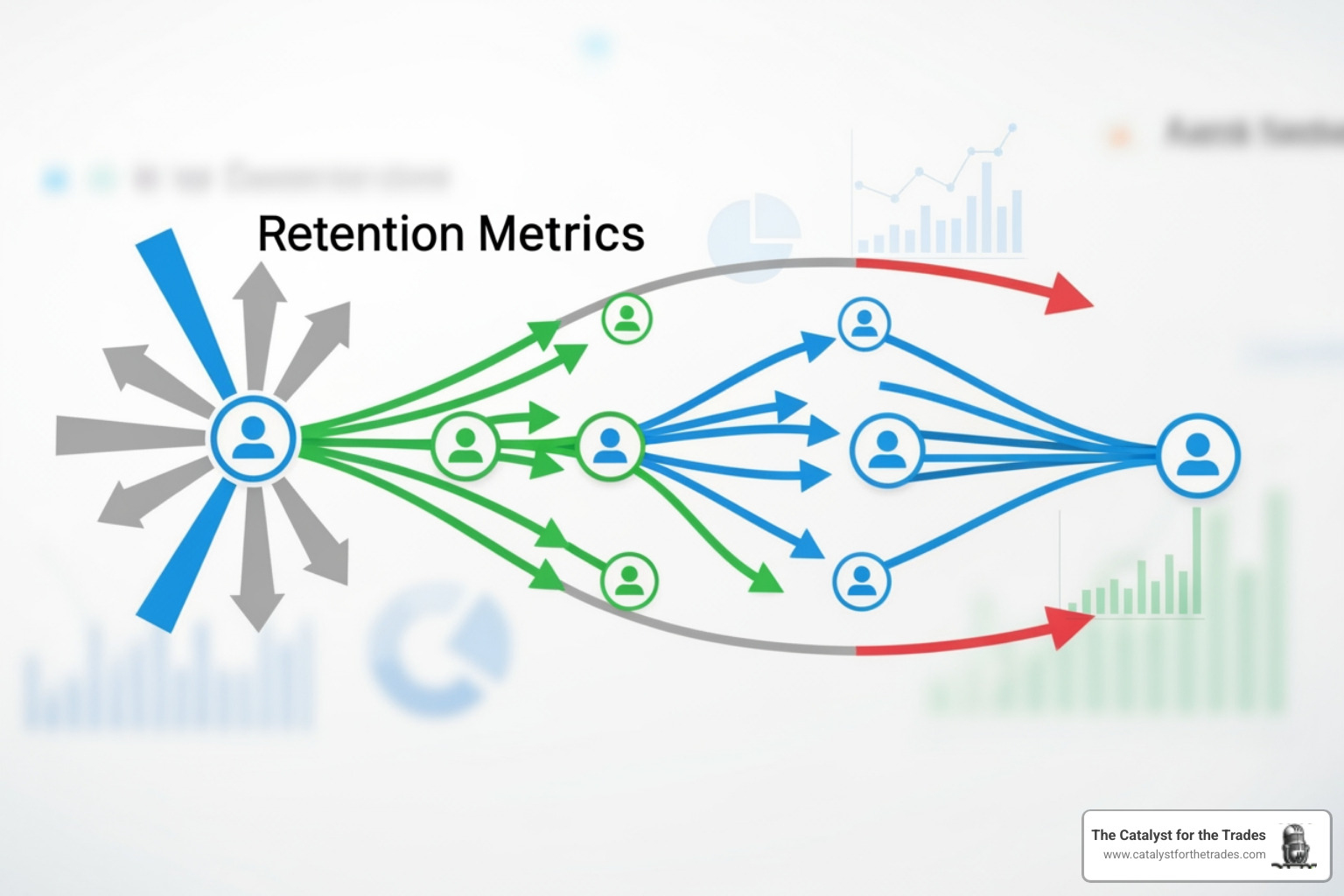
Key retention metrics concepts you will see throughout this guide:
For any home service business, success isn't just about acquiring new customers or hiring new team members; it's about keeping them. Customer retention and employee retention are two interconnected pillars supporting your business.
The connection is simple: happy employees lead to happy customers. When technicians and office staff feel valued and engaged, they provide better service. This creates positive customer experiences, boosting loyalty and repeat business. Conversely, high employee turnover disrupts service quality, strains existing staff, and frustrates customers who value consistency.
Neglecting either pillar creates a leaky bucket scenario where resources continuously drain away. A stable, knowledgeable workforce saves money, builds institutional knowledge, and fosters a positive environment. Focusing on both customer and employee retention builds the strong, lasting relationships that are essential for sustainable Business Growth Strategies.
Understanding how to keep customers coming back is fundamental for sustainable growth. This starts with tracking the right customer retention metrics.
A retention metric measures how many customers remain active over a given period. To define a meaningful metric, use this framework:
For example, an HVAC company might track Yearly Active Maintenance Subscribers, where the core action is booking an annual check-up. A business can and often should track multiple retention metrics if it serves different customer needs.
When defining these metrics, avoid common mistakes:
Here are the most crucial retention metrics for a home service business:
These metrics provide a comprehensive view of your customer relationships and the effectiveness of your Customer Service Strategy.
Here are the formulas and examples for your home service business:
Customer Retention Rate (CRR)
Customer Churn Rate
Customer Lifetime Value (CLTV)
Net Promoter Score (NPS)
A robust CRM system is invaluable for tracking these metrics. Learn How to Get Your CRM Right and Why It Matters More Than You Think.
While related, customer retention and loyalty are different.
Customer retention is behavioral—it tracks whether customers continue to buy from you. It's about repeat business.
Customer loyalty is attitudinal—it reflects a customer's willingness to advocate for your brand, forgive mistakes, and choose you over competitors. Loyal customers generate positive word of mouth and referrals.
Loyalty metrics like NPS help you understand the reasons customers stay. High loyalty is a strong predictor of future retention. If loyalty is low, your current retention may be at risk. To build both, you must Wow Every Call: The Key to Customer Experience Excellence.
Just as with customers, employee retention is vital for a stable and successful home service business. Your employees are the face of your company, and their satisfaction directly impacts service quality and your reputation.
High turnover is costly, not just in recruitment and training expenses, but also in lost productivity, disrupted customer relationships, and lower team morale. A consistent, experienced team builds trust with customers and increases their satisfaction. High employee retention also strengthens your employer brand, creating a virtuous cycle that attracts top talent.
What's a good employee retention rate? For most industries, over 90% is considered a strong benchmark, signaling a healthy and effective work environment.
To improve employee retention, you need to track these key employee retention metrics:
Employee Retention Rate
Voluntary vs. Involuntary Turnover
Employee Net Promoter Score (eNPS)
Average Employee Tenure
Tracking these metrics helps you understand not just if employees are leaving, but why, which is key for a strong team of CSRs. Find how Your CSRs Are Sitting on Untapped Revenue. Here's How to Fix It.
Use insights from your metrics to implement these retention strategies:
Measuring retention metrics is the first step; the real value comes from turning data into action. A robust Customer Relationship Management (CRM) system is an essential tool for this, as it centralizes customer data for easier analysis.
Here's how to leverage data to improve retention:
By continuously analyzing these data points, you can make informed decisions to optimize your strategies and Stop Chasing New Leads, Start Closing the Ones You Already Have.
A "good" rate varies, but for home services, an annual customer retention rate above 75-80% is a strong benchmark. This shows that most customers are choosing you again for their needs. It's crucial to establish your own benchmark based on historical data and aim for continuous improvement.
When tracking retention metrics, avoid these common pitfalls:
In the dynamic world of home services, where customer needs and team dynamics are constantly evolving, understanding and actively managing retention metrics is no longer optional—it's essential. We've explored how these powerful indicators serve as the bedrock for a stable workforce and a thriving customer base, driving profitability and sustainable growth.
From the critical importance of keeping both our customers and our employees happy to the specific formulas for calculating key metrics like Customer Retention Rate, Churn, CLTV, and eNPS, we've laid out a roadmap for data-driven decision-making. We've also highlighted the nuanced difference between customer retention and loyalty, emphasizing that true success comes from nurturing both repeat business and passionate advocacy.
The journey from data to action involves leveraging tools like our CRM, employing sophisticated analysis techniques such as cohort analysis, and continuously optimizing critical touchpoints like customer onboarding. By avoiding common mistakes and committing to a cycle of measurement, analysis, and strategic adjustment, we can transform our understanding of retention into tangible improvements across our business.
Strong retention is a core driver of Home Service Business Growth. It reduces acquisition costs, boosts revenue from existing clients, and cultivates a stable, engaged team that delivers exceptional service every time.
For more insights into scaling your home service business with cutting-edge strategies and real-world industry experience, we invite you to explore More info about our resources, including The Catalyst for the Trades podcast. Let's empower our business with data and build a future where every customer stays, and every employee thrives.

Discover how leading home‑service companies are leveraging AI, subscription models, and digital‑first strategies.

Learn why private equity, automation, and customer‑centric tech are reshaping the trades.



Discover how the communication style of your technicians affects customer retention and learn proven strategies to boost loyalty and reduce churn.

Learn how to build accountability in a trades business team with proven systems that cut turnover and boost profits.

Learn how to build systems in a trades business that do not depend on the owner with proven steps for scalable, owner-independent operations.
.webp)