Learn · July 8, 2026
How to Build a 90 Day Growth Plan for a Home Service Business: 2026 Guide
Learn how to build a 90 day growth plan for a home service business with this practical 90-day sprint guide for contractors.
By The Catalyst Editorial Team Operator education · 15 min read · Updated July 24, 2026

Why Most Contractor Growth Plans Fail Before They Start
How to build a 90 day growth plan for a home service business is one of the most practical things you can do if your phone isn’t ringing the way it should — and most owners who’ve tried annual planning already know why that approach breaks down.
Here’s the short answer:
- Choose your 2-3 highest-margin services (your “money services”) and define your target service area
- Days 1-30 — Build the foundation: Optimize your Google Business Profile, launch a review system, fix your website’s conversion basics, and set up lead tracking
- Days 31-60 — Build proof and generate leads: Publish service and city pages, clean up local directory listings, launch Google Ads (only after tracking is in place), and add a follow-up system
- Days 61-90 — Scale what works: Expand into top cities, add video content, activate email reactivation for past customers, and build local partnerships
- Review weekly against a simple scorecard — leads by source, calls answered, close rate, and reviews collected
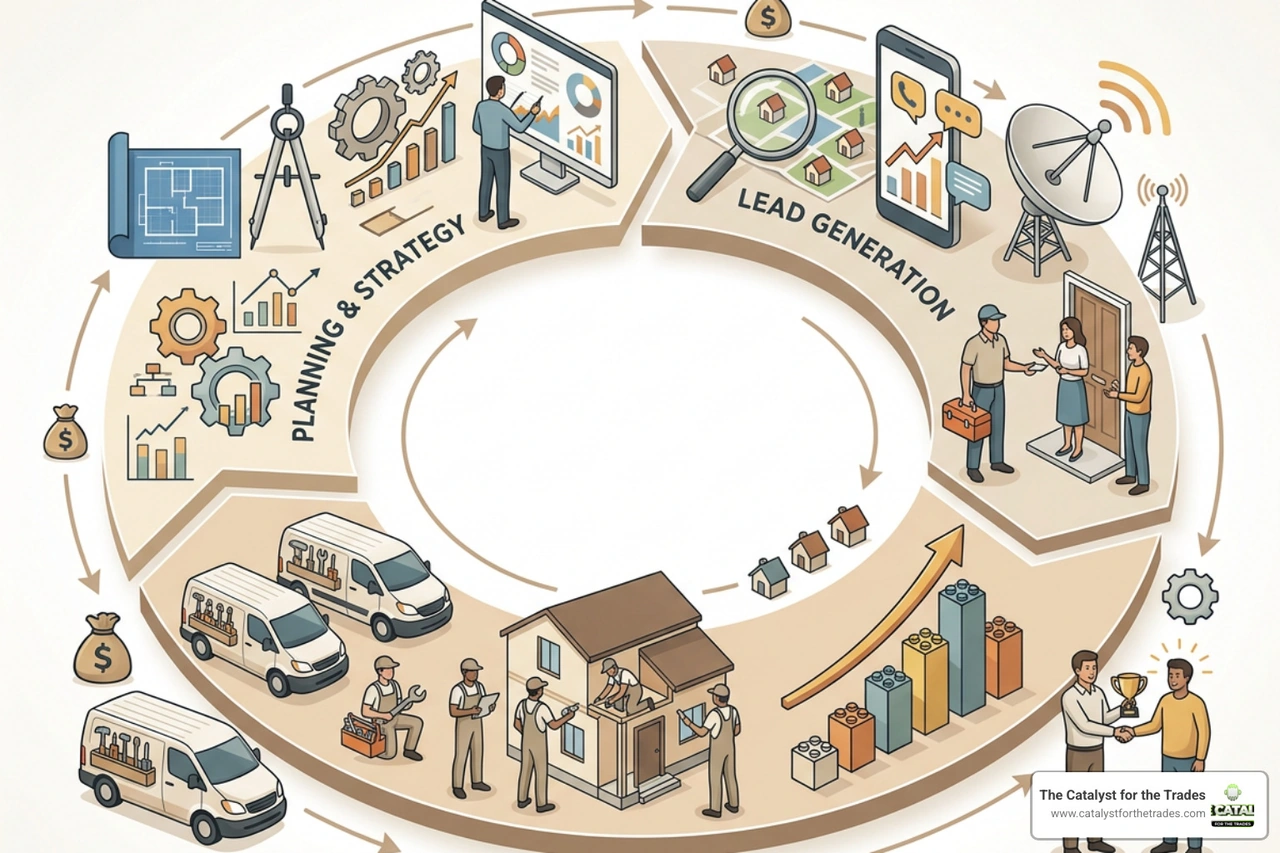
That’s the framework. The sections below walk you through each phase in detail, including how to set measurable goals, avoid the most common mistakes, and connect your 90-day sprint to a longer-term growth roadmap.
Every January, business owners sit down and write annual goals. By March, most of those goals are collecting dust. The reason isn’t a lack of ambition — it’s that a 12-month horizon is simply too far away to drive daily behavior. Life happens, jobs pile up, and the urgent always seems to push aside the important.
Quarterly planning solves that. Ninety days is short enough to create real urgency, long enough to produce results you can actually measure, and structured enough to connect big ambitions to weekly action. Research consistently shows that the habits, systems, and revenue trajectory a business sets in its first focused sprint tend to define performance well beyond that period.
For home service businesses specifically — where you’re on job sites during the day and estimating at night — a lean, sequenced 90-day plan isn’t just helpful. It’s the difference between growing on purpose and growing by accident.
Why 90-Day Sprints Beat Annual Planning for Contractors
When we talk to plumbers, HVAC technicians, and electricians, we often hear the same story: “I wrote down my goals in January, but by March, a major storm hit, two techs left, and we were so busy putting out fires that we threw the plan out the window.”
This is the reality of running a trade business. Annual plans are too rigid for the fast-moving home services industry. A 12-month timeline creates a psychological cushion that encourages procrastination. When you have 365 days to hit a target, it is easy to say, “We’ll focus on lead generation next month.” Before you know it, the shoulder season arrives, and your schedule is completely empty.
By breaking your calendar into 90-day increments, you align your business with natural quarterly cycles. This timeframe matches seasonal demand shifts, allowing you to run targeted campaigns for air conditioning tune-ups in the spring and furnace installations in the autumn.
Most importantly, 90 days is the perfect sweet spot for execution. It is short enough that every single week matters, yet long enough to build momentum, execute technical website fixes, and see a measurable impact on your bottom line. Transitioning to this model is a core part of a modern strategic planning process that keeps your team agile and focused.
Why You Need to Learn How to Build a 90 Day Growth Plan for a Home Service Business
If your business is currently operating on “gut feel” and word-of-mouth referrals, you are leaving your growth to chance. Statistically, roughly 72% of contractors operate without any defined marketing system. They rely on the phone ringing by luck, which makes scaling impossible.
When you learn how to build a 90 day growth plan for a home service business, you stop guessing and start building a predictable lead-generation machine.
This approach works because it forces you to implement targeted business growth strategies in a logical order. You cannot build a beautiful house on a cracked foundation. Similarly, you shouldn’t spend money on paid advertising if your website loads slowly, lacks a click-to-call button, or has no recent reviews. A 90-day sprint enforces an “order of operations” that ensures every dollar you invest actually converts into booked jobs.
How to Build a 90 Day Growth Plan for a Home Service Business: The Step-by-Step Roadmap
To build a roadmap that actually works, we have to look at your business through three lenses: Visibility (showing up where customers search), Trust (proving you are the best choice), and Conversion (turning clicks into booked calls).
Pre-Planning: Identifying Money Services and Service Areas
Before you write down a single goal, you must choose your “money services” and define your true service area.
Many contractors make the mistake of trying to promote every service they offer. If you are an electrician, you might handle everything from changing a lightbulb to commercial rewiring. But trying to market all of them at once dilutes your budget and confuses your audience. Instead, pick your top 2 to 3 most profitable, high-demand services. For example:
- HVAC: AC replacements, ductless mini-split installations, or heat pump upgrades.
- Plumbing: Water heater replacements, sewer line repairs, or water filtration installations.
- Electrical: Panel upgrades, EV charger installations, or whole-home generator setups.
Once you have identified these high-margin services, map out your target service area. Do not try to cover a massive 50-mile radius if you don’t have the trucks to support it. Focus on the top 3 to 5 high-value suburbs or neighborhoods where your ideal customers live. This step is critical for local search visibility and is detailed further in our business development complete guide.
Step-by-Step: How to Build a 90 Day Growth Plan for a Home Service Business
Once your pre-planning is complete, you are ready to execute the three-phase roadmap.
Phase 1: Days 1–30 — Build the Foundation
The first month is all about fixing the leaks in your digital bucket. We want to ensure that when a homeowner finds you, they can easily call you, and they immediately trust what they see.
- Step 1: Optimize Your Google Business Profile (GBP). Since Google Maps is where the highest-intent local leads come from, this is your top priority. Ensure your business name, address, and phone number (NAP) are 100% accurate. Fill out every single service attribute, write a clear business description highlighting your money services, and upload at least 3 to 5 high-quality job photos every week. GBP optimization alone drives 15% to 25% more phone calls from local searches in most markets.
- Step 2: Launch a Review Velocity Program. Roughly 96% of consumers read online reviews before choosing a local business. Do not just “ask sometimes.” Implement a system where your technicians send a text message with a direct Google review link immediately after finishing a job. Aim for a consistent flow of 2 to 5 new reviews per week.
- Step 3: Fix Website Conversion Basics. Ensure your website loads in under 3 seconds on mobile devices. Place a large, clickable phone number and a simple booking form “above the fold” (visible without scrolling) on every page.
- Step 4: Set Up Lead Tracking. Install Google Analytics, set up Google Search Console, and use call-tracking software. By Day 30, you should be able to answer, “Where did this lead come from?” in under 10 seconds.
Phase 2: Days 31–60 — Build Proof and Launch Lead Flow
Now that your foundation is solid, it is time to start driving high-intent traffic to your business and demonstrating your expertise. This phase is where you begin to see tangible home service business growth.
- Step 5: Create “Proof Content.” Start documenting your work. Take clear before-and-after photos of your projects. Write simple “job stories” explaining what problem the customer had, how your team solved it, and the final result.
- Step 6: Build Service and City Pages. Write dedicated, 1,500-word service pages for your money services. Then, build 3 to 5 dedicated “suburb pages” targeting your key service cities (e.g., “AC Repair in Denver”). Do not use duplicate templates; write real, local content for each page.
- Step 7: Launch Targeted Google Ads. Now that your landing pages are fast and your tracking is active, launch your first paid campaigns. Focus on high-intent search terms (e.g., “emergency plumber near me” or “furnace replacement installer”). Never send ad traffic to your homepage; always send it to a page that perfectly matches the ad’s offer.
- Step 8: Implement Lead Follow-Up Automation. The first contractor to respond to a lead wins the job 78% of the time. Set up automated text and email replies that trigger within 60 seconds of a form submission.
Phase 3: Days 61–90 — Scale What Works and Lock in Authority
In the final month, we focus on expanding your reach, staying top-of-mind with past customers, and building long-term local authority.
- Step 9: Expand Locally. Build out an FAQ library on your website to capture voice searches and long-tail keywords.
- Step 10: Run a Customer Reactivation Campaign. Your past customers are a goldmine. Send a simple, personalized email or text campaign offering a seasonal maintenance check-up or an exclusive loyalty discount.
- Step 11: Add Simple Video Content. Record 4 short, 30-to-60-second videos answering common customer questions (e.g., “How often should I change my air filters?” or “What are the signs of a water heater failure?”). Post these to your website, social media, and Google Business Profile.
- Step 12: Build Local Partnerships and Backlinks. Reach out to local home builders, real estate agents, or property managers to establish referral partnerships. Submit your business to high-authority local directories to build digital trust.
By executing this roadmap consistently across all three phases, a contractor can expect an organic traffic increase of +150% to +300% from their starting baseline, alongside a +20% to +40% increase in Google Business Profile calls from the GBP optimization alone.
Competitive Intelligence and Keyword Gap Analysis
To make your 90-day plan highly effective, you must understand what your local competitors are doing. This is where keyword gap analysis and competitive intelligence come into play.
You do not need to guess what keywords to target. By analyzing the websites of the top three contractors in your area, you can identify the exact search terms they rank for that you are missing. Look for high-intent, localized keywords like “plumbing company near me” or “Denver AC repair.”
Once you identify these gaps, you can prioritize them in your Phase 2 content build. This strategic targeting is a key element of the scaling methods we discuss in how to climb to 10m the event strategy that actually grows your trades business.
Setting Measurable Goals and Success Criteria for Each Phase
A plan without clear, measurable targets is just a wish list. To keep your team accountable, you must define what “done” looks like for every single phase of your 90-day sprint.
Defining Success Criteria and KPIs
Instead of setting vague goals like “get more leads,” use the SMART framework (Specific, Measurable, Achievable, Relevant, and Time-bound). Set clear success criteria for each 30-day block, utilizing robust kpi tracking for home services to monitor progress.
Here is an example of how to structure your KPIs:
Phase 1 (Days 1–30) Success Criteria:
- Google Business Profile fully optimized (100% complete)
- Call tracking installed and working
- 10 new Google reviews collected
- Website mobile load speed under 3 seconds
Phase 2 (Days 31–60) Success Criteria:
- 3 new city-specific landing pages published
- Google Ads campaign launched with a conversion rate of at least 15%
- Automated lead follow-up sequence active and responding under 60 seconds
- 15 new Google reviews collected
Phase 3 (Days 61–90) Success Criteria:
- 1 customer reactivation campaign completed, generating at least 10 booked jobs
- 4 short educational videos published
- Organic website traffic increased by 20%
- Cost per lead (CPL) tracked and stabilized across all channels
Validating and Adjusting the Plan with Stakeholders
If you have partners, a leadership team, or key office staff, you must validate the plan with them before launching. Sit down with your team and walk them through the 90-day roadmap. Ask for their feedback:
- Do we have the capacity to handle the extra call volume in Phase 2?
- Are the technicians trained to ask for reviews using the new text system?
- Are our service descriptions accurate?
Once everyone is aligned, schedule a weekly 15-minute check-in to review your scorecard. If a particular strategy isn’t working—or if you encounter unexpected operational bottlenecks—adjust the plan. A 90-day sprint is designed to be flexible, allowing you to pivot quickly without throwing off your entire year.
Integrating 90-Day Sprints with Long-Term Goals
While 90-day plans focus on immediate, tactical execution, they must still align with your long-term vision.
Think of your 90-day sprint as a single step on a larger journey. Your quarterly plans should directly support your annual revenue targets, which in turn feed into your 5-year business roadmap for contractors.
By connecting your daily actions to quarterly sprints and annual goals, you build a sustainable, highly valuable asset. This structured approach is essential if your ultimate goal is to learn how to build a sellable trades business insights from a 3 7 billion advisor.
Balancing Quick Wins with Long-Term Operational Systems
A challenge for contractors is balancing the need for immediate cash flow with the long-term work of building a stable business. To scale successfully, you must deliver quick wins while simultaneously building robust backend systems.
30-60-90 Day Plan vs. 90-Day Sprint: Which is Best?
While they sound similar, a 30-60-90 day plan and a 90-day sprint serve very different purposes. Knowing which one to use is crucial for your business’s current stage.
| Feature | 30-60-90 Day Plan | 90-Day Growth Sprint |
|---|---|---|
| Primary Focus | Learning, onboarding, and relationship building. | Rapid execution, lead generation, and scaling. |
| Best Used For | New hires, newly promoted managers, or buying a new business. | Established owners looking to scale revenue and fix marketing. |
| Success Metric | Role integration, process mastery, and cultural fit. | Booked jobs, search rankings, reviews, and revenue growth. |
| Structure | Phase 1: Learn; Phase 2: Contribute; Phase 3: Own. | Phase 1: Foundation; Phase 2: Launch; Phase 3: Scale. |
For most active contractors looking to grow their existing business, a 90-day growth sprint is the superior format because it focuses entirely on market execution and operational momentum.
Balancing Quick Wins with Relationship Building
When launching a growth plan, it is tempting to focus solely on aggressive marketing to get the phone ringing. However, if your internal team culture is weak or your customer service is lacking, those new leads will quickly go to waste.
Use the first 30 days to secure “quick wins” that build trust with your team and your customers. For example, setting up a missed-call text-back system is a fast, inexpensive win. When you miss a call because you are on a roof, the system automatically texts the customer back: “Sorry we missed your call! How can we help you today?” This simple touchpoint saves the lead, wins the customer’s trust, and shows your team that you are investing in tools that make their jobs easier.
As you roll out these quick wins, continue documenting your internal processes to build sustainable operational systems for contractors. This ensures your customer experience remains excellent even as your call volume doubles.
Common Mistakes Contractors Make in a 90-Day Sprint
Even the best-laid plans can fail if they are executed poorly. Over the years, we have seen contractors make the same few mistakes that completely derail their progress.
Common Execution Pitfalls
If you want your 90-day sprint to succeed, avoid these four common traps:
- 1. Overcomplicating the Plan: If your plan requires 30 slides, complex software setups, and hours of daily administrative work, your team won’t execute it. Keep your plan simple enough to fit on a single sheet of paper.
- 2. Ignoring Lead Tracking: Spending money on marketing without tracking where your leads come from is like throwing cash into a furnace. If you don’t know which campaigns are driving booked jobs, you cannot scale. Make tracking your top priority in Phase 1, as outlined in our contractor business strategy ultimate guide.
- 3. Slow Lead Follow-Up: If a homeowner fills out a form on your website and you take four hours to reply, they have already booked with your competitor. You must respond to every web lead within 5 to 15 minutes.
- 4. Trying to Do Everything at Once: Don’t try to launch Google Ads, Facebook Ads, TikTok, SEO, and local events all in the same month. Pick one or two channels, master them, and only add more once the existing channels are profitable and automated.
Essential Tools and Resources for Execution
To execute your plan without burning out, you need the right technology in your corner. We recommend using a simple, integrated stack of tools:
- Call Tracking (e.g., CallRail): To track exactly which marketing channels are making your phone ring.
- Reputation Management Tool: To automate text-based review requests immediately after jobs are completed.
- A Modern CRM (e.g., ServiceTitan, Housecall Pro, or Jobber): To manage your customer database, dispatch techs, send estimates, and track booked revenue.
- A Simple Weekly Scorecard: A basic spreadsheet updated every Friday to track your key metrics: leads by source, calls answered vs. missed, estimate requests, close rate, and reviews received.
Frequently Asked Questions About 90-Day Growth Plans
What is the difference between a 90-day plan and OKRs?
Objectives and Key Results (OKRs) are high-level goal-setting frameworks used to define what a company wants to achieve and how they will measure success. A 90-day growth plan is much closer to the ground. While it includes goals, it is a highly tactical, week-by-week execution roadmap that outlines the exact steps, tools, and campaigns required to hit those numbers in a short timeframe.
How quickly can a contractor expect to see results from a 90-day plan?
Many contractors see measurable improvements within the first 30 days simply by optimizing their Google Business Profile and launching a consistent review system. These foundational fixes cost very little but quickly improve local search visibility. Paid campaigns like Google Ads can drive lead flow within days of launching in Phase 2, while organic SEO and city page rankings typically begin to show significant growth between Day 60 and Day 90.
How do we handle unexpected disruptions during a 90-day sprint?
Disruptions are guaranteed to happen in the trades. If a key technician leaves or a sudden weather event shifts your operational focus, do not abandon the plan. Because the plan is broken into tight, 30-day phases, you can easily pause or adjust your current phase. If you get overwhelmed with emergency calls, you can temporarily pause your Phase 2 paid ads while keeping your foundational Phase 1 tracking and review systems running in the background.
Conclusion
Building a successful trade business isn’t about chasing every new marketing trend; it is about executing a simple, proven system with absolute consistency.
By committing to a structured 90-day growth plan, you take control of your lead generation, build trust in your local community, and create a predictable path to scaling your revenue. You stop reacting to the market and start driving it.
If you are ready to stop guessing and build a business that runs on systems rather than sweat, we are here to help. Dive deeper into our resources, and read our comprehensive contractor business strategy ultimate guide to start building your customized growth roadmap today.


