Learn · July 10, 2026
How to Build Systems in a Trades Business That Do Not Depend on the Owner: 5 Proven Steps
Learn how to build systems in a trades business that do not depend on the owner with proven steps for scalable, owner-independent operations.
By The Catalyst Editorial Team Operator education · 11 min read · Updated July 24, 2026

Why Most Trades Businesses Are Still Built Around One Person — And How to Fix It
How to build systems in a trades business that do not depend on the owner is one of the most important questions any contractor can ask. The short answer: you need to document your core processes, install the right people in the right roles, and create financial visibility — so the business runs on structure, not on you being present for every decision.
Here is a quick overview of what that looks like in practice:
- Document your core workflows — quoting, scheduling, job delivery, invoicing, and follow-up should all exist as written processes anyone can follow.
- Build a management layer — a service manager, office manager, and bookkeeper give the business a spine that does not rely on the owner.
- Create financial visibility — monthly reporting, KPI dashboards, and job costing let you manage by the numbers, not by instinct.
- Test the system before you need it — step away for a defined period and see what breaks. Fix those gaps before they become crises.
- Plan for a realistic timeline — full systemization typically takes 12 to 24 months for most trades businesses, not a single weekend project.
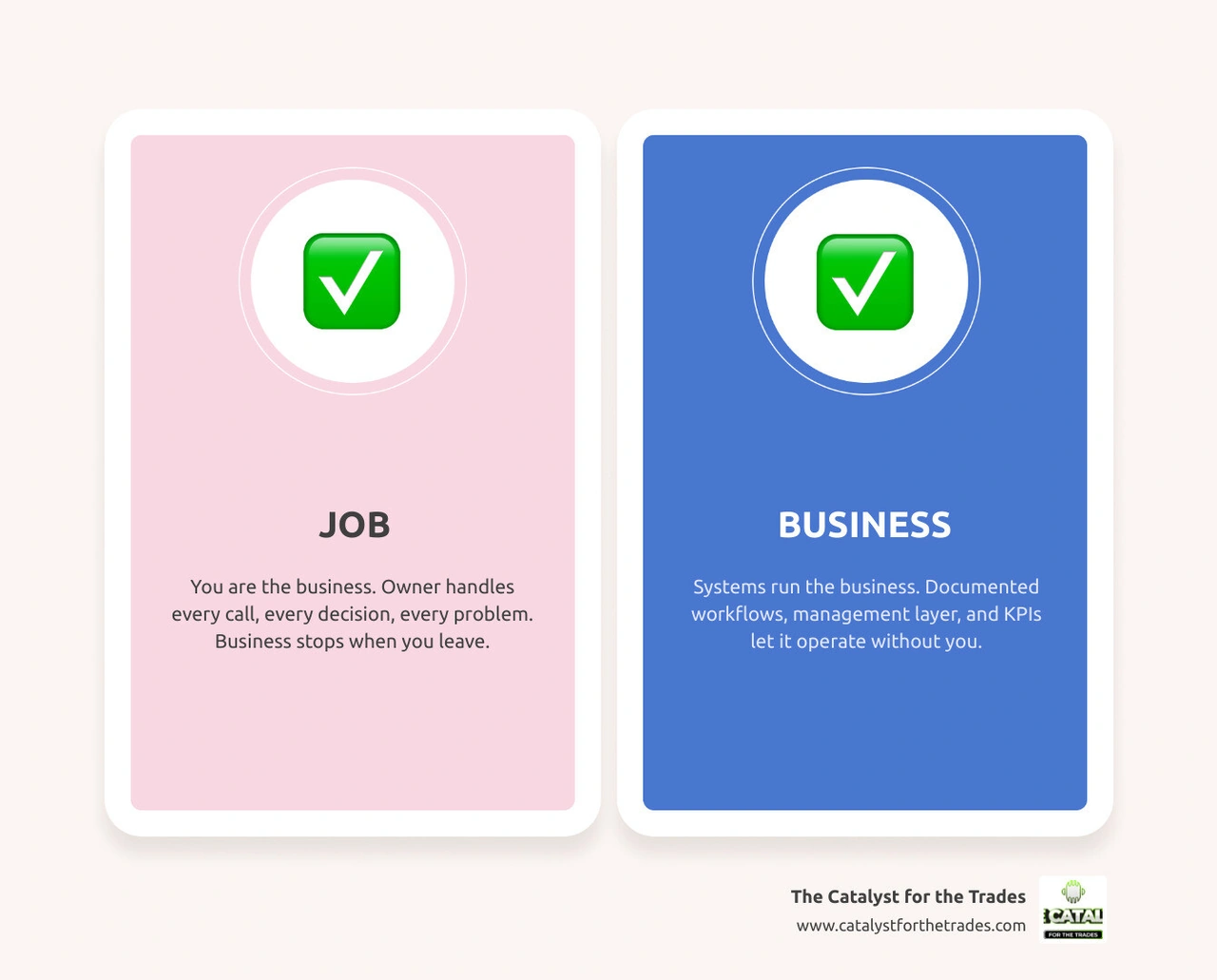
There is a hard truth sitting underneath all of this: if you cannot leave your business for a month without it collapsing, you do not own a business. You own a job. That distinction matters enormously — for your quality of life today, and for the value of what you have built when you are ready to step back or sell.
The trades are full of talented, hardworking owners who have built something real. But too many of them have built it around themselves — their knowledge, their relationships, their phone number. This guide walks you through how to change that, step by step.
The Reality of Owner Dependency in the Trades

Many home service business owners find themselves working longer hours as their business grows. What started as a quest for freedom and control quickly morphs into a 60-to-70-hour workweek where every decision, customer complaint, and scheduling conflict must pass through the owner’s head.
This is the classic “Founder Trap.” It occurs because we build businesses based on personal effort rather than organizational leverage. When you are the system, growth does not bring freedom; it simply brings more noise, more complexity, and more fires to put out. To break free, you must transition from running the day-to-day operations to designing Operational Systems for Contractors that can run without your constant supervision.
The Hidden Costs of the Founder Trap
Remaining owner-dependent carries severe personal and financial penalties. On a personal level, the psychological toll of never being fully off-duty compounds over the years. When vacations feel like guilt trips and weekends are spent catching up on invoices, burnout is inevitable. In the trades, where physical energy and sharp decision-making are critical, working under chronic stress leads to costly mistakes on job sites and strained relationships at home.
Financially, an owner-dependent business is worth significantly less to an outside buyer or successor. If you decide to sell your plumbing or HVAC company, a buyer is not purchasing your hard work—they are purchasing predictability, cash flow, and systems.
Industry data shows that trades businesses heavily dependent on the owner’s daily involvement typically sell for a fraction of the valuation multiples commanded by systemized companies. By failing to document your processes, you are essentially gifting your hard-earned equity to the future buyer, who will have to build those systems themselves. To protect your wealth, you must learn How to Build a Profitable Scalable Trades Business: Lessons from Dana Staszkiewicz by shifting your focus from toolbelt operations to strategic leadership.
Operational Milestones and Revenue Thresholds
Systemization is not an all-or-nothing project; it is a journey tied directly to your revenue and operational maturity. Attempting to build a massive corporate management layer when you are generating under $1 million in revenue is unrealistic because the margins simply cannot support the overhead.
- Under $1.5M: The owner is typically the primary system. You are managing a handful of technicians, handling the quoting, and acting as the main point of contact for clients. At this stage, your focus should be on “quick wins” like automating lead intake and basic scheduling.
- $1.5M to $3M: This is the common operational bottleneck where growth begins to break. You have too many technicians for one person to manage, but you have not yet built a middle management tier.
- $5M and Beyond: This is the true inflection point where a trades business can afford to layer in dedicated management roles. At this scale, with a healthy 50% to 55% gross margin, the business has the financial capacity to support a service manager, a dedicated customer service representative (CSR) team, an install supervisor, and a professional bookkeeper or controller.
To successfully navigate these stages without destroying your margins, you must focus on Building Scalable Service Operations that align your hiring plan with your revenue milestones.
How to Build Systems in a Trades Business That Do Not Depend on the Owner
A true business system is not just a collection of software apps. Many contractors make the mistake of purchasing expensive field service management platforms, thinking the technology itself will solve their operational chaos. But software is merely a tool. If you put a messy, undocumented process into a powerful software program, you simply automate and accelerate your inefficiencies.
A real system is a documented, repeatable process that consistently delivers a predictable result, regardless of who is executing it. W. Edwards Deming famously noted that 94% of problems in business are systems-driven, and only 6% are people-driven. When a technician forgets to upload job photos or a CSR misses a follow-up, it is rarely a character flaw; it is almost always a failure of the system. To build a business that runs on autopilot, you must master SOP Development for Contractors so your standards are clearly defined and easily executed by anyone on your team.
Step-by-Step: How to Build Systems in a Trades Business That Do Not Depend on the Owner
To build an owner-independent trades business, you must systematically design and implement four core operational engines:
- Client Delivery & Quality Control: Document your standards from the moment a technician arrives at a property to the final sign-off. Create clear checklists requiring timestamped, geotagged photos of completed work. This ensures consistent quality and protects your business from unwarranted damage claims.
- Sales & Pipeline Management: Remove the owner as the sole estimator. Build standardized quoting templates covering scope, exclusions, materials, and labor. Implement automated follow-up sequences to nurture outstanding estimates within minutes of submission.
- Operations & Dispatch Coordination: Establish clear rules for scheduling based on technician skill tags, geography, and job priority. The office team should manage the schedule based on documented criteria, not by asking the owner who should go where.
- Financial & Cash Collection: Standardize your billing cycle. Ensure invoices are sent immediately upon job completion, and set up automated payment reminders at fixed intervals (e.g., 7, 14, and 21 days) to keep your cash flow consistent.
Implementing these four engines requires a structured organizational framework. Many home service entrepreneurs find that learning How EOS Helps You Scale Without the Chaos provides the exact accountability and meeting rhythms needed to keep these systems running smoothly.
Fast-Tracking Documentation with AI and Outsourcing
The biggest obstacle to systemization is time. Most contractors simply do not have the hours to sit down and write hundreds of pages of standard operating procedures (SOPs). Fortunately, you do not have to.
Instead of writing documentation from scratch, use your smartphone or a screen-recording tool to record yourself or your top technicians performing a task. Whether it is dispatching a call, processing a refund, or conducting a maintenance check, film the process once. You can then feed that recording or transcript into AI tools to instantly generate a clean, step-by-step written SOP.
Additionally, you can leverage virtual assistants or fractional operations support to handle administrative tasks like data entry, permit filing, and invoice matching. This allows you to scale your operational capacity and reclaim up to 30 hours per week without adding permanent, expensive local headcount. Discovering From Chaos to Clarity: How EOS Transforms Your Business will show you how to combine these modern technology tools with clear human accountability to accelerate your path to freedom.
Transitioning and Testing Your Systems for Succession
Many contractors think of succession or exiting their business as a single, sudden event—like signing a contract and walking away. In reality, a successful, profitable transition is a five-to-ten-year process. Whether you plan to hand the business down to a family member, transition it to key employees, or sell to an outside buyer, you must design the business to survive your departure. This requires proactive Business Transition Planning to ensure your company remains highly profitable and attractive to future leadership.
The 90-Day Roadmap: How to Build Systems in a Trades Business That Do Not Depend on the Owner
You cannot systemize your entire business overnight, but you can make massive progress in a single quarter. Here is a practical, phased 90-day roadmap to get you started:
- Phase 1: The Revenue & Bottleneck Audit (Days 1–30): Map out your daily activities. Identify every task that currently flows through you and categorize them. Pinpoint the single biggest operational bottleneck—usually scheduling or quoting—and focus on automating or documenting that first.
- Phase 2: Process Documentation & Quick Wins (Days 31–60): Record video walk-throughs of your core administrative and field processes. Use AI to convert these into simple checklists. Store all documentation in a single, cloud-based repository accessible to your entire team.
- Phase 3: Delegation & Accountability (Days 61–90): Hand over the documented tasks to your office staff or senior technicians. Train them using the checklists, and establish clear key performance indicators (KPIs) to measure their success.
By breaking the project down into bite-sized phases, you prevent overwhelm and build operational momentum. For a deeper look at managing this transition over the long term, explore our comprehensive guide on Succession Planning.
The Handoff Test and Financial Transfer Mechanics
How do you know if your systems actually work without you? You test them using the “Handoff Test.”
Start by taking a long weekend entirely offline—no phone calls, no emails, no texts. If the business survives, step away for a week. Eventually, build up to a full 30-day absence. Anything that breaks during your absence is not a personnel failure; it is a gap in your systems that needs to be documented and refined.
Furthermore, a truly transferable business requires clean, professional financial reporting. You must transition from cash-basis accounting to accrual-basis accounting, perform regular job costing, and maintain clean balance sheets. When transferring ownership, whether through a gradual equity transfer to family or an installment sale to an outside buyer, having transparent, verifiable financial data is non-negotiable.
If you want to build a highly valuable company that commands premium multiples, listen to Building Your Business with an Exit in Mind: Strategic Insights for Home Service Entrepreneurs to align your financial reporting with buyer expectations.
Frequently Asked Questions about Trades Business Systemization
What is the difference between a process and a system?
A process is simply a sequence of steps taken to achieve a specific result (for example, “how we clean a condenser coil”). A system, however, is a documented, integrated loop of processes, people, and tools that consistently produces a predictable business outcome without requiring manual oversight (for example, an automated maintenance agreement system that schedules the call, dispatches the tech, invoices the client, and requests a review automatically).
How do I get my field technicians to follow documented systems?
The secret is to involve your technicians in writing the checklists so the processes reflect their real-world experience rather than manager theories. Once the standards are agreed upon, make following the documented systems a non-negotiable condition of employment. Use clear accountability loops: if a job is not documented with the required photos and checklists in your field software, the job is not considered complete.
Can a trades business under $1M in revenue be fully owner-independent?
While it is difficult to hire a full-time, in-house management team at this revenue level, you can achieve a high degree of independence by leveraging automated software integrations and fractional support. By automating lead intake, dispatch notifications, and invoice chasing, and utilizing part-time virtual assistants, a sub-$1M owner can easily step back from daily administrative tasks and focus purely on high-level strategy.
Conclusion
Building a trades business that runs without you is not an overnight project, but it is the only path to true wealth, freedom, and peace of mind. By shifting your mindset from operator to architect, you transform your company from a chaotic job into a valuable, transferable asset.
At The Catalyst for the Trades, our hosts Jennifer Bagley and Chuck Staszkiewicz are dedicated to helping home service entrepreneurs combine cutting-edge technology with real-world operational scaling strategies. If you are ready to stop putting out fires and start building a business that works for you, check out How to Build a Sellable Trades Business: Insights from a 3.7 Billion Advisor and take the first step toward true operational independence.


