Learn · July 14, 2026
How to Build Accountability in a Trades Business Team: 5 Proven Steps
Learn how to build accountability in a trades business team with proven systems that cut turnover and boost profits.
By The Catalyst Editorial Team Operator education · 14 min read · Updated July 24, 2026

Why Accountability Is the Foundation of Every Successful Trades Business
How to build accountability in a trades business team starts with these core steps:
- Define clear roles and outcomes – Every team member should know exactly what they own, not just what they do.
- Set measurable goals – Use specific, binary targets so success is never a gray area.
- Create consistent meeting rhythms – Weekly check-ins keep commitments visible and on track.
- Align field and office teams – Shared priorities and clear handoffs prevent breakdowns between departments.
- Model accountability from the top – Leaders who own their mistakes set the standard for everyone else.
- Handle missed commitments early – Address issues privately and focus on problem-solving, not blame.
- Recognize follow-through – Reinforce the right behaviors before problems force your hand.
If you run a trades business, you already know the feeling. A goal gets announced in a team meeting. Everyone nods. Two weeks later, nothing has moved — and when you ask why, the answers circle back to someone else’s lane. Blame-shifting, missed deadlines, and stagnant growth are not just frustrating. They are expensive. And they are far more common in construction and trades than in almost any other industry.
The numbers back this up. Construction and trades carry one of the highest employee turnover rates in the United States, sitting at a staggering 65%. That kind of churn does not just cost money in recruiting and training — it creates a culture where leaders avoid hard conversations because they are afraid of losing yet another person. Over time, that avoidance becomes the real accountability problem.
The good news is that accountability is a system, not a personality trait. It can be built, measured, and improved — even in fast-moving field environments where every day looks different. The sections below walk you through exactly how to do that.
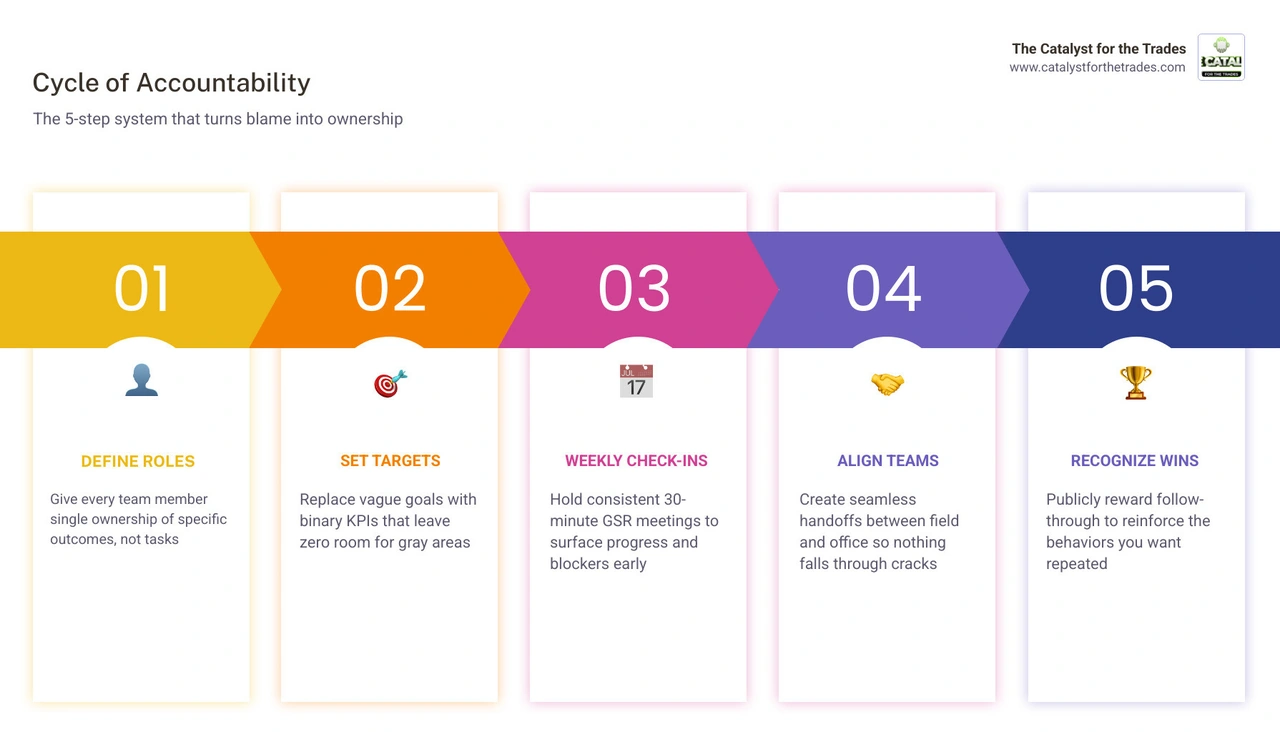
The Cost of Excuses: Why Trades Teams Struggle with Ownership
In the trades, work is fast, physical, and highly dependent on external factors. Supply chain delays, weather changes, and sudden client requests can derail a project in hours. However, when things go wrong, there is a massive difference between a team that adapts and a team that makes excuses.
Without a structured system, teams naturally default to finger-pointing. When a project falls behind or a callback occurs, the office blames the field, the field blames the suppliers, and the owner is left holding the bag. This dynamic creates a bottleneck of owner dependency, where every decision waits on you, and quality drops the moment you step away. Understanding how to break this cycle is the core of effective Contractor Leadership.
Five Warning Signs of an Accountability Deficit
How do you know if your team is struggling with ownership? Look for these five warning signs:
- Meaningless Goals: Team members have no idea what success looks like. They show up, do their hours, and go home, but they do not know if they had a “good” day or a “bad” day in terms of business performance.
- Blame Games: When a deadline is missed or a mistake is made, the conversation immediately turns to why it was someone else’s fault. “I couldn’t finish the rough-in because the drywallers left a mess,” rather than, “I saw a conflict, called the supervisor, and worked around it.”
- Rogue Actions: Technicians or project managers make major, unauthorized changes on jobsites without consulting the plan or the office, leading to costly rework.
- Entitled Mindsets: A feeling of “that’s not my job” spreads through the crew. If a piece of trash is on the floor or a tool is left out, people walk right past it because it does not fall strictly under their job description.
- Stagnant Business: Despite working long hours and winning plenty of bids, your net profit remains flat, and projects consistently run over budget.
The Leadership Trap: Why Confrontation Avoidance Fuels High Turnover
With the trades experiencing a 65% turnover rate, many business owners walk on eggshells around their staff. You worry that if you hold a technician accountable for a late start or a sloppy job, they will pack up their tools and walk across the street to a competitor.
This is the ultimate leadership trap. In an effort to be likable and avoid confrontation, leaders tolerate mediocrity. This actually increases turnover among your best performers. High-performing tradespeople do not want to work in chaotic environments where lazy behaviors are tolerated. They want clear structure, fair expectations, and a team they can rely on. Shifting away from confrontation avoidance requires a commitment to Authentic Leadership in Home Services.
How to Build Accountability in a Trades Business Team: The Core Framework

To build a team that operates independently, you have to move from a mindset of people management to people enablement. This means building a structural framework that makes it incredibly easy for your team to succeed—and impossible for them to claim they “didn’t know” what was expected. Investing in this structure is a critical step in Leadership Development for Business Owners.
Defining Roles and Outcomes Over Tasks
The biggest mistake trades owners make is defining roles by lists of daily tasks. A job description that says “run service calls, fill out paperwork, and clean the truck” is too vague. It does not define what a successful day actually looks like.
Instead, we need to transition from a traditional organizational chart (which only shows who reports to whom) to an accountability chart. An accountability chart focuses on who owns specific business functions and outcomes.
Every key role in your business should have single ownership over a specific, measurable result. For example:
- The Dispatcher does not just “schedule calls.” They own the First-Call Booking Rate and Schedule Efficiency.
- The Lead Technician does not just “do repairs.” They own the Callback Rate (keeping it under 5%) and Average Ticket Value.
- The Project Manager does not just “check on jobs.” They own the On-Time, On-Budget Project Completion Rate.
By defining clear handoff points between these roles, you eliminate the gray zones where tasks slip through the cracks.
Setting Precision Expectations with KPIs and OKRs
Once outcomes are defined, you must establish Key Performance Indicators (KPIs) and Objectives and Key Results (OKRs) that are binary—meaning they are either done or not done, with no room for debate.
Organizations that actively measure and discuss performance metrics experience productivity improvements of 10% to 20% compared with those that rely solely on informal supervision. The table below illustrates the difference between vague, task-based instructions and precise, outcome-based metrics.
| Role | Vague Task-Based Instruction | Precise Outcome-Based KPI |
|---|---|---|
| Service Tech | “Make sure you do a good job and keep callbacks down.” | Callback rate under 5% per month; average ticket of $380. |
| Estimator | “Get your quotes out to clients as fast as you can.” | Sent bid within 24 hours of site visit; 35% close rate. |
| Office Admin | “Keep up with the schedule and answer the phones.” | Same-day booking rate of 90%; invoice dispatch within 4 hours. |
| Crew Lead | “Work hard and don’t let the job run too long.” | Project completed within ±5% of budgeted labor hours. |
Systems and Rhythms That Drive Consistent Follow-Through
A framework is only as good as the system that keeps it alive. If you set goals in January and do not look at them again until December, you do not have an accountability system—you have a wish list. To make accountability stick, you need consistent, structured rhythms. This is the heart of professional Performance Management.
The power of structured systems is clear: third-party case studies show that home service and custom building companies have more than doubled their revenue—such as growing from $6 million to $17 million in just four years—simply by implementing a consistent Goal Setting & Review (GSR) accountability system.
The Weekly GSR Meeting: How to Build Accountability in a Trades Business Team through Consistent Check-Ins
A Goal Setting & Review (GSR) meeting is a highly structured, 30-minute, one-on-one meeting held at the same time every week or two. It is not a casual chat over a cup of coffee; it is a dedicated space to review numbers and commitments.
The standard agenda for a GSR meeting follows a simple, four-step structure:
- Employee Wellbeing Check (5 mins): Start by asking, “How are you doing?” Showing support and checking in on their mental state builds trust and ensures they feel valued as a human being, not just a number.
- Review Past Performance (10 mins): Look at last week’s metrics. Did they hit their KPIs? Did they complete the one or two high-priority goals they committed to?
- Current Status & Roadblocks (10 mins): Review current projects, labor hours, and schedules. Identify any obstacles preventing them from hitting their targets.
- Future Plans & Commitments (5 mins): Set one or two clear, binary goals for the coming week.
The key to a successful GSR is consistency. These meetings must be treated as non-negotiable. If you cancel or reschedule them constantly, you send a clear message to your team that accountability is not actually a priority.
Daily Logs and Dashboards: Visibility Without Micromanagement
You cannot be on every jobsite, and you should not try to be. Micromanagement kills morale and burns you out. Instead, build visibility through simple, daily reporting systems that help you build Building High Performing Field Teams.
- Keep Daily Logs Short: A daily report from a job foreman should take no more than three minutes to complete on a mobile app. It should answer three basic questions: What got completed today? Were there any delays or material shortages? What is the plan for tomorrow?
- Use Photos as Proof: Require your field team to take organized, date-stamped photos of completed work milestones before they cover up walls, pour concrete, or leave a site. This protects your margins, reduces dispute risks, and creates instant visibility.
- Build Simple Dashboards: Use a shared digital dashboard or a physical whiteboard in the office to display key numbers. When the team’s weekly performance is visible to everyone, peer accountability naturally steps in to do the heavy lifting for you.
Bridging the Gap: Aligning Field and Office Teams
One of the most common friction points in any trades business is the invisible wall between the field crews and the office staff. The field thinks the office doesn’t understand the physical realities of the jobsite; the office thinks the field is disorganized and terrible at paperwork. This division is a major barrier to growth, making Team Building Strategies HVAC Guide 2026 crucial for modern business owners.
Establishing Seamless Handoffs and Shared Priorities
To break down these silos, you must align both teams around shared priorities and establish clear communication rhythms.
- The Dispatcher & Lead Tech Sync: Create a daily, five-minute morning huddle. The dispatcher and the lead technician review the day’s schedule, highlight any complex jobs, and confirm that the necessary materials are loaded onto the trucks.
- Document the Handoffs: Write down exactly what information is required when a job moves from sales to operations, and from operations to billing. If a salesperson submits an incomplete job file, the operations team should have the authority to send it back rather than trying to guess the details.
- Foster Peer Accountability: When the office and the field see how their delays affect each other’s metrics, they stop treating each other as the enemy. For example, show the team how a delay in submitting field paperwork directly impacts the billing cycle and cash flow.
Cultivating a Culture of Ownership, Feedback, and Support
Systems and metrics are the skeleton of accountability, but culture is the heartbeat. If your team thinks accountability is just a tool to catch them doing something wrong, they will resist it. To build a culture of true ownership, you must practice People First Leadership in Construction.
This starts with psychological safety. If your team members are terrified of making mistakes, they will hide their errors, shift the blame, and refuse to take any initiative. As a leader, you must model accountability by owning your own mistakes first. If you miss a deadline or make a bad call, admit it openly to your team. This sets a standard of honesty and vulnerability.
Handling Missed Commitments: How to Build Accountability in a Trades Business Team Without Killing Morale
Even with the best systems, people will occasionally miss their commitments. How you handle these misses determines the strength of your culture. When a goal is missed, follow this step-by-step response:
- Start with a Private Conversation: Never call out an employee’s failure in front of the crew. Address the issue one-on-one.
- Diagnose the Problem, Don’t Accuse: Begin with curiosity. Ask, “I noticed we missed the target on labor hours for the Smith job. What got in the way?” Look for systemic issues first—such as bad estimating, broken tools, or material delays—before assuming it was a performance issue.
- Look for Patterns: A single miss is an opportunity for coaching and support. However, if the same issue repeats three weeks in a row, it is time for a formal performance conversation.
- Implement a Performance Improvement Plan (PIP): If a pattern of missed commitments continues, outline clear, written expectations, timelines, and consequences. This keeps the process objective and fair. For deeper insights on navigating these leadership challenges, listen to our discussion on How to Lead Serve and Grow in the Trades with Raul Rodriguez.
Recognition and Rewards: Reinforcing the Right Behaviors
Accountability is not just about correcting poor performance; it is also about celebrating excellent follow-through. To build long-term momentum, you must recognize and reward the behaviors you want to see repeated.
- Use Non-Monetary Incentives: While bonuses are great, simple recognition often carries more weight. A public shout-out in a team meeting, a handwritten note of thanks, or giving a high-performing technician a preferred parking spot or first choice of new tools can build massive pride.
- Reward Consistency, Not Just Big Wins: It is easy to celebrate the salesperson who lands a massive contract, but make sure you also celebrate the technician who has submitted perfect daily logs for three months straight. Consistent, boring execution of daily habits is what builds highly profitable trades businesses. This long-term focus is discussed in detail in The Future of Leadership How to Build a Team That Drives Growth.
Frequently Asked Questions about Trades Team Accountability
What are the key metrics we should track to ensure team accountability?
In a trades or home services business, you do not need dozens of complex dashboards. Focus on four to six core KPIs that directly impact your profitability and customer satisfaction:
- First-Call Completion Rate: The percentage of service calls resolved on the first visit without needing to return for parts.
- Same-Day Booking Rate: How quickly your office team schedules incoming service inquiries.
- Callback Rate: The percentage of jobs that require a technician to return to fix a mistake (target should be under 5%).
- Average Ticket Value: The average revenue generated per service call, indicating whether your team is presenting complete options to customers.
When should a trades business consider outside support for accountability systems?
Many business owners reach a point where they simply run out of time or objective perspective to build these systems themselves. You should consider looking for outside support—such as professional business coaching, peer groups, or specialized software upgrades—if:
- You are working 60+ hours a week but your business growth has hit a flat plateau.
- You have tried to implement checklists or meetings in the past, but they fell apart after a few weeks.
- You feel constant anxiety about your field teams’ quality of work when you are not on-site.
If you find yourself in this position, exploring a comprehensive Leadership Training Contractors Guide can provide the structured path you need to scale.
What practical first steps can a business owner take today?
You do not have to overhaul your entire business by tomorrow morning. Start with these three practical, immediate action steps:
- Schedule a One-on-One: Pick one key manager or lead technician and schedule a recurring, weekly 30-minute meeting. Stick to the GSR agenda and do not cancel it.
- Define One Single KPI: Choose one critical outcome for one role in your business. Make sure it is binary (either done or not done) and agree on the metric with the employee who owns it.
- Model the Behavior: The next time you make a mistake—whether it is a late meeting or a scheduling error—admit it openly to your team. Show them that taking ownership is safe and expected.
Conclusion
Building a culture of accountability in your trades business is not about installing surveillance cameras or breathing down your team’s neck. It is about creating a clean, structured environment where outstanding performers can thrive, and where poor habits have nowhere to hide.
By defining outcomes over tasks, establishing consistent rhythms like the weekly GSR meeting, and pairing high expectations with real, human support, you can step out of the daily firefighting loop. You will build a business that scales predictably, protects its profit margins, and runs smoothly—even when you are not on the jobsite.
Ready to stop being the bottleneck in your business and start building a self-managing team? Learn more about transforming your company’s foundation by reading our complete guide on Company Culture Development.


